
You might be looking at a course page right now and wondering whether an online physiology lab is a real lab, or just a digital workaround. Students ask that when they need a prerequisite that fits around work, placements, or travel. Program managers ask it when they need a lab format that protects standards without forcing every learner into the same room at the same time.
From an educator's standpoint, the better question is different. It's not whether physiology with lab online can work. It's whether the course has been designed to teach the right skills, using the right tools, in a way that still connects to professional practice in sport science, rehabilitation, and clinical testing. That's where many courses succeed, and where some still fall short.
Table of Contents
- The Rise of the Remote Physiology Lab
- Deconstructing the Online Physiology Lab Experience
- Comparing Online Lab Delivery Models
- How Practical Skills Are Taught and Assessed Remotely
- Choosing the Right Equipment and Technology Stack
- Navigating Accreditation and Safety Considerations
- FAQs for Students and Course Managers
- Can an online physiology lab prepare me for real testing equipment
- What should a department ask before adopting a course
- What if a learner already uses field testing methods at work
- Is physiology with lab online harder than an on-campus lab
- What makes a course feel professionally relevant
- What should a student do before enrolling
The Rise of the Remote Physiology Lab
A working coach needs a formal physiology credit for postgraduate entry. A rehab assistant needs to finish a prerequisite without leaving full-time employment. A university department needs a lab option for learners who can't get to campus every week. Those aren't edge cases anymore. They're common planning realities.
That's one reason physiology with lab online has moved from a niche offer to a mainstream delivery model. A 2019 to 2020 survey of U.S. baccalaureate institutions found that about 28% of departments offered at least one fully online physiology-related course with a lab, up from roughly 12% in 2014 to 2015, which means prevalence nearly doubled over five years according to this survey summary on Study.com.
For sports science and health education, that matters because physiology labs aren't decorative. They sit underneath later work in exercise testing, rehab prescription, cardiopulmonary monitoring, and performance analysis. If a learner can't access the lab stage, progression often stops.
Why demand keeps growing
Traditional campus labs still make sense for many students. But they assume fixed schedules, local attendance, and access to specialist rooms. Online delivery helps institutions serve people who are already working in gyms, clinics, schools, or performance environments.
It also solves a practical mismatch. Many adult learners already understand testing culture. They may have seen blood pressure measurements, heart-rate monitoring, step testing, spirometry, or body composition assessment in the workplace. What they often lack is the formal academic route that turns that practical familiarity into recognised credit.
Practical rule: Treat online physiology labs as an access model, not a reduced model. The standard should stay high even when the location changes.
What this shift means for buyers and educators
Departments choosing a course shouldn't ask only, “Can we put this online?” They should ask, “Can learners collect, interpret, and defend physiological data in a way that maps onto professional practice?”
Students should ask a parallel question. Not just “Will this fit my schedule?” but “Will this course teach me habits that transfer to real testing environments?”
Those two questions shape everything that follows. Delivery format matters less than design quality, equipment choices, assessment logic, and whether the lab feels connected to the work people do after the course ends.
Deconstructing the Online Physiology Lab Experience
Many people hear “online lab” and picture recorded lectures plus a quiz. That's not a physiology lab. A proper one blends theory, guided experimentation, and data handling so students don't just memorize body systems. They work with evidence.
What students actually do each week
Most solid courses run through three connected layers.
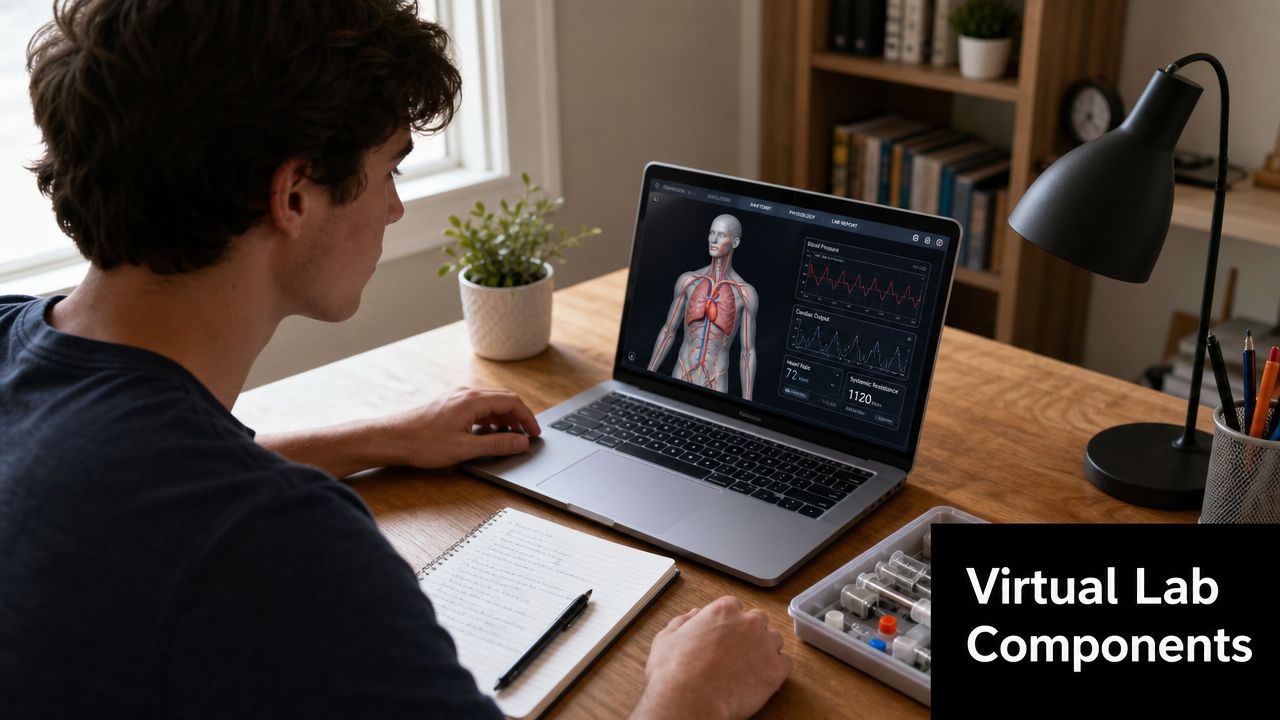
First comes the concept layer. Students review lectures, readings, diagrams, and short explanations of topics such as cardiovascular control, pulmonary mechanics, muscle contraction, or autonomic responses to exercise. This isn't filler. It gives meaning to later observations. If a student measures heart rate recovery after exercise, they need to understand what recovery reflects and what can distort the signal.
Second comes the simulation layer. This is useful for phenomena students can't safely or practically create at home. A course may use software to model gas exchange, neural conduction, cardiac output changes, or fatigue responses under changing workloads. Simulations let students repeat conditions and test “what happens if” questions without equipment limits.
Third comes the hands-on layer. Students use simple lab materials or home kits to collect real physiological data. That may include pulse measures, blood pressure, breathing rate, oxygen saturation, step-test responses, or basic spirometry patterns depending on the course design.
A good online lab feels less like watching content and more like doing a coached field session with a strong theory backbone.
Where online labs often confuse learners
Students usually get stuck in one of three places:
- They confuse activity with evidence. Taking a pulse is easy. Explaining why it changed, and whether the method was sound, is the actual lab skill.
- They expect perfect data. Home data are often noisy. That's normal. Learning to identify artifact, inconsistent pacing, or poor sensor placement is part of physiology training.
- They separate theory from practice. They'll write one answer from the lecture and another from their recorded data, without reconciling the two.
Online labs work best when instructors mark reasoning, not just completion.
That's why strong lab instructions are very explicit. They tell students what to do, what a valid measurement looks like, what common errors look like, and how to discuss uncertainty.
Later in the module, some courses also introduce platform demonstrations similar to the one below, which helps learners get comfortable with digital workflows before they submit practical work.
Comparing Online Lab Delivery Models
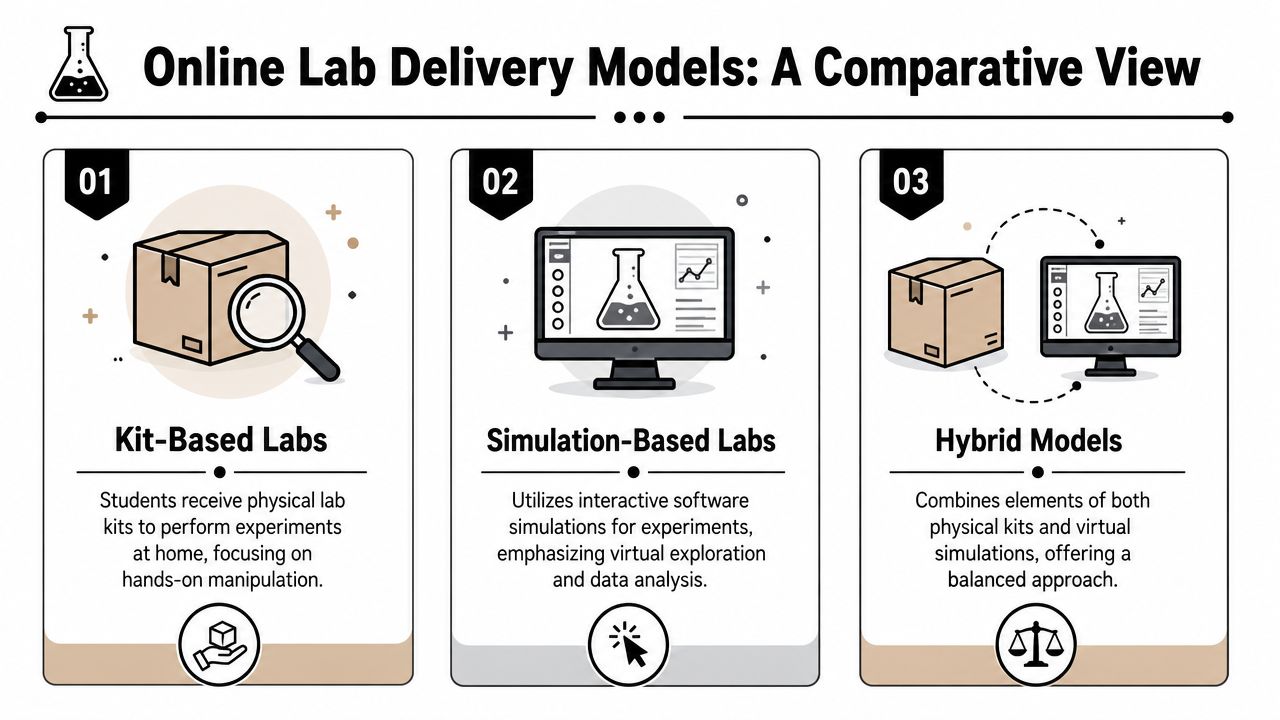
Once you move from student experience to course design, the key decision is the delivery model. Institutions usually choose between simulation-only, kit-based, or hybrid formats. Each can work. Each also has limitations.
Simulation only
This model relies on digital experiments and software-guided data analysis. It's often the easiest to scale across large groups and the simplest to manage logistically. No shipping delays. No kit loss. Fewer setup problems.
It also gives instructors high control. Every student can run the same protocol under the same virtual conditions, which makes comparisons cleaner.
The trade-off is obvious. Students don't learn much about real-world measurement friction. They won't practice cuff placement, pacing a step protocol, handling a spirometer correctly, or checking whether a reading is believable. For concept-heavy modules, simulation may be enough. For preparation into applied sport science or clinical testing, it usually isn't enough on its own.
At-home kit model
This format sends learners physical tools and asks them to gather their own measurements. For physiology, that creates a stronger bridge to applied work because the student has to manage setup, consistency, and recording discipline.
That said, kit-based delivery introduces operational questions. What happens when a student receives a faulty cuff, uses the wrong phone, or doesn't understand calibration? Who handles replacement parts? How do you support international learners? Academic design and logistics become tightly linked.
A kit model usually suits courses where tactile skill matters. If the learning outcomes include basic instrument handling, simple field protocols, or data collection from live measurements, kits add genuine value.
Hybrid design
For many departments, the hybrid route is the most sensible. It uses simulation where home practice is limited and hands-on tasks where direct measurement matters. Students might simulate respiratory control variables in one week, then record step-test or recovery responses at home in the next.
Here's a quick decision view:
| Model | Best for | Main strength | Main limitation |
|---|---|---|---|
| Simulation-based | Large enrolments, theory-heavy modules | Consistency and scale | Less tactile skill development |
| Kit-based | Applied training and basic instrument use | Real measurement practice | More logistics and support demands |
| Hybrid | Broad learning outcomes | Balance of realism and efficiency | Requires careful curriculum planning |
A department should choose the model that matches its learning outcomes, not the one that looks easiest to market.
For sports science programs, hybrid delivery often mirrors the profession best. Real practice rarely uses only one mode. Coaches, clinicians, and physiologists move between software, live sensors, field observations, and structured interpretation all the time. A course should reflect that mixed reality.
How Practical Skills Are Taught and Assessed Remotely
The hardest objection usually sounds like this: “But can you really assess practical skills online?” Yes, you can, if the course assesses actual performance rather than just asking students whether they did it.
A strong remote lab doesn't try to copy every feature of a campus bench. It targets the skills that matter most in physiology. Can the learner follow a protocol, collect usable data, identify errors, interpret results, and explain what the findings mean in physiological terms?
What remote practical assessment looks like
Remote assessment usually works best as a combination of evidence types rather than a single exam.
One common method is the data-backed lab report. Students submit their own results from home measurements, then interpret them in context. If they complete a submaximal exercise task, the report might ask them to discuss heart rate response, perceived effort, recovery pattern, and possible sources of variability.
Another useful method is procedure video submission. A student records a short clip demonstrating how they position a blood pressure cuff, prepare a participant, or conduct a basic field protocol. The marker can then judge process, not just final numbers.
Timed simulation-based practicals also have value. These are especially useful where you want students to respond to unfamiliar data traces, choose correct next steps, or spot protocol errors under time pressure.
A final layer is dataset interpretation. Students may receive a heart rate, respiratory, or exercise response file and be asked to identify artifact, extract meaning, and defend a conclusion. That is very close to what entry-level practitioners do in practice.
What good marking focuses on
Weak marking rewards neatness. Strong marking rewards judgment.
A practical rubric should usually look for:
- Protocol fidelity: Did the student follow the instructions in the correct order and control obvious variables?
- Measurement quality: Are the readings plausible, repeatable enough, and clearly recorded?
- Interpretation: Can the student connect the observed response to physiology rather than just restating lecture notes?
- Reflection: Did they identify likely error sources and limits?
A useful benchmark for confidence comes from a 2021 multi-institutional study in which students in online lab sections scored within 2.3 percentage points of on-campus peers on standardized cardiovascular and respiratory physiology exam questions, with means of 78.1% versus 80.4% and p > 0.05, indicating comparable core learning outcomes according to this study reference provided here.
For departments that want the lab to connect with applied performance settings, it also helps to check whether students are being exposed to the logic behind professional testing systems, including workflows similar to those used with metabolic testing equipment. The point isn't that every learner needs advanced hardware at home. The point is that their training should build toward that level of practice.
Choosing the Right Equipment and Technology Stack
If the equipment is poor, the lab becomes an exercise in frustration. If the software is poor, students waste time fighting interfaces instead of learning physiology. That's why the technology stack deserves the same scrutiny as the syllabus.
For students, this is a quality check. For institutions, it's a procurement decision with academic consequences.
What belongs in a serious student kit
The exact contents depend on learning outcomes, but a good physiology kit should support real measurement rather than novelty tasks.
A typical useful kit may include tools such as:
- Cardiovascular basics: a heart-rate monitor or validated pulse measurement method, plus a blood pressure device where appropriate.
- Respiratory tools: a simple spirometer or breathing assessment device if pulmonary topics are part of the course.
- Exercise protocol items: a metronome app, timing tool, and a clear step-test or submaximal exercise setup.
- Recording support: worksheets or digital templates that force students to log conditions, not just results.
Students heading into applied movement analysis may also benefit from adjacent tools that improve observation skills. For example, a structured online posture analysis guide can help learners understand how visual assessment frameworks support broader screening and interpretation, even though posture analysis isn't the same as a physiology lab.
Why technical specifications matter
Many buyers focus on whether a sensor is included. Better buyers ask how it performs.
According to the verified course guidance, high-quality online physiology labs often integrate consumer or clinical-grade sensors such as pulse oximeters, ECG leads, or spirometers with sampling rates of at least 250 Hz and precision validated against reference standards, which supports reliable measurement of variables such as heart rate variability, respiratory rate, and oxygen saturation in this UC San Diego Extended Studies course reference.
That matters because students carry habits forward. If they learn on vague, poorly specified tools, they may assume any reading is acceptable. If they learn to ask about sampling rate, validation, signal noise, and software export format, they're already thinking more like a practitioner.
This is the bridge between academic labs and professional environments. A learner may start with a pulse oximeter and simple step protocol, then later work with ECG systems, metabolic carts, and more advanced medical monitoring devices. The educational value lies in that progression.
What institutional buyers should ask vendors
When reviewing suppliers or platform partners, I'd keep the conversation concrete.
Ask questions like these:
- What exactly can the sensor measure? Ask for the variables, sampling behavior, and any stated validation details.
- How does the data leave the platform? CSV export, raw trace access, and compatibility with common analysis workflows matter.
- What happens when a student gets an unusable reading? There should be troubleshooting support, not just replacement policy.
- Can the software support interpretation, not just display? Students need annotation, comparison, and reporting tools.
- Does the kit prepare students for the professional tools they'll meet later? If the answer is no, the course may be academically tidy but professionally thin.
Buyers should think beyond course completion. Equipment choices shape how students define “good data.”
For sport and clinical programs, that mindset makes a big difference. The best online physiology with lab setups don't pretend to be miniature hospitals or performance labs. They teach the measurement discipline that students will need when they eventually work with validated step-test systems, metabolic analysers, respiratory instruments, and body composition tools in a professional setting.
Navigating Accreditation and Safety Considerations
A well-designed lab still fails its purpose if the credit isn't recognised or the activities aren't safe. Those two checks belong at the front of the decision process, not buried in small print.
Academic recognition checks
Students often assume that if a course looks rigorous, it will automatically count. That's not always true. Before enrolling or adopting a provider, someone needs to verify whether the institution's credit, lab designation, and transcript format meet the requirements of the receiving program.
For course managers, the practical checklist is simple:
- Institution status: confirm the awarding body's accreditation and whether the credit is issued in a form target programs recognise.
- Lab designation: check whether the transcript or course record clearly identifies a lab component.
- Prerequisite fit: compare the course description against the requirements of the professional or academic pathway students plan to enter.
- Documentation: keep module outlines, lab activity summaries, and assessment descriptions ready for transfer review.
If the course is meant for clinicians or trainers returning to study, it also helps to explain how the academic lab relates to devices they may already see in practice. A concise background resource on the regulatory importance of validated devices, such as this overview of an FDA-cleared wearable cardio device, can help frame why evidence, claims, and device status need careful reading.
Home lab safety rules
Remote physiology labs should never rely on vague warnings like “exercise at your own risk.” Safety guidance has to be specific enough for a novice to follow.
At minimum, a course should provide:
- Clear contraindications: who should not perform a given exercise or self-test.
- Pre-lab screening: a simple way to identify medical, orthopedic, or environmental reasons to modify or skip an activity.
- Stop criteria: visible instructions on when to end a test immediately.
- Consent and privacy guidance: especially if students record themselves or collect data from another person.
- Quality controls: procedures for safe setup, hygiene, storage, and disposal where relevant.
A department should also review how the provider handles device standards, documentation, and process control. That's one reason many teams look for guidance connected to broader medical device quality assurance principles when building or evaluating remote practical work.
Safety in online labs depends less on location and more on how carefully the protocol is written.
A well-run remote lab is not casual. It is structured, bounded, and explicit about what learners may do, what they must not do, and how they should respond when something doesn't feel right.
FAQs for Students and Course Managers
The final questions people ask are usually the most practical ones. They sit right at the point of decision.
Can an online physiology lab prepare me for real testing equipment
Yes, if the course teaches measurement habits rather than just assignment completion. A student doesn't need a full clinical setup at home to learn pacing control, signal quality awareness, protocol adherence, and data interpretation.
That foundation transfers well into later work with more advanced tools such as Chester Step Test systems, metabolic analysers, spirometry platforms, and body composition devices. The academic course should be the start of that pathway, not a disconnected side route.
What should a department ask before adopting a course
I'd ask five questions immediately:
- Are the lab outcomes explicit? If the provider can't name the practical competencies, the course probably isn't designed tightly enough.
- Do students handle real data? Simulations have value, but learners should still interpret authentic measurements where possible.
- Is the hardware specified properly? Vague equipment lists are a warning sign.
- How are practical skills marked? Look for evidence-based assessment, not just auto-graded quizzes.
- Does the model suit the student group? Working professionals, undergraduates, and clinical trainees often need different levels of support.
What if a learner already uses field testing methods at work
This is one of the biggest gaps in the current market. Many trainers, rehab practitioners, and performance staff already run field tests, collect submaximal exercise data, or work alongside formal testing equipment. Yet course descriptions for online physiology labs rarely mention clear pathways for learners who can document experience running physiological field tests, which is described as a missed opportunity in this University of North Dakota course reference.
That matters because prior experience can be real, but still unofficial. Someone may competently run a step test or understand VO2 protocol structure, yet still need formal physiology credit. Good course design should recognise that tension.
A sensible response from institutions is to build flexibility into assessment. That might mean allowing a learner to submit evidence from supervised real-world protocols, adding competency-based options, or using reflective comparisons between workplace practice and academic method.
Is physiology with lab online harder than an on-campus lab
It's different hard. Students usually have more flexibility, but they also carry more responsibility. They must manage their own timing, setup, and troubleshooting. There's less passive following and more active execution.
That's why self-organization matters. Learners who block time, read protocols carefully, and repeat measurements when needed usually do well. Learners who rush the practical work often struggle, even if the theory feels manageable.
What makes a course feel professionally relevant
Professional relevance comes from alignment. The protocol should look like something a coach, exercise physiologist, or rehab practitioner would recognise. The reports should ask students to interpret data the way a practitioner would. The equipment should train habits that still matter when the learner graduates to validated tools.
If a course never mentions signal quality, standardisation, contraindications, calibration logic, or interpretation limits, it may pass as education but it won't feel close to practice.
What should a student do before enrolling
Keep it simple:
- Check recognition first: make sure the course and lab will be accepted where you want to progress.
- Read the equipment list carefully: don't assume every online lab includes real measurement.
- Review the assessments: look for reports, data interpretation, or demonstration tasks.
- Ask about support: if a device fails or data look wrong, you'll need help quickly.
- Match the course to your goal: prerequisite credit, continuing education, and professional upskilling are not always the same thing.
The strongest online physiology labs do something very useful. They let learners study flexibly without losing contact with the realities of measurement, testing, and applied interpretation. That's what makes the format credible.
If you're building a teaching lab, upgrading a performance-testing setup, or choosing validated equipment that aligns academic training with real-world assessment, Cartwright Fitness is a practical place to start. Their range covers the kinds of professional tools educators, clinicians, and sport science teams rely on when they need reliable data, clear workflows, and equipment that supports serious testing rather than guesswork.