

Medical device quality assurance (QA) is the comprehensive system of processes that ensures every single device is safe, effective, and compliant from its initial concept all the way through to its post-market life. I like to think of it like the meticulous safety protocol for a spacecraft—it’s not a one-time final check, but a continuous, rigorous process woven into every stage. It's the foundational promise a manufacturer makes to patients, healthcare providers, and regulatory bodies.
The Engine Behind Patient Safety and Market Success
At the core of medical device QA is a robust Quality Management System (QMS). This isn't some dusty binder of procedures or just a piece of software; it's the operational engine that powers every single quality-related activity in the company. A QMS provides the essential framework for everything, from selecting raw materials and establishing design controls to managing manufacturing and distribution.
Trying to operate without a solid QMS is like navigating a minefield blindfolded. The system formalizes a company's commitment to quality, making sure every step is documented, repeatable, and completely traceable. This is what truly separates a compliant, successful medical device company from one that's constantly battling product recalls, regulatory fines, or, in the worst-case scenario, causing patient harm.
It's About More Than Just Checking Boxes
While meeting regulatory demands is a critical part of the job, the real spirit of medical device QA runs much deeper. It’s about building quality directly into the product from the very first sketch, not just trying to inspect for it at the end of the production line. This proactive mindset is all about preventing defects before they ever happen.
Let's look at the difference in a real-world context:
Reactive Approach (Poor QA): A company manufactures a large batch of infusion pumps. During the final inspection, they discover a critical flaw in the alarm mechanism. The result? The entire batch has to be scrapped or sent back for expensive rework, leading to huge financial losses and significant production delays.
Proactive Approach (Strong QA): A robust QMS ensures the alarm's design is thoroughly tested and proven reliable during the development phase—a process we call validation. The manufacturing processes are then tightly controlled to prevent any variations, and component suppliers are carefully vetted. The final product works consistently and reliably because quality was a key ingredient from the start, not just a final inspection.
A well-implemented QMS doesn't just manage tasks; it transforms quality from a departmental responsibility into a company-wide culture. It creates a powerful feedback loop where data from devices already in the field is used to continuously improve the design and production of future products.
The Real-World Impact on How Devices Work
This systematic approach has a direct and measurable impact on the reliability of every component inside a device. Take sensors and actuators, for example. Their precision is absolutely critical in countless medical applications, from MRI machines to robotic surgical systems. To get a better sense of how this works in practice, it's helpful to see how specific components are managed, as seen in the applications of LVDTs in the medical devices manufacturing industry. Making sure these parts meet their exact specifications isn't an accident; it's the direct outcome of effective QA protocols.
Ultimately, medical device quality assurance is the very foundation of trust. It's what ensures a pacemaker will function without fail, a diagnostic test will provide an accurate result, and a surgical tool will perform exactly as a surgeon expects. This isn't just about avoiding penalties; it's fundamental to protecting patient health and building a sustainable business in one of the world's most demanding industries.
Navigating Global Regulatory Frameworks
Effective medical device quality assurance simply can't exist in a bubble. It's built on a complex foundation of global regulations, all designed with one core mission: to protect patient safety.
Think of these rules not as bureaucratic red tape, but as an internationally recognized playbook for excellence. For any company with ambitions to sell products across borders, mastering this playbook isn't just a good idea—it's absolutely essential for survival and success.
The two most powerful voices in this space are the U.S. Food and Drug Administration (FDA) and the European Union. While they share the same ultimate goal of ensuring devices are safe and effective, their methods and specific requirements can be surprisingly different. Staying on the right side of these regulations means being proactive and nimble, because the rules are constantly adapting to new technologies and emerging safety data.
The Two Titans of Medical Device Regulation
In the United States, the FDA uses a risk-based classification system, sorting devices into three categories: Class I (low risk), Class II (moderate risk), and Class III (high risk). Each class follows a distinct regulatory path, with higher-risk devices understandably facing much stricter scrutiny and data requirements.
A major shift is on the horizon. The FDA’s new Quality Management System Regulation (QMSR) is set to go into effect in February 2026. This isn't just a minor update; it's a significant move to align American quality practices more closely with the global standard, ISO 13485.
Meanwhile, across the Atlantic, the European Union's Medical Device Regulation (MDR) has completely reshaped the landscape with a more demanding set of rules. The MDR places a much heavier emphasis on robust clinical evidence, continuous post-market surveillance, and complete traceability throughout the entire supply chain. It's a fundamental pivot toward a "lifecycle" approach to regulation, demanding constant vigilance from manufacturers long after a product hits the market.
The transition to new regulations like the FDA's QMSR and the EU's MDR is more than a compliance drill. It represents an industry-wide evolution toward greater transparency, stronger evidence, and ultimately, a higher standard of patient safety for everyone.
This new reality presents a steep learning curve. One industry report found that nearly half of all medical device companies admitted they weren't fully prepared for the EU MDR's stringent new requirements. Similar concerns are bubbling up about readiness for inspections under the upcoming U.S. QMSR.
Key Regulatory Frameworks at a Glance
Let's break down the core differences between how the FDA and the EU approach quality. Although they both prioritize safety, their philosophies create distinct operational challenges for any team. Navigating these is crucial for maintaining continuous medical device regulatory compliance in the world's largest markets.
The table below offers a high-level comparison of these two influential frameworks.
| Regulatory Body | Governing Regulation | Primary Focus | Key Requirement Example |
|---|---|---|---|
| U.S. FDA | Quality Management System Regulation (QMSR) | Aligning with global standards (ISO 13485) and maintaining a risk-based approach. | Premarket Approval (PMA) for high-risk Class III devices, which requires extensive clinical data. |
| European Union | Medical Device Regulation (MDR) | A lifecycle approach with strict clinical evidence and post-market surveillance (PMS) demands. | Appointing a Person Responsible for Regulatory Compliance (PRRC) within the organization. |
As you can see, one focuses on harmonizing with existing global standards, while the other introduces a more comprehensive, lifecycle-based system.
How This Affects Your Daily Operations
So, what does all this mean for the day-to-day work of a quality assurance team? These regulatory shifts have a very real, practical impact. Your operations need to be built for agility to handle these demands effectively.
Here’s a look at what changes on the ground:
- Deeper Documentation: Both the FDA and the EU now mandate far more detailed and accessible technical documentation. This includes everything from design history to comprehensive clinical evaluation reports.
- Intense Supply Chain Scrutiny: The EU MDR, in particular, holds manufacturers accountable for their entire supply chain. This requires a new level of transparency and control over every supplier and partner involved.
- From Reactive to Proactive Surveillance: The old way of simply reacting to complaints is over. Companies must now implement proactive systems to constantly gather and analyze performance data from devices already in the field.
Embracing these global rules isn't just about avoiding penalties. A proactive and thorough approach ensures you can access key international markets, but it also builds a powerful reputation for quality and reliability—a true competitive advantage.
The Core Components of a Quality Management System
Think of a Quality Management System (QMS) as the central nervous system of a medical device company. It’s not some dusty binder on a shelf or a piece of software you only touch during an audit. It's the living, breathing framework that connects every single department, decision, and action to the ultimate goal: patient safety and device effectiveness.
An effective QMS is a highly interconnected system. When one part stumbles, the shockwaves are felt everywhere. For example, a seemingly minor slip-up in document control—an engineer working from an outdated blueprint—can easily snowball into a manufacturing defect, potentially triggering a costly, reputation-damaging product recall. It's a perfect illustration of why every component must work in harmony.
The Blueprint for Building Safety In
At the heart of any solid QMS, you'll find Design Controls. This isn't just about what the final product looks like. It’s the entire roadmap, the step-by-step process for developing a safe and effective medical device.
The process kicks off by defining what the user truly needs the device to accomplish—these are the user needs. From there, those needs get translated into concrete, measurable engineering specs, which we call design inputs.
Let’s say you're developing a new blood glucose meter. A simple user need like "give me an accurate reading, fast" gets broken down into very specific design inputs:
- Display a result in under 5 seconds.
- Maintain an accuracy of +/- 10% when compared to a laboratory reference test.
- Operate reliably in temperatures between 50°F and 90°F.
This structured method ensures nothing is left to chance. It forces the development team to think through potential problems and build in solutions long before the first prototype is ever assembled.
The Foresight to Prevent Failures
Working hand-in-glove with design controls is Risk Management. This entire discipline, guided by the global standard ISO 14971, is about anticipating what could go wrong and stopping it before it starts. It’s not a one-and-done checklist; it’s a continuous cycle of vigilance.
Risk management means systematically identifying hazards, figuring out how severe the harm could be and how likely it is to happen, and then putting controls in place to knock that risk down to an acceptable level. This isn't just a medical device concept; in fields like professional fitness, for example, standardized procedures are just as crucial for safety and effectiveness. You can see parallels in our guide on fitness testing protocols.
This infographic does a great job of visualizing the hierarchy of risk management, showing how you move from broad categories to specific analysis and action.
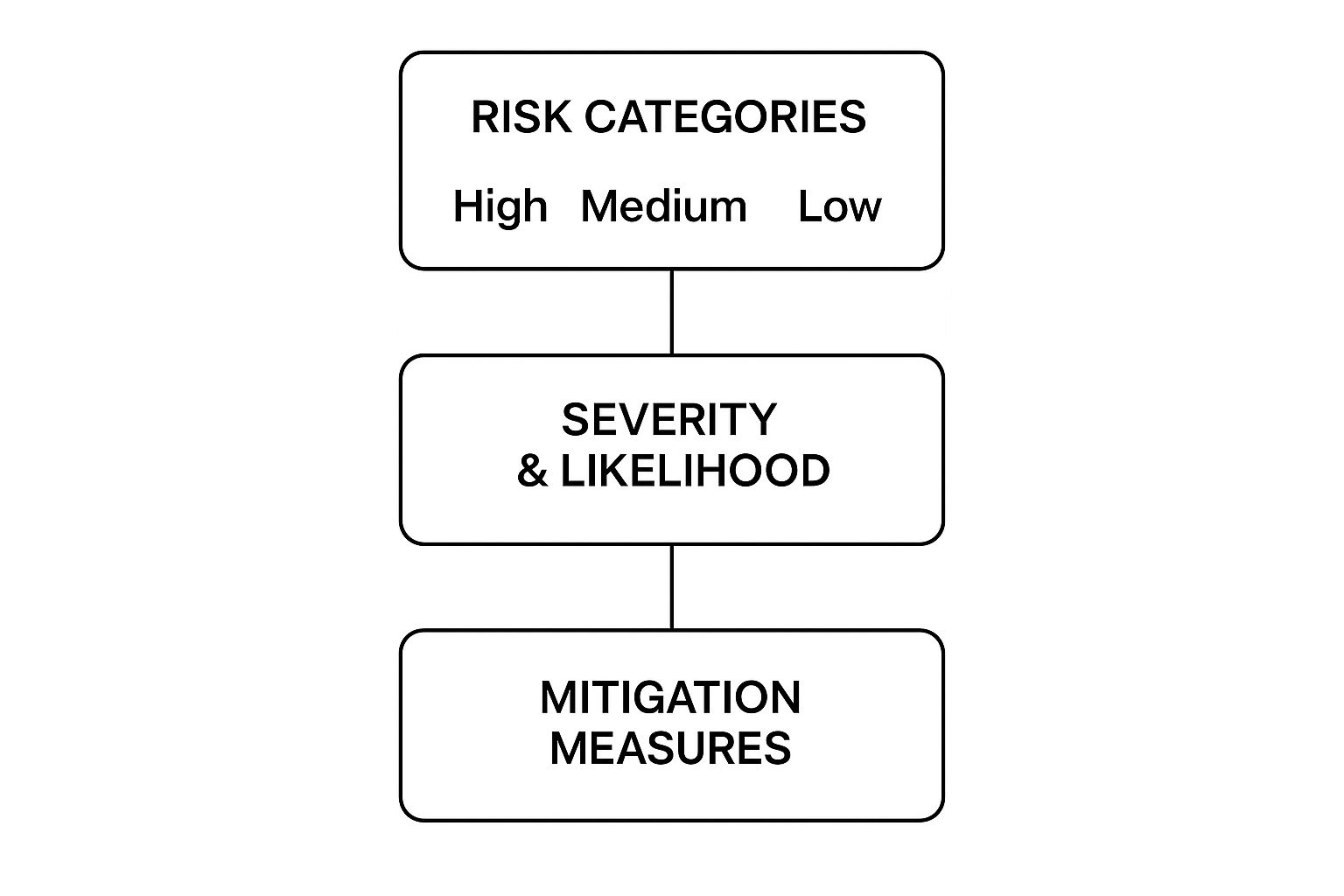
As you can see, every risk you identify has to be carefully weighed for its severity and likelihood. That evaluation is what tells you exactly what you need to do to mitigate it.
An effective QMS embeds this risk-based thinking into the company culture. It shifts the mindset from "what do we do if it fails?" to "how do we prevent it from failing in the first place?"
The Rapid Response System
Of course, even with the most meticulous planning, things can still go wrong. That's where Corrective and Preventive Actions (CAPA) come into play. Think of CAPA as the QMS’s emergency response system, designed to investigate issues, fix them, and make sure they never happen again.
A corrective action tackles a problem that has already happened, like figuring out why a batch of devices didn't pass a quality inspection. A preventive action, on the other hand, deals with a potential problem before it has a chance to occur—like noticing a pattern of wear on a component and updating the maintenance schedule to head off future failures.
These core components—Design Controls, Risk Management, and CAPA—aren't standalone silos. They are tightly woven threads that create the strong, resilient fabric of a world-class medical device quality program. When they work together, they build a system that not only protects patients but also drives the long-term success of the business.
Mastering Verification and Validation Processes
In the world of medical device quality assurance, two terms get thrown around constantly: verification and validation. While they sound similar, and are often used interchangeably by mistake, they represent two fundamentally different questions we must answer. Getting this distinction right isn't just about semantics; it's a non-negotiable step to prove your device is safe, effective, and ready for regulatory scrutiny.
Let’s use an analogy. Imagine you're building a custom race car.
Verification asks, "Did we build the car correctly?" It's about checking every part against the technical blueprints. Did we use the specified engine? Is the chassis welded exactly as the engineering drawing dictates? This is a meticulous, evidence-based check against a predetermined list of requirements.
Validation, on the other hand, asks the much bigger question: "Did we build the correct car?" This is where you put a professional driver behind the wheel on a real racetrack. Can it actually win a race safely? Does it handle the corners as intended? It’s all about performance in its intended environment, not just on paper.
Verification: Did We Build the Device Correctly?
At its core, verification is the process of confirming that your design outputs—the finished components—perfectly match your design inputs, which are the initial requirements and specifications. It’s a series of tests and inspections that create objective proof you built the device precisely as you planned.
For a new surgical robot, verification would confirm that when a surgeon inputs a command to move the arm 10 millimeters to the left, it moves exactly that distance—not 9.9mm or 10.1mm. It's all about precision and strict adherence to the specs.
Common verification activities include things like:
- Unit and Integration Testing: We check individual software modules on their own, then confirm they work together seamlessly.
- Code Reviews: Another engineer reviews the software code to spot errors and ensure it aligns with our established standards.
- Design Reviews: These are formal meetings at key development stages to ensure the design meets every single technical requirement before we move on.
Each of these steps generates a detailed paper trail proving the device was built according to its blueprint. This becomes the first layer of defense in a robust QA system.
Verification: The process of evaluating a system or component to determine whether the products of a given development phase satisfy the conditions imposed at the start of that phase. It is an internal check of conformance to specifications.
Validation: Did We Build the Correct Device?
Validation takes it a crucial step further. It's about making sure the final, verified device actually meets the user’s real-world needs and its intended use. This is the ultimate test of whether the device truly solves the clinical problem it was designed for.
Back to our surgical robot. Validation means putting it in a simulated operating room where a surgeon uses it to perform a mock procedure on an anatomical model. The goal isn't just checking coordinates anymore. We're asking bigger questions: Can the surgeon perform the procedure safely and intuitively? Does the workflow make sense in a clinical setting? Does the device actually help without introducing new risks?
This is where you find out if a device that is technically perfect on paper is also practically useful and safe for patients. Similar rigorous evaluations, like a submaximal exercise test, are used in other health fields to validate fitness under specific, controlled conditions, showing how procedural validation is a vital concept across the board.
The Three Pillars of Validation
Validation isn't just one big test; it's a multi-faceted process. It's typically broken down into three key pillars, each generating critical evidence for regulators.
- Process Validation: This confirms that your manufacturing process can consistently produce a device that meets its specifications. For instance, you need to prove a sterilization process kills 99.999% of microbes not just once, but every single time you run it.
- Software Validation: A comprehensive look at how the software performs within the final device. This goes beyond just finding bugs; it confirms the software reliably and safely carries out its intended function in the context of the entire system.
- Test Method Validation (TMV): A step that’s often overlooked but is absolutely essential. TMV validates your test methods themselves. It ensures your measurement and inspection techniques are accurate, precise, and repeatable. Without TMV, you simply can't trust the data from any of your other V&V activities.
Ultimately, verification and validation are two sides of the same coin. You can't have one without the other. Verification builds the evidence that the device was made right, while validation provides the proof that the right device was made. Both are absolutely indispensable for bringing a safe and effective medical device to the people who need it.
Weaving Risk Management into the Product Lifecycle
Think of risk management not as a final hurdle to clear, but as the steady heartbeat of a medical device's entire existence. It’s a way of thinking that should be baked into every decision, from the first sketch on a napkin to the device's final day in service. This approach transforms quality assurance from a last-minute check into a core principle of development and monitoring. This entire philosophy is captured in ISO 14971, the international standard that guides risk management for medical devices.
At its core, ISO 14971 gives manufacturers a framework for systematically finding, evaluating, and controlling risks. It forces teams to look past the obvious and anticipate every potential point of failure, no matter how unlikely it might seem. This constant vigilance ensures patient safety is always the number one priority, from concept to post-market surveillance.
Spotting Hazards and Sizing Up the Harm
The journey starts with a simple, yet profoundly important question: “What could possibly go wrong?” This kicks off a methodical process of identifying potential hazards—any source of harm. These can pop up in unexpected places, from a subtle software bug to a biocompatible material that breaks down faster than expected.
Once you’ve spotted a hazard, you have to figure out how risky it really is. This isn't just a gut feeling; it’s a structured analysis that balances two critical factors:
- Severity: If this hazard actually leads to a failure, how badly could it hurt the patient or the person using the device?
- Likelihood: What are the actual odds of this harm happening?
Let's take a common infusion pump as an example. A major hazard is delivering the wrong dose of medication. The severity here is off the charts—it could easily be fatal. The team then has to calculate the likelihood of this happening based on the pump's mechanical design, software code, and how intuitive the user interface is.
Effective risk management is fundamentally a closed-loop system. It requires a constant flow of information between analysis, control, and review, ensuring that patient safety informs every engineering and manufacturing choice.
This kind of proactive thinking is what prevents catastrophic failures. A deep risk assessment on that infusion pump might show that a failed alarm is a significant risk. By catching this early, engineers can build in more reliable alarm systems and add software fail-safes, directly neutralizing a danger before the device ever gets near a patient.
Putting Controls in Place and Checking Your Work
Finding risks is only half the job. The next essential step is implementing risk controls, which are simply actions you take to bring those risks down to an acceptable level. These controls might be built into the design, like adding a physical guard over a moving part, or they could be informational, like putting clear, unmissable warnings in the user manual.
There’s a clear pecking order for these controls. It’s always better to design a hazard out of existence than it is to just warn people about it later. After putting controls in place, the team has to check if they actually work and then reassess the residual risk. The ultimate goal is to make sure the device's remaining risk is a fair trade-off for its medical benefits.
This thinking has to extend beyond the device itself and into the real world. Great quality assurance also considers how medical devices are deployed and used safely. For example, understanding crucial workplace AED safety considerations helps reduce user-related risks and ensures the device performs as expected in a high-stress emergency.
The work isn't done when the product ships. A solid risk management plan includes post-market surveillance, where manufacturers actively gather and analyze data from devices being used in the field. This real-world feedback on performance, user mistakes, and unforeseen problems is looped right back into the risk management process. It creates a powerful cycle of continuous improvement that makes future products—and patients—safer.
The Business Impact of Robust Quality Assurance

It’s easy to look at quality assurance as just another line item in the budget—a regulatory hurdle you have to clear. But that mindset misses the mark entirely. In reality, a genuine commitment to quality is one of the most powerful assets a medical device company can have, directly fueling its growth and long-term viability.
Instead of seeing QA as a cost center, think of it as a strategic investment. It’s the best financial shield you can have against the devastating costs of product recalls, massive regulatory fines, and reputation-shattering lawsuits. Beyond that, it builds the most critical currency in all of healthcare: trust.
Building a Competitive Advantage Through Quality
In a field as competitive as medical technology, brand reputation is everything. When your company is known for exceptional quality and unwavering reliability, you gain a massive edge. Clinicians and healthcare providers become your biggest advocates, choosing your devices because they know they can count on them when a patient's well-being is at stake.
This kind of trust builds a loyalty that competitors find nearly impossible to crack. Every single device that works perfectly, every single time, strengthens this reputation. It creates a positive feedback loop that not only keeps your current customers happy but also attracts new ones, cementing your place in the market.
Investing in a world-class quality assurance program is a direct investment in the long-term financial health and success of your business. It transforms compliance from an obligation into a powerful competitive tool.
Safeguarding Your Business in a Growing Market
The medical device industry is booming. Valued at roughly $542 billion in 2024, the global market is expected to rocket past $886 billion by 2032. This incredible growth is powered by breakthroughs in AI, robotics, and personalized medicine—all of which require even more sophisticated and meticulous quality assurance to guarantee they are safe and effective.
Of course, with rapid innovation comes greater risk. A single, high-profile quality failure can do more than just lose you market share; it can trigger intense regulatory scrutiny that brings your entire operation to a standstill. A strong QMS is your first and best line of defense, making sure that as you push the boundaries of technology, you're doing it responsibly.
A solid QA framework provides tangible benefits:
- Financial Protection: Catching defects early saves millions that would otherwise be spent on recalls and rework.
- Market Access: A clean track record of quality and compliance is your passport to new international markets.
- Patient and Clinician Trust: Unwavering reliability creates a loyal user base, which is the bedrock of sustainable revenue.
In the end, quality assurance isn't just about meeting the standards; it's about setting them. As devices become more deeply integrated into patient care—like those used for advanced diagnostics such as a VO2 max test—the expectation for flawless performance only intensifies. The companies that put quality first are the ones that will lead the industry, protect their patients, and deliver lasting value to their stakeholders.
Frequently Asked Questions About Medical Device QA
Diving into the world of medical device quality assurance can feel overwhelming, especially when you're trying to figure out how all the different systems, rules, and acronyms fit together. Let's clear up some of the most common questions people have.
What Is the Difference Between QA and QC?
It's easy to get Quality Assurance (QA) and Quality Control (QC) mixed up, but they represent two very different—though equally important—sides of the quality coin. Think of it like baking a cake.
Quality Assurance is everything you do before and during the baking to make sure the cake turns out great. It’s the proven recipe you follow, the process of preheating the oven to the right temperature, and making sure your ingredients are fresh. In the medical device world, QA is the entire Quality Management System (QMS)—the proactive, process-focused framework designed to prevent defects from ever happening.
Quality Control, on the other hand, is the taste test after the cake is out of the oven. It's a reactive, product-focused check. Did it rise properly? Is it burnt? For medical devices, QC is the hands-on inspection and testing of the final product to catch any defects before it ever reaches a patient.
Simply put, QA builds the system to get it right, while QC inspects the final result to confirm it is right.
Why Is a Quality Management System So Important?
A Quality Management System (QMS) is the absolute bedrock of medical device quality assurance. It’s the documented, operational rulebook that governs every single activity, from the first design sketch to handling feedback once the device is in use.
A QMS is far more than just a dusty binder on a shelf. It's the engine that drives consistency, traceability, and compliance with non-negotiable standards like the FDA's QMSR and ISO 13485. Without a solid QMS, a company is essentially flying blind, unable to prove its devices are consistently safe and effective. This opens the door to massive regulatory penalties and, more importantly, puts patients at risk.
A QMS fundamentally changes quality from a last-minute inspection into a guiding principle. It serves as the documented proof that a manufacturer has designed and built safety and effectiveness into a device from the very beginning.
How Does Risk Management Fit into QA?
Risk management isn't a box you check off; it's a continuous thread woven throughout the entire life of a medical device. It’s a core component of any strong QA strategy, guided by the international standard ISO 14971.
Instead of being a one-and-done task, it demands that manufacturers are always:
- Identifying potential hazards that could arise from using the device.
- Evaluating how severe those risks are and how likely they are to occur.
- Implementing controls to reduce those risks to an acceptable level.
- Monitoring the device post-market to ensure those controls remain effective.
This proactive cycle ensures patient safety is the number one consideration behind every design choice, manufacturing step, and post-market action.
At Cartwright Fitness, we understand that reliable data starts with trusted equipment. Our curated selection of high-precision health and fitness testing tools, from Chester Step Test kits to Cosmed metabolic analysers, is built on the principles of accuracy and validated performance. Equip your practice with instruments you can depend on. Visit the Cartwright Fitness website to explore our professional-grade solutions.