

Metabolic testing equipment gives us a direct look at an individual's unique metabolic profile by analyzing how their body uses oxygen and creates carbon dioxide. Think of it as popping the hood on a car to see how the engine runs—it shows you exactly how efficiently the body is burning calories for fuel. This is the technology that lets us move past one-size-fits-all fitness advice and build health strategies that are genuinely personal.
What Is Metabolic Testing and Why Does It Matter

Ever wonder why two people can stick to the exact same diet and workout plan, yet see completely different results? The answer almost always comes down to their metabolism—the complex chemical reactions that turn food and oxygen into the energy that powers our lives. Metabolic testing equipment takes the mystery out of this process, giving us a precise, data-driven snapshot of a person's individual physiology.
Instead of just relying on population-based formulas and educated guesses, these sophisticated systems measure what’s actually happening inside the body. By capturing and analyzing the gases you breathe in and out, they offer a clear window into your metabolic function. This "metabolic fingerprint" is packed with invaluable data, forming the essential foundation for any effective health or performance plan.
Key Metrics from Metabolic Testing
The real power of this equipment is in the specific metrics it uncovers. Professionals in the field use this data to build strategies that are perfectly tuned to a client's biological reality. Two of the most critical metrics are:
- Resting Metabolic Rate (RMR): This tells you the exact number of calories your body burns at complete rest. It’s the baseline for any smart nutrition plan, making sure calorie targets are both accurate and sustainable.
- VO2 Max: Long considered the gold standard for measuring cardiorespiratory fitness, VO2 max quantifies the maximum amount of oxygen your body can utilize during intense exercise. It's a powerful indicator of athletic potential and even long-term health.
By pinpointing these values, we can finally stop guessing. It’s no surprise that the global market for this equipment has seen such impressive growth. In 2024, the market was valued at USD 6.415 billion and is expected to climb to USD 13.95 billion by 2035. This boom is fueled by a massive shift toward the kind of personalized nutrition and fitness plans that professionals now rely on every day. You can read the full research about this market growth to see just how fast this trend is accelerating.
Metabolic testing equipment transforms ambiguity into action. It gives trainers, clinicians, and scientists the objective data needed to stop guessing and start delivering results based on an individual's unique physiology.
This level of precision is exactly why metabolic testing equipment is becoming an essential tool for so many different professionals. For personal trainers and sports scientists, it unlocks insights needed to optimize training zones and perfect fueling strategies. For clinicians, it's a reliable tool for managing weight and tracking a patient's recovery. At the end of the day, understanding a client's metabolic profile is the first real step toward unlocking their true potential.
Decoding the Different Types of Metabolic Analyzers
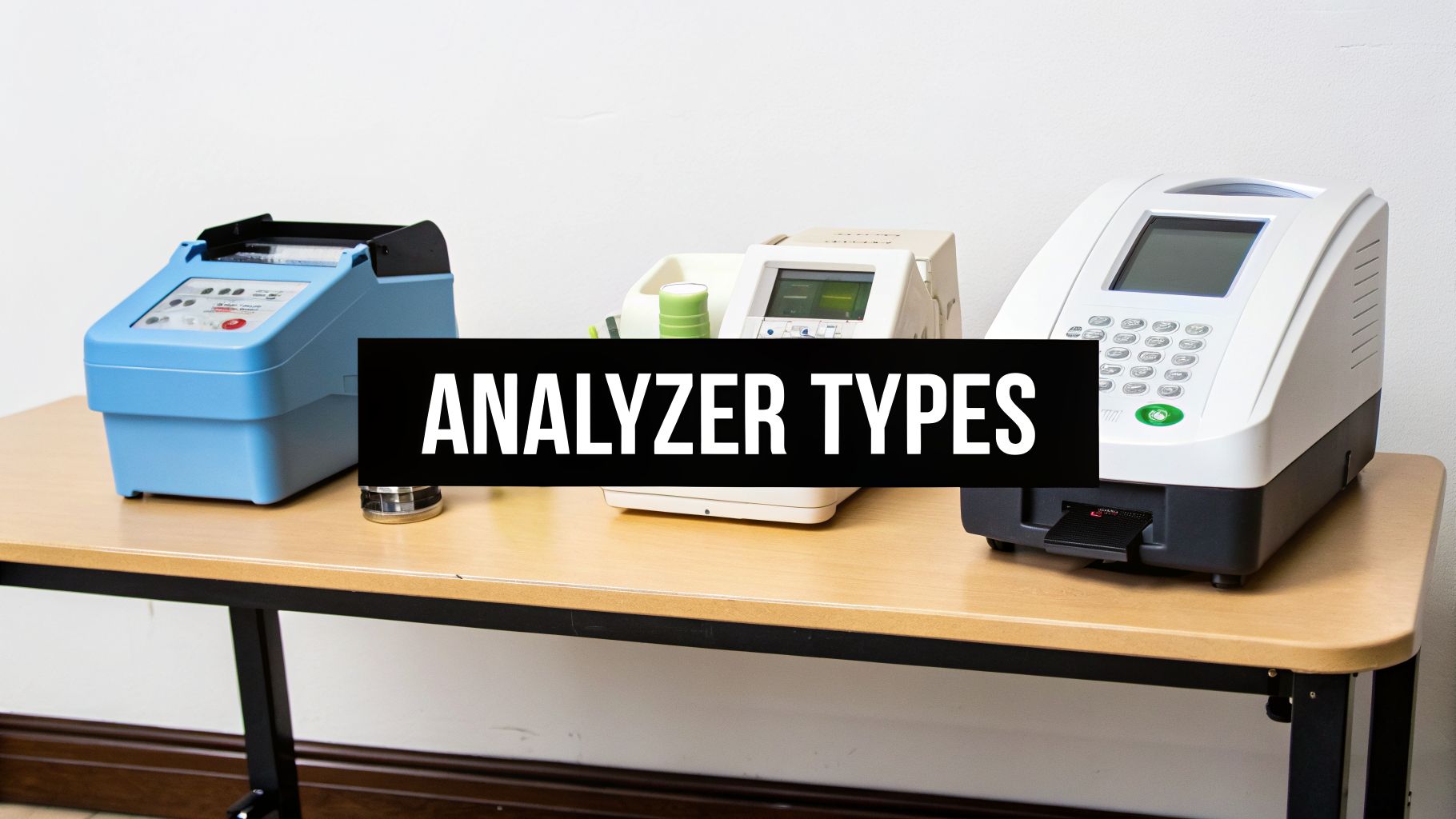
When you start exploring metabolic testing, you’ll quickly see that not all equipment is created equal. Think of it like buying a vehicle: you wouldn’t take a Formula 1 car off-roading, and a rugged jeep isn't built for the racetrack. Each analyzer has a specific job, a specific environment it thrives in, and an ideal user.
At the heart of all this tech is a method called indirect calorimetry. It sounds intimidating, but the concept is straightforward. The equipment measures the oxygen you breathe in (VO2) and the carbon dioxide you breathe out (VCO2). By analyzing this gas exchange, it can calculate with incredible accuracy how much energy your body is burning, whether you're completely at rest or pushing your physical limits.
Getting to grips with the different types is the first real step in matching the right tool to your professional needs. It ensures you invest in a system that gives you the right data in the right way.
The Gold Standard: Metabolic Carts
Metabolic carts are the big, comprehensive systems you'll find in high-level university research labs, clinical settings, and elite sports performance centres. They are the undisputed gold standard for a reason—they offer unmatched accuracy and detailed, breath-by-breath analysis for the deepest possible physiological insights.
These are stationary units built for one thing above all else: precision. Because of this, they represent the largest and most important segment of the market. In 2023, metabolic carts commanded 43.7% of the market share, a figure that’s expected to climb to 48.7% by 2025. This isn't surprising, as they are the backbone of everything from clinical obesity studies to the most granular VO2 max testing for pro athletes.
While you can't pack them up and take them to the field, their strength lies in creating a controlled, repeatable testing environment. This is absolutely critical for longitudinal studies and clinical diagnostics where there is zero room for error.
The Field-Ready Option: Portable Metabolic Analyzers
For professionals who need to break free from the lab, portable metabolic analyzers have been a game-changer. These are lightweight, wearable devices that bring the power of indirect calorimetry right to where the action is.
Imagine testing a cyclist on their actual bike out on the road, a runner on their preferred track, or even a firefighter running through job-specific drills in full gear. This is where portable units prove their worth. They let you assess performance in the most authentic environment possible—the one where your client or athlete actually performs.
This opens up a world of practical applications:
- Real-World Data: You can capture metabolic responses during sport-specific movements, not just on a lab treadmill.
- On-Site Flexibility: Take the assessment directly to teams, individual clients, or corporate wellness events.
- Greater Accessibility: High-level testing becomes a viable option for private gyms, coaching businesses, and independent trainers.
These devices are perfect for exercise physiologists and performance coaches who need to deliver on-the-go assessments without compromising scientific credibility. The best portable systems have become so advanced that their accuracy is now right on par with stationary carts for most applications.
A metabolic analyzer should fit your workflow, not force you to change it. Whether you need the absolute precision of a lab-based cart or the real-world flexibility of a portable device, the right choice empowers you to gather more relevant data.
The Specialist Tool: Handheld Calorimeters
Finally, we have handheld calorimeters. These devices offer a streamlined, focused solution for measuring one key metric: Resting Metabolic Rate (RMR).
Designed for speed and simplicity, they are incredibly popular with nutritionists, dietitians, and fitness centres that offer foundational metabolic assessments. The process couldn't be easier: a client simply breathes into the device for a few minutes while resting, and it delivers a precise RMR measurement.
They don't measure VO2 max or track exercise data, but they excel at their one job: giving you the single most important number needed to build a truly personalized nutrition plan. For any practice centered on weight management and dietary guidance, a handheld device is often the most efficient and cost-effective tool you can have.
To understand how these different devices fit into a testing protocol, you can learn more about VO2 max testing equipment and see how it compares to RMR-focused tools in our detailed guide.
Comparing Metabolic Testing Equipment Types
To help you visualize the differences, this table breaks down the three main types of metabolic analyzers, outlining what they do best and who they're for.
| Equipment Type | Primary Use | Key Metrics | Portability | Ideal User |
|---|---|---|---|---|
| Metabolic Carts | High-precision clinical diagnostics, elite sports performance, academic research | VO2, VCO2, RER, VO2 max, RMR | Low (Stationary) | Hospitals, Universities, Professional Sports Teams |
| Portable Metabolic Analyzers | Field-based performance testing, real-world activity analysis, mobile assessments | VO2, VCO2, VO2 max | High (Wearable) | Sports Scientists, Exercise Physiologists, Performance Coaches |
| Handheld Calorimeters | Quick and simple resting metabolic rate assessment | RMR | High (Handheld) | Nutritionists, Dietitians, Weight Management Clinics, Gyms |
Choosing the right system comes down to understanding your specific goals. Whether you need the exhaustive data from a metabolic cart or the quick, targeted RMR reading from a handheld device, there's a tool designed to meet your needs.
Choosing the Right Equipment for Your Practice
Picking the right metabolic testing equipment is a huge decision. It's an investment that will directly impact the quality of your services and the future of your business. This isn't about finding a single "best" machine; it's about finding the right machine for your world. The needs of a clinical physiotherapist and a mobile personal trainer are worlds apart, and their equipment should be, too.
This guide is here to cut through the noise. We'll break down what really matters for different professionals, connecting specific features to the real-world challenges you face every day. The goal is to make sure you invest in a tool that doesn't just spit out numbers, but genuinely helps you do your job better.
For Clinicians and Physiotherapists
In a clinical setting, there’s no room for error. Accuracy isn’t just a feature—it’s the entire foundation of your work. For clinicians, physiotherapists, and other healthcare professionals, your top priority is gathering objective, repeatable data for diagnostics, planning treatments, and tracking a patient's recovery journey.
This means you should be looking for systems with a rock-solid history of validation against gold-standard methods. A stationary metabolic cart is almost always the best bet here. It gives you the controlled environment you need to get reliable Resting Metabolic Rate (RMR) and VO2 assessments you can trust, time and time again.
Here's what should be on your checklist:
- Medical-Grade Accuracy: Demand to see the validation studies. Look for a low coefficient of variation, which tells you the test-retest reliability is high.
- Data Integration: Can the system talk to your electronic health records (EHR) or patient management software? This is a massive time-saver and reduces the chance of manual entry errors.
- Regulatory Compliance: Make sure the equipment meets all relevant medical device standards and has the proper certifications, like a CE mark.
Getting these things right means the data you collect is not only precise but also fits neatly into your workflow, letting you support diagnoses and track rehabilitation outcomes with complete confidence.
For Sports Scientists and Universities
In the lab or out in the field with elite athletes, data is the name of the game. For sports scientists and university researchers, the focus shifts from a single metric to a deep, granular picture of what’s happening physiologically. You need equipment that can capture every nuance, export data in flexible ways, and stand up to the intense scrutiny of peer-reviewed research.
A research-grade metabolic cart or a highly validated portable analyzer is non-negotiable. These systems deliver the high-fidelity data needed to answer tough questions about performance, training adaptations, and the limits of human physiology. The ability to pull raw data for analysis in programs like SPSS or R is an absolute must-have.
For research and elite performance, the equipment must serve as a precise instrument, not just a measurement tool. It needs to provide clean, exportable data that can fuel discovery and inform high-stakes performance strategies.
Look for these critical features:
- Breath-by-Breath Analysis: This gives you the most detailed view of gas exchange dynamics as they happen.
- Raw Data Export: You need the freedom to slice, dice, and analyze the raw numbers to find new insights.
- Durability and Support: University labs and performance centers put their gear through the wringer. Robust build quality and responsive tech support are vital.
For this group, the investment is all about the quality and depth of the data. It’s what empowers new discoveries and pushes the boundaries of what we know about human performance.
For Gyms and Performance Centers
Gyms and performance centers live at the intersection of science and commerce. The metabolic testing equipment you bring in has to be accurate, of course, but it also has to be user-friendly, tough enough for daily use, and able to generate a clear return on investment (ROI). Your goal is to offer a premium service that gets members excited and keeps them coming back because they see real, data-driven progress.
The sweet spot is often a versatile portable analyzer or a streamlined stationary unit that multiple staff members can learn to operate quickly. A huge plus is software that generates client-facing reports that are easy to understand. This is how you translate complex data into actionable advice your members can actually follow. Your workflow has to be efficient, too, allowing you to run several tests a day without getting bogged down.
For example, offering firefighter fitness testing can create a fantastic, dependable revenue stream. You become the go-to solution for local departments that need objective fitness data but don't have their own equipment or expertise.
A facility manager should focus on:
- Ease of Use: You want minimal setup time and intuitive software. This drastically cuts down on the time and cost of staff training.
- Client-Friendly Reporting: Look for automated reports with great visuals. This is your tool for demonstrating value to members.
- Strong ROI Potential: Think about how you’ll price assessments. Can you bundle them with personal training packages to drive sales?
For Personal Trainers and Mobile Practitioners
If you’re an independent personal trainer or a coach on the go, your world revolves around three things: portability, affordability, and simplicity. Your "lab" might be a client's living room, a local park, or a small private studio. A lightweight, wearable metabolic analyzer is your perfect partner, letting you bring elite-level testing right to your clients' doorstep.
Devices like the VO2 Master have completely changed the game for field testing. They provide accurate VO2 max and metabolic data without needing to be hooked up to a big, clunky machine. This means you can test a runner on their favorite trail or a cyclist on their own bike, capturing data in the environment where they actually perform. You need a system that sets up in minutes, has a long-lasting battery, and produces straightforward reports you can discuss with clients right then and there. Your equipment should empower your business, not weigh it down.
Mastering Protocols for Reliable Test Results
Having a top-of-the-line metabolic cart is one thing, but getting data you can actually trust? That all comes down to execution. A consistent, rock-solid protocol is what separates a fancy piece of equipment from a tool that delivers reliable, actionable insights. Without one, even the most precise analyser can give you noisy, inconsistent data that undermines client confidence and progress.
Think of it like a meticulous lab experiment. The outcome depends just as much on following the procedure perfectly as it does on having the right instruments. When you master your testing protocols, you’re ensuring that every single measurement is accurate and, just as importantly, repeatable. This gives you a foundation of truth to build every decision upon.
Nailing the RMR Test: Preparation is Everything
A Resting Metabolic Rate (RMR) test is incredibly sensitive to what’s going on both inside and outside the body. You're trying to capture a snapshot of the body’s energy use in a state of absolute rest, which means controlling the pre-test environment isn't just a suggestion—it’s mandatory. The most important step here is giving your clients clear, simple instructions they can actually follow.
For the most accurate RMR reading, make sure your clients stick to these rules:
- Fasting is a Must: They should have no food or drinks containing calories for at least 7-12 hours beforehand. Plain water is fine, and you should even encourage it.
- No Stimulants: This means no caffeine, nicotine, or other stimulants for a minimum of 12 hours. Remind them this includes coffee, tea, energy drinks, and even some pre-workout supplements.
- Rest Up: No moderate or strenuous exercise for a full 24 hours before their appointment. A light walk the day before is okay, but anything more is out.
- Arrive Calm: Have them show up a few minutes early. This gives them time to sit quietly, catch their breath, and let their heart rate and metabolism settle down.
Once your client arrives, get them comfortable in a quiet, dimly lit room for a good 15-20 minutes before you even think about starting the test. This little acclimatization period is crucial for measuring their true resting state, not their "I just rushed through traffic" state. For a deeper dive, check out our complete guide on how to measure Resting Metabolic Rate correctly.
Your protocol is your promise of quality. A tightly controlled testing procedure ensures that changes in a client's results reflect genuine physiological adaptations, not just variations in test-day conditions.
Conducting a Sub-Maximal VO2 Test
While a maximal VO2 test pushes someone to their absolute limit, a sub-maximal test is a fantastic way to estimate VO2 max by tracking how their body responds to a controlled, graded workout. A brilliant and well-validated protocol for this is the Chester Step Test. It's efficient, doesn't require a ton of gear, and works well for a huge range of fitness levels.
Before you start any assessment, it's vital to confirm that your gear is giving you true numbers. Proper equipment calibration is a non-negotiable for all scientific instruments, not just pipettes, and it ensures the highest accuracy in your metabolic tests. Always follow the manufacturer's guidelines to calibrate your metabolic analyser, heart rate monitor, and any other sensors you're using.
The Chester Step Test itself is straightforward and follows a clear progression:
- Initial Setup: Get the client standing in front of an appropriately sized step (e.g., 30cm). Make sure their heart rate monitor is on and fits well, and the metabolic analyser mask is secure and comfortable.
- Stage 1: The client begins stepping at a rate of 15 steps per minute for 2 minutes. Use a metronome to keep the pace steady. At the end of the stage, record their heart rate and Rate of Perceived Exertion (RPE).
- Subsequent Stages: Every 2 minutes, you’ll increase the pace (to 20, then 25, 30, and 35 steps per minute). Keep recording heart rate and RPE at the end of each stage.
- Test Termination: Stop the test once the client’s heart rate hits 80% of their age-predicted maximum or if they report a high RPE that indicates they are working too hard.
By plotting the heart rate at each stage against the workload (the stepping rate), you can then extrapolate that data to predict their VO2 max. It’s a safe, reliable, and perfectly repeatable way to track someone's cardiorespiratory fitness as they progress.
Integrating Hardware, Software, and Consumables
Top-tier metabolic testing equipment isn’t just a single machine. It's a finely tuned ecosystem where the analyzer (hardware), the software, and the consumables work in perfect sync. Think of it like a professional recording studio: the microphone is essential, but it's useless without a mixing board to process the sound and quality cables to transmit a clean signal.
The hardware, whether it's a full metabolic cart or a portable analyzer, is the core of the operation. It’s what captures the raw data, breath by meticulous breath. But on its own, that data is just a stream of numbers. The software is what gives it a voice.
This is where powerful analysis software comes in, translating raw VO2 and VCO2 measurements into reports and dashboards that actually mean something. It does the heavy lifting, calculating crucial metrics like RMR, VO2 max, and ventilatory thresholds. Good software presents this with clear charts and graphs, making it incredibly simple to explain a client's metabolic profile and show them their progress over time.
The Critical Role of High-Quality Consumables
A common mistake we see is people investing in a great analyzer only to cut corners on the consumables. It's like putting cheap, remolded tires on a Ferrari. You completely undermine the machine's performance and, in this case, the integrity of every single test.
Using generic or low-quality parts introduces variables that make your data unreliable from the start. You should never compromise on these key items:
- Breathing Masks and Valves: A poor-fitting mask is one of the most frequent sources of error. If it leaks, you get an immediate underestimation of oxygen consumption, and the entire test is flawed.
- Tubing and Hoses: These aren't just any old tubes. They must be non-permeable and designed specifically for gas analysis to prevent outside air from diffusing in and contaminating the sample.
- Calibration Gases: The accuracy of your system is directly chained to the precision of your calibration gas. Using a certified, medical-grade gas mixture isn't just a recommendation; it's a non-negotiable step for getting trustworthy results.
Think of consumables as the vital link between your client and the analyzer. If that link is weak, the entire chain of data breaks down, no matter how advanced your hardware or software is.
This workflow really brings the concept to life, showing how each step is completely dependent on the others.

As you can see, the process flows from preparation (with the right consumables) to precise calibration, and finally to the test itself. A failure at any point—a leaky mask, an old hose, or an inaccurate gas tank—invalidates everything that follows.
Ultimately, understanding this complete ecosystem is what separates a professional testing service from an amateur one. When you invest in the whole system, you ensure that you're turning complex physiological data into clear, actionable insights for every single client.
Ensuring Long-Term Success With Your Equipment
Buying a piece of high-end metabolic testing equipment is a serious investment. But the purchase itself is just the starting point. To make sure your system delivers accurate, data-driven insights for years, you need to think about the long game: procurement, maintenance, and support. Getting this right from day one protects your investment and, just as importantly, the credibility of every single test you run.
It all starts with getting the equipment to your door. A smooth delivery process is crucial. You want to work with a supplier like Cartwright Fitness who is transparent about shipping times, whether you're looking for economy delivery or need something fast-tracked internationally. Solid logistics mean your gear arrives safe and sound, letting you get up and running without frustrating delays.
The Non-Negotiable Role of Maintenance and Calibration
Once your system is set up, ongoing maintenance becomes your number one priority. Think of it like a high-performance car—you wouldn’t skip its scheduled service and expect it to perform at its peak. For a metabolic analyser, that service is routine calibration. It’s not optional; it’s essential for keeping your measurements precise and trustworthy.
Over time, sensors can drift. It's a natural process. Regular calibration corrects for this, guaranteeing your gas analysis is spot-on every time. If you skip this, you're looking at flawed data, which destroys client trust and can lead to completely wrong training or diet advice. A good preventive maintenance checklist template can be a lifesaver here, helping you systematise all the necessary checks to keep your equipment in top shape.
An uncalibrated metabolic analyzer is no better than a stopwatch for measuring athletic performance. It gives you numbers, but they lack the scientific integrity required for professional use. Consistent calibration is the bedrock of reliable data.
If you want to get this critical process right, it pays to understand the fundamentals. We've put together a comprehensive guide where you can learn more about metabolic cart calibration and master the best practices for consistent accuracy.
Choosing a Partner, Not Just a Product
The quality of support you get is just as important as the quality of the machine. The relationship shouldn't end when the delivery truck leaves. What you really need is a partner who provides expert guidance to help you squeeze every bit of value out of your investment.
So, when you're sizing up suppliers, here's what to look for as signs of a real support system:
- Personalised Training: Do they offer hands-on training seminars or one-on-one sessions? You want your team to feel completely confident with the equipment and protocols from the get-go.
- Accessible Expert Support: When you have a question or run into an issue, can you easily get a product expert on the line? UK-based support can be a huge advantage for quick, effective help.
- Regulatory Adherence: Make sure the supplier provides equipment that meets all the necessary standards, like carrying a CE mark, especially for clinical or professional settings.
Choosing the right partner means you're not just buying the best metabolic testing equipment. You're also gaining the knowledge and the support network to use it like a pro. That's how you turn a simple purchase into a lasting professional advantage.
Your Top Questions About Metabolic Testing Equipment
If you're diving into the world of metabolic testing, it’s natural to have questions. Whether you're making your first equipment purchase or looking to sharpen up your existing protocols, getting clear answers is key. It's how you build confidence and deliver a truly standout service.
Let's walk through some of the most common queries we hear from professionals, covering everything from daily operations to building a business case for the investment.
How Often Does My Equipment Need to Be Calibrated?
There’s no single answer here—it really depends on the specific device and how much you use it. For high-precision systems in busy clinical or research settings, daily or even weekly checks are pretty standard.
Think of it like tuning a guitar before a concert. You do it to make sure every note is pitch-perfect. With metabolic testing, calibration ensures every data point you collect is accurate and reliable. Your first and best resource is always the manufacturer’s guidelines. Following them isn't just a suggestion; it’s essential for maintaining the integrity of your results.
Your data is only as good as your calibration. Sticking to the manufacturer's schedule isn't just a box-ticking exercise—it’s the only way to guarantee the scientific validity of your assessments.
Can I Use RMR Results to Create Diet Plans?
Yes, but it's crucial to understand your professional role. Resting Metabolic Rate (RMR) data gives you a client's true caloric baseline—a number far more accurate than any generic online calculator. It’s the perfect foundation for building an effective nutrition plan.
However, the person who actually designs that plan should be a qualified nutritionist or registered dietitian. As a trainer or sport scientist, your job is to provide this precise metabolic data. You hand off the numbers, and the nutrition expert uses them to craft a safe, effective, and fully customised diet.
What's the Typical ROI for a Gym or Performance Centre?
For a gym, the return on investment (ROI) for metabolic testing equipment can be fantastic. You're not just buying a machine; you're unlocking a premium, data-driven service that opens up several new revenue streams.
Here are a few ways we see facilities make it work:
- One-Off Assessments: Charge a flat fee for standalone RMR or VO₂ max tests. This is a great entry point for new clients.
- Premium Memberships: Bundle metabolic testing into your top-tier packages as a high-value incentive.
- Integrated Programming: Build assessments directly into personal training packages or weight-loss challenges to show clients tangible, data-backed progress.
The ROI isn't just about the direct income, either. When members see personalised results backed by real science, they become more engaged and motivated. That leads to better retention, turning them into loyal, long-term clients.
At Cartwright Fitness, we don't just sell equipment; we provide the validated, high-precision tools and expert support you need to launch a successful metabolic testing service. Explore our professional-grade metabolic solutions and find out how we can help you deliver better results.