

A warehouse operative arrives for an occupational health assessment after a period away from work. The assessor has a branded sub-maximal fitness device, a printed score and a demanding manual-handling role to consider. The score looks reassuring, but the assessment hasn't captured medication use, a recent shoulder injury or whether the test reflects the actual lifting, carrying and positional demands of the job.
That situation is uncomfortable because the number can appear more certain than the process that produced it. A device labelled professional doesn't automatically provide a valid answer to every occupational, clinical or performance question. Validated assessment tools are useful only when their evidence, protocol, equipment, operator and intended decision align.
The same issue affects return-to-work clearance, rehabilitation progression, talent identification and research conclusions. Brand recognition, available budget and administrative convenience can replace a proper appraisal of validity, reliability and standardisation. Professional measurement requires a more disciplined question: what decision must the assessment support, and what evidence is sufficient for that decision?
Table of Contents
- Why the Choice of Assessment Tool Matters in Professional Practice
- What Makes an Assessment Tool Validated
- How Validation Studies Are Actually Designed
- Matching Validated Tools to Real Decisions
- Implementation and Quality Control Checklist
- Common Pitfalls and How to Avoid Them
- Professional Principles and FAQs on Validated Assessment
Why the Choice of Assessment Tool Matters in Professional Practice
The warehouse example illustrates a common failure. The assessor didn't necessarily use a poor instrument. The problem was the assumption that one sub-maximal score could answer a wider question about safe heavy lifting. Aerobic capacity, medication effects, shoulder function, lifting tolerance and task-specific risk are different assessment domains. A single result can't automatically represent all of them.
The choice of tool determines what becomes visible and what remains unmeasured. A grip dynamometer can describe force production under a defined hand position, but it doesn't reproduce a box lift, an awkward reach or repeated handling under fatigue. A step test can provide structured information about exercise response, but it isn't a complete cardiopulmonary diagnostic assessment. A questionnaire can identify reported symptoms, yet it may not capture every relevant stressor in a mixed workforce.
Practical rule: A validated result is evidence about the construct the tool measures, not permission to infer every capability surrounding it.
This distinction matters particularly in UK occupational health, where a decision may involve fitness for a specific role rather than general health. The Health and Safety Executive's manual-handling resources group assessment methods by task type and recommend using more than one tool when a job contains multiple exposure types. Its MAC, ART and RAPP tools support risk interpretation and communication before controls are selected, which is more useful than treating one score as a universal clearance certificate. The UK occupational health commentary on assessment tools explains this task-matching approach.
A number is only as defensible as its context
Clinical teams face a similar choice. A rehabilitation service may need to monitor change, while a diagnostic service may need a measurement traceable to laboratory reference methods. Sport scientists may require sensitivity to small performance changes, whereas an emergency-services team may need a practical, repeatable occupational screen.
Published evidence also has boundaries. A 2019 systematic review of reviews identified 63 UK-validated dietary assessment tools across 68 reviews, with more than 900 validation results spanning five life stages, 18 nutrients, six dietary assessment methods and nine validation method types. Only 17 tools had been validated against biomarkers, and 19 had been validated in infant, child or adolescent populations, showing both the breadth and limitations of validation evidence in the UK (systematic review of UK-validated dietary assessment tools).
The lesson transfers to physical assessment. Validation isn't a permanent label attached to a product. It describes how an instrument and protocol behaved in a defined population, under defined conditions, for a defined purpose. Professional judgement begins when the assessor decides whether those conditions resemble the current client, role and decision.
What Makes an Assessment Tool Validated
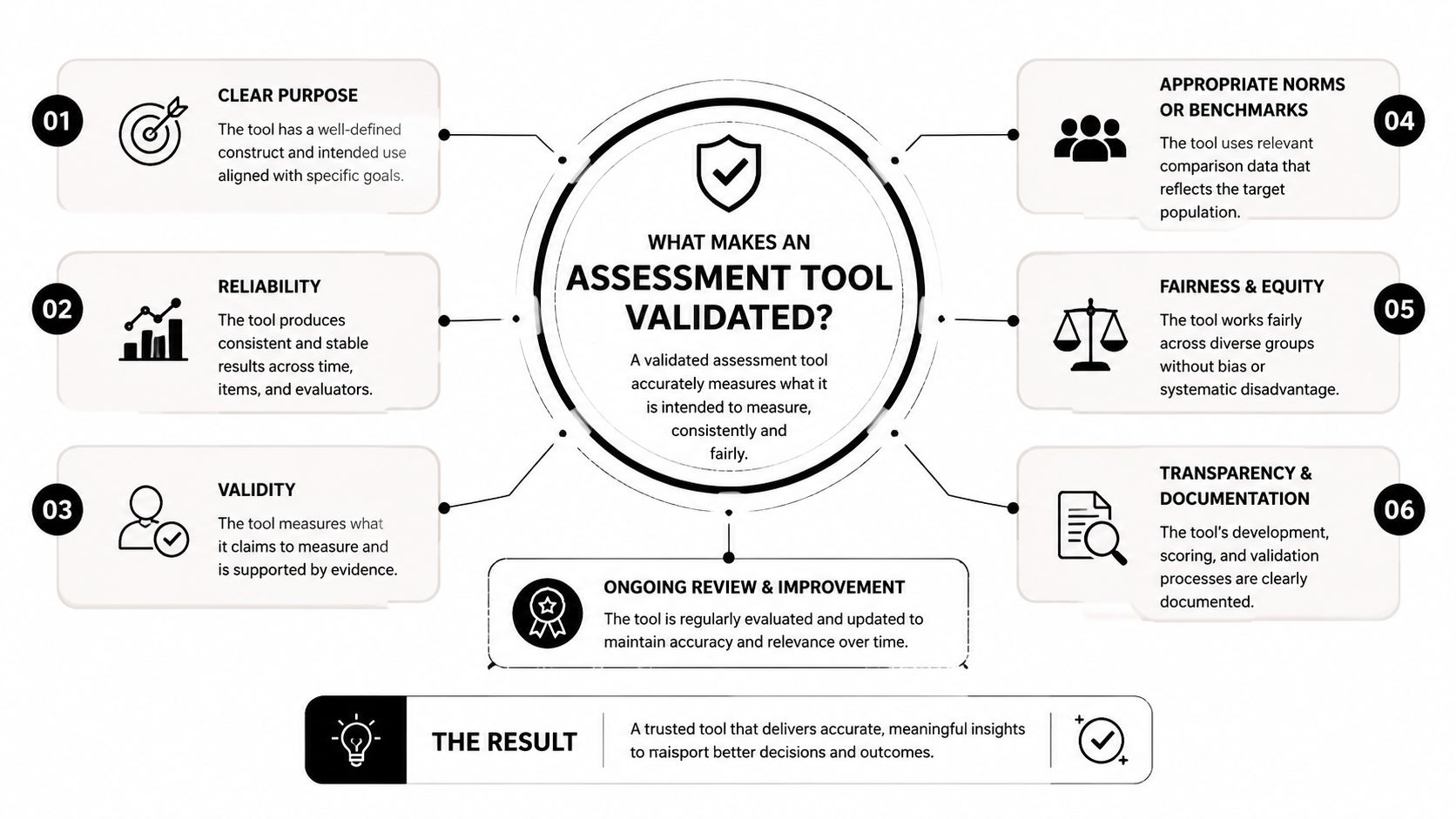
A validated assessment tool is an instrument whose measurement properties have been independently examined and shown to behave acceptably for a particular population and purpose. “Acceptably” doesn't mean perfectly. It means the known uncertainty, error and limitations are understood well enough for the intended decision.
A practical assessment of validation has several layers:
- Validity: Does the tool measure what it claims to measure?
- Reliability: Does it produce consistent results when the underlying condition hasn't changed?
- Calibration: Do readings relate to a known reference or standard?
- Standardisation: Can trained operators reproduce the same procedure?
- Responsiveness: Can the tool detect meaningful change when change has occurred?
- Fit for purpose: Does the evidence support the actual population and decision?
The distinction between these concepts is explored in what measurement validity means. Criterion validity, for example, compares a new method with a trusted reference. A sub-maximal step test might be compared with laboratory gas analysis when estimating aerobic capacity. Construct validity asks whether results behave as theory predicts. Grip strength that changes in an expected relationship with age or training can contribute to that argument, although it doesn't prove that the test answers every functional question.
Content validity is especially relevant to questionnaires and functional assessments. Experts examine whether the items cover the construct rather than only an appealing fragment of it. Reliability then asks whether the same person, or different assessors, can obtain comparable results. A hand-grip dynamometer requires calibration against known loads, while standardisation includes handle position, instructions, rest intervals and verbal encouragement.
Instrument evidence and operator competence are separate
A validated instrument doesn't make an untrained operator competent. The operator can introduce error through poor positioning, inconsistent cadence, altered encouragement or incomplete recording. Conversely, a careful assessor can't rescue an instrument that lacks evidence for the decision being made.
The Takei Hand Grip Dynamometer uses an adjustable isometric design for reproducible grip-strength evaluation, measures from 5.0 to 100 kgf, and can display maximum measured values. Those characteristics describe the equipment. They don't replace a defined protocol or population-appropriate interpretation.
The required depth of evidence depends on consequence. A low-stakes training monitor may tolerate more uncertainty than a safety-critical clearance decision. The assessor should therefore document not only whether a tool is validated, but validated against what, in whom, under which protocol and for which decision.
How Validation Studies Are Actually Designed
Validation studies answer different questions, and a paper that answers one question shouldn't be treated as evidence for all the others. The strongest practical appraisal starts by identifying the study design, then asking whether its sample and protocol resemble the intended service.
Criterion validity compares a tool with a reference method. A sub-maximal step test may be compared with laboratory expired-gas analysis. Correlation can show association, but agreement is often more useful for a decision. Standard error of estimate and limits of agreement help the assessor judge how far an individual result may sit from the reference value.
Construct validity tests theoretical behaviour. A grip-strength measure might be expected to differ across groups with different strength characteristics, or to respond to training exposure. The key indicator isn't a single impressive coefficient. The question is whether the direction and size of the relationship are plausible and consistent with the construct.
Content validity relies on informed review of item relevance and coverage. It matters when a questionnaire or functional scale claims to represent a broad experience. If a workplace stress survey omits important stressors for a particular workforce, a clean completion rate won't repair that gap. UK guidance warns that a survey may miss relevant stressors and may require additional questions or methods when it doesn't cover the whole workforce context (NICE baseline assessment tool).
| Design | Question answered | Example | Key statistic |
|---|---|---|---|
| Criterion validity | How closely does the tool compare with a reference method? | Step test compared with laboratory gas analysis | Standard error of estimate and limits of agreement |
| Construct validity | Does the result behave as theory predicts? | Grip strength related to a relevant strength construct | Correlation or group comparison |
| Content validity | Do the items represent the intended domain? | Occupational stress questionnaire reviewed for role relevance | Expert agreement and item relevance |
| Reliability | Does the method repeat across time and assessors? | Repeated dynamometry by the same and different assessors | ICC, Bland-Altman analysis and coefficient of variation |
| Responsiveness | Does the tool detect meaningful change? | Pre and post rehabilitation functional assessment | Change score relative to measurement error |
Read the study beyond the headline
Reliability studies may report test-retest, intra-rater and inter-rater agreement. An intraclass correlation coefficient can help assess consistency, while Bland-Altman plots reveal systematic bias and the spread of individual differences. A coefficient of variation can be useful when proportional error matters.
Sample size affects confidence in all of these estimates. A small study may be suitable for early feasibility work but provide imprecise limits of agreement or unstable subgroup conclusions. Larger and independently replicated studies are more persuasive, particularly when the assessment will affect employment, clinical progression or selection.
Responsiveness deserves separate attention. A tool can be reliable yet insensitive to meaningful change, or sensitive to change yet too noisy for individual decisions. The Cosmed Q-NRG Max Metabolic Analyser is described as supporting true aerobic-capacity assessment, individual assessment and metabolic analysis, but its suitability still depends on the reference protocol, operator competence and decision.
A single validation paper rarely settles the matter. Trust grows when evidence is replicated across relevant populations, settings and operators, with uncertainty reported clearly rather than hidden behind one summary statistic.
Matching Validated Tools to Real Decisions
Tool selection should begin with the decision, not the prestige of the instrument. The same person may require different assessments for a clinical diagnosis, a work capability opinion and a performance intervention because each question has a different error tolerance.
| Audience | Typical decision | Validated tool example | Key psychometric demand |
|---|---|---|---|
| Occupational health | Fitness for a defined task or exposure | Grip dynamometry, task-specific HSE methods or structured aerobic screening | Reproducibility and relevance to the job demand |
| Clinical practice | Rehabilitation progression or functional monitoring | Incremental shuttle walk testing, timed up-and-go or targeted symptom scales | Responsiveness, reliability and clinically interpretable change |
| Sport science | Performance profiling or training response | Laboratory VO₂ assessment, 30-15 Intermittent Fitness Test or force-platform countermovement jump | Sensitivity, repeatability and appropriate reference methods |
| Emergency services | Occupational fitness screening | Chester Step Test or multi-stage fitness testing | Standardised administration and defensible thresholds |
Occupational health often needs a practical balance between validity, time and technician skill. Grip dynamometry can contribute to manual-handling assessment, but heavy-work clearance may also require functional movement, injury history, task simulation and clinical review. The test must map to the actual exposure rather than merely produce a familiar number.
Clinical services may favour tools that can be repeated without excessive burden. A timed up-and-go can contribute to functional assessment, while an incremental shuttle walk test may be relevant to rehabilitation monitoring. Neither should be treated as a diagnosis in isolation. The intended outcome, measurement error and patient context determine how the result is interpreted.
Sport-science laboratories can justify more complex equipment when the research or performance question requires direct physiological measurement. A clinic-grade treadmill with expired-gas analysis may be appropriate for cardiopulmonary assessment, but over-engineered for a routine return-to-work check where a pragmatic, standardised screen answers the narrower question.
The Chester Step Test illustrates fit for purpose
The Chester Step Test was originally designed for occupational use and is widely applied in firefighter and emergency-services fitness screening, according to a UK occupational-medicine source (Occupational Medicine discussion of the Chester Step Test). It is therefore a logical option when a service needs a progressive, sub-maximal workplace screen under controlled conditions.
It isn't automatically suitable for elite-athlete VO₂ estimation. Elite performers may need direct gas analysis, sport-specific demands and tighter sensitivity to small performance differences. The Chester Step Test can be fit for the screening decision without being fit for every physiological estimation question. That distinction prevents both under-testing in diagnosis and over-engineering in routine occupational practice.
For safety-critical roles, targeted tools may also be necessary. Occupational health guidance identifies the MRC Dyspnoea Scale as useful for respiratory capability assessment, with a score of 3 or more indicating significant functional impact, and lists PHQ-9, GAD-7, AUDIT, CAGE, fatigue scales, STOP-BANG and the Montreal Cognitive Assessment as commonly used validated tools for targeted fitness-for-work screening. The guidance also warns that some require training or role-specific interpretation to avoid false reassurance or over-restriction (psychometric assessments in occupational health guidance).
Implementation and Quality Control Checklist
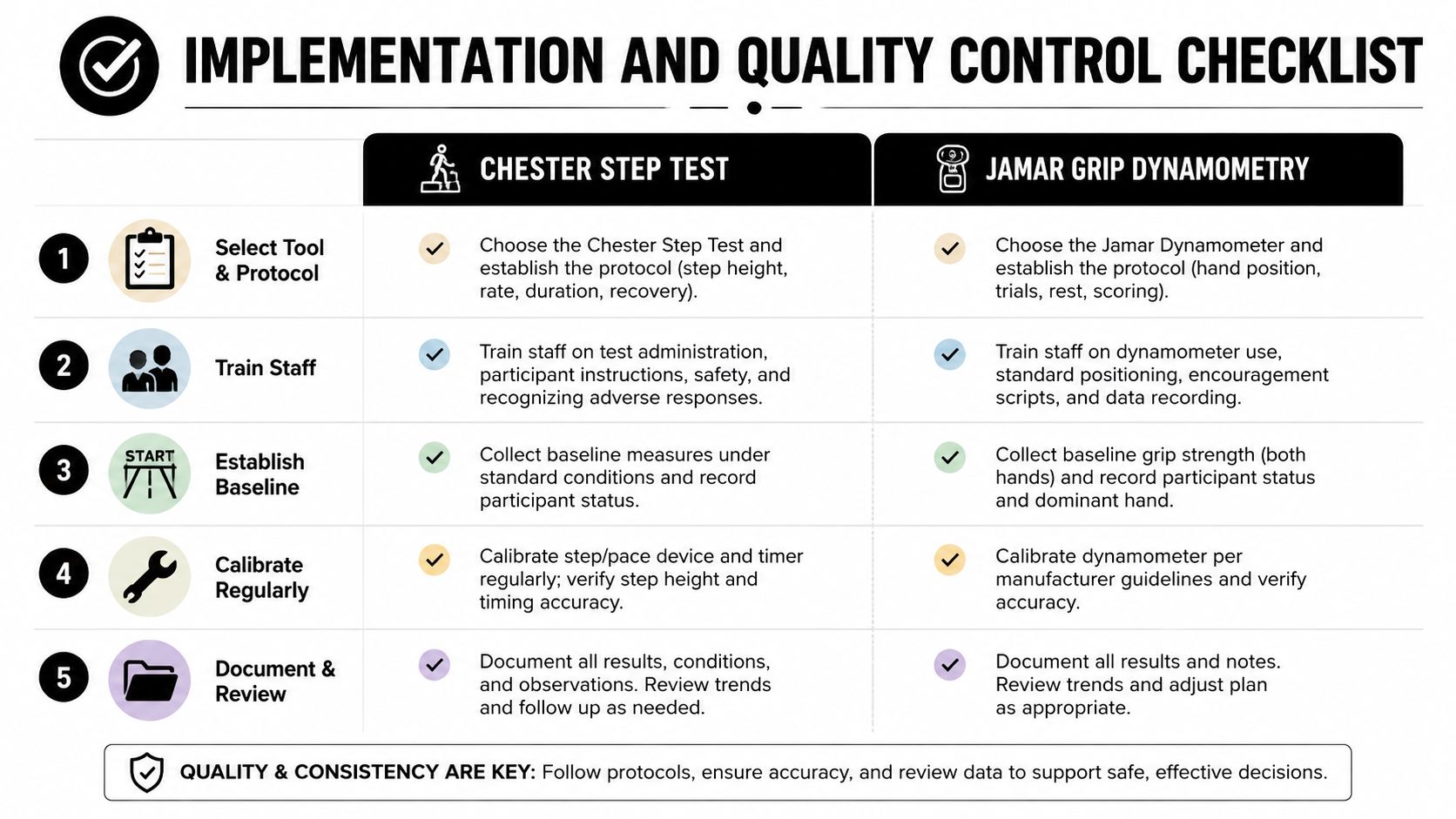
A defensible assessment service turns evidence into a controlled workflow. The process should make it possible for another trained assessor to understand what was done, repeat it and identify any deviation that could affect interpretation.
Select the equipment and protocol
The first step is to select the exact instrument and protocol supported by the evidence. A near-equivalent substitute may not be equivalent for pooled reporting, longitudinal tracking or a high-stakes threshold. Equipment specifications, software versions and prediction equations should be recorded before testing begins.
For the Chester Step Test, the published protocol starts at 15 steps per minute for two minutes, then increases by 5 steps per minute every two minutes through five stages, reaching 35 steps per minute. Heart rate and rating of perceived exertion are recorded at the end of each stage. The test stops when exercise heart rate reaches 80% of age-predicted maximum or RPE reaches 14, with a maximum duration of 10 minutes (Chester Step Test protocol).
A Jamar-style grip protocol should specify posture, handle setting, verbal instructions, order of hands and rest. A UK NHS procedure requires three measurements for each hand, alternating sides, with a 60-second rest period between trials on the same hand, providing a reproducible approach for serial testing (UK NHS JAMAR grip-strength procedure).
Train people, not just systems
Staff should receive competency sign-off against the written protocol. Dual assessment during implementation lets a service examine inter-rater agreement before results are pooled. Training should include contraindication checks, stop criteria, standardised scripting, equipment handling and documentation of deviations.
The client also needs consistent preparation. Pre-test instructions, footwear requirements, recent exertion, medication disclosure and symptom reporting should be handled through a controlled script. Verbal encouragement must be standardised because enthusiastic prompting can alter effort and make repeated tests incomparable.
Calibrate, record and audit
Calibration schedules should be written into the service rather than left to individual memory. Dynamometers require checks against known loads, while step-test equipment needs verification of height and cadence. Metabolic systems require appropriate gas-analysis verification according to the manufacturer's and laboratory procedures.
The Cartwright Fitness quality control procedures provide a useful reference point for organising documented checks, but every service still needs a procedure suited to its equipment and governance requirements.
Raw values should remain available alongside calculated outputs. Records should identify the instrument, operator, date, protocol version, prediction equation, rest periods and any deviation. Periodic internal reliability checks can use repeated assessments and intraclass correlation coefficients to monitor whether local performance remains consistent.
A checklist isn't evidence of quality by itself. An audit must compare actual practice with the documented protocol, identify drift and assign corrective action. Digital recording can improve traceability, but it can't compensate for an incorrectly selected tool or an unstandardised test.
Common Pitfalls and How to Avoid Them
Validated equipment can generate weak evidence when the service changes the conditions around it. The most damaging errors are often mundane: different devices, altered instructions, missing rest periods or a dashboard that conceals inconsistent entries.
Device-brand mixing creates a comparability problem. British grip-strength reference data have been developed across cohorts using Jamar, Smedley, Nottingham electronic and Takei dynamometers, and a published analysis drew on twelve British studies to build life-course reference data. Device choice therefore matters when results are compared across sites or against reference data (British grip-strength reference data). A service should lock the equipment specification or establish its own equivalence evidence before pooling measurements.
Protocol drift is quieter. A warm-up may become longer, encouragement may become more forceful and rest periods may disappear. Version-controlled instructions, competency refreshers and audit observations help preserve the conditions under which validation evidence applies.
Single-tool reliance is another common shortcut. Grip strength alone can't clear a worker for every heavy-handling demand, just as a symptom questionnaire can't establish unrestricted fitness for safety-critical work. High-consequence decisions should triangulate relevant evidence, including the task, medical context and functional demand.
A clean dashboard can display inconsistent measurements with impressive clarity.
Digitisation without standardisation adds a false sense of control. Digital MAC, ART and RAPP tools announced by the HSE show the move towards digital ergonomic workflow support, but the HSE's toolkit still emphasises matching methods to tasks and using several tools when exposure types differ (HSE digital ergonomic assessment tools). Electronic forms need controlled fields, validation rules, version history and staff training.
Finally, face validity isn't criterion validity. A wrist-worn optical heart-rate monitor may look credible while failing comparison with a laboratory method. Likewise, a study in healthy young adults shouldn't automatically justify use in an older clinical population. The protective practice is simple but demanding: match the cited population, protocol and decision, then document the limits.
Professional Principles and FAQs on Validated Assessment
Professional use of validated assessment tools rests on five principles:
- Define the decision first. A return-to-work opinion, diagnostic investigation, rehabilitation measure and talent-identification test need different evidence.
- Judge the complete evidence. Validity, reliability, calibration and responsiveness answer different questions.
- Standardise the protocol. Equipment, posture, cadence, instructions, rest and stop criteria must remain controlled.
- Train and audit assessors. Competence includes recognising contraindications, recording deviations and interpreting uncertainty.
- Revisit fit for purpose. A tool may need review when the population, task, intervention or decision changes.
Validation is therefore an ongoing professional duty, not a procurement checkbox. The question “is this tool validated?” should be followed by “for whom, against what, under which conditions and for what action?”
Frequently asked questions
How recent should validation evidence be?
Recency matters, but it isn't the only criterion. A well-designed study may remain relevant when the instrument and protocol are unchanged, while newer evidence may be less useful if it concerns a different population or decision. Services should record the evidence reviewed, the date of review and the reason the tool remains appropriate.
Can a consumer-grade device count?
It can contribute evidence, but appearance and convenience don't establish validity. The assessor should seek evidence for the exact device, application and population, then consider calibration, repeatability, data access and the consequences of error. A consumer device may be unsuitable for a safety-critical threshold even if it appears plausible.
What happens when no validated tool exists for a role?
The assessor should define the construct, identify the closest evidence-based options, consult relevant professional guidance and state uncertainty explicitly. Combining methods may provide better coverage than forcing one generic tool to represent a complex role. New local data should be treated as evaluation evidence, not silently presented as established validation.
How should validation status be documented for audit and CQC purposes?
A record should identify the instrument, manufacturer, model, protocol version, calibration status, operator competency, source evidence, intended population, decision supported and known limitations. A controlled register, standard operating procedure and audit trail make the reasoning inspectable. For questions about assessment workflows and digital documentation, Ekipa AI answers can provide an additional general resource, but professional accountability remains with the responsible assessor and organisation.
Cartwright Fitness supplies professional equipment and solutions for aerobic and VO₂ assessment, the Chester Step Test, grip and back-and-leg dynamometry, body composition, metabolic testing and functional assessment. Visit Cartwright Fitness to review equipment and professional assessment resources that can support standardised testing, documented quality control and defensible occupational, clinical and performance decisions.


