

A delayed metabolic cart rarely looks like a vendor management problem at first. It looks like a missed testing block, an annoyed client, a technician reshuffling the diary, and a pile of emails trying to work out whether the issue is shipping, calibration, paperwork, or support.
That's the reality for smaller operators in health and fitness tech. You might be supplying or using specialist systems like body composition ultrasound, respiratory testing equipment, or validated step test kits, but you probably don't have a procurement department sitting in the background. The same person who knows the product best often ends up chasing documents, checking delivery dates, handling support escalations, and deciding whether a supplier is still worth the risk.
That's where vendor relationship management becomes practical rather than corporate. In small and mid-sized businesses, it isn't about building a giant supplier governance programme. It's about putting just enough structure around critical vendors so equipment arrives ready, support is reachable, records are in order, and problems get solved before they damage your schedule or your reputation.
Table of Contents
- Beyond Transactions Why Vendor Relationships Matter
- Building Your VRM Framework From Scratch
- The VRM Playbook Setting Up for Success
- The VRM Playbook Managing Ongoing Performance
- Tools and Systems to Support Your VRM Strategy
- Turning Key Suppliers into Strategic Partners
Beyond Transactions Why Vendor Relationships Matter
If an ultrasound system arrives uncalibrated, or a respiratory analyser is held up when you've already booked assessments, the damage spreads quickly. Staff lose time, clients lose confidence, and your team starts making decisions under pressure. In specialist environments, a supplier isn't just fulfilling an order. They're affecting service continuity.
That's why vendor relationship management matters more in niche health and fitness operations than many generic guides admit. Smaller firms often rely on a handful of highly specific suppliers, yet they manage them without a dedicated procurement function. The same business can be exposed to single-source dependencies, compliance obligations, software updates, lead-time risk, and support bottlenecks, all while running day-to-day operations with a lean team.
The wider market is moving in this direction too. The global supplier relationship management software market is projected to grow from $13.69 billion in 2025 to $26.76 billion by 2031, according to Factura.ai's 2026 SRM market report. That projection matters because it signals a shift in how organisations treat suppliers. Formal governance is becoming standard practice, not a nice extra for large enterprises.
Strong vendor relationship management starts when you stop treating supply issues as one-off incidents and start treating them as repeatable operational risks.
For smaller operators, that doesn't mean copying an enterprise procurement model. It means deciding which relationships need active management and which can stay simple. A supplier providing critical, regulated equipment deserves a different process from a vendor delivering routine consumables or office stock.
It also helps to distinguish vendor management from adjacent disciplines. If your work involves installers, service engineers, or temporary third parties on site, this practical guide to what is contractor management is useful because it separates supplier oversight from the controls needed for external workers and contractors. They overlap, but they are not the same job.
Building Your VRM Framework From Scratch
A workable framework should help your team answer one question fast: what do we need from this supplier, and how will we know if the relationship is healthy? If the framework can't answer that, it's too vague. If it takes an hour to update, it's too heavy.
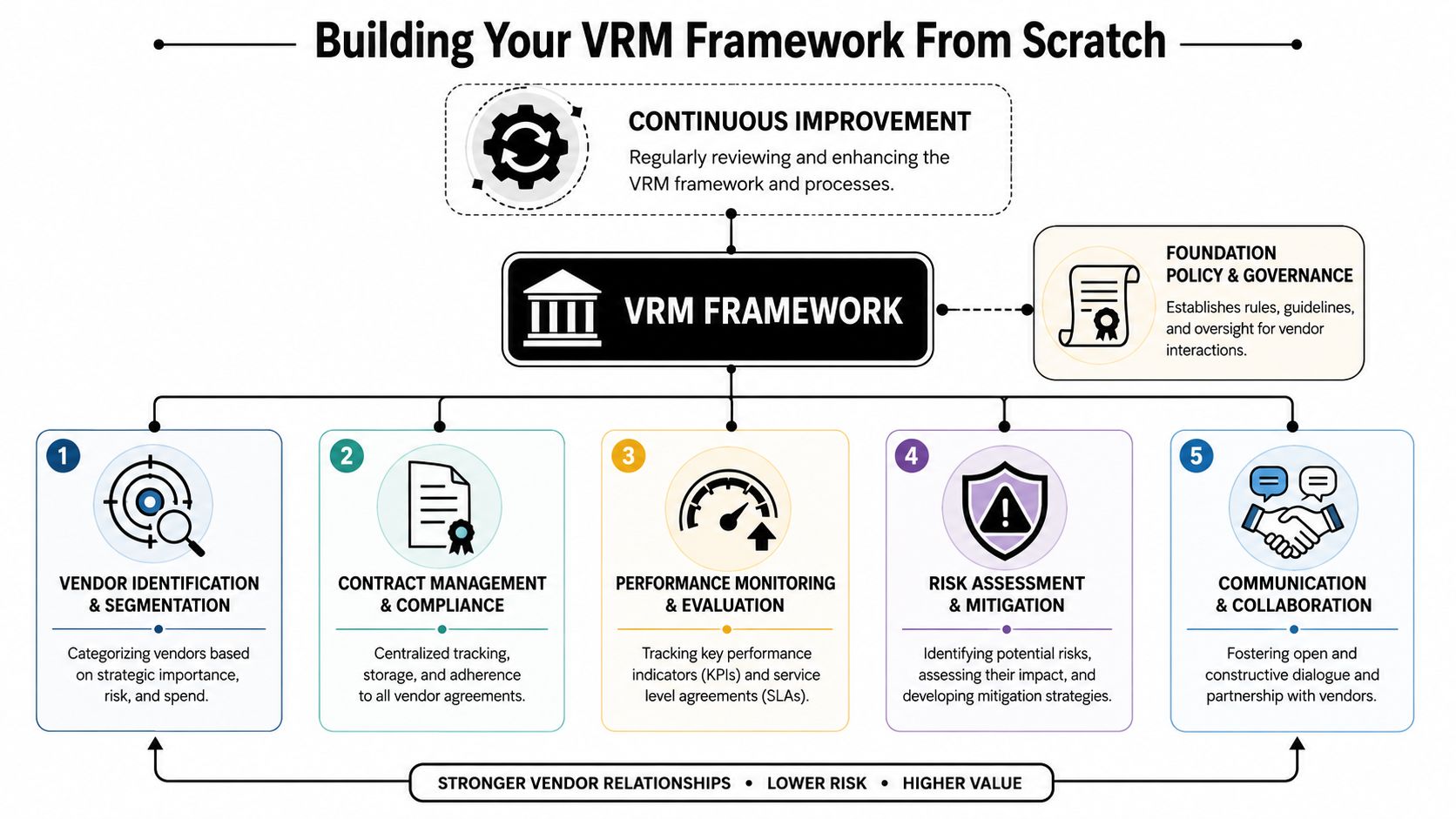
Start with four operating priorities
In a specialised equipment business, I'd build vendor relationship management around four practical priorities.
- Risk mitigation. Focus on downtime, missing paperwork, poor support coverage, long lead times, and single-source exposure.
- Performance and quality. Check whether equipment arrives as specified, works reliably, and is supported with the right technical documentation.
- Cost optimisation. Look beyond unit price. Freight, delays, replacement cycles, training time, consumables, and support access all affect real cost.
- Strategic partnership. Reserve this for the small number of vendors whose products or expertise materially shape your service capability.
Those priorities help you avoid a common SME mistake. Teams often treat every vendor as equally important until something goes wrong. That wastes attention on low-impact suppliers and leaves critical relationships under-managed.
Keep the framework lightweight
Most small businesses don't need a policy manual full of procurement jargon. They need a shared record and a few repeatable rules.
A good basic framework includes:
| Element | What to record |
|---|---|
| Vendor type | Strategic, Important, or Transactional |
| Main dependency | Equipment, consumables, service, software, calibration, logistics |
| Key contacts | Sales, technical support, accounts, escalation contact |
| Core documents | Contract, warranty terms, certificates, support terms, compliance records |
| Review rhythm | Formal review, periodic check-in, or exception-only management |
Practical rule: If losing that supplier for a month would disrupt clinical work, research testing, or revenue delivery, the relationship needs active management.
The framework also needs a home. For a small team, that can be a shared spreadsheet, a structured drive folder, and a simple naming convention. If you already manage product operations or stock through linked internal processes, keep the supplier framework close to that workflow rather than creating a separate system no one opens. That matters more than sophistication.
For businesses handling specialist equipment, it often helps to align supplier records with the products you already track operationally, such as those listed in an exercise equipment online catalogue. The point isn't the storefront. It's the discipline of tying each supplier to the equipment families, accessories, and support obligations your team manages day to day.
The VRM Playbook Setting Up for Success
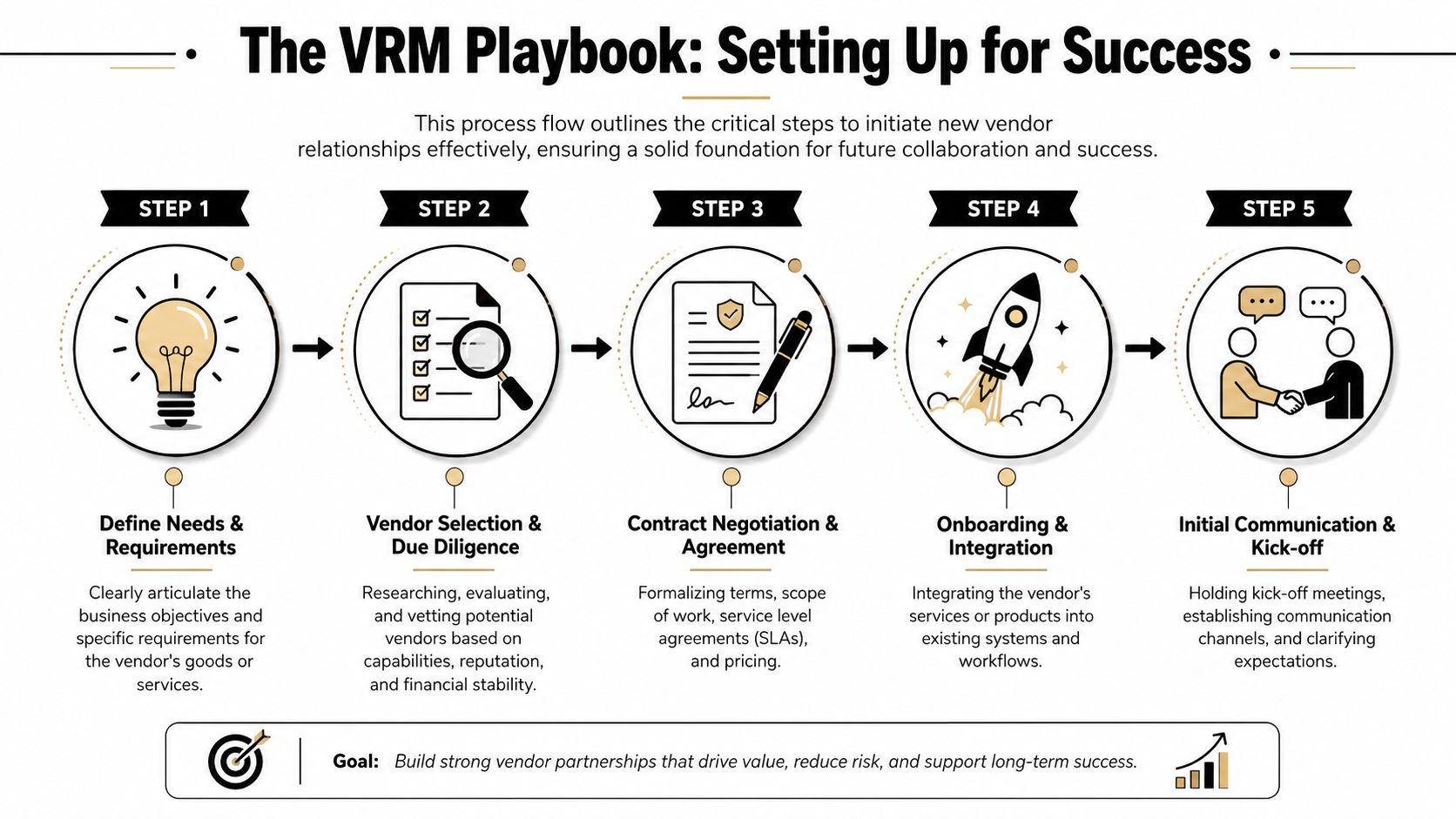
Most supplier problems don't start at renewal. They start at the beginning, when everybody assumes the basics are understood. One side thinks delivery means ready for use. The other thinks delivery means boxed product leaving a warehouse. One side assumes support includes troubleshooting. The other assumes support means email-only ticketing.
That's why setup matters. A lean team can't afford fuzzy expectations.
Early-stage setup is where a tiered governance approach pays off. A 2026 VRM ROI study found that segmenting suppliers by criticality and managing them accordingly can generate an average ROI of 731% through cost avoidance and reduction. For SMEs, the lesson isn't to build a massive governance engine. It's to put your effort where failure hurts most.
A simple visual helps anchor the workflow.
Segment vendors by operational impact
Use three labels. That's usually enough.
- Strategic. These suppliers support core service delivery or provide equipment that is difficult to replace quickly. A single-source BodyMetrix ultrasound supplier or a specialist Cosmed systems partner sits here.
- Important. These vendors matter, but disruption is manageable for a short period. Think recurring consumables, accessories, or non-exclusive technical services.
- Transactional. Standard items with easy alternatives belong here. Keep control, but don't waste management time.
The key is operational impact, not spend alone. A lower-value supplier can still be strategic if they support a critical process with long lead times or specific compliance needs.
Build a practical onboarding checklist
A purchase order isn't onboarding. It only starts the relationship. For specialised hardware, onboarding should capture the information your team will scramble for later if it isn't collected up front.
Use a checklist like this:
- Confirm scope clearly. Record exact product configuration, accessories, software components, country-specific power or plug requirements, and any installation dependencies.
- Store support contacts. Don't keep only the salesperson. Add technical support, returns contact, finance contact, and at least one escalation path.
- Collect compliance records. File certificates, user documentation, calibration information, warranty terms, and any service commitments relevant to your environment.
- Agree delivery definition. Clarify whether the order is considered complete on dispatch, arrival, installation, validation, or handover.
- Document first-response expectations. Support timing matters as much as shipping timing for critical kit.
For teams that learn better through examples, this walkthrough can help frame the setup mindset before you formalise it:
Choose KPIs and SLAs that reflect reality
Generic KPIs fail in specialist environments because they measure what's easy, not what matters. “On-time delivery” is useful, but it won't protect you if the equipment arrives without the right documentation, misses calibration requirements, or leaves users waiting on technical support.
For regulated or high-dependency vendors, good measures often include:
- Technical support responsiveness. How quickly does the supplier acknowledge and progress a genuine issue?
- Documentation completeness. Did the shipment include the records and instructions your team needs?
- Calibration status. Can the equipment be placed into service with confidence?
- Issue closure discipline. Does the vendor track root cause and corrective action, or just close tickets quickly?
- Replacement and returns handling. How straightforward is the process when something is faulty or incomplete?
A useful SLA is one your team will actually reference during a problem call. If nobody uses it, it's just contract decoration.
Keep the first draft short. Two or three meaningful service expectations are better than a long list no one monitors.
The VRM Playbook Managing Ongoing Performance
A supplier relationship becomes visible after the order is delivered. That's when you find out whether the vendor responds well under pressure, keeps records current, and spots issues before you have to raise them. Ongoing vendor relationship management is less about policing and more about maintaining operational readiness.
In specialised health-tech environments, generic review routines usually fall short. A compliance-centric approach is often necessary because supplier oversight may need to include ISO-related documentation, calibration traceability, and audit readiness, as highlighted in this report on health-tech VRM gaps. If your supplier supports equipment used in clinical assessments, research protocols, or validated testing, performance reviews need to reflect that reality.
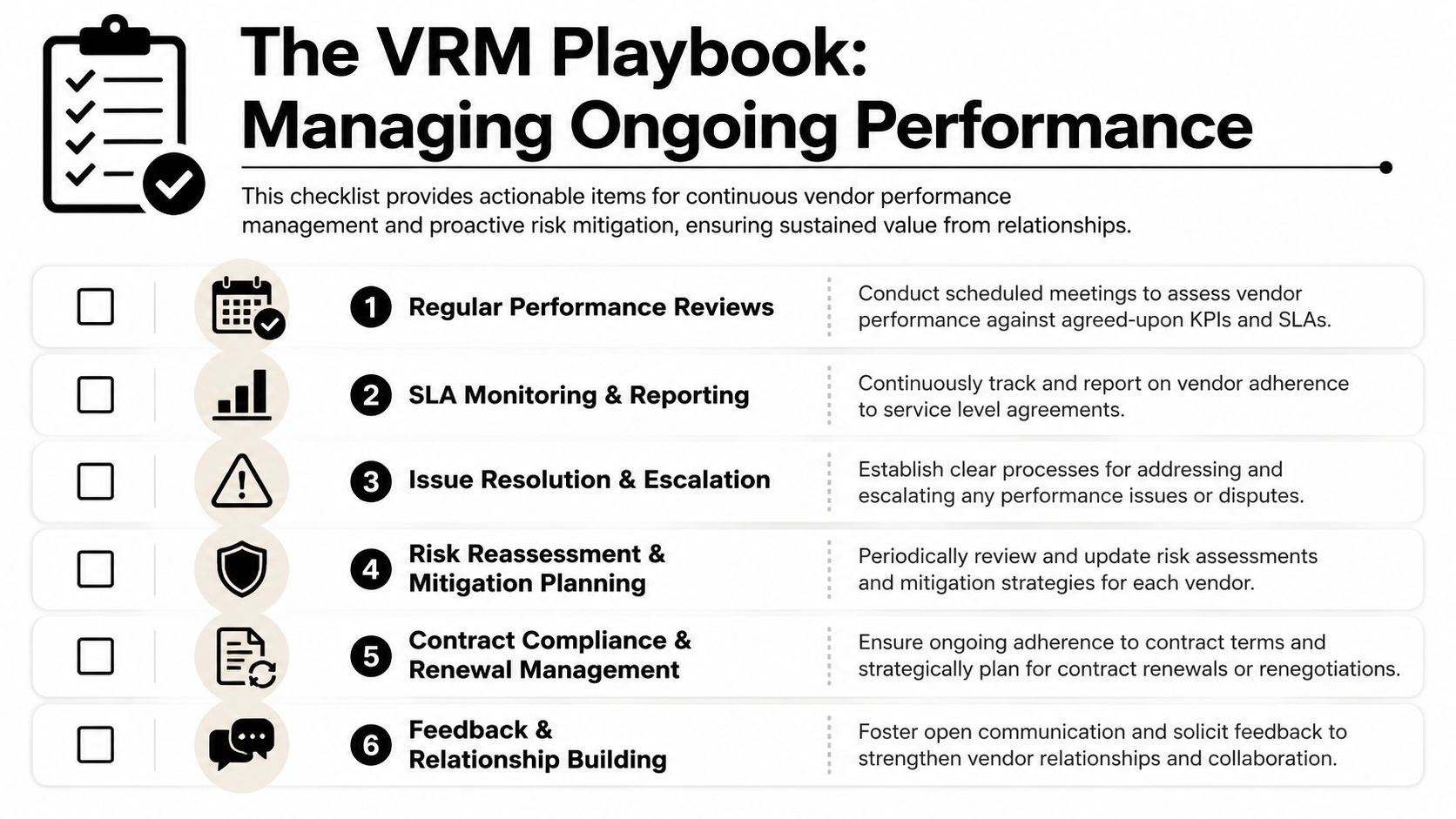
Use a scorecard that people will actually update
For most SMEs, a scorecard doesn't need software at the start. It needs discipline. One page per supplier is usually enough if the fields are chosen well.
A practical scorecard can include:
| Field | Why it matters |
|---|---|
| Recent orders and issues | Shows whether problems are isolated or recurring |
| SLA observations | Tracks response, resolution, and service consistency |
| Documentation status | Flags missing certificates, manuals, or support records |
| Calibration and service dates | Prevents silent non-compliance |
| Risk notes | Records dependency concerns, recurring delays, or support weaknesses |
| Next review action | Forces a decision instead of passive monitoring |
The score should support conversation, not replace judgment. If a supplier had one difficult month because of a known logistics issue but communicated clearly and fixed the problem, that's different from repeated silence and vague answers.
Review cadence should match vendor criticality
Strategic suppliers deserve a more formal review rhythm. Important suppliers usually need lighter check-ins. Transactional ones can often be managed by exception.
For a Quarterly Business Review with a strategic supplier, use an agenda like this:
- Open issues. What remains unresolved, and what's the root cause?
- Service performance. Were support, lead times, and documentation good enough?
- Operational changes. Any product revisions, software updates, logistics changes, or service model changes?
- Forward risks. Are there supply constraints, planned discontinuations, or support dependencies on the horizon?
- Actions and owners. Every decision should leave with a named owner.
For an Important supplier, a shorter monthly or periodic check-in often works:
- recent orders
- delivery problems
- documentation gaps
- next expected demand
- any support concerns
The best review meeting is boring. If it turns into a crisis meeting every time, the relationship is being managed too late.
Treat compliance and calibration as live obligations
This is where many general vendor guides miss the mark. In specialist equipment, compliance is not a folder you update once at purchase. It's a moving obligation tied to service intervals, calibration validity, software changes, and document control.
Build one simple register that tracks:
- Equipment linked to supplier
- Latest calibration or validation record
- Next due date
- Relevant certificates or quality documents
- Software or firmware update status
- Named internal owner
If your team already works within a documented quality process, align the supplier review with that system rather than duplicating it. A resource on medical device quality assurance can help frame what “current and traceable” should look like for equipment records and supporting documentation.
When issues appear, use a clear escalation path. Start with the operational contact, move to technical support, then escalate commercially or manager-to-manager if deadlines slip or root cause remains unclear. The mistake many small teams make is escalating emotionally rather than structurally. A written trail with dates, issue description, expected action, and agreed deadline solves more problems than a long frustrated email thread.
Tools and Systems to Support Your VRM Strategy
A lot of smaller firms stay stuck because they think the only choices are chaos or expensive software. In practice, there's a middle ground. The right tool is the one your team will keep current without turning vendor management into a second job.
The bigger danger is over-reliance on manual chasing. A 2026 procurement automation benchmark found that 85% of procurement teams rely on manual processes, causing a 25% delay in identifying underperforming suppliers, while automated tracking delivers a 60% higher rate of operational efficiency. Even if you're not ready for dedicated VRM software, that's a clear warning against inbox-only management.
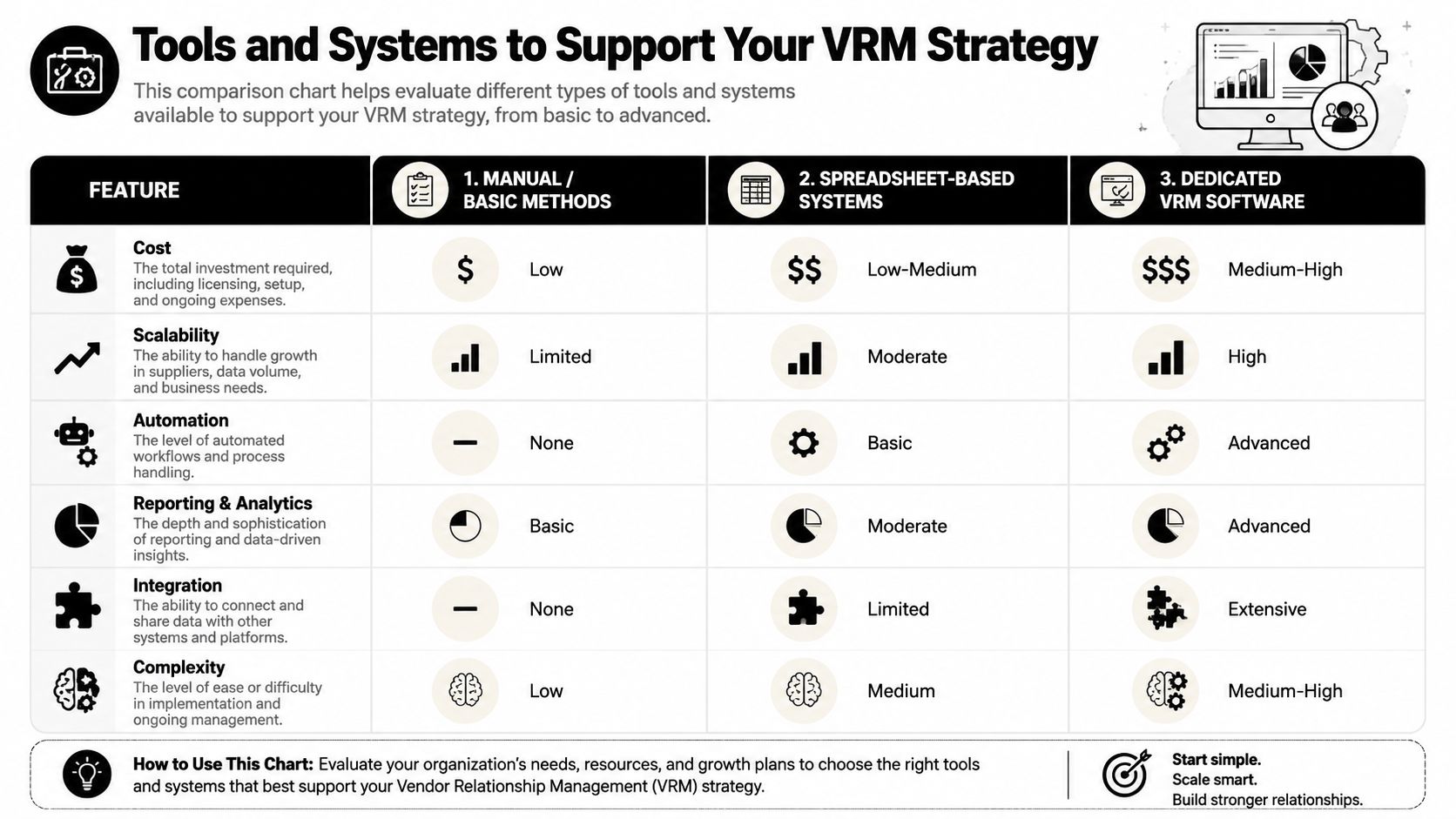
When a spreadsheet is enough
A shared spreadsheet works well when:
- You have a limited vendor base. The team knows the suppliers and can review them quickly.
- Your process is still stabilising. You're deciding what to track before investing in software.
- You need flexibility. It's easy to add fields for lead time, support response, calibration status, or document expiry.
The weakness is consistency. Spreadsheets drift when ownership is vague. Solve that by assigning one person to maintain supplier records and one recurring review date.
When basic workflow tools help
Tools like Trello, Asana, or a shared task platform can improve follow-through without becoming a full procurement system. They're useful when the main problem isn't lack of data, but dropped actions.
Use them for:
- Renewal reminders
- Calibration follow-ups
- Document chase lists
- Escalation tasks
- Review meeting actions
This setup is often enough for product-led SMEs because it connects supplier management to normal operational work. If the team already uses project boards, keep VRM in that environment.
A practical example is linking supplier records to the product categories your team already monitors for demand, servicing, or customer support, such as health monitoring devices. That link makes supplier information useful to operations rather than buried in a separate admin file.
When dedicated software makes sense
Dedicated VRM or procurement tools become more attractive when supplier count rises, documentation obligations multiply, or several people need access to the same live record. They're also worth considering when you need stronger reporting, structured approvals, or automated reminders across many contracts and service dates.
Choose software only after you've stabilised your process. Otherwise, you'll digitise confusion.
Here's a simple way to decide:
| Situation | Best fit |
|---|---|
| Few critical suppliers, lean team | Spreadsheet plus shared folders |
| Multiple recurring actions, missed follow-ups | Spreadsheet plus workflow tool |
| Large vendor base, frequent audits, many owners | Dedicated VRM platform |
Buy software to support a working process, not to invent one for you.
Turning Key Suppliers into Strategic Partners
The end goal isn't tighter control for its own sake. It's a supplier base that helps you stay reliable under real operating pressure. That only happens when you move beyond reactive purchasing and start managing a few critical relationships with intent.
Partnership starts with simple habits. Segment suppliers properly. Onboard them with the right records and contacts. Define a small set of meaningful service expectations. Review performance before issues pile up. Then treat recurring conversations as part of operations, not a side task you remember after a problem.
What partnership looks like in practice
A strategic supplier behaves differently from a basic vendor. They tell you about lead-time changes early. They help you think through compatibility, servicing, training, or replacement planning. They respond with context rather than scripted replies. When a problem occurs, they work the issue with you instead of defending themselves immediately.
That kind of relationship is especially valuable in specialist sectors where single-source products, regulated workflows, and technical dependencies create real exposure. If you're also thinking about broader resilience planning, this guide to mitigating supply chain disruption is worth reading because it complements vendor management with a wider risk lens.
Start with one critical supplier
Don't try to formalise every supplier this month. Start with the one relationship that would hurt most if it failed. Build a one-page scorecard. Put support contacts in one place. Confirm documentation. Schedule a review call with a real agenda. That's enough to shift from reactive buying to active vendor relationship management.
Small businesses usually don't need more complexity. They need more clarity.
If you need reliable, specialist health and fitness testing equipment backed by practical product knowledge, Cartwright Fitness is a strong place to start. As a family-run business focused on validated testing tools, body composition systems, metabolic analysers, and related support, they understand the operational realities behind choosing and managing critical suppliers.