
You're standing at the table, the feed starts, and someone says, “That was a let, right?” Another player calls it a fault, the coach says the receive was late, and the whole point of the rally gets lost in the argument. That's where table tennis terms matter most, not as glossary filler, but as the language that keeps coaching, officiating, and match analysis clean and usable.
The sport's vocabulary didn't appear by accident. The term table tennis emerged in late-19th-century England, the game was formalized with the ITTF in 1926, and Olympic inclusion in 1988 helped lock in consistent terminology across countries and competition levels, with “table tennis” as the formal sporting term and “ping-pong” staying more recreational or commercial in tone ITTF history of table tennis. That shift matters because coaches, officials, and practitioners need the same words to mean the same thing, whether they're discussing spin, serve legality, or scoring under pressure.
Table of Contents
- Introduction to Table Tennis Terms
- Key Categories of Table Tennis Terms
- Basic Stroke Terms Explained
- Spin and Ball Contact Terms Explained
- Scoring and Serve Term Definitions
- Advanced Tactical and Equipment Terms
- Common Mistakes in Using Table Tennis Terms
- Coaching Examples Illustrated
- Cross References and Related Term Links
- Quick Reference Glossary Table
Introduction to Table Tennis Terms
A player steps into a club session and hears three different cues for the same ball. One coach says “push,” another says “soft backspin receive,” and a teammate says “work the spin.” The problem is not the movement. It is the vocabulary. Table tennis developed from a casual parlour game in late-19th-century England into a formal international sport governed by the ITTF and recognized at the Olympics ITTF history of table tennis, so the language had to become precise.
Why the wording has to be exact
In training, one loose word changes the drill. If an athlete hears “rally” but the coach means a controlled exchange with two or three planned contacts, the session loses its target. If a match report says “spin” without saying whether it is topspin, backspin, or sidespin, the next correction becomes guesswork.
That is why serve, rally, spin, forehand, and backhand need shared meanings across practice groups and competition settings. Coaches also need those terms to match the way skills are trained. Open skills and closed skills help explain that difference, because some table tennis actions happen in predictable patterns while others depend on live ball response, and the terminology should match the drill being used open skills vs closed skills.
Practical rule: if a term can mean two different things in the same session, it is too vague for coaching.
The best habit is simple. Say the formal term first, then add the coaching cue. “Short push,” “deep counter,” and “heavy topspin” tell the player what the ball is doing and what response is expected. That keeps the language accurate and makes it usable on the table.
Key Categories of Table Tennis Terms
A coach watching a session rarely needs every table tennis term at once. The useful move is to sort the language by what it helps you do on the table, because the words change depending on whether you are checking stroke shape, ball flight, movement, tactics, or equipment. That is also why the same term can matter differently in an open rally than in a fixed feeding drill, where the response is more predictable and the coaching cue has to match the drill design comparison of open skills vs closed skills.
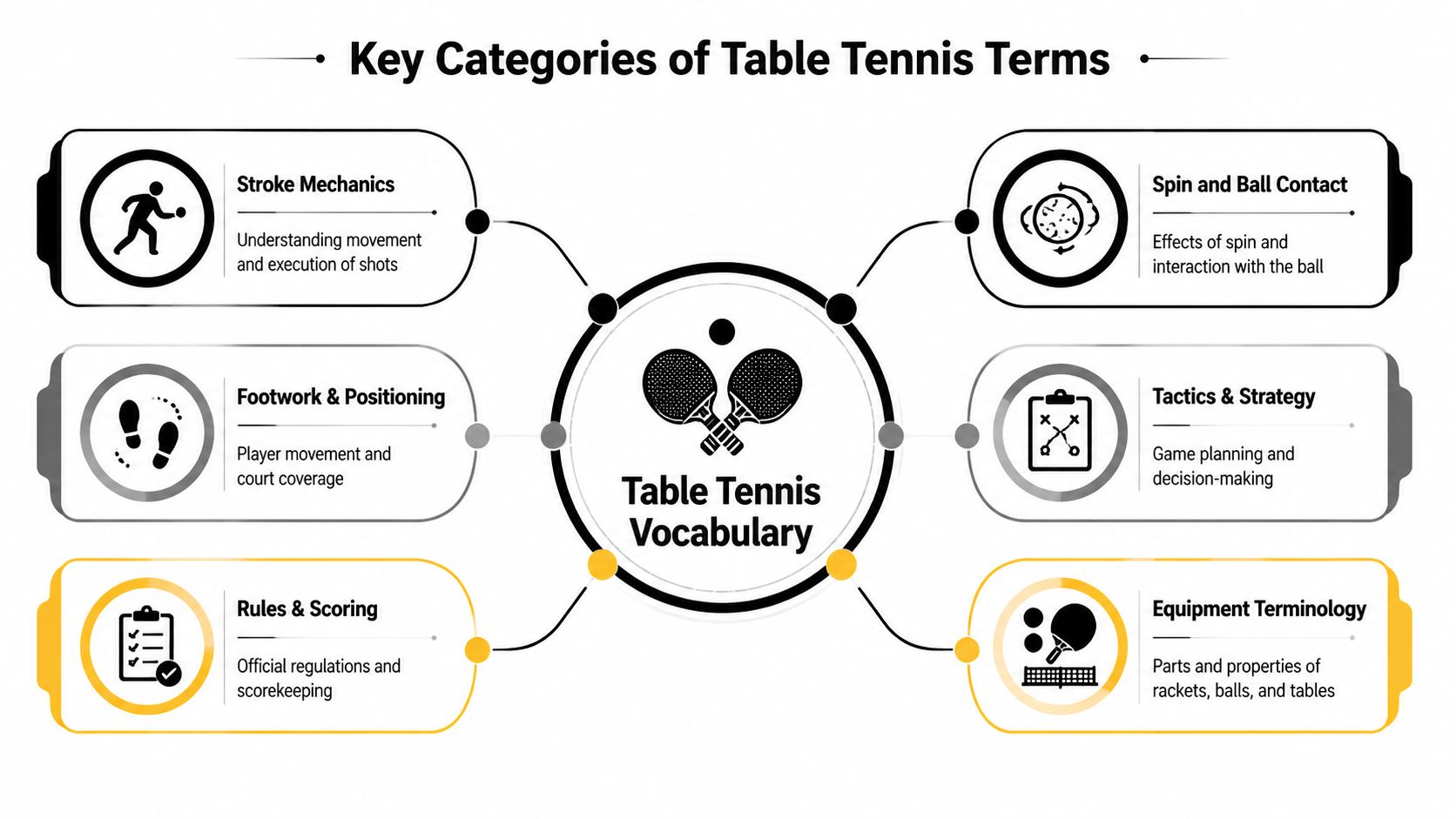
The working taxonomy coaches actually use
A practical framework looks like this.
- Stroke mechanics. Words such as forehand, backhand, push, block, lob, and smash describe the body action, contact point, and recovery pattern.
- Spin and ball contact. Terms such as topspin, backspin, sidespin, dwell time, and heavy spin describe how the ball behaves off the racket.
- Footwork and positioning. These words cover recovery, stance, crossover, and court coverage, which shape how well a player arrives balanced.
- Tactics and strategy. Terms such as third-ball attack, transition play, placement, and tempo guide decision-making during the rally.
- Equipment terminology. Blade, sponge, rubbers, hardness, and stiffness matter when players compare setups, because each change alters feel and response.
- Rules and scoring. Game, match, let, fault, legal point, and service fault shape how the rally is judged and what counts on the scoreboard.
That structure is useful beyond conversation. It gives coaches a clean way to tag video, write session notes, and choose drill progressions without mixing up the problem. A stroke issue should be recorded as a stroke issue, not disguised as a footwork fault when the player struck the ball late.
Why this structure works in practice
The categories connect, but they do not describe the same problem. A player's stroke mechanics change the spin, the spin changes the receiver's response, and that response changes the next tactical choice. Equipment changes can alter all of that, which is why the language has to stay separated long enough to show where the error starts.
That separation matters in coaching because it keeps correction specific. If a player misses a short receive, the fix might be touch quality, racket angle, or starting position, depending on which category is really failing. A player who understands the terms can also describe the miss more accurately, which shortens the gap between observation and correction.
Good vocabulary does not just label play, it isolates the variable you need to fix.
Basic Stroke Terms Explained
The stroke words are the ones players use most, but they're also the easiest to blur together. A coach who says “take it earlier” may mean a more forward contact point on the forehand, while another coach may be trying to clean up balance during the backhand. Precision matters because each term points to a different body shape, racket path, and recovery pattern.
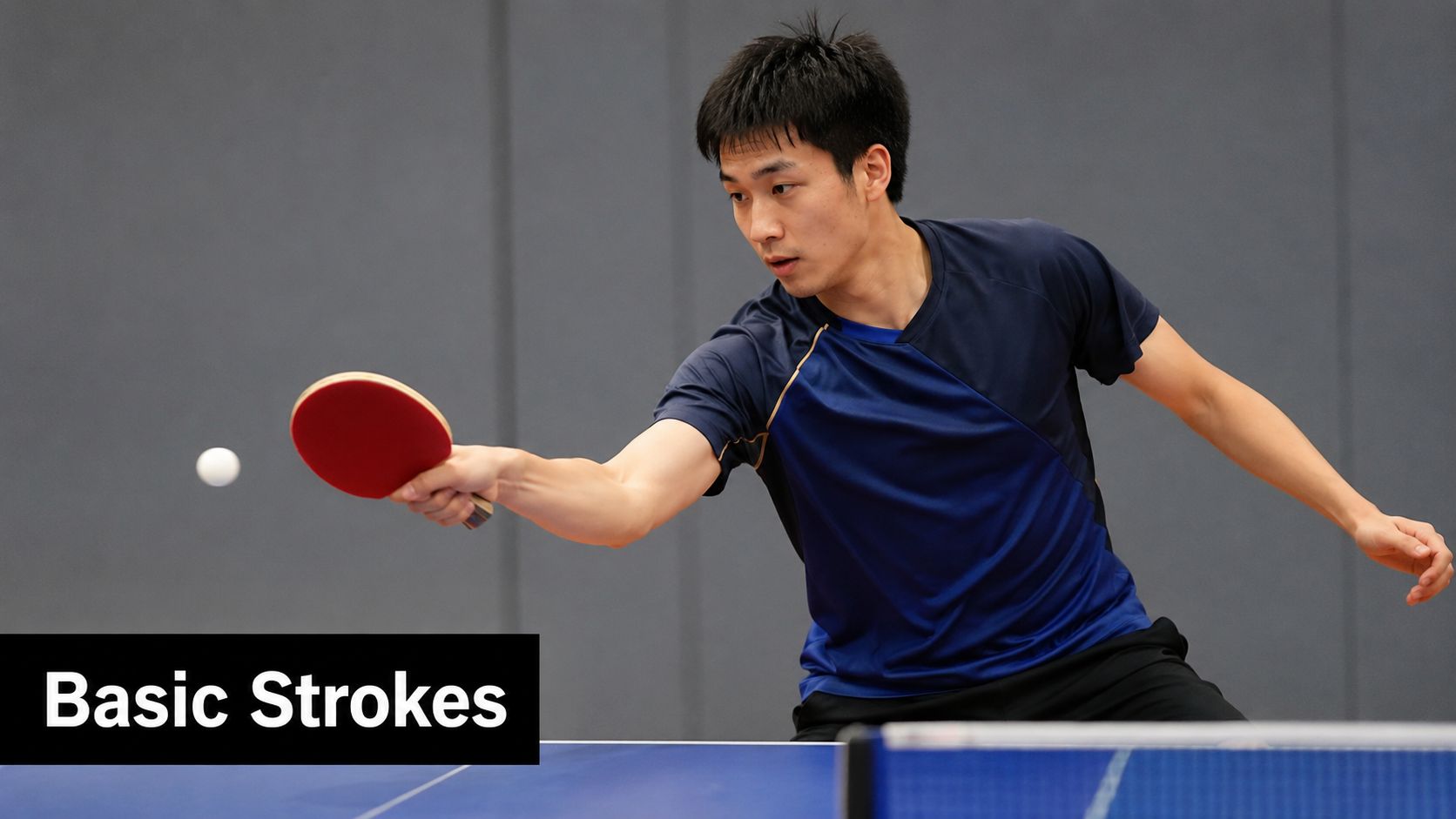
Forehand, backhand, push, block, lob, smash
Forehand usually means the stroke played on the dominant side of the body, using more trunk rotation and often more available power. Backhand is the opposite side, where compact mechanics and quick preparation matter more. In coaching, that difference helps explain why one player can drive a forehand well but still struggle to create clean backhand pressure.
Push is a controlled, usually underspin-oriented touch shot used near the table. It's valuable in serve receive because it keeps the ball low and can force a higher-quality next ball from the opponent. Block is the shorter, more compact defensive reply against topspin, often used to redirect pace instead of generating it.
Lob is a higher defensive return, usually deeper and more arcing, while smash is the aggressive overhead finishing shot. Those two terms sit at opposite ends of the control-power spectrum. A lob buys time and disrupts rhythm, while a smash ends a loose ball quickly.
How to coach the strokes without overcomplicating them
Use one cue per stroke phase. For forehand, that might be “load, rotate, finish.” For backhand, “compact, forward, recover” often works better than a long technical speech. On push and block drills, reward balance and racket angle before speed.
A useful session script is:
- Forehand loop drill: feed one controlled ball, ask for shape and balance first, then increase tempo.
- Backhand block drill: alternate topspin feeds and ask for stable angle, not a bigger swing.
- Push exchange: keep the ball short and low, then add one cue about spin quality.
- Smash practice: only train it when the ball is clearly high enough, otherwise players start swinging at mediocre opportunities.
The video below is useful if you want a visual reminder of how stroke timing and body position change across contact types.
Spin and Ball Contact Terms Explained
A missed read on spin usually shows up in the first two contacts. The ball looks ordinary off the opponent's racket, then dives, kicks, or drifts once it lands. Coaches care about these terms because they describe how contact changes the next ball, not just how the shot looks in the air. Spin, net clearance, and placement accuracy all shape that outcome.
Topspin, backspin, sidespin, corkspin
Topspin makes the ball dip more sharply after contact and lets a player swing with more margin while still keeping the ball on the table. It is the safest spin for aggressive rally play because the forward rotation helps the ball clear the net and drop back down. The trade-off is simple, if the brushing contact is too thin, the ball can sail long or lose pace.
Backspin does the opposite, slowing the forward travel and keeping the ball lower after the bounce. Coaches use it in pushes, chops, and short receive work because it forces the opponent to lift the ball before they can attack. The pitfall is equally clear, a player who misjudges the underside contact can leave the ball sitting up for an easy counter.
Sidespin changes the ball's sideways movement, which matters most on serves, angled receives, and disguise. It can pull a returner off line even when the ball does not look especially fast. In drills, I watch whether the player can still place the ball after adding sidespin, because extra rotation without control usually hurts more than it helps.
Corkspin is used less often in everyday coaching language, but it describes a spin axis that mixes vertical and horizontal rotation. Players do not need the label to hit the shot, yet the term helps when the ball behaves in a way that pure topspin or backspin does not explain cleanly. For coaching, the practical question is always the same, what did the ball do after the bounce, and did the receiver have to change the racket face to handle it?
Dwell time, dead ball, heavy spin
Dwell time is the moment the ball stays on the racket before release. A contact that feels longer can help a player shape spin and manage arc, while a shorter contact rewards direct timing and a cleaner strike. That trade-off shows up fast in training, because players who try to force spin with a very brief contact often dump the ball into the net.
A dead ball carries very little spin. It can be effective because it strips away the usual read that a receiver expects, especially on touch shots and short exchanges. The downside is that it gives the hitter less margin, so any small error in angle or depth is easier to punish.
Heavy spin is the opposite case, where the rotation is strong enough to change the receiver's decision before the ball even arrives. It matters most when a player wants to force a weaker return or create an awkward first attack. If the opponent keeps adjusting the racket angle late, the spin read is still not stable.
If the receiver's racket angle keeps changing, the spin problem is probably not solved yet.
Teaching spin with feedback, not guesswork
The cleanest way to coach spin is to check the ball in three places. First, listen to the contact and watch the arc. Second, watch the bounce on the other side of the table. Third, ask the receiver what they felt. That gives a usable read on the spin before video or sensors enter the picture.
For spin-reception work, alternate light and heavy feeds so the athlete has to read the ball instead of memorizing a pattern. For generation work, keep the feed consistent and change only the brushing action. In a drill like that, the term has to match the ball's actual behavior. If it does not, the player is rehearsing intention, not skill.
Scoring and Serve Term Definitions
The scoring vocabulary is where many match arguments begin, because players often use the same words for different situations. In official play, a game goes to 11 points, and a player or pair has to lead by 2 points once the score reaches 10-10 11-point win-by-two rule. That one rule shapes pacing, serve choice, and how coaches design pressure drills.
Game, set, match, let, fault
A game is one scoring unit. A match is made up of games. A set is commonly used in casual conversation to mean a game or a sequence of games, but coaches should stay consistent with the event format they're using so no one confuses the scoring layer.
A let is a rally that doesn't count and is replayed under the rules. A fault is a service or play error that ends the point immediately for the opponent. The biggest coaching mistake is treating those as interchangeable labels. They're not, and the difference matters when a player is under pressure and needs to know whether to reset or accept the point outcome.
Service mechanics that affect training
The serve is more than a start signal. The service toss, contact point, and intended service point all influence legality, deception, and the quality of the first attack or receive. A legal and repeatable serve also changes how you sequence drills, because a good serve can be practiced as a skill in its own right instead of being treated like a throwaway start.
Pressure drills should reflect the 11-point, win-by-two structure. Once the score gets tight, the first ball after serve becomes more valuable, so serve-receive patterns and third-ball intent need to be trained with that late-game reality in mind. Players don't just need to know the words, they need to know what those words demand when the score is close.
Tight-score practice should punish lazy serve-receive decisions, not just missed serves.
Advanced Tactical and Equipment Terms
Advanced terminology is where match patterns and equipment choices start to overlap. A player can use the right tactic with the wrong setup and still lose the battle for control. That's why terms like tempo, transition play, third-ball attack, blade stiffness, and sponge hardness need to be understood together, not in separate silos.
Tactical terms that shape rally planning
Third-ball attack refers to winning initiative on the ball after your serve, usually by setting up a predictable reply and then attacking it. Transition play is the move from one phase to another, such as defense into attack or passive receive into counter-looping. Tempo is the rhythm you impose on the exchange, and it's one of the most underrated match terms because players often confuse pace with tempo.
These ideas matter in video review. If a player keeps losing the third ball, the issue may be the serve, the receive, or the delayed recovery after serve. Using the right term helps you isolate which layer failed.
Equipment terms that coaches should use precisely
A blade is the wooden or composite core of the racket. Sponge hardness and blade stiffness change how the racket feels at impact and how quickly it responds under pressure. Dwell time also matters here, because it connects feel to contact quality, which is why equipment talk should stay tied to observed ball behavior rather than brand mythology.
If a player is comparing gear, keep the conversation around structure and use, not hype. That same mindset is why many players prefer to keep blade identity stable while adjusting rubbers first, because it makes the change easier to interpret. If you want a broader equipment reference, the sports ball sizes guide is a useful way to think about measurement discipline across sports.
The coaching trade-off
Harder, more demanding setups can reward committed technique, but they can also punish players who don't yet produce clean contact. Softer, easier setups can create comfort, but they may hide technical leaks. The right terminology helps you explain that trade-off without turning the discussion into brand loyalty.
Common Mistakes in Using Table Tennis Terms
Most mistakes in this area aren't about ignorance. They happen because players borrow casual language from club culture and then use it in match situations where the rules need cleaner wording. Coverage online often stays at glossary level and rarely clarifies the rule-adjacent questions that confuse players in real matches, especially around serve faults and point legality table tennis lingo coverage gap.
The errors that create the most confusion
One common mistake is calling every awkward serve return a let. Another is using backspin and underspin as if they're always different things, when in coaching conversation they're often being used to describe the same general ball action from different angles. A third is calling something a fault when the point was a legal rally and the shot missed the table.
The label ping-pong is another trap. It's fine in casual settings, but competitive coaching needs the formal sporting language because that's the language shared by officials, event materials, and research contexts. If your group mixes the two without clear boundaries, the result is usually sloppy feedback.
How to correct the language fast
Use the correction immediately, but keep it short.
- Say the correct rule term first. “That was a fault,” or “That was a let.”
- Attach the action second. “The serve didn't clear the net cleanly,” or “The replay is because of interference.”
- Repeat the same label in practice. Don't alternate between three near-synonyms if you want the athlete to learn one stable concept.
- Coach the outcome, not the story. Focus on what the ball did, then what the rule call means.
The fastest way to clean this up is consistency across coaches. If one coach says “net ball” and another says “let,” players waste mental energy translating instead of training.
Coaching Examples Illustrated
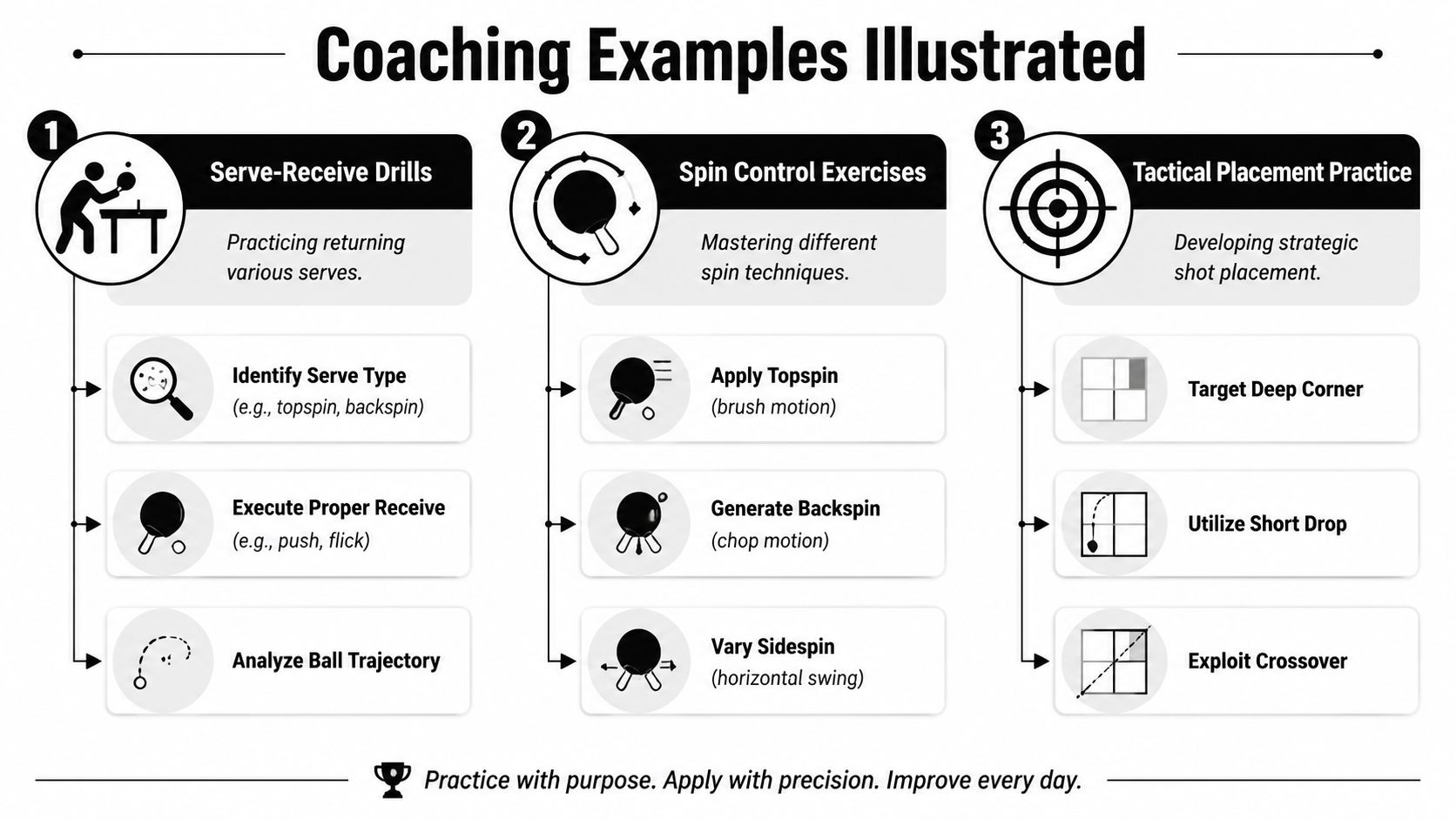
A player can know the vocabulary and still not use it well under speed. That's why session scripts matter. They turn abstract terms into repeatable actions, and they let you coach the same words through serve-receive, spin control, and placement work without drifting into vague chatter.
Serve receive drills that teach decision making
Start with a fixed serve pattern. The objective is to train the player to identify topspin, backspin, or a shorter no-spin ball and choose the correct receive, such as push, flick, or controlled block. The coach should call the serve type out loud during the first round, then remove the call so the athlete has to read it.
Common errors show up quickly. Players often overreach on short serves, open the racket too much on backspin, or overhit a flick because they're rushing the first touch. The correction language should stay short. “Shorter angle,” “softer hand,” and “hold the line” are better than a long technical lecture in the middle of the drill.
A good addition for younger athletes or beginners is private one-on-one work, especially when the player needs calm repetition before the terms become automatic. A resource like private sports coaching for youth fits well here because individual sessions make it easier to connect the word, the ball, and the movement without group noise.
Spin control exercises that sharpen contact quality
Use a topspin-to-backspin progression. One player brushes up for topspin, then changes only the racket path to produce backspin, then alters the horizontal path for sidespin. The point isn't to chase speed, it's to make the term match the visible ball flight and bounce.
The main error is trying to create too much effect too early. Athletes often swing harder when they need better contact. That's where structured feedback helps. If the ball isn't kicking after the bounce, the issue is probably contact, not effort.
Tactical placement practice that links words to targets
Set up three landing zones, deep corner, short drop, and crossover pressure. Ask the player to name the target before each shot. That keeps the term tied to intention and prevents random placement work that looks busy but teaches very little.
One practical way to coach this is to compare two rallies. In the first, the player just hits to a zone. In the second, they must say the tactic aloud, such as “deep corner to open the next ball.” That simple language shift helps athletes connect placement with the next phase of the rally.
The next tool I'd add here is reaction-time language, because tactical decisions are never just about shot choice. The reaction-time definition in fitness gives a clean model for how fast perception and response have to work together in live play.
Cross References and Related Term Links
A good table tennis terms glossary works best when each term points to the next decision on the table. A word like topspin leads straight into third-ball attack, because the amount of spin changes how early a player can step in and finish the point. Dwell time links to blade stiffness for the same reason, since racket feel changes how much contact control the player can shape at the moment of impact.
How the terms connect across play
A legal point depends on more than putting the ball on the table. The opponent must fail to return it correctly over the net or commit an infringement, so spin, net clearance, and placement accuracy all affect scoring legal point explanation. That connection matters in match review, because the point is often decided by the quality of the earlier contact, not by the final swing.
Serve language and tactical language are tied together as well. A short serve is not just a serve description, it often sets up the receive pattern that follows. A heavy backspin push is not only a defensive shot, it can force a weaker lift or create a ball that is easier to attack on the next stroke.
Good places to go deeper
Use official rule references when the question is legality. Use stroke and spin video when the issue is contact quality. Use equipment notes when the player's feel changes after a gear adjustment. Mixing all three into one sentence leaves the athlete with a fuzzy target and very little to correct.
If you can't name the layer that failed, you can't fix the layer that failed.
That is why a glossary works best as a network, not a list. Each term points to another term, and each one narrows the coaching problem until the next drill becomes obvious.
Quick Reference Glossary Table
Use this as a fast lookup during coaching, video review, or match prep. The definitions stay short on purpose, because the goal is to keep the language consistent and immediately usable.
| Term | Definition | Category |
|---|---|---|
| Backhand | Stroke played on the non-dominant side of the body | Stroke Mechanics |
| Block | Compact return used to redirect topspin | Stroke Mechanics |
| Blade | Core of the racket | Equipment Terminology |
| Corkspin | Unusual spin axis mixing vertical and horizontal rotation | Spin and Ball Contact |
| Dead Ball | Shot with minimal spin | Spin and Ball Contact |
| Dwell Time | Time the ball stays on the racket during contact | Spin and Ball Contact |
| Fault | Service or play error that ends the point | Rules and Scoring |
| Forehand | Stroke played on the dominant side of the body | Stroke Mechanics |
| Game | Scoring unit played to 11 points | Rules and Scoring |
| Heavy Spin | Strong rotation that changes the next contact | Spin and Ball Contact |
| Let | Rally replayed without a point counted | Rules and Scoring |
| Lob | High defensive return | Stroke Mechanics |
| Match | Full contest made up of games | Rules and Scoring |
| Push | Controlled short return, often with backspin | Stroke Mechanics |
| Rally | Sequence of ball exchanges after serve | Rules and Scoring |
| Smash | Aggressive finishing overhead shot | Stroke Mechanics |
| Sidespin | Rotation that moves the ball sideways | Spin and Ball Contact |
| Sponge Hardness | Feel and firmness of the rubber sponge | Equipment Terminology |
| Stiffness | Resistance of the blade to bending | Equipment Terminology |
| Serve | Initial stroke that starts the point | Rules and Scoring |
| Topspin | Forward rotation that helps the ball dip | Spin and Ball Contact |
| Third-Ball Attack | Attack made on the third ball after serve | Tactics and Strategy |
| Transition Play | Shift from one rally phase to another | Tactics and Strategy |
| Win by Two | Rule requiring a two-point lead at 10-10 | Rules and Scoring |
Use the table as a live coaching script, not as a memorization exercise. If a player can explain the term, show it, and apply it in one drill, the language is doing its job.
If you're building a coaching system, tighten the vocabulary first, then use it to clean up your drills, your video notes, and your match reviews. For a practical next step, visit Cartwright Fitness and use their assessment and testing resources to keep your performance language as precise as the training you're trying to improve.