

You're probably dealing with this already. A client looks perfect in a controlled drill, then falls apart the moment you add an opponent, a time limit, or even a second task. Another client can produce a clean squat in the clinic, yet struggles to organise the same lower-limb control when attention shifts to catching a ball or changing direction.
That gap isn't just about strength, mobility, or motivation. It's often a skill-classification problem. If the task demand is open and your training has been almost entirely closed, transfer will be limited. If the task is closed and you keep adding chaos too early, technique quality often degrades before the learner has a stable solution.
For coaches, physios, and sports scientists, open skills vs closed skills is useful only when it changes how you assess, cue, load, and progress drills. The practical value sits in one question: how predictable is the environment, and how much adaptation does the performer need in real time?
Table of Contents
- From Predictable to Dynamic The Core of Skill Mastery
- Rethinking the Model The Skill Classification Continuum
- Comparing Open vs Closed Skills Key Characteristics
- Practical Examples in Sport and Clinical Rehabilitation
- Evidence-Based Principles for Skill Training
- How to Design and Progress Your Drills
- Integrating Skill Assessment into Client Progression
From Predictable to Dynamic The Core of Skill Mastery
A max-effort deadlift and a point guard breaking a full-court press don't ask the nervous system to solve the same problem. The deadlift happens in a largely stable environment. The athlete can set stance, brace, grip, and timing before the bar leaves the floor. The point guard has no such luxury. Space changes, defenders close angles, teammates move, and the movement solution has to update continuously.
That difference sits at the centre of open skills vs closed skills. Closed skills happen in environments that are relatively stable and predictable. Open skills happen in environments that shift, forcing perception, decision-making, and movement adjustment during the task itself.
Why this matters in day-to-day practice
If you coach both tasks the same way, you usually get one of two errors. You either overload the learner with variability before they can organise a repeatable movement pattern, or you keep training a polished drill that never prepares them for the demands of performance.
A useful way to frame it is this:
- Closed tasks reward consistency: stable set-up, repeatable timing, and refinement of a specific motor solution.
- Open tasks reward adaptability: reading cues, selecting responses, and adjusting movement under pressure.
- Most real programmes need both: even highly dynamic sports contain moments of stability, and rehab often needs a path from control to adaptability.
Practical rule: Match the training environment to the real performance environment, then adjust one step up or down based on the learner's current capacity.
Coordination is often where this becomes visible first. A client may look strong enough, mobile enough, and pain-free enough, but still fail when task timing and environmental demands increase. That's why a working understanding of coordination in movement performance is tied so closely to skill classification.
The coaching problem
Most professionals don't need another textbook definition. They need a cleaner way to decide when to simplify, when to add variability, and when a drill has become too detached from the target task to be worth keeping.
That decision starts by dropping the rigid binary.
Rethinking the Model The Skill Classification Continuum
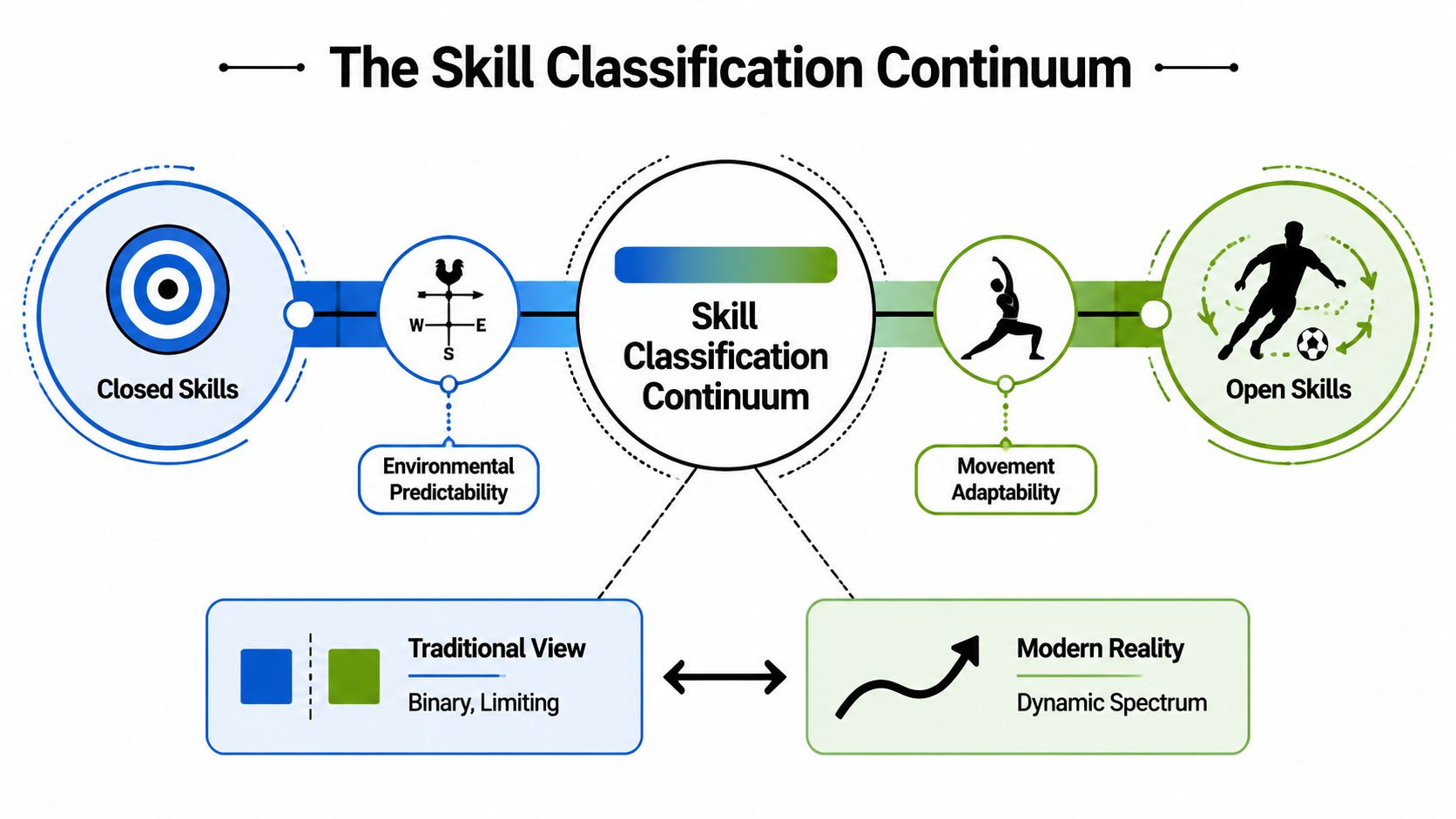
The common teaching model treats open and closed skills as separate boxes. It's tidy, easy to teach, and often too blunt to guide programming well. In practice, skills sit on a continuum of environmental predictability, not in a fixed either-or category.
A useful overlooked point from this discussion of skill classification continuums is that the same movement can shift category depending on context. A movement rehearsed in a stable drill may function like a closed skill. The same movement in competition can become much more open because the performer must respond to opponents, timing changes, and space constraints.
Two poles and a large middle ground
At one end, a highly closed task happens in a stable setting. The performer knows what's coming, when it's coming, and what movement pattern is required. Think of a controlled lifting pattern, a bowling release, or a seated rehab exercise with fixed tempo and position.
At the other end, a highly open task happens in an unstable setting. Information changes during execution. The athlete has to detect cues, pick a response, then reorganise movement quickly. A rugby phase, a tennis rally, or reactive court movement fits this end of the spectrum.
Most tasks live between those poles.
Why the continuum works better for coaches and clinicians
The continuum gives you something the binary model can't. It lets you manipulate the environment with precision.
If a single-leg landing drill is too difficult, you don't have to abandon the pattern. You can close it down by reducing speed, removing external distraction, fixing the landing target, or pre-planning the direction. If the drill is too easy, you can open it up with a visual cue, delayed instruction, an unpredictable feed, or live opposition.
Closed and open aren't fixed labels attached to exercises. They're descriptions of the relationship between the performer and the environment.
That framing changes progressions in a useful way:
- For beginners: you can keep the movement simple enough for success without pretending the end goal is purely technical repetition.
- For injured athletes: you can reintroduce uncertainty in layers instead of jumping from table-based exercises to unrestricted sport.
- For experienced performers: you can identify whether a plateau is technical, perceptual, or decisional.
The classification question that actually helps
When I assess a drill, I don't ask only, “What movement is this?” I ask:
- How stable is the environment?
- How much of the movement can be pre-planned?
- What perceptual information must the athlete use?
- How much adjustment is needed after movement initiation?
Those questions place the task on the continuum far more accurately than naming the sport. Football isn't solely an open-skill sport. Some football actions are tightly rehearsed and relatively closed. Others are highly reactive and very open.
That distinction is where good drill design starts.
Comparing Open vs Closed Skills Key Characteristics
Before building progressions, it helps to compare the two ends of the spectrum directly. The table below gives a practical reference point.
Open vs Closed Skill Characteristics
| Characteristic | Closed Skill | Open Skill |
|---|---|---|
| Environment | Stable and predictable | Variable and unpredictable |
| Pacing | Often internally paced | Often externally paced |
| Movement planning | Largely pre-planned | Continuously updated |
| Perceptual demand | Lower during execution | Higher during execution |
| Decision-making | Limited once movement starts | Ongoing throughout the task |
| Movement pattern | More consistent and repeatable | More adaptable and variable |
| Feedback use | Often technical and corrective | Often outcome- and cue-driven |
| Practice style | Blocked repetition often useful early | Variable and random practice often more relevant |
| Transfer focus | Precision in stable conditions | Performance under changing conditions |
| Common examples | Deadlift set-up, bowling release, seated leg extension | Tennis rally, evasive running, reactive return-to-play drills |
Environmental stability
This is the first filter. In a closed skill, the setting doesn't change much while the action unfolds. The athlete can anchor set-up and timing before movement begins. In an open skill, the environment keeps moving. A defender changes angle, a ball flight shifts, or another player occupies space the athlete intended to use.
That's why closed drills often clean up mechanics quickly. They reduce noise. But they can also create false confidence if the target task is dynamic.
Perception and decision load
Open skills ask the performer to process relevant information while moving. They don't just execute. They perceive, decide, and adjust. The movement quality you see is partly a product of information processing.
In clinic and performance settings, this matters more than many people admit. A client may show good isolated force production and still fail under reactive conditions because the limiting factor isn't raw capacity. It's cue pickup, timing, or action selection.
Consistency versus adaptability
Closed skills usually benefit from repetition that sharpens a stable motor solution. You're looking for efficient setup, economical sequencing, and low noise between attempts. An Olympic lift variation, a gymnastics take-off drill, or a controlled calf raise often fits this mode during technical work.
Open skills are different. If every repetition looks identical, the drill may be too detached from the sport. In a game, the solution changes with context. Good performers don't repeat one perfect movement. They produce functional variations around a stable intent.
A movement can be technically sound in isolation and still be unprepared for the environment in which it must survive.
What each type rewards
A short way to think about the trade-off is below:
- Closed skills reward: precision, timing consistency, positional control, and repeatability.
- Open skills reward: scanning, anticipation, adaptation, and action under uncertainty.
- High-level performance requires: the ability to preserve useful mechanics while the environment becomes less predictable.
Typical coaching errors
Professionals usually miss in one of two directions.
- Over-closing the task: You get clean reps, compliant movement, and strong confidence in the gym or clinic, but poor transfer once the person has to react.
- Over-opening the task: You expose the athlete to complexity before they own the basic movement, and technique fragments under pressure.
- Confusing fatigue with skill demand: A hard drill isn't automatically a useful drill. Exhaustion can mask whether the issue is movement control or decision quality.
A better analytic habit
When comparing open skills vs closed skills, don't classify the whole session with one label. Classify the specific action you want to improve.
A medicine ball throw against a fixed target is not the same as a throw made after an unpredictable visual cue. A lateral hop to a marked spot is not the same as a hop directed by a partner's call. The movement family may look similar. The learning demand is not.
Practical Examples in Sport and Clinical Rehabilitation
The continuum becomes more useful when you stop talking in broad categories and start tracking how the same athlete moves across different demands.
Sport example with football actions
Football is commonly called an open-skill sport, and that's broadly fair. But day-to-day coaching gets sharper when you break the sport into actions rather than labels.
A penalty kick taken after a consistent set-up is relatively closed compared with dribbling through pressure in open play. The kicker can pre-plan approach angle, body shape, and strike pattern. The environment is constrained enough that technical consistency becomes a major priority.
Now compare that with receiving under pressure, turning away from a defender, and accelerating into space. The player must scan, judge speed and distance, protect the ball, and update the movement as the situation unfolds. That's far more open.
A practical drill sequence might move like this:
- Closed starting point: first-touch patterning with a predictable feed and fixed exit direction.
- Mid-continuum layer: same first touch, but with two possible exit gates called late.
- Open end point: live defender, variable feed, and a scoring consequence tied to the decision.
For practitioners building field sessions, cone agility drills for change-of-direction and movement control can be useful when they're treated as a bridge rather than an endpoint. Cones can organise spacing and intent well. They don't replace perception-action coupling on their own.
Clinical example with ACL rehabilitation
In rehabilitation, the continuum gives structure to progression without forcing an all-or-nothing jump.
Early after ACL reconstruction, the task is often deliberately closed. The patient may begin with controlled quadriceps activation, supported sit-to-stand patterns, bilateral strength work, and simple step tasks in predictable conditions. The point isn't to mimic sport immediately. It's to restore confidence, force production, and movement organisation without unnecessary noise.
Then the environment starts to open up.
A practical progression route
Stable execution
Fixed stance, known tempo, predictable foot placement, and no external decision demand.
Controlled locomotion
Walking drills, planned deceleration, and pre-set direction changes.
Reactive elements
Ball drop responses, colour or number calls, or late directional cues added to hopping and landing tasks.
Sport-relevant uncertainty
Opponent presence, visual distraction, imperfect feeds, and transitions between tasks.
The common mistake is progressing only by load or speed. A patient may tolerate heavier split squats and still be unready for a reactive cut because the challenge hasn't shifted meaningfully along the predictability continuum.
In rehab, readiness isn't just the ability to produce force. It's the ability to organise force when the situation changes.
That's why return-to-performance work needs more than tissue capacity. It needs staged exposure to uncertainty.
Evidence-Based Principles for Skill Training
Motor learning principles become more practical when tied directly to the continuum. Three matter most in everyday programming: practice variability, feedback, and transfer.
Practice variability should match the task
For a closed task, blocked repetition often makes sense at the start. If the athlete is learning a technical set-up, refining bar path, or rebuilding a movement after injury, repetition in stable conditions helps reduce unnecessary variation. You're giving the learner a chance to stabilise the pattern.
For a more open task, though, fixed repetition can become misleading. The athlete gets good at solving one exact version of the problem, not at adapting to the problem class. Variable starts, changing cues, altered timing, and decision demands usually matter more.
A useful piece of evidence comes from a 2021 study in children published in Scientific Reports. It found that open-skill sports outperformed closed-skill sports on multiple motor and cognitive measures, with higher accuracy on the incongruent Flanker task, shorter response time than general sports, and better agility, sprint speed, and reaction-time outcomes. That doesn't mean every open drill is superior. It does support the practical point that environments requiring adaptation can shape broader performance qualities.
Feedback should change with the learning context
The more closed the task, the easier it is to justify direct technical feedback. Position, sequencing, balance strategy, and timing can all be coached tightly because the environment is stable enough for the athlete to apply the correction on the next attempt.
As the task opens up, feedback often works better when it shifts toward outcomes and relevant cues.
- In a closed drill: “Set the foot earlier,” or “keep the trunk quieter.”
- In an open drill: “Scan before the bounce,” or “beat the defender's front foot.”
Both styles have value. Problems start when clinicians and coaches use the first style in every situation. Under pressure, performers rarely have time to consciously run through multiple body-part instructions.
Transfer is where programmes succeed or fail
Many athletes look excellent in drills that don't transfer. The usual reason isn't effort. It's representativeness. The practice task doesn't contain enough of the information and adaptation demands of the target performance.
That's why evidence-based programming matters. Not because it gives a single perfect template, but because it forces better reasoning about what the drill is training. A grounded framework for implementing evidence-based practice in sport and health settings helps keep that reasoning honest.
A simple rule for applying the evidence
Use this sequence when selecting training structure:
- Stabilise first when the learner lacks a basic movement solution.
- Add variability when the pattern is reliable enough to survive small changes.
- Test transfer by reintroducing the perceptual and decisional features that exist in the actual task.
The skill isn't finished when the rep looks clean. It's finished when the performer can reproduce a functional solution in the conditions that matter.
How to Design and Progress Your Drills
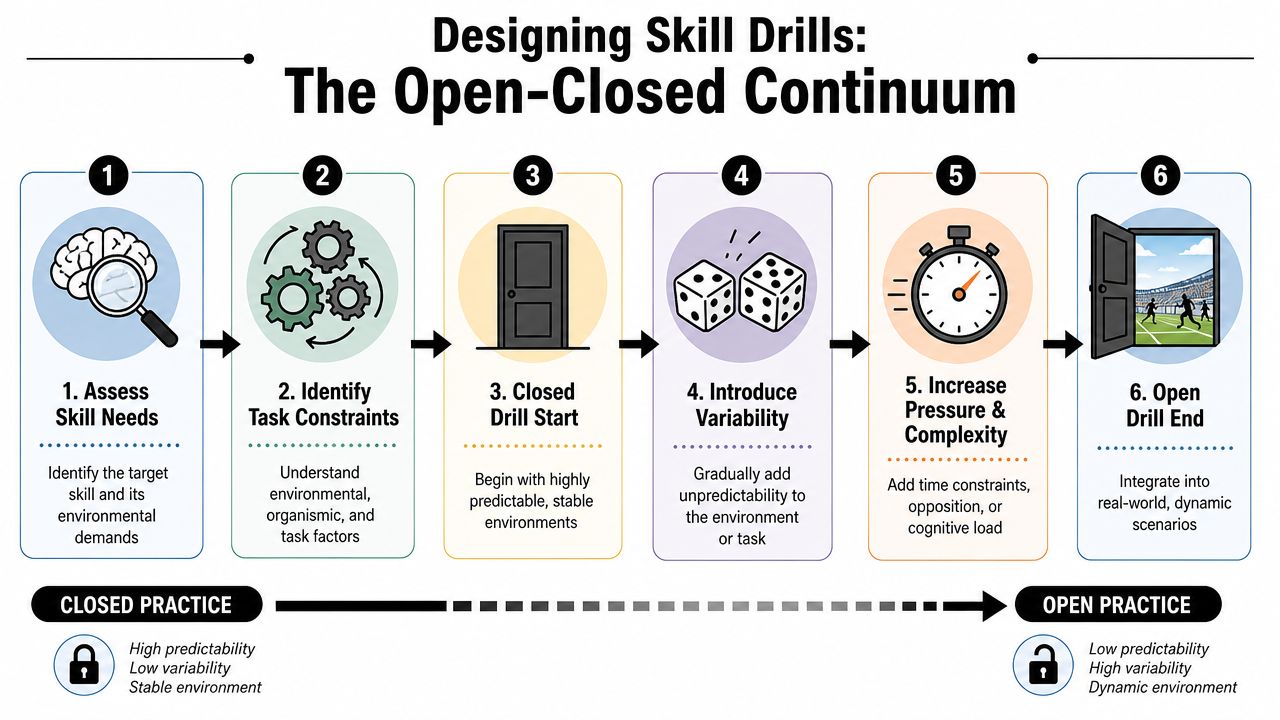
If you want a drill to do real work, manipulate constraints deliberately. Don't just make it harder. Move it along the continuum with a clear reason.
How to close a drill down
When a learner is overloaded, simplify the environment before changing everything else.
- Reduce options: give one target, one direction, or one timing window.
- Fix the start condition: same stance, same feed, same distance.
- Remove live opposition: use passive markers or pre-planned movement paths.
- Slow the task: increase time to organise the response.
This is especially useful when pain, fear, or unfamiliarity is interfering with movement quality. The aim is to preserve the action while stripping away irrelevant uncertainty.
How to open a drill up
Once the athlete owns the base pattern, introduce uncertainty one layer at a time.
Add perceptual demand
Use a visual cue, delayed signal, moving target, or partner feed.
Increase decision pressure
Offer multiple exits, scoring options, or opponent-related choices.
Tighten time constraints
Shrink the response window so the athlete can't over-plan.
Create interaction
Introduce a defender, a competing task, or a transition between actions.
A practical manipulation framework
The easiest way to build progressions is to adjust one category at a time:
| Constraint category | Ways to close it down | Ways to open it up |
|---|---|---|
| Environment | Stable surface, fixed space, no distractions | Moving people, variable space, visual noise |
| Task | One known goal, fixed pattern | Multiple goals, late changes, combined tasks |
| Performer demand | Low speed, low cognitive load | Higher speed, divided attention, fatigue-aware decisions |
What usually doesn't work
Programmes drift when progression is based on novelty instead of demand matching.
Common examples:
- Adding instability too early: unstable surfaces often change the task, but not always in a sport-relevant way.
- Layering too many variables at once: if technique breaks down, you won't know whether the issue is perception, timing, force, or decision-making.
- Using generic chaos: randomness without purpose doesn't improve transfer reliably.
A better standard is simple. Every added challenge should answer one question: does this make the drill more like the target performance in a way the athlete can still learn from?
Integrating Skill Assessment into Client Progression
Most assessments still lean heavily on isolated capacity. Strength, range of motion, and local endurance all matter. They just don't tell you enough about how the client performs once the environment becomes less predictable.
A stronger assessment process asks whether the person can preserve movement quality across different levels of openness. Can they perform the task when it's known, then when timing changes, then when a cue appears late, then when attention is split? That sequence tells you much more about usable function than a single successful rep in a sterile environment.
What to assess in practice
Use the same movement family across several conditions and watch what changes.
- Base movement quality: can the client organise the task in a stable setting?
- Adaptability: what happens when direction, timing, or target changes?
- Decision integrity: do they still choose appropriate actions under pressure?
- Efficiency under complexity: does the movement stay economical, or does it become noisy and hesitant?
This works well in both athletic and clinical environments because it ties assessment directly to progression. You're not testing for the sake of testing. You're identifying the exact point where the task becomes too open for the current skill level.
Set realistic expectations about cognitive effects
There's often enthusiasm around the idea that open-skill training automatically creates a large cognitive advantage. The evidence is more balanced than that. A 2024 meta-analytic review of 19 studies found a small, non-significant overall executive-function advantage for open- versus closed-skill participation, with Hedge's g = 0.174 and p = 0.157. Subdomain effects were also low to moderate, including cognitive flexibility g = 0.210, inhibitory control g = 0.191, and working memory g = 0.138.
That's a useful message for practitioners. Open-skill work may provide a cognitive edge, but it's modest and not universal. So don't promise sweeping brain benefits. Use open-task exposure because it improves relevance, adaptability, and readiness for real performance. Treat broader cognitive gains as possible, not guaranteed.
The best reason to assess and train along the continuum isn't that it sounds sophisticated. It's that performance rarely happens in laboratory conditions.
When you integrate open skills vs closed skills into assessment, your programming usually becomes cleaner. Early stages build capacity and coordination in stable conditions. Middle stages protect movement while introducing variability. Final stages demand that the client solve the task under pressure, not just demonstrate it on command.
Cartwright Fitness supports professionals who need accurate, validated tools for performance testing, clinical assessment, and applied sports science. If you're building stronger return-to-play pathways, refining athlete monitoring, or standardising testing in education or practice, explore the equipment and support available from Cartwright Fitness.