

You're about to run a client through a VO2 max test, a Chester Step Test, or a body composition assessment. The room is ready, the equipment's calibrated, and the client has already said, “I'm fine with whatever you need.” That's the moment when weak consent practice causes trouble, because a quick nod isn't the same as a valid decision.
Informed consent procedures are the part of professional testing that protects autonomy, improves trust, and keeps your documentation defensible when questions come later. The modern standard didn't appear overnight. The legal roots trace back to early 20th-century cases, then the language of “informed consent” itself emerged in Salgo v. Leland Stanford, Jr. University Board of Trustees in 1957, shifting the focus from simple permission to disclosure of risks, alternatives, and consequences (historical review).
The practical reality is simpler than the legal history, but stricter than many busy clinics and gyms assume. If a client doesn't understand what the test involves, why it's being done, what could feel uncomfortable, and what choices they still control, the process isn't really informed. A useful reference point for building stronger onboarding and research-adjacent workflows is Verbex resources for CRCs, especially if you manage intake across multiple staff members and need a consistent consent handoff.
Table of Contents
- Why Thorough Informed Consent Is Necessary
- The Core Elements of Valid Informed Consent
- A Step-by-Step Consent Process for Testing Sessions
- Adapting Consent Procedures for Special Populations
- Documentation and Record-Keeping Best Practices
- Frequently Asked Questions on Informed Consent
Why Thorough Informed Consent Is Necessary
A client arrives for a graded exercise test. They've signed the intake packet, but they haven't been told that the session may include breath-by-breath analysis, symptom-limited stopping points, or the chance that the protocol could end early if they do not tolerate the workload. That gap matters because the client's agreement was not based on a real understanding of the session.

The strongest reason to treat consent seriously is simple. It is not a form, it is a decision-making process. The doctrine developed through court decisions, beginning with early foundations in 1905, then Schloendorff v. New York Hospital in 1914, which is widely described as a key step because it tied medical decision-making to self-determination (historical review). By 1957, the term “informed consent” made explicit that disclosure is part of the duty, not an optional courtesy.
Practical rule: if the client would be surprised by the procedure, the workload, or the risks, consent was not complete.
That matters in fitness and clinical testing because the stakes are often underestimated. A treadmill test, metabolic assessment, or exercise tolerance screen can feel routine to staff, but the client experiences it as a health decision. When you explain the purpose, limits, and alternatives clearly, you reduce anxiety and make it easier for people to ask the questions they are already thinking.
By 1972, cases such as Canterbury v. Spence, Cobbs v. Grant, and Wilkinson v. Vesey had pushed disclosure expectations further and helped move practice toward a more patient-centered standard, especially in the United States, which strongly influenced medical ethics and hospital policy (historical review). That history still shows up in day-to-day work. If your workflow depends on a hurried signature, you are relying on the weakest part of the process, not the strongest.
A practical consent process also protects trust. People are more willing to proceed when they feel the professional is being straight with them, not steering them toward a preferred outcome. That trust is easier to build when your intake and consent sequence is deliberate, a point worth aligning with broader onboarding systems such as those described in member-registration workflows for fitness operations and research-facing teams, like Fitness GM's member onboarding guide and Verbex resources for CRCs.
The Core Elements of Valid Informed Consent
A consent form can look polished and still miss the basic standard. For research under 45 CFR part 46, U.S. rules require legally effective consent obtained prospectively, and HHS guidance breaks the process into three key features, disclosure, understanding, and voluntariness (HHS informed consent guidance). In practice, capacity also has to be checked, because the person has to be able to make the decision in the first place.
The four pillars that hold the process together
| Pillar | Description | Fitness Testing Example |
|---|---|---|
| Disclosure | Give the person the information needed to decide, including purpose, what will happen, possible discomforts, and alternatives. | Explain whether the session is a submaximal step test, a maximal VO2 assessment, or a body composition scan, and what each one involves. |
| Comprehension | Check that the person actually understands the information, not just that they heard it. | Ask the client to restate the stopping rules or describe what they expect to feel during the test. |
| Voluntariness | Make sure the choice is free of pressure, coercion, or rushed signing. | Let a corporate wellness participant decline a maximal protocol without being penalized or shamed. |
| Capacity | Confirm the person can understand, weigh, and communicate a choice. | Pause and escalate if a client appears confused, heavily distressed, or unable to follow basic instructions. |
Disclosure is where many staff stop, but it is only the first layer. If you have described the procedure in technical language and handed over a signature page, you have informed them on paper, not necessarily in practice. HHS guidance says the process should facilitate understanding and promote voluntariness, not just collect a name.
Comprehension checks matter in testing environments because clients often nod politely while still being uncertain. Plain-language explanations reduce that gap. A person deciding about a treadmill protocol does not need a lecture on cardiopulmonary physiology, they need a clear explanation of what they will do, what might happen, and when you will stop.
The best consent discussion sounds calm and ordinary. If it sounds like a warning label or a sales pitch, people stop listening.
Voluntariness can be lost in subtle ways. A client might feel they cannot decline because they booked through an employer, a coach, or a rehab pathway. Make space for the decision to be yes, no, or not today, because a pressured yes is not reliable consent.
Capacity is the part professionals often assume rather than check. You do not need a formal legal proceeding for every session, but you do need to notice when the person cannot follow the explanation or cannot meaningfully compare options. If that happens, pause, simplify, or involve the appropriate decision-maker.
In practice, consent work is integrated into the rest of your intake system. A structured screening pathway such as the Cartwright Fitness health questionnaire for exercise helps staff spot issues before testing begins, while a clear onboarding flow like Fitness GM's member onboarding guide shows clients that screening, consent, and participation decisions are handled as one process rather than separate chores.
A Step-by-Step Consent Process for Testing Sessions
The cleanest consent workflows start before the client enters the room. The practical model is simple, pre-appointment information, face-to-face discussion, questions, signature, copy, and documentation. That sequence fits well whether you're running a Chester Step Test, a metabolic analysis, or an occupational screening battery.
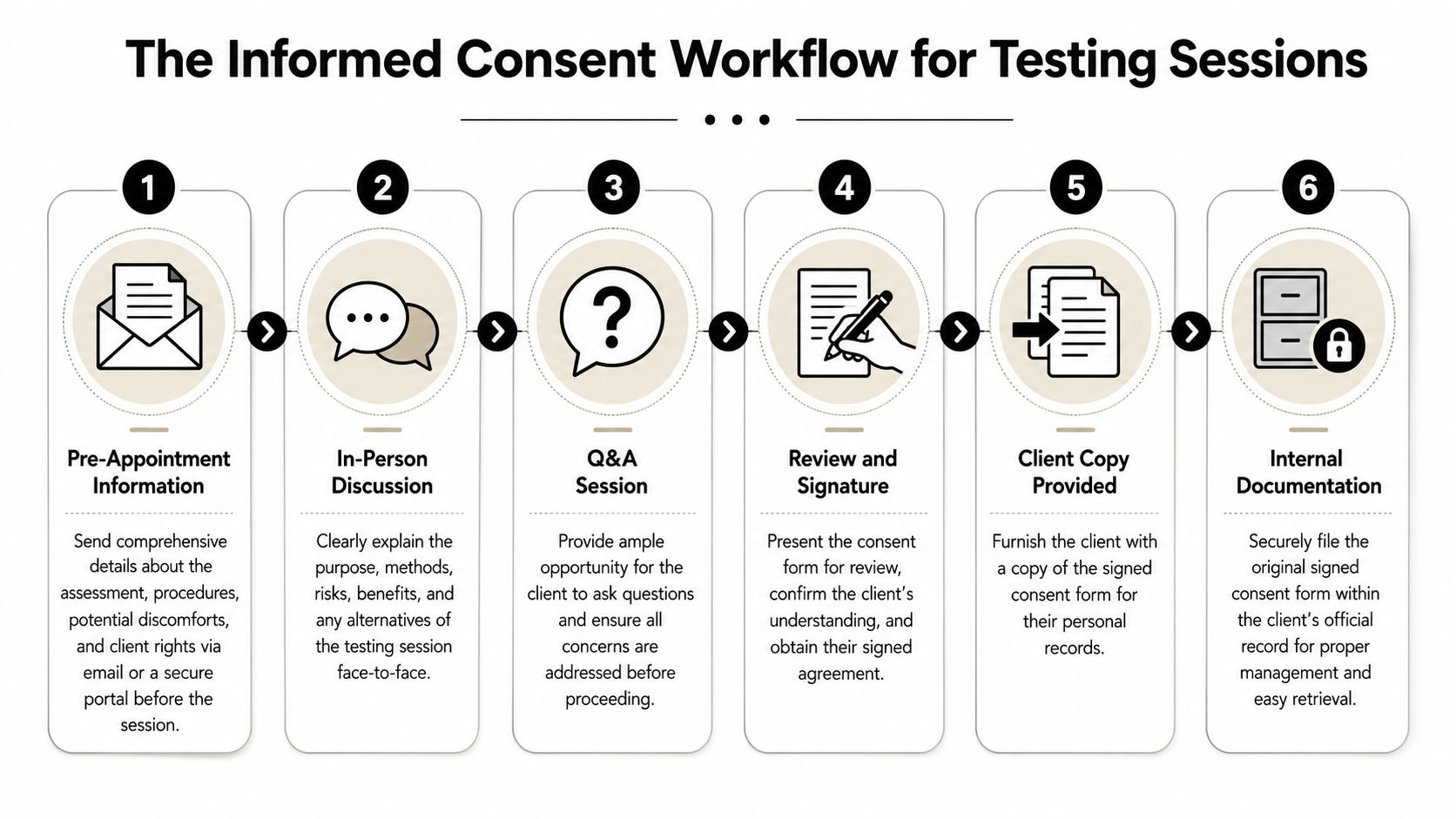
Start with the pre-appointment pack. Send the client a concise overview that names the test, says what equipment will be used, explains likely sensations, and lists the reasons the session might stop early. If you're using a structured health screen, it helps to connect that intake to a clear pathway like the Cartwright Fitness health questionnaire for exercise, because the client should see that screening and consent are part of the same decision chain.
The in-person discussion should be calm and ordinary, not rushed or conducted while the client is already changing into test gear. Use plain language. Say what the test is for, what the client will need to do, what discomforts can happen, and what alternatives exist if they're unsure or not ready.
For a Chester Step Test, a useful explanation is: the client steps to a set rhythm, heart rate and recovery are monitored, and the test stops if symptoms or safety limits are reached. For a metabolic assessment, describe the mask or mouthpiece, the breathing pattern required, and the fact that the result depends on good effort and good fit. That kind of specificity helps the person decide whether they're comfortable proceeding.
Use the question period as a real checkpoint, not a courtesy pause. If the client asks whether they can stop the test, the answer should be direct and unambiguous. If they ask what happens if they feel dizzy, say exactly what the team will do, who will intervene, and what the immediate exit plan is.
Field note: a client who asks detailed questions is usually giving you a gift, not creating a problem. Answering clearly now is easier than explaining later why the test felt different from what they expected.
After the discussion, review the form and obtain the signature only when the client can still state, in their own words, what they're agreeing to. Give them a copy immediately. Then document the interaction in the record with enough detail that another professional could reconstruct what was explained, what questions came up, and why the session was allowed to proceed.
For teams managing multiple intake points, it helps to align consent with broader onboarding logic. A structured member-entry process, like the one outlined in Fitness GM's member onboarding guide, can reduce missed steps because staff follow the same sequence every time.
The embedded training video below is useful for staff who need a visual reminder of how the workflow should feel in practice.
Adapting Consent Procedures for Special Populations
A single script does not fit every client. Minors, people with impaired decision-making capacity, and clients who do not share the clinician's language need a consent process that matches their circumstances, not the clinic's convenience. The Joint Commission treats consent as an active process, and its guidance supports everyday language, professional interpreters, teach-back, and culturally appropriate materials to close comprehension gaps (Joint Commission guidance).
Minors and assent
For minors, the usual ethical standard is parental or guardian permission plus the child's assent when developmentally appropriate. In exercise testing, that means you still explain the session to the young person in age-appropriate language instead of talking only to the adult in the room. If the child looks uncertain, disengaged, or fearful, treat that as useful information.
Impaired capacity and substitute decision-makers
When a client cannot weigh information or communicate a stable choice, involve the legally authorized representative and slow the conversation down. If you need a practical reference point for assessing decision-making ability, the Orange Neurosciences guide on capacity is useful for understanding how capacity questions are framed in real settings. In testing environments, avoid treating an unable-to-consent client as if silence equals agreement. The right standard is understanding, not guesswork.
Language and cultural barriers
Many clinics lose the thread here. The Joint Commission guidance recommends everyday language, professional interpreters, teach-back, and culturally appropriate materials because informed consent is not just a signed page (Joint Commission guidance). The same guidance points to comprehension gaps by language and race, which means a neat-looking form can still leave serious misunderstandings in place.
A short workflow works best in practice:
- Use a qualified interpreter: Do not rely on family members for nuanced risk discussion.
- Slow the pace: Give one idea at a time, then pause.
- Use teach-back: Ask the client to explain the procedure back in their own words.
- Match materials to the person: Use translated or culturally appropriate handouts when available.
If you work in elderly fitness or rehabilitation screening, the same principles apply during balance and mobility testing. A consent process that accounts for hearing limits, cognitive load, and cultural context makes the session safer and less transactional, especially in workflows similar to Cartwright Fitness balance assessment tests for elderly.
Documentation and Record-Keeping Best Practices
Good consent conversations can still fail if the record is thin. Documentation is what proves the conversation happened, what was said, and what the client appeared to understand. It also protects staff consistency when a procedure is repeated across multiple sites or by different practitioners.
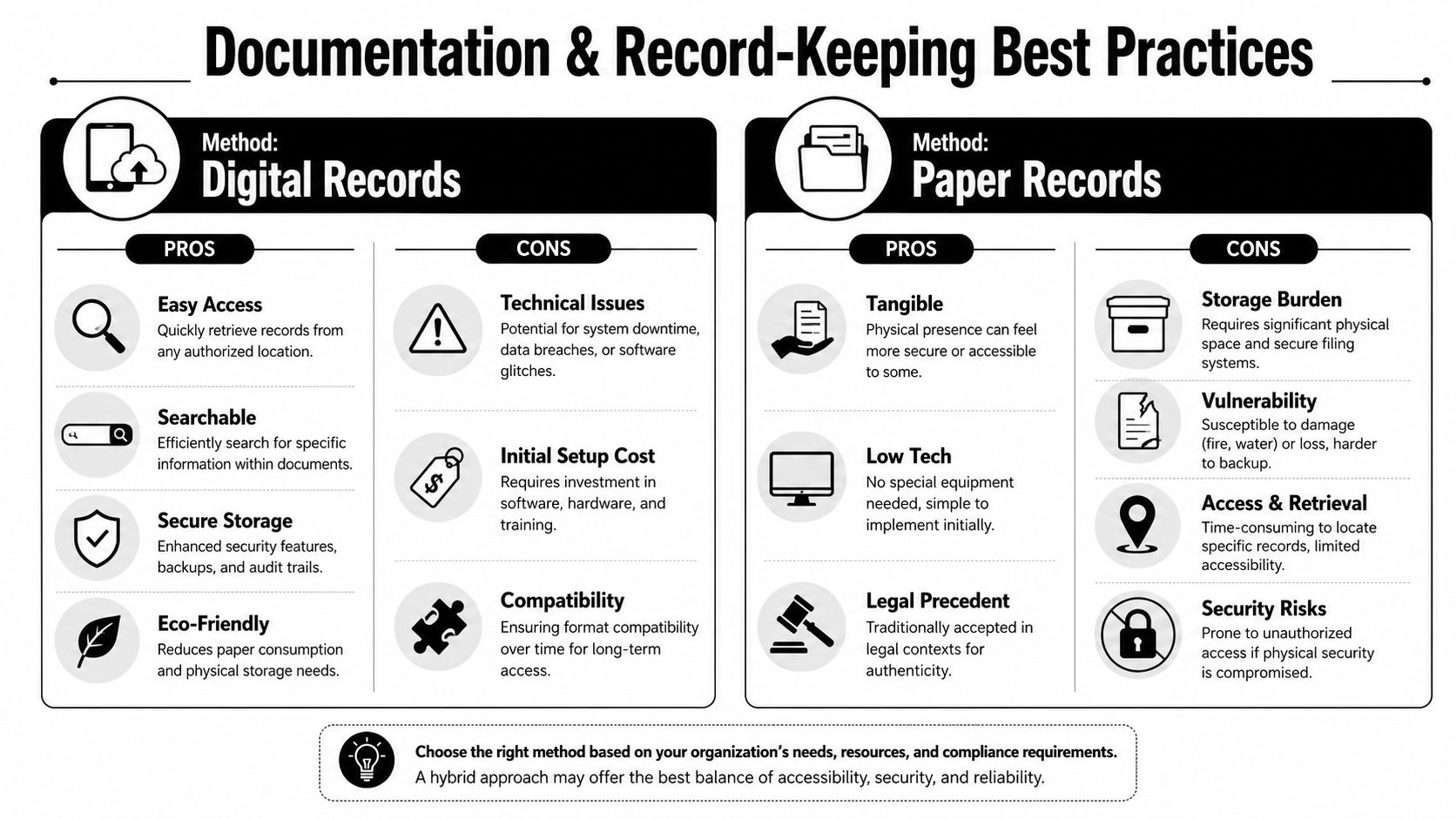
Digital records usually fit testing environments better than paper. They're easier to retrieve, easier to search, and easier to back up, which matters when consent needs to be reviewed by another clinician or auditor. The stronger eConsent studies reviewed in the literature also leaned toward better understanding with interactive digital methods, and no studies in that review favored paper over eConsent (systematic review of eConsent).
Paper still has a place, especially in low-tech settings or during outages, but it's clumsy for audit trails and long-term retrieval. If you keep paper forms, file them immediately, store them securely, and make sure someone can still find them months later without digging through miscellaneous folders. That's not just good administration, it's part of the defense if the record is ever questioned.
For mixed-format teams, a digital-first approach usually works best. If your practice is formalising its data flow, a system like the one discussed in Cartwright Fitness data management systems is worth studying because consent records are only useful if the whole client file stays coherent.
Documentation rule: if it wasn't written down, it's much harder to prove it happened.
At minimum, the record should show the test name, the main risks discussed, the alternatives offered, the client's questions, the fact that consent was voluntary, and whether a copy of the form was provided. If you use a verbal consent process for a low-risk activity, document it carefully and state why a written form wasn't used. That note should be clear enough that another practitioner can tell the difference between a real conversation and a hurried checkbox.
Security matters too. Access should be limited to staff who need the record, and retention should follow your local legal and professional requirements. The safest systems are the ones that combine readable consent content with controlled storage, because compliance and usability have to work together.
Frequently Asked Questions on Informed Consent
Do I need new consent for every session in an ongoing training or testing program? Not every time, but I do need to check whether the original consent still matches what is about to happen. If the protocol changes, the risk profile changes, or the client's condition changes, I ask for fresh consent rather than relying on an old signature that no longer reflects the session.
Can consent be given verbally? Yes, in some settings verbal consent is appropriate, especially for low-risk activity, but the discussion still has to be documented. The record should show what was explained, what the client agreed to, and why a written form was not used, so another practitioner can see that a real conversation took place.
What should I look for in a digital e-consent platform? It needs to support prospective consent, clear disclosure, a way to confirm understanding, and a reliable audit trail. Secure storage matters as well, along with an easy way to give the client a copy. A polished interface is useful, but it is not enough if the record cannot stand up to review.
For teams running fitness, rehabilitation, or occupational health testing, the practical answer is standardisation. Use one consent script, one documentation template, and one review process, then apply them consistently so staff do not improvise under time pressure. If you want to tighten your procedures, update your intake workflow, and align your testing records with a more defensible standard, visit Cartwright Fitness and use its testing and assessment resources to build a clearer consent process before your next client arrives.