
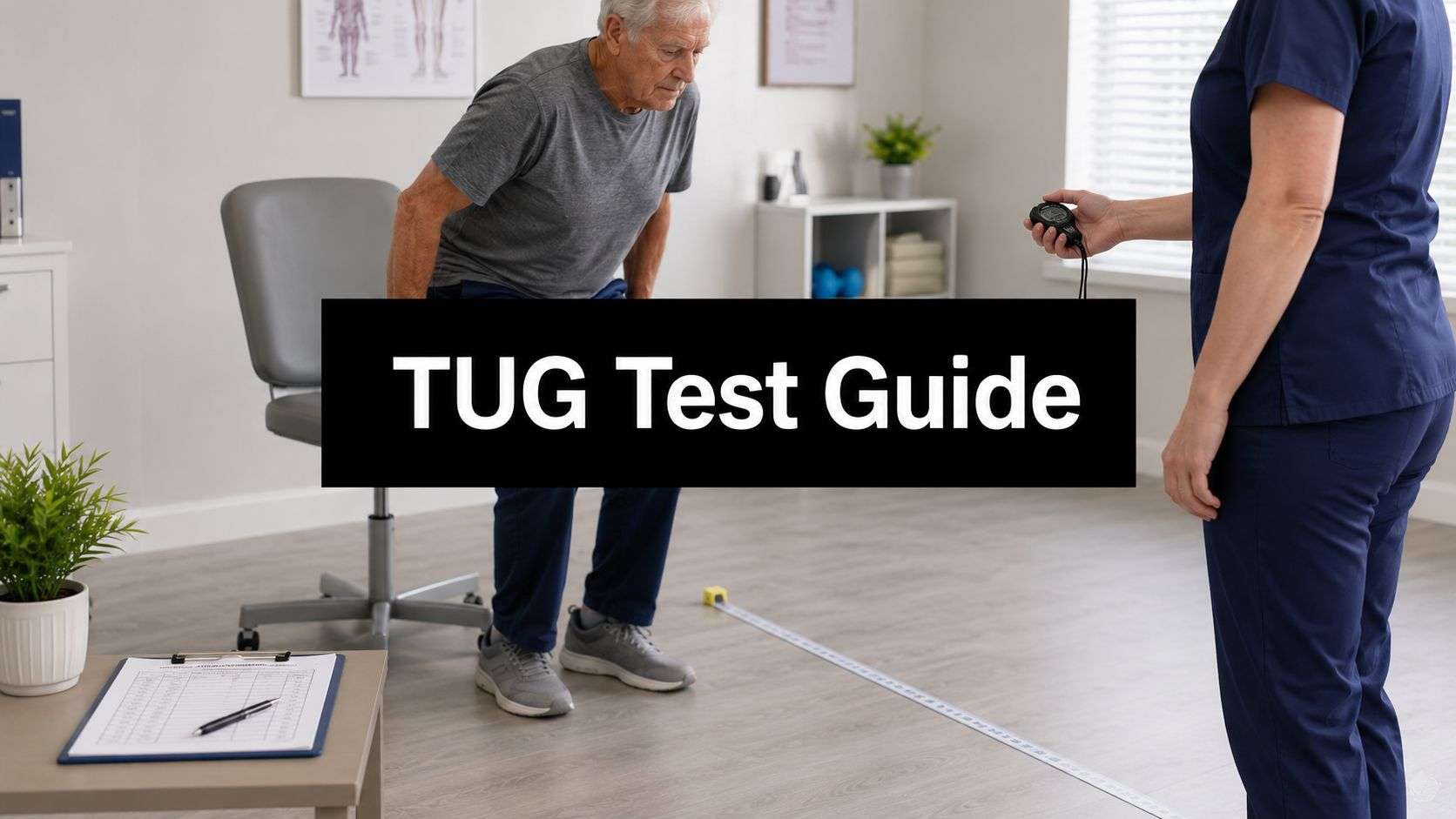
A test that takes only a short walk, one turn, and a return to the chair can still deliver 87% sensitivity and 87% specificity for identifying older adults at risk of falling, with inter-rater and intra-rater reliability both at 0.99 according to this clinical summary of the Timed Up and Go test. That should change common perceptions of the Timed Up and Go test.
Too many discussions reduce the Timed Up and Go test to a single rule. If the score is over a generic cutoff, the person is “high risk.” If it's under, they're “fine.” That shortcut is convenient, but it breaks down fast in real practice. A frail older adult, a person with Parkinson's disease, a post-stroke patient, and a fit middle-aged adult after surgery don't all move on the same baseline.
That's where the test becomes more useful, and more interesting. Used properly, it's not just a quick screening tool. It's a practical way to observe transfers, gait initiation, turning control, balance under time pressure, and how a person manages a familiar sequence of daily movements. In clinics focused on restoring physical mobility, it fits because it measures the exact type of task patients struggle with outside the treatment room.
Table of Contents
- Why a Simple Mobility Test Matters
- Understanding the Timed Up and Go Test
- Standard Protocol and Test Setup
- Interpreting TUG Scores and Normative Data
- Clinical Applications Across Diverse Populations
- Advanced Variations and Practical Tips
- Documenting Results and Guiding Interventions
Why a Simple Mobility Test Matters
Falls rarely happen during isolated strength efforts. They happen during transitions. Standing up too quickly. Turning in a tight space. Walking while planning the next step. Reaching the chair and sitting without full control. The Timed Up and Go test matters because it captures that chain of movement rather than a single component.
That's the practical strength of the test. It combines sit-to-stand ability, walking, turning, deceleration, and transfer control into one brief task. For a new graduate, that makes it far more useful than looking at gait speed alone. For a fitness professional working with older adults or deconditioned clients, it offers a structured way to spot mobility concerns that won't show up in a simple strength screen.
The other reason it matters is standardization. A quick test is only clinically useful if it can be repeated with confidence. The Timed Up and Go test has that advantage. It's consistent enough to track change over time, and simple enough to use across community, outpatient, rehab, and residential settings.
A good TUG score doesn't cancel out poor movement quality. A poor TUG score doesn't tell you why performance is limited. The value is in pairing time with observation.
The biggest mistake I see isn't poor timing technique. It's poor interpretation. Many guides stop at one threshold for “older adults,” then leave clinicians guessing when the person in front of them is younger, post-operative, neurologically impaired, frail, or using an aid. That's where the test either becomes sharp and clinically useful, or vague and misleading.
Understanding the Timed Up and Go Test
The Timed Up and Go test, often shortened to TUG, is a timed functional mobility assessment. The person starts seated in a chair, stands up, walks to a marker, turns, walks back, and sits down again. On paper, that sounds basic. In practice, it's a compact test of several systems working together.
A useful way to explain it to patients or students is this: it's a mini-obstacle course for daily life. There's no true obstacle, but there is sequencing. The task asks the person to initiate movement, control momentum, turn safely, and finish with an accurate transfer back into sitting. Those are exactly the moments where mobility problems often become obvious.

What the test actually assesses
The TUG doesn't isolate one body system. It samples several functional abilities at once:
- Transfer ability involves generating enough force and coordination to stand from the chair without losing balance.
- Dynamic balance shows up during gait initiation, turning, and the transition back to sitting.
- Functional walking becomes visible in stride rhythm, path deviation, pace control, and use of an aid.
- Motor planning matters because the person has to complete a sequence, not just a single action.
That combination is why the test remains clinically relevant. Someone can have reasonable straight-line gait speed and still perform poorly when turning or sitting. Another patient can stand strongly but lose efficiency during the return to the chair. The TUG reveals those weak links.
Why it outperforms simpler screens
Gait speed has value. Sit-to-stand tests have value. Balance tests have value. The TUG earns its place because it blends those demands into one practical task. It doesn't replace a fuller assessment, but it does give a broader snapshot than many single-domain measures.
Clinical lens: If the time is only slightly slower than expected but the turn is hesitant, the final sit is uncontrolled, or the patient reaches for support late, that's not a reassuring result.
For a fitness professional, this matters when deciding whether a client needs closer supervision during transitional tasks. For a therapist, it matters because the score helps, but the movement pattern often tells you what to train next.
Standard Protocol and Test Setup
A Timed Up and Go test is only as useful as its consistency. Small setup changes alter the result. Different chairs, vague instructions, inconsistent timing points, or changing whether the person uses their usual walking aid can all make one session difficult to compare with the next.
What the setup must include
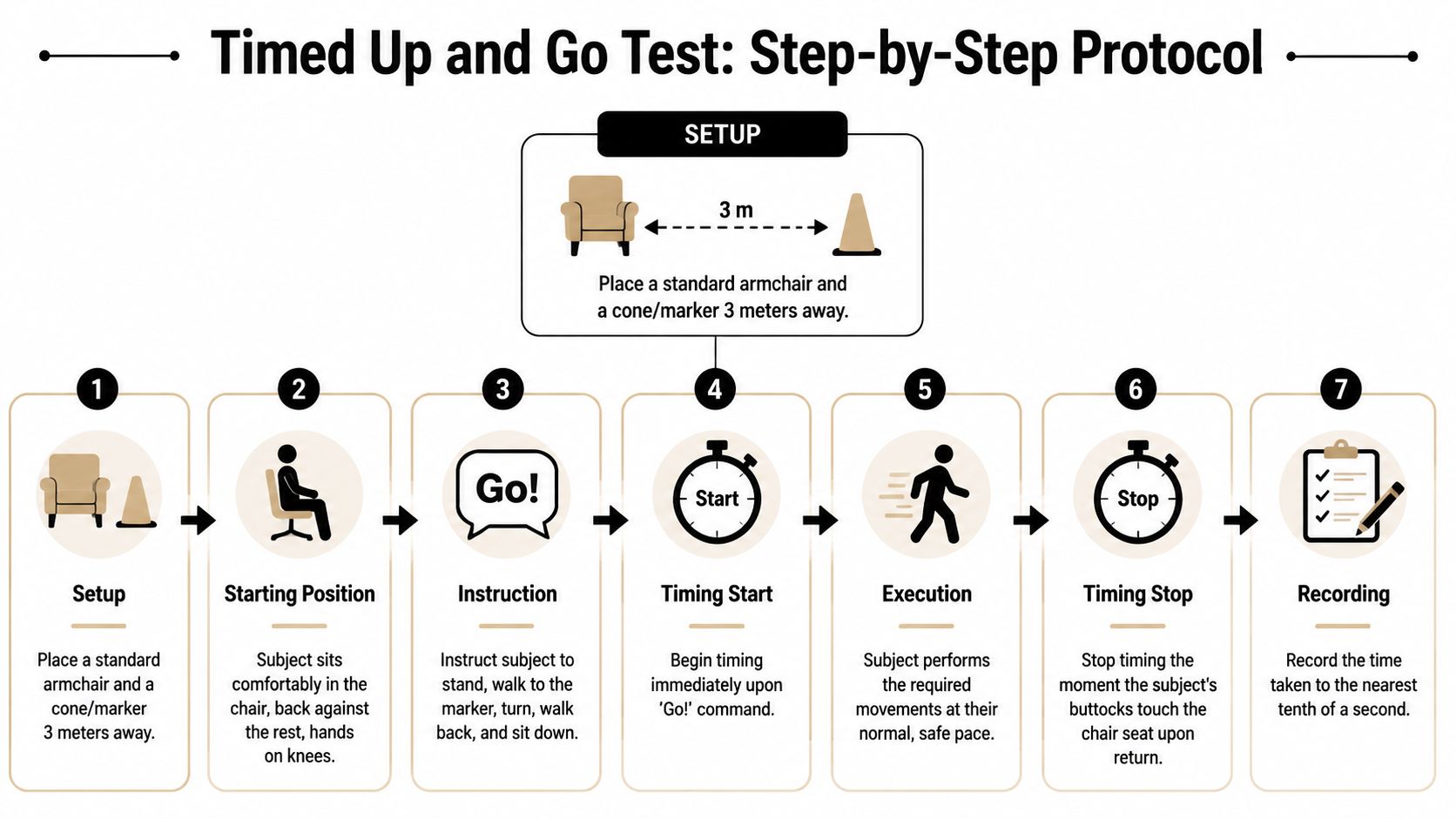
Use a standard chair with armrests, a clear walkway, a visible marker, and a stopwatch. The walking distance is 3 meters, which is part of the established test procedure discussed in this fitness testing protocol reference. The person should wear their usual footwear and use their customary aid if they normally rely on one.
The room matters more than people think. Don't place the chair where feet can catch on mats, cords, or uneven floor transitions. Keep the marker clear and obvious. Give enough turning space so you're assessing the person, not a cluttered environment.
A useful training video can help newer staff see the flow of the test before they run it on patients:
How to administer the test consistently
Use a repeatable process every time.
- Prepare the area. Measure the walking path and place the marker at the standard distance. Check that the chair is stable and won't slide.
- Position the patient. The person starts seated with their back supported. Keep the setup the same at retests.
- Explain the task clearly. Tell them to stand up, walk to the marker, turn, walk back, and sit down at their normal safe pace.
- Confirm understanding. If they look unsure, repeat the instructions before timing starts.
- Start timing on the verbal cue. Begin the stopwatch on “Go.”
- Stop timing at seat contact. End timing when the buttocks touch the chair on return.
- Record the result carefully. Note the time and any relevant observations such as gait aid use, hesitation, loss of balance, or poor turning control.
Practical rule: Standardize the chair, footwear expectations, instructions, and aid use before you start worrying about fine interpretation.
One issue that often goes unaddressed is interpretation after administration. Most clinicians know the older-adult rule of 12 seconds or more as a concern threshold, but the CDC material also highlights an unaddressed gap. It notes that many resources don't stratify thresholds well for non-elderly or post-surgical populations, and that 13.5 seconds may be more predictive for community-dwelling adults under 65 in that context, which creates ambiguity in acute rehab settings according to the CDC STEADI assessment guidance.
That doesn't mean you should invent a new cutoff for every patient. It means you should stop pretending one number answers every clinical question.
Interpreting TUG Scores and Normative Data
A difference of 2 or 3 seconds can change the clinical message of a TUG score. In one person, it points to mild slowing. In another, it marks a meaningful fall-risk threshold. That is why interpretation needs more than a single older-adult cutoff.
Population, diagnosis, baseline function, and movement strategy all matter. A community-dwelling older adult, a person with Parkinson's disease, and a patient early after orthopaedic surgery can post similar times for very different reasons. If you want this test to guide decisions well, read the time alongside how the task was performed and who performed it.
Understanding Common Cutoffs
For older adults, 12 seconds or longer is widely used as a concern threshold in practice, and 13.5 seconds is also used in some settings for community-dwelling adults. Those numbers are useful screening anchors, not universal rules. In non-elderly adults, post-operative patients, and higher-functioning rehabilitation groups, a score near those thresholds can be hard to interpret without better context.
That gap is one reason I prefer population-specific reference points whenever possible. The TUG becomes more useful when you match the score to the question in front of you. Are you screening fall risk, estimating functional mobility, or tracking change after treatment? Those are not the same job.
The test also has good measurement properties, which is why it remains part of many rehabilitation assessment tools used in practice. Reliability supports repeated use over time, but reliability does not solve interpretation. A precise number can still be misread if the wrong cutoff is applied to the wrong population.
Quick reference table
Use the nearest validated population where possible, and document when you are extrapolating.
| Population | Cutoff Time (seconds) |
|---|---|
| Older adults at heightened fall risk | 12 |
| Community-dwelling adults | 13.5 |
| Older stroke patients | 14 |
| Parkinson's disease | 11.5 |
| Hip osteoarthritis | 10 |
| Frail elderly individuals | 32.6 |
| Lower extremity amputation | 19 |
| Vestibular disorders | 11.1 |
| Increased fall risk association | Over 16 |
The table helps, but it does not replace observation. A person can finish within an acceptable time and still show poor turning control, cautious step initiation, heavy use of the arms to stand, or a poorly controlled descent into the chair. Those features often explain why the score sits where it does, and they help you choose the next intervention.
Age adds another layer. Expected performance changes across the lifespan, but age alone does not tell you whether a result is concerning. This guide to physical performance changes with age is a useful reminder that mobility benchmarks need context, especially in adults who do not fit neatly into geriatric reference ranges.
A good TUG interpretation answers three questions. Which population does this patient resemble most closely? Does the observed movement quality match the stopwatch time? Has the score changed enough to alter clinical decisions?
Use the cutoff as a reference point. Base the decision on the person in front of you.
Clinical Applications Across Diverse Populations
A single TUG cutoff misses too much. An 11-second result can be reassuring in one patient and concerning in another, depending on diagnosis, age, turning ability, and expected baseline.
How the same score means different things
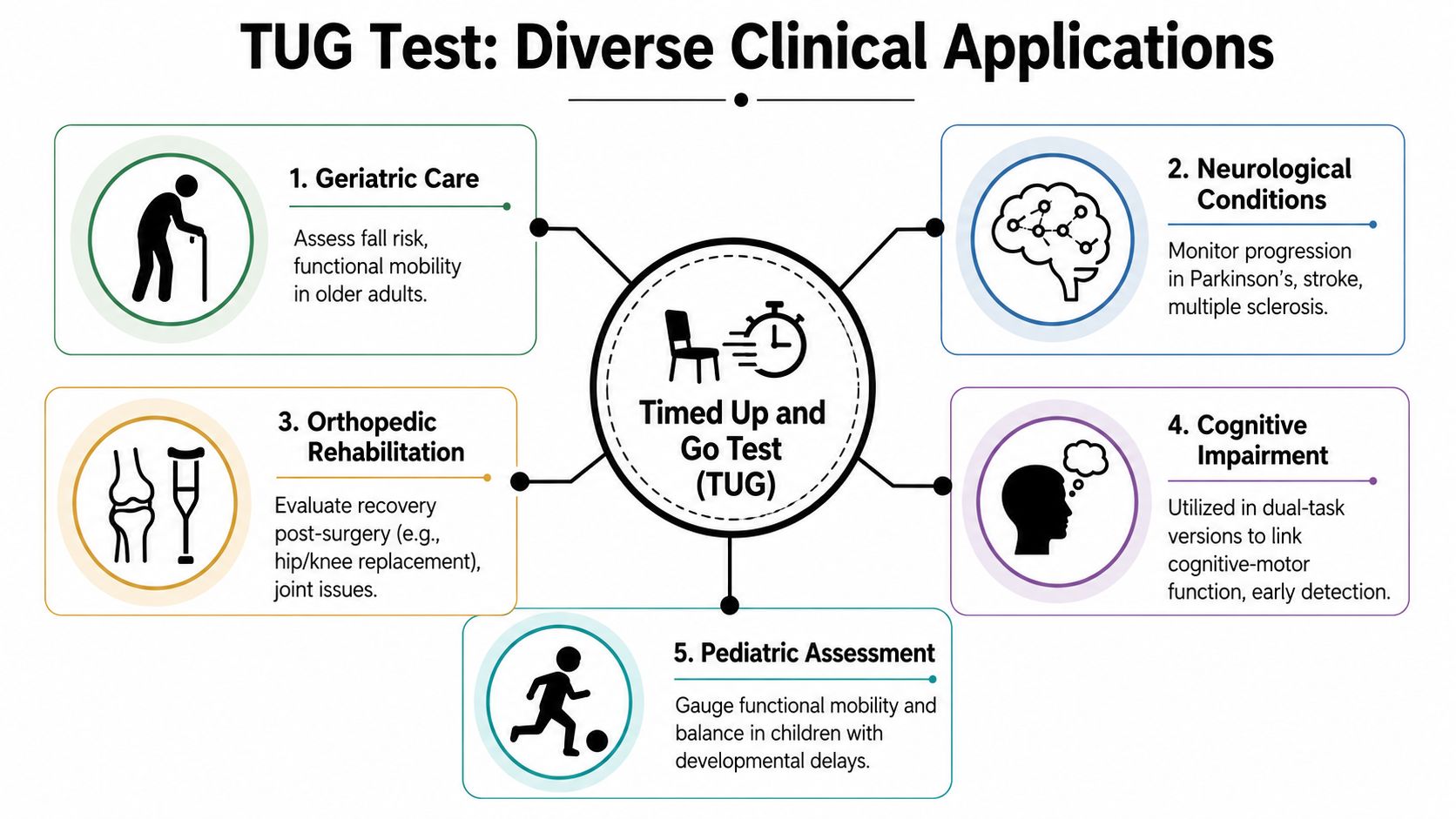
Stroke is a good example. In older adults after stroke, 14 seconds has been used as a cutoff, and the test shows high reliability with strong association to functional mobility measures, as summarized by Physio-pedia's TUG reference). In practice, that matters because a 14-second TUG in stroke often reflects more than reduced gait speed. It may reflect impaired sit-to-stand mechanics, asymmetrical loading, poor turning, or difficulty stopping and sitting with control.
Parkinson's disease shifts the threshold lower. The cited cutoff of 11.5 seconds fits what clinicians often see. Straight-line walking may still look reasonable, but the turn, step initiation, and sequencing break down earlier. If you only react to clearly slow overall times, you can miss a patient whose mobility is becoming less safe in daily life.
Frail older adults are different again. A cutoff of 32.6 seconds reflects a much lower functional reserve. At that end of the spectrum, the TUG is less about fine discrimination between mild and moderate impairment, and more about documenting global mobility status, transfer dependence, and whether the person is losing capacity over time.
The same principle applies outside standard geriatric use. In lower extremity amputation, 19 seconds fits the added demands of prosthetic control and altered gait mechanics. In vestibular disorders, 11.1 seconds shows that a person can appear reasonably strong yet still perform poorly because of disequilibrium, visual dependence, or difficulty with the turn.
Where the test is most useful
Use the TUG where it changes management.
In outpatient stroke rehab, a slower score with a wide, segmented turn usually points me toward transfer practice, pivot training, and directional stepping, rather than spending the whole session on straight-path walking. In Parkinson's reviews, mild slowing plus hesitation before standing or freezing on the turn often supports cueing strategies and a closer look at divided-attention demands. In residential or domiciliary care, serial TUG testing helps show whether mobility is becoming less efficient, even when the person already needs assistance.
Post-operative patients need careful interpretation too. A TUG after joint replacement or other orthopaedic surgery is influenced by pain, weight-bearing restrictions, confidence, and the walking aid being used that day. Early on, the absolute time matters less than whether the patient can stand safely, turn without losing balance, and sit with control. If you want to place TUG alongside other tools in a wider rehab battery, this overview of rehabilitation assessment tools is a useful starting point.
Age still matters, but it should not dominate the interpretation. A broad guide to physical performance changes with age can help newer clinicians separate expected age-related slowing from a pattern that warrants further assessment. That point becomes especially relevant in middle-aged adults, post-op adults, and younger neurological patients, where geriatric cutoffs are often borrowed rather than properly validated.
One final clinical point. A TUG time over 16 seconds is associated with a 3.86-fold increased risk of falling, and fallers have been reported with a mean time of 16.8 seconds (±10.1) compared with 11.2 seconds (±5.2) in non-fallers in the Physio-pedia summary already cited above. Use that information as supporting context, not as a stand-alone verdict. The safer interpretation is always population-specific, and it should match what you observe during the stand, walk, turn, and sit.
Advanced Variations and Practical Tips
The standard Timed Up and Go test gives you a clean mobility snapshot. But real life doesn't happen in a clean testing lane. People walk while talking, scanning, carrying objects, and making decisions. That's why advanced variations can add value when the standard test doesn't explain enough.

When to use dual-task versions
One established variation is TUG Cognitive, which adds a mental task during the walk and turn. The purpose isn't to make the test harder for its own sake. It's to expose what happens when attention is divided. That matters because many falls occur when mobility shares bandwidth with conversation, planning, or environmental distraction.
A manual variation can do something similar by adding object handling. Carrying a cup, holding an item, or managing another simple load changes arm swing, trunk control, and attention. These versions are useful when the standard TUG looks acceptable but the patient reports near-falls in busy, real-world settings.
Use them selectively. If the person is already unsafe in the standard test, there's no advantage in layering complexity too early.
Administration details that change the result
Small errors can make your data noisy. These are the details that experienced clinicians watch closely:
- Assistive device consistency: If the patient uses a stick, frame, or walker in daily life, test with that same aid each time unless your goal is to examine a specific change in support.
- Chair contact on return: Some patients hover over the seat or touch down lightly before standing again. Make sure the trial ends only when they sit properly.
- Turning strategy: A wide, multi-step turn often reveals more than the total time. Record it.
- Pacing language: “As fast as you can” and “at your normal safe pace” are not interchangeable instructions.
- Guarding position: Stay close enough to protect the patient, but don't cue, steer, or pace them through the task unless safety demands it.
If you change the instructions, the chair, or the aid, you've changed the test.
A final practical point. Advanced versions work best after you've mastered standard administration. If your baseline TUG isn't consistent, adding cognitive load won't create better insight. It only adds more variables.
Documenting Results and Guiding Interventions
A TUG score becomes far more useful when the documentation captures the conditions around it. Time alone is too thin. You need the context that explains whether the result reflects strength loss, balance impairment, turning difficulty, fear, poor transfer mechanics, or a change in aid dependence.
What to document every time
Use a simple format and keep it consistent. If you want a broader framework for concise clinical notes, this Simbie AI guide for OT documentation is a useful reference for structuring functional observations clearly.
Documentation example
Timed Up and Go test completed using usual footwear and usual walking aid. Time recorded: ___ seconds. Start cue standardized. Time stopped at seat contact. Observations: sit-to-stand quality, gait pattern, turning strategy, balance loss or hesitation, control when returning to sit, need for supervision or guarding. Clinical interpretation: compare with relevant population threshold and prior performance.
A practical template library such as these physical therapy documentation templates can also help newer clinicians build repeatable reporting habits.
How results should guide treatment
The score should push your treatment plan toward functional priorities. If the person loses time in the first step, train initiation and transfer mechanics. If the turn is the problem, train deceleration, pivot control, and directional changes. If the final sit is unsafe, work on eccentric lowering and chair approach.
This is also the point where one equipment mention makes sense. In settings where repeated mobility screening is part of routine service delivery, structured assessment tools such as Cartwright Fitness balance assessment options can support standardized testing workflows. That's useful when multiple staff members need comparable data over time.
Good TUG use isn't about collecting another number. It's about making the next intervention more specific, the handover more precise, and the re-test more meaningful.
If you need reliable tools and practical resources for mobility and health assessment, Cartwright Fitness is worth exploring. Their range is built around validated testing workflows used by clinicians, exercise professionals, and academic departments, which makes it easier to run assessments consistently and document them properly.