

What Makes a Fitness Testing Protocol Actually Work
Imagine this: you've splashed out on the latest fitness testing gadgets, your team's trained up, and your first assessment day is booked. But here's the catch: most fitness testing protocols fall flat, not because the science is bad, but because they forget about the human factor. It's like baking a cake – having the best ingredients and a fancy oven won't help if you ignore the recipe and forget to adjust for altitude. Likewise, even the most advanced fitness testing protocol won't give you useful results if it doesn't account for the practicalities of real-world use.
The Three Pillars of Effective Fitness Testing
Talking to experienced exercise physiologists reveals a common theme: truly effective fitness testing protocols are built on three vital pillars:
Practicality: The protocol needs to be doable within your existing resources and constraints. This means thinking about things like available space, equipment budget, and staff skills. For example, a complex VO₂ max test needing pricey lab equipment might not be right for a small gym. But a simple field test like the Chester Step Test, which needs minimal equipment, can be easily used in different settings. Cartwright Fitness offers a variety of Chester Step Test equipment designed for practical use in various environments.
Reliability: The protocol should deliver consistent and repeatable results, no matter who administers the test. Think of your bathroom scale – you expect it to show the same weight each time you step on it, assuming your actual weight hasn't changed. A reliable fitness test should work the same way, giving similar results when performed multiple times under the same conditions.
Relevance: The protocol must measure fitness components that matter to the person or group being tested. A test made for elite athletes might not be appropriate for older adults or people with long-term health conditions. This is where understanding your target population is key. For example, assessing power output might be important for a powerlifter but less so for someone focusing on general health and well-being.
Context Over Complexity
This diagram shows the different components of physical fitness, highlighting how they’re all connected. The key takeaway is that fitness has many sides, and a thorough testing protocol should address the relevant components based on individual goals and needs. This reinforces the idea that context is more important than complexity – choosing the right test for the right person at the right time.
Often, simple, well-executed field tests are more useful than complex lab assessments in real-world situations. This is because field tests are usually more practical and less daunting for participants, leading to better cooperation and more accurate data. Plus, field tests can be easily adapted to different environments and populations, making them very flexible.
Why Simple Tests Often Win
Think about a workplace wellness program trying to improve employee health. A complex VO₂ max test might be difficult and expensive to carry out for a large workforce. A simpler test, however, like the multi-stage fitness test, can be easily given to a large group, providing valuable data on cardiovascular fitness. This shows how context beats complexity – using the right test for the right situation often leads to better results. Building an effective fitness testing protocol requires careful thought about these key principles. By focusing on practicality, reliability, and relevance, you can create a program that delivers meaningful results and contributes to long-term success.
How Modern Testing Approaches Actually Evolved
The story of fitness testing is quite a journey. Think of those early days – assessments were often pretty basic, like checking someone's strength or how fast they could run. It’s like trying to figure out how a car works by just looking at one tire. You miss the full picture.
Over time, things became more sophisticated. Fitness testing started looking at the whole person, like a doctor diagnosing a patient. They don't just look at the cough; they consider the whole person's health and history to understand what's really going on.
From Basic Measures to Comprehensive Assessments
Early fitness tests were simple. How many push-ups? How fast can you run a mile? These gave you a starting point, but they didn't tell the whole story. Like how someone might be great at push-ups (strong upper body) but run out of breath easily (low endurance). We needed tests that could look at all parts of fitness. If you're curious about how these tests work, you might be interested in the specific step test procedure used today.
There's a great example of how fitness tests have changed: the U.S. Army. In 1946, their test included pull-ups, squat jumps, push-ups, sit-ups, and a 300-yard run. By 1980, this evolved into the Army Physical Fitness Test (APFT) with push-ups, sit-ups, and a 2-mile run. This APFT stuck around for over 40 years! Then, in 2020, they switched to the Army Combat Fitness Test. This new test has six tasks to better match what soldiers do today. It’s a perfect illustration of how tests adapt to changing needs and our growing understanding of how the body performs. Discover more insights.
Technology and the Future of Fitness Testing
Technology has played a huge part in these changes. Think about wearable tech like heart rate monitors and fitness trackers. It’s like having a tiny lab constantly tracking your body's work. This flood of information opened doors to personalized fitness testing and training, tailored just for you.
Plus, our knowledge of exercise science has grown. We understand more about what drives top performance, which leads to better testing methods. It's exciting to think where fitness testing will go next – even more precise and personalized!
Popular Testing Methods That Actually Deliver Results
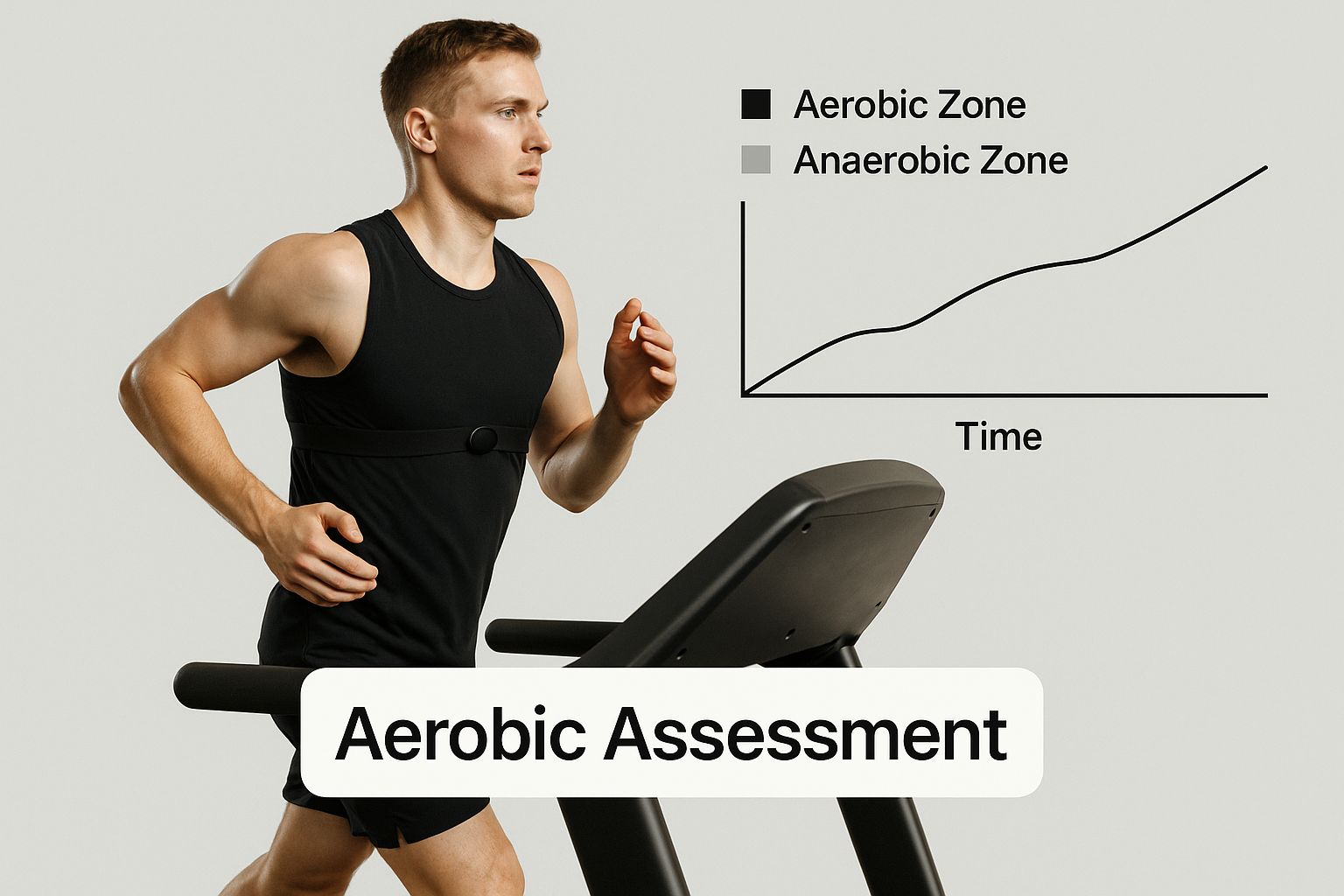
This infographic shows us an athlete on a treadmill, hooked up to a heart-rate monitor. It's a snapshot of an aerobic assessment, highlighting how important it is to track what's happening in the body during these tests. The athlete's concentration and the prominent heart-rate monitor really emphasize the intense, data-driven nature of these assessments. It's a good reminder of how technology plays a key role in modern fitness testing.
But fitness testing isn't just about treadmills. Let's explore some other common methods.
The Beep Test and Beyond
One popular protocol is the multi-stage fitness test, better known as the beep test. Imagine a progressively challenging audio track guiding you to run back and forth between two points. The speed increases every minute, pushing you to your aerobic limit. Developed by Luc Léger, the protocol starts at 8.5 km/h and increases by 0.5 km/h each minute. It's a common tool in schools and the military for evaluating cardiovascular fitness. One of the reasons it's used so widely is because it works well for people of various fitness levels, even those who are overweight or obese. Its simplicity and universal application make it a go-to assessment worldwide. You can learn more about the history and impact of the multi-stage fitness test.
Beyond the Beep Test: A Diverse Toolkit
Just like a carpenter uses different tools for different jobs, a skilled fitness professional needs a variety of testing protocols. Field tests, such as the 30-15 Intermittent Fitness Test, are excellent for evaluating anaerobic capacity and agility. They simulate the quick bursts of energy needed in many sports. Then there are simpler assessments like the push-up test and the sit-up test, which effectively measure muscular endurance and core strength, respectively. These require minimal equipment, making them practical for almost any setting.
If you're looking to expand your assessment toolkit, exploring different sports performance testing options is a great idea. The best method always depends on several factors. What are you trying to measure? Who are you testing? What resources do you have available? For example, a VO₂ max test provides in-depth information about aerobic capacity, but requires specialized equipment and a lab setting. This isn't always practical, which is why submaximal tests or field tests are sometimes necessary.
To help you see the differences between these tests, let's look at a comparison table:
Comparison of Common Fitness Testing Protocols
A comprehensive comparison of popular fitness tests including equipment needs, time requirements, population suitability, and measured outcomes.
| Test Type | Duration | Equipment Required | Fitness Component | Best Population | Advantages | Limitations |
|---|---|---|---|---|---|---|
| Multi-stage Fitness Test (Beep Test) | ~10-20 minutes | Marked track, audio recording | Cardiovascular endurance | Large groups, various fitness levels | Simple to administer, minimal equipment | Can be difficult for individuals with joint issues |
| 30-15 Intermittent Fitness Test | ~15-20 minutes | Marked track, audio recording | Anaerobic capacity, agility | Athletes involved in intermittent sports | Sport-specific assessment | Requires motivation and pacing strategy from the participant |
| Push-up Test | ~1-2 minutes | None | Muscular endurance (upper body) | Most populations | Simple, accessible | May not be suitable for individuals with shoulder issues |
| Sit-up Test | ~1-2 minutes | Mat (optional) | Muscular endurance (core) | Most populations | Simple, accessible | May not be suitable for individuals with lower back issues |
| VO₂ Max Test | ~20-30 minutes | Treadmill or stationary bike, metabolic cart | Aerobic capacity | Athletes, individuals needing precise data | Provides detailed physiological data | Requires specialized equipment and trained personnel |
This table provides a quick overview of some popular tests, highlighting their strengths and weaknesses. Remember, choosing the right test is all about matching the method to the individual and the situation.
Tailoring the Protocol to the Individual
The most popular test isn't always the best fit. Understanding your client's specific needs and limits is key to choosing the right protocol. Consider factors like age, current fitness level, any pre-existing health conditions, and even their preferences. This tailored approach ensures the test is both safe and effective, providing accurate and useful data. For instance, a modified step test might be a better choice for an older adult than a high-impact running test. Similarly, someone with a knee injury might find a cycling test a safer and more comfortable option than a treadmill test.
Choosing the Right Protocol for Your Situation
This image perfectly captures the essence of choosing a fitness testing protocol: it requires careful thought and consideration. Just like a carpenter selects the right tool for a specific job, picking a fitness test involves understanding the task and the available resources. There isn't a one-size-fits-all approach. The best protocol is the one that aligns perfectly with your unique needs and circumstances.
The ideal fitness testing protocol isn't some magical, universal solution. It's about finding the right fit for your specific situation. Imagine shopping for a vehicle. A sleek sports car offers exhilarating speed, but a minivan is the practical choice for a family. Similarly, a sophisticated lab test might be ideal for research, while a simple field test makes more sense for a large group.
Factors Influencing Protocol Selection
Several important factors play a role in choosing the right protocol. Let's explore a few:
Available Resources: Do you have a state-of-the-art lab at your disposal, or are you working with limited equipment? This significantly impacts which protocols are feasible. A VO₂ max test, for instance, requires specialized equipment, while a step test can be conducted with minimal resources.
Participant Characteristics: Think about the age, fitness level, and any health conditions of the individuals you're testing. A protocol designed for young athletes wouldn't be appropriate for older adults. Modern fitness testing can even incorporate AI tools like the AI Workout Generator to personalize protocol recommendations.
Testing Objectives: What exactly are you hoping to measure? Are you focused on aerobic fitness, strength, flexibility, or other aspects of physical health? The chosen protocol must align with your specific goals.
Environmental Constraints: Consider practical factors like available space, time, and even the climate. Some protocols demand a controlled indoor environment, while others can be conducted outdoors.
Understanding the history of fitness testing also provides valuable context. Back in the 1970s and 1980s, there was a significant movement in the US to develop standardized youth fitness tests. This led to numerous organizations creating their own test batteries, primarily focused on measuring aerobic fitness, musculoskeletal fitness, and body composition, reflecting the growing understanding of children’s and teenagers' fitness needs. Discover more insights.
Avoiding Common Pitfalls
Many well-intentioned fitness testing programs stumble because of overlooked practicalities. Here are some common mistakes to avoid:
Choosing a Protocol That's Too Complex: A highly complex protocol might seem impressive on paper, but if it's difficult to implement in practice, it won't be effective.
Ignoring Participant Feedback: If the participants find a protocol uncomfortable or inconvenient, they're less likely to give their best effort, potentially skewing the results.
Failing to Pilot Test the Protocol: A pilot test, even with a small group, can reveal unforeseen issues before you roll out the protocol to a larger population.
By carefully considering these factors and steering clear of these common mistakes, you can select a fitness testing protocol that yields valuable data and helps individuals reach their fitness goals. This thoughtful selection process is essential for the success of any fitness testing program.
Implementation Strategies That Actually Work
The difference between a well-designed fitness testing protocol and a successful fitness testing program often boils down to execution. Think of it like baking a cake: you can have the perfect recipe (your protocol), but if you don't follow it carefully and use the right tools, the cake will be a flop. A solid implementation strategy is what turns a theoretical plan into real-world results.
Preparing for Success: Avoiding Common Pitfalls
Before you even think about testing the first participant, you need a plan. Like a pilot running through a pre-flight checklist, make sure your equipment is calibrated and working correctly. Have backups ready in case something breaks down mid-test. Confirm participant schedules to avoid no-shows. For instance, if your protocol involves a step test, having extra step boxes and metronomes prevents delays if one malfunctions. Sending reminders also helps keep participants on track.
Training Your Team: The Key to Consistency
Consistent results require a well-trained team. Imagine a restaurant: if every cook prepares a dish differently, the quality will be inconsistent. Fitness testing is the same. Your team needs to be trained on every aspect of the protocol, from administration techniques and data recording to safety procedures. This ensures reliable results, regardless of who's conducting the test. Exploring options for the latest fitness testing equipment can be a helpful part of your planning.
Maintaining Quality Control: Catching Problems Early
Think of quality control as regular car maintenance. Catching small problems early prevents major breakdowns down the line. Regular equipment calibration checks, standardized data entry, and periodic reviews of your testing protocol are crucial for ensuring data quality and preventing larger issues from arising.
Troubleshooting Common Implementation Challenges
Even with the best planning, challenges can pop up. Equipment malfunctions, participant dropouts, and scheduling conflicts are all common occurrences. Having backup equipment, flexible scheduling options, and clear communication with participants helps you navigate these issues and maintain program momentum.
Keeping Participants Engaged: The Human Factor
A positive testing experience is crucial for participant engagement and accurate data. Think about a boring lecture – you're less likely to absorb the information. Similarly, a negative testing environment can impact results. Create a supportive atmosphere, provide clear instructions and feedback, and celebrate participant progress to boost engagement and data quality.
The American College of Sports Medicine (ACSM)
The ACSM offers valuable resources for fitness professionals.
This screenshot displays the ACSM logo, symbolizing their dedication to advancing and applying exercise science and sports medicine research. Their guidelines and certifications are instrumental in maintaining quality and credibility in fitness testing protocols.
By using these strategies, you can ensure that your fitness testing program doesn't just collect data but provides valuable insights to help people achieve their health and fitness goals. This holistic approach, addressing both the technical and human aspects of implementation, is the key to building sustainable and effective testing programs.
Turning Test Results Into Meaningful Insights
Let's talk about fitness test results. Imagine having all the ingredients for a delicious meal, but no recipe. That's what raw data is like – full of potential, but meaningless without interpretation. Turning those numbers into actionable insights is the key to unlocking real change.
It's like a doctor interpreting blood work. They don't just hand you the results and walk away. They explain what the numbers mean for your health, right? Fitness professionals do the same thing. We translate the data into understandable feedback. This involves comparing the results to normative data, considering individual goals, and communicating the findings in a way that empowers action.
Bridging the Gap Between Data and Feedback
Effective communication is crucial. It's not just about stating the facts, it's about framing them positively and constructively. Instead of simply saying, "Your VO₂ max is low," a skilled professional might say, "Your current cardiovascular fitness presents an opportunity for improvement. Let's work together to increase your aerobic capacity." This positive framing, paired with concrete action steps, encourages motivation and empowers individuals to take control of their fitness journey. Surprisingly, delivering constructive feedback in fitness draws parallels with effective customer service strategies. You can even look at best practices like call center monitoring for inspiration on how to provide feedback that motivates and leads to improvement.
Avoiding Interpretation Pitfalls
Misinterpreting results can be like misdiagnosing an illness – it leads to ineffective actions. Here are some common pitfalls to avoid:
Overgeneralizing: One test score doesn't tell the whole story. It's just one piece of the puzzle.
Ignoring Individual Variability: Everyone is different. Age, training history, and genetics all play a role.
Focusing Solely on Numbers: Don't forget the qualitative aspects of performance, like technique and effort. Those matter too!
Tracking Progress: The Long-Term View
A single fitness test is a snapshot in time. Think of it like a gardener tending a plant. They don’t just plant the seed and walk away. They monitor growth, water and fertilize, and adjust their approach as needed. Similarly, we need consistent monitoring and adjustments to the fitness testing protocol. Effective progress tracking involves regular reassessments, adjustments to training programs, and ongoing communication.
Comparing Results: Frameworks and Strategies
Comparing results across different populations and time periods provides valuable context. This allows us to:
Benchmark Performance: See how an individual stacks up against others in their age group or fitness level.
Track Changes Over Time: Monitor the effectiveness of training programs and pinpoint areas for improvement.
Identify Trends and Patterns: Uncover insights into population-level fitness changes, which can even inform public health initiatives.
To help you interpret results accurately, let's look at some general guidelines. The following table offers a simplified overview of how to interpret common fitness test results.
Fitness Test Result Interpretation Guidelines
Reference ranges and interpretation guidelines for common fitness test results across different age groups and populations
| Age Group | Test Type | Excellent | Good | Average | Below Average | Poor |
|---|---|---|---|---|---|---|
| 20-29 | VO₂ Max (ml/kg/min) | >50 | 40-50 | 30-40 | 20-30 | <20 |
| 30-39 | VO₂ Max (ml/kg/min) | >45 | 35-45 | 25-35 | 15-25 | <15 |
| … | … | … | … | … | … | … |
Keep in mind, this is a simplified example. Actual interpretation guidelines will be more detailed and specific to each test.
By mastering these interpretation techniques, you transform raw data into a powerful tool. It’s about empowering individuals to reach their fitness goals and build lasting health and well-being. This transformation, from numbers to insights, is the heart of effective fitness testing.
Building Sustainable Testing Programs That Last
Most fitness testing programs start with a burst of energy and optimism, but often, that initial spark fizzles out within months. Why? It's usually not a problem with the science behind the testing itself, but rather a lack of practical planning and grounded expectations. Think of it like starting a garden: even the best seeds won't flourish without consistent watering and weeding. The same applies to fitness testing – even the best protocols need ongoing care to truly thrive.
Overcoming Common Challenges
Several roadblocks can derail a well-intentioned fitness testing program. Staff turnover, for instance, can disrupt established routines if replacements aren't properly trained. Budget limitations can restrict access to necessary equipment or software updates. Participant burnout can occur if the testing process is too strenuous or inconvenient. And finally, the sheer administrative workload of scheduling, data entry, and report generation can quickly become overwhelming if not streamlined.
Strategies for Long-Term Success
Sustainable fitness testing programs share some common traits. They emphasize stakeholder buy-in by showcasing the value of testing to everyone involved, from participants to management. They adapt their protocols over time, incorporating new research and technological advancements. And they establish robust systems that can weather disruptions like staff changes. This might involve developing comprehensive training manuals, establishing clear data management protocols, or using software like TeamUp or Mindbody to automate tasks like scheduling and reporting.
Building a Framework for Sustainability
A successful, long-lasting program needs a strong foundation. This framework should include:
Actionable Checklists: Break complex procedures into smaller, more manageable steps. Imagine a checklist for testing day: it might include checking equipment calibration, confirming participant attendance, and prepping data collection forms.
Realistic Implementation Timelines: Avoid setting overly ambitious deadlines. Building a successful program takes time. Gradually introduce new protocols, allowing ample time for staff training and participant adaptation.
Meaningful Success Metrics: Define clear, measurable objectives. These could include participation rates, improvement in fitness scores, or a decrease in health risks. Regularly monitor these metrics and use the data to inform program adjustments. This ensures the program stays valuable and aligned with overarching goals.
By focusing on these core principles, you can build a fitness testing program that not only provides insightful data, but also endures over time. This long-term perspective is essential for achieving meaningful and sustained improvements in health and fitness. Visit Cartwright Fitness for high-quality fitness testing equipment and software to support your sustainable testing program.