

A client completes every set on the programme, hits the prescribed reps, and still leaves the gym looking defeated. The coach sees compliance and assumes motivation is intact. The client may be working hard, but effort alone doesn't tell you whether they feel ownership, capability, or connection to the process.
That distinction matters in fitness, rehabilitation, occupational health, and performance settings. Motivation in coaching is not a personality trait to diagnose from one session. It's a changing system shaped by psychological needs, the meaning attached to the goal, the quality of feedback, and the environment created by the coach and organisation.
Self-Determination Theory, developed by Edward Deci and Richard Ryan, moved coaching away from a simple reward-and-punishment model toward autonomy, competence, and relatedness. Those needs apply to the client and the practitioner. A coach who feels controlled, ineffective, or isolated will struggle to create a supportive environment for someone else.
Table of Contents
- Why a Client's Effort Is Not the Same as Their Motivation
- The Three Psychological Needs That Drive Coaching Motivation
- Motivation Types and Why They Fade Over a 12-Week Block
- Assessing Motivation With Tests, Scales and Progress Data
- Session Examples That Build Motivation Through Conversation
- When More Motivation Backfires in Coaching
- Keeping the Coach Motivated so the Client Stays Engaged
- Putting It Together With a Weekly Motivation Checklist
Why a Client's Effort Is Not the Same as Their Motivation
Tuesday's session is familiar. Your client completes the warm-up, performs every set, and nods when you ask whether the load feels manageable. Yet their answers are clipped, their movement is passive, and they leave before the usual conversation at the end.
The visible behaviour is effort. It includes the repetitions completed, distance covered, weight lifted, or exercises tolerated in that moment. Motivation is the regulatory process underneath that behaviour. It influences whether the person starts, persists, adapts after a setback, and continues training when the immediate reward disappears.
Two clients can produce the same training volume for completely different reasons. One may value the process, understand its relevance, and feel increasingly capable. Another may be training because they feel guilty, fear disappointing a therapist, or want to avoid criticism. Their session notes can look identical while their likely response to fatigue, missed sessions, or a plateau differs sharply.
Read regulation, not just compliance
A willpower explanation usually sounds simple: the client isn't committed enough. That conclusion can hide a programming or communication problem. If the client doesn't understand the purpose of an exercise, has no meaningful choice within the plan, or receives feedback only when something goes wrong, pushing harder may increase visible output while weakening long-term engagement.
A more useful working definition treats motivation as coachable and observable. Assess:
- Need satisfaction: Does the client experience choice, progress, and a respectful relationship?
- Regulation type: Are they acting from pressure, personal value, or genuine interest?
- Feedback response: Do test results help them make decisions, or do they feel judged by them?
- Persistence pattern: What happens when the session is difficult or the outcome is slower than expected?
The practitioner's job isn't to label a flat-looking client as lazy or unmotivated. It's to find out what the behaviour is costing them, what the goal means, and which part of the environment needs changing.
The Three Psychological Needs That Drive Coaching Motivation
A workplace example makes Self-Determination Theory easier to apply. An employee is more likely to engage with a project when they have some influence over how it develops, can see their skills improving, and trust their manager enough to ask for help. Someone pushed through rigid instructions, given no evidence of progress, and left socially isolated may still deliver work, but their engagement is more fragile.
The framework centres on autonomy, competence, and relatedness, three basic psychological needs refined in Deci and Ryan's later work. Environments that support them are associated with more autonomous motivation, better well-being, and higher-quality engagement. The historical development and coaching application of this model are summarised in the overview of Self-Determination Theory in coaching.
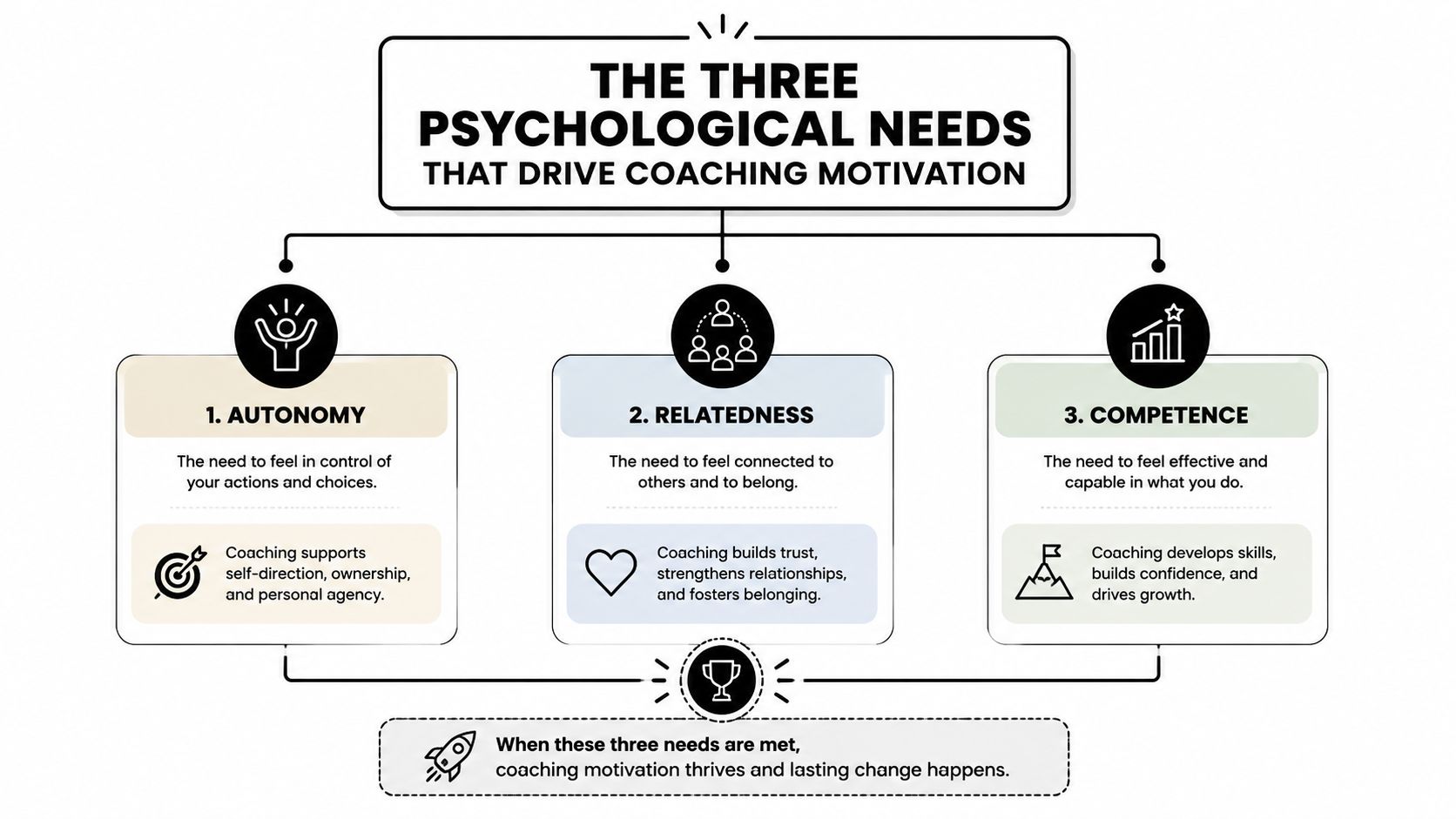
Autonomy gives the plan personal meaning
Autonomy doesn't mean allowing a client to design an unsafe or inappropriate programme. It means offering meaningful choice within professional boundaries. Let a client choose exercise order, select between suitable variations, or identify the process goal they can commit to this week. Explain why a test or exercise matters instead of presenting every instruction as a command.
In rehabilitation, you might say, “We need to build single-leg capacity. Would you rather begin with the supported split squat or the step-down today?” The clinical target remains clear, but the client has an active role in reaching it.
Competence turns feedback into evidence
Clients need credible signs that they can do difficult things. Track technique, range of motion, repeated strength tests, walking tolerance, or task quality. A progression should make capability visible, especially when the final outcome remains distant.
A client recovering from pain may not feel motivated by a future return to sport. They may respond better to noticing that they can control a movement that previously felt threatening. Achievement Goal Theory principles can help coaches frame success around controllable process improvements rather than comparison alone.
Relatedness makes challenge tolerable
Relatedness is the experience of being respected and understood. Consistent session rituals, a brief conversation before loading, and attentive responses to concerns can matter as much as a technically accurate programme. In a workplace, an employee needs a manager they can approach. In a clinic or gym, a client needs a coach who won't treat a slow session as a character failure.
For practitioners who want small, repeatable ways to reinforce learning, reflection, and capability in professional conversations, these executive growth mindset micro-practices offer a useful adjacent resource. The principle is simple: support the person's sense of development rather than using praise as a substitute for meaningful feedback.
Motivation Types and Why They Fade Over a 12-Week Block
A client can attend consistently without having autonomous motivation. Self-Determination Theory describes a continuum that runs from amotivation, through external and introjected regulation, to identified, integrated, and intrinsic regulation. The distinction is practical because each form changes how a person responds when supervision, praise, or visible results become less available.
External regulation depends on rewards, approval, penalties, or pressure. Introjected regulation sounds like “I should train” or “I'll feel guilty if I miss this.” Identified regulation appears when the person values the outcome, while integrated regulation connects the behaviour with a broader identity. Intrinsic motivation comes from interest or enjoyment, but it isn't a realistic starting point for every injured, anxious, or deconditioned client.
| Regulation Type | Early Weeks 1-4 | Mid Block 5-8 | Late Block 9-12 |
|---|---|---|---|
| Amotivation | Attendance may be inconsistent or passive | Setbacks reinforce doubt | The client may disengage unless meaning is clarified |
| External | Compliance can be strong when rewards or approval are visible | Questions arise when feedback slows | Behaviour is vulnerable when the external incentive ends |
| Introjected | Attendance is driven by guilt or obligation | Effort may become rigid and emotionally expensive | Burnout, avoidance, or shame after a missed session can appear |
| Identified | The client connects training with a valued outcome | Persistence becomes more self-directed | Carry-over into independent practice is more plausible |
| Integrated | Training fits the person's broader identity and priorities | Choices become more consistent | The client can adapt the plan without constant prompting |
| Intrinsic | Enjoyment may support exploration | Interest helps sustain effort | The person is more likely to continue because the activity itself matters |
A knee rehabilitation example
A post-operative knee client might begin with external regulation, attending because the surgeon or therapist expects it. The first useful conversation doesn't demand enthusiasm. It asks, “What would being able to trust this leg allow you to do?”
If the client identifies walking comfortably with family as meaningful, the coach can connect early exercises to that value. Later, the conversation can shift toward ownership: “Which part of the home plan feels realistic, and what would make it easier to repeat?” The coach isn't trying to force the client toward intrinsic enjoyment. They're helping the person internalise the reason for the work.
What the evidence supports
Motivational interviewing can help, but it isn't a one-off cure. A 2024 systematic review and meta-analysis found effects equivalent to about 1,323 additional steps per day, 95 additional minutes per week of moderate-to-vigorous physical activity, and roughly 51 fewer sedentary minutes per day, but the certainty of evidence ranged from low to very low and benefits didn't persist beyond one year (systematic review and meta-analysis). Build follow-up, reinforcement, and environmental support into the block rather than relying on one powerful conversation.
Assessing Motivation With Tests, Scales and Progress Data
Motivation assessment works best as a layered system. Self-report gives you the client's interpretation, while attendance, perceived exertion, and progression provide behavioural context. Neither should be treated as a perfect measurement.
Start at the door with one question: “How willing do you feel to engage with today's plan?” Ask for a brief rating, then follow with, “What's influencing that answer?” The rating opens the conversation. The explanation guides the adjustment.
Use formal tools at meaningful intervals
At intake, and again at a planned review point, consider the Behavioural Regulation in Exercise Questionnaire-3 or the Sport Motivation Scale where the tool fits your population and scope. Use the result to identify the dominant regulation pattern, not to rank clients. A person high in external regulation with little intrinsic interest may need more rationale, choice, and achievable competence markers before you increase training demands.
| Tool | When to Use | What It Measures | Coaching Action |
|---|---|---|---|
| Doorway check-in | Every session | Current willingness and context | Adjust communication, exercise order, or session demand |
| BREQ-3 | Intake and scheduled review | Regulation of exercise behaviour | Discuss values, pressure, choice, and ownership |
| Sport Motivation Scale | Sport-focused intake or review | Motivational orientations in sport | Align goals, feedback, and training environment |
| Single-item intrinsic probe | Session opening | Immediate interest or enjoyment | Select a suitable variation or create a small choice |
| Session data | Every session | Behavioural proxies | Compare attendance, RPE, progression, and confidence over time |
A single-item probe can be direct: “How interested are you in today's training, separate from how important it is?” That separates enjoyment from value. A client may care about rehabilitation while finding the exercises tedious.
When you need to compare platforms or workflows before adopting a formal process, this guide to choose the right assessment tool provides useful decision context. For broader psychological context, pair motivation notes with a Profile of Mood States assessment, while keeping mood and motivation conceptually separate.
Log the pattern beside performance
Record attendance, session RPE, confidence, exercise choice, and load progression in the same note as strength or capacity results. Watch for a client whose loads rise while confidence falls, or whose RPE increases for the same work. Those patterns don't prove a motivational cause, but they tell you to ask better questions before adding intensity.
Session Examples That Build Motivation Through Conversation
A rehabilitation client rebuilding capacity after ACL reconstruction arrives with a clear return-to-sport ambition but limited confidence. The coach uses testing data as a conversation prompt, not as a lecture.
Session one starts with the client's reason
The coach opens with, “What would returning to sport give you that you're missing now?” Then they wait. If the client says, “I want to trust my knee in front of my teammates,” the coach reflects it back: “Trust is the main outcome for you, not just a number on the programme.”
The next question is, “What are you willing to change between now and our next review?” This keeps the client involved in the action rather than producing a promise on the coach's behalf. Practitioners refining this skill can use guidance on how to master listening levels, particularly the difference between hearing words and tracking meaning.
Session two turns results into interpretation
The coach shares the isokinetic strength symmetry result without attaching a verdict: “Here's what the comparison shows. What stands out to you?” Pause before explaining. The client may focus on the difference between legs, the improvement from the previous assessment, or uncertainty about what the result means.
A useful response is, “You're noticing the gap, and you're also saying the stronger side feels less intimidating. Which part should guide this week's work?” The data remains clinically relevant, but the client supplies the meaning and helps decide the next emphasis.
Session three uses capacity to set a choice
After reviewing gains in the single-leg hop battery, ask, “Which quality do you want to make more reliable next, distance, landing control, or confidence?” If the chosen target is appropriate, convert it into a process goal for the week. The coach can then say, “What will make that practice realistic around your schedule?”
Session four consolidates ownership
Review attendance and confidence ratings together. Ask, “What did you do that helped you keep going, even when confidence dipped?” The client's answer becomes a repeatable strategy for the next phase. Finish with, “What do you want to keep, change, or stop in the next block?”
When More Motivation Backfires in Coaching
“Your client just needs to want it more” is often a shortcut around poor coaching design. Controlling environments can produce immediate compliance, but pressure, surveillance, public ranking, and performance-only language can undermine autonomy and satisfaction. A scoping review of 22 studies on motivating and demotivating motivational climates found that the field remains dominated by cross-sectional research, with one cohort study and one qualitative study, leaving important uncertainty about causality and long-term effects (scoping review).
The practical warning isn't that accountability is harmful. Clear standards can help. The issue is whether the client experiences accountability as useful structure or as surveillance that threatens their standing with the coach.
Scan for pressure signals
Look for:
- Rigid effort: The client can't tolerate a lighter session or planned rest.
- Guilt-driven attendance: A missed session leads to shame rather than problem-solving.
- Perfectionism: A small performance error becomes evidence that the whole plan has failed.
- Withdrawal: The client becomes quiet or avoids contact after a setback.
- Narrow feedback: They care only about load, rankings, or approval and dismiss technique or confidence gains.
A randomized controlled trial included in the review found coaching effective regardless of goal orientation, while learning-goal framing increased perceived goal achievement in the coaching group. That supports a more precise approach. Ask whether the person needs intensity today, or whether they need to learn, recover, practise, or regain trust.
Practical rule: If motivation makes rest feel like failure, the system needs redesigning, not another motivational speech.
Keeping the Coach Motivated so the Client Stays Engaged
The coach is part of the motivational environment. A practitioner who feels depleted may still deliver a technically correct session, but their questions become predictable, their feedback narrows, and their tolerance for uncertainty falls. Evidence focused on coaches shows that coaches' own psychological need satisfaction predicts autonomous motivation for coaching, which in turn is associated with more participative, attuning, guiding, and clarifying behaviours (review of coach motivation and supportive behaviours).
Common drains include emotional labour with chronic-pain clients, repetitive programming, income pressure that encourages overselling, and professional isolation. These aren't personal weaknesses. They're conditions that can frustrate autonomy, competence, and relatedness in the practitioner.
Run a week-six self-check
Ask yourself:
- How enthusiastic am I before each session, and is that changing across the block?
- Do my notes show fresh observations, or am I repeating the same script?
- Which part of coaching currently gives me evidence of competence?
Track enthusiasm in a simple 0 to 10 log if a numeric record helps you notice a pattern. Don't treat the number as a diagnosis. Use it as a prompt to inspect workload, boundaries, and recovery.
Restore the conditions you want to provide
Schedule a peer case review, protect time for non-coaching mastery, and introduce deliberate variation where the client's goals allow it. Set at least one autonomy-supportive boundary, such as limiting out-of-hours messaging or clarifying what belongs in a scheduled review.
A re-energised coach asks better questions and notices subtler changes in movement, confidence, and effort. That improves the feedback loop for the client, while the client's data gives the coach a more meaningful sense of progress than attendance alone.
Putting It Together With a Weekly Motivation Checklist
Every Friday, reserve a short review for three columns: measure, converse, adjust. The purpose isn't to create another administrative burden. It's to catch small changes before they become disengagement.
Measure
- Review RPE: Compare recent perceived exertion with the work completed.
- Check attendance: Note missed sessions and the client's response afterward.
- Audit language: Record whether your feedback offered rationale, choice, and specific progress evidence.
- Update regulation: Revisit the relevant motivation tool when a planned review is due.
Converse
Schedule one values check-in with a stalled client. Plan one progress conversation using a recent test result, and ask the client what the result means before you interpret it.
Adjust
Trial a choice of exercise order, a different variation, or a revised process goal. Change the environment only when it serves the person, whether that means a quieter setting, a new music rotation, or a more supportive training partner. Review practical retention principles alongside this process in 10 client retention strategies.
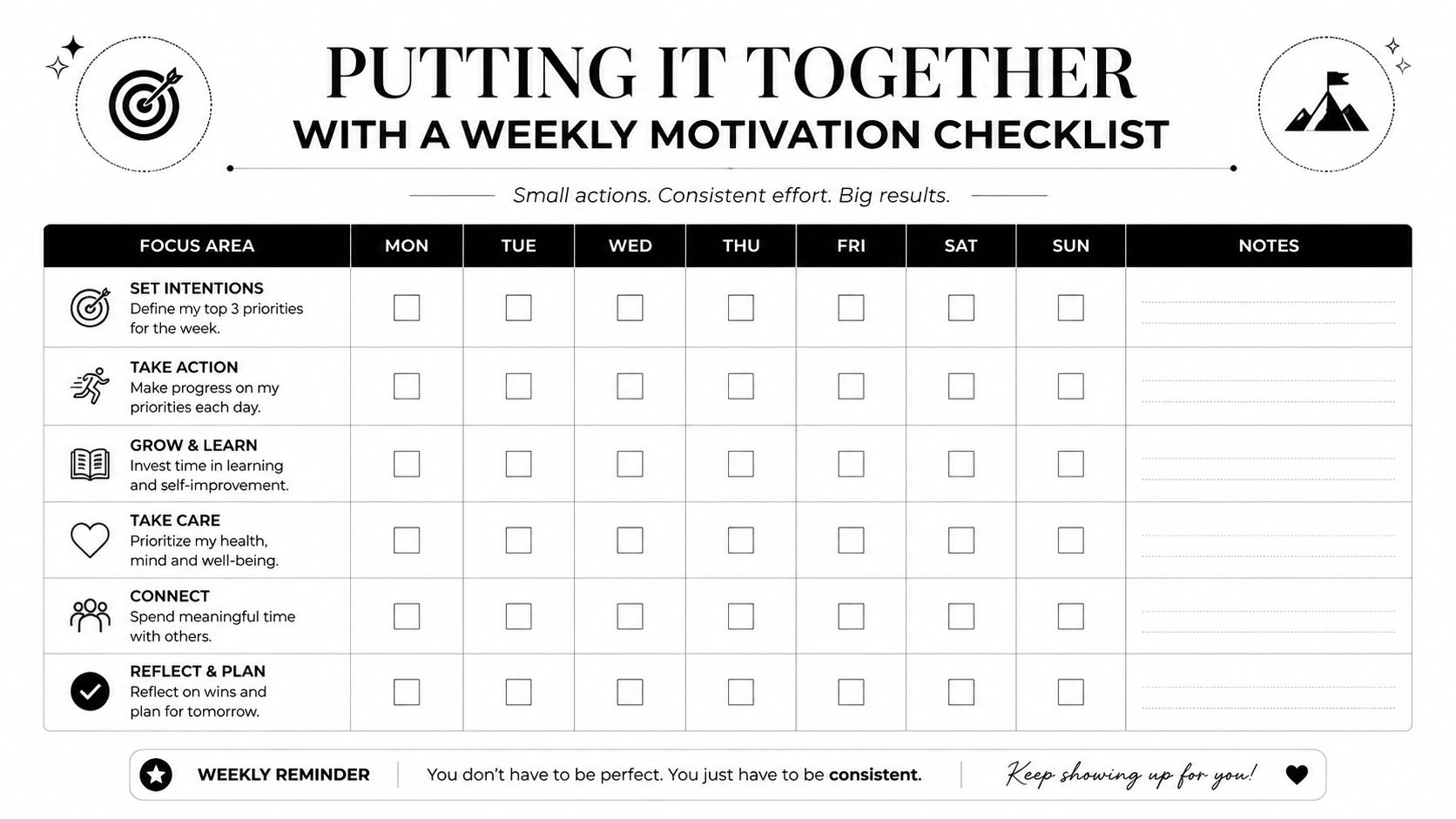
Use this short video as another prompt for reviewing how your coaching conversations support consistency.
Motivation is a system to tune, not a spark to find. Small weekly changes to measurement, conversation, and environment can do more than occasional high-pressure interventions.
Cartwright Fitness supplies validated health and fitness testing equipment and software, including Chester Step Test tools, BodyMetrix Professional Ultrasound systems, Cosmed metabolic analysers, and related consumables. Visit Cartwright Fitness to explore assessment equipment that can give your coaching conversations more reliable progress data.