

Think of it like a weather forecast for your mind. The Profile of Mood States (POMS) is a powerful tool that gives coaches and clinicians a validated snapshot of a person's current emotional climate. It helps us see the 'high-pressure systems' like tension and anxiety or the 'clear skies' of vigor and energy, allowing for smarter, more responsive training and recovery plans.
What Is the Profile of Mood States Assessment

At its heart, the Profile of Mood States is a straightforward questionnaire. But its purpose is very specific: it measures temporary, fluctuating mood states, not deep-seated personality traits. It’s like taking someone’s “psychological vital signs.” In the same way we use a heart rate monitor to track physical load, the POMS helps us track a person's emotional load with real, objective data.
And this isn't just for elite athletes. Its use is incredibly broad, helping professionals get a handle on the psychological effects of training, competition stress, injury recovery, and even the grind of daily life. By turning abstract feelings into concrete numbers, the POMS empowers you to spot trends and make decisions based on data, not just guesswork.
From Subjective Feelings to Objective Data
What makes the Profile of Mood States so effective is its ability to quantify the intangible. Instead of asking a vague question like, "How are you feeling?" and getting an equally vague answer, the POMS uses a specific list of adjectives to pinpoint distinct emotional states. This simple but brilliant approach accomplishes a few key things:
- Creates a Baseline: It gives you a clear and measurable starting point for a client's emotional state, which is absolutely critical for tracking change over time.
- Identifies Hidden Stressors: It often brings underlying fatigue or tension to the surface—things an individual might not even be consciously aware of.
- Links Mood to Performance: It helps you connect the dots between how someone feels and how they perform, highlighting risks like performance slumps or injuries.
This is invaluable because mood is directly tied to motivation, focus, and physical capacity. A high fatigue score, for instance, is a massive red flag for overtraining. It’s a signal to pull back before an athlete hits a wall. Just as physical health benefits from regular check-ups, understanding mental well-being often starts with specialised mental health screenings.
A Scientifically Validated Tool
The POMS isn't some new-age trend; it's a robust, scientifically backed instrument that has stood the test of time. Originally developed back in 1971, the first version contained 65 self-report items rated on a 5-point scale. Its psychometric properties were stellar, showing internal consistency scores between 0.84 and 0.95 and excellent test-retest reliability. This has made it one of the most trusted mood assessment tools in the world.
By translating feelings into measurable data, POMS gives practitioners a clear, actionable picture of a client’s inner world, bridging the gap between mind and body.
This long history of validation is precisely why the Profile of Mood States remains a go-to tool in sports science, clinical psychology, and any field focused on high performance. It produces dependable data that can be measured against established benchmarks. You can learn more about how this works by reading our guide on using https://www.cartwrightfitness.co.uk/what-is-normative-data/ in assessments. This gives your results crucial context, showing how a client’s mood stacks up against a wider population.
The Six Mood Dimensions POMS Measures
The real strength of the Profile of Mood States assessment is how it hones in on very specific, fleeting emotional states. It’s crucial to understand that these aren't permanent personality traits. Instead, think of them as the "emotional weather" of an individual—constantly changing based on things like training load, daily stress, and recovery.
These six dimensions are the heart of the POMS questionnaire. They give us the specific data points we need to move beyond a vague "I feel good" or "I feel bad" and really understand the feelings driving someone's performance and well-being. Each one tells a different part of the story, from the nervous energy before a big game to the deep exhaustion that screams for a day off.
The Negative Mood States
A key function of POMS is to flag negative feelings that can get in the way of an athlete's progress. These scores aren’t about diagnosing a problem, but about raising a hand to say, "Hey, something here needs a closer look."
- Tension-Anxiety: This is that classic feeling of being physically and mentally wound up. It’s the pre-competition jitters, the tight shoulders, and the racing thoughts that can shatter an athlete's focus. A high score here is a clear sign that stress levels are climbing.
- Depression-Dejection: This scale picks up on feelings of sadness, low spirits, and even a sense of personal failure. You might see this spike after a disappointing performance or during a long, grueling training block that feels like it's going nowhere.
- Anger-Hostility: This captures feelings of frustration, irritation, and antagonism. For an athlete, this might look like snapping at a teammate or feeling resentful about a coach's decision. It’s a good indicator that pressure is starting to boil over.
The Arousal and Confusion States
Beyond the more obvious negative moods, POMS also tracks energy levels and mental sharpness. These are often the first things to go when an athlete is tipping into overtraining or mental burnout.
- Fatigue-Inertia: This isn't just about feeling a bit tired. It’s a much deeper sense of weariness, lethargy, and feeling like your energy tank is completely empty. In a sports setting, a consistently high fatigue score is one of the most reliable red flags for overtraining syndrome.
- Confusion-Bewilderment: This scale measures a kind of "mental fog"—a lack of clarity or a feeling of being jumbled and disorganized. An athlete scoring high here might struggle to remember plays, feel disoriented during a game, or just find it hard to process instructions.
Vigor: The Golden Metric
The final dimension is in a class of its own. While the other five track potential problems, this one measures the very thing we’re trying to build.
Vigor-Activity: This is the golden metric. It represents a state of high energy, enthusiasm, and a genuine eagerness to perform. For any athlete or high-performer, high vigor is the ultimate goal—it's the emotional fuel for motivation, resilience, and peak performance.
When you see a high Vigor score paired with low scores across all five negative dimensions, you get what’s known as the Iceberg Profile. This pattern is famously associated with elite athletes at their peak. It gets its name from the way it looks on a graph: a single, massive peak for Vigor rising high above a flat, low line of negative moods.
By tracking these six dimensions, you can follow an athlete's journey toward this ideal psychological state. A sudden dip in Vigor or a spike in Fatigue acts as an early warning system, allowing you to adjust training or recovery protocols long before burnout takes hold. It’s this emotional data that provides a complete picture of an athlete's readiness to perform, perfectly complementing the physical metrics you’re already tracking.
How to Score and Interpret POMS Results
Collecting the POMS data is the easy part. The real skill lies in turning those questionnaire responses into meaningful insights that can genuinely shape an athlete's training or a client's recovery plan. It’s a process of simple math followed by thoughtful, expert interpretation.
The single most important number you’ll work with is the Total Mood Disturbance (TMD) score. Think of it as a quick, powerful snapshot of a person's overall psychological state at that very moment.
This is how we translate subjective feelings into a clear, measurable profile you can act on.

The flow from athlete to profile shows exactly how we build a data-driven assessment, like the famous Iceberg Profile, from an individual's mood.
Calculating the Total Mood Disturbance Score
Getting the TMD score is straightforward. You just add up the scores for the five negative mood states and then subtract the score for the one positive state, Vigor.
TMD = (Tension + Depression + Anger + Fatigue + Confusion) – Vigor
A higher TMD score means greater mood disturbance—more negative feelings and less positive energy. A lower score, or even a negative number, signals a much better emotional state. For instance, if you see an athlete's TMD score creeping up over a few weeks, that's a classic warning sign they might be heading into overtraining. It’s your cue to intervene and schedule some much-needed recovery.
Using T-Scores to Add Context
Raw scores are a great start, but they only tell part of the story. To get a much clearer picture, we convert them into T-scores. A T-score standardizes an individual's result by comparing it against a large, "normal" population. It helps answer the critical question: "Is this level of fatigue actually high, or is it pretty typical for someone in this age group?"
- A T-score of 50 is the dead average for the reference group.
- Scores above 50 on negative scales (like Tension or Anger) are higher than average.
- A score below 50 on Vigor means it's lower than average.
This step is what gives your POMS results their scientific weight. You can read more about why this matters in our guide on the importance of reliable and valid assessment methods.
Visualizing Profiles for Clearer Insights
Once you have your T-scores, plotting them on a chart is where the data truly comes to life. This visual graph makes spotting crucial patterns incredibly simple. Two of the most common profiles you'll see are the "Iceberg Profile" and its opposite, the "Burnout Profile."
The Iceberg Profile gets its name from how it looks on the chart. The Vigor score shoots up high like the tip of an iceberg, while all the negative mood scores stay flat and low, just like the surface of the water. This is the classic signature of a mentally healthy, well-prepared athlete.
On the flip side, you might see what looks like an inverted iceberg. This "Burnout Profile" would show dangerously high scores for Fatigue, Tension, and Depression, with a worryingly low score for Vigor. Seeing this pattern is an unmistakable red flag. It's a clear signal that you need to step in immediately to prevent physical or mental collapse. By turning numbers into these visual profiles, you go from being a data collector to a confident expert who truly understands a client's psychological landscape.
Putting POMS to Work in Your Practice
Knowing the theory behind the Profile of Mood States is one thing. But the real magic happens when you put it into practice. This is where the numbers on a page turn into real-world strategies that can prevent burnout, speed up recovery, and give your clients a genuine competitive edge.
Think of POMS as more than just a questionnaire. It’s a conversation starter and a roadmap for personalized care. For any professional whose work sits at the intersection of mind and body, tracking mood adds a crucial layer of insight that physical assessments alone can't provide. Let's dig into how different practitioners can put it to work.
Applications in Sports Science
For coaches and sports scientists, the Profile of Mood States is an indispensable tool for walking the fine line between peak conditioning and overtraining. Pushing an athlete to their limits is part of the game, but without careful monitoring, it's a quick trip to burnout.
POMS acts as an early warning system. By tracking an athlete’s mood scores weekly, you can spot troubling trends long before they sabotage performance. For example, a steady climb in the Fatigue score paired with a drop in Vigor is a classic red flag for overtraining syndrome. Catching this pattern allows you to proactively schedule a deload week or an extra recovery day, turning a potential disaster into a minor adjustment.
It’s also incredibly useful for managing the psychological fallout after a big game. A tough loss can send Depression-Dejection scores through the roof. By quantifying that emotional impact, you can offer targeted mental support and tweak training to help the athlete recover their mindset, not just their muscles.
Use in Clinical and Rehab Settings
In a clinical environment, like physical therapy or post-op rehabilitation, POMS gives practitioners a window into a patient’s emotional response to injury. An injury is never just a physical event; it carries a heavy emotional toll that can easily derail recovery.
A patient's mood is a surprisingly accurate predictor of how well they'll stick to their rehab program. A high Tension-Anxiety score, for instance, might reveal a deep-seated fear of re-injury, making them hesitant during exercises. Identifying this allows you to address their fears directly, offer reassurance, and modify the program to build their confidence back up. It helps you treat the person, not just the injury.
The versatility of POMS is well-documented across a huge range of clinical and non-clinical groups. It’s been validated in athletes, psychiatric patients, older adults, and individuals managing chronic conditions like multiple sclerosis and HIV. It was even selected by the IMMPACT initiative because it's brief, easy to use, and effectively measures key dimensions like anxiety and anger in people without a formal psychiatric diagnosis.
Guidance for Personal Trainers
Even in a general fitness setting, a quick POMS check-in can completely change the game. For personal trainers, knowing a client’s mood helps you decide whether it’s a day to push for a new personal record or focus on recovery.
Imagine a client walks in with rock-bottom Vigor and sky-high Fatigue. Forcing them through a grueling high-intensity workout is a recipe for injury or burnout. Instead, you can pivot to a session focused on mobility, technique, or active recovery. This responsiveness demonstrates that you’re paying attention to their total well-being, which builds incredible trust and boosts long-term results.
When POMS does reveal heightened stress, you can also guide clients toward helpful resources. Integrating effective workplace stress management techniques can be a crucial step in improving their mental state both in and out of the gym.
POMS Application Across Professional Fields
The Profile of Mood States isn't just a niche tool; its applications span a wide variety of professional fields where understanding a person's mental state is key to achieving results. The table below highlights how different professionals can leverage POMS in their daily work.
| Professional Role | Primary POMS Application | Key Benefit |
|---|---|---|
| Sports Coach | Monitor for overtraining and burnout. | Optimize training loads and prevent performance decline. |
| Physical Therapist | Assess psychological response to injury. | Improve patient adherence and address recovery barriers. |
| Clinical Psychologist | Track mood fluctuations during therapy. | Quantify treatment progress and guide interventions. |
| Personal Trainer | Gauge daily readiness for exercise. | Personalize workouts and build stronger client relationships. |
| Corporate Wellness | Measure employee stress and burnout levels. | Inform wellness initiatives and improve workplace morale. |
Ultimately, whether you're working with an elite athlete or a weekend warrior, POMS provides a simple yet powerful way to listen to what the body and mind are trying to tell you.
Creating a Holistic Athlete Profile
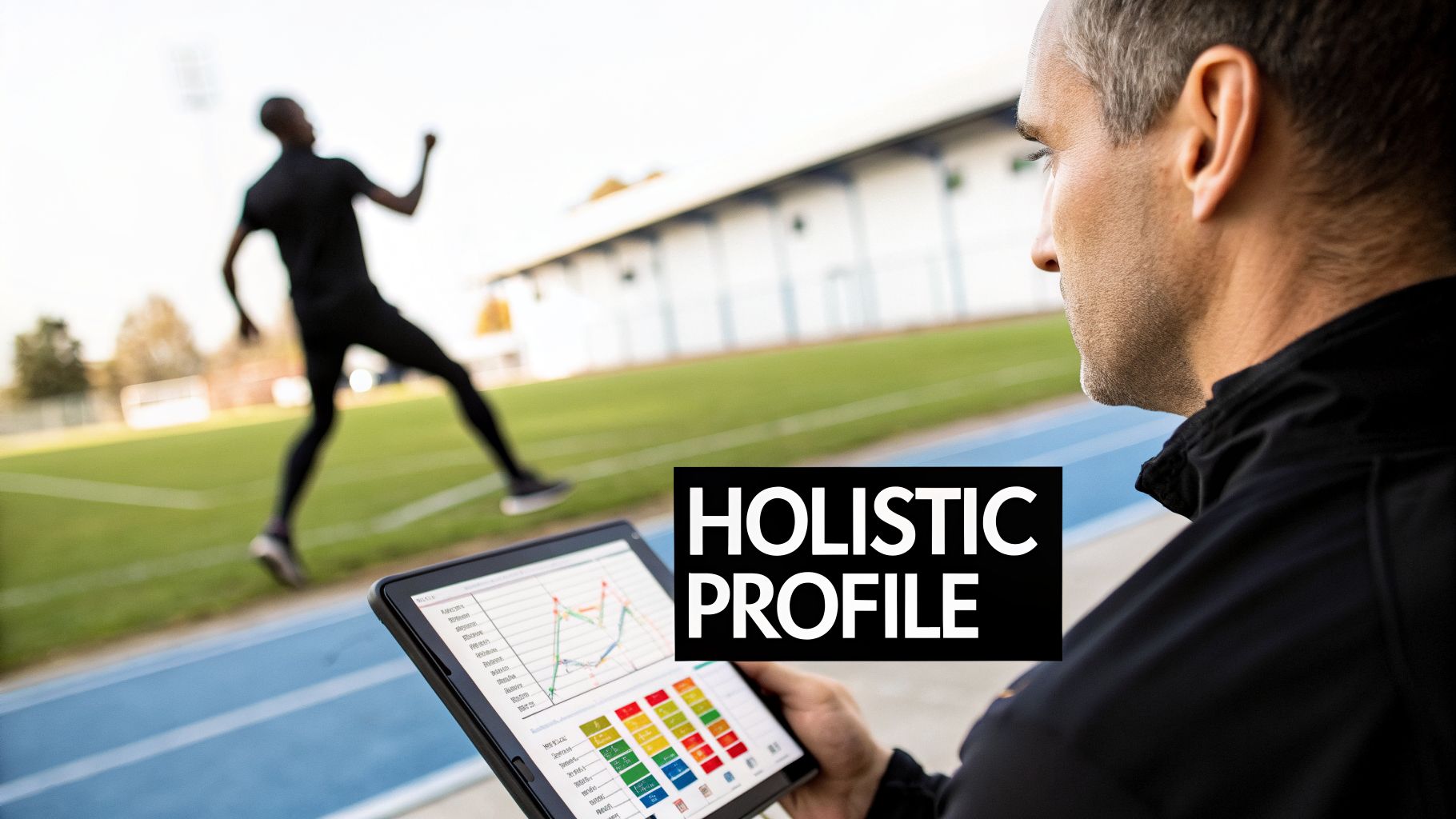
Physical assessments are fantastic at telling you the "what" of an athlete's performance—their VO2 max, body composition, or one-rep max. But those numbers often leave you wondering about the "why." This is where the Profile of Mood States comes in, giving you a direct look into the psychological state driving those physical outputs.
When you bring these two worlds together, you stop being a simple data collector and start becoming a true performance detective. You can finally see the connections between mind and body, helping you figure out if an athlete has hit a genuine physical wall or if a psychological barrier is holding them back.
Connecting POMS to Physical Data
The real magic happens when you pair the psychological insights from a Profile of Mood States assessment with the hard physiological data you’re already gathering. After all, a dip in performance on a test rarely tells the full story on its own. Is it a lack of fitness, or is it just a symptom of something bigger going on under the surface?
Think about an athlete whose progress on the Chester Step Test has completely stalled. For weeks, their heart rate recovery has been sluggish, and their endurance seems to have hit a ceiling. On paper, it looks like a clear-cut cardiovascular limitation.
But what if you add a POMS assessment? Suddenly, you see consistently high scores for Fatigue and worryingly low scores for Vigor. That plateau is no longer just a physical issue. It's a massive red flag for mental and emotional exhaustion. The problem isn't that their heart and lungs can't keep up; it's that they are running on fumes. This insight completely changes your approach, shifting the focus from "push harder" to "recover smarter" with an emphasis on sleep and stress management.
A Workflow for Integrated Assessment
The best time to start weaving these assessments together is right from day one. By creating both a physical and a psychological baseline during your client intake, you build a powerful foundation for tracking how these two aspects influence each other over the long haul.
Here’s a simple but effective workflow to get started:
- Initial Physical Screening: First, run your standard battery of tests. This could include a BodyMetrix Ultrasound for body composition, a Chester Step Test for aerobic fitness, and any relevant strength assessments. This gives you the objective data on their physical capacity.
- Administer the POMS: Either right before or just after the physical tests, have the client complete the POMS questionnaire. This gives you a clean snapshot of their mood state before the stress of the day’s training kicks in.
- Analyze and Correlate: Now, look at both sets of data together. Start searching for patterns. Does a high Tension-Anxiety score seem to correlate with sloppy technique or poor movement patterns? Do elevated Confusion scores line up with an athlete struggling to grasp new drills?
By overlaying mood data onto performance metrics, you create a multi-dimensional client profile. You can see not only where they are physically, but also understand the emotional and mental factors driving their results.
This process is a fundamental part of building a comprehensive client picture. For a much deeper dive into this concept, you can learn more about what performance profiling is and how to use it in your own practice.
Putting these pieces together provides answers that one-dimensional testing simply can't. You get the whole story, which allows you to build programs that fix the root cause of a performance issue, not just the symptoms. You're no longer just following numbers; you're equipped with a much deeper understanding of the person right in front of you.
Why Mood Assessment Is Critical in 2026
For years, we've been taught to track the physical side of fitness—sets, reps, weight, and PRs. But as seasoned pros know, those numbers only tell part of the story. The truth is, the invisible battles your clients fight outside the gym often have the biggest impact on their performance inside it. Understanding a client's mood isn't just a "nice-to-have" anymore; it's becoming a core part of effective coaching.
When you use a tool like the Profile of Mood States, you're opening a door to a much deeper connection. It's a simple, tangible way to show you’re paying attention to the hidden struggles that might be derailing their progress. When you have that emotional context, you can build programs that truly support their whole well-being, not just their physical goals.
The Mental Health of Your Core Clientele
If you need convincing, just look at the global trends. The data reveals a sharp decline in psychological well-being, hitting one of the fitness industry's biggest demographics the hardest: younger adults.
Global mental health data from 2024 shows that adults aged 18-34 are experiencing substantially diminished psychological well-being. Their average Mental Health Quotient (MHQ) was just 38, with a staggering 41% experiencing functionally debilitating distress.
That’s a stark contrast to adults aged 55 and older, who posted an average MHQ of 101. You can dive into the full demographic breakdown in the 2024 Mental State of the World report. These aren't just abstract statistics; they represent the very people walking into your facility every single day, carrying a heavy psychological load that directly affects their energy, focus, and ability to train.
From Motivation to Genuine Support
This reality demands that we evolve our definition of great coaching. A simple "you can do it!" isn't enough for a client who is battling deep-seated fatigue, tension, or feelings of hopelessness. Pushing someone who is already running on empty is a surefire way to cause burnout and, ultimately, lose a client.
This is precisely where a profile of mood states assessment proves its worth. By adding a quick, validated mood check-in to your process, you can immediately shift the dynamic.
- Show You Genuinely Care: It signals that you see them as a whole person, not just another body to train. This alone can build incredible trust and loyalty.
- Personalize on a Deeper Level: You gain the insight needed to adjust the day's session based on their emotional state. A high fatigue score might mean swapping a grueling HIIT workout for an active recovery and mobility session—a decision that supports them instead of breaking them.
- Boost Adherence and Get Better Results: When clients feel understood, they are far more likely to stick with their program. By addressing the real obstacles to their success—whether physical or mental—you clear the path for sustainable, long-term change.
Looking ahead to 2026 and beyond, the most successful fitness professionals will be the ones who embrace this holistic view. They will be the coaches who understand that a person's mental state isn't separate from their physical performance—it’s the very foundation it's built on.
POMS in Practice: Your Questions Answered
Once you grasp the fundamentals of the Profile of Mood States, the real-world questions start to surface. How do you actually use it? Which version is right for your client? What do you do with the results? This section tackles those common questions head-on, giving you the practical insights you need to use the POMS assessment confidently and professionally.
Getting these details right is what separates a good practitioner from a great one. It’s all about using the tool ethically and effectively.
What Are the Different Versions of the POMS Test?
The POMS has evolved since its creation, and you now have a few options to choose from. The one you pick really depends on how much time you have and the level of detail you need.
The Original POMS (1971): This is the classic, comprehensive version. With 65 questions, it gives you the most detailed snapshot of an individual's mood state. It's the gold standard for a deep dive, but it does take the longest to complete.
POMS-SF (Short Form): When time is tight, the Short Form is your best friend. It trims the assessment down to just 30 to 40 items, making it perfect for quick check-ins, like before a competition or during a high-volume training week.
POMS 2: This is the modernized version. It keeps the trusted core of the original but comes with updated scoring data and a more streamlined process. The POMS 2 also offers different lengths, including versions specifically for adults and youth, helping you match the test to your population.
Think about your goal. For an in-depth annual psychological screen, the full POMS or POMS 2 is probably your best bet. For monitoring an athlete week-to-week, the POMS-SF is far more practical.
Is POMS a Diagnostic Tool for Mental Illness?
This is an absolutely critical point: POMS is not a diagnostic tool. It was never designed to diagnose clinical conditions like depression or anxiety disorders, and using it that way is unethical and irresponsible.
Think of POMS as a thermometer for mood, not an MRI for mental illness. It tells you if there's a 'fever' (high mood disturbance), but it doesn't tell you the underlying cause or diagnose the specific 'illness.' It measures transient, or temporary, feeling states.
For instance, a high score on the Depression-Dejection scale simply means the person is feeling very sad or down at that moment. It does not mean they have clinical depression. If you see consistently high negative scores over several weeks, your professional responsibility is clear: refer that individual to a qualified mental health professional for a proper diagnostic workup.
How Often Should I Administer the POMS Assessment?
There's no single "right" answer here—the ideal frequency depends entirely on what you're trying to achieve. Here are a few battle-tested approaches from the field:
During Heavy Training Blocks: A weekly POMS check-in with athletes is a fantastic way to spot the early signs of overtraining syndrome. If you see Fatigue scores climbing while Vigor scores are dropping, that’s a red flag telling you it might be time for a recovery day before they burn out.
Pre- and Post-Competition: Using the POMS a day before and a day after a big event can tell you a lot about an athlete's mental game. You can see how they handle pressure and, just as importantly, how quickly their mood bounces back to baseline afterward.
During Injury Rehabilitation: For a patient working through a long recovery, a bi-weekly or monthly POMS can be invaluable. It helps you track their emotional journey alongside their physical progress. A sudden spike in Anger or Depression could signal frustration, giving you a chance to adjust their program or offer more support.
When you integrate these assessments correctly, they provide a much richer understanding of your clients. Of course, having the right tools makes all the difference. Cartwright Fitness specializes in providing the validated equipment you need to build a complete picture of performance and well-being. Discover our full range of professional testing equipment.