
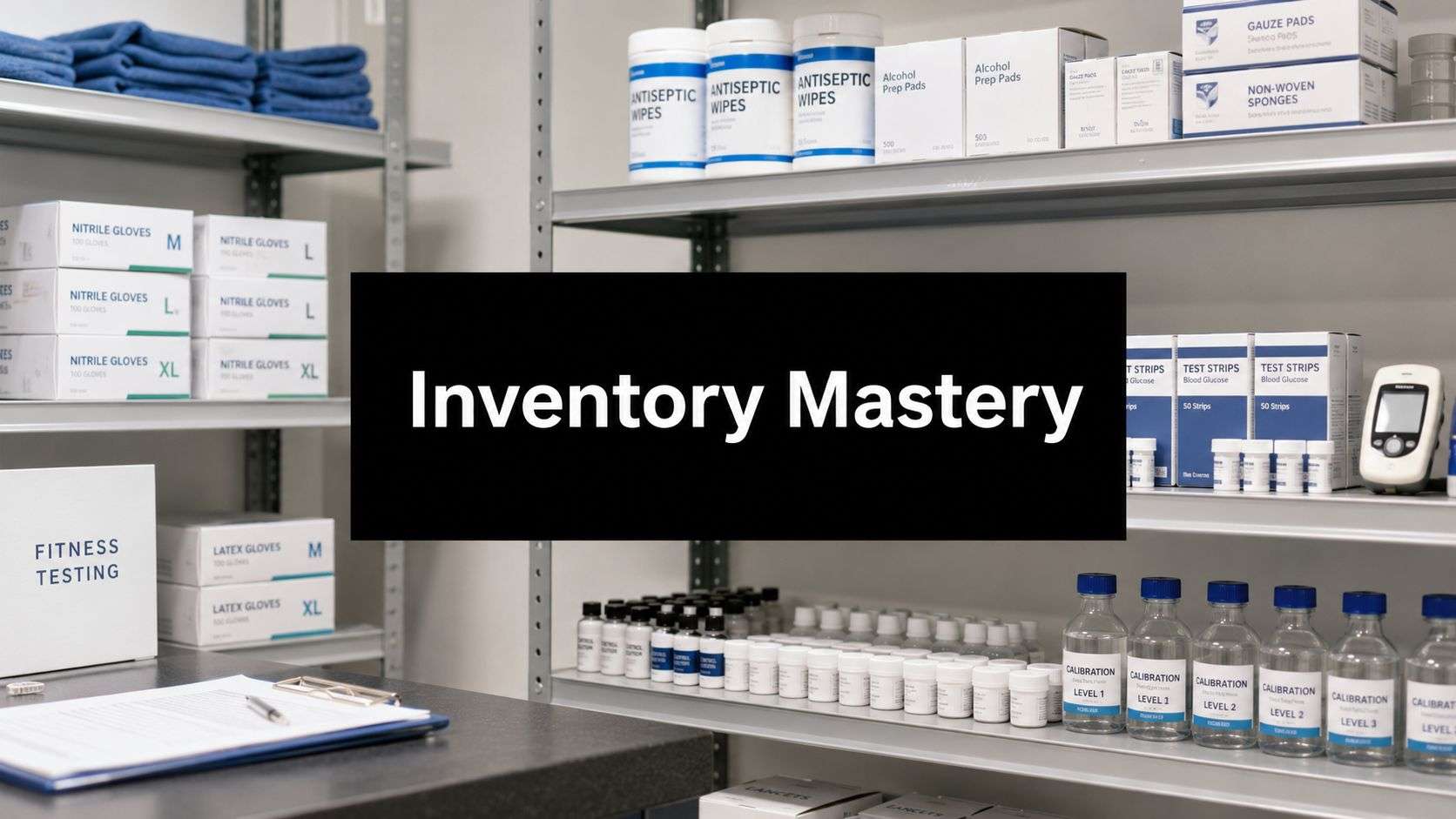
You're probably reading this because your stock cupboard looks full, yet the one item you need for today's test block is missing. The ECG electrodes are down to a half-open sleeve. The calibration fluid is close to expiry. Someone opened the last box of lancets without logging it. A VO2 test is booked in an hour, and now you're checking drawers, back rooms, and old delivery boxes instead of preparing the client.
That's how consumables inventory management fails in most small fitness and clinical settings. Not with a dramatic warehouse problem. With a missing packet, an expired bottle, or a rushed order placed too late.
In a lab or performance facility, consumables sit in an awkward middle ground. They're not glamorous like the analyser or software platform, but they decide whether the session runs on time. Electrodes, turbine parts, printer rolls, gloves, wipes, Roche lactate strips, gas canisters, test kits, disinfectant, and calibration supplies all have to be available, traceable, and usable. If they aren't, the equipment you paid for can't do its job.
Table of Contents
- Why Your Consumables Cost More Than You Think
- First Steps Audit and Categorize Your Inventory
- Set Smart Par Levels and Reorder Points
- Manual vs Software Choosing Your Tracking Method
- Mastering Day-to-Day Operations Storage and Ordering
- Measure What Matters KPIs for Inventory Control
Why Your Consumables Cost More Than You Think
The obvious cost is the invoice. The hidden cost is everything that happens after poor control.
A missed delivery of calibration gas can cancel a testing block. An expired bottle of calibration fluid can invalidate prep work. Running out of wipes, mouthpieces, or single-use accessories slows staff down because they start improvising. In a fitness lab, that doesn't just waste supplies. It disrupts bookings, staff time, and client trust.
Organizations don't typically lose money on consumables because the items are individually expensive. They lose money because the process is sloppy. One person orders by memory. Another stores fresh stock in front of old stock. A third opens a new pack while an older one sits in another cupboard. By the time anyone notices, you've paid for duplicate stock, urgent shipping, and wasted appointment time.
Small items create big operational friction
In practice, the damage shows up in three places:
- Rush purchasing: You pay more because the item is needed now, not next week.
- Waste through expiry: Perishable consumables such as electrodes, reagents, and fluids sit too long and get binned.
- Service disruption: The athlete, patient, or student doesn't care why the test was delayed. They remember that it was delayed.
Practical rule: If a low-cost item can stop a booked assessment, treat it like an operational risk, not a stationery problem.
This is the same mindset used in managing facility asset expenses. The purchase price rarely tells the whole story. Storage, waste, downtime, repeat orders, and admin time all belong in the total cost.
Consumables are an operational asset
Teams often focus on the analyser, treadmill, spirometer, or software licence because those are visible investments. Consumables don't get the same attention, even though they determine whether the equipment can be used properly on a given day.
That's why good consumables inventory management starts with a reframing. Stop treating supplies as background clutter. Treat them as the enabling layer of your service.
A simple example makes the point. A metabolic cart may be maintained perfectly, but if the correct consumable part isn't available, the session still fails. The test doesn't happen because the workflow is broken at the lowest level.
The fix isn't complicated. It does require discipline. Count what you have, sort what matters most, set reorder triggers before panic starts, and make shelf organisation visible enough that anyone on the team can follow it. That's what separates a tidy cupboard from a reliable inventory system.
First Steps Audit and Categorize Your Inventory
Most labs think they know what they hold until they do a proper count. Then they find duplicate orders, half-used boxes with no dates, and expensive items mixed in with everyday supplies.
The first reset is physical, not digital. Walk the site and count everything that gets used up. Include testing rooms, treatment areas, mobile kits, storage cupboards, office drawers, and any “temporary” overflow shelves that became permanent months ago.

Start with a physical count
Create one master list. Each line should record the item name, pack size, quantity on hand, storage location, supplier, expiry date if relevant, and who uses it.
For a fitness testing environment, that usually includes:
- Assessment-specific items: electrodes, lactate strips, sampling accessories, mouthpieces, bacterial filters, turbine consumables, calibration gas, and calibration fluids
- General clinical supplies: gloves, disinfectant, wipes, paper roll, alcohol prep pads, disposable towels
- Equipment support items: printer paper, batteries, replacement sensors, tubing, and manufacturer-specific parts
A count only helps if the names are consistent. “Electrodes,” “ECG pads,” and “sticky sensors” can't live as three separate entries. Standardise the description so you can see true stock levels.
Use ABC logic to decide what deserves attention
Not every item needs the same level of control. That's where ABC classification helps.
Applying the ABC method to consumables management shows that A-items make up only about 20% of stock inventory but account for about 80% of total purchases, and they need close monitoring with a 99% service level target, while C-items need less attention and a 90 to 95% service level according to Itefy's overview of consumable inventory management.
In a small lab, that can look like this:
| Class | Typical examples | How to manage them |
|---|---|---|
| A-items | calibration gas, analyser sensors, specialist test kits | Count often, keep tighter approval, review expiries first |
| B-items | electrode packs, turbine flow consumables, lancets | Track regularly, maintain clear reorder points |
| C-items | wipes, paper towels, gloves, printer rolls | Simpler controls, bulk visibility, less admin |
The point isn't to build a perfect academic model. It's to stop treating calibration gas and couch roll as if they deserve the same attention.
The fastest way to improve control is to spend most of your effort on the few items that can stop testing or quietly drain budget.
Once the categories are set, mark them physically. I prefer shelf labels or bin labels that show the ABC class, expiry sensitivity, and normal storage location. Staff make fewer mistakes when the system is visible.
For teams that also handle shipped products or multi-location stock, some of the same thinking used to streamline e-commerce fulfillment applies surprisingly well. Clear naming, consistent locations, and standard reorder habits matter just as much in a lab cupboard as they do in a warehouse.
Set Smart Par Levels and Reorder Points
Counting stock is reactive. Par levels and reorder points make the system proactive.
A par level is the minimum working quantity you want available. A reorder point is the trigger that tells you it's time to buy again. If you don't define both, staff fall back on instinct, and instinct is unreliable when client volume swings.
Start this section with the basic visual model, then build your numbers around it.

Use a formula, then adjust it to real life
A solid method for consumables inventory management begins by grouping items by usage and criticality, then setting reorder alerts. The reorder point formula is (Average Daily Usage × Lead Time) + Safety Stock as outlined in Argos Software's guide to tracking consumables.
That formula is simple enough to use in a spreadsheet:
- Average daily usage means what you consume in normal operation
- Lead time means how long the supplier usually takes to deliver
- Safety stock is your buffer for delays, damaged goods, extra bookings, or staff forgetting to order the same day
If you use specialist items such as Roche lactate strips, the safety stock matters more than people expect. These aren't items you want to discover are low during a teaching block or testing clinic.
Here's the practical mistake I see most often. Teams calculate a reorder point once, write it down, and never revisit it. That works for stable demand. It fails in real labs, where usage changes with term dates, athlete screening windows, staff rotas, and event schedules.
A small table keeps the logic clear:
| Item type | Better approach |
|---|---|
| High-value, critical | Lower tolerance for stockouts, tighter review cycle |
| Perishable | Smaller buys, more frequent checks, expiry-first logic |
| Cheap but fast-moving | Simple min-max level, visual trigger on shelf |
A par level should reflect how the item behaves, not just how often it's ordered.
Build micro-reorder points for busy periods
Many small facilities get caught by static thresholds. The cupboard looks fine during a quiet week, then a university practical block or pre-season testing run eats through stock in days.
That's why I recommend micro-reorder points for items with sharp, predictable swings. Instead of one fixed threshold all year, set a normal trigger and a peak-period trigger.
Examples:
- Electrodes: one reorder point for routine clinic use, a higher one before team screening days
- Calibration consumables: a standard level for weekly tests, then a temporary uplift before a teaching module or research phase
- Disposables for field kits: a separate trigger for outreach sessions so mobile work doesn't cannibalise in-house stock
This doesn't need expensive software. A calendar note, a peak-season column in a spreadsheet, or a laminated reorder sheet by month can do the job.
To make the numbers useful, review them after each busy block. If you repeatedly finish with excess perishable stock, the peak threshold is too high. If staff are still borrowing from unopened backup packs, it's too low.
A lot of inventory advice stops at formulas. In a fitness or clinical lab, the better question is whether the trigger reflects actual booking patterns. If it doesn't, the math is neat but the stockroom still fails.
Later in the section, it helps to see the workflow in motion:
Manual vs Software Choosing Your Tracking Method
Most small facilities ask the wrong question. They ask, “Should we buy software?” The better question is, “What method will our team use every day?”
A brilliant system nobody follows is worse than a basic one that gets updated consistently. That's why manual methods still deserve serious respect, especially in single-site fitness labs, university teaching rooms, and small clinical services.

When manual systems work well
A manual setup can be excellent if stock volume is modest and the team is disciplined.
The strongest low-cost methods are simple:
- Two-bin system: staff use from the front bin first. When it empties, they reorder and move to the reserve bin.
- Colour-coded FIFO labels: older stock gets a visible label so nobody grabs the newest pack first.
- Monthly count sheet: one person counts key items on the same day each month and signs it off.
- Issue logbook or spreadsheet: stock taken from store is recorded at the point of use, not “later”.
This isn't just budget-friendly advice. A 2025 Harvard Business Review analysis found that 55% of SMBs achieve better waste reduction through simple, low-tech solutions than through expensive software, as cited in this discussion of consumable inventory management for SMBs.
That matches what many practitioners see. Badly implemented software often creates false confidence. Staff assume the dashboard is right even when nobody has booked stock out properly.
A paper checklist used consistently beats a neglected platform every time.
If your operation is small, one locked cupboard, a labelled shelf map, and a disciplined spreadsheet may be enough.
When software earns its keep
Software starts making sense when the operation gets harder to manage by eye.
That usually means one or more of these conditions apply:
- Multiple locations: stock is spread across rooms, buildings, or mobile kits
- More users: several staff members remove supplies and not all of them order
- More traceability: you need stronger reporting on usage, expiry, or purchasing
- More volatility: busy periods create usage spikes that are difficult to track manually
There's also a market signal behind this shift. The global inventory management market reached $2.76 billion in 2025 and is projected to grow to $3.89 billion by 2030, at a CAGR of 7.1%, according to Swell's inventory management statistics roundup. That doesn't mean every lab needs software. It does show that more organisations are looking for better visibility and automated replenishment.
A reasonable middle path is often best. Use a spreadsheet and visual labels first. Once the process is stable, look at whether sports facility management software or a dedicated inventory tool fits the scale of your operation.
Here's a practical comparison:
| Question | Manual system | Software |
|---|---|---|
| Team size is small and stable | Usually enough | Often unnecessary |
| Multi-room or multi-site stock | Harder to maintain | Much easier |
| Need auto alerts | Manual reminders | Built-in |
| Budget is tight | Strong option | Needs clear ROI |
Choose the simplest method that gives reliable visibility. Don't pay for features that replace a discipline problem with a subscription.
Mastering Day-to-Day Operations Storage and Ordering
Inventory systems usually break on ordinary days, not exceptional ones. The count may be accurate and the reorder points sensible, but if staff can't see what to use first, where to put new deliveries, or how to flag damage, stock control drifts almost immediately.
Consumables also take up more room than many teams realise. According to industry analysis, consumable inventory stock occupies approximately 20% of a company's total storage space, which is why shelf layout and access rules matter so much in practice, as noted in this guide to consumables inventory management.

Make FIFO obvious on the shelf
FIFO means first in, first out. Older stock gets used before newer stock. Everyone says they do it. Fewer teams build the shelves so it happens automatically.
Use practical shelf rules:
- Date every incoming pack: write the received date and, if relevant, the expiry date where it can be seen instantly
- Load new stock behind old stock: don't rely on memory
- Separate opened from unopened boxes: partly used stock hidden behind sealed packs causes duplicate opening and waste
- Create a quarantine spot: damaged, expired, or questionable items should never stay on the active shelf
For perishable items like fluids, sensors, or specialist clinical consumables, shelf visibility matters more than neatness. A tidy cupboard can still hide waste if the labels face inward or the oldest stock is buried.
Write a simple ordering routine your team can follow
Most facilities don't need a long SOP. They need a short one that staff will indeed follow.
A workable daily and weekly routine looks like this:
On receipt
Check quantity, product match, visible damage, and date-sensitive details before the item is shelved.On storage
Put stock in its assigned location, rotate older stock to the front, and update the count sheet or system immediately.On issue to staff or testing room
Record what left the store. If it's going into a mobile kit, assign it to that kit rather than treating it as “still in stock”.On low stock trigger
Raise the order on the same day. Don't leave it for the next admin block.On weekly check
Review critical items, short-dated items, and any products that have moved unexpectedly fast.
This is also where procurement discipline helps. Use approved suppliers where possible, keep order quantities sensible, and avoid panic buying substitutes unless the team has agreed they're suitable for the protocol.
If you already rely on a service routine for equipment, add consumables checks into the same rhythm. A fitness equipment maintenance checklist works better when it's paired with a quick review of the parts and supplies that let that equipment run.
Store by workflow, not by purchase category. Keep the items used together physically close together.
That one change often cuts wasted motion immediately. If mouthpieces, wipes, filters, and calibration supplies live in separate corners, staff will create unofficial mini-stashes in testing rooms. Once that happens, central stock accuracy is gone.
Measure What Matters KPIs for Inventory Control
If you don't measure the system, you'll drift back into guesswork.
The goal isn't to build a complicated dashboard. It's to track a short list that tells you whether stock is available, moving properly, and expiring too often. In fitness and clinical settings, that matters because waste is rarely dramatic. It accumulates subtly in opened packs, forgotten backup cupboards, and products that age out before anyone notices.
There's a hard reason to watch this closely. A 2024 report from the International Facility Management Association found that 41% of fitness and clinical testing facilities discard $1,200+ annually in expired consumables due to inadequate manual tracking processes. In this article, I'm citing that figure without repeating the source link used earlier, because the same source URL must only appear once.
Track a short list consistently
These KPIs are enough for most small and mid-sized facilities:
- Stockout frequency: how often a required item wasn't available when needed
- Wastage cost: the value of expired, damaged, or discarded consumables
- Order accuracy: whether what arrived matched what was ordered and could be used immediately
- Turnover by item: which products move fast, move slowly, or linger too long
- Expiry exposure: which items are most likely to become waste in the next review period
A simple monthly review works. For each expired or discarded item, record the product, quantity, reason, and whether the cause was over-ordering, poor rotation, or demand that never materialised.
Use the numbers to improve the system
The point of KPIs is action.
If stockouts keep appearing on B-items, the reorder point is probably wrong or staff aren't logging use. If wastage clusters around one perishable line, the purchase quantity may be too large. If one supplier repeatedly sends short-dated stock, that's a purchasing problem, not an inventory mystery.
A short purchasing review helps here. If your team needs a cleaner process for approvals, receipt checks, and exceptions, this guide to managing purchase orders efficiently is useful background.
Keep the review grounded in operations. Ask:
- What ran out?
- What expired?
- What was ordered too late?
- What was ordered in the wrong quantity?
- What forced staff to improvise?
Those answers tell you where the process is weak. Once you fix those points, consumables inventory management stops being a recurring fire drill and becomes routine operational control.
If you need reliable testing consumables, validated equipment, or practical support for setting up a tighter stock process around your assessment workflow, Cartwright Fitness is a strong place to start. Their range covers professional fitness and clinical testing environments, including specialist equipment and consumables that need to be accurate, available, and fit for day-to-day use.