

Metabolic testing is a powerful way to look under the hood and see exactly how your body’s engine runs. It gives us two vital pieces of information: your precise metabolic rate (the number of calories you burn) and what your body prefers to use for fuel—carbohydrates or fats—both at rest and during activity.
Your Body's Engine Explained
Think of your body like a high-performance car. Some engines are built for incredible efficiency, sipping fuel to go the distance. Others are built for pure power, guzzling fuel for quick bursts of speed. Just like every car engine is different, every human metabolism is unique.
Most health advice relies on standard formulas to guess your "fuel" needs. That’s like using the average MPG for all cars on the road to predict how your specific car will perform. It's a shot in the dark.
Metabolic testing changes all that. It's the diagnostic tool we can hook right up to your engine to get a precise, real-time reading. We stop guessing and start measuring.
Moving Beyond Basic Formulas
At its core, metabolic testing works by analyzing the air you breathe. By measuring the oxygen you consume (O2) and the carbon dioxide you produce (CO2), a test can calculate exactly how much energy your body is using at any given moment. This simple process unlocks two game-changing insights:
- Caloric Burn: We can pinpoint your unique resting metabolic rate (RMR). This is the number of calories your body burns just to keep the lights on—for basic functions like breathing and cell repair. It’s your personal energy baseline.
- Fuel Preference: The test also reveals whether your body is primarily burning fats or carbohydrates to create that energy. This is absolutely critical for fine-tuning a nutrition plan for fat loss, improving endurance, or simply optimizing your overall health.
This shift toward hard data is catching on in a big way. The global metabolic testing market was valued at around USD 547 million recently and is on track to nearly double, projected to hit USD 1.06 billion by 2033. This boom shows a clear demand for personalized health strategies that actually work. You can dig deeper into these numbers with the full metabolic testing market research.
Key Takeaway: Metabolic testing gives you a personalized health blueprint based on your unique physiology. It swaps vague estimates for concrete data, empowering you to make truly informed decisions about your nutrition and fitness.
Ultimately, understanding what metabolic testing is means recognizing its power to build a hyper-personalized roadmap. It translates complex biology into actionable numbers, giving you the foundation for a nutrition and fitness plan that is built specifically for you.
Metabolic Testing Metrics at a Glance
To make this even clearer, let's break down the key measurements from a metabolic test and what they mean in practical terms. This table simplifies the core data points and shows how they directly relate to your health and fitness goals.
| Metric | What It Measures | What It Means for You |
|---|---|---|
| VO2 Max | The maximum amount of oxygen your body can use during intense exercise. | This is the gold standard for measuring your cardiovascular fitness and aerobic endurance. |
| RMR | Resting Metabolic Rate—the number of calories your body burns at complete rest. | This is your baseline for creating a nutrition plan. Eating below this number leads to weight loss. |
| RER | Respiratory Exchange Ratio—the ratio of CO2 produced to O2 consumed. | This tells you if your body is burning carbs or fats for fuel at any given moment. |
| Metabolic Efficiency | The point where your body switches from burning primarily fat to burning primarily carbohydrates. | Knowing this helps you train smarter to improve your body's ability to burn fat for fuel. |
These metrics aren't just abstract numbers; they are the building blocks of a truly personalized health strategy. They provide the "why" behind what's happening in your body, allowing for precise adjustments that lead to real, sustainable results.
Measuring Your Idle Speed and Redline
Not all metabolic tests are created equal. Just as a car has an idle speed and a redline, your body operates in different metabolic gears. The two main types of tests—Resting Metabolic Rate (RMR) and VO2 Max—are designed to measure these distinct states, giving us different but equally valuable pieces of information.
Your Body's Idle: The RMR Test
Think of an RMR test as finding your engine’s idle speed. It pinpoints the absolute minimum number of calories your body needs to keep the lights on—powering essential functions like breathing, circulating blood, and repairing cells while you're completely at rest. This is your personal metabolic baseline, the energy cost of simply being alive.
The process itself is quite relaxing. You'll sit back in a comfortable chair for about 15-20 minutes, breathing normally into a mask or mouthpiece. This is connected to a metabolic analyser that captures every breath to calculate your precise caloric burn. We dive much deeper into the specifics in our guide on how to measure resting metabolic rate.
Pushing to the Limit: The VO2 Max Test
If RMR measures your idle, then a VO2 max test is all about finding your engine’s redline. This is a full-throttle assessment of your peak physical performance. It measures the maximum amount of oxygen your body can effectively absorb and use during intense, all-out effort.
That single VO2 max number is widely seen as the gold standard for gauging cardiovascular fitness and aerobic endurance.
As you’d expect, the protocol is far more active. You’ll be on a treadmill or stationary bike, with the intensity gradually cranked up until you hit your absolute limit. The whole time, a mask measures your oxygen consumption and carbon dioxide output, pinpointing the exact moment your body reaches its peak capacity.
For serious athletes or anyone looking to truly optimise their fitness, this data is gold. It allows a coach or trainer to map out incredibly precise training zones, making sure every workout is structured to build endurance, boost performance, and prevent burnout.
The image below shows a clinician using a metabolic analyser, the sophisticated technology that makes both RMR and VO2 max testing possible.
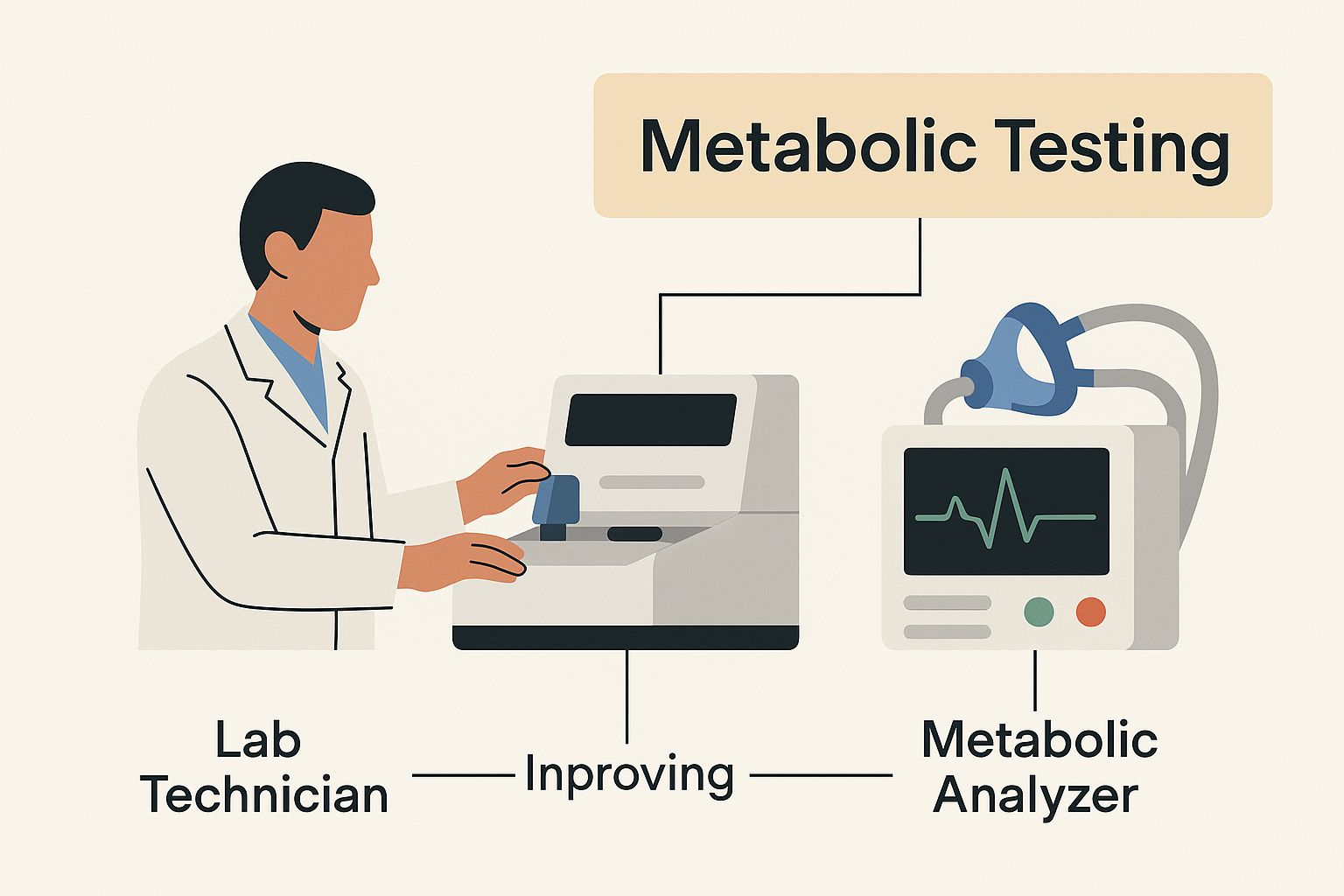
This is the kind of equipment that translates your breath into actionable health data, creating the bridge between your body’s inner workings and a truly personalised health plan.
One test establishes your baseline for nutrition and weight management, while the other maps out your performance ceiling. Understanding the purpose of each test makes it clear how they serve different goals, from fine-tuning a diet to shattering a personal best.
The Technology That Powers Your Health Insights
To really understand your personal energy needs, we can't just guess. We need specialized tools that can listen to your body's subtle biological cues. The technology behind metabolic testing is what turns something as simple as your breath into a precise, actionable roadmap for your health. It’s not magic—it's a direct window into your body’s most fundamental process.
The undisputed gold standard for accuracy is the metabolic cart. Think of it as a sophisticated system that performs indirect calorimetry, a method that analyzes the air you breathe. By meticulously measuring the oxygen you consume versus the carbon dioxide you produce, it calculates your real-time energy expenditure with incredible precision.
The Tools of the Trade
These systems aren't just for elite athletes in university labs anymore. A growing emphasis on preventative health and managing conditions like obesity has fueled incredible innovation. As a result, there's now a wide range of equipment available for different environments, from hospitals and clinics to local fitness centers.
While the metabolic cart provides the core measurement, other tools are often used alongside it to add critical layers of data:
- Body Composition Analyzers: These devices, using technologies like DEXA or BIA, tell you your ratio of lean muscle to body fat. Since muscle burns more calories than fat, even at rest, this information is vital for interpreting your metabolic rate.
- Cardiopulmonary Exercise Testing (CPET) Systems: Often built into metabolic carts, these systems are essential for VO2 max testing. They measure how your heart and lungs respond to physical stress, giving us a complete picture of your cardiorespiratory fitness.
Key Insight: Your metabolic rate is just one piece of the puzzle. When you combine it with body composition data, you get a much clearer understanding of why your metabolism is what it is, directly connecting your energy burn to your body's unique structure.
From the Lab to Your Home
The great news is that this technology is becoming more accessible than ever. While clinical-grade metabolic carts still represent the peak of precision, a new generation of portable and handheld devices is hitting the market. These tools are designed to bring real-time metabolic feedback out of the clinic and into our daily lives, making it far easier to track how your body responds to changes in diet and exercise. Knowing how to measure metabolism with these different options helps you find the right approach for your specific goals.
While this article focuses on your body's energy systems, it's worth noting that similar scientific rigor is applied elsewhere in the health industry. For example, validating the purity and potency of other health products relies on thorough lab testing for supplements.
Translating Test Results into Real-World Wins

So, you have all this metabolic data. What now? It’s far more than just a bunch of numbers on a report; it’s the key to unlocking a truly personalized health strategy. This is where the science hits the real world, turning data into victories—whether that means losing weight, smashing a new personal record, or simply safeguarding your long-term health.
The results finally give you the "why" behind what your body is doing. For anyone who has ever been frustrated with a weight-loss plateau, an accurate RMR measurement is a complete game-changer. It puts an end to the guesswork that comes with generic calorie calculators. Suddenly, you know your body’s true resting energy burn—a precise, non-negotiable baseline to build a successful nutrition plan around.
From Data Points to Daily Performance
For athletes and fitness enthusiasts, VO2 max results are just as powerful. Instead of following a one-size-fits-all training plan you found online, you can use your data to design scientifically-backed training zones. This is how you make sure every drop of sweat is spent building real endurance and power, not just pushing you toward overtraining and burnout.
Think of the data as your personal roadmap to better performance:
- Pinpointing Fat-Burning Zones: The results can tell you the exact heart rate and intensity where your body most efficiently burns fat for fuel. This lets you structure workouts specifically for fat loss, making your time in the gym incredibly effective.
- Improving Aerobic Capacity: Knowing your VO2 max is the first step. The next is creating targeted interval sessions designed to raise that ceiling, improving how your body uses oxygen when it matters most.
This level of personalization is why the field is exploding. The global metabolic testing market was recently valued at around USD 780.7 million and is expected to grow to USD 1.3 billion by 2032. Much of this growth comes from new, portable devices that can offer real-time metabolic feedback right at home.
Key Takeaway: Metabolic testing removes the ambiguity from health and fitness. It provides a personalized blueprint that helps you train and eat with purpose, ensuring your efforts are aligned with your body’s unique physiology for maximum results.
Identifying Hidden Health Risks
Beyond just performance metrics, metabolic testing can shine a light on crucial health insights you’d otherwise miss. One of the most important is identifying metabolic inflexibility.
This is a condition where the body struggles to switch efficiently between burning carbs and fats for fuel. It’s a major underlying factor in many modern health problems, including insulin resistance and an increased risk for type 2 diabetes.
By catching this early, you and your health provider can implement targeted lifestyle changes—like specific dietary tweaks or exercise routines—to improve your metabolic flexibility long before it becomes a serious medical issue. As you start working with this data, good research data management practices can help you organize and apply these insights effectively. Ultimately, this data provides the clarity needed to finally move past generic advice and achieve your specific goals.
Is Metabolic Testing Right for You?
So, you're hearing about metabolic testing and wondering if it's really worth it. It sounds advanced, maybe even a little intimidating. How do you know if it's the right move for your health and fitness journey?
The answer isn't about how serious of an athlete you are; it's about whether you're facing a problem that generic advice just can't solve. Think of it this way: you wouldn't use a blurry, outdated map to navigate a new city. Metabolic testing is like switching to a crystal-clear, real-time GPS for your own body. For many, that level of detail is the missing piece of the puzzle.
Who Benefits Most from Metabolic Insights?
Metabolic testing isn't some niche luxury. It's an incredibly practical tool that offers game-changing advantages for a few specific groups. If any of these sound familiar, a test could finally give you the clarity you've been searching for.
- The Dedicated Athlete Hitting a Performance Wall: You're putting in the work. You follow your training plan to the letter, but your times have flatlined. A VO2 max test can pinpoint your true aerobic potential and give you the precise heart rate zones you need to train smarter, not just harder, finally pushing past that frustrating plateau.
- The Individual Frustrated by Weight Loss: You've tried everything. You’ve counted calories religiously and spent hours in the gym, but the scale just won't cooperate. An RMR test replaces guesswork with your exact daily calorie burn. You might discover your metabolism is significantly different from what those online calculators assume, allowing you to build a plan that actually works for your body.
- Anyone Focused on Proactive Health: Maybe you have a family history of conditions like diabetes, or you're simply committed to long-term wellness. Testing can be a powerful early-warning system. It can spot issues like poor metabolic flexibility long before they become serious health problems, giving you a chance to make targeted changes.
Key Insight: Metabolic testing shines when you have a specific question to answer or a problem to solve. Whether it's about performance, weight, or long-term health, the data provides a clear path forward when generic strategies have let you down.
For athletes especially, understanding how your body performs under pressure is everything. Taking a deeper dive into what is metabolic stress testing can unlock even more powerful strategies for boosting performance and speeding up recovery.
Ultimately, metabolic testing is about making one crucial shift: moving from guessing to knowing. It swaps broad, one-size-fits-all assumptions for personalized, actionable data, empowering you to build a strategy that's perfectly aligned with your unique physiology. It’s that targeted approach that so often turns frustrating effort into real, lasting results.
What to Expect on Your Test Day

Knowing what happens during a metabolic test can turn any nervousness into genuine curiosity. The whole process is surprisingly straightforward and incredibly empowering. You’re essentially getting a direct look under the hood to see how your body’s engine really runs.
So, let's walk through what a typical appointment looks like, from the moment you book it to the moment you walk out with your results.
Preparing for Your Appointment
Your journey to getting accurate data starts before you even step foot in the facility. You'll get a list of pre-test instructions, and it’s crucial to follow them to the letter. Think of it like preparing a clean canvas—we need to remove any temporary factors that could skew the picture of your metabolism.
The preparation is simple, but it makes all the difference. Here’s what you’ll likely be asked to do:
- Fasting: For a Resting Metabolic Rate (RMR) test, you'll need to avoid food for 8-12 hours beforehand. This ensures we're measuring your body in a true, fasted, resting state, not the energy it's using to digest your breakfast.
- No Caffeine or Stimulants: That morning coffee or pre-workout drink will have to wait. Stimulants can artificially rev up your metabolic rate, so you'll need to avoid them for at least 12-24 hours.
- Avoiding Exercise: You'll also need to take a rest day. Skip any tough workouts on the day of your test, as strenuous activity keeps your metabolism elevated for hours afterward.
Following these steps is non-negotiable for getting data that truly reflects your unique physiology.
Key Insight: The entire point of the prep is to measure your metabolism in its natural, undisturbed state. If you don't follow the protocol, you risk getting inflated RMR numbers, which will lead to a plan built on faulty data.
During the Test and After
When you get to the facility, a technician will greet you, explain everything, and get you settled. It's a very low-stress environment.
For an RMR test, you'll simply recline and relax in a quiet, comfortable room. You'll breathe normally into a specialized mask for about 15-20 minutes. That's it. For a VO2 max test, you’ll be on a treadmill or stationary bike, starting at a very easy pace. The intensity will gradually increase until you hit your maximum effort.
Once the test is over, your part is done. The technician takes the raw data and translates it into a report that makes sense. It will clearly show your key metrics, explain what they mean for you, and give you the foundation for a truly personalized health and fitness strategy.
You won't just leave with a bunch of numbers; you'll leave with a clear, actionable roadmap.
Got Questions About Metabolic Testing? We've Got Answers
It's completely normal to have a few questions swirling around as you think about metabolic testing. Getting clear, straightforward answers is the best way to feel confident you're making a smart decision for your health and performance. Let's tackle some of the most common ones.
Just How Accurate Are These Tests?
The accuracy of any metabolic test really boils down to one thing: the quality of the equipment. Think of it like this: you have professional-grade tools and you have consumer-grade gadgets.
Clinical systems, the kind you’ll find in a lab or a high-end training facility, are the gold standard. These metabolic carts directly measure the oxygen you consume and the carbon dioxide you produce, giving you incredibly precise and reliable data. This is what you want if your plan relies on exact numbers.
On the other hand, you'll see consumer devices like some handheld breathalyzers or fitness wearables. They're convenient for sure, but that convenience often comes at the cost of precision. They're fine for spotting general trends over time, but for a truly personalized plan, a professional-grade test is the only way to go.
Will My Insurance Pay for It?
This is probably the biggest question on everyone's mind. The answer? It depends on why you're getting the test.
If your doctor orders a metabolic test to diagnose or manage a specific medical issue, like a suspected metabolic disorder, there's a good chance your insurance will cover it. It’s seen as medically necessary.
However, if you're doing it to dial in your fitness, boost athletic performance, or for general wellness, it's almost always considered an elective service. That means you should plan on paying for it yourself. It's always a good idea to call your insurance provider directly to get the specifics of your plan.
Key Takeaway: If it's for a medical diagnosis, insurance might foot the bill. If it's for fitness or performance, think of it as a personal investment in your health.
How Often Should I Get Retested?
Your metabolism isn't set in stone. It's a dynamic system that constantly adapts to what you do. A single test gives you an incredibly valuable snapshot in time, but your body changes, and your plan should too.
So, when should you book a follow-up? It's a good idea after any significant life or body change, such as:
- Losing or gaining a substantial amount of weight (think 10% of your body weight or more).
- Making a big shift in your training routine, like starting a marathon prep or a new strength program.
- Overhauling your diet or making other major lifestyle adjustments.
A good rule of thumb is to retest every 6-12 months. This ensures your nutrition and training strategies are always perfectly matched to your body's current needs, keeping you on the most efficient path to your goals. For more in-depth articles that can answer even more of your questions, check out Salthea's blog for diverse health insights.


