

You're probably in this position right now. A manufacturer is telling you their device is “validated,” the brochure looks polished, and the app screenshots are impressive. One option is affordable and easy to sell to clients. The other costs far more, often comes from a brand like Cosmed or BodyMetrix, and arrives with research papers attached.
The question that matters isn't whether the tool looks advanced. It's whether the readings mean what you think they mean.
That's where measurement validity comes in. If you're a personal trainer, exercise physiologist, rehab clinician, or facility manager, validity sits underneath every decision you make from body composition tracking to aerobic testing to return-to-play monitoring. If the measurement is invalid, the programming built on top of it can drift off course, even when your coaching is good.
A useful way to think about what is measurement validity is this. Does the tool measure the thing it claims to measure? If the answer is uncertain, you're not just choosing equipment. You're choosing how much confidence you can place in every result you hand to a client.
Table of Contents
- The Critical Question Before You Buy Any Fitness Tech
- The Three Pillars of Measurement Validity
- Validity vs Reliability Why Consistent Is Not Always Correct
- Measurement Validity in Action Fitness and Clinical Examples
- Common Threats That Can Invalidate Your Measurements
- How to Evaluate Manufacturer Validation Claims
- Your Checklist for Choosing and Using Validated Tools
The Critical Question Before You Buy Any Fitness Tech
Say you're comparing two body composition tools. One gives fast readings, slick reports, and a lower upfront cost. The other asks you to spend more, learn more, and follow a tighter protocol. Most buyers first look at price, speed, and convenience. Experienced practitioners look at one thing before all three.
Does it measure what it says it measures?
That is the practical meaning of what is measurement validity. A valid tool gives you a result that represents the characteristic you're trying to assess, whether that's body fat, aerobic capacity, resting metabolic rate, or respiratory function. If the measurement misses the target, every chart, recommendation, and retest becomes harder to trust.
Clients often assume all digital outputs are equally credible, a misconception given they aren't. A flashy interface can present weak data very convincingly. A more useful starting point is to compare the actual types of devices used to measure fitness and health variables and then ask how each one was validated for the job you need it to do.
Practical rule: Don't buy a device because it produces a number. Buy it because the number has evidence behind it.
A gadget creates output. A scientific instrument creates output that can support decisions.
The Three Pillars of Measurement Validity
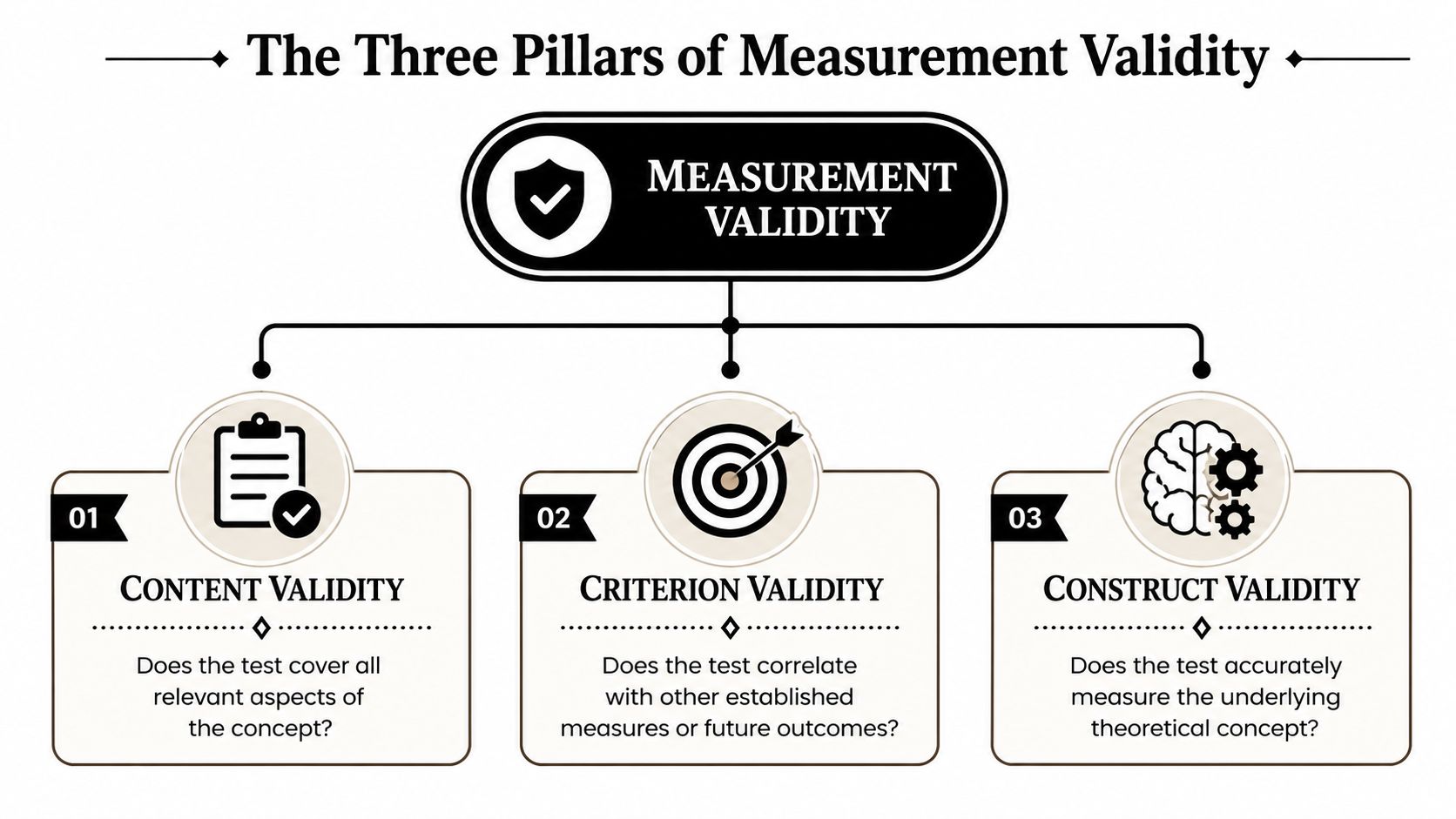
Measurement validity isn't one single stamp of approval. It's built from different kinds of evidence. In day-to-day fitness work, three pillars help you judge whether a test deserves your trust.
Content validity
Content validity asks a simple question. Does the test cover the full topic it's supposed to cover?
This comes up often with questionnaires, screening tools, and self-report forms. If you create a “lifestyle readiness” questionnaire for new clients, but every question focuses on motivation and none address sleep, stress, schedule, pain, or confidence, you haven't captured the whole picture. The tool may still look polished, but its content is too narrow.
For trainers, this matters most when you build your own forms. A pre-exercise questionnaire can be well written and still have weak validity if it leaves out important parts of the construct you care about.
Construct validity
Construct validity deals with abstract ideas such as fitness, fatigue, recovery, confidence, or exercise adherence. These aren't as directly measurable as body mass or heart rate, so you need a broader body of evidence. According to Open Text BC's explanation of reliability and validity, construct validity is the overarching type of measurement validity because it subsumes all other types, and it requires evidence of both convergent validity and discriminant validity.
In plain language, a good measure should line up with related things and stay separate from unrelated things. If you build a “lower-body power confidence” score, it should relate sensibly to other measures of performance confidence, but it shouldn't also behave like a stress scale unless there's a good reason.
If you want to see how the same logic appears outside fitness, Synopsix on validity in hiring is a useful parallel example. Hiring assessments face the same problem you do in performance testing. People must prove a tool is measuring the intended construct, not just producing tidy reports.
Criterion validity
Criterion validity is the pillar most fitness professionals use most often, even if they don't call it that. It asks whether a new or simpler test agrees with an accepted reference method.
A predicted VO2max test, for example, is useful only if it corresponds well with a stronger reference measure. A field body fat tool is useful only if its estimates compare well against a more established method. Such practical buying decisions depend on these comparisons, and it's why articles on criterion validity in fitness testing matter so much for coaches and clinicians.
A quick working table helps:
| Pillar | Main question | Fitness example |
|---|---|---|
| Content validity | Does it cover the full topic? | A readiness questionnaire that includes recovery, soreness, sleep, and stress |
| Construct validity | Does it reflect the underlying concept? | A fatigue score behaving like a fatigue measure rather than a mood scale |
| Criterion validity | Does it agree with a trusted reference? | A field VO2max estimate compared with metabolic analysis |
Criterion validity often shows up in two practical forms:
- Concurrent validity compares the new tool and reference method at the same time.
- Predictive validity asks whether the measure forecasts a future outcome you care about.
Most confusion starts when people assume one strong-looking graph proves the whole story. It doesn't. Validity comes from a pattern of evidence, not one attractive claim.
Validity vs Reliability Why Consistent Is Not Always Correct
One of the biggest mistakes in testing is assuming consistency equals accuracy. It doesn't.
The target analogy trainers remember
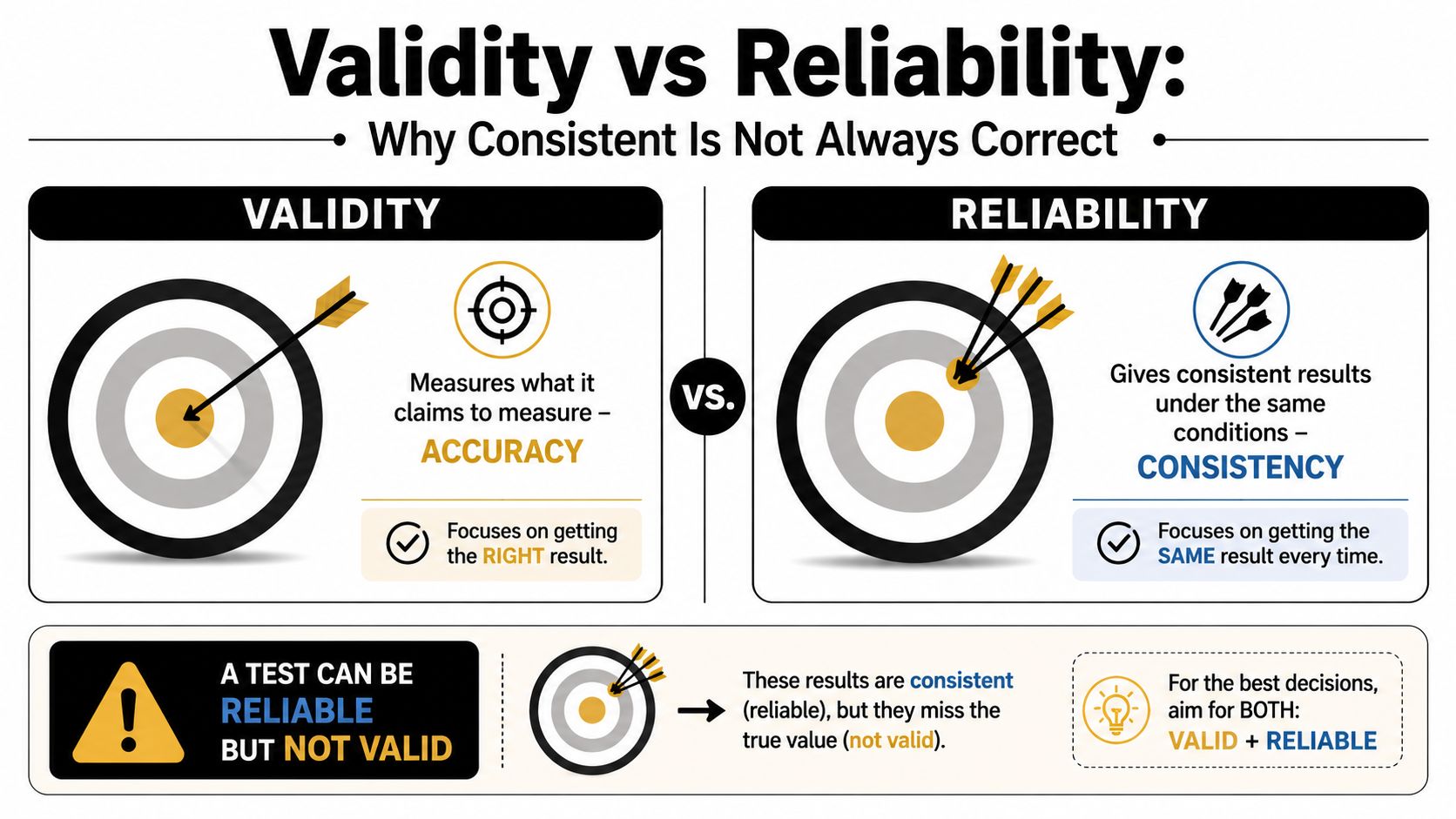
Think about a dartboard. If all the darts land tightly together, the throw is reliable. If they land on the bullseye, the throw is valid. You can have a tight cluster off to one side. That's reliable, but wrong.
Reliability means a tool gives consistent readings under the same conditions. Validity means those readings represent what you wanted to measure. Those are not the same job.
A useful technical summary is built around this distinction. Validity concerns whether a measure captures what it claims to measure, while reliability concerns consistency across time, items, or researchers. If you want a practical companion piece for this side of the equation, test-retest reliability in applied assessment helps clarify how consistency is checked.
Here's a short visual explanation worth showing staff members who are new to testing:
What this looks like on the gym floor
A body fat device might give the same reading every morning for three days in a row. That sounds reassuring. But if the true value sits meaningfully elsewhere, the device is giving you the same wrong answer repeatedly.
That's where many facilities get trapped. They praise a tool because the output looks stable, when what they really need is confidence that the tool is anchored to reality.
A measurement can be precise enough to look professional and still be inaccurate enough to mislead programming.
Use reliability as a minimum standard. Then ask the harder question. Is the tool consistently right, or just consistently repeatable?
Measurement Validity in Action Fitness and Clinical Examples
A trainer is choosing between a low-cost body fat device and a higher-priced ultrasound unit. A clinic is deciding whether a field aerobic test is enough, or whether direct gas analysis will change care in a meaningful way. Those decisions are really about validity in practice. You are asking whether a tool gives information that is close enough to the truth to justify the cost, time, and staff training.
A helpful way to judge this is incremental validity. That means asking whether a more advanced tool adds decision-making value beyond the simpler option you already have. If a premium device changes programming, referral decisions, or client adherence in a useful way, the extra precision may pay for itself. If it produces nicer-looking data without changing what you do, the return is much weaker.
Chester Step Test
The Chester Step Test is a good example of a tool with practical value because it estimates aerobic fitness without full lab equipment. The key question is not whether it is convenient. The key question is whether its estimate tracks closely enough with a stronger reference method for the purpose you have in mind.
The Measurement Toolkit explanation of validity gives a useful framework here. For a field test such as the Chester Step Test, criterion validity depends on how well the estimate aligns with a gold-standard comparison, such as direct gas analysis for VO2max. For a personal trainer screening general fitness and tracking broad changes, that may be good enough. For exercise prescription in a clinical population or fine-grained performance testing, the same level of approximation may no longer be enough.
That is the practical lesson. Validity is always tied to the decision. A field estimate can be suitable for one job and too limited for another.
BodyMetrix ultrasound
BodyMetrix-style ultrasound sits in an interesting middle ground. It usually promises more detail than consumer body composition tools, but with less cost and complexity than reference methods such as DXA. For many coaches, the primary buying question is whether that added detail improves coaching decisions enough to justify the spend.
Incremental validity's practical value is evident. If ultrasound helps you detect meaningful tissue changes that skinfolds or BIA would miss, it may improve progress reviews, increase client trust, and help justify premium assessment services. If your staff are not trained well enough to standardise site selection and probe use, the theoretical advantage can disappear quickly.
In other words, a higher-tech device only earns its place when it adds better information, not just more information.
Cosmed metabolic analysis
Cosmed metabolic analysis sits much closer to the reference end of the spectrum. Direct gas analysis is often used to judge the validity of simpler aerobic tests because it measures physiology more directly rather than estimating from heart rate responses or workload.
That extra precision matters most when the decision is expensive or high stakes. If you run athlete testing, exercise referral, return-to-play assessments, or clinical exercise services, better measurement may improve risk stratification and programme design enough to support the investment. If your main service is general population coaching, a high-end metabolic cart may offer limited incremental value unless you can build a business model around testing.
This is the ROI side of validity that basic explanations often skip. The best tool is not always the most precise one. It is the one that improves decisions enough to justify ownership.
The same logic shows up outside fitness. In psychology and medicine, practitioners judge a test by whether it adds useful information beyond simpler screening steps, which is one reason a clinical guide to adult ADHD testing looks carefully at how different assessment methods contribute to diagnosis rather than treating every measure as equally informative.
For practitioners comparing equipment, Cartwright Fitness is one supplier that carries Chester Step Test tools alongside BodyMetrix and Cosmed systems. That makes it easier to compare what each method adds to your workflow, your reporting, and your client outcomes before you buy.
Common Threats That Can Invalidate Your Measurements
Even a well-validated device can produce bad data in your facility. Validity doesn't live in the machine alone. It also lives in the protocol, the person being tested, and the person doing the testing.
Equipment and protocol problems
Start with the obvious. If the device isn't calibrated, updated, or set up according to the intended procedure, you can't assume the result is meaningful. This is common with metabolic systems, ultrasound tools, and step test workflows that drift over time as staff cut corners.
Watch for these issues:
- Calibration drift: The tool may still power on and display numbers, but those numbers may no longer align with the expected standard.
- Protocol creep: Staff gradually shorten rest periods, change instructions, or skip setup steps.
- Context mismatch: A test validated in one setting may not transfer cleanly to another if you alter the procedure heavily.
A protocol sheet in a drawer doesn't protect validity. Staff behaviour does.
Client related problems
Clients can distort a valid test without meaning to. They arrive dehydrated, over-caffeinated, anxious, sore, under-fuelled, or unfamiliar with the task. On another day, the same person may test under calmer and more controlled conditions and produce a different outcome.
These factors matter because measurement reflects both the instrument and the state of the person being measured.
A useful parallel comes from clinical screening. In areas such as neurodevelopmental or psychological testing, practitioners pay close attention to context, instruction quality, and participant state because those factors can alter interpretation. The same principle is clear in this clinical guide to adult ADHD testing, where procedure and interpretation both depend on careful standardisation.
On the gym floor: If a client's preparation changes, the meaning of the retest changes too.
Tester related problems
The tester can also become the weak link. One coach gives firm, standardised instructions. Another coach “helps” by pacing the client differently, changing verbal cues, or signalling what result they expect. That inconsistency can push data around more than people realise.
A practical safeguard is to tighten the human parts of the process:
| Threat | What it looks like | What to do |
|---|---|---|
| Inconsistent instructions | Different staff explain the test differently | Script the setup and delivery |
| Expectancy bias | Tester nudges effort or interpretation | Standardise encouragement and scoring |
| Poor repetition control | Retests happen at different times or states | Fix the timing and pre-test guidance |
If you want cleaner data, write down your procedure, train the team, and audit the process occasionally. Most validity problems in applied settings don't start in research papers. They start in routine shortcuts.
How to Evaluate Manufacturer Validation Claims
When a manufacturer says a device is “validated,” treat that as the beginning of your review, not the end of it.
What to look for in a validation study
The first question is straightforward. Validated against what? Criterion-based evidence depends on the quality of the reference measure. If the comparison standard is weak, the headline claim is weak too.
The statistical side also matters. According to Wikipedia's overview of validity in statistics), validity commonly relies on correlation coefficients such as Pearson's r, and 0.70 or higher typically indicates strong agreement with a reference measure. The same source also notes that validity studies need sufficient statistical power, and that 0.80 is often treated as the minimum probability to detect an effect, because underpowered studies can distort conclusions.
That gives you a practical review list:
- Reference method: Was the device compared with a serious gold standard?
- Study design: Were the conditions relevant to your use case?
- Sample adequacy: Was the study large enough to support the claim?
- Outcome fit: Did the study test the exact thing the brochure is promising?
Manufacturers often show that a tool works somewhere. Your job is to decide whether it works for your population, your staff, and your decisions.
Where incremental validity changes the buying decision
This is the part many explainers skip. A device can be valid and still not be worth buying.
Incremental validity asks whether the new tool adds meaningful predictive value beyond what you already use. That's especially important when you're comparing premium equipment against simpler field methods. A high-precision body composition device may produce excellent numbers, but the core business question is whether it helps you make better decisions than skinfolds, circumference tracking, or a lower-cost method.
For fitness professionals, this is often the bridge between research and ROI. A new tool should not only measure well. It should improve the quality of your decision-making enough to justify cost, workflow complexity, staff training, and maintenance.
You can use the same mindset you'd apply in regulated health spaces. For example, when people review claims around treatment categories or product status, they often want to see a clear evidence standard before acting. That's why a resource such as PepFlow's FDA approval resource is a useful reminder of a broader principle. Claims mean more when they're tied to a defined evidence pathway rather than presentation alone.
Ask manufacturers the question most brochures avoid: What does this tool help me predict or decide better than my current method?
If they can't answer that clearly, the tool may be valid in theory but weak in value.
Your Checklist for Choosing and Using Validated Tools
Most professionals don't need more theory. They need a filter they can apply before signing a purchase order or rolling out a new testing protocol.
A practical five step checklist
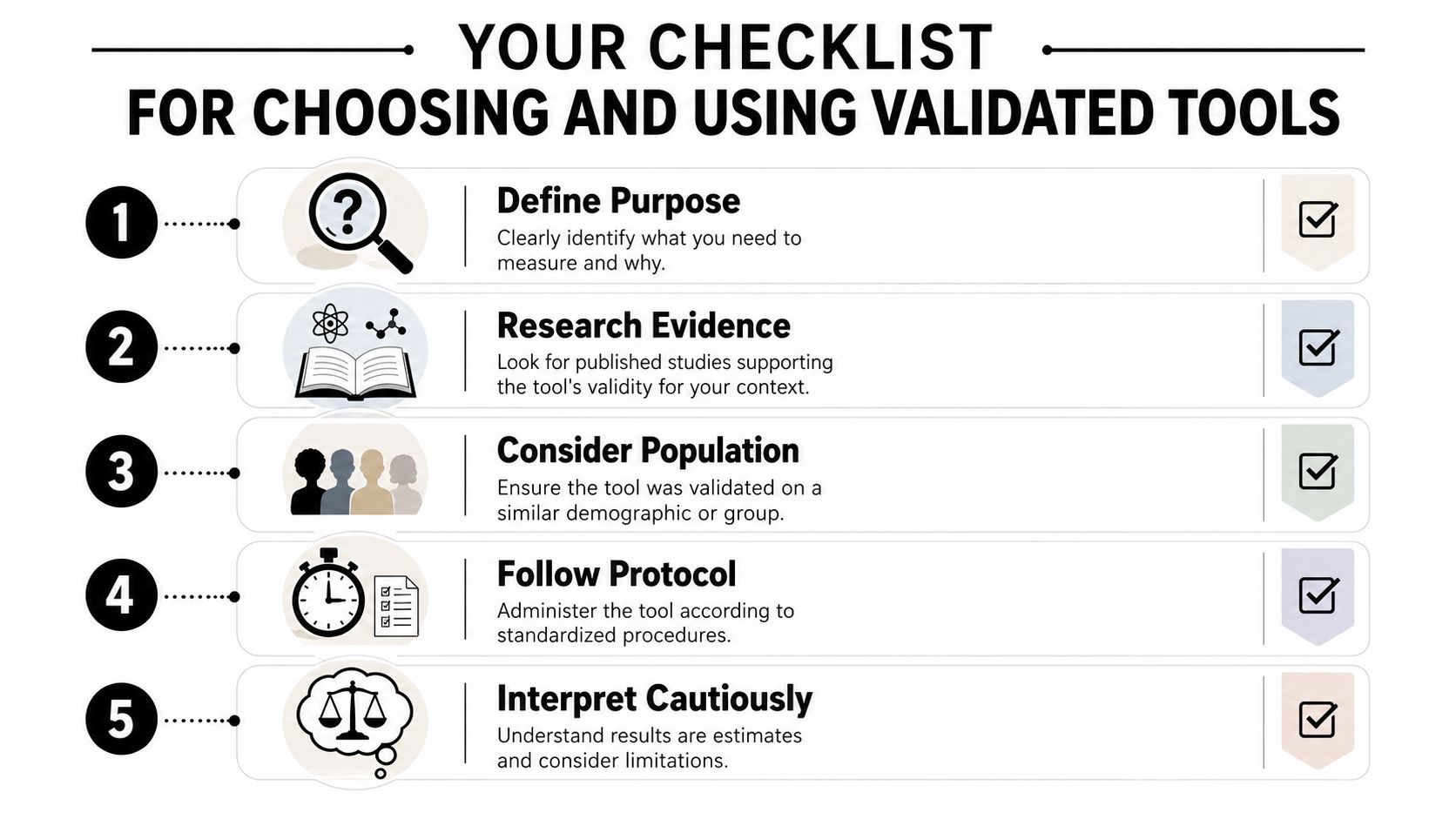
Use this when you're evaluating a new analyser, field test, software platform, or assessment workflow.
Define the exact decision you need the tool to support
Don't start with features. Start with purpose. Are you screening risk, tracking change, estimating aerobic capacity, or guiding nutrition coaching? A tool can be valid for one purpose and weak for another.Ask for the validation evidence, not just the brochure claim
Read the methods section carefully. Look for how the tool was compared, who it was tested on, and whether the setting resembles your own environment. If the claim is vague, treat it cautiously.Check whether the population matches your clients
A tool validated on one group may not transfer neatly to another. Age, training status, health status, and test familiarity all influence whether the evidence fits your setting.Protect validity with strict in-house protocol control
Your team needs standardised instructions, fixed pre-test guidance, consistent timing, and routine equipment checks. The strongest device can still produce weak information if the process around it is loose.Ask the incremental validity question before paying for precision
As discussed in the GESIS guidance on validity and incremental validity, the underserved issue is whether a new test predicts outcomes better than existing methods. In fitness settings, that's the evidence you need to justify the ROI of high-precision systems rather than buying them because they look more scientific.
A short buying table can help when you compare tools internally:
| Buying question | Why it matters |
|---|---|
| What decision will this result change? | Stops feature-driven buying |
| What was the reference method? | Reveals whether the comparison was meaningful |
| Was the tool tested on people like our clients? | Improves transferability |
| Can our staff reproduce the protocol properly? | Protects day-to-day validity |
| Does it add value beyond our current method? | Clarifies ROI through incremental validity |
The best testing setup isn't the one with the most advanced screen. It's the one that gives you defensible information you can act on confidently.
When people ask what is measurement validity, the shortest useful answer is this. It's the degree to which a tool measures what it claims to measure. The professional answer is broader. It's the foundation for safe decisions, credible reporting, and sensible investment in technology.
If you keep that standard, you'll buy fewer gimmicks, trust your data more, and build stronger client confidence over time.
If you're reviewing assessment tools for a clinic, university lab, or performance facility, Cartwright Fitness offers a range of validated testing equipment including Chester Step Test tools, BodyMetrix ultrasound systems, and Cosmed metabolic analysers, which can help when you want to compare field-friendly methods with higher-precision options before making a purchase.


