

For decades, lactate got a bad rap. It was unfairly branded as a metabolic waste product, the villain behind muscle soreness and fatigue. The reality? Lactate is a vital, high-octane fuel that's essential for intense exercise and overall metabolic health.
Think of it less like exhaust fumes and more like a high-speed energy courier.
Debunking The Lactate Myth
Let's start by clearing the air. That old story you probably heard in biology class—that lactic acid buildup causes that searing burn in your muscles and leaves you sore for days—is simply wrong. Modern science has completely flipped this outdated view on its head, showing us what lactate truly is: a dynamic and indispensable fuel source.
Instead of being a metabolic dead-end, lactate is a critical link in your body's energy supply chain. It’s a fast-acting go-between, letting your body sustain high-intensity efforts for far longer than it otherwise could.
A Fuel Shuttle, Not A Waste Product
Imagine your body is a bustling city during rush hour. Your muscles are factories that need a constant stream of energy shipments to keep production humming. When you start exercising hard, the normal delivery trucks (your aerobic system) can’t keep up with the skyrocketing demand.
This is where lactate enters the picture. It’s like a fleet of high-speed motorcycle couriers zipping through the traffic jams. It rapidly transports energy from cells that have a surplus (like your powerful fast-twitch muscle fibers) to cells that are in desperate need.
Lactate is not the cause of metabolic fatigue; rather, it is a key fuel for metabolic-cellular homeostatic control and a major gluconeogenic precursor. Its production represents a crucial link between anaerobic and aerobic metabolism.
This "lactate shuttle" is a brilliant biological workaround. The lactate produced in your working muscles doesn't just hang around; it's actively transported and put to work by other tissues, including:
- Your Heart: Cardiac muscle loves using lactate as a preferred fuel source, helping your heart keep pumping strong under stress.
- Your Brain: The brain readily uses lactate for energy, especially during demanding physical activity.
- Other Muscles: Your endurance-oriented slow-twitch muscle fibers are exceptionally good at taking up and using lactate for fuel, helping you sustain your effort.
Getting your head around this is the first crucial step for any coach or athlete. Once you move past the myth of "lactic acid burn," you can unlock the door to much smarter training. When you appreciate lactate as a fuel, you start to understand how you can improve your body's ability to produce, transport, and clear it.
This metabolic efficiency is a cornerstone of elite athletic performance and is directly tied to concepts like your anaerobic threshold. Beyond performance goals, understanding how the body uses fuel sources like lactate is also a key part of the bigger picture of achieving good health.
Understanding Lactate Production And Clearance
To really get what lactate is, we have to look at the constant, dynamic cycle of how your body makes it and clears it. It's not some simple waste product. Far from it. Its production is a brilliant metabolic workaround that lets you push through high-intensity efforts—a rapid-fire system for generating and redistributing energy.
It all starts with glycolysis, which is just the process of breaking down glucose for fuel. When you're exercising hard, your body's demand for energy goes through the roof. As you burn through glucose at this frantic pace, you create a molecule called pyruvate.
Now, under normal, low-intensity conditions, that pyruvate would happily head into the mitochondria to make energy aerobically (with oxygen). But when you're going all-out, you create a metabolic traffic jam. Pyruvate gets produced way faster than the mitochondria can keep up.
The Pyruvate Fork In The Road
This is where pyruvate hits a critical fork in the road. Instead of just backing up and grinding energy production to a halt, the body has a clever solution: it converts the excess pyruvate into lactate. This isn't a sign of failure or hitting a limit; it's a necessary and incredibly efficient patch that allows glycolysis to keep cranking out fast energy.
This rapid conversion is why lactate levels shoot up when your oxygen demand outpaces supply during intense work. While resting blood lactate levels in healthy adults are usually around 0.5-1.5 mmol/L, they can climb dramatically during a max effort. Your body actually produces about 1500 mmol of lactate every single day, which shows just how central it is to our metabolism all the time. You can dig deeper into the numbers on lactate production and clearance if you're curious.
This concept map perfectly captures this shift in thinking, moving away from the old myth and toward the reality of lactate as a powerful ally.
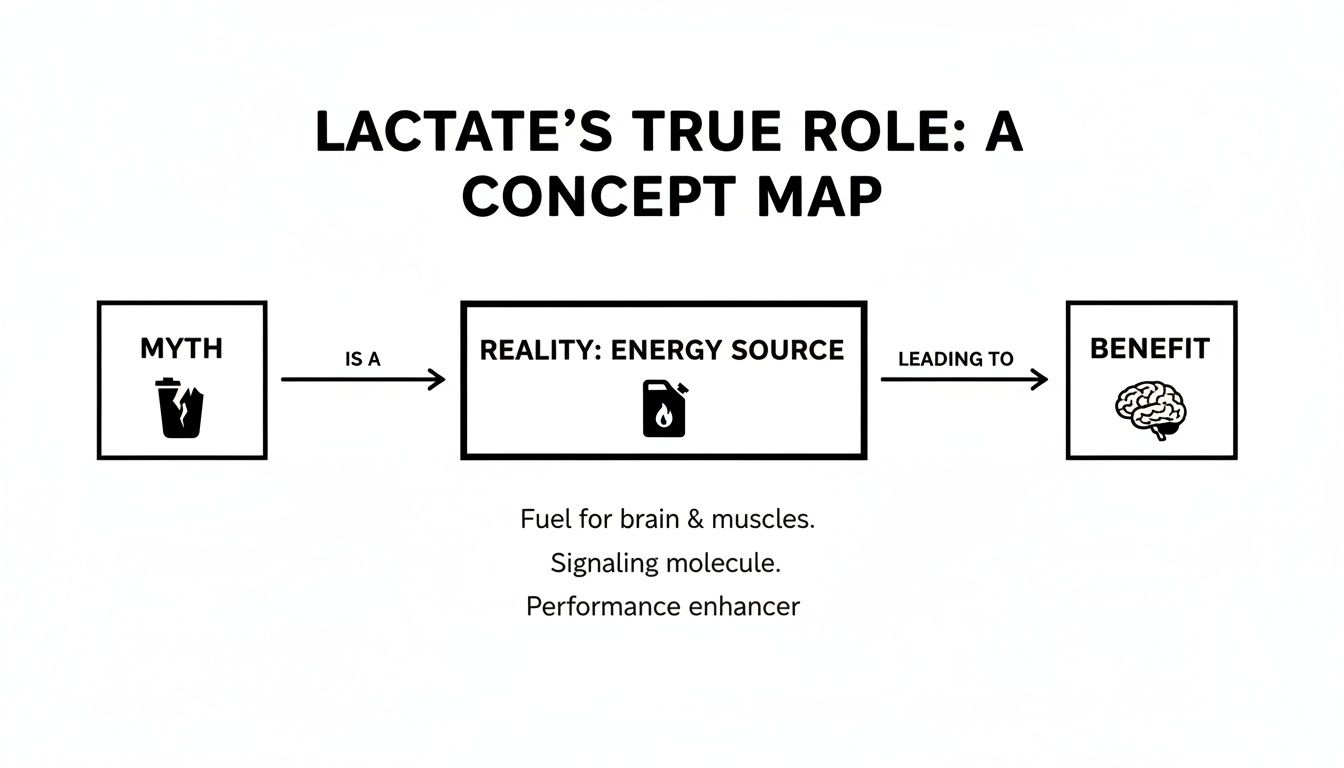
You can see the clear journey from viewing lactate as a dead-end waste product to recognizing it as a super-fuel that benefits everything from your muscles to your brain.
The Efficient Lactate Clearance System
Once it's produced, lactate doesn't just hang around causing problems. Your body has an incredibly sophisticated system for clearing it from the bloodstream and putting it right back to work. This whole process is often called the lactate shuttle.
Think of it as a city-wide recycling program. Lactate made in one area gets picked up, transported across the body, and repurposed somewhere else. The major players in this recycling network are your liver, kidneys, and other muscle tissues.
- The Lactate Shuttle in Muscles: Lactate produced in your big, powerful, fast-twitch muscle fibers gets shuttled over to neighboring slow-twitch fibers. These endurance-oriented fibers are metabolic powerhouses, exceptional at taking up lactate and using it as an aerobic fuel.
- The Heart as a Consumer: Your heart muscle absolutely loves lactate. It readily pulls it from the blood and actually prefers it as a fuel source, especially during exercise.
- The Liver and Cori Cycle: The liver is the main recycling plant, processing about 60% of all lactate. Through a nifty process called the Cori Cycle, the liver converts lactate back into glucose. This "new" glucose can then be sent back to the muscles for more energy or stored for later.
This constant, elegant loop between the muscles and the liver turns a potential metabolic problem into a sustainable energy solution.
Key Takeaway: The balance between how much lactate you produce and how well you clear it is what truly dictates your performance. A highly trained athlete isn't someone who produces less lactate—they're someone whose body is a master at clearing it and using it as high-octane fuel.
The kidneys also get in on the action, clearing a solid 25-30% of circulating lactate. After a truly gut-busting effort, this entire clearance system can kick into overdrive, processing over 500 mmol/hour to get your body back to a state of balance. Having a solid grasp of this production-and-clearance dynamic is fundamental to making sense of performance data and building truly effective training programs.
Using Lactate Thresholds To Create Training Zones
Once you understand what lactate is and how the body uses it, you can unlock a much smarter way to train. Forget those old, generic heart rate formulas based on age. When you pinpoint an athlete's unique lactate thresholds, you can build training zones that are a direct reflection of their real-world physiology.
This data-driven approach means you can finally stop guessing. Instead, you can program workouts designed to hit a very specific metabolic target. The result? You get the maximum training adaptation with a much lower risk of overtraining, creating a more efficient path to peak performance.

Defining The Key Thresholds
In lactate-based training, we're really focused on two key inflection points that define an athlete's metabolic profile: Lactate Threshold 1 (LT1) and Lactate Threshold 2 (LT2). These aren't just random numbers; they are distinct physiological markers that tell you exactly how an athlete's body is handling stress and burning fuel.
Lactate Threshold 1 (LT1) is the very first significant and sustained rise in blood lactate above resting levels. You can think of it as the point where the body's energy production starts making a little more metabolic "noise." Below LT1, you’re in a comfortable cruise control, clearing lactate just as fast as you produce it.
Lactate Threshold 2 (LT2), on the other hand, is the intensity where lactate production starts to seriously outpace your body's ability to clear it. This is where lactate begins accumulating rapidly in the blood. It's often called the Onset of Blood Lactate Accumulation (OBLA) or maximal lactate steady state. If you try to push past this point, you won't be able to hold that intensity for very long.
These thresholds are not just data points; they are the boundaries that define your physiological training zones. Knowing an athlete's LT1 and LT2 allows a coach to prescribe intensities that elicit a specific, desired metabolic response.
Understanding these markers is truly the foundation of high-level programming. A properly conducted lactate threshold test will give you the precise heart rate, power, or pace data tied to each threshold, essentially handing you the blueprint for that athlete's training plan.
Understanding Lactate Threshold Training Zones
With the key thresholds identified, we can map out a simple but incredibly effective set of training zones. Each zone serves a unique purpose, targeting different physiological systems to build a well-rounded athlete.
| Zone/Threshold | Typical Lactate (mmol/L) | Physiological State | Primary Training Goal |
|---|---|---|---|
| Zone 1 | Below 2.0 mmol/L | Fully aerobic; lactate production and clearance are balanced. Fat is the primary fuel. | Build aerobic base, improve fat oxidation, enhance recovery, and increase mitochondrial density. |
| LT1 | Around 2.0 mmol/L | The upper limit of purely aerobic work. The first sign of lactate rising above baseline. | This is the "all-day" pace. Training just below LT1 builds a massive aerobic engine. |
| Zone 2 | 2.0 – 4.0 mmol/L | A mix of aerobic and anaerobic energy. Lactate is elevated but stable. | Improve the body's ability to use lactate as fuel and clear it efficiently. The "sweet spot" for raising LT2. |
| LT2/OBLA | Around 4.0 mmol/L | Lactate production rapidly exceeds clearance. The effort is unsustainable for long periods. | The maximal lactate steady state. Training at or near LT2 pushes your performance ceiling higher. |
| Zone 3 | Above 4.0 mmol/L | Highly anaerobic; severe metabolic disruption. Fatigue sets in quickly. | Increase V̇O₂ max, boost anaerobic power, and improve tolerance to high levels of acidosis. |
This table shows how each zone corresponds to a distinct internal state, allowing coaches to target specific adaptations with incredible accuracy.
Practical Application In Programming
Translating this model into a weekly schedule is where the magic really happens. Many successful training plans, like the polarized or pyramidal models, are built on this foundation. They emphasize spending most of your time in Zone 1, with carefully planned, targeted sessions in Zone 3.
Let’s imagine how this could look for an endurance athlete:
- Long Endurance Ride/Run: A 2-4 hour session spent entirely in Zone 1. This is all about building that deep aerobic engine and muscular endurance without racking up excessive fatigue.
- Interval Session: A tough workout featuring short, hard efforts in Zone 3. For example, 4 sets of 4 minutes at an intensity just above LT2, with equal recovery periods in between.
- Tempo Workout: A solid, sustained effort right in the middle of Zone 2. This might be a 20-30 minute block of work just below LT2, directly training the body to get better at clearing lactate at race-pace intensities.
- Recovery Sessions: A few shorter, very easy sessions deep in Zone 1 to help the body recover and adapt from the harder workouts.
You just can't get this level of precision from generic, age-based formulas. By using advanced tools to measure lactate directly, you gain an unparalleled view into an athlete's unique physiology. It lets you tailor every single session to their specific needs, ensuring every minute of training has a purpose and moves them closer to their goals.
The Overlooked Source of Lactate: Your Fat Tissue
When you hear the word "lactate," your mind probably jumps straight to burning muscles during a tough workout. For decades, that’s where the story began and ended. But this muscle-centric view misses a huge piece of the puzzle—a surprisingly busy and important player in our metabolism: our adipose tissue, or body fat.
It turns out that fat tissue isn't just a passive storage tank for extra energy. Far from it. New research is showing us that it's a dynamic metabolic organ that cranks out a significant amount of lactate, especially in the hours after we eat. This completely changes how we should think about whole-body energy regulation.
This discovery draws a direct line between someone's body composition and their daily energy balance. It confirms that fat tissue is constantly "talking" to the rest of the body, and lactate is one of its primary languages.
Why Would Fat Cells Make Lactate?
At first, this might sound completely backward. Why would a tissue designed to store energy be so busy producing a molecule we associate with spending energy? The answer is all about how fat cells deal with sugar. After you eat a meal with carbohydrates, your blood glucose rises, and your fat cells dutifully take up some of that glucose.
But instead of just packing it all away, they get to work, converting a big chunk of that glucose into lactate through glycolysis. This isn't some metabolic mistake; it's a feature, not a bug. The fat cells then release this newly made lactate back into the bloodstream.
From there, it becomes a versatile fuel that can be shipped off to other tissues. The liver can grab it and turn it back into glucose, or the heart can use it directly for energy. In this sense, your body fat acts as a metabolic buffer, helping to manage the post-meal sugar rush by turning it into a more flexible fuel source.
This shows us that lactate metabolism isn't just an "exercise thing." It's a continuous, 24/7 process deeply connected to our diet and body fat. Fat tissue is a major reason we have baseline lactate levels, even when we're just sitting on the couch.
Just how much lactate are we talking about? One eye-opening study used microdialysis to measure lactate levels directly inside subcutaneous abdominal fat. After participants drank a solution with 100g of glucose, the lactate concentration inside their fat tissue shot up to an incredible 1798 ± 173 µmol/L—a spike that dwarfed the rise seen in their blood. The researchers concluded that fat cells are responsible for turning 10-20% of the entire body's glucose uptake into lactate after a meal. If you want to see the data for yourself, you can read the full research on fat tissue's role in lactate production.
What This Means in the Real World
This knowledge has major implications for anyone in the fitness and clinical fields. It adds a critical layer of context to how we think about metabolic health and body composition, reframing the link between fat mass and overall well-being.
Here’s how this can inform your work:
- A New Angle on Weight Management: When helping clients lose weight, you can explain that reducing excess body fat is about more than just aesthetics or taking stress off their joints. It fundamentally changes their metabolic environment by dialing down a major source of systemic lactate, which can lead to better insulin sensitivity and metabolic flexibility.
- Deeper Insights from Body Composition: For those of you using tools like ultrasound body composition analyzers, this gives you a more powerful "why." You're not just tracking a decrease in fat thickness; you're watching a client reduce a metabolically active organ that's influencing their entire energy economy.
- Understanding Post-Meal Metabolism: Knowing that lactate naturally spikes after meals—thanks to adipose tissue—helps clarify that not every rise in lactate is due to a workout. It gives you a much more complete and accurate picture of a client's metabolic state throughout the entire day.
Ultimately, appreciating the role of fat tissue helps us move beyond a purely muscle-focused view of lactate. It reinforces the idea that lactate is a central character in our body's constant quest to manage and distribute energy, whether we're sprinting down a track or simply digesting lunch.
A Practical Guide to Lactate Testing Protocols
Alright, let's get down to the brass tacks. All the theory in the world doesn't mean much if you can't get reliable data in the field. This is where the rubber meets the road—conducting a professional-grade lactate test.
Mastering these protocols is what separates a good coach from a great one. It’s about delivering truly data-driven insights that can change an athlete's entire season.

The key to effective field testing is a high-quality portable lactate analyzer. These little handheld devices are game-changers, giving you results almost instantly and allowing for real-time adjustments during a test. They’re built to be used on the track, in the gym, or even poolside.
Lactate Analyzer Comparison
Choosing the right analyzer is a critical first step, as not all devices are created equal. Different models have unique strengths, so it's worth considering what you need most—speed, data storage, or minimal sample size. Here's a quick breakdown of the common types you'll encounter.
| Analyzer Type | Key Feature | Best For | Consideration |
|---|---|---|---|
| Basic Handheld | Simple operation, affordability | Individual coaches, small teams, personal use | Limited data storage, manual result tracking |
| Advanced Handheld | Bluetooth connectivity, data storage | Performance labs, pro teams, researchers | Higher cost, may require software integration |
| Multi-Parameter | Measures lactate plus other markers (e.g., glucose) | Clinical settings, comprehensive athlete monitoring | More expensive, may require larger blood samples |
Ultimately, the best analyzer is the one that fits your workflow and budget while delivering the accuracy you need to make confident decisions.
Equipment and Sample Collection Best Practices
Remember this: your data is only as good as your sample. A little contamination or sloppy technique can throw off your results completely, leading to flawed training zones and wasted effort. Precision is everything.
First things first, get your gear in order. You'll need:
- A calibrated portable lactate analyzer
- The correct lactate test strips for your device
- An automated lancet for consistent puncture depth
- Alcohol wipes and sterile gauze
- Gloves for yourself
The best spots for a sample are usually the fingertip or the earlobe. Both have great blood flow and are easy to get to. The earlobe is a fantastic alternative for cyclists or rowers whose hands might be sweaty or busy gripping equipment.
Follow these steps for a perfect sample every time:
- Clean the Site: Wipe the area (side of a fingertip is great) with an alcohol wipe, then dry it completely with sterile gauze. Any leftover sweat or alcohol will mess with the reading.
- Puncture the Skin: Use a spring-loaded lancet for a quick, clean puncture. Don't "milk" the finger too hard—that can pull in other fluids and dilute the blood.
- Wipe Away the First Drop: The first bit of blood is often mixed with tissue fluid. Get rid of it with a clean piece of gauze to make sure you’re sampling pure capillary blood.
- Collect the Sample: Let a fresh, full drop of blood form. Just touch the tip of the test strip to it, and it will suck up the perfect amount on its own.
- Analyze: Pop the strip into the analyzer and wait for the magic. As soon as you get the number, write it down with the corresponding heart rate, power, or pace.
Pro Tip: Consistency is king. Always use the same sample spot for an athlete during a test, and stick with it for all future tests. This cuts down on variability and makes your data truly comparable over time.
Structuring a Graded Exercise Test
The gold standard for finding lactate thresholds is the graded exercise test, or GXT. The whole point is to slowly ramp up the intensity in stages, taking a blood sample at the end of each one to map out the athlete’s lactate curve.
The test itself needs to be tailored to the athlete's sport. A cyclist will be on a smart trainer, a runner on a treadmill. The equipment changes, but the core principles don't.
Here’s what a typical GXT protocol looks like:
- Warm-up: A solid 10-15 minutes of easy movement.
- Initial Stage: Start at a very low intensity. This first stage should last around 4-5 minutes to let the body settle in.
- Incremental Increases: At the end of each stage, bump up the intensity by a set amount (e.g., add 20 watts on the bike or increase treadmill speed by 0.5 mph).
- Sampling: This is the quick-stop part. The athlete pauses just long enough for you to get a blood sample—the whole process should take under 30 seconds—before starting the next stage.
- Continuation: Keep this rhythm of work-sample-work going until lactate levels really start to shoot up, which tells you they've blown past their second threshold (LT2).
By plotting the lactate values against the intensity, you can literally see where LT1 and LT2 happen. This data is the foundation for building truly personalized and effective training zones. For a more detailed walkthrough, our complete guide to blood lactate testing has all the extra details you might need.
Your Top Questions About Lactate, Answered
Even after getting the science down, a few questions about lactate always seem to pop up. Let's tackle them head-on. This is your go-to guide for clearing up the confusion and shutting down those stubborn myths once and for all.
Think of this as the conversation you’d have with a client or athlete. Straightforward, practical, and based on what we actually see in the field.
Does Lactate Cause Muscle Soreness?
This is probably the biggest myth in all of exercise science, and the answer is a hard no. That deep, sometimes brutal ache you feel a day or two after a killer workout? That's Delayed Onset Muscle Soreness, or DOMS.
DOMS is all about the tiny micro-tears in your muscle fibers from the hard work, followed by the body's natural inflammatory response to repair and rebuild them stronger. It’s a sign of adaptation.
The timing just doesn't work for lactate to be the villain. Your blood lactate levels shoot up during intense effort but are typically back to normal within 30 to 60 minutes of you stopping. DOMS, on the other hand, doesn't even show up until hours later, usually hitting its peak 24 to 48 hours after your session. The two are completely separate events.
Can I Improve My Lactate Threshold?
Absolutely. In fact, it’s one of the most trainable metrics we have and a huge key to unlocking better endurance performance. When you push your thresholds (both LT1 and LT2) higher, it means you can hold a faster pace or produce more power for longer before that heavy-legged feeling of fatigue takes over.
So, how do you do it? The training targets two main goals:
- Build a Massive Aerobic Engine: A large volume of low-intensity, "conversational pace" training (Zone 1) is your foundation. These long, steady efforts are what build more mitochondria—the powerhouses of your cells—and make your body a master at burning fat for fuel.
- Get Better at Clearing Lactate: Training right around your LT2 is where the magic happens for lactate clearance. This teaches your body to get more efficient at shuttling, processing, and reusing lactate as a high-octane fuel. Think structured tempo runs and "sweet spot" intervals.
A smart, polarized training plan that mixes lots of easy mileage with very specific, targeted hard work is the proven formula for raising your lactate thresholds over time.
Is a High Lactate Level Always a Bad Thing?
Not at all. During a hard workout, a high lactate reading is often a sign that an athlete is digging deep and their body is successfully cranking out a ton of energy very quickly. The world’s best endurance athletes can hit and tolerate incredibly high blood lactate numbers because their bodies are so well-tuned for high performance.
The real game-changer isn't just the peak lactate number an athlete can reach. It's how quickly and efficiently their body can clear that lactate and turn it back into fuel. That massive clearance capacity is an elite athlete’s superpower.
Now, a high lactate level at rest is a different ballgame. In a hospital, elevated resting lactate can be a serious red flag for medical problems related to oxygen delivery or metabolic issues. But during a workout? High lactate just means high effort.
Are There Lactate Differences Between Men and Women?
When you look at how the body produces and uses lactate during exercise, the process is remarkably consistent between men and women. While there are obvious physiological differences in areas like body composition or VO2 max, the fundamental machinery of lactate metabolism works the same way for everyone.
Research backs this up. Studies that have directly compared peak blood lactate after intense exercise show no significant differences between men and women at rest, at their max effort, or during recovery. One study noted that nearly 80% of the lactate was cleared within just 30 minutes of active recovery for all participants, regardless of gender.
You can dive deeper into these gender-based lactate findings in the full study.
This just confirms that lactate metabolism is a universal human process. The focus for any coach should always be on the individual athlete’s unique physiology, which is exactly what proper testing helps us understand.
At Cartwright Fitness, we provide the high-precision equipment that professionals trust for accurate metabolic and performance testing. From advanced metabolic analyzers to validated body composition tools, our curated selection is designed to deliver the reliable data you need to elevate your practice. Explore our professional-grade solutions at https://www.cartwrightfitness.co.uk.