

When you hear the term criterion validity, think of it as a simple question of trust: does this new, easy-to-use test give me the same answer as the old, super-accurate, "gold standard" one? It's all about making sure a practical tool—like a fitness watch—is actually accurate when measured against a trusted, high-grade instrument, like a laboratory ECG machine.
Understanding Criterion Validity in Fitness Testing
As a personal trainer, clinician, or exercise physiologist, you rely on data for everything from body fat percentage to VO₂ max to guide your clients' programs. But how can you be sure the numbers from your portable, everyday equipment are telling you the truth? That’s exactly what criterion validity is for.
It's a specific type of evidence that shows how well one measurement stacks up against another, already-proven measure. That trusted, second measure is called the criterion or, more commonly, the gold standard. This benchmark is considered the most accurate method available, but it's often expensive, inconvenient, or stuck in a lab.
The Gold Standard Comparison
For a new test to prove its worth, its results have to line up closely with the gold standard's results. Without that direct comparison, you're just guessing if your tools are providing anything meaningful. This principle is the bedrock of evidence-based practice in our field, making sure our decisions are driven by real data, not just assumptions.
For professionals on the ground, this matters a great deal:
- Client Trust: When you use validated equipment, you're showing clients a commitment to accuracy and professionalism. That builds immense confidence.
- Effective Programming: Good data leads to good insights. You can create much more effective and personalized training or rehab plans when you can trust your numbers.
- Risk Management: Accurate assessments help you spot potential health risks or limitations, keeping your clients safe and your program intensity appropriate.
Real-World Validation in Action
A fantastic example of this in practice is the validation of the Chester Step Test, a go-to tool for many of us. To validate it, researchers had to prove its aerobic capacity estimates were reliable. So, they compared its results against direct VO₂ max measurements from a lab-based gas analysis system—the undisputed gold standard for cardiorespiratory fitness.
The study, which included 150 healthy adults, found a Pearson's correlation coefficient of r=0.92. Statistically speaking, that's an exceptionally strong positive relationship between the simple step test and the complex lab equipment.
This high correlation gives professionals the confidence to use the Chester Step Test knowing it provides a remarkably accurate estimate of aerobic capacity in a practical, real-world setting. Thanks to this validation, you can trust its results without ever needing to step foot in a metabolic lab. You can dig into the specifics in the full research on the Chester Step Test validation.
Ultimately, getting a handle on criterion validity lets you cut through the marketing fluff and choose equipment that's backed by real science.
Here’s a quick reference to keep these concepts straight.
Criterion Validity at a Glance
This table breaks down the core ideas of criterion validity, making it easy to see what each component means for your practice.
| Concept | What It Means | Why It Matters for Professionals |
|---|---|---|
| Criterion Validity | A new test is compared to a "gold standard" to check for accuracy. | Ensures the tools you use daily (e.g., body fat calipers, fitness apps) provide reliable data for client programming. |
| The "Criterion" | The benchmark or "gold standard" measure that is already known to be accurate. | Provides a trusted reference point to prove that a newer, more convenient test is actually valid. |
| Correlation | A statistical measure showing how closely the new test's results match the gold standard's results. | A high correlation (close to 1.0) means you can trust the new test's output, making your assessments more credible. |
Having this understanding allows you to critically evaluate the tools of your trade and make informed decisions based on genuine evidence.
Concurrent and Predictive: The Two Types of Criterion Validity
Criterion validity isn't a single concept; it's a family with two distinct members. Each one answers a different but equally important question about the tests and tools you rely on. Knowing the difference is what separates a good practitioner from a great one, as it dictates which test to use and when.
The two types are concurrent validity, which is all about the here and now, and predictive validity, which is about forecasting what's to come.
Concurrent Validity: Assessing the Present Moment
Concurrent validity is all about immediate accuracy. It tells you how well a new, often simpler, test stacks up against an established "gold standard" when both are performed at the same time.
Think of it like this: you're trying a new smart watch and want to know if its heart rate monitor is any good. To check, you wear it while also wearing a hospital-grade chest strap monitor during a workout. If the numbers on your watch consistently match the numbers from the chest strap, your watch has high concurrent validity. It's a trustworthy stand-in for the more cumbersome tool.
The question it answers is simple: “Does this convenient test give me the same information as the complex, lab-based one right now?”
This is the kind of validation you’ll see most often for the equipment you use every day in a gym or clinic. It’s all about finding a reliable substitute.
A perfect real-world example is in body composition analysis.
- The Practical Test: A portable device like the BodyMetrix Ultrasound system. It's fast and can be used anywhere.
- The Gold Standard: A DEXA (Dual-Energy X-ray Absorptiometry) scan. It’s incredibly precise but requires a massive, expensive machine in a dedicated facility.
To prove the BodyMetrix is a valid tool, researchers would measure a group of people with both the ultrasound device and a DEXA scanner during the same visit. If the body fat percentages line up closely, we can say the BodyMetrix has strong concurrent validity. For more on this, check out our guide on what is concurrent validity.
This kind of immediate, trusted feedback is essential for making on-the-spot decisions with your clients.
Concurrent validity is your green light. It confirms that a convenient field test is a solid proxy for a complicated lab test, ensuring you don't sacrifice critical accuracy for the sake of practicality.
Predictive Validity: Forecasting Future Outcomes
While concurrent validity is focused on the present, predictive validity is all about looking into a crystal ball. It measures how well a score from a current test can forecast a future outcome, like performance, injury risk, or behavior change.
It asks a much different question: “Can this measurement I’m taking today give me a reliable glimpse into what will happen down the road?”
This makes it an incredibly powerful tool for long-term planning, identifying at-risk individuals, and even spotting talent.
Think about university entrance exams. Their real job isn't just to see what a student knows today, but to predict their chances of succeeding in their first year of college. If students with high entrance scores consistently earn high GPAs later on, that exam has strong predictive validity.
In the worlds of sport and health, this forecasting ability is a game-changer.
For example, a firefighter recruit's score on a Chester Step Test could be used to predict their likelihood of passing a physically brutal training academy three months later. A high score suggests a strong chance of success, while a low score might flag that person for extra conditioning to get them ready.
This is where a device's data can go from just being a number to being a strategic asset. A 2017 study, for example, validated Omron heart rate monitors against a 12-lead ECG with 250 elite athletes. The data didn't just show a strong correlation for predicting VO₂ max (r=0.88) after an injury. It also showed 76% accuracy in flagging athletes at risk of overtraining four weeks in advance. That’s predictive validity in action.
A Head-to-Head Comparison
To really lock in the difference, let’s put these two concepts side-by-side. Knowing which type of validity to look for helps you choose the right tool for the right job, whether your goal is an immediate snapshot or a long-range forecast.
Here’s a quick breakdown to help you distinguish between them at a glance.
Concurrent Validity vs Predictive Validity
| Attribute | Concurrent Validity | Predictive Validity |
|---|---|---|
| Time Frame | Measures are taken at the same time. | A measure is taken now to forecast the future. |
| Core Question | "Does this test agree with the gold standard right now?" | "Can this test predict a future outcome?" |
| Primary Use | Finding a trustworthy and convenient substitute for a complex test. | Forecasting future performance, identifying risk, or predicting behavior. |
| Fitness Example | Comparing a new bioimpedance scale to a BodPod for immediate body fat %. | Using a youth athlete's agility test score to predict their success rate in a future season. |
Ultimately, both are crucial for a well-rounded, evidence-based practice. Concurrent validity gives you confidence in the data you collect day-to-day, while predictive validity gives you the foresight to guide your clients toward long-term success.
2. The Statistical Toolkit: How We Actually Measure Criterion Validity
So, we’ve established that a new test needs to square up against a “gold standard” to earn its stripes. But how do researchers actually prove it? They don't just eyeball the results and say, "Looks about right." They use a specific set of statistical tools to measure the strength of that relationship, turning an abstract idea into hard numbers you can rely on.
Getting to grips with these methods is crucial for cutting through marketing fluff. When a manufacturer claims their device is validated, these are the techniques they used to back it up. Let's pull back the curtain on the most common ones.
This diagram breaks down criterion validity into its two core jobs: assessing the "now" and forecasting the "future."
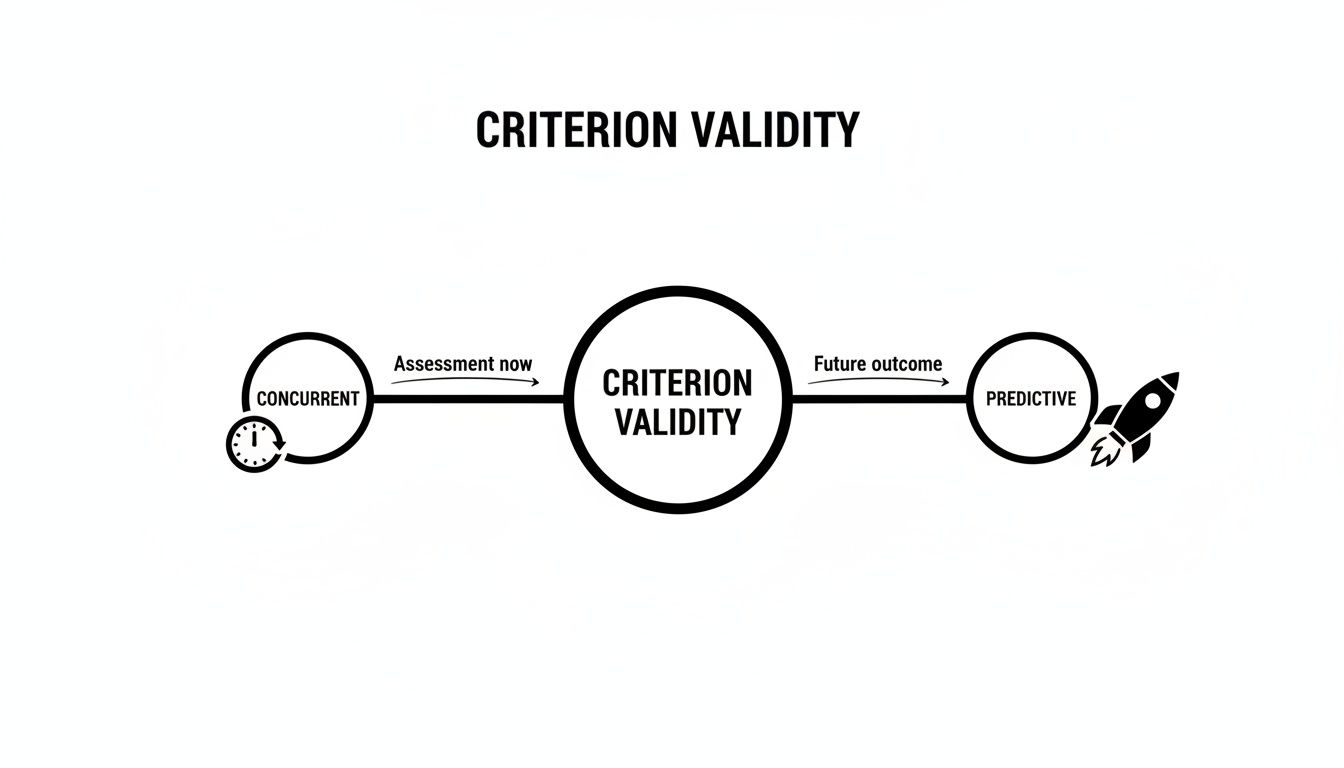
As you can see, concurrent validity is all about the present moment, while predictive validity is about looking ahead to a future outcome.
Correlation: The Agreement Dial
The most common and straightforward method is correlation. Think of it as a volume dial for agreement that ranges from -1 to +1. The closer that number gets to +1, the stronger the positive connection between the new test and the gold standard.
A perfect +1 means they move in perfect harmony. A 0 means there’s no relationship whatsoever—just random noise. In the world of fitness and clinical testing, the specific statistic used is Pearson's correlation coefficient, often just shown as the letter r.
A strong positive correlation (typically r > 0.80) is the green light. It shows that as scores on the gold standard go up, scores on the new test follow suit in a highly predictable way. This is the statistical proof you're looking for.
For example, when a study reports a correlation of r = 0.92 between the Chester Step Test and a direct VO₂ max test, it's providing powerful evidence that the step test is a very accurate substitute.
Regression: Drawing the Line of Best Fit
While correlation tells us if two things are related, regression analysis tells us how. It goes a step further by creating a predictive equation, essentially drawing a "line of best fit" through all the data points.
Imagine you plot every person's result from a new body fat scale against their DEXA scan result on a graph. Regression analysis creates an equation for the single straight line that best slices through that cloud of dots.
This is incredibly powerful for predictive validity. That regression equation is what allows a simple test to estimate a "true" score, and it’s often the magic behind the algorithms in our equipment. It's also a key part of making sure your tools stay accurate over time; for more on this, check out our guide on testing equipment calibration.
Sensitivity and Specificity: The Screening Power-Couple
When a test is designed to screen for something—like flagging athletes at a high risk of injury—a simple correlation doesn't cut it. We need to know how good it is at making a correct "yes" or "no" decision. That's where sensitivity and specificity come into play.
Think of them as two different security guards working together:
- Sensitivity: This is the "true positive rate." It tells you how well the test correctly spots people who have the condition. High sensitivity means very few false negatives—the test is great at catching what it’s supposed to.
- Specificity: This is the "true negative rate." It measures how well the test correctly clears people who do not have the condition. High specificity means very few false positives—it's great at ruling people out.
A test screening for overtraining risk needs high sensitivity so you don't miss anyone in danger. In contrast, a test that confirms a serious diagnosis before a major intervention needs sky-high specificity to make sure you aren’t treating people who don't need it.
Bland-Altman Plots: A Visual Reality Check
Finally, one of the most revealing tools is the Bland-Altman plot. While a correlation gives you a single number, a Bland-Altman plot gives you the whole picture. It shows you exactly how much two tests agree or disagree across the entire range of measurements.
The plot graphs the difference between the two measurements against their average. In a perfect world, all the data points would hug the zero line, showing no difference.
This visual approach is brilliant for spotting sneaky systematic errors. For instance, a plot might reveal that a new device consistently overestimates body fat in leaner individuals but underestimates it in heavier ones. That's a critical flaw that a simple correlation coefficient would completely miss. It answers the most practical question of all: "For any given person, how far off are these two tests likely to be?"
Criterion Validity in Action: Real-World Fitness Equipment
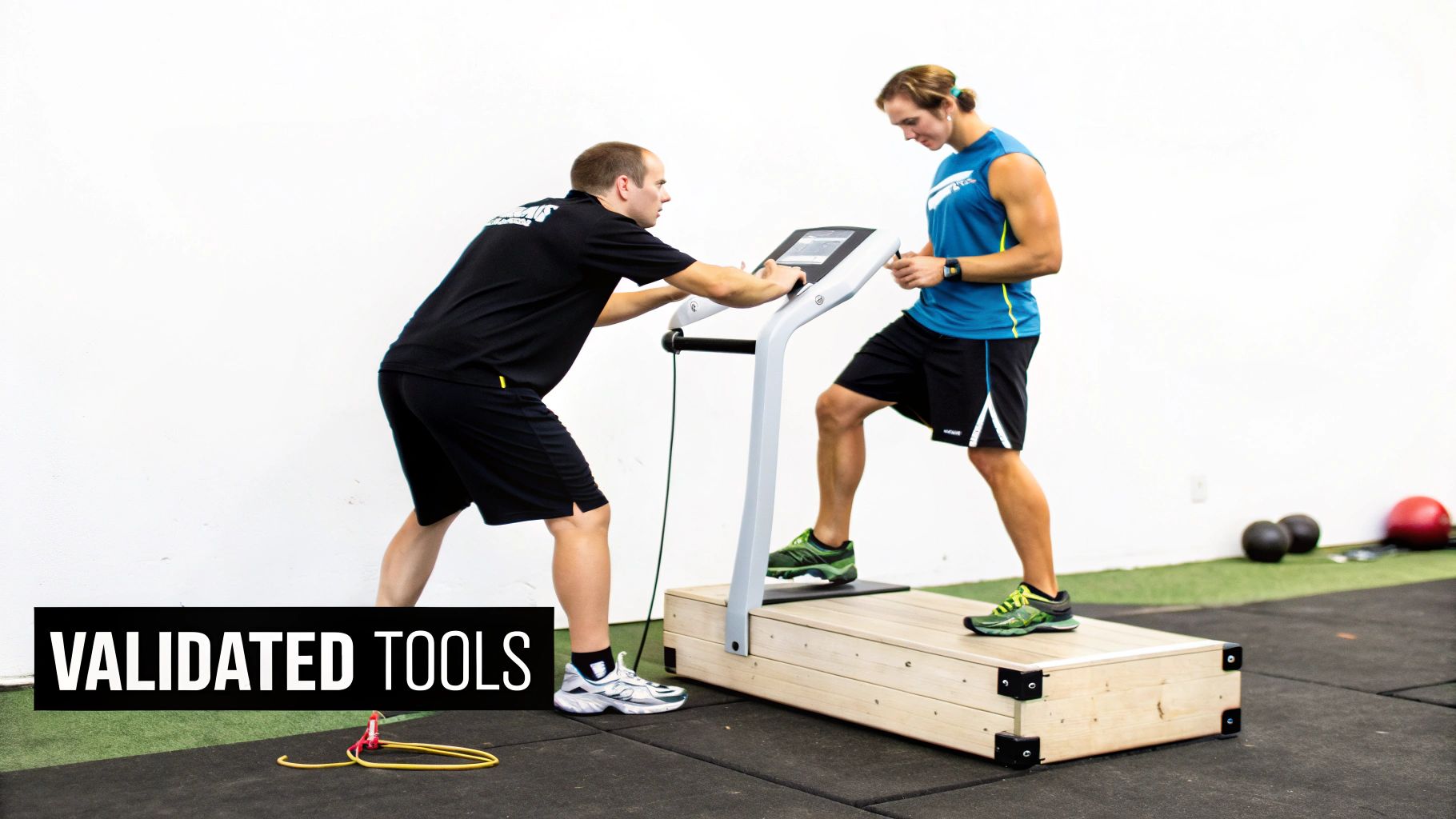
It’s one thing to understand the stats behind criterion validity, but it's another to see how it all comes together on the gym floor. Those numbers and charts from validation studies are precisely what allow you to trust the portable, everyday tools you rely on. They’re the proof in the pudding, showing that a device isn’t just guessing—it’s actually reflecting a client’s true physiological state.
So, let's step away from the theory and look at how this plays out with two common types of professional fitness equipment: one for aerobic capacity and another for body composition. These examples really highlight the scientific rigor that sets professional-grade tools apart from consumer gadgets.
Assessing Aerobic Capacity: The Chester Step Test
The Chester Step Test is one of the most popular field tests for aerobic fitness, and for good reason. It’s simple, requires minimal equipment, and can be done just about anywhere. But its true value hangs entirely on how well its VO₂ max estimates stack up against the gold standard.
In the world of cardiorespiratory fitness, the undisputed benchmark is direct gas analysis with a metabolic analyzer, like a Cosmed system. This lab-based method measures the exact volume of oxygen someone consumes at peak exertion. It's incredibly precise but also completely impractical for routine client check-ins.
This is where criterion validity comes in. To validate the Chester Step Test, researchers perform a head-to-head comparison:
- Step 1: A group of participants completes the Chester Step Test, and their VO₂ max is estimated using their heart rate response.
- Step 2: The same people then do a maximal exercise test on a treadmill while hooked up to a Cosmed metabolic analyzer to get their true VO₂ max measurement.
- Step 3: The two sets of results are compared. Validation studies have found a strong correlation (r=0.92) between the two, proving that the simple step test provides results that closely track the complex lab test.
It's this rigorous validation process that elevates the Chester Step Test from a simple fitness challenge to a reliable scientific assessment.
Measuring Body Composition: The BodyMetrix Ultrasound
Accurately measuring body composition is just as crucial for tracking a client's journey. While methods like DEXA scans are considered a gold standard, they’re expensive and not exactly accessible for most trainers. This gap created the need for portable, reliable alternatives.
This is where a device like the BodyMetrix Ultrasound system comes in. It uses ultrasound technology to measure tissue thickness, but to prove its worth, it has to show strong concurrent criterion validity against an established benchmark. In exercise science, a common comparison is the BodPod, which uses air displacement to measure body composition.
A major multicenter trial did exactly that, testing 300 people across the UK and EU. The study revealed a strong correlation of r=0.87 for body fat percentage between the BodyMetrix and the BodPod, with the average difference being less than 2.1%.
This is a big deal. A result like that falls comfortably within the accuracy guidelines set by the American College of Sports Medicine (ACSM), confirming the device is fit for professional use. You can dive deeper into these kinds of studies and see more criterion validity examples at simplypsychology.org.
Ultimately, it’s these validation studies that give you the confidence that the body fat percentage you’re recording is a true reflection of your client's physiology. It means you can build effective nutrition and training programs on a foundation of solid data.
How to Evaluate a Manufacturer's Validation Claims
When a company stamps "scientifically validated" on its product, it’s easy to take that claim at face value. But let's be honest, not all validation claims are created equal. As a discerning professional, you need to be able to look past the marketing jargon and scrutinize the science for yourself. This is how you invest in equipment that is genuinely accurate and reliable.
Knowing what to look for is a critical skill. It’s the difference between buying a high-performance assessment tool and an expensive gadget. By asking the right questions, you ensure the data you collect is trustworthy, which protects both your clients and your professional reputation.
Look for Peer-Reviewed Research
First things first: where is the validation coming from? A glossy white paper published on the manufacturer's own website is, at its core, a marketing document, not independent scientific proof. It might offer some insights, but it lacks the unbiased rigor needed for true validation.
What you're really looking for is research published in a peer-reviewed scientific journal. This means the study was torn apart and analyzed by independent experts in the field before it ever saw the light of day. This process is designed to expose flaws in methodology and interpretation. Simply put, peer review is the gold standard for scientific credibility.
Identify the Gold Standard Used
A validation study is only as good as the yardstick it’s measured against. The manufacturer should clearly state which "gold standard" they used for comparison. If they can’t name a legitimate, widely accepted benchmark, that’s a massive red flag.
For example, a new device should be compared against the best possible existing method:
- Aerobic Capacity: The gold standard is direct gas analysis (VO₂ max), not another simplified field test.
- Body Composition: The best measures are multi-compartment models, often using DEXA or air displacement plethysmography (like a BodPod).
- Heart Rate: Nothing beats a 12-lead electrocardiogram (ECG) for accuracy.
If a study compares a new device to a less accurate or unproven method, the results are essentially meaningless. It’s like checking a new watch’s accuracy against a broken clock.
Analyze the Study's Participants
Okay, so they have a study. But who was in it? A device validated on elite male cyclists between 20 and 25 years old might not be accurate for your 65-year-old female client recovering from surgery. The study’s sample size and the population tested are crucial.
A larger, more diverse sample—in terms of age, sex, and fitness level—provides stronger, more generalizable evidence. Look for studies with a sample size that is statistically significant, often meaning at least 30-50 participants, and ideally much more.
A small, homogenous group can produce impressive-looking stats that just don't hold up in the real world. A reputable study will be transparent about who participated, allowing you to judge if the findings are truly relevant to your own clients. For a deeper dive into the formal steps involved, our guide on the medical device validation process provides some excellent context.
Decode the Statistical Results
Finally, don't let the numbers intimidate you. Understanding a few key statistics will tell you most of what you need to know. The big one to look for is the correlation coefficient, often reported as Pearson's r.
An r value close to 1.0 (e.g., r=0.92) indicates a very strong positive relationship, giving you confidence that the device is accurate. A value below 0.80 suggests a weaker relationship that should make you pause. The principles behind creating a robust certification program that builds trust often parallel this process, as both rely on transparent, verifiable data to prove their worth.
Your Checklist for Choosing Validated Equipment
Investing in new equipment is a big decision for your practice. So, how do you make sure you're choosing a tool that's genuinely accurate and not just cleverly marketed? After breaking down what criterion validity is and how it’s measured, let's pull it all together into a straightforward checklist.
Think of this as your practical guide to asking the right questions. It'll help you see past the sales pitch and build a toolkit you can trust to deliver real, measurable results for your clients.
The Core Validation Questions
Before you even think about buying, you need to probe into the science behind the product. A manufacturer worth their salt will have clear, ready answers to these questions.
Is the validation study published in a peer-reviewed journal? An internal white paper is one thing, but a peer-reviewed study is the gold standard of scientific proof. It means independent experts have picked apart the research and given it their stamp of approval for quality and accuracy.
What was the "gold standard" used for comparison? This is crucial. The study has to compare the new device against the most accurate, established method available—think direct gas analysis for VO₂ max or a DEXA scan for body composition. If they're just comparing it to another field test, that’s a major red flag.
Who were the study participants? A device proven accurate on a small group of elite male cyclists might not hold up for the diverse population you work with. Look for studies with a large sample size that actually reflects your clientele.
Interpreting the Results
Getting your hands on the research is the first step; understanding what the numbers mean is the next. Don't just accept a simple "validated" claim at face value—you need to dig into the statistics.
Key Takeaway: A strong Pearson's r correlation coefficient (r > 0.80) shows a solid relationship between the new test and the gold standard. Anything lower might suggest the device isn't reliable enough for professional use.
But don't stop there. If you can find a Bland-Altman plot, it gives you a much richer story than a single correlation number ever could. This chart visually reveals if the device has a systematic bias, like overestimating at lower fitness levels and underestimating at higher ones. That's a critical detail a simple correlation often hides.
Getting answers to these questions ensures you're investing in tools that are not just convenient, but genuinely accurate.
At Cartwright Fitness, we pride ourselves on supplying health and fitness testing equipment that's backed by rigorous, peer-reviewed validation. Explore our range of professional-grade tools, including the official Chester Step Test kits, BodyMetrix Ultrasound systems, and Cosmed metabolic analysers, to build your practice on a foundation of accuracy and trust. Visit our website to learn more.