

A fire and rescue service needs a defensible indication of aerobic fitness, but the assessment setting has no metabolic cart, specialist laboratory or time for an exhaustive maximal test. A physiotherapy team may face a similar decision when monitoring rehabilitation, while a university sports science department may need a repeatable teaching protocol that students can deliver consistently. In each case, the central question is practical: what is a step test, and how can it produce useful professional information without becoming an improvised exercise challenge?
A step test is a controlled field assessment. The assessor sets a defined stepping workload, monitors the participant's heart-rate response and uses that response to estimate aerobic capacity. The value lies in the relationship between purpose, protocol, measurement quality and interpretation, not just in asking someone to step on and off a box.
For practitioners completing a wider complete head to toe assessment, step testing can provide one component of a broader functional and cardiovascular picture. The sections below distinguish submaximal prediction from direct VO₂ measurement, explain the Chester Step Test, compare common protocols and show how professionals can use results responsibly in occupational health, rehabilitation and sports science.
Table of Contents
- Introduction to Step Testing in Professional Practice
- What a Step Test Is and How It Works
- The Physiology Behind Submaximal Step Testing
- How the Chester Step Test Works in Practice
- Comparing Common Step Test Protocols
- Interpreting Results and Using Step Tests Professionally
- Key Takeaways for Reliable Step Testing
Introduction to Step Testing in Professional Practice
An occupational health practitioner has a participant ready for assessment. The room is suitable, the appointment is limited, and the organisation needs a result that can be explained to managers and understood by the individual. A maximal laboratory test might offer direct physiological measurement, but the service may not have the equipment, staffing or clinical environment required to deliver it.
A step test addresses that operational gap through standardisation. The participant follows a defined cadence, the assessor records heart rate and perceived exertion, and the result is calculated from the response to progressively controlled work. It's less demanding on facilities than direct metabolic testing, but it still requires professional judgement.
Practical rule: A short test is only defensible when the workload, cadence, monitoring and interpretation are controlled.
The test shouldn't be treated as a generic fitness challenge. A participant who steps quickly without a metronome, uses inconsistent technique or receives unclear instructions isn't completing the same assessment as someone following a published protocol. The resulting estimate may then reflect procedural variation as much as cardiovascular fitness.
Why the context matters
The Chester Step Test was developed in the UK by Professor Kevin Sykes in 1998 and has been used for more than two decades in occupational health, sports science and workforce fitness screening (Occupational Medicine). Its professional relevance comes from its design as a practical estimate of cardiovascular fitness where direct metabolic testing isn't feasible.
That makes step testing particularly useful for services that need repeatable screening, education or monitoring. It can support a work-readiness conversation, contribute to rehabilitation review or demonstrate how workload and heart rate interact in a sports science teaching environment. It shouldn't, however, be presented as identical to a directly measured VO₂max.
The professional task
A good assessment begins before the participant mounts the step. The assessor must identify the purpose, select an appropriate protocol and step height, check the equipment, establish stopping criteria and document the conditions. Those decisions influence whether the outcome can be compared with a reference band or with a later test.
The Chester Step Test provides a structured example of this approach. Its importance isn't that stepping is superior to every other aerobic assessment. It's that a defined submaximal protocol can turn a simple movement into a more consistent physiological measurement.
What a Step Test Is and How It Works
A step test estimates how the cardiovascular system responds to a known workload. The participant steps at a controlled rate, heart rate is recorded, and the assessor uses the pattern of response to estimate maximal aerobic capacity. The participant generally doesn't need to reach an all-out effort.
A useful analogy is an engine. A mechanic can learn about an engine's behaviour by observing how it responds as load increases through lower gears. The mechanic isn't required to drive at maximum speed to understand the relationship between load and response. Similarly, a step test uses manageable workloads to observe heart-rate behaviour and infer aerobic capacity.
The basic process has four elements:
- A standard workload: Step height and cadence define the external demand.
- A physiological response: Heart rate indicates how the participant is responding to that demand.
- Progression: Workload increases in stages, allowing the assessor to observe the response across more than one level.
- Prediction: The recorded relationship is used to estimate aerobic capacity rather than directly measuring oxygen consumption.
That distinction matters. A direct laboratory VO₂ test measures respiratory gases while a participant exercises, whereas a step test predicts aerobic capacity from field measurements. The estimate is therefore dependent on the quality of the workload and heart-rate data.
Why stepping is used
Stepping requires limited equipment, occupies relatively little space and can be delivered in a controlled environment. A metronome helps regulate cadence, while a heart-rate monitor provides the principal physiological observation. These features make step testing practical for occupational screening, clinical education and field-based performance assessment.
The Chester Step Test Kit consists of a step of the desired height and calculation software. A separate heart-rate device can be purchased, such as the Polar H10 Heart Rate Strap. The kit options include step height and software version, and its calculation system uses test credits that expire one year after purchase, with one credit used each time a test is calculated.
What the result can and cannot mean
A step-test result is an estimate, not a direct gas-exchange measurement. It can help classify or monitor aerobic fitness when the protocol is appropriate and delivered consistently. It can't remove the need for screening, clinical judgement or a clear understanding of the work requirement.
Recovery also matters. The assessor needs to observe how the participant responds as the workload changes and stop according to the protocol, rather than encouraging the participant to continue until exhaustion. The test's purpose is to obtain a controlled physiological response, not to produce the highest possible stepping score.
The Physiology Behind Submaximal Step Testing
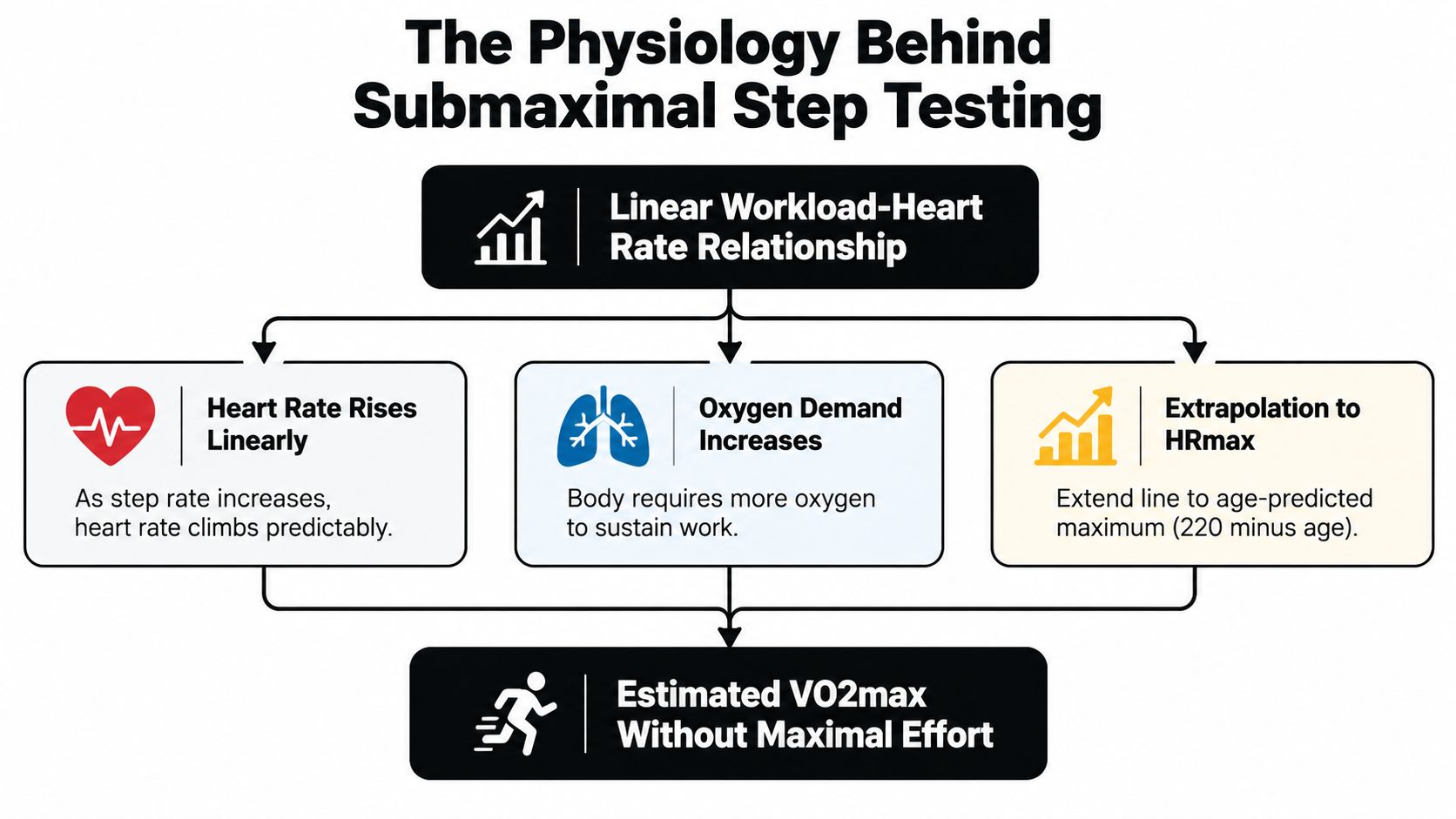
The physiological basis of a step test is the relationship between external workload and cardiovascular response. As stepping demand rises, the muscles require more oxygen, cardiac output increases and heart rate generally rises in a sufficiently predictable pattern. The assessor can then use the observed relationship to estimate how the participant might respond at a higher, age-predicted maximum heart rate.
This is an extrapolation, not a direct measurement. The protocol observes the participant below maximal effort and extends the pattern to estimate maximal aerobic capacity. That approach is useful because it limits the intensity required, but the estimate becomes less credible when the relationship is disrupted by poor cadence control, unreliable heart-rate capture or an unsuitable step height.
Why the test remains submaximal
The Chester protocol stops at about 80% of age-predicted maximum heart rate, an RPE of 15, or after 10 minutes, according to UK occupational medicine guidance (Chartered Society of Physiotherapy). These limits create a defined ceiling. The assessor isn't asking the participant to continue until voluntary exhaustion, and the protocol can be used in settings where a maximal laboratory assessment isn't practical.
RPE provides a second perspective on intensity. Heart rate can be affected by factors outside the test itself, while perceived exertion records how hard the participant feels the effort is. The assessor should record both rather than treating either measure as a complete description of physiological stress.
Sources of variation
Step height changes the mechanical demand of each repetition. Cadence changes the frequency of the work. Technique affects how efficiently the participant moves, and a loose or delayed heart-rate signal affects the quality of the data. These variables should be controlled or documented.
The published protocol commonly uses a 25 cm step in research, while UK practice describes 15 cm, 20 cm, 25 cm and 30 cm options depending on the participant and purpose (BrianMac Chester Step Test protocol). A different height isn't a minor equipment substitution. It changes the workload and therefore must be considered when results are interpreted or compared.
A prediction equation can't correct for a workload that the assessor hasn't standardised.
Direct metabolic testing may be more appropriate when a precise measurement is required, when the participant's response is atypical or when clinical and performance decisions demand respiratory-gas analysis. A submaximal estimate remains valuable, but its limitations should appear in the report.
How the Chester Step Test Works in Practice
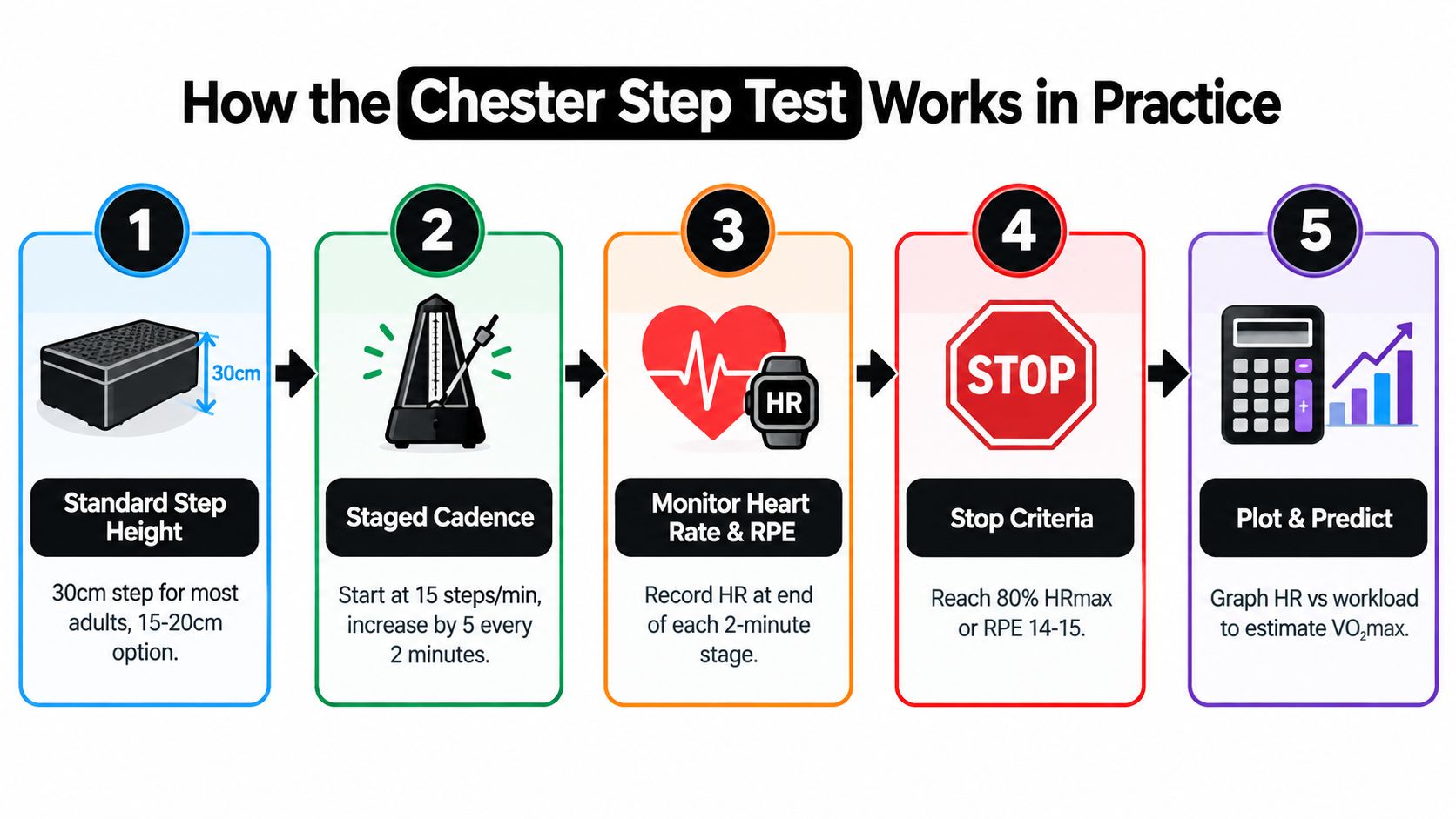
The Chester Step Test is a UK-developed, multistage submaximal aerobic assessment. The protocol begins at 15 steps per minute, then increases by 5 steps per minute after each 2-minute stage (Chartered Society of Physiotherapy). This staged progression gives the assessor several workload and heart-rate observations rather than a single post-exercise value.
A metronome is central to delivery. The participant follows the audible cadence and uses a consistent stepping pattern, while the assessor records heart rate at the end of each stage. The test continues only while the participant can maintain the required cadence and remains within the planned safety limits.
Selecting the step
The height should match the participant and assessment purpose. Published material describes 15 cm to 30 cm options in UK practice, with 25 cm commonly used in research (BrianMac Chester Step Test protocol). The assessor should record the selected height because it forms part of the workload description.
The participant should receive clear instructions before starting. The assessor can demonstrate the stepping rhythm, confirm that the participant understands the cadence and explain that the test will stop if the participant becomes unable to continue safely or reaches the defined limit.
Delivering the stages
The practical sequence is:
- Prepare the station: Check the step, metronome, heart-rate monitor and recording system.
- Set the cadence: Begin at 15 steps per minute.
- Complete each stage: Maintain the cadence for 2 minutes.
- Increase progressively: Add 5 steps per minute for the next stage.
- Record the response: Capture heart rate and RPE at the prescribed point.
- Apply stopping criteria: Stop at about 80% of age-predicted maximum heart rate, RPE 15 or 10 minutes, as specified by the protocol.
- Calculate the estimate: Enter the recorded workload and heart-rate data into the appropriate calculation software.
A controlled warm-up and consistent pre-test instructions can help the participant understand the movement and reduce avoidable procedural variation. The assessor should also document interruptions, cadence failures, unusual symptoms and any reason for early termination.
The Chester Step Test protocol provides a practical reference for professionals establishing a consistent testing procedure. Software can reduce arithmetic and plotting errors, but it can't compensate for an incorrect step height, poor heart-rate signal or inconsistent stage delivery.
Recording for repeat assessment
Repeat testing requires more than using the same person and the same piece of equipment. The assessor should aim to reproduce the step height, cadence, instructions, heart-rate device, recording points and environmental conditions. Any meaningful change in procedure should be noted before comparing results.
The output should state that the value is estimated, identify the protocol and step height, and include the stage data used for interpretation. A concise record gives another practitioner enough context to understand how the result was produced.
Comparing Common Step Test Protocols
Step tests share a movement pattern, but they don't all answer the same question. The Chester Step Test uses staged incremental workloads to estimate VO₂max, while the YMCA Step Test is described in UK occupational screening guidance as a validated selection test for aerobic capability (South East Coast Ambulance Service physical fitness assessment procedure).
The choice should follow the assessment purpose. A service comparing candidates against a defined occupational requirement may need a protocol with clear progression and established calculation procedures. A rapid selection screen may prioritise a simpler, controlled submaximal approach. A rehabilitation service may value repeatability and tolerability over a broad prediction range.
Choosing the right step test for your setting
| Protocol | Workload Structure | Primary Purpose | Best Use Case |
|---|---|---|---|
| Chester Step Test | Multistage stepping, beginning at 15 steps per minute and increasing by 5 steps per minute every 2 minutes | Estimate VO₂max from workload and heart-rate response | Occupational health, sports science, workforce screening and structured monitoring |
| YMCA Step Test | Controlled submaximal step-test procedure for estimating aerobic capability | Validated selection assessment for aerobic capability | Selection contexts where safety, repeatability and time efficiency matter |
| Other field step tests | Varies by step height, cadence, stage design and recovery procedure | Screening, education or monitoring according to the selected protocol | Settings where the method has been specified, validated or approved for the population |
Avoiding interchangeable-protocol errors
A report shouldn't describe a result as “a step test”. The protocol name, step height, cadence, stage duration, stopping rule and heart-rate method affect interpretation. Without those details, a later result may appear comparable when it was produced under a different workload.
For teaching, the Chester protocol can demonstrate staged workload and extrapolation clearly. For occupational screening, the organisation should specify which assessment is approved and how the output relates to work demands. For clinical work, the assessor should also consider whether a step assessment is suitable for the individual before testing begins.
The correct question isn't which test is universally best. It's which protocol offers the most defensible match between population, purpose, risk management and reporting requirement.
Interpreting Results and Using Step Tests Professionally
A calculated VO₂max estimate gains meaning only when it is tied to the workload, population and decision being assessed. UK reference data place men aged 20 to 29 in bands ranging from very poor below 23.6 ml/kg/min to superior above 41.0 ml/kg/min, according to the published Chester Step Test protocol guidance. These bands support comparison with a reference population. They do not establish a universal occupational pass mark.
The distinction becomes clear in fire-service assessment. UK Occupational Medicine literature reports that a VO₂ requirement of 42.3 ml O₂/kg/min has been used for operational duties (Occupational Medicine). A reference band classifies aerobic capacity against population data, whereas an operational requirement relates capacity to the demands of a defined role. The two figures may appear similar, but they answer different professional questions.
Read the result with the workload
Step height changes the physiological demand at each stage and therefore affects the estimated values. The published protocol guidance describes estimated VO₂ values of about 11 to 25 ml/kg/min on a 15 cm step and 16 to 37 ml/kg/min on a 30 cm step across stages I to V. The estimate must therefore remain attached to the workload that produced it, like a test score reported alongside the difficulty of the task.
A defensible record includes:
- Protocol details: Test name, step height, cadence and stage structure.
- Physiological data: Heart rate at relevant stage points and reported RPE.
- Test behaviour: Cadence accuracy, stepping technique, pauses and early termination.
- Interpretive context: Reference band, occupational standard or rehabilitation objective.
- Decision limits: Whether the estimate is sufficient or direct metabolic testing is required.
Applying results to professional decisions
Occupational health teams may use step testing for workforce screening when the chosen protocol matches the role and governing procedure. Sports scientists can use it to monitor aerobic fitness if test conditions remain consistent. Physiotherapists and rehabilitation services can include submaximal responses within a wider assessment, subject to individual suitability and clinical oversight.
A result is one measurement within a decision process. It is not a diagnosis or, by itself, a declaration of work readiness. Interpretation should also consider symptoms, medical history, role demands and organisational policy.
Equipment selection should follow the reporting process rather than precede it. Reviewing step test equipment for professional assessment can help teams specify the step, heart-rate measurement and calculation requirements. Software may support consistent reports and assessment histories, but practitioners still need training to understand the calculation and its limits.
Reporting principle: The most useful result is one that another qualified assessor can reproduce, audit and interpret from the written record.
Key Takeaways for Reliable Step Testing
A step test is a standardised submaximal assessment, not a casual stepping challenge. It estimates aerobic capacity from the relationship between controlled workload and heart-rate response, so the quality of the result depends on the quality of the procedure.
The Chester Step Test offers a structured UK-developed option for occupational health, sports science and workforce fitness assessment. Its staged cadence, defined stopping criteria and calculation process make it suitable where direct laboratory VO₂ measurement isn't practical. The estimate still requires careful interpretation, particularly when a result informs fit-for-work decisions or comparison with a formal occupational standard.
Reliable delivery rests on a small group of essential controls:
- Define the purpose: Select a test that matches the population, role and decision.
- Standardise the workload: Record the step height and follow the prescribed cadence.
- Capture heart rate accurately: Use a dependable monitor and document the measurement method.
- Control the session: Give consistent instructions, observe technique and apply stopping criteria.
- Interpret proportionately: Use reference data or occupational thresholds only when they fit the assessment context.
- Record enough detail: Preserve the conditions and stage data needed for repeat testing.
A professional service should audit its current process before buying equipment. The audit can identify whether assessors use the same step height, whether cadence is controlled, whether heart-rate data are captured consistently and whether reports distinguish estimated VO₂max from directly measured oxygen uptake.
Cartwright Fitness supplies professional assessment equipment, calculation software and training relevant to aerobic fitness and occupational measurement. Practitioners who need to implement or standardise the Chester Step Test can review the available solutions and visit Cartwright Fitness to identify suitable equipment, software and professional support for their assessment service.