

For a long time, lactate got a bad rap. It was the molecule everyone loved to blame for that muscle burn during a tough workout, dismissed as nothing more than metabolic junk. We now know that couldn't be further from the truth.
Lactate is actually a high-octane fuel source your body cleverly produces and recycles when you're pushing the pace. It’s a central player in energy metabolism, not a villain to be avoided.
This one molecule tells two completely different stories. One story unfolds on the track and in the weight room; the other happens in the emergency room.
From Performance Fuel to Medical Warning Sign
Lactate measures the concentration of lactate in the blood, but what that number means depends entirely on the situation. For an athlete, it’s a direct window into metabolic efficiency and how hard they’re working. For a doctor, it’s a critical red flag signaling metabolic stress and a lack of oxygen in the body's tissues.
The Athlete's Performance Gauge
For coaches and athletes, a lactate test is like getting a look under the hood of an engine during a race. It gives you hard data on an athlete's capacity to handle high-intensity work.
By measuring lactate, you can pinpoint the exact moment when the body starts producing it faster than it can clear it away. That inflection point is the famous "lactate threshold," a gold-standard measure of endurance fitness. Tracking this allows for smarter, more precise training designed to push that threshold higher and improve performance.
The Clinician's Warning Signal
In a hospital, the question "What does lactate measure?" takes on a much more urgent tone. Here, it’s no longer a performance metric but a critical alarm bell.
High lactate levels in a patient often point to a dangerous condition called tissue hypoperfusion, where vital organs aren't getting enough oxygen. This is a life-threatening consequence of conditions like sepsis, shock, or major trauma.
Clinicians rely on lactate as a direct, measurable sign of how sick a patient is. A rising lactate level is a powerful predictor of short-term mortality, giving doctors a crucial signal to intervene aggressively to restore oxygen flow and prevent organ failure.
The numbers really tell the story. For example, research on prehospital patients found that a lactate level of ≥4.0 mmol/L was linked to a 12.8% 7-day mortality rate. In stark contrast, patients with levels below 2.0 mmol/L had a mortality rate of just 2.0%. You can explore more data on how lactate levels correlate with patient outcomes to see just how significant this marker is.
That massive difference is why lactate is one of the most trusted biomarkers in emergency and critical care.
Lactate's Dual Role At a Glance
To put it simply, context is everything when it comes to lactate. This table breaks down its two primary roles.
| Context | What Lactate Measures in Athletics | What Lactate Measures in Clinical Settings |
|---|---|---|
| Primary Goal | Optimize performance and training intensity. | Assess illness severity and guide treatment. |
| What It Signals | How efficiently the body is using fuel during exercise. | A lack of oxygen delivery to the body's tissues (hypoperfusion). |
| Key Threshold | The "lactate threshold" or "anaerobic threshold." | Clinically significant hyperlactatemia (e.g., >2.0 or >4.0 mmol/L). |
| Interpretation | A higher threshold indicates better endurance fitness. | A higher level indicates greater metabolic stress and higher mortality risk. |
| Typical User | Athletes, coaches, and sports scientists. | Doctors, nurses, and emergency medical personnel. |
Ultimately, whether it’s helping an athlete shave seconds off their personal best or helping a doctor save a life, lactate provides an invaluable piece of the physiological puzzle.
How Your Body Produces and Recycles Lactate
To really get what lactate measures, we have to look under the hood at your body’s energy economy. Think of your body as a workshop that's constantly using and creating energy. The main fuel for this workshop is glucose, a simple sugar from the food you eat.
The first step in using this fuel is a process called glycolysis. It’s a lightning-fast reaction happening right inside your cells, where one glucose molecule gets split into two smaller molecules of pyruvate. This breakdown gives your cells a quick, immediate shot of energy.
This initial process is incredibly efficient for speed because it doesn't need any oxygen. It’s the energy system your body relies on for any sudden, intense effort—like sprinting to catch a train or hoisting a heavy box.
The Crossroads of Energy Production
Once pyruvate is created, it hits a fork in the road. If you're just relaxing and your body has plenty of oxygen, pyruvate takes the scenic route. It heads into the mitochondria—the cell’s powerhouses—to enter a slower, more complex process that wrings out a ton more energy.
But what happens when you kick things into high gear? Your muscles start screaming for energy much faster than that slow, oxygen-based system can provide. Pyruvate starts to back up, like cars piling up in a traffic jam at rush hour. To clear the jam and keep the energy flowing, your body quickly converts this excess pyruvate into lactate.
Lactate isn't the villain it's often made out to be. It's actually a clever metabolic workaround. This conversion allows glycolysis to keep churning out high-speed energy, making sure your muscles have the fuel they need to keep pushing hard.
This isn't just an emergency process, either. Your body is producing and clearing lactate all the time, even when you're sitting still, just to maintain a steady balance.
The image below shows this dual nature of lactate perfectly—how it's a performance fuel for athletes but a red flag for doctors.
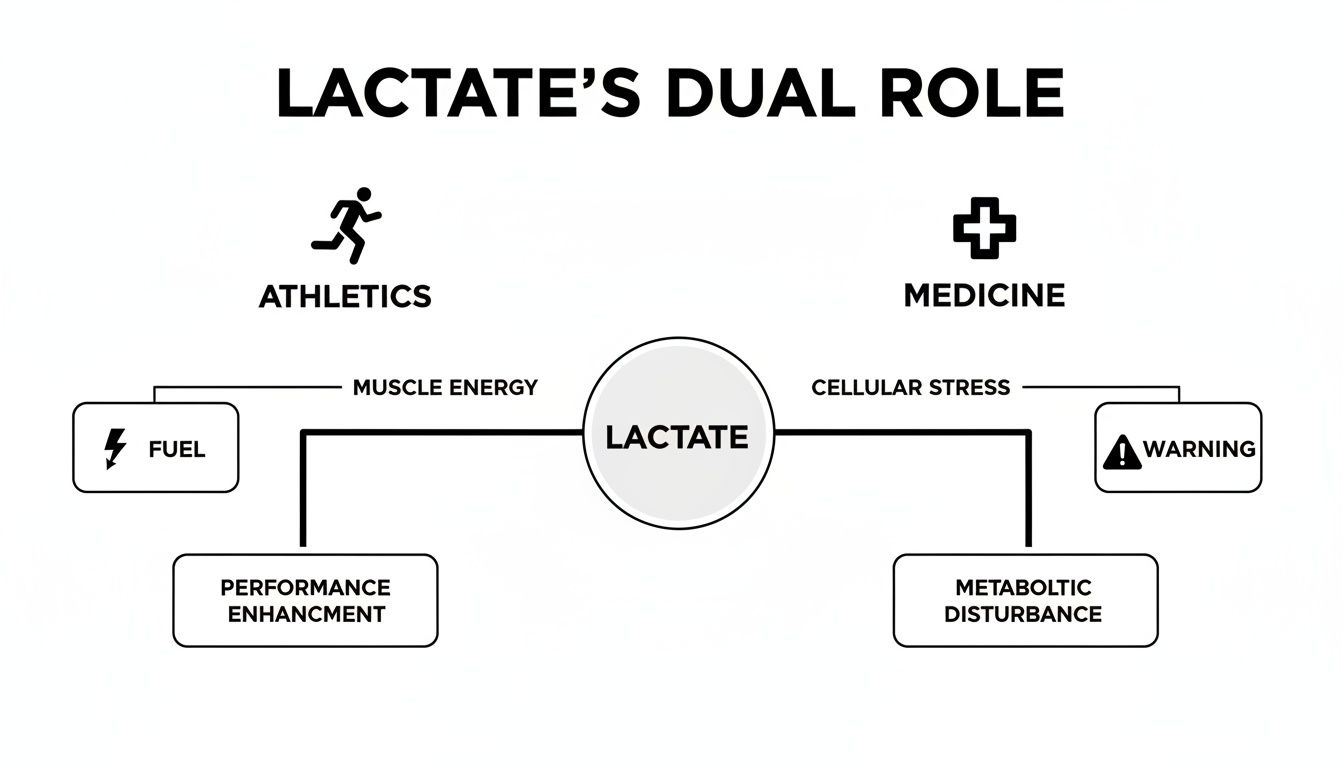
You can see how it shifts from being a valuable resource in a healthy, exercising body to a critical warning sign when the body is under severe metabolic stress.
The Great Recycling Program: The Cori Cycle
So, where does all this lactate go? Your body is far too resourceful to just throw away a perfectly good fuel source. Instead, it has a brilliant recycling system called the Cori cycle.
Lactate made in your muscles doesn't just hang around. It gets shuttled into your bloodstream and makes its way to the liver. Your liver then works like a sophisticated recycling plant, converting the lactate back into glucose. This new glucose is then sent back to the muscles for another round of energy production or gets stored for later use.
It’s an elegant loop that keeps you fueled during long bouts of activity and helps manage lactate levels in the blood. For a closer look at its function, you can explore more about what lactate is in the blood and how this amazing cycle keeps your metabolism in check.
Ultimately, everything comes down to the delicate balance between how fast lactate is being produced and how quickly it's being cleared.
- Production Rate: This is how fast your muscles are churning out lactate from pyruvate.
- Clearance Rate: This measures how efficiently your liver, heart, and other tissues are pulling lactate from the blood to reuse it.
When you push your physical limits, your production rate temporarily outstrips your clearance rate. That’s when lactate levels in the blood start to climb, and it's this very accumulation that we measure with lactate testing. Understanding this dynamic is the key to interpreting what lactate means, whether you're assessing a world-class athlete or a patient in the ICU.
The Practical Side of Measuring Lactate
Alright, we've talked about the "why" behind lactate. Now, let's get into the "how." Understanding the theory is one thing, but actually getting a reliable reading—whether you're trackside with an athlete or bedside in a hospital—involves specific tools and techniques.

The tools of the trade really boil down to two main camps: the fast-and-nimble handheld analysers and the heavy-duty laboratory systems. Each has its place, and they strike a very different balance between convenience and deep analytical power.
Handheld Analysers vs. Laboratory Systems
For coaches and sport scientists, portable lactate meters are indispensable. These little devices give you results in seconds from a tiny pinprick of blood, making them perfect for real-time feedback during a gruelling training session. They’re built for the field, allowing you to make on-the-fly adjustments to an athlete's effort. If you're weighing your options, our guide to choosing a lactate measurement device can point you in the right direction.
On the other end of the spectrum, clinical settings lean on larger, more sophisticated blood gas analysers. These lab-based workhorses require a bigger blood sample, usually drawn from a vein, and they don't just measure lactate—they run a whole panel of biomarkers. While you'll wait longer for the results, they are the undisputed gold standard for accuracy, providing the precision needed for critical medical decisions.
Blood Sampling Techniques
Where you get the blood from is just as important as the machine you put it in. The two go-to methods are capillary and venous sampling.
- Capillary Sampling: This is the quick-and-easy finger or earlobe prick. It's minimally invasive and exactly what you need for the frequent, repeated tests in an athletic protocol. A tiny lancet makes the puncture, and a small bead of blood is all it takes.
- Venous Sampling: This involves a proper blood draw from a vein, typically in the arm, performed by a healthcare professional. It gives you a larger sample for a full lab workup and provides a picture of the average lactate concentration circulating throughout the entire body—vital information in a clinical setting.
A healthy adult's resting whole-blood lactate typically sits around 1–2 mmol/L. The beauty of point-of-care handheld meters, which might need just 0.7 µL of blood and deliver a result in 13 seconds, is how quickly they can track deviations from that baseline. While lab methods are more precise, these portable devices are invaluable for quick decisions. Still, their results always need to be interpreted with the full physiological picture in mind. You can read more about the methodological nuances of lactate measurement and what they mean in practice.
Ensuring an Accurate Reading
The old saying "garbage in, garbage out" has never been more true than with lactate testing. A sloppy sample collection can completely throw off your results, rendering the data useless. A clean, consistent procedure isn't just best practice—it's non-negotiable.
Here’s how to get a reliable capillary sample every single time:
- Clean the Site: Use an alcohol wipe to thoroughly clean the fingertip or earlobe. You need to get rid of any sweat, lotion, or dirt.
- Let it Dry: This is a step people often rush. Let the alcohol evaporate completely on its own. Wiping it can reintroduce contaminants, and any leftover alcohol will dilute the blood.
- Wipe Away the First Drop: The first bead of blood is often contaminated with tissue fluid, which will give you a falsely low reading. Always wipe it away with a clean piece of gauze.
- Collect the Second Drop: Use the next nice, round drop of blood for your measurement. And whatever you do, don't "milk" or squeeze the finger—that just forces more tissue fluid into the sample.
Following these simple but crucial steps ensures the number on your screen is a true reflection of what's happening inside the body. It’s the only way to get trustworthy data for optimising performance or making a clinical call.
How Lactate Unlocks Peak Athletic Performance
For any serious endurance athlete, lactate isn't some dreaded byproduct of fatigue—it's one of the most honest performance metrics we have. It gives us a direct, unfiltered look under the hood at the body's metabolic engine, showing precisely how efficiently an athlete is burning fuel. This is where we move past the biochemistry and see how measuring lactate translates directly into real-world speed and endurance.

At the heart of this conversation is the lactate threshold (LT). Think of it like the redline on a car's tachometer. It’s that specific point during exercise where your body starts producing lactate faster than it can clear it away. Stay below this point, and you’re in a sustainable, steady-state groove. Push past it, and fatigue starts piling up fast.
Finding this threshold is the absolute key to unlocking an athlete's potential. Why? Because it represents the highest intensity they can sustain for a long time without "blowing up." A higher lactate threshold means you can run faster, cycle harder, or swim stronger for much longer.
Mapping Your Performance Engine
So, how do we find this critical redline? Through a structured lactate threshold test. This isn't just a single blood draw; it's a systematic process that creates a personalized performance map, revealing an athlete's unique physiological fingerprint.
A standard test protocol looks something like this:
- Warm-Up: The athlete starts with a light warm-up to get the body ready.
- Incremental Stages: The test kicks off at a very low intensity. Every few minutes, the workload—speed on a treadmill or power on a bike—is increased by a set amount.
- Blood Sampling: At the end of each stage, a tiny blood sample is taken, usually from a fingertip or earlobe, and immediately analyzed for its lactate concentration.
- Data Plotting: The coach or sport scientist then plots the lactate levels against the corresponding heart rate and power/speed for each stage.
This sequence repeats until the athlete's lactate levels begin to spike, which tells us they’ve crossed their threshold. The graph you end up with shows the precise relationship between effort and metabolic stress.
From Data to Dominance
Once you have this performance map, the data becomes incredibly powerful. Instead of relying on generic formulas or just "how you feel," coaches and athletes can design hyper-specific training zones based on the individual's actual physiology.
The goal of smart endurance training isn't just to train harder; it's to systematically push the lactate threshold to the right. By training at or near this threshold, you stimulate powerful adaptations, teaching the body to become more efficient at clearing lactate and using it as fuel.
Let's make this practical. A marathon runner might discover their lactate threshold hits at a pace of 6:30 per mile with a heart rate of 170 bpm. Their training plan can now be built around this specific data:
- Tempo Runs: Performed just below or at their threshold (say, a 6:35-6:40 pace) to improve the body's lactate clearance machinery.
- Long Runs: Kept well below the threshold to build their aerobic base without accumulating junk fatigue.
- Interval Training: Involving short bursts well above the threshold to improve their tolerance to high lactate levels.
This data-driven approach takes the guesswork out of training. It ensures every single workout has a clear physiological purpose. Athletes can finally avoid that common pitfall of "moderate-intensity" training, which is often too hard for proper recovery but not hard enough to trigger meaningful adaptation. For a closer look at the nuts and bolts, a deeper dive into specific blood lactate testing protocols can offer valuable practical guidance.
Ultimately, by understanding what lactate measures in a performance setting, athletes gain genuine control over their training. They learn how to push their limits intelligently, paving the way for breakthrough performances and a whole new level of endurance.
Why Lactate Is a Critical Tool in Emergency Medicine
When you step away from the athletic field and into the emergency room, the question "what does lactate measure?" takes on a whole new level of urgency. In a clinical setting, an elevated lactate level isn't about athletic performance; it's a serious red flag. It’s one of the body’s most reliable warning signs that something is going profoundly wrong at the cellular level.
This alarm bell often points to a dangerous state called tissue hypoperfusion. The easiest way to think about it is as a critical supply chain failure within the body. For one reason or another, vital tissues and organs just aren't getting the oxygen-rich blood they desperately need to function. This oxygen deficit shoves cells into anaerobic metabolism, causing lactate to spill into the bloodstream as a byproduct.
Major medical events like severe infections (sepsis), significant trauma, and shock are the usual suspects behind this metabolic crisis. For an ER doctor, a lactate measurement offers a direct, quantifiable look at this hidden cellular stress—often long before other vital signs even begin to drop.
The Power of Lactate Clearance
In the high-stakes environment of emergency medicine, a single lactate reading is really just the opening chapter of the story. While that initial number gives a crucial snapshot of the patient's state, the real insight comes from tracking its trend over time. This is where the concept of lactate clearance becomes such a powerful tool.
Lactate clearance is simply the rate at which lactate levels fall once treatment begins. Think of it like a firefighter watching a smoke detector. You don’t just want to hear the alarm; you want to see the smoke level drop once you start putting out the fire. A falling lactate level is a clear signal to the medical team that their interventions, like giving IV fluids and oxygen, are actually working and that blood flow is being restored.
On the other hand, a lactate level that stays stubbornly high—or worse, continues to climb—is an ominous sign. It means the underlying problem isn't fixed, and the patient faces a much higher risk of organ failure and death.
A Case Study in Sepsis Management
Let's walk through a common ER scenario. An elderly patient is brought in with a fever, confusion, and low blood pressure—all classic signs of sepsis. The initial lab work comes back with a lactate level of 6.0 mmol/L, a dangerously high number that immediately elevates the urgency of the situation.
The team jumps into action, starting aggressive IV fluid resuscitation and broad-spectrum antibiotics. An hour later, they draw blood again. This time, the lactate has dropped to 4.5 mmol/L. This is what we call positive lactate clearance, and it's a deeply reassuring sign that the patient is responding. With continued care over the next few hours, the lactate level slowly normalizes, confirming the metabolic storm is passing.
This practice of serial measurement is now a cornerstone of modern critical care. The adoption of lactate monitoring in sepsis protocols has surged, with repeat testing after a high initial value becoming standard procedure. Evidence shows that a lactate level over 4 mmol/L is linked to significantly higher mortality, with some trauma studies reporting death rates around 33% for these patients. Tracking the trend provides far better prognostic information than any single measurement. Learn more about the evolution of lactate monitoring in clinical practice.
As a reference, here’s how lactate levels are generally interpreted in a clinical context.
Clinical Lactate Thresholds and Associated Risks
This table outlines common lactate reference ranges used in clinical settings and their general interpretation regarding patient mortality risk.
| Lactate Level (mmol/L) | Clinical Interpretation | Associated Mortality Risk |
|---|---|---|
| < 2.0 | Normal | Low |
| 2.0 – 3.9 | Mildly Elevated (Hyperlactatemia) | Moderate; indicates stress, warrants monitoring |
| ≥ 4.0 | Severely Elevated (Lactic Acidosis) | High; strongly associated with sepsis/shock |
| > 10.0 | Critically Elevated | Very high; indicates profound metabolic failure |
This data underscores why lactate is such a critical biomarker for triaging and managing critically ill patients.
Lactate as a Diagnostic Piece of the Puzzle
It’s crucial to remember that while lactate is a powerful signal, it's not a diagnosis in and of itself. High levels are strongly linked to sepsis and shock, but other conditions can also cause a spike, including severe liver disease, certain medications, or even intense seizures.
Because of this, clinicians must use the lactate value as one key piece of a much larger diagnostic puzzle. In emergency medicine, interpreting a test like this is central to building an effective differential diagnosis. It’s about weaving together the lactate reading with the patient's history, a physical exam, and other lab results to paint a complete clinical picture.
Ultimately, by measuring lactate, clinicians get a powerful, real-time window into a patient’s metabolic health, allowing them to guide life-saving decisions with far greater confidence.
So, What Does This All Mean for You?
We’ve covered a lot of ground, from the track to the ICU. It’s pretty clear that what lactate measures isn't one single thing—it's all about context. Whether you're a coach with a stopwatch or a clinician with a patient chart, the real skill is looking past the number and understanding the metabolic story it's telling.
Lactate isn't just "good" or "bad." It's a dynamic signal from the body. The goal is to use that signal to make better decisions, whether that’s dialing in a training plan or steering a critical medical intervention.
Take-Home Points for Coaches
For coaches and athletes, lactate testing is your secret weapon for training smarter. It gives you a direct look under the hood at an athlete's physiological engine, allowing you to move beyond cookie-cutter plans and truly personalize their journey to peak performance.
Nail Down Those Training Zones: Use lactate threshold data to set up rock-solid training zones for heart rate, pace, or power. This way, every single workout has a clear purpose, whether it's building that aerobic base or pushing the threshold.
See Real, Objective Progress: Watching an athlete's lactate threshold climb is one of the most concrete signs of improving endurance. It’s hard data that proves the training is working, which is a huge motivator.
Dodge the Overtraining Bullet: Regular lactate monitoring can be an early warning system. It tells you when an athlete is redlining too often, giving you a chance to prioritize recovery before burnout sets in.
For a coach, the lactate curve is the most honest feedback you'll ever get. It shows you exactly how an athlete's body is handling stress, letting you fine-tune their training with a precision that just going by "feel" can never deliver.
Critical Reminders for Clinicians
In the clinic, context is king. A high lactate reading is a major red flag, but it’s not a diagnosis in and of itself. Think of it as a critical piece of a much larger puzzle that you need to solve, and quickly.
The real insight often comes from the trend over time, not a single snapshot. Lactate clearance—how quickly those levels come down—is often a far better predictor of a patient's outcome than the initial high reading. If that number is falling, it’s a good sign your interventions are working and tissues are getting the oxygen they need.
For anyone—clinician or coach—wanting to dive deeper and systematically review the evidence on lactate, learning how to conduct a meta-analysis is a powerful skill. In the end, whether you're trackside or bedside, understanding what lactate truly measures is what empowers you to turn complex data into decisive, life-changing action.
Got Questions About Lactate? Let's Clear a Few Things Up.
Even after getting the basics down, a few common questions and myths about lactate tend to pop up again and again. Getting these sorted is key, whether you're an athlete trying to dial in your training zones or a clinician making sense of a patient's lab results.
Let's tackle some of the most frequent queries I hear.
Is Lactate What's Causing That Awful Burn in My Muscles?
Nope. This is probably the biggest myth in exercise science, and it just won't die. For years, everyone pointed the finger at lactate for that searing pain you feel when you're pushing hard.
The real culprit is actually an accumulation of hydrogen ions (H+). These little guys are a byproduct of the high-speed energy production needed for intense exercise, and they make your muscle cells more acidic. That drop in pH is what your nerves feel as a burn. Lactate is produced right alongside these hydrogen ions, so it's guilty by association, but it doesn't cause the pain.
How Often Should I Test My Lactate Threshold?
For serious athletes, a good rule of thumb is to re-test every 8 to 12 weeks. This timeframe lines up nicely with most training blocks, giving you a chance to see how your body has adapted to all that hard work.
Testing more often than that usually isn't necessary. Real, meaningful changes to your lactate threshold don't happen overnight. The best strategy is to test at the start of a major training cycle to get your baseline, and then again at the end to see exactly what you’ve gained. That data lets you perfectly adjust your training zones for the next phase.
Can Lactate Be High for Reasons Other Than Sepsis or Shock?
Yes, definitely. High lactate is a massive red flag for conditions like sepsis and shock where tissues aren't getting enough oxygen, but those aren't the only causes. A high reading always demands attention, but it needs careful clinical context because other factors can push the numbers up.
Think of a high lactate reading as a signal, not a diagnosis in itself. Its real value comes when you put it together with the rest of the patient's clinical picture to figure out what’s truly driving their metabolic stress.
Here are a few other potential causes for elevated lactate:
- Severe Liver Disease: Your liver does most of the heavy lifting when it comes to clearing lactate from your blood. If it’s not working properly, lactate can build up even when there's plenty of oxygen to go around.
- Certain Medications: Some drugs, like metformin (a common diabetes medication), can interfere with metabolic pathways and cause lactate to rise.
- Intense Seizures: The incredible amount of uncontrolled muscle activity during a seizure can churn out a huge amount of lactate in a very short time.
- Thiamine (Vitamin B1) Deficiency: Thiamine is a key player in energy metabolism. Without enough of it, the body can't process pyruvate efficiently and shunts it toward producing more lactate instead.
This is exactly why context is king when a clinician sees that high lactate number on a lab report.
At Cartwright Fitness, we focus on getting professional-grade testing equipment into the hands of athletes, coaches, and clinicians who need accurate data they can trust. From lactate analysers to metabolic carts, you can check out our validated solutions for performance and health assessment on our official website.