

BIA can mean several things, but in health and fitness it stands for Bioelectrical Impedance Analysis. It's a non-invasive method that estimates body composition by measuring how a weak electrical current moves through the body.
If you're a trainer, clinician, or exercise professional, you've probably seen this acronym on a smart scale, a handheld device, or a clinic-based analyser and thought: fine, but what does that mean in practice? That's where many people get stuck. Knowing the definition is easy. Using BIA responsibly, interpreting the result properly, and collecting data in a way that's worth acting on is where professional skill begins.
Most readers looking up what does BIA stand for are really asking a second question too. Can I trust the number on the screen? The answer is: sometimes, if the protocol is good and the interpretation is sensible. A BIA reading can be useful, but only when the operator understands what the device measures, what it estimates, and what can distort the result.
For trainers working with real clients in real settings, that practitioner's gap matters. A scale can produce a body fat estimate in seconds. Turning that output into sound coaching is a different task entirely.
Table of Contents
- An Introduction to BIA in Health and Fitness
- The Science Behind How BIA Works
- Types of BIA Devices From Scales to Clinical Analyzers
- Understanding BIA Accuracy and Key Limitations
- Best Practices for Reliable BIA Measurements
- How BIA Compares to Other Body Composition Methods
- Putting It All Together for Your Practice
An Introduction to BIA in Health and Fitness
A client steps onto a smart scale after a hard morning workout, sees a body fat reading, and asks whether they gained muscle since last week. That moment captures the practitioner's gap. Knowing that BIA stands for Bioelectrical Impedance Analysis is only the starting point. Using the result well requires protocol, context, and careful interpretation.
In health and fitness settings, BIA is a body composition method that estimates values such as body fat percentage, total body water, and lean mass by passing a very small electrical current through the body. The key word is estimates. A BIA device does not measure body fat directly in the way a tape measure reads circumference or a scale reads body mass.
That distinction matters in practice. New trainers often meet BIA through consumer scales that produce a fast set of numbers and labels. The screen can make those outputs look definitive, but the device is combining raw electrical measurements with prediction equations based on factors such as height, weight, sex, age, and sometimes activity profile.
BIA works like using a thermometer in coaching. The reading is useful, but only if you understand what affects it and how to interpret it in context. Hydration status, recent exercise, food intake, and testing conditions can all shift the result enough to change the story you tell a client.
For Cartwright Fitness readers, that is the professional standard. The job is not just to know what the acronym means. The job is to collect BIA data in a controlled way, explain what the number represents, and use repeat measurements to support decisions about training, recovery, nutrition, and progress monitoring.
A BIA result is strongest as one data point inside a structured assessment process.
That approach changes the question you ask. Instead of treating a single printout as a verdict, ask whether the test conditions were consistent and whether the result fits the wider picture of the client in front of you. That is how BIA becomes a useful tool rather than a misleading one.
The Science Behind How BIA Works
Why electrical flow tells us something about body composition
A trainer runs a body composition test for two clients of the same height and body mass. The readings come back different. The reason starts with how electrical current travels through the body.
In BIA, the device sends a very small electrical current through the body and records how the tissues oppose that current. Two electrical properties matter most. Resistance reflects how strongly the body slows the current, and reactance reflects the brief delay created as cell membranes store and release electrical charge. From those measurements, the system estimates values such as total body water, fat-free mass, body fat percentage, and in some devices phase angle.
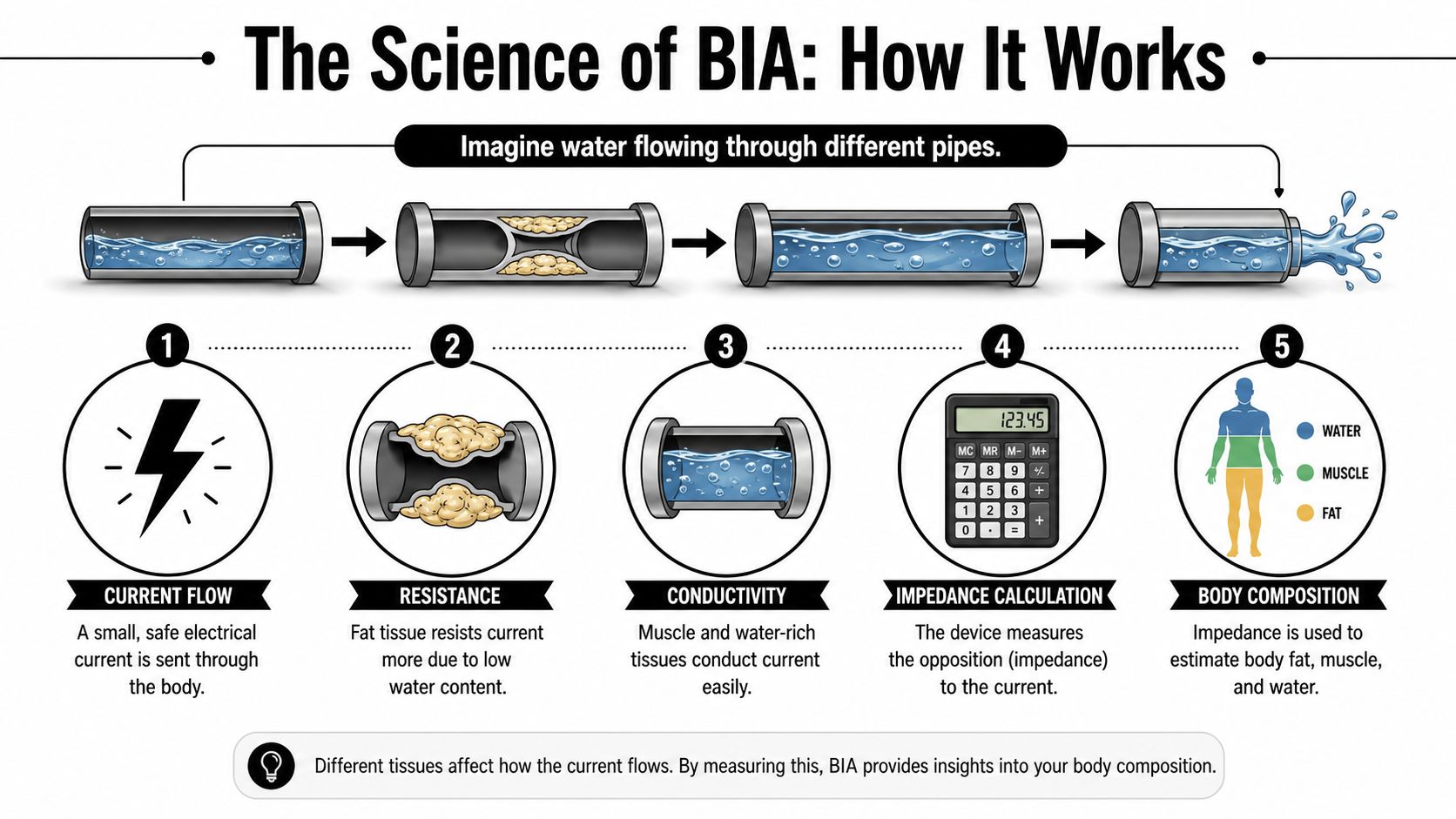
The teaching point is simple. Current passes more easily through tissues that contain more water and electrolytes. Muscle tissue, blood, and other lean tissues tend to conduct well. Fat tissue contains less water, so it offers more opposition. A flow analogy helps here. The current moves through body tissues like water through different routes. Some routes are open and easy, while others are narrower and slower.
That is why hydration status affects BIA so strongly. The device is not detecting fat cells one by one. It is measuring electrical behaviour, then relating that pattern to body composition through prediction equations.
If you work with clients using professional body composition scales for gyms and clinics, this distinction matters every time you explain a printout.
What the device is estimating
Many new trainers stop at the acronym. Practitioners need one layer deeper.
The device first captures raw electrical data. The body composition numbers shown on screen are derived estimates, not direct measurements in the same sense as body mass on a calibrated scale.
A clear working sequence looks like this:
- The device sends a weak current through the body using its contact points or electrodes.
- It measures impedance, including resistance and reactance.
- It applies an equation that combines the electrical data with inputs such as height, weight, age, and sex category.
- It produces estimates for total body water, fat-free mass, body fat percentage, and sometimes segmental values or phase angle.
For practice, this creates a gap between what the machine records and what the software reports. That gap is where professional judgment matters.
- Measurement and interpretation are separate steps. The hardware measures electrical properties. The software converts them into body composition estimates.
- Equations shape the result. Two devices can record similar impedance values and still produce different estimates because their underlying models differ.
- Context changes meaning. A shift in total body water can alter the estimate even when tissue change is minimal.
Practical rule: Explain BIA outputs as estimates built from electrical measurements and prediction equations, not as direct readings of body fat.
Phase angle deserves careful wording. It comes from the relationship between resistance and reactance, and in clinical or performance settings it may be used as one indicator related to cellular integrity and hydration. For general fitness clients, it is usually better treated as a supporting metric than a headline number. Weight Method's body fat insights give a useful practitioner-level overview of why that interpretation step matters.
For Cartwright Fitness readers, this is the key science to remember. BIA is useful because it is quick, non-invasive, and repeatable under controlled conditions. Its value in coaching comes from standardised testing, sensible interpretation, and knowing what the device measured first.
Types of BIA Devices From Scales to Clinical Analyzers
A trainer weighs a client on a gym-floor smart scale at 6 pm and gets one body fat estimate. The next morning, a clinic-grade analyser gives a different result. New coaches often assume one device must be wrong. In practice, the bigger question is whether the two systems measured through the same pathways, under the same setup, and with the same intended use.
Consumer devices and professional systems
BIA is a category, not a single machine type. A bathroom scale, a handheld device, and a clinical analyser all use electrical impedance, but they do not collect data in the same way or support the same level of assessment control.
At one end are consumer scales and handheld units. These are common in homes, commercial gyms, and short screening sessions because they are quick and simple. For one person using the same device under repeatable conditions, they can be useful for tracking direction of change over time.
At the other end are professional analysers used in clinics, occupational health, performance settings, and some fitness assessments. These systems usually offer more controlled testing workflows, more electrode contact points, and more detailed reporting. That does not mean every professional device is automatically more useful. It means the operator has more information to manage and more responsibility for standardising the test.
For practitioners, electrode arrangement is one of the first technical differences to understand. Current follows the path available to it, much like checking traffic flow on one road versus mapping a whole road network.
- Foot-to-foot systems send current mainly through the lower-body pathway.
- Hand-to-hand systems reflect the upper-body pathway more strongly.
- Foot-to-hand or multi-contact systems are designed to estimate whole-body status from a broader measurement path.
- Segmental systems aim to analyse regions such as each limb and the trunk rather than giving one single-body estimate.
That design choice affects what you can do with the result. A basic scale may be enough for simple repeat weigh-ins. A segmental analyser is more suitable if you need regional data for monitoring rehabilitation, asymmetry, or athlete support. The device should match the coaching question.
A useful companion read if you want a plain-English view of what body fat outputs can and can't tell you is Weight Method's body fat insights. It helps bridge the gap between the client-facing number and the coach's interpretation.
What matters when choosing a device
New trainers often start by comparing brands. Start with workflow instead. The practical gap in BIA is rarely the definition. It is whether your setting can produce repeatable measurements and whether your staff can explain the output correctly.
| Device type | Typical setting | Common output style | Main trade-off |
|---|---|---|---|
| Consumer scale | Home or general gym floor | Quick whole-body estimate | Easy access, limited control over assessment conditions |
| Handheld unit | Field testing or mobile screening | Portable estimate | Convenient, but based on a narrower pathway |
| Professional analyser | Clinic, sports science, rehab, OH | Broader body composition profile | More testing control, more operator input required |
| Segmental system | Performance or detailed assessment setting | Region-specific outputs | More detail, greater interpretation demands |
If you are choosing a unit for professional use, focus on three operational points first.
- Contact design: More contact points can support a fuller measurement pathway, especially if trunk and limb estimates matter in your setting.
- Testing workflow: A device only helps if staff can use it the same way every time, with clear pre-test instructions and positioning.
- Reporting clarity: The report should support coaching decisions and client education, not flood the screen with numbers no one in the room can explain.
For readers comparing equipment categories, body composition scales for professional use shows the sort of systems used in assessment settings rather than only home weigh-in scenarios.
A short demonstration can also help newer staff understand how these systems are used in practice.
The practical takeaway for Cartwright Fitness readers is simple. Device type shapes the measurement pathway, the workflow, and the kind of interpretation you can defend professionally. Better equipment improves practice only when the protocol improves with it.
Understanding BIA Accuracy and Key Limitations
BIA is useful. It is not magical. The reading on the screen is shaped by physiology, timing, and testing conditions as much as by the person's actual body composition status.
That's where many practitioners drift into overconfidence. They assume that because the output looks technical, it must be stable. In reality, BIA is highly sensitive to changes in body water distribution and the conditions surrounding the test.
Why readings change even when body fat may not
A client can produce a different result from one day to the next without any meaningful change in fat mass. That doesn't automatically mean the device is failing. It usually means the test conditions have changed.
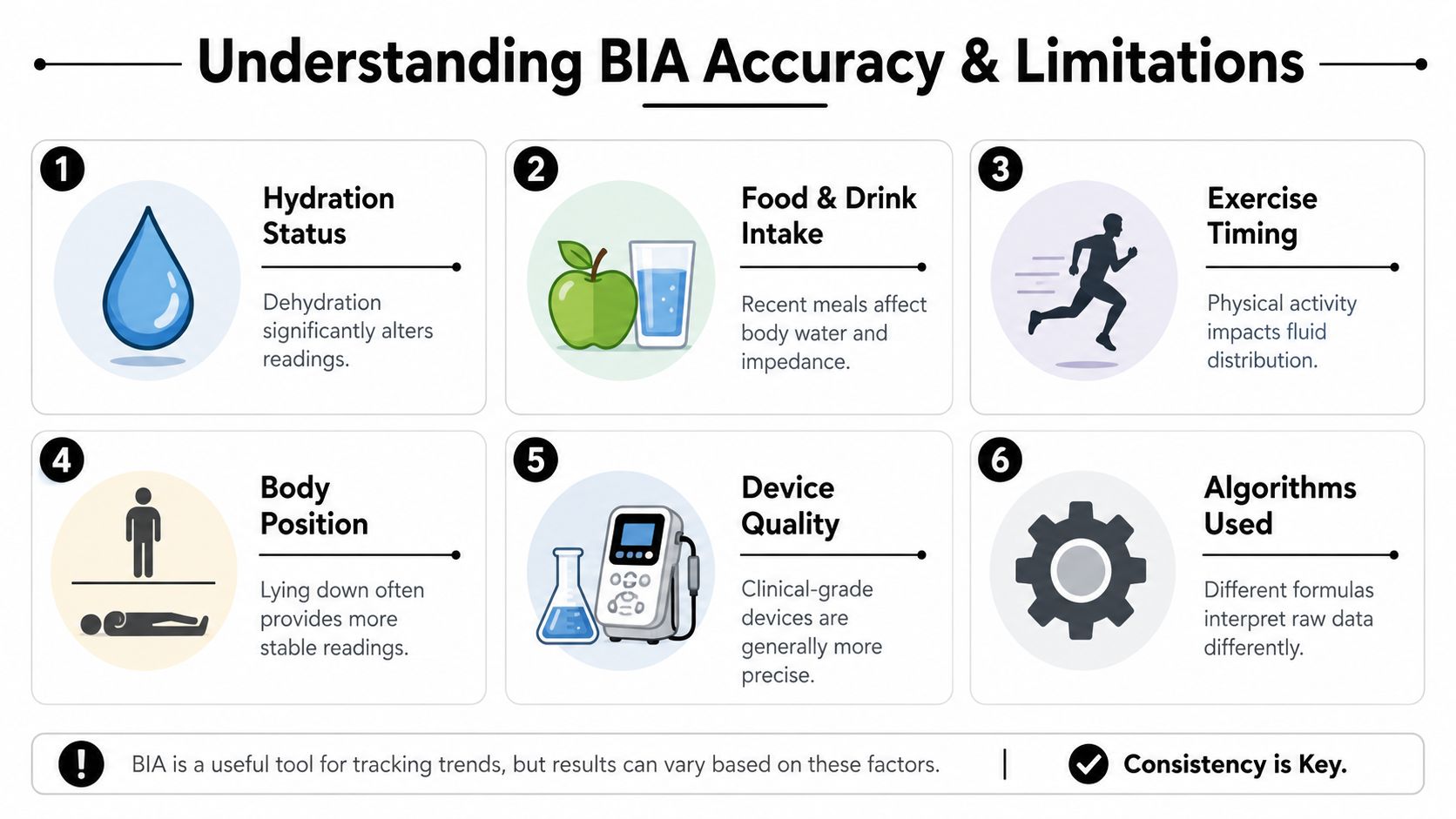
The most common influences include:
- Hydration status: Dehydration and overhydration can both shift impedance.
- Food and drink intake: A recent meal or fluid intake can alter body water distribution.
- Exercise timing: Training affects circulation, temperature, and fluid balance.
- Body position: Standing and lying assessments don't produce the same physiological setup.
- Device quality: Equipment design affects how data is captured.
- Algorithms used: The device's formula affects how raw impedance becomes a body composition estimate.
This is one reason I encourage trainers to stop asking, “Is BIA accurate?” as if accuracy were one fixed property. A better question is, “How controlled was this measurement?”
If the protocol changes, the reading may change before the client's body composition does.
That's also why it helps to educate clients before the first test. If they understand that hydration and timing affect the result, they're less likely to panic over small fluctuations and more likely to follow the preparation guidance.
For a more detailed look at how testing conditions influence outcomes, BIA accuracy guidance for practitioners is worth reviewing.
Why trend data matters more than one result
In practice, BIA shines as a monitoring tool. It is far more valuable for repeated, standardised tracking than for trying to declare an absolute truth from one isolated reading.
That changes the way you should report results.
Instead of saying:
- “Your body fat is exactly this.”
Say:
- “Under these testing conditions, this is your current estimate, and we'll compare future tests under the same conditions.”
That language is more honest and more useful. It also protects your credibility. Clients tend to trust practitioners who explain limitations clearly rather than hiding them.
A reliable BIA workflow usually includes:
- Consistent timing
- Consistent preparation
- The same device
- The same testing posture
- The same operator instructions
- Comparison across time, not obsession with a single printout
Clinical mindset: Look for direction of change, not perfection of a single estimate.
This is the practitioner's gap in one sentence: many people can operate the machine, but fewer can frame the result properly. Good practice means controlling what you can control, documenting what you can't, and interpreting the output in context.
Best Practices for Reliable BIA Measurements
The easiest way to improve BIA usefulness is to standardise the process. Most device errors blamed on “poor accuracy” are really protocol problems.
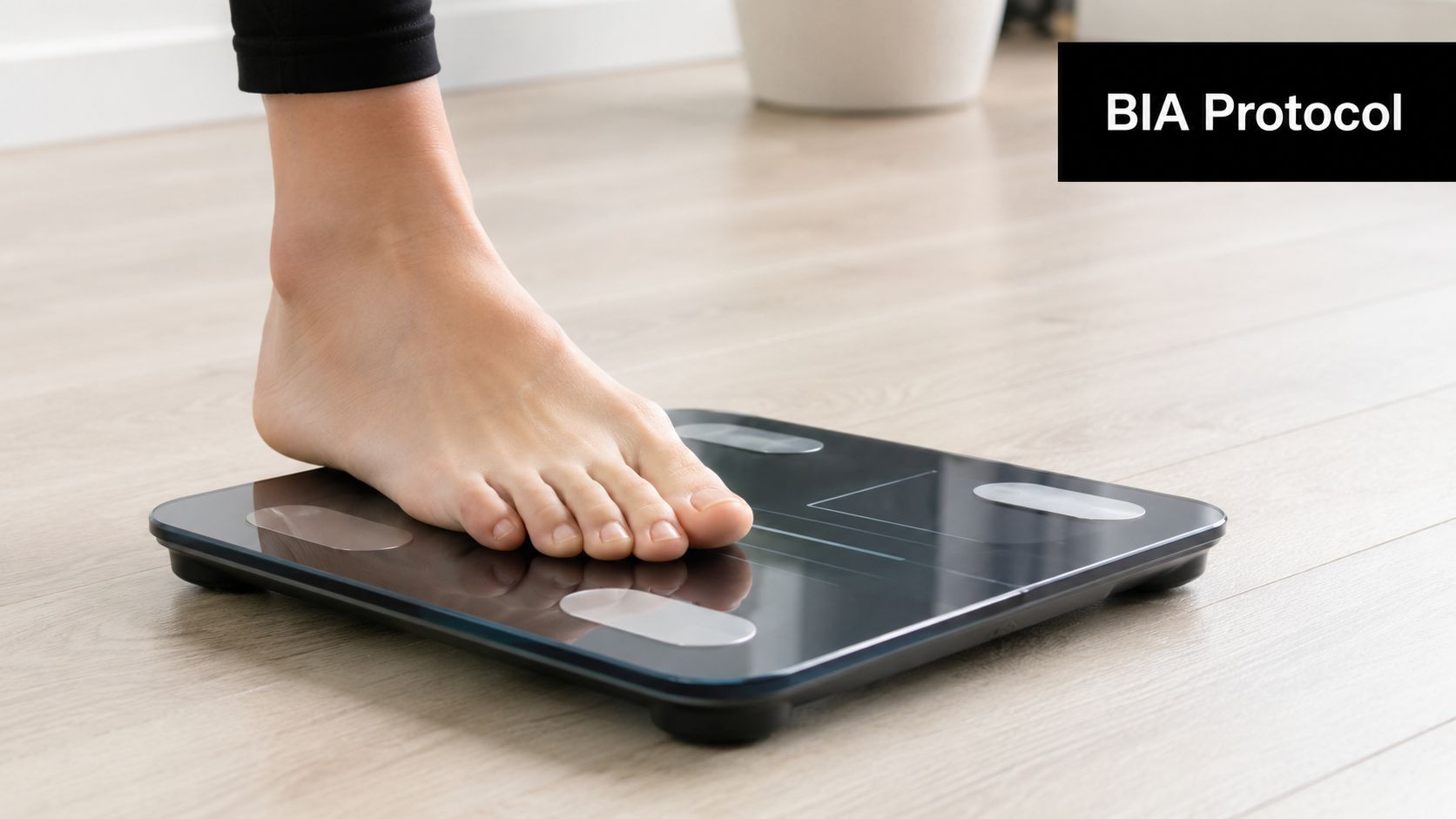
A practical pre-test protocol
Give clients a short preparation script before every assessment. Keep it simple enough that they'll follow it.
- Arrive under similar conditions each time: Test at the same time of day whenever possible. Morning testing often works well because routines are easier to standardise.
- Avoid food and drink beforehand: A recent meal or large fluid intake can change the reading.
- Avoid alcohol before testing: Alcohol can alter hydration status and make comparisons less reliable.
- Avoid exercise before the appointment: Training can shift fluid distribution and body temperature.
- Empty the bladder beforehand: This reduces one more avoidable source of variation.
- Use clean, dry contact areas: Lotions, sweat, or poor contact can interfere with the reading.
- Repeat the same posture and setup: If the protocol changes, your comparison value weakens.
If you manage a team of trainers, turn that list into a standard operating procedure. Don't leave preparation advice to memory or improvisation.
What to say to clients before and after the test
Client communication matters as much as device handling.
Before the test, say something like:
“This result is an estimate, so we want to control the conditions and compare your future tests like for like.”
After the test, keep your interpretation grounded:
- Use ranges and trends in your language: Avoid overclaiming certainty from one reading.
- Explain unusual changes cautiously: If a result jumps unexpectedly, review hydration, meals, training, and timing before drawing conclusions.
- Record context notes: A short note such as “afternoon test after training” can save you from bad interpretation later.
The strongest BIA operators aren't the ones who produce the most reports. They're the ones who produce the most comparable reports.
How BIA Compares to Other Body Composition Methods
BIA sits in a useful middle ground. It isn't the only way to assess body composition, and it shouldn't be treated as the answer to every assessment problem. But in day-to-day professional work, it often gives the best balance of practicality and repeatability.
A practical comparison for working professionals
Here's a simple working comparison.
| Method | Principle | Accessibility & Cost | Key Consideration |
|---|---|---|---|
| BIA | Estimates composition from electrical impedance | Widely accessible in fitness, clinical, and workplace settings | Strong for repeat monitoring when protocol is controlled |
| DEXA | Imaging-based body composition assessment | Less accessible in routine fitness settings | Often used when a more detailed baseline is needed |
| Hydrostatic weighing | Body density from underwater weighing | Limited access and specialist setup | Can be impractical for many clients |
| Air displacement plethysmography | Body volume assessment in a chamber | Specialist equipment required | Comfortable for many users, but less common |
| Skinfold calipers | Subcutaneous fat estimation from pinch sites | Low equipment cost and portable | Highly dependent on operator skill |
Each method has a place. DEXA is often discussed when people want a more detailed reference assessment. Skinfolds remain useful when the operator is well trained and the site measurement process is consistent. Hydrostatic weighing and air displacement methods are valid in the right setting, but they're less common in everyday coaching environments.
BIA's advantage is operational. It's quick, non-invasive, and realistic for repeat use. That's why it fits so well into coaching, occupational health, rehabilitation, and sports science workflows where regular follow-up matters more than a one-off lab-style event.
For readers who want a simple companion tool alongside formal assessment, this guide can help you assess your body fat for health goals in a broader planning context. For a fuller overview of testing options in practice, body composition assessment methods provides a useful comparison.
The mistake is to ask which method is universally best. The better question is which method fits the decision you're trying to make. If you need frequent, practical, low-friction monitoring, BIA is often the most workable choice.
Putting It All Together for Your Practice
If someone asks what does BIA stand for, the short answer is Bioelectrical Impedance Analysis. The professional answer goes further. It's a body composition estimation method that only becomes useful when the operator controls the testing conditions and interprets the output responsibly.
Use BIA to track trends. Use it to support conversations about progress. Use it to help clients see that body weight alone doesn't tell the whole story. But don't use it as a blunt instrument or a false promise of perfect precision.
When trainers close the practitioner's gap, BIA becomes more than a scale feature. It becomes a structured assessment tool that supports better coaching decisions, better client education, and better follow-up over time.
If you're building a more reliable assessment workflow, Cartwright Fitness offers professional body composition and health testing equipment used in fitness, clinical, occupational health, and education settings. If you already know the science but need tools that support standardised measurement and clearer reporting, their product range is a practical place to continue your research.