

A VO2 max treadmill test is widely considered the gold standard for measuring your cardiorespiratory fitness. It’s designed to find the absolute maximum amount of oxygen your body can take in and use during all-out, intense exercise.
Think of it as a stress test for your body's "aerobic engine." The final number you get—your VO2 max score—tells you just how powerful that engine is. It’s a single, powerful metric that reveals your peak endurance capacity.
What Your VO2 Max Score Actually Means
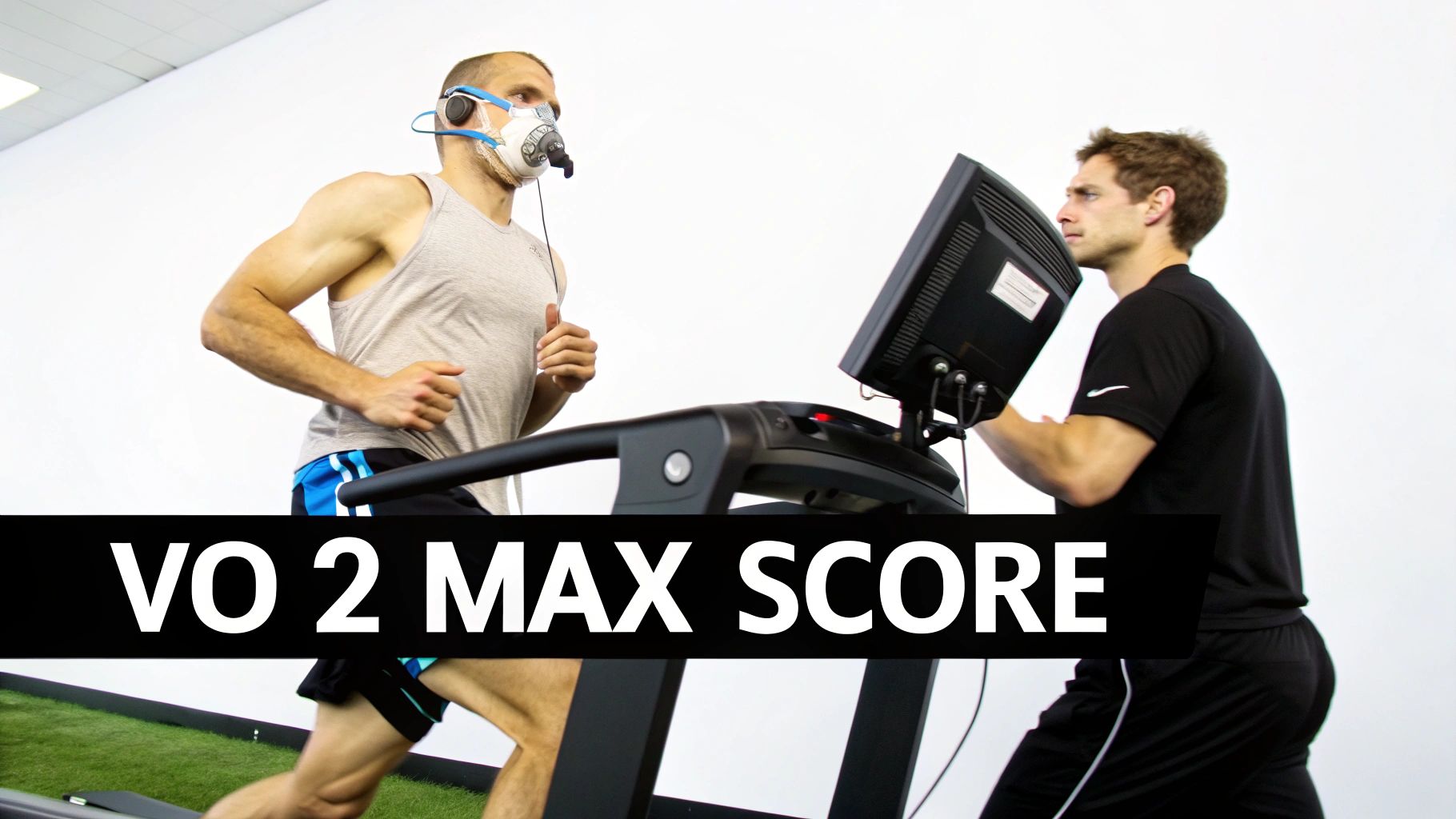
At its core, your VO2 max score is a precise measure of your body’s efficiency. It literally quantifies how well your heart, lungs, and circulatory system work together to pull oxygen from the air you breathe and deliver it to your working muscles.
This measurement is expressed in milliliters of oxygen used per kilogram of body weight per minute, or mL/kg/min.
And it's not just a metric for elite athletes. For anyone serious about their health, it offers a powerful benchmark of cardiovascular well-being. Time and again, studies show that a higher VO2 max is strongly linked to better long-term health and longevity.
Why Oxygen Is the Key to Performance
Imagine your muscles are like tiny factories that burn oxygen to create energy. As you start a graded exercise test on a treadmill, the intensity gradually increases, forcing these factories to ramp up production and demand more and more oxygen. Your heart responds by pumping faster and your breathing deepens to keep up with the demand.
Sooner or later, you'll hit a point where your body simply can't increase its oxygen uptake any further, even as the treadmill gets faster or steeper. That physiological ceiling is your VO2 max.
VO2 max is the ultimate indicator of your aerobic endurance. It reflects the peak capacity of your cardiorespiratory system to deliver and utilize oxygen, defining the upper limit of your sustained physical performance.
Once you know this limit, you can start working to improve it. The data from a VO2 max treadmill test gives you the insights needed to build a smarter, more effective training plan. For a deeper dive into the concept, you can learn more about what is maximal oxygen uptake and why it's such a critical fitness metric.
Putting Your Score into Context
Okay, so you've got your number. What now? A VO2 max score is deeply personal, and comparing it to others is tricky without the right context, as it's influenced by several key factors.
Here’s what shapes your score:
- Age: Our aerobic capacity naturally peaks in our 20s and tends to decline gradually as we get older.
- Gender: On average, men have higher VO2 max values than women, which is largely due to physiological differences like body composition, lung size, and hemoglobin levels.
- Fitness Level: It's no surprise that a sedentary person will have a much lower score than a trained marathon runner.
- Genetics: Your genes also play a role in setting your potential for achieving a high VO2 max.
By knowing your score, you get a clear picture of where your fitness stands relative to your age and gender group. This allows you to set realistic goals, accurately track your progress over time, and make truly informed decisions about your health and training.
The Science of Measuring Your Aerobic Engine
To really get what a VO2 max treadmill test is all about, you have to follow the amazing journey of a single oxygen molecule. Picture it like a critical package moving through an intricate delivery system—your body. The entire operation's success depends on how efficiently that package gets from the air you breathe to its final stop inside your muscles.
It all starts with a simple breath. When you inhale, oxygen floods into your lungs and hops into your bloodstream, where red blood cells act like a fleet of microscopic delivery vans. Your heart is the main hub, pumping this oxygen-loaded blood out to every tissue in your body.
Once you start running on that treadmill and the intensity ramps up, your muscles scream for more fuel. This demand forces the whole system to kick into a higher gear. Your breathing quickens, your heart thumps faster, and blood gets rerouted to the muscles doing all the work.
The Moment of Truth: The Oxygen Plateau
At first, as the treadmill gets faster or the incline steeper, your body keeps up by consuming more and more oxygen to meet the energy demand. You can feel it—your heart is pounding, and your breaths get deeper. For a while, the system manages to deliver everything the muscles ask for.
But that can't last forever. You eventually hit a point where, even though the workout is getting harder, your oxygen consumption just flatlines. This is the oxygen plateau, the physiological ceiling where your cardiorespiratory system is officially maxed out.
Hitting this plateau is the defining moment of a true VO2 max test. It’s the sign that your heart, lungs, and circulatory system simply can't deliver oxygen any faster. That peak value is your VO2 max—the ultimate measure of your aerobic horsepower.
This isn't some new-fangled concept. The idea was first hammered out in the 1920s by physiologist A.V. Hill, who snagged a Nobel Prize for his research on muscle metabolism. His early experiments, while primitive by today's standards, laid the foundation for the sophisticated tests we use now and proved that VO2 max is a cornerstone of fitness assessment. You can learn more about the fascinating history of VO2 max measurement.
Beyond Oxygen: What Else Does the Test Measure?
A proper VO2 max treadmill test isn't a one-trick pony. The metabolic cart also analyzes the carbon dioxide (CO2) you breathe out, giving us a much deeper look into how your body is producing energy. From this, we get one of the most useful secondary metrics out there: the Respiratory Exchange Ratio (RER).
RER is simply the ratio of carbon dioxide produced to the oxygen consumed (VCO2/VO2). But don't let its simplicity fool you; this ratio tells a powerful story about which fuel source your body is relying on at any given moment.
- An RER around 0.70: This means your body is running primarily on fat. You'll see this at rest or during very light, easy exercise.
- An RER around 1.00: This shows a major shift. Your body is now burning almost entirely carbohydrates to keep up with the intensity.
- An RER above 1.00: This is a strong indicator that you've pushed past your anaerobic threshold and are nearing your absolute limit.
Tracking your RER at different effort levels helps map out your personal metabolic transition points. This kind of data is gold for building training zones and dialing in a nutrition plan, helping you fuel smarter and perform better. The test gives you more than just a single number; it hands you your complete metabolic blueprint.
What to Expect During a Standard VO2 Max Test
Stepping onto the treadmill for a maximal exertion test can feel a little intimidating, but knowing what you’re in for removes all the guesswork. A standard VO2 max treadmill test isn't just about running until you're exhausted; it's a highly structured event designed to safely guide you to your physiological peak.
When you understand what happens before, during, and after, you can show up mentally and physically ready to give your best effort.
Pre-Test Preparations
Proper preparation is the first step toward getting an accurate result. Think of it as setting the stage for a peak performance. Your body needs to be rested and properly fueled, so labs will always provide a clear set of pre-test instructions.
Following these guidelines is critical. They help ensure the data we collect is a true reflection of your fitness, not skewed by things like fatigue, dehydration, or that morning cup of coffee.
To get the most reliable results, you’ll need to follow a few simple rules in the 24 hours leading up to your appointment:
- Avoid Strenuous Exercise: Don’t do any hard workouts for at least 24 hours before the test. Your body needs to be fully recovered.
- Stay Hydrated: Drink plenty of water the day before and leading up to your test, but don't chug a huge amount right beforehand.
- Fuel Appropriately: Eat a light, carbohydrate-rich meal about 2-3 hours before the test. You'll want to avoid heavy, fatty, or spicy foods that could cause discomfort.
- Skip the Stimulants: Stay away from caffeine, alcohol, or nicotine for at least three hours prior to your test, as they can artificially elevate your heart rate.
While a VO2 max test is a specific event, having a general understanding of various physical exercises can give you some context for the kind of high-intensity effort that's required.
The Stages of the Test
Once you arrive at the lab, the technician will walk you through the entire process. They’ll fit you with the necessary equipment—typically a heart rate monitor and a specialized breathing mask—and then get you started on the treadmill.
The whole procedure follows a distinct, multi-stage pattern designed for both safety and accuracy. A typical test unfolds in four key phases:
- Warm-Up: The test always starts with a gentle warm-up, usually lasting 5-10 minutes. This just involves walking or a light jog at low intensity to get your muscles and cardiovascular system ready.
- Graded Exertion: This is the heart of the test. The treadmill's intensity will increase at regular, predetermined intervals. The technician follows a specific protocol, which dictates exactly how much the speed and/or incline go up at each stage.
- Reaching Exhaustion: As the intensity keeps climbing, you'll eventually hit a point where you simply can't continue. That's the goal—to push until you reach your absolute maximal effort. The technician will be watching you closely and encouraging you the whole time.
- Active Cool-Down: The moment you signal that you're done, the test stops. You'll immediately move into a cool-down, walking slowly for another 5-10 minutes to let your heart rate and breathing come back down gradually.
This whole process is about measuring how your body's systems—your lungs, heart, and muscles—work together to transport and use oxygen under stress.
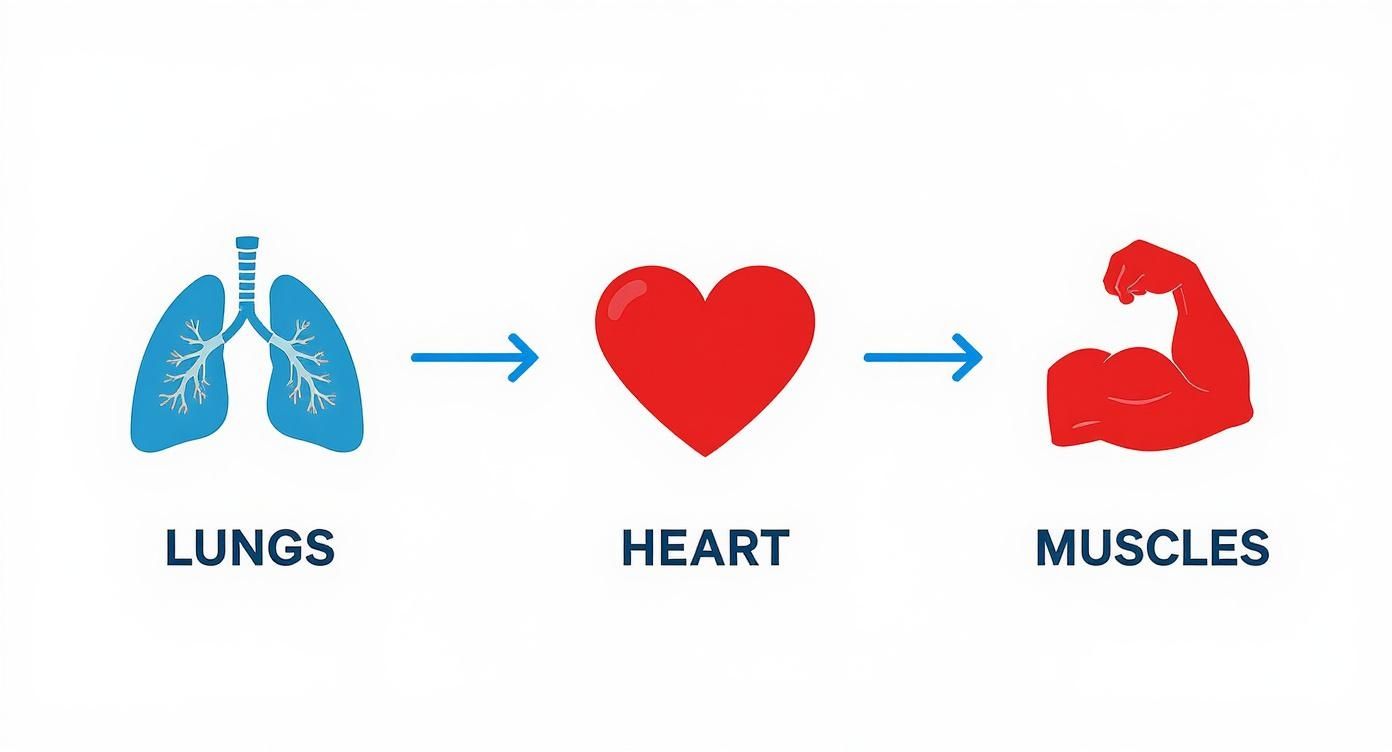
The image above shows that critical chain of oxygen delivery, which is precisely what the VO2 max test is designed to measure.
Understanding Test Protocols
Not all tests are run exactly the same way. Laboratories use established frameworks, known as protocols, to make sure the test is standardized, safe, and repeatable. These protocols are just different recipes for methodically increasing the workload.
The goal of any good protocol is to bring an individual to volitional exhaustion within a timeframe of 8 to 12 minutes. This duration is the sweet spot for getting a true VO2 max without causing premature muscle fatigue from a test that drags on too long.
For example, two of the most established protocols are the Bruce and the Astrand. They both get you to your max, but they take different paths to get there.
Common VO2 Max Treadmill Test Protocols
| Protocol Feature | Bruce Protocol | Astrand Protocol |
|---|---|---|
| Starting Point | 1.7 mph at a 10% incline | 5.0 mph at a 0% incline |
| Stage Duration | 3 minutes | 2 minutes |
| Progression | Increases both speed and incline every 3 minutes | Incline increases by 2.5% every 2 minutes; speed remains constant |
As you can see, the Bruce Protocol uses big jumps in both speed and incline, which can feel quite aggressive. In contrast, the Astrand protocol keeps the speed steady and only increases the incline, offering a more gradual build-up.
The choice of protocol often depends on your fitness level and the lab's standard procedures. If you're interested in the nuts and bolts, you can explore the specifics of a VO2 max testing protocol and see just how many variations exist.
Ensuring an Accurate and Safe Test Experience
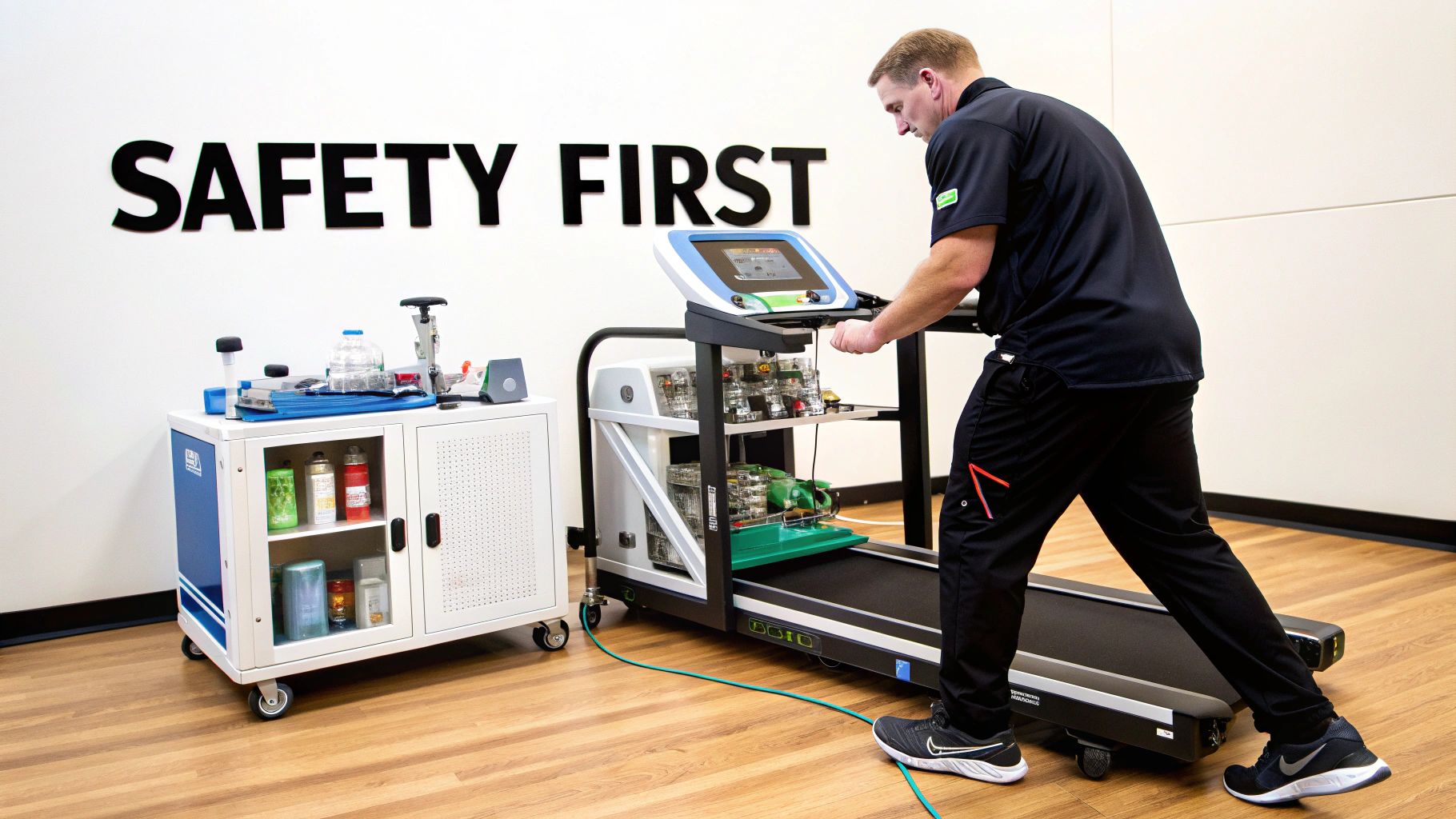
A VO2 max score is only as good as the test that produced it. To get data you can actually trust, the entire process has to be built around two core principles: accuracy and safety. This isn't just about running until you can't run anymore; it’s a controlled scientific assessment that demands specialized equipment, careful procedures, and a watchful expert eye.
Think of it like getting a diagnostic run on a high-performance race car. You need the right tools and a skilled mechanic to get a true reading. The same goes for a VO2 max treadmill test—without precision and expertise, the results are just noise.
The Core Equipment for a Valid Test
At the heart of any legitimate VO2 max test is the metabolic cart. This is the sophisticated piece of equipment that analyzes every single breath you exhale, measuring the exact amount of oxygen you consume and carbon dioxide you produce. It works in tandem with a sealed breathing mask and a heart rate monitor to paint a complete picture of your body's response to the exercise.
Of course, you also need a clinical-grade treadmill. This isn’t your average gym machine; it has to be capable of making precise, incremental adjustments to speed and incline to follow a specific testing protocol.
The accuracy of the metabolic cart is everything. If its gas analyzers are even slightly off, every piece of data it spits out—from your final VO2 max score to your metabolic thresholds—will be fundamentally flawed.
This is why the setup and calibration process is so critical. For a deep dive into this crucial step, you can learn more about the specifics of metabolic cart calibration and why it’s the foundation of every valid test.
Meticulous Calibration for Accurate Data
Long before an athlete ever steps onto the treadmill, a trained technician runs through a series of essential calibrations. This is a non-negotiable, detailed procedure that guarantees the equipment is reading correctly.
This process always includes two key steps:
- Gas Analyzer Calibration: The system is first checked against certified tanks of gas that have known concentrations of oxygen and carbon dioxide. This sets an accurate baseline, so the machine has a perfect standard to compare your exhaled air against.
- Flowmeter Calibration: The technician uses a large, 3-liter calibration syringe to push a precise volume of air through the flow sensor. This step confirms that the cart is accurately measuring the volume of every breath you take.
Skipping these steps is like trying to measure a room with a warped ruler. You'll get numbers, but they won't mean a thing.
Safety First, Always
Pushing your body to its absolute physiological limit requires an intense focus on safety. Any reputable lab will prioritize your well-being over everything else. The process always starts with a comprehensive pre-test health screening.
This screening helps identify any contraindications, which are simply medical conditions that would make a maximal-effort test unsafe. Throughout the entire test, the supervising technician is your dedicated safety monitor, trained to spot any signs of distress.
They are constantly watching for specific signals to end the test immediately, including:
- Any indication of chest pain or angina-like symptoms
- Dizziness, confusion, or sudden loss of coordination
- A drop in blood pressure as the workload increases
- Your own request to stop the test
The goal is to push you to your peak performance, but never at the expense of your health. Your safety is always the number one priority.
How to Interpret Your VO2 Max Test Results
So, you’ve pushed yourself through a VO2 max treadmill test, and now you have a report full of numbers. The headline figure is your VO2 max score, but that number on its own is just data. Turning it into a meaningful tool for your fitness journey is all about understanding the context behind it.
The first thing to know is that your result is presented in two main ways: absolute and relative.
Absolute VO2 max is the raw measure of oxygen your body can use, measured in liters per minute (L/min). Think of it as the total size or horsepower of your aerobic engine. It’s a pure measure of your body's maximum capacity to process oxygen.
But what if you're comparing a big person to a small person? The larger individual will naturally have a bigger engine. That’s where relative VO2 max comes in. This is the metric you'll almost always see used for comparison, and it's expressed in milliliters of oxygen per kilogram of body weight per minute (mL/kg/min). It standardizes the score, showing you how efficient your body is at using oxygen, pound for pound.
Absolute vs. Relative VO2 Max
Here’s a simple way to think about it. Imagine two cars: a massive SUV and a lightweight sports car. Both might have engines that produce 300 horsepower (their absolute power). But because the sports car is so much lighter, it's far more efficient with that power and will be much faster.
Relative VO2 max applies the same logic to human physiology. It levels the playing field, making it possible for a 130-pound runner to fairly compare their cardiorespiratory fitness to a 200-pound rower. This is precisely why all the normative charts and fitness classifications are based on the relative score.
Where Do You Stand? Benchmarking Your Score
Once you know your relative VO2 max, the real fun begins: seeing how you stack up. Your score is a product of many factors, including your age, gender, genetics, and of course, your training status. Comparing your result to population averages for your specific demographic is what gives the number real meaning.
Gender, for instance, plays a major role. Studies have shown male athletes scoring a mean of 52.37 mL/kg/min on treadmill tests, while female athletes averaged 40.96 mL/kg/min. On average, men tend to have values about 26% higher than women, which is largely due to natural physiological differences in body composition and hemoglobin concentration. You can dive deeper into the research on these gender-based differences in VO2 max.
Your VO2 max is more than just a number—it’s a snapshot of your current cardiorespiratory health. By comparing it to normative data, you gain a clear, objective understanding of your fitness level, which is the essential first step toward setting meaningful and achievable goals.
The table below provides normative data, allowing you to classify your score from poor to superior based on your age and gender. It’s the perfect tool for pinpointing exactly where your fitness stands today.
VO2 Max Normative Values by Age and Gender (ml/kg/min)
Finding your score in the table below is a powerful way to add context to your test result.
| Age Group | Gender | Poor | Fair | Good | Excellent | Superior |
|---|---|---|---|---|---|---|
| 20-29 | Men | < 36.4 | 36.5-42.4 | 42.5-46.4 | 46.5-52.4 | > 52.4 |
| Women | < 28.4 | 28.5-33.9 | 34.0-38.9 | 39.0-44.9 | > 44.9 | |
| 30-39 | Men | < 33.4 | 33.5-39.9 | 40.0-43.9 | 44.0-49.4 | > 49.4 |
| Women | < 26.4 | 26.5-31.4 | 31.5-35.4 | 35.5-41.9 | > 41.9 | |
| 40-49 | Men | < 30.4 | 30.5-35.4 | 35.5-40.9 | 41.0-46.4 | > 46.4 |
| Women | < 23.4 | 23.5-28.9 | 29.0-32.9 | 33.0-38.9 | > 38.9 | |
| 50-59 | Men | < 26.4 | 26.5-32.9 | 33.0-38.9 | 39.0-43.9 | > 43.9 |
| Women | < 21.4 | 21.5-25.9 | 26.0-30.9 | 31.0-35.9 | > 35.9 | |
| 60+ | Men | < 22.4 | 22.5-28.9 | 29.0-34.9 | 35.0-40.9 | > 40.9 |
| Women | < 19.4 | 19.5-23.4 | 23.5-27.9 | 28.0-32.9 | > 32.9 |
Whether you land in the "fair" category with a goal of reaching "good," or you're already "excellent" and want to push for "superior," you now have a concrete benchmark. This information empowers you to track your progress with precision and see exactly how your hard work translates into real, physiological improvements over time.
Frequently Asked Questions About VO2 Max Testing
So, you've gotten through the science, the step-by-step protocols, and how to make sense of the results. It's totally normal to still have some practical questions buzzing around. Let's tackle the most common ones people ask before booking their first VO2 max treadmill test.
This is where we get into the real-world details—from what you can expect to pay to how often you should think about coming back to track your progress.
How Much Does a VO2 Max Treadmill Test Cost?
The price tag for a VO2 max test usually lands somewhere between $100 and $250. What you'll actually pay depends on a few things: where the facility is located, the credentials of the staff running the test, and how deep they go with the final report and consultation.
You can sometimes find less expensive tests at university exercise science labs, where they might be conducting research or training students. On the other end of the spectrum, elite sports performance clinics will likely charge more for a premium service that often includes a detailed training plan based on your results. No matter where you go, the fee should cover the test itself plus a report breaking down your VO2 max, heart rate zones, and other key metabolic data.
Can I Actually Improve My VO2 Max Score?
Yes, absolutely. This is one of the most empowering things about knowing your VO2 max—it’s not set in stone. While your genetics do set a ceiling on your ultimate potential, almost everyone can improve their score with smart, consistent training.
Two of the most effective ways to push that number up are:
- High-Intensity Interval Training (HIIT): Think short, all-out bursts of effort followed by quick recovery periods. HIIT forces your heart and lungs to adapt, making your entire system better at getting oxygen where it needs to go.
- Sustained Endurance Workouts: Long, steady-state activities like running, cycling, or rowing are also incredibly important. This kind of work builds your aerobic foundation and improves your body's overall stamina.
Most people who stick to a structured plan will see a real, measurable jump in their score in just a few months.
Is a Treadmill Test More Accurate Than a Bike Test?
For most people, and especially for runners, the treadmill is going to give you a higher and more accurate VO2 max value. Why? Because running is a weight-bearing exercise that uses a huge amount of muscle mass, which puts a bigger demand on your cardiovascular system. It simply pushes you closer to your true physiological limit.
That said, the best test is the one that’s most specific to your sport. If you’re a competitive cyclist, a test on a bike ergometer will give you a more relevant score because your body is already highly adapted to that specific movement.
For a non-cyclist, it's pretty common to see a VO2 max score that's 10% to 20% lower on a bike compared to a treadmill. This really drives home the principle of sport specificity in physiological testing.
At the end of the day, while the choice depends on your athletic focus, the treadmill is widely considered the gold standard for measuring general cardiorespiratory fitness.
How Often Should I Retest My VO2 Max?
There’s no one-size-fits-all answer here—it really comes down to your goals. The right frequency for retesting depends on what you're trying to achieve with your training.
Here are a few scenarios to help you figure out what makes sense for you:
- For Competitive Athletes: If you're dialing in your training for a big race or event, retesting every 3 to 6 months is a great way to get feedback on whether your program is working.
- For General Fitness Enthusiasts: If your goal is more about long-term health and just getting fitter over time, checking in once a year is usually plenty to monitor your progress and stay motivated.
- After a Major Training Block: A perfect time to retest is right after you finish a big training cycle, like after a 12-week marathon prep or a dedicated HIIT program. It's the best way to quantify your gains and set new, more accurate training zones for whatever comes next.
At Cartwright Fitness, we provide the validated, high-precision equipment that professionals rely on for accurate health and fitness assessments. From metabolic analysers to complete testing kits, our curated selection of professional-grade solutions supports accurate and reliable performance testing. Explore our range of equipment at https://www.cartwrightfitness.co.uk.