

The same VO2 max value can move from good to poor depending on which reference table, test mode and body-size expression a practitioner chooses. That is exactly why vo2 max normative data has to be read as a measurement system, not a single score, especially in UK occupational and clinical settings where imported tables, field estimates and lab values are often mixed without a clear method statement.
Table of Contents
- Why VO2 Max Normative Data Trips Practitioners Up
- Defining VO2 Max and Its Common Expressions
- The UK Evidence Base for VO2 Max Norms
- How Normative Tables Are Built and What That Means
- UK Adult Age and Sex Reference Bands
- Why Body Composition Adjustment Changes the Picture
- Chester Step Test as a UK Field Estimation Method
- Athletes, Occupational Groups and Clinical Cut-Offs
- Applying Norms in Practice
- Common Mistakes in VO2 Max Interpretation
- A Practitioner Checklist for Using Norms
- Frequently Asked Questions on VO2 Max Norms
Why VO2 Max Normative Data Trips Practitioners Up
A single VO2 max result is only useful after three things are declared, the test method, the reference population, and the normalisation used. A 2020 UK analysis found that British reference standards were lacking and that estimated cardiorespiratory fitness values were still being interpreted against external norms rather than a dedicated national standard, which is why the same result can sit awkwardly between tables built for different cohorts and protocols (UK analysis of British CRF reference gaps).
The first source of disagreement is body size
Relative VO₂ max expressed per kilogram of body mass is influenced by body size and composition. In some populations, especially where body composition varies substantially, interpretation may differ when oxygen uptake is expressed relative to fat-free mass rather than total body mass.
Practical rule: if the service screens people with higher mean body mass, the report should say whether the classification is based on total body mass or fat-free mass.
The second source is test mode
A treadmill result and a cycle result are not interchangeable. Cycle-based values are typically lower for the same person because less muscle mass is engaged, so a cycle estimate can look weak against a treadmill-derived table even when the underlying physiology is unchanged.
The third source is the source dataset
Imported tables are not neutral. A table derived from one population will classify another population differently, especially when the second group differs in body composition, age profile or test setting. That is why two qualified practitioners can end up defending different labels for the same firefighter if one uses a treadmill-based clinical table and the other uses a field-test occupational table.
Defining VO2 Max and Its Common Expressions
VO2 max is the highest rate at which oxygen can be taken up and used during progressive exercise to volitional exhaustion. In practice, professionals need to separate the number into the expression being reported, because the same physiology can be written in different units and those units answer different questions.
Absolute, relative and fat-free-mass expressions
Absolute VO2 max is reported in litres per minute, and it's the right expression when the discussion is about central oxygen delivery, cardiac output or broader metabolic capacity. Relative VO2 max is reported in ml/kg/min, and that is the version most often used in clinical, occupational and population tables because it scales to body mass.
A third expression, ml/kg fat-free mass/min, is more informative when body composition matters. In the UK Fenland data, mean estimated VO2max per total body mass was 35.4±7.6 ml/kg/min in women and 42.1±7.4 ml/kg/min in men, but the gap narrowed to 59.7±11.8 vs 62.5±10.4 ml/kg fat-free mass/min when the result was adjusted for fat-free mass (Fenland Study body-composition analysis).
The method of normalisation can therefore change how a result is classified. Reports should state clearly whether values are expressed relative to total body mass, fat-free mass or in absolute terms.
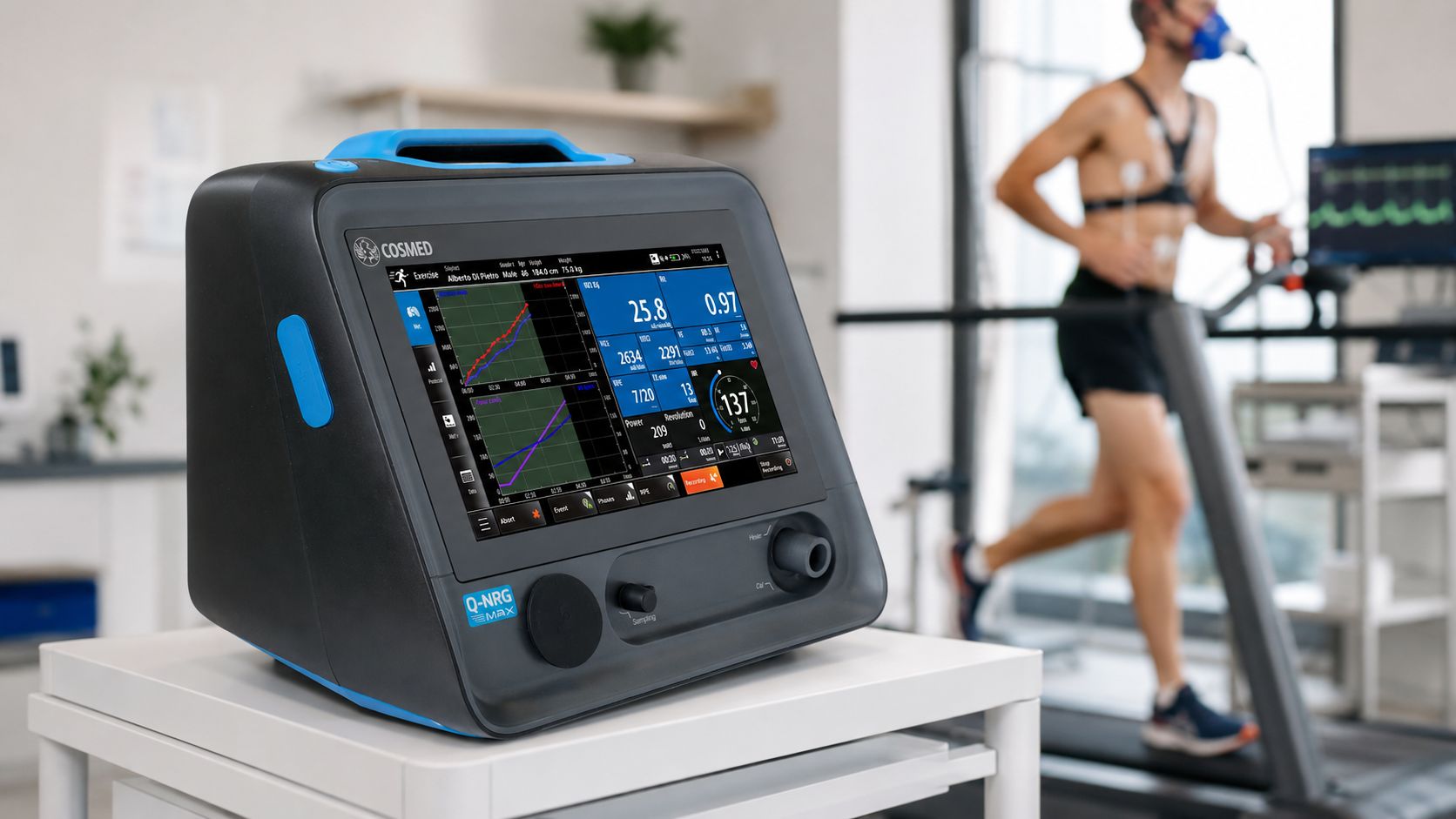
A metabolic analyser such as the Cosmed Q-NRG Max Metabolic Analyser can be used where direct respiratory gas measurement is required. This differs from field tests, which estimate aerobic capacity from performance or physiological responses.
| Common VO2 Max Expressions and Their Uses | |||
|---|---|---|---|
| Expression | Units | Typical Use | Key Limitation |
| Absolute VO2 max | L/min | Cardiorespiratory physiology, oxygen delivery discussions | Hard to compare across body sizes |
| Relative VO2 max | ml/kg/min | Occupational, clinical and public-health tables | Penalises higher body mass |
| Fat-free-mass VO2 max | ml/kg FFM/min | Research and body-composition-aware interpretation | Less familiar in routine reports |
The UK Evidence Base for VO2 Max Norms
UK VO2 max reference data is fragmented. A UK cardiorespiratory fitness analysis identified limited objective VO2 max evidence in Britain and no dedicated national reference standard. Practitioners therefore often interpret treadmill-estimated, cycle-estimated or field-test values against external norms or protocol-specific prediction bands, rather than a single UK-wide threshold.
Imported tables filled the gap
UK services have consequently used North American datasets and tables derived from narrower samples. These references can support comparison, but their classifications depend on the population from which they were built. A firefighter cohort, university sport-science cohort and rehabilitation clinic may differ in training status, health, age distribution and testing practice. A value estimated from a Chester step test should not be treated as interchangeable with directly measured laboratory VO2 max because both are reported in ml/kg/min.
The source dataset also interacts with body-size adjustment and test mode. Relative VO2 max may classify a larger-bodied person differently from an absolute or fat-free-mass expression, while treadmill and cycle results can produce different rankings for the same individual. The table is therefore part of the measurement, not a neutral label applied afterward.
UK practice is therefore pragmatic
The defensible approach is to declare the reference table, identify whether the value was measured or estimated, document the protocol and retain the same method for repeat assessments. Classification then means comparison with a specified benchmark, not a universal statement about physiological capacity. This distinction matters in occupational health, rehabilitation and research, where different departments or cohorts may apply different datasets.
Ask what the value means against this table, from this test, in this population. That question is more defensible than assigning a general meaning to the number.
How Normative Tables Are Built and What That Means
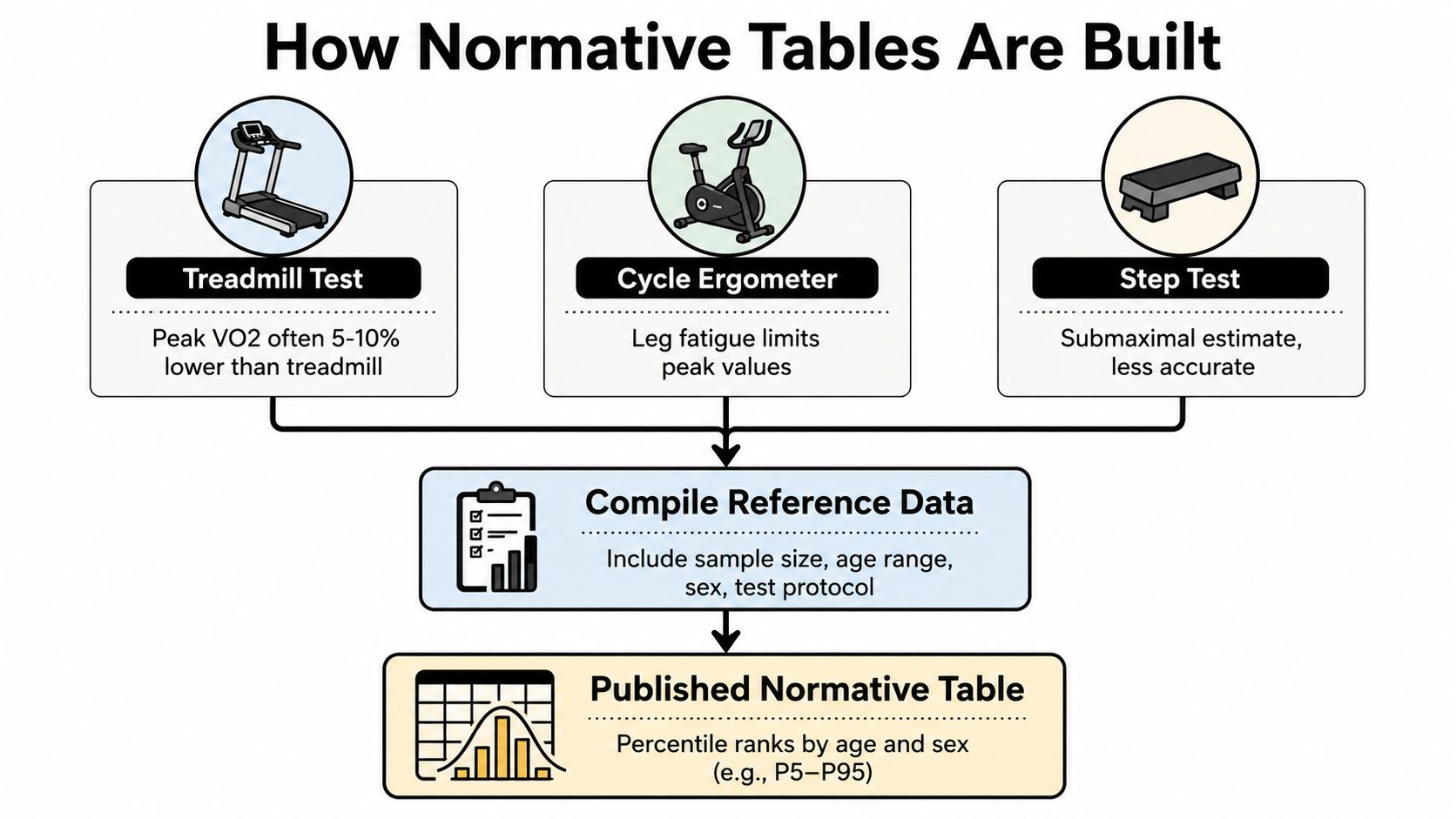
A VO2 max table looks simple because the hard choices are hidden upstream. The derivation starts with the test mode, then moves through the prediction equation, the sample used to build the reference, the age bands chosen for grouping and the way body size is handled.
Test mode changes the table before the table exists
Treadmill, cycle ergometer and step protocols do not produce the same peak value. Cycle testing is typically lower for the same person, which is why treadmill-derived rows can make a cycle result look artificially weak. Step tests are different again, because they estimate capacity from a standardised submaximal workload ladder rather than a direct maximal gas exchange measure.
Age banding and category design shape the verdict
Some tables are percentile-based. Others use categories such as poor, fair, good, excellent and superior. Those category labels can make the same result look more or less favourable depending on where the band edges were drawn, which is why two published tables can disagree by a full fitness category without any real physiological change in the person being tested.
The practical consequence is simple. A report should name the table, the mode and the adjustment method, or the category can't be defended later. That matters just as much in occupational screening as it does in serial rehab testing.
| Common VO2 Max Expressions and Their Uses | |||
|---|---|---|---|
| Expression | Units | Typical Use | Key Limitation |
| Treadmill-derived relative VO2 max | ml/kg/min | Reference tables and maximal lab testing | Not interchangeable with cycle or step estimates |
| Cycle-derived relative VO2 max | ml/kg/min | Ergometer testing and rehab labs | Lower peak values for many people |
| Step-test estimate | ml/kg/min | Occupational screening and field testing | Depends on protocol compliance and prediction equation |
UK Adult Age and Sex Reference Bands
Age- and sex-stratified reference data can be useful, but there is no single universal UK VO₂ max classification table that should be applied across all populations and test methods. Practitioners should use a clearly identified reference source that matches the assessment method and population as closely as possible. For men aged 20 to 29, the bands are very poor below 23.6 ml/kg/min, poor 23.6 to 28.9, fair 29.0 to 32.9, good 33.0 to 36.9, excellent 37.0 to 41.0 and superior above 41.0 (UK-facing VO2 max normative table).
The previously listed women’s 20–29 bands were internally inconsistent and have been removed rather than presenting questionable cut-offs as authoritative. The same source places men aged 50 to 59 at very poor below 20.2 and superior above 35.7 ml/kg/min, while women aged 50 to 59 are rated very poor below 20 and superior above 35 ml/kg/min (UK-facing VO2 max normative table).
What those bands actually do
They convert a raw physiology number into a practical comparison language. That is useful in occupational health, clinical exercise testing and university sport-science teaching, but only if the service also states that the table is an interpretation framework rather than a diagnosis.
| Composite UK-facing relative VO2 max reference bands by age and sex | ||
|---|---|---|
| Age band (years) | Men poor to superior (ml/kg/min) | Women poor to superior (ml/kg/min) |
| 20 to 29 | 23.6 to above 41.0 | below 23 to above 41 |
| 30 to 39 | lower than the 20s band, with age-related decline | lower than the 20s band, with age-related decline |
| 40 to 49 | lower still, with the same category structure | lower still, with the same category structure |
| 50 to 59 | 20.2 to above 35.7 | below 20 to above 35 |
| 60+ | age-adjusted bands continue downward | age-adjusted bands continue downward |
Why Body Composition Adjustment Changes the Picture
Relative VO2 max tables describe aerobic capacity in relation to body mass, not fitness in isolation. A higher fat mass increases the denominator and can lower the classification, even when absolute oxygen uptake is less unusual than the label implies.
Total body mass is not metabolically active tissue
The Fenland results illustrate why the denominator matters. Dividing VO2 max by total mass produces a wider difference between men and women than dividing it by fat-free mass. The narrower gap after fat-free-mass adjustment indicates that body composition contributes to the apparent classification difference.
This issue is relevant to occupational screening, where body mass may differ from that of the general population. A firefighter could receive a lower per-kilogram rating even when their aerobic capacity is less atypical, particularly if the assessment does not record how much of their mass is fat-free tissue.
Body composition measurement therefore needs a defined purpose. Guidance on how to measure body composition can help align the anthropometry protocol with the VO2 reporting method.
The report should match the question
For occupational readiness, relative VO2 max may be the appropriate outcome because the job is performed at the person's actual body mass. For aerobic adaptation or rehabilitation where body composition is central, fat-free-mass normalisation may provide a more informative companion measure.
The same participant can therefore receive different interpretations from relative and fat-free-mass-adjusted values. The result also depends on whether VO2 max was measured in a laboratory or estimated by treadmill, cycle, or field method. A normative table built from one test mode should not be treated as interchangeable with estimates from another.
Record the measurement method, denominator, and reference dataset alongside the category. A low relative VO2 max can reflect a large denominator rather than a proportionately low aerobic engine.
Chester Step Test as a UK Field Estimation Method
The Chester Step Test is a recognised UK occupational method for estimating aerobic capacity. It was developed for workplace medico-fitness screening, and UK guidance describes it as recommended by the UK Home Office for British Fire Service entry screening (Chester Step Test manual).
The protocol is fixed, not improvised
The standard cadence progresses through 15, 20, 25, 30 and 35 steps per minute. Each stage lasts 2 minutes, and the test stops when the participant reaches 80% of age-predicted maximum heart rate (Chester Step Test protocol table). This creates a repeatable field estimate, rather than a self-selected step exercise.
Step height must also be recorded. Protocol documents describe 0.25 m and 0.30 m steps, while the published estimation table reports values according to both stage and step height. The table provides ranges rather than a single universal VO2 max value: estimates span 11 to 25 ml/kg/min for a 15 cm step and 16 to 37 ml/kg/min for a 30 cm step across stages I to V. The source table also includes intermediate step heights, so the selected protocol should match the table used for interpretation.
The estimate depends on execution
The method links a defined external workload with the participant's heart-rate response. Errors in step height, cadence, stage completion or end-stage heart-rate recording can therefore change the estimated VO2 max. The result is a field estimate, not a directly measured laboratory VO2 max, and it should not be placed uncritically into norms derived from treadmill or cycle testing.
For local reference material and interpretation guidance, Cartwright Fitness provides a Chester Step Test norms summary. Practitioners should document step height, completed stage, heart-rate endpoint and the reference table alongside the estimate.
| Chester Step Test stage-by-stage VO2 estimation ranges | |||
|---|---|---|---|
| Stage (cadence bpm) | 15 cm step VO2 estimate | 20 cm step VO2 estimate | 25 cm step VO2 estimate |
| 15 | 11–15 ml/kg/min | 12–17 ml/kg/min | 13–19 ml/kg/min |
| 20 | 15–18 ml/kg/min | 17–21 ml/kg/min | 19–24 ml/kg/min |
| 25 | 18–21 ml/kg/min | 21–25 ml/kg/min | 24–29 ml/kg/min |
| 30 | 21–23 ml/kg/min | 25–29 ml/kg/min | 29–34 ml/kg/min |
| 35 | 23–25 ml/kg/min | 29–33 ml/kg/min | 34–37 ml/kg/min |
Athletes, Occupational Groups and Clinical Cut-Offs
The word norm means different things depending on the audience. In sport, it usually means where a person sits relative to performance cohorts. In occupational testing, it usually means whether the person clears a role-related benchmark. In clinical medicine, it often means whether risk rises above a prognostic cut-off.
Athletic ceilings are not population norms
Endurance athletes should be compared with reference data drawn from similarly trained populations where possible. Sport-performance reference values are not interchangeable with occupational or clinical thresholds because they answer different questions and may be derived from different protocols.
Emergency-services thresholds are role thresholds
Fire and rescue services may use role-specific aerobic standards rather than general-population reference values. Where the Chester Step Test is used, the protocol and decision threshold should be those specified by the organisation or governing standard, and the result should not be treated as a universal pass/fail rule across all services.
Clinical cut-offs serve a different purpose again
Clinical thresholds and prognostic values are developed for specific patient populations and clinical questions. They should not be applied to healthy or occupational populations without appropriate validation, and clinical interpretation belongs with suitably qualified healthcare professionals.
| Population-specific VO2 max thresholds used in the UK | |||
|---|---|---|---|
| Population / setting | Typical male threshold (ml/kg/min) | Typical female threshold (ml/kg/min) | Interpretation |
| Athlete cohorts | High performance ceiling | High performance ceiling | Performance comparison, not health screening |
| Fire and rescue screening | Role-specific operational benchmark | Role-specific operational benchmark | Pass-fail or fitness-for-duty decision |
| Clinical prognosis | 18 ml/kg/min linked with all-cause mortality | 18 ml/kg/min linked with all-cause mortality | Risk stratification, not occupation or sport ranking |
| Perioperative risk | 14 ml/kg/min surgical risk mark | 14 ml/kg/min surgical risk mark | Pre-op planning and risk discussion |
Applying Norms in Practice
The practical mistake is not choosing the wrong number, it's using the wrong framework for the question. A service can avoid most errors by deciding in advance whether the measurement is for occupational screening, clinical prognosis or teaching.
Occupational health
Use one table that matches the protocol being run, most often a Chester Step Test-derived reference for field screening. Record height, weight and body-composition method where the assessment depends on relative VO2. Reassess against the same table and the same test mode so serial change reflects physiology, not a switch in method.
Clinical exercise testing
Use lab-measured VO2 max against disease-related thresholds, not general-population age bands. The comparison should sit inside a broader clinical interpretation that includes diagnosis, treatment status and the purpose of the test.
University sport science
Cycle and treadmill datasets can be used side by side to show students why the same athlete gets a different number in each mode. That's often more educational than repeating a single chart, because it exposes how much of “normative data” is protocol design.
Common Mistakes in VO2 Max Interpretation
The recurring errors are usually procedural, not physiological. They show up when services want a quick answer and skip the method details that make the answer defensible.
Four errors that keep repeating
- Switching test modes: comparing a treadmill baseline to a cycle retest can make improvement look smaller or larger than it really is.
- Treating field estimates as lab values: a step-test result is an estimate, not direct gas exchange.
- Ignoring body composition: a body-mass table can understate capacity in people with higher adiposity.
- Using population norms for athlete decisions: sport decisions need sport cohorts, not general-public tables.
A fifth error sits behind all four, failing to check the derivation paper for the sample, age range and prediction equation before adopting the threshold.
A Practitioner Checklist for Using Norms
- Verify the source dataset. Check sample size, age range and test mode before the table is used.
- Match the population. Make sure sex, age band and screening purpose fit the reference.
- Use a consistent protocol. Keep the same ergometer, step height or ramp structure at reassessment.
- Document the reference. Record the table version and citation in the report.
- Re-evaluate periodically. Replace outdated norms when newer standards are published.
Frequently Asked Questions on VO2 Max Norms
Which table should be used for UK firefighter screening? A UK occupational service should use the table that matches the actual screening protocol, most often a Chester Step Test-derived reference for field work, and should state that choice clearly in the report.
How often should VO2 max norms be reviewed? They should be reviewed whenever the service changes protocol, equipment or population, and at set intervals when newer reference standards appear.
Do beta-blockers or statins change the expected value? They can affect exercise response and interpretation, so the number should be read in context rather than compared blindly with an age band.
What about ethnically diverse UK cohorts? Where a local cohort differs from the source table, the practitioner should be cautious and avoid treating the reference as a universal truth.
Cartwright Fitness supports professional VO2 assessment with metabolic and respiratory equipment, Chester Step Test resources and assessment tools built for occupational health, clinical and university settings. For services that need validated measurement workflows, a Cartwright Fitness discussion can be the practical starting point for matching equipment and protocols to the norm table being used.