

A vertical jump measuring device is only useful if its number is consistent enough to guide training. A more important question is not whether it measures jump height, but how it does so, how repeatable the result is, and whether that level of detail matches your setting.
Measuring What Matters in Athletic Performance
The vertical jump remains one of the quickest ways to screen lower-body explosiveness, but the device matters because different tools can return meaningfully different values in the same session. A comparison study found that some portable systems tracked closely with a criterion device while others showed much larger bias, which is exactly why coaches should not treat all jump scores as interchangeable across technologies device-comparison study.
This guide focuses on the practical side of buying and using these tools: which device types are worth considering, what they measure, where they tend to fail, and how to choose one without paying for a lab when all you need is a quick weekly check-in. That leaves a gap: explanations of jump testing often describe the concept but do not help you make a purchase or testing decision.
Why Objective Measurement Is a Game Changer
For decades, coaches used chalk marks and wall reaches because they were cheap and fast. That still works for basic screening, but modern training usually needs more than a rough estimate. A good device lets you repeat the same protocol under the same conditions and compare week-to-week changes without guessing whether the athlete touched higher, landed differently, or had a better warm-up.
A dedicated vertical jump measuring device also gives athletes a stable target. That matters more than it sounds. I have seen teams buy decent equipment and then use it inconsistently; the problem was not the hardware, it was the lack of a repeatable process. Reliable testing starts with a device, but it only becomes useful when the setup is consistent.
By putting a number on explosive power, these devices empower coaches and athletes to make decisions based on data, not just gut feelings. Training programs can be tweaked based on hard evidence, ensuring every single session is moving the needle.
More Than Just Jump Height
While jump height is still the headline output, better systems can also track metrics tied to how the jump was produced. Sports-science practice commonly uses ground contact time and reactive strength index for fast stretch-shortening-cycle tasks, while force plates can add force-time characteristics that simpler tools cannot capture directly force-plate comparison.
- Ground Contact Time (GCT): Useful when you care about how quickly an athlete can absorb force and re-apply it.
- Reactive Strength Index (RSI): Typically derived from jump height and contact time in rebound-style testing; often more informative than height alone for elastic/reactive qualities.
- Rate of Force Development (RFD): A force-plate metric that can help explain whether an athlete is producing force early enough to improve explosive actions.
By looking at these data points together, a coach can spot specific weaknesses. An athlete may jump reasonably high but take too long on the ground, which points you toward reactive work rather than chasing more squat strength. In that sense, the device is less a scoreboard than a filter for better programming.
How We Evaluated Vertical Jump Measuring Devices
To compare device types fairly, I used the criteria that usually matter in real buying decisions rather than marketing claims.
- Accuracy: How closely the device tracks a criterion method and whether known biases are small enough for the intended use.
- Repeatability: Whether you can expect stable readings across repeated tests when the athlete and setup are unchanged.
- Portability: Can a coach carry it between courts, weight rooms, and away fixtures without changing the whole testing routine?
- Metrics available: Does it only give jump height, or can it also provide contact time, RSI, or force-time data?
- Ease of setup: How long does it take to get athletes through a valid test session?
- Durability: Will it survive school, team, or clinic use without constant recalibration or replacement parts?
- Cost and value: Not just purchase price, but whether the metrics justify the spend.
That framework matters because the "best" option changes by setting. A school PE department may value speed, simplicity, and resilience. A rehab clinic may care more about asymmetry and force tracing than absolute portability. My own bias is toward tools that are easy to use correctly under real-world pressure; a slightly less complex system that gets used every week beats a superior one that stays in a cupboard.
The Evolution From Chalk Marks to Force Plates
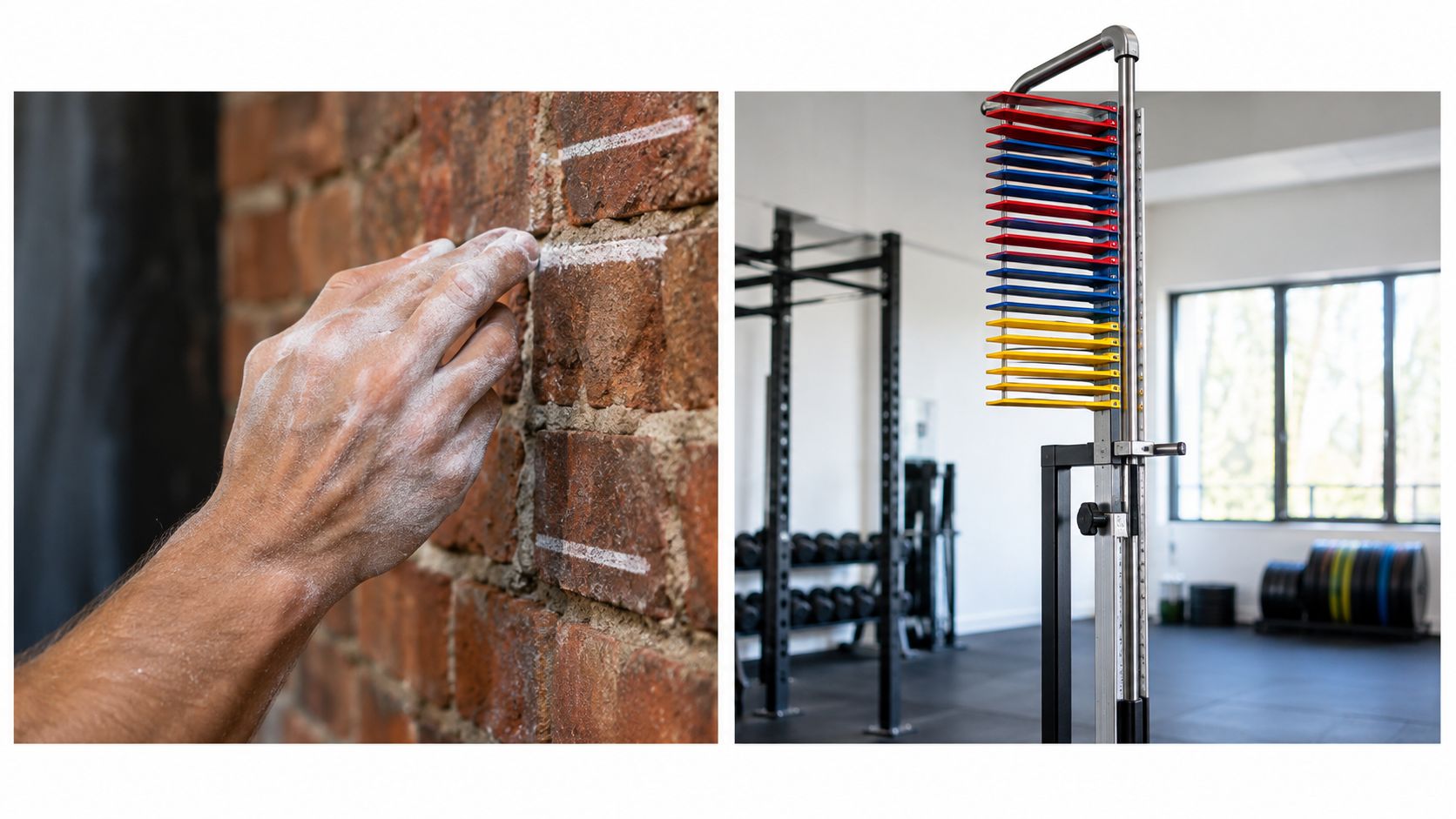
Vertical jump testing started with simple jump-and-reach methods and gradually shifted toward instrumented systems as coaches demanded better repeatability. The broad modern market now spans contact mats, force plates, optical systems, transducers, video tools, and wearables, and that expansion happened because researchers kept finding that devices were not always interchangeable historical comparison context.
One of the earliest standardized methods was the Sargent jump-and-reach test, commonly associated with the early 20th century and still central to the logic of reach-based testing. The athlete marks standing reach, jumps, and records the difference. That basic concept fed directly into later tools such as Vertec-style vane systems. For a concise timeline, see this history of jump measurement innovations.
Older methods still matter because they remain practical in schools, combines, and large group settings. If you need to test 40 athletes in a short block and only need a clean height measure, a wall-reach or vane system can still do the job well enough. I would not dismiss them just because force plates exist.
The key trade-off is this: reach-based tools measure displacement relative to standing reach, while flight-time and force-based systems estimate or directly measure what happened at take-off and landing. Reach tools are simple and engaging, but they can be influenced by shoulder mobility, timing of the hand strike, and approach to the target. Force and flight-time tools remove some of that subjectivity, but they introduce their own assumptions and technical demands.
Comparing Different Types of Measuring Devices
The useful way to compare devices is not by asking which one is most advanced, but by checking four things: price band, expected accuracy, setup burden, and the type of decision the data will support. Some tools are great for weekly screening; others are built for rehab, research, or high-performance monitoring.
Whatever device is used, repeatable technique and a consistent protocol are essential if results are going to be compared over time.
Mechanical Vane Testers: Best for Fast Group Testing
Mechanical vane systems such as a Vertec-style tester are still one of the easiest ways to test a large group quickly. Typical pricing is usually in the low hundreds rather than thousands, setup is minimal, and athletes understand the result instantly.
Their limitation is built into the method: they record how high the athlete reaches, not what happened during take-off and landing. That means no contact time, no RSI, and no force profile. In validation work, Vertec systems have shown bias relative to criterion methods, with one comparison reporting an average value 2.4 cm lower than criterion in the same sample validity study. For schools and combines, that may be acceptable. For detecting small changes in elite athletes, it may not be.
Typical price band: roughly entry-level to mid-range.
Expected accuracy/limitations: good enough for reach-based benchmarking, but affected by timing, reach mechanics, and shoulder position.
Setup burden: very low.
Best use case: PE departments, camps, combines, and teams that want a visible, competitive test.
Jump Mats: Best Value for Height Plus Contact Metrics
Jump mats calculate jump height from flight time. That makes them a practical middle ground: still portable and relatively affordable, but capable of giving more than a simple reach score. Many models also calculate contact time and RSI for repeated jump tasks.
The caveat is that flight-time methods depend on assumptions about body position at take-off and landing. If an athlete lands with more knee or hip flexion than they used at take-off, flight time can be artificially extended and jump height overestimated. That limitation is widely recognized in sports science because the device is not directly measuring center-of-mass displacement; it is inferring it from time in the air criterion comparison.
Typical price band: budget to mid-range.
Expected accuracy/limitations: useful for trend tracking, but sensitive to landing strategy and protocol quality.
Setup burden: low; usually quick enough for weekly team testing.
Best use case: coaches who want height, contact time, and basic reactive testing without force-plate cost.
Wearable Sensors: Best for Portability, With Caveats
Wearable sensors use accelerometers and algorithms to estimate jump metrics from body movement. Their main advantage is convenience: they travel well, work across venues, and can fit around normal training rather than forcing a formal testing block.
I would be cautious. Wearables are often good enough for rough monitoring when the same athlete wears the same device in the same position under the same protocol. They are less convincing when you want absolute values that line up tightly with force plates or optical systems. Small shifts in belt placement, sensor orientation, jump style, and filtering algorithms can change the output, especially if the platform estimates jump height indirectly rather than measuring flight time or force directly.
Typical price band: budget to mid-range, sometimes with app subscriptions.
Expected accuracy/limitations: acceptable for portable tracking if protocol discipline is high; weaker when you need interchangeable values across athletes, locations, or systems.
Setup burden: very low once the athlete knows where and how to wear it.
Best use case: travelling coaches, individual athletes, and practitioners who value portability over lab-grade precision.
When Wearable Sensors Are Good Enough
Wearables make sense when your main goal is to monitor broad readiness or training response without carrying more hardware. If you are asking, "Did this athlete look flat today compared with their own recent baseline?" a wearable can be enough. If you are asking, "Did this rehab athlete improve by a small but clinically meaningful amount?" I would rather have a force plate or a validated optical/contact system.
Readings can be skewed by inconsistent attachment point, loose clothing, different jump styles, and software smoothing. They also tend to provide less transparency about how the final number was derived. For coaches who need portable jump testing, I would rank wearables below a good mat or optical system for confidence in the result, but above them for convenience.
Optical and Laser Systems: Best Portable Step Up in Precision
Optical systems use infrared or light-based detection to identify take-off and landing events. In practice, they offer much of what coaches like about mats—portability and quick setup—while often improving event detection and repeatability.
Recent field-based validation work has reported strong reliability for optical systems, including ICC values as high as 0.98 for Optojump and 0.90 for BTS Smart in one comparison optical reliability data. That does not make every optical system identical, but it does explain why they are a common performance-centre choice.
Typical price band: mid-range to premium.
Expected accuracy/limitations: generally strong for flight-time and contact metrics; still dependent on test protocol and surface.
Setup burden: moderate; easier than a force-plate workflow, but more involved than a mat.
Best use case: coaches who want portable jump testing with better confidence than a wearable and more detail than a vane tester.
Force Plates: Best for High-Performance and Rehab Decision-Making
Force plates directly measure ground reaction forces, which is why they remain the reference option for detailed jump analysis. They can provide jump height, impulse, asymmetry, braking and propulsive characteristics, and time-based variables that simpler systems either estimate or cannot access at all. Newer work in 2025 and 2026 continues to support their sensitivity for detecting performance and recovery changes, and recent comparisons have shown strong agreement between newer and established platforms in several phases of the jump 2026 force-plate study.
The trade-off is obvious: price, setup, software, and interpretation. A force plate is not just equipment; it is a workflow. In my view, it becomes worth the investment when the decisions are expensive enough to justify the data, such as return-to-play calls, high-performance monitoring, or research.
Typical price band: premium to very high.
Expected accuracy/limitations: best available for detailed biomechanical profiling, but only as useful as the protocol and analyst behind it.
Setup burden: highest of the common options.
Best use case: elite sport, university labs, rehab clinics, and practitioners who need force-time detail rather than a single height number.
Comparison of Vertical Jump Measuring Device Technologies
| Device Type | Typical Price Band | Expected Accuracy / Limits | Setup Burden | Best Use Case |
|---|---|---|---|---|
| Mechanical Vane Tester | Low to mid | Consistent enough for reach-based testing; affected by hand timing and reach mechanics | Very low | Schools, combines, large groups |
| Jump Mat | Low to mid | Good for trends; flight-time estimate can be skewed by landing technique | Low | Coaches wanting height plus contact metrics |
| Wearable Sensor | Low to mid | Useful for portable monitoring; more sensitive to placement and algorithms | Very low | Travelling coaches, solo athletes |
| Optical/Laser System | Mid to high | Strong reliability for take-off/landing detection; still protocol dependent | Moderate | Performance centres needing portable precision |
| Force Plate | High to very high | Best detail and strongest case for advanced analysis | High | Rehab, elite sport, research |
Choosing the right device is mostly about deciding how much uncertainty you can tolerate. If a one-centimeter swing would change what you do next, buy the more defensible system. If you just need a stable weekly snapshot, simpler tools can be excellent value.
| Device Type | How It Works | Pros | Cons | Best For |
|---|---|---|---|---|
| Mechanical Vane Tester | Measures the physical displacement by having an athlete swat at movable vanes. | Simple, durable, reliable, great for motivation, no batteries required. | Only measures maximum reach height, bulky, not portable. | Gyms, schools, athletic combines, and team settings. |
| Jump Mat | Measures the "flight time" an athlete is in the air and calculates height. | Portable, affordable, can measure GCT and RSI, easy to use. | Accuracy can be affected by landing technique (tucking legs). | Coaches, personal trainers, and athletes wanting more than just height. |
| Wearable Sensor | Uses an accelerometer to measure movement and algorithmically estimate height. | Extremely portable, convenient for on-the-go testing, tracks multiple jumps. | Can be less accurate/consistent than direct measurement devices. | Individual athletes and trainers who need maximum portability. |
| Optical/Laser System | Uses light beams to precisely measure flight time as they are broken by the athlete. | Highly accurate, portable, provides advanced metrics like RSI. | More expensive than mats or wearables, requires a flat surface. | Performance centers and researchers needing high accuracy without a force plate. |
| Force Plate | Directly measures ground reaction forces throughout the entire jump. | Provides the most detailed force-time data of the common options and is widely used for advanced biomechanical analysis. | Very expensive, not portable, requires expertise to interpret data. | University labs, professional sports teams, and clinical research settings. |
What Your Jump Data Really Tells You
The number you see on the screen from a vertical jump measuring device? That's just the start of the story. While jump height always grabs the headlines, a genuine competitive advantage is buried in the deeper metrics. This data turns a simple jump into a detailed report on an athlete's unique physiological blueprint.
Think of it this way: jump height is like the final score of a game. It tells you who won, but not why. The detailed metrics are the game film—they show you the strategy, the execution, and the specific plays that decided the outcome. By digging into this data, a coach can stop guessing and start designing programs that target an athlete's specific needs.
Moving Beyond Simple Jump Height
An athlete's vertical leap is a product of many different biomechanical factors. In fact, two athletes can hit the exact same jump height of 30 inches but get there in completely different ways.
One might be a "bulldozer," using raw muscular strength to power off the ground. The other might be a "pogo stick," using elastic, reactive strength to bounce off the floor in an instant. A modern vertical jump measuring device can tell you exactly which type of athlete you're working with, which is crucial because each profile requires a totally different training focus.
Key Metrics for Deeper Analysis
To really get a handle on an athlete's power profile, you need to look at a few key metrics that paint a much richer picture. These are the numbers that explain the how and why behind the jump.
- Ground Contact Time (GCT): This is how long an athlete's feet are on the ground during the jump, measured in milliseconds. A short GCT points to fantastic reactive strength and an efficient stretch-shortening cycle, which is critical for any sport that involves quick cuts and changes of direction.
- Rate of Force Development (RFD): Think of this as going from zero to max power as fast as possible. A high RFD is the signature of an explosive athlete who can "switch on" their strength in a flash.
- Reactive Strength Index (RSI): Often seen as the master metric, RSI is calculated by dividing jump height by ground contact time. It gives you a single, powerful score that sums up an athlete's explosive ability by blending both power and speed.
By tracking these metrics, you can pinpoint exactly what’s holding an athlete back. An athlete with a great jump height but a long GCT probably needs more plyometrics. Another with a low RFD might need to hit the weight room to build their raw force-producing capacity.
Understanding these individual pieces allows for a far more surgical approach to training.
The Science Behind the Numbers
The link between movement speed and jump height is rock-solid. For example, studies on loaded jump squats have found that bar velocity is a very strong predictor of jump performance. The research is clear: maximum velocity gives you a valid window into an athlete's explosive power and neuromuscular efficiency, telling you so much more than a simple height measurement ever could. You can dig into the full findings on how bar velocity predicts jump height here.
This same principle applies to unloaded jumps. The data from an advanced vertical jump measuring device gives you a direct look into an athlete's neuromuscular system—showing how well their brain can tell their muscles to produce force, and how quickly those muscles respond.
Turning Data into a Competitive Edge
So, what does this look like in practice? Imagine a basketball player whose data reveals a low RSI. Sure, he might have a decent standing jump, but his inability to get off the floor quickly kills his effectiveness when grabbing rebounds in traffic. With that insight, his coach can build a plan around specific drills to shorten his ground contact time.
Or think about a volleyball player with a slow Rate of Force Development. She'll struggle to generate the power needed for a killer spike at the net. Her training can be tweaked to include exercises that specifically improve her ability to generate force fast. This data-driven approach makes sure every minute of training is spent efficiently, attacking the exact factor limiting performance. To see how your own numbers stack up, check out our guide on vertical jump test normative data.
A vertical jump measuring device does more than just measure jumps. It delivers a detailed diagnostic report on an athlete's power, speed, and efficiency, giving coaches the insights they need to build smarter, more effective athletes.
How to Choose the Right Device for Your Needs
A Guide to Vertical Jump Measuring Devices 10
The most useful way to choose is by matching the device to the setting. A home athlete, a school team, a travelling coach, and a rehab lab should not buy the same kit. If they do, one of them is overspending and another is under-measuring.
Home athlete: keep it simple and repeatable
If you train at home and mainly want to track progress over time, a jump mat, a reliable app-assisted video workflow, or an entry-level wearable usually makes the most sense. Expect a budget from modest to low-mid range depending on whether you want only height or also contact metrics.
The metrics worth paying for are basic jump height and, if your training includes rebound or plyometric work, contact time or RSI. Force curves and advanced asymmetry dashboards are usually overkill here. In my experience, home athletes benefit more from testing under the same conditions every two to four weeks than from buying more complicated hardware.
A minimum viable home setup is straightforward: flat non-slip surface, consistent footwear or barefoot policy, same warm-up, same jump type, and a device you can set up in minutes. If the setup takes 20 minutes, habitual use declines.
School or team setting: prioritize throughput and durability
For schools, colleges, and team environments, the first question is how many athletes must be tested in one block. If the answer is "a lot," mechanical vane systems and jump mats tend to offer the best balance of speed and cost. Budget usually sits in the low to mid range per station, and the best purchase is often the one staff can run without technical friction.
Here, jump height is the core metric. Contact time and RSI are useful if the staff understand how they will change programming; otherwise they can become nice-looking data with no real action behind it. What is overkill? A premium lab-grade force setup for a PE department that only needs seasonal screening.
If your squad is also working on explosiveness development, structured programming matters as much as testing. The resource examples of plyometric training pairs well with simpler testing tools because it helps turn the score into an actual training response.
Coach who needs portable data: choose the least fussy system you trust
If you move between facilities or test courtside, portability becomes a buying criterion rather than a bonus. Optical systems and better wearable platforms then enter the conversation. Budget usually ranges from mid to premium depending on software and reporting.
The metrics worth paying for are the ones you can collect consistently in the field: jump height, contact time, RSI, and perhaps repeated-jump outputs. For most travelling coaches, that is enough. Full force-time analysis is valuable, but often unrealistic if setup space, athlete flow, and time are limited.
My editorial take: if a portable tool creates doubt every session because athletes wear it differently or the app workflow breaks concentration, it is not portable in practice. Convenience only counts if it survives a messy real-world environment.
Rehab clinic or high-performance lab: pay for force data if you will act on it
In rehab and elite-performance settings, force plates are easier to justify because small changes can carry big implications. Budget moves from premium into serious capital spending, but you gain access to braking, propulsive, landing, and asymmetry information that can shape return-to-play and performance decisions.
The metrics worth paying for include force-time characteristics, asymmetry, eccentric and concentric strategy, and repeatable jump variants. What would be overkill here is not the force plate itself but buying one without staff training or a clear testing model. Data quality is only half the purchase; interpretation is the other half.
Think about total cost of ownership
Purchase price is only the start. Software subscriptions, calibration needs, replacement vanes or mats, transport cases, tablets, staff training time, and reporting workflows all add cost. A cheaper device can become expensive if it breaks often or if nobody trusts the data enough to use it.
I would also factor in testing friction. The best-value system is often the one that gets used consistently, exports data cleanly, and does not need a specialist present every time. For a commercial facility, staff confidence may matter as much as raw measurement capability.
A practical decision rule
If you need only a stable jump-height trend, buy simple. If you need height plus fast-reactive metrics, buy a mat or optical system. If you need to understand why the number changed and whether left-right force patterns or braking strategy shifted, buy a force plate. That rule will solve most buying decisions faster than reading another specification sheet.
Cartwright Fitness Vertical Jump Tools
Need a practical physical measurement device? The Takei Vertical Jump Meter is a live product option for straightforward vertical-jump measurement.
Already have the jump result? Use the free Vertical Jump Test Calculator for age- and sex-based percentile context.
Running repeated assessments across a team? Cartwright Assess adds the professional workflow around repeat testing, optional participant records, reporting and team access.
Answering Your Top Questions About Vertical Jump Testing
A few testing questions matter regardless of which device you buy: how accurate the result is, which conditions affect it, and what counts as a fair comparison from one session to the next.
What affects a vertical jump score the most?
The biggest confounders are jump type, arm swing policy, landing technique, surface, warm-up, and whether the athlete repeats the test under similar fatigue conditions. A countermovement jump with free arm swing is not directly comparable to a hands-on-hips jump, and a soft tucked landing can inflate flight-time-based devices.
If you want useful trend data, standardize those conditions before worrying about tiny hardware differences. I would rather see a well-run test on a decent device than a sloppy protocol on expensive equipment.
How accurate are different tester types in practice?
Reach-based tools can be perfectly serviceable for field testing, but they are less precise than direct force measurement and can undershoot or vary with technique. Jump mats and optical systems are usually strong practical options, especially when take-off and landing events are cleanly detected. Force plates remain the best option when you need the most defensible detail, while wearables can be useful for monitoring but tend to be more dependent on placement and algorithm assumptions comparison overview.
Are smartphone apps accurate enough?
They can be adequate for casual self-checks, especially when video is captured well, but they are usually not the first choice for coaching decisions that depend on small changes. The issue is not that every app is poor; it is that consistency is harder to control across phones, frame rates, angles, and manual input.
How often should you test?
For most athletes, every 2-6 weeks is enough for formal maximal testing, with readiness-style submax checks used more often if the coaching model supports them. If recovery quality is poor, the number can drift for reasons unrelated to training adaptation, which is why broader recovery habits matter too. A useful companion resource is The Sleep Consultant's page on athletic recovery, because sleep debt and accumulated fatigue can distort jump outputs before they show up elsewhere.
Frequently Asked Questions
What equipment is needed for the vertical jump test?
At the simplest end, you only need a wall and chalk for a jump-and-reach test. More formal setups use a mechanical vane tester, jump mat, optical system, wearable sensor, or force plate depending on how much accuracy and detail you need. The right equipment depends less on the sport than on whether you need a quick field score or deeper performance data.
How much does a vertical jump tester cost?
Costs range from very affordable for basic home-use tools to several thousand for premium optical systems and much more for force-plate setups. Mechanical testers and mats usually sit in the more accessible middle ground, while force plates become expensive because you are buying both hardware and analysis capability. The useful budgeting question is not just price, but whether you will use the extra metrics often enough to justify them.
Can you test your vertical jump at home?
Yes, provided you keep the setup consistent. Use the same surface, warm-up, footwear policy, and jump protocol each time, and avoid changing from arm-swing to hands-on-hips testing between sessions. For home use, simplicity usually beats sophistication because a quick, repeatable setup gets used more often.
How accurate are vertical jump testers?
Accuracy varies by device type and by how well the protocol is controlled. Force plates are the strongest option for detailed measurement, optical systems and better mats are often very good for practical coaching, and reach-based tools are useful but more technique-dependent. Wearables can be helpful for trend monitoring, though their readings are more vulnerable to placement and algorithm differences than direct-measurement systems.
Are Vertec-style tools still accurate enough?
Often, yes—if your goal is consistent field testing rather than force analysis. They remain popular because they are quick, durable, and easy for groups, but they do not capture contact or force metrics and can differ from criterion methods by a few centimeters. That makes them suitable for many school, combine, and team settings, but less ideal when you need to detect very small changes.
At Cartwright Fitness, we focus on validated, high-precision equipment so you can trust your data. If you're ready to improve your performance testing, explore our professional-grade solutions at Cartwright Fitness.