

Whether you're holding a Size 5 soccer ball (68-70 cm) or a Size 7 basketball (74.9-76.2 cm), you’re handling a piece of equipment built to exacting standards. These aren't just arbitrary numbers. Governing bodies like FIFA and the NBA set these precise dimensions to guarantee a level playing field for every athlete, which has a massive impact on performance, skill development, and the integrity of the game itself.
How We Chose and Verified These Sports Ball Sizes
This guide compares the official adult or competition standards that are easiest to verify from governing-body rules and technical specifications, then adds youth sizes where a sport uses clear age bands. I reviewed the measurement points that affect use in practice: circumference, approximate diameter, weight, inflation or pressure where relevant, and the age bracket attached to each reduced-size version.
I also excluded balls that are mostly training variations rather than match standards. In practice, that means novelty mini balls, weighted skill balls, and retailer-only labels did not make the comparison tables unless they map cleanly to a recognised competition size. That matters because, in my experience, size confusion usually starts when product marketing mixes "junior," "youth," and "official" without naming the governing standard behind it.
Where possible, the numbers below align with primary sources such as the Laws of the Game from IFAB, the ICC clothing and equipment regulations, and the ITF technical booklet. For basketball, I cross-checked the size split between men’s and women’s play against a widely used basketball size reference).
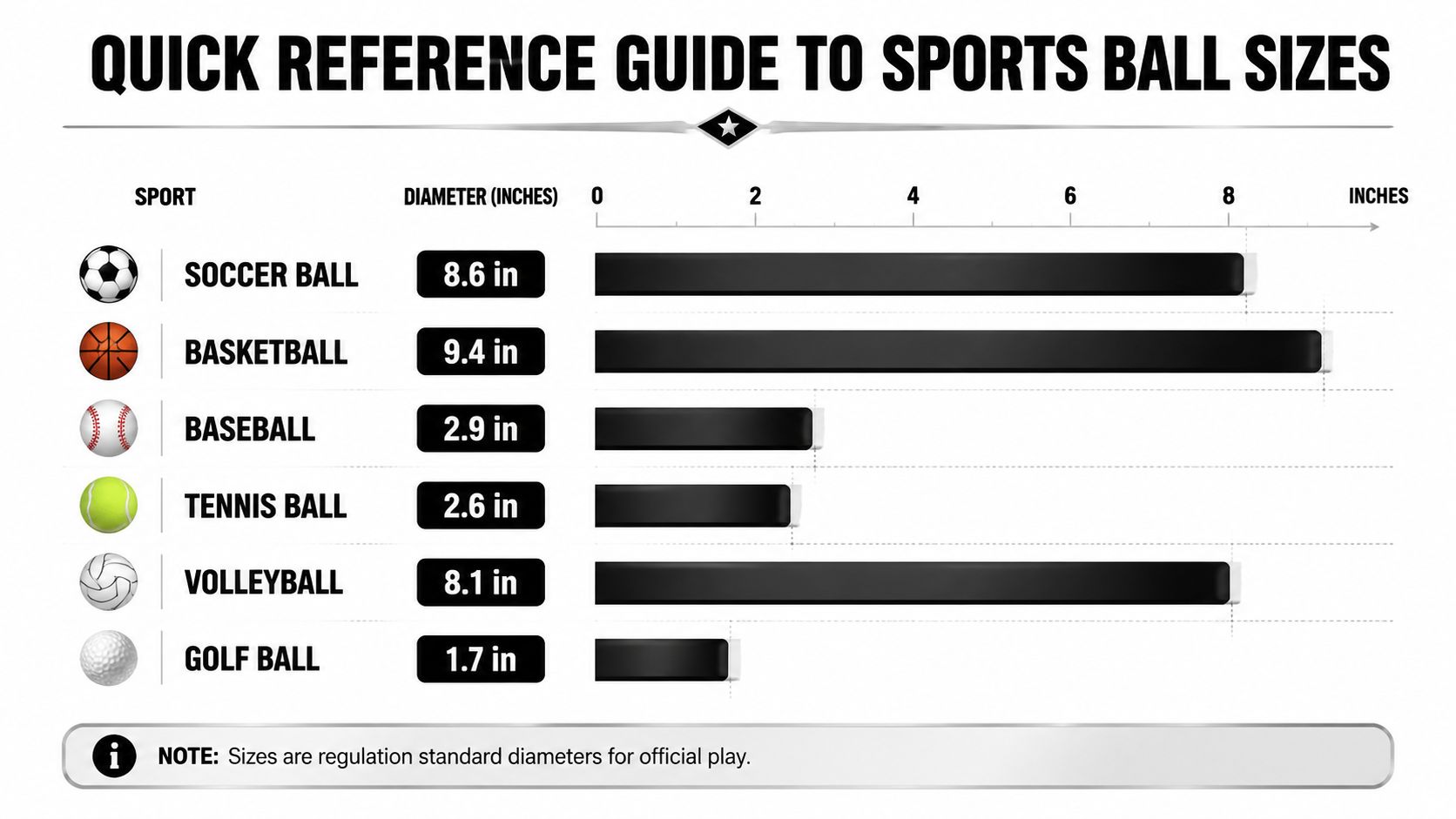
Quick Reference Guide to Sports Ball Sizes
Here’s the shortest useful answer: sports ball sizes are not one system. Some sports define size by circumference, some by diameter, and some by both shape and weight. That is why a tennis ball can be tiny yet tightly regulated, while an American football needs separate long and short circumference measurements.
The second thing worth knowing is that bigger does not always mean heavier. A basketball is far larger than a cricket ball and also heavier overall, but a cricket ball feels surprisingly heavy in the hand because so much mass is packed into a much smaller object. When I compare spec sheets, this is the mistake I see most often: people mix up hand feel, density, and raw weight as if they were the same thing.
This chart gives you a quick visual comparison of the circumferences for three of the most popular sports balls, making the size differences immediately obvious.
The Ultimate Guide to Sports Ball Sizes 8
Size vs Weight Comparison Table
| Sport | Official Size Designation | Main Size Measure | Approx. Diameter (cm) | Weight (g) | Quick Note |
|---|---|---|---|---|---|
| Tennis | Type 2 | 20.6–21.9 cm circumference | 6.54–6.86 | 56.0–59.4 | Smallest ball here; tightly regulated by the ITF |
| Baseball | Official | 22.9–23.5 cm circumference | 7.3–7.5 | 142–149 | Small diameter, moderate weight |
| Cricket | Men’s | 22.4–22.9 cm circumference | 7.1–7.3 | 155.9–163 | Heavier than baseball despite similar size |
| Volleyball | Official | 65–67 cm circumference | 20.7–21.3 | 260–280 | Large and relatively light |
| Soccer | Size 5 | 68–70 cm circumference | 21.6–22.3 | 410–450 | Standard adult match ball |
| American Football | Pro | 70.5–72.4 cm long circumference | 21–21.6 (short axis) | 397–425 | Oblong, so direct diameter comparisons are limited |
| Basketball | Size 7 | 74.9–76.2 cm circumference | 23.8–24.2 | 567–624 | Largest and heaviest standard ball in this set |
Heaviest in this guide: the adult basketball is the heaviest ball covered here at 567–624 g. Most deceptive by feel: the cricket ball, because 155.9–163 g is concentrated into a ball barely over 7 cm in diameter.
Why Standardized Sizes Matter
Sticking to official sizes isn't just about playing by the rules, it's about creating a predictable environment where athletes can grow. When you're running drills or outfitting a multi-sport complex, having standardized equipment is the bedrock of your operation. For those managing complex scheduling and equipment inventories, a deep understanding of these specifications is essential. You can find more strategies for juggling these details in our guide to sports facility management software.
Using the correct ball size ensures that skill acquisition is biomechanically sound, especially in younger athletes. A ball that is too large or heavy can force unnatural movements, impeding long-term development.
Think about it this way: a young basketball player trying to learn with a full-size, Size 7 ball is going to have a tough time. Their hands are too small, forcing them to develop awkward, ineffective shooting habits. Give them the right Size 5 ball, however, and they can build the correct muscle memory from day one. This same principle holds true for every sport.
Detailed Specifications for Soccer Balls
The Ultimate Guide to Sports Ball Sizes 9
In soccer, the ball itself is one of the most tightly regulated pieces of equipment in all of sports. FIFA has established precise benchmarks to guarantee every match is played on a level field. The familiar Size 5 ball is what you see in every professional league and tournament, and it's the standard for any player aged 11 and up.
This wasn't always the case, of course. It wasn't until 1872 that the English FA first put rules on paper, mandating a circumference of 27-28 inches and a weight of 14-16 ounces. Modern regulations have fine-tuned those figures, and ball construction has continued to evolve through changes in panel count, materials, and bonding methods. You can really get a feel for how we got here by exploring the fascinating history of its size and design.
The Official Size 5 Soccer Ball
For a ball to get the green light for professional play, it has to pass a battery of tests. This isn't just about rules for rules' sake; at the elite level, the slightest variation in the ball's weight or shape can affect a player's first touch or the trajectory of a game-winning free-kick.
- Circumference: 68–70 cm (27–28 inches)
- Weight: 410–450 grams (14–16 ounces)
- Pressure: 8.5–15.6 PSI (0.6–1.1 bar) at sea level
- Diameter: Approximately 22 cm (8.65 inches)
This consistency is vital for assessing players, too. Athletes are pushed to meet incredible physical benchmarks, and using a regulation ball is the only way to get an accurate read on their abilities. If you're curious about what it takes, you should check out our breakdown of the standards for a football fitness test.
The evolution of ball construction, from traditional 32-panel stitched designs to modern thermally bonded balls, has had a profound impact on aerodynamics. Fewer panels generally mean a truer, more predictable flight, but can also reduce the traditional "swerve" players use on free kicks.
Youth Soccer Ball Sizes
Starting a young player with the right equipment makes a big difference. Using a ball that’s too big or heavy doesn't just hinder their ability to learn—it can force bad habits and even increase the risk of injury. The system is designed to scale the ball down to fit the player.
Size 4 Soccer Ball
- Age Group: 8 to 11 years old
- Circumference: 63.5–66 cm (25–26 inches)
- Weight: 350–390 grams (12–14 ounces)
- Purpose: The Size 4 ball is a bridge. It’s perfectly designed to help players transitioning from early childhood to pre-teen years build better control and passing strength as they grow.
Size 3 Soccer Ball
- Age Group: Under 8 years old
- Circumference: 58.5–61 cm (23–24 inches)
- Weight: 300–320 grams (10–12 ounces)
- Purpose: This is the first ball for most kids. Its smaller size and lighter weight make those first dribbles and kicks feel natural and fun, helping build a foundation of confidence and skill from the very beginning.
If you want an extra age-by-age soccer breakdown with coaching context, there’s a practical guide over at Villarreal Houston Academy that pairs the official size progression with youth development tips, and another useful reference on choosing the right size soccer ball for U11 players.
Detailed Specifications for Basketballs
Governing bodies like the NBA and FIBA have dialed in the specifications for basketballs with incredible precision. This ensures every dribble, pass, and shot feels consistent, no matter what court you’re on. The most common standard you'll see is the Size 7 ball—the official choice for men's professional, college, and high school leagues around the world.
But it wasn't always this way. Dr. James Naismith's original 1894 ball was a hefty 32 inches in circumference, a full four inches larger than a soccer ball. By 1949, the official size was slimmed down to 30 inches before being refined into the modern Size 7 we know today. This evolution, combined with new rules for bounce height, helped tighten consistency around modern basketball standards. You can learn more about this journey by reading up on the evolution of the official NBA ball on Hoopsbasket.com.
The Official Size 7 Basketball
For a ball to get the green light for professional play, it has to pass a strict test for size, weight, and even how it bounces. This isn't just about red tape; it's about guaranteeing fair play and allowing players to perform at the highest level. These exact dimensions are what let a player build reliable muscle memory for their handle and shot.
- Circumference: 74.9–76.2 cm (29.5 inches)
- Weight: 567–624 grams (20–22 ounces)
- Pressure: 7.5–8.5 PSI (0.52–0.59 bar)
- Bounce Height: Must rebound 49–54 inches when dropped from a height of 6 feet.
This level of consistency is everything for player development and performance analysis.
"The consistency of a basketball's size and pressure is the bedrock of player development. When an athlete practices, they are programming their nervous system. If the tool changes, the programming becomes unreliable." – Professional Coach Insight
Women's Professional and Youth Sizes
Just like in other sports, basketballs come in different sizes to match the athlete's age and physical development. This approach helps players build solid fundamentals without struggling with a ball that's too big or heavy for them to control.
Size 6 Basketball
This is the official ball for women's professional (WNBA), collegiate (NCAA), and international (FIBA) basketball. It's also the standard for boys aged 12-14. Its slightly smaller size is a much better fit for players with smaller hands, enabling better grip, control, and shooting form.
- Age Group: Females 12+, Males 12–14
- Circumference: 72.4 cm (28.5 inches)
- Weight: 510–567 grams (18–20 ounces)
Size 5 Basketball
As the standard youth ball for kids aged 9-11, the Size 5 is an essential tool for building a strong foundation. It’s light enough for young players to shoot with proper mechanics and small enough to dribble with confidence, helping them develop correct habits right from the start.
- Age Group: 9 to 11 years old
- Circumference: 69.9 cm (27.5 inches)
- Weight: 470–510 grams (16.6–18 ounces)
Which Ball Is Heaviest? Quick Comparison Across Major Sports
Among the balls covered in this guide, a regulation basketball is the heaviest. Adult size 7 basketballs weigh 567–624 g, which puts them well above soccer, American football, volleyball, baseball, tennis, and cricket.
That answer sounds obvious once you see the numbers, but equipment buyers regularly confuse heaviness with compactness. In my view, cricket is the main reason: a cricket ball feels dense and hard because it packs substantial mass into a small leather shell, while a basketball spreads much more mass across a much larger air-filled ball.
| Ball | Official Weight Range |
|---|---|
| Basketball (Size 7) | 567–624 g |
| Soccer (Size 5) | 410–450 g |
| American Football (Pro) | 397–425 g |
| Volleyball | 260–280 g |
| Cricket (Men’s) | 155.9–163 g |
| Baseball | 142–149 g |
| Tennis | 56.0–59.4 g |
So, between cricket and basketball, the answer is straightforward: a basketball is substantially heavier than a cricket ball. Using the common adult ranges above, the basketball exceeds the men’s cricket ball by roughly 404 to 468 grams. Put another way, the basketball weighs more than three times as much.
Specifications for American Football and Rugby Balls
Not every sport is played with a perfect sphere. When we get into contact sports like American football and rugby, the ball itself, a prolate spheroid, is different. Its oblong shape is purpose-built for how the game is played, dictating everything from grip and flight to handling.
For anyone coaching or training athletes in these sports, knowing the precise differences between these balls isn't just trivia; it's critical.
The official ball of the NFL, affectionately known as "The Duke," has very specific dimensions. These specs have been honed over decades to give quarterbacks the ideal surface for gripping and throwing a tight spiral, which is the cornerstone of any effective passing game.
- Length (tip to tip): 27.9–28.6 cm (11–11.25 inches)
- Long Circumference (end to end): 70.5–72.4 cm (27.75–28.5 inches)
- Short Circumference (around the middle): 52.7–54.0 cm (20.75–21.25 inches)
- Weight: 397–425 grams (14–15 ounces)
Of course, these numbers are for the pros. You’ll find slightly smaller footballs at the collegiate (NCAA) and youth levels. This allows younger players with smaller hands to develop proper throwing mechanics without struggling with a ball that's too big.
Comparing Football and Rugby Balls
At a quick glance, a rugby ball might look similar to its American cousin, but they are built for entirely different jobs. A rugby ball's shape and texture are optimized for carrying and lateral passing, not the long, forward spiral of an American football. For adult play in both rugby union and rugby league, the standard is a Size 5 ball.
The most obvious difference is the shape. A rugby ball is noticeably rounder and less pointed at the ends. This makes it far more suitable for the varied passing and kicking styles in rugby, like the tumbling end-over-end kicks or the low, bouncing grubbers that are impossible with a pointed football.
Let's break down the key differences in a direct comparison.
| Feature | NFL Football (Pro) | Rugby Union (Size 5) | Rugby League (Size 5) |
|---|---|---|---|
| Length | 27.9–28.6 cm | 28–30 cm | 27–29 cm |
| Long Circumference | 70.5–72.4 cm | 74–77 cm | 73–75 cm |
| Short Circumference | 52.7–54.0 cm | 58–62 cm | 60–61 cm |
| Weight | 397–425 g | 410–460 g | 383–440 g |
As you can see in the table, a Size 5 rugby union ball is generally bigger around the middle and can be heavier than an NFL football. A rugby league ball lands somewhere in between—a bit more pointed than a union ball, but still much rounder than an American football.
These subtle variations in shape and weight have a massive impact on how an athlete grips, handles, and kicks the ball.
Specifications for Racquet and Bat Sports Balls
In this category, weight comparisons are often more useful than size labels because the balls are small, dense, and governed very differently. The practical ranking in this guide is: basketball heavier than volleyball, cricket, baseball, and tennis; cricket heavier than baseball; baseball heavier than tennis.
I think tennis is the best example of how strict regulation can matter even when the ball looks simple. The ITF technical rules require standard balls to measure 6.54 to 6.86 cm in diameter and 56.0 to 59.4 g in mass. That is one of the narrowest tolerance windows in mainstream sport, and it helps explain why a slight change in bounce or felt condition is immediately obvious to frequent players.
Weight Comparison: Cricket vs Basketball, Baseball, Tennis, and Volleyball
A basketball is heavier than a cricket ball. A regulation size 7 basketball weighs 567–624 g, while a men’s cricket ball weighs 155.9–163 g under the ICC equipment regulations. A baseball comes in at 142–149 g, a tennis ball at 56.0–59.4 g, and a volleyball at 260–280 g.
| Ball | Weight Range | Key Takeaway |
|---|---|---|
| Basketball | 567–624 g | Heaviest comparison point here |
| Volleyball | 260–280 g | Much larger than cricket, still lighter than basketball |
| Cricket (Men’s) | 155.9–163 g | Small but notably dense |
| Baseball | 142–149 g | Slightly lighter than cricket |
| Tennis | 56.0–59.4 g | Lightest of the group |
The reason people mix up cricket and basketball is simple: size and weight are different questions. A basketball is much larger and clearly heavier by total mass, but a cricket ball is compact, hard-cored, and leather-wrapped, so it can feel disproportionately heavy for its size. When I compare them side by side, cricket wins on density and impact feel; basketball wins by a huge margin on raw weight.
Baseball Official Dimensions
To ensure a level playing field across the league, every modern MLB ball has to meet strict guidelines. These numbers are the foundation for analyzing everything from pitching mechanics to the physics of a bat hitting a ball.
- Circumference: 22.9–23.5 cm (9–9.25 inches)
- Weight: 142–149 grams (5–5.25 ounces)
- Diameter: 7.3–7.5 cm
If you're interested in the sport's design background, you can dig into the historical evolution of the baseball's design on Wikisource. If you're interested in other high-speed stick-and-ball sports, it's worth comparing how they handle their own equipment standards. For a good example, check out the official lacrosse ball sizes.
Tennis Ball Regulations
The International Tennis Federation (ITF) is the authority on tennis ball specifications, making sure every ball bounces and flies predictably in competitions worldwide. What makes tennis balls unique is that they are also classified by their bounce, which is specifically matched to different court surfaces.
A key test for any official tennis ball is its rebound height. When dropped from a height of 100 inches (254 cm) onto a solid, flat surface, a standard Type 2 ball has to bounce back up between 53 and 58 inches (135–147 cm).
The most common ball you'll see is the Type 2, the go-to for standard hard courts. But there are also "fast" (Type 1) balls for slower clay courts and "slow" (Type 3) balls designed to even out the speed on fast grass courts.
Cricket Ball Specifications
Cricket often shows size-versus-weight confusion. Under the ICC regulations, a men’s cricket ball must weigh 155.9 to 163 g and measure 22.4 to 22.9 cm in circumference. Women’s cricket uses a slightly smaller and lighter ball at 140 to 151 g with a circumference of 21.0 to 22.5 cm.
That means a cricket ball is heavier than a baseball at the top end, but nowhere near the mass of a basketball. It is, however, far denser in the hand. That distinction matters for coaching and buying: if someone says a cricket ball feels heavier than a basketball, what they usually mean is that it feels more solid and concentrated, not that it weighs more.
How to Select and Measure the Right Sports Ball
The Ultimate Guide to Sports Ball Sizes 10
Any experienced coach will tell you that the ball you train with matters. It’s not just about grabbing whatever is available; choosing the right ball is fundamental for developing proper technique, ensuring player safety, and getting the most out of every practice and game. This is especially true for young athletes, whose skills can be held back by using gear that's too big or heavy.
Getting it right isn't complicated. It just means knowing what to look for and how to check it.
How to Accurately Measure a Sports Ball
So, how do you confirm a ball meets official specs? You just need a couple of basic tools. Taking these quick measurements ensures everyone is training with consistent, professional-grade equipment.
1. Measuring Circumference
Grab a flexible tailor's tape measure for this. Wrap the tape around the widest part of the ball, keeping it snug without squashing the surface. For balls that aren't perfect spheres, like a rugby ball or American football, you'll need two measurements: the long circumference (from tip to tip) and the short circumference (around the fattest part of the middle). If you're looking for a reliable tool, you can find a quality tape measure at Cartwright Fitness that works perfectly for this.
2. Verifying Weight
A digital kitchen or postal scale is your best bet for accuracy. Just pop the ball on the scale, note the weight in grams (g) or ounces (oz), and check it against the official specs for that particular ball and size.
3. Checking Pressure
Proper inflation is essential to how a ball performs. A dedicated low-pressure gauge is the right tool for the job. Insert the needle into the ball's valve, and the reading should match the recommended PSI or Bar range that’s usually printed right on the ball itself.
A quick word of caution: An under-inflated ball will feel dead and sluggish, while an over-inflated one can bounce unpredictably, feel rock-hard, and increase the risk of injuries. Always stick to the manufacturer’s inflation guide.
Making the Right Selection
When you're picking out a ball, think about its main job. Is it for a championship match, everyday practice, or just a kickabout in the park?
- For Competition: Don't compromise. Always train with the official size and weight specified for your league and age group. There's no substitute for getting used to the exact ball you'll use on game day.
- For Training: You can get creative. Sometimes, using a slightly different ball can help sharpen specific skills. For example, soccer players often use smaller balls to fine-tune their footwork, while a basketball player might use a weighted training ball to build dribbling strength.
- For Recreation: If it's for casual play, precise specs are less important than durability. A tough rubber or composite ball that can handle different surfaces like concrete or grass is usually the smartest and most cost-effective choice.
Frequently Asked Questions About Sports Ball Sizes
Is a size 4 or 5 soccer ball bigger?
Size 5 is bigger. A standard size 5 soccer ball measures 68–70 cm in circumference and is used for players 11 and older, while size 4 measures 63.5–66 cm and is typically used for ages 8 to 11. A simple example: if a Year 6 player is moving into full-sided football, they may still train with size 4 before switching to size 5 as league rules require.
Is size 7 a regular ball?
For men’s basketball, yes: size 7 is the regular adult match ball. It has a circumference of about 29.5 inches (74.9–76.2 cm) and is used in men’s professional, college, and most boys’ high-school play. In a sports shop, though, "regular" can be misleading because volleyball, soccer, and rugby all use different naming systems.
Is the NBA ball size 6 or 7?
The NBA uses size 7, not size 6. Size 7 is the men’s professional standard at roughly 29.5 inches in circumference, while size 6 is the smaller 28.5-inch ball used in women’s professional basketball and many youth divisions. A quick example: an adult men’s recreational league that follows NBA-style sizing should be using size 7.
What size ball should a 12-year-old use?
It depends on the sport. For soccer, a 12-year-old typically uses a size 5 ball. For basketball, a 12-year-old boy usually uses size 6, while a 12-year-old girl may use size 6 in leagues that follow the women’s standard; younger basketball players below that age often use size 5. In practice, this is why mixed equipment rooms can get messy: the same child may need a size 5 in one sport and a size 6 or 7 label in another.
At Cartwright Fitness, our focus has always been on providing high-precision health and fitness testing equipment so you can get the most accurate data possible. Explore our professional-grade solutions for top-tier performance testing and analysis.
| Sport | Official Size Designation | Circumference (cm) | Diameter (cm) | Weight (g) |
|---|---|---|---|---|
| Soccer | Size 5 | 68–70 | 21.6–22.3 | 410–450 |
| Basketball | Size 7 | 74.9–76.2 | 23.8–24.2 | 567–624 |
| Volleyball | Official | 65–67 | 20.7–21.3 | 260–280 |
| American Football | Pro | 70.5–72.4 (long) | 21–21.6 (short) | 397–425 |
| Tennis | Type 2 | 20.6–21.9 | 6.54–6.86 | 56.0–59.4 |
| Baseball | Official | 22.9–23.5 | 7.3–7.5 | 142–149 |