

Ever wondered what those pincer-like gadgets are that you see personal trainers using? Those are skin-fold calipers, and they're one of the most time-tested tools for measuring body composition.
Their job is to measure the thickness of your subcutaneous fat—that's the layer of fat sitting just beneath your skin. By gently pinching a fold of skin at very specific spots on your body, the calipers give you a direct measurement that, with a little math, helps estimate your overall body fat percentage. It’s a straightforward, non-invasive way to see what you're really made of.
What Are Skin Fold Calipers and How They Work
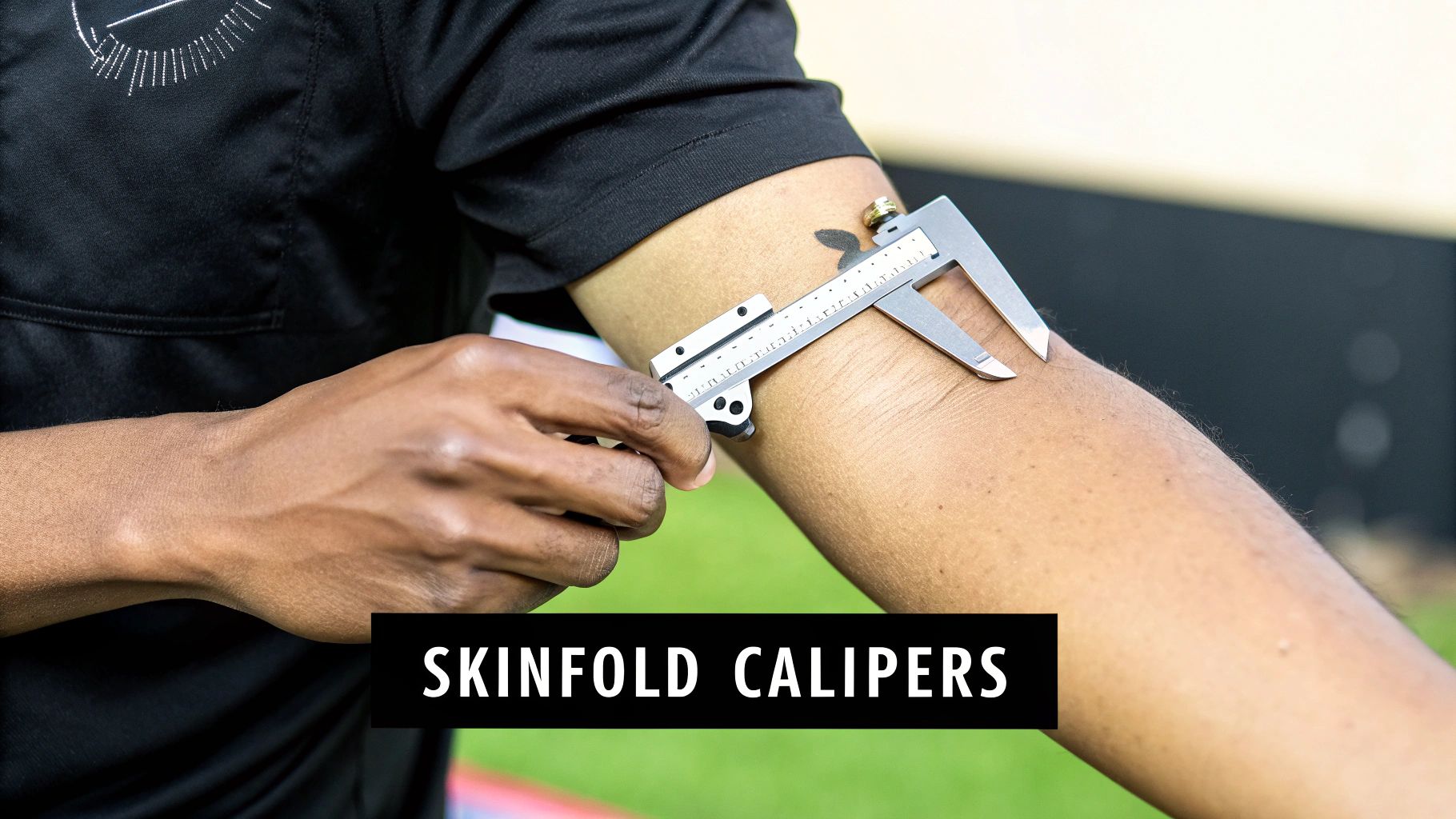
Think about it this way: a regular scale tells you your total weight, but it can't distinguish between muscle, bone, water, and fat. That's a huge blind spot. Gaining five pounds of muscle is a world away from gaining five pounds of fat, but the scale sees them as the same. Skin-fold calipers help fill in that missing information, acting like a targeted ruler for your fat stores.
The basic idea is simple. The tool gently pinches a fold of skin and the fat underneath, measuring its thickness in millimeters. This works because a substantial and relatively predictable amount of our total body fat is stored right under the skin.
The Science Behind the Pinch
You don't just take one measurement and call it a day. For an accurate picture, you take readings from several standardized locations on the body—common sites include the abdomen, thigh, and the back of the arm (triceps).
Once you have these numbers, you plug them into a special formula. These are often called population-specific equations, and they're the key to converting those millimeter readings into an estimated body fat percentage.
Researchers developed these formulas by comparing thousands of caliper readings against "gold standard" methods like underwater (hydrostatic) weighing. They found a reliable correlation between the thickness of subcutaneous fat and total body fat. So, the caliper gives you the raw data, and the formula does the heavy lifting of interpreting it.
The core idea is simple yet powerful: measure the fat you can see and pinch to estimate the fat you can't. This makes it one of the most accessible and practical methods for monitoring changes in body composition over time.
A Legacy of Precision Measurement
This concept isn't some new fitness fad. The lineage of skin-fold calipers goes all the way back to precision measuring tools from the 19th century. The vernier caliper, invented in the United States around 1851, was a general-purpose instrument that paved the way for more specialized tools.
Fast forward to 1994, when Mitutoyo developed a digital body-fat caliper, bringing the method into the modern era. You can explore more about the evolution of these measuring devices to see just how deep their roots in scientific measurement go.
Choosing the Right Skin Fold Caliper for You
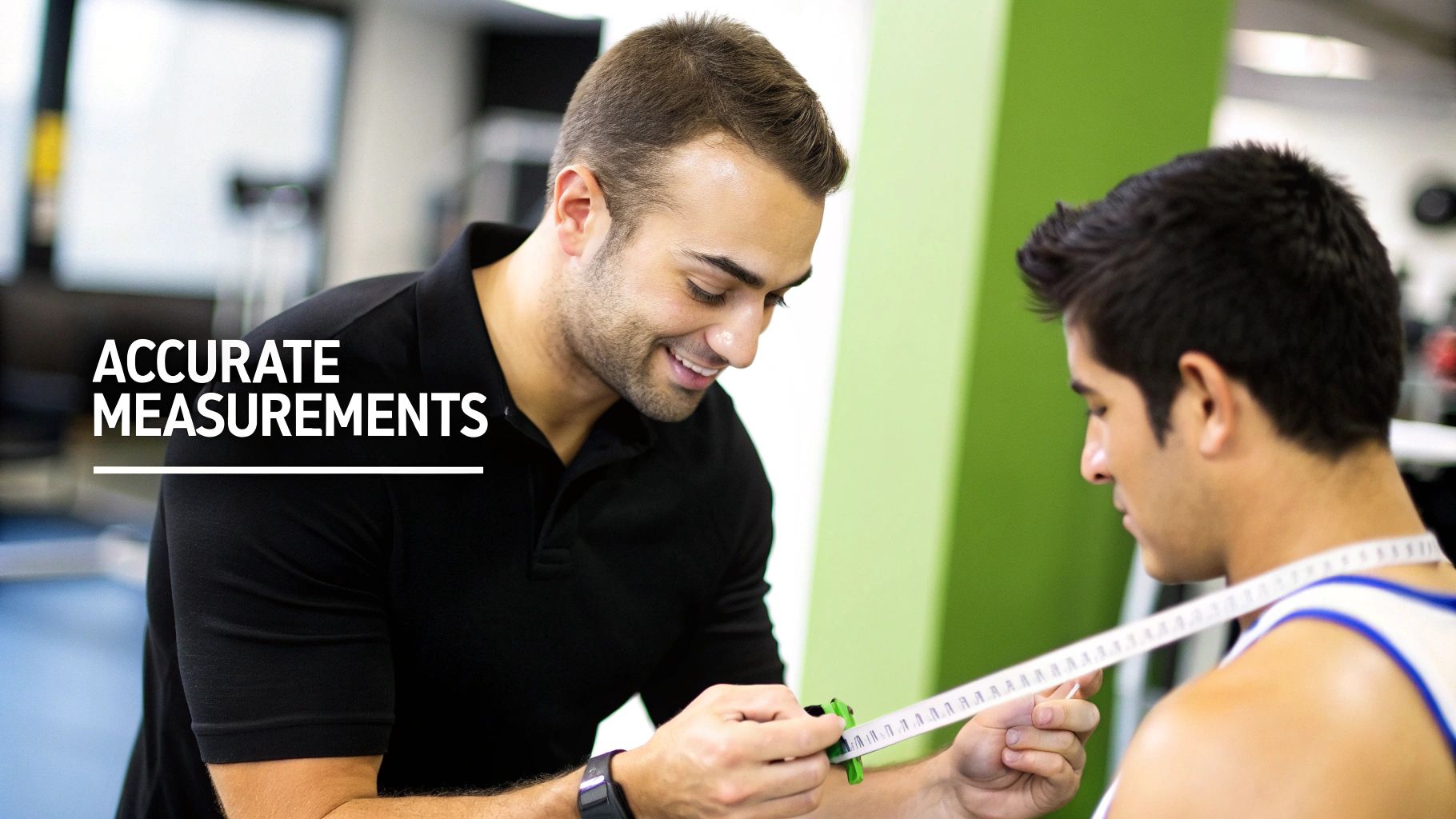
Not all skin fold calipers are the same. Picking the right one really boils down to what you need it for—your goals, your budget, and how precise you need to be. It's a bit like choosing a kitchen knife; a simple paring knife gets the job done for small tasks, but a professional chef is going to want a perfectly weighted, razor-sharp blade for consistent, professional results.
When you start shopping around, you’ll find that calipers generally fall into three buckets: basic plastic models, professional-grade metal ones, and modern digital versions. Each has its place, from casual home tracking to rigorous clinical assessments.
Plastic Calipers for Personal Tracking
If you're just dipping your toes into tracking your body composition, a simple plastic caliper is a fantastic place to start. They're light on the wallet, easy to handle, and great for getting the hang of the whole process without a big investment.
Are they as dead-on accurate as the expensive models? No, but that's not really their purpose. Their strength is in tracking trends. As long as you use the same tool and technique every time, you’ll get a clear picture of whether your body fat is heading up or down. For personal progress, that directional data is often all you need.
Professional Metal Calipers for Precision
When you get to a point where every millimeter matters, it's time to look at professional metal calipers. You'll see names like Harpenden and Lange pop up again and again in research labs, clinics, and elite training facilities. There's a good reason for that.
These tools are built like tanks and, more importantly, are engineered to apply a perfectly constant pressure—10 g/mm²—every single time you take a measurement. This consistent pressure is the secret sauce. It removes a massive variable from the equation, ensuring the only thing changing is the skinfold itself, not how hard you're squeezing. They cost more, but for a professional whose reputation depends on accurate data, they are an essential piece of equipment.
The Expert's Edge: The real game-changer between a cheap caliper and a professional one is the calibrated tension. Pro-level tools apply the exact same standardized pressure with every pinch, which eliminates a huge source of user error. This is what makes the measurements scientifically valid and comparable over time.
Digital Calipers for Modern Convenience
Digital calipers offer a nice middle ground, blending modern tech with the tried-and-true skinfold method. Instead of squinting at tiny markings on a scale, you get a crisp, clear number on a digital screen. This feature alone can dramatically cut down on reading errors, especially if you're new to this.
Many digital models even do the math for you, calculating your body fat percentage on the spot. It’s incredibly convenient, but be sure to invest in a quality model. The accuracy of the electronic sensors is everything. They bring a dose of modern convenience to a classic body composition technique.
To help you decide, let's break down the key differences in a simple table.
Comparison of Skin Fold Caliper Types
| Caliper Type | Best For | Material | Accuracy | Price Range |
|---|---|---|---|---|
| Plastic | Beginners, home use, and tracking personal trends | Plastic | Good for consistency, lower precision | $10 – $30 |
| Metal | Professionals, researchers, and clinical settings | High-grade metal | Excellent precision and reliability | $200 – $500+ |
| Digital | Users wanting ease-of-use and tech features | Plastic/Metal Combo | Varies by model, generally good | $30 – $100+ |
Ultimately, the best caliper is the one that fits your specific context. A casual user doesn't need a $400 clinical instrument, but a professional can't rely on a basic plastic model for client assessments. Choose the tool that aligns with your need for accuracy and your budget.
Mastering the Skinfold Measurement Technique
Using skinfold calipers effectively is a skill—it's much more about finesse and consistency than brute force. Think of it less like a simple measurement and more like learning an instrument; getting a reliable reading requires precise technique every single time. If you can master a standardized method, you'll unlock incredibly useful body composition data.
The whole idea is to isolate the layer of subcutaneous fat (the fat just beneath the skin) from the muscle underneath. This isn't a rough grab, but a careful, firm pinch. Once you’ve located the correct anatomical site, you’ll use your thumb and forefinger to grasp a double fold of skin and fat, gently pulling it away from the body.
The Art of the Pinch and Placement
To make sure you're only measuring fat, the pinch needs to be firm enough to create a clean fold without causing any pain. Your grip should be about 1 cm above the spot where you plan to place the caliper jaws. That little bit of space is crucial—it keeps the pressure from your fingers from messing with the measurement.
With a stable fold secured, it's time to bring in the calipers. The jaws should be placed perpendicular to the fold, right on the skin at the marked site. Then, release the caliper's trigger so the jaws can apply their full, calibrated pressure on the skinfold.
What happens next is key. Skinfold calipers work by compressing the fat, but this isn't instantaneous. Research shows that skin and fat continue to compress for a few seconds after the caliper is applied. To standardize your readings, the sweet spot for recording the thickness is about two to three seconds after the initial pressure is applied. You can discover more about the science of skinfold compression to really grasp why timing is so critical for accuracy.
Step-by-Step Measurement Protocol
When you're taking measurements, consistency is everything. Following the exact same steps, in the same order, every single time will dramatically improve how reliable your results are.
This simple guide breaks down the core actions for getting a single, accurate measurement.
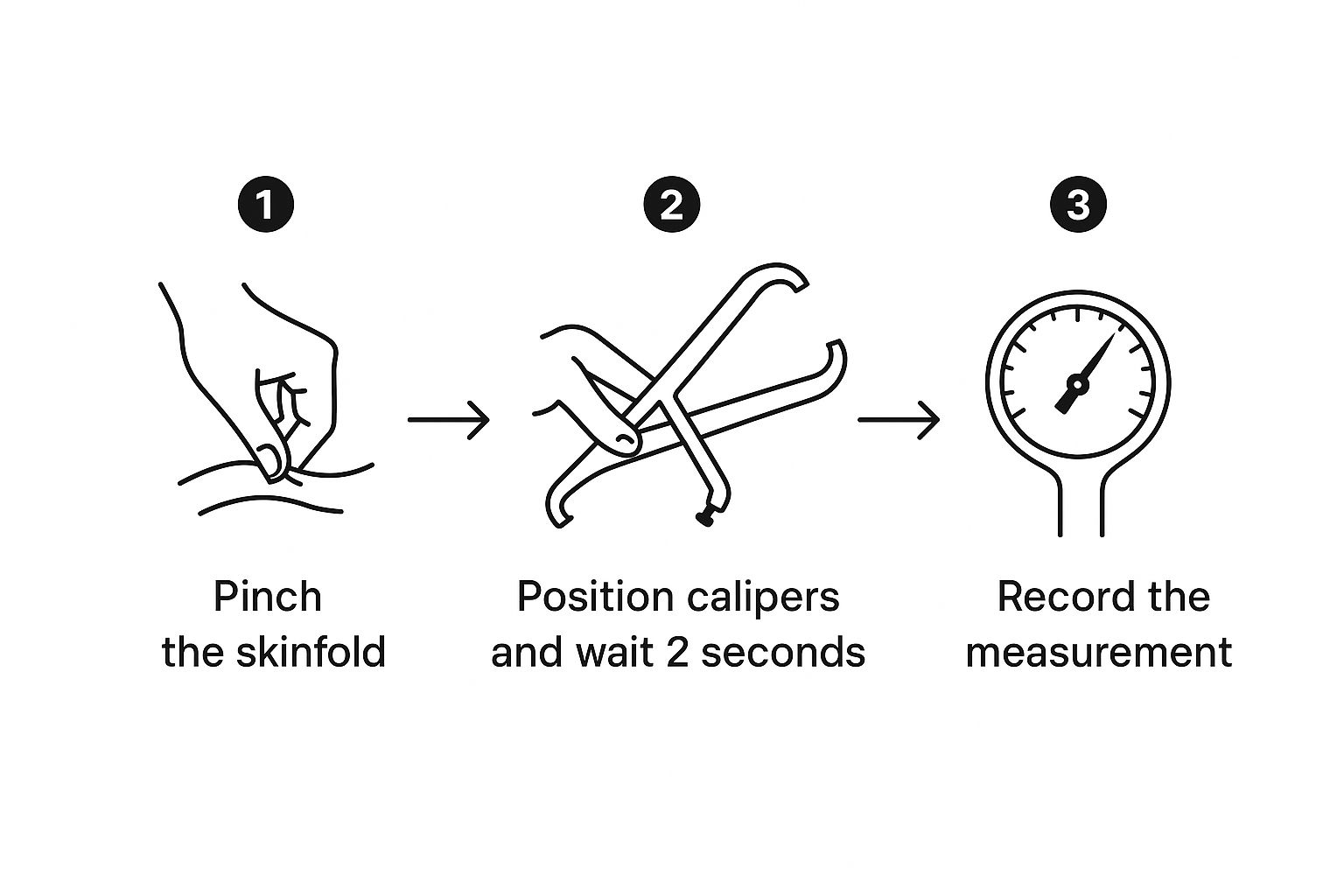
This visual really hammers home the three-step flow—pinch, place, and record—that forms the backbone of every reliable skinfold test.
Let's break that process down into formal steps:
- Identify and Mark the Site: Use a non-permanent marker to pinpoint the exact anatomical landmark. This ensures you're measuring the same spot session after session.
- Grasp the Skinfold: With your thumb and forefinger, firmly pinch a double fold of skin and subcutaneous fat roughly 1 cm above the mark you just made.
- Apply the Caliper: Place the caliper jaws directly on the marked site, keeping them perpendicular to the fold. Let go of the trigger to allow the jaws to apply full pressure.
- Wait and Read: Keep holding the pinch and wait 2-3 seconds for the reading on the dial to settle. Record the measurement to the nearest 0.5 millimeter.
- Repeat for Accuracy: Take at least two measurements at each site. If they differ by more than 1-2 mm, take a third and use the average of the three.
Here’s a mantra to live by: Same sites, same time of day, same person measuring. Sticking to this simple rule eliminates most of the variables that can throw off your data. When you do that, you can truly trust the trends you see over time, turning your skinfold calipers from a simple tool into a powerful device for tracking real progress.
How to Interpret Your Results and Track Progress
So you've pinched and measured, and now you have a handful of numbers in millimeters. That’s the easy part. The real magic happens when you translate those raw readings into a clear picture of your body composition, giving you a powerful way to see real, tangible changes over time.
Think of your caliper readings as the raw ingredients. To turn them into a body fat percentage, you need a recipe—in this case, a specific formula. Equations like the classic Jackson-Pollock or Durnin-Womersley methods use your gender, age, and the sum of your skinfold measurements to estimate your body's density. A second quick calculation then converts that density into your final body fat percentage.
But don't worry, you won't need to dust off your old algebra textbook. There are countless free online calculators that do all the heavy lifting for you. Just plug in your numbers, and you'll get an instant result, making the whole process incredibly straightforward.
Putting Your Numbers into Context
Okay, you have your body fat percentage. Now what? A single number on its own doesn't mean much without some context. What’s considered healthy or athletic varies quite a bit depending on your gender, age, and fitness goals.
The Big Picture: Your body fat percentage isn't a final grade—it's just a data point. The real power comes from tracking the trend over weeks and months. A consistent downward trend in your millimeter measurements is undeniable proof of fat loss, no matter what the bathroom scale says.
To get a general idea of where you might fall, here are some widely accepted ranges.
Body Fat Percentage Ranges for Women (by Age):
- Ages 20-39: A healthy range is typically 21-32%.
- Ages 40-59: This shifts slightly higher to 23-33%.
- Ages 60-79: It’s generally considered healthy to be in the 24-35% range.
Body Fat Percentage Ranges for Men (by Age):
- Ages 20-39: A healthy range is typically 8-19%.
- Ages 40-59: This moves up a bit to a healthy range of 11-21%.
- Ages 60-79: For this age group, a healthy range is often 13-24%.
Keep in mind, athletes often sit at the lower end or even below these numbers, while percentages above these ranges might suggest an increased risk for certain health issues.
Focus on the Trend, Not a Single Day
It’s completely natural to get hung up on one measurement, but your body is constantly in flux. Things like your hydration level, what you ate last night, and even the time of day can cause small variations in your skinfold readings. A single measurement is just a snapshot.
The best way to use your calipers is for tracking progress consistently. Pick a schedule and stick to it—say, every two weeks on a Saturday morning right after you wake up. Jot down the sum of your skinfold measurements in millimeters and the calculated body fat percentage.
When you do this over time, a clear trend will start to emerge. Is the total sum of your measurements steadily going down? That's a fantastic sign you're losing fat, even if your scale weight is being stubborn. This long-term perspective is far more accurate and motivating than obsessing over one day's result.
Common Measurement Mistakes to Avoid
Getting consistent, reliable readings from skinfold calipers is a skill. It takes a bit of practice, and even tiny, unintentional mistakes can throw your numbers way off, making a great tool feel frustratingly inaccurate. The good news is that once you know what to watch out for, you can easily refine your technique.
The single biggest mistake I see is inconsistent site selection. Think about it: if you measure your thigh one inch higher or lower than last time, the reading will naturally be different. That difference isn't a real change in body fat; it's just noise in your data that makes it impossible to see if you're actually making progress. The goal is to hit the exact same spot, every single time.
Another classic error is getting the pinch wrong. People tend to go one of two ways: either they pinch too timidly and only grab the very top layer of skin, or they go too deep and grab the muscle underneath. A proper skinfold should feel firm, separating the fat layer from the muscle without causing any real pain. You're aiming for a clean, parallel fold for the calipers to grab onto.
Refining Your Measurement Technique
To sidestep these common issues, you need to standardize your process. Just a few small tweaks to how you approach each measurement can make a world of difference.
- Mark Your Territory: This is the best trick in the book. Use a skin-safe, non-permanent marker to put a small dot on each measurement site. It might sound overly simple, but this is the single most effective way to guarantee you're measuring the exact same spot week after week. Your trend data will thank you.
- Practice the Perfect Pinch: Use your thumb and forefinger to firmly grasp a double fold of skin and the fat beneath it. Gently pull this fold away from your body—this helps ensure you haven't accidentally grabbed any muscle. The fold should be just big enough for the caliper jaws to sit comfortably in the middle.
- Mind the Clock: Don't be in a rush to read the number. Once you apply the calipers, hold them in place for a consistent 2-3 seconds before taking the reading. You’ll notice the needle or digital display drops slightly as the tissue compresses. Standardizing this brief wait time is key for getting repeatable results.
Key Takeaway: Remember, consistency trumps absolute perfection. Using the same calipers, hitting the same marked spots, and using the same technique every time is what gives you trustworthy trend data. That trend is far more valuable than any single measurement.
Controlling Environmental and Biological Factors
Beyond your technique, a few other things can mess with your skinfold readings. If you're aware of these variables, you can control for them and make your data even cleaner.
For instance, how hydrated you are can actually change the thickness of a skinfold. Measuring right after a sweaty workout when you're dehydrated will give you a different reading than when you're well-hydrated. Fluid retention can also swell the tissues and throw off your numbers.
To keep these variables in check:
- Measure at the Same Time of Day: Your body’s fluid balance shifts throughout the day. Many people find that measuring first thing in the morning, before eating or drinking anything, provides the most stable baseline.
- Avoid Post-Workout Measurements: Exercise brings more fluid to your skin and muscles, which can temporarily alter your readings. It's best to wait at least a few hours after a workout.
- Ensure Skin is Dry: Always take measurements on clean, dry skin. Any lotion or sweat can cause the caliper jaws to slip, making it tough to get a proper pinch and an accurate reading.
By steering clear of these common pitfalls, you turn your skinfold calipers from a simple gadget into a seriously precise instrument for tracking your body composition.
Maintaining Your Calipers for Reliable Readings
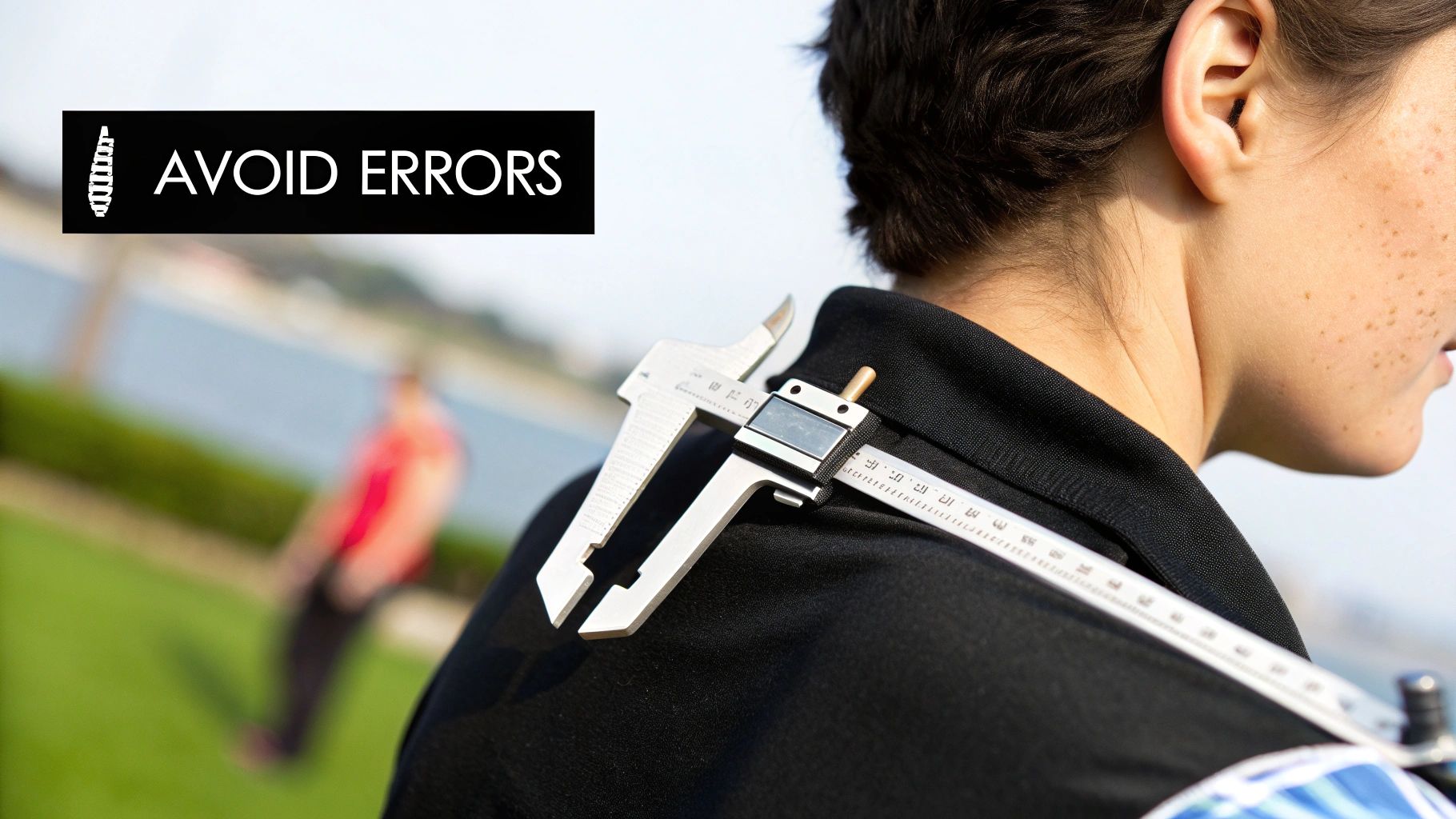
Like any precision instrument, your skinfold calipers need a little TLC to give you consistently accurate readings. Skipping basic maintenance is a bit like never tuning a guitar—sooner or later, every note will be off, and you just can't trust the music it makes. A little upkeep goes a long way in making sure your tool provides reliable data for years to come.
The single most important part of this is calibration. This is just the process of making sure your calipers are measuring against a known, correct standard. For the professional-grade metal calipers, this is non-negotiable, since their accuracy depends on applying a very specific, consistent amount of pressure every single time you take a measurement.
Simple Checks and Proper Care
The good news is you don't need a fancy lab to do some basic checks. A quick visual inspection is your first line of defense.
- The Zero Test: Gently close the caliper jaws all the way. The dial or digital screen should read exactly zero. If it's off, even by a little, every single measurement you take will be skewed from the start.
- Jaw Alignment: Check that the tips of the jaws meet perfectly flush. If there's a gap or one is slightly higher than the other, it's going to affect how the skinfold is pinched and measured.
How you store them matters, too. Always keep your calipers in their protective case. Dropping them is a surefire way to knock the delicate spring mechanism out of whack, which is what controls that all-important pressure. After you're done using them, just give the jaws a quick wipe with a soft, dry cloth to get rid of any skin oils or lotion residue.
Think of your calipers as a scientific tool, not just another piece of
gym equipment . The care you put into maintaining them directly translates into the confidence you can have in your body composition data.
This isn't just my opinion; it's standard practice. Major health organizations like the CDC follow incredibly strict protocols for this very reason. When conducting large-scale studies, they used calipers that exerted constant pressure and rigorously tested their precision daily against metal standards. You can learn more about these methodological controls to see just how seriously they take it—because proper care is what turns a simple measurement into statistically reliable data.
Got Questions About Skinfold Calipers? We've Got Answers.
Even after you've got the technique down, a few questions always pop up when you start using skinfold calipers. Let's tackle some of the most common ones head-on.
So, How Accurate Are These Things, Really?
This is the million-dollar question, isn't it? When a skilled person takes the measurements, skinfold calipers can get remarkably close to the truth, often within a 3-5% error margin compared to high-tech methods like DEXA scans. But chasing a single, "perfect" number isn't where calipers truly shine.
The real power of skinfold calipers is their consistency for tracking change over time. A DEXA scan gives you a highly precise snapshot, but for affordable and regular progress tracking week after week, calipers are king.
Can I Actually Do This on Myself?
You absolutely can, though there’s a bit of a learning curve. Measuring sites on the front of your body—think thigh, abdomen, and chest—is pretty straightforward to do on your own.
Getting to spots on your back, like the subscapular (just under the shoulder blade), is a whole different story. For the most reliable results across all measurement sites, having a practiced partner is your best bet. If you're flying solo, just focus on nailing the sites you can easily reach and track their combined total consistently.
How Often Should I Be Measuring?
Here, consistency beats frequency every single time. Your body composition doesn't shift dramatically from one day to the next, so daily measurements will only drive you crazy with minor, meaningless fluctuations.
A great rhythm for most people is to take measurements every 2 to 4 weeks. This gives your body enough time to show real, meaningful change, but it’s still frequent enough to keep you on track and motivated. Just be sure to always measure at the same time of day and under the same conditions (like first thing in the morning, before breakfast) to make sure your numbers are truly comparable.
At Cartwright Fitness, we focus on providing validated, high-precision equipment so you can get the most accurate and reliable results possible. To see our professional-grade tools for body composition analysis, take a look at our solutions at https://www.cartwrightfitness.co.uk.


