

When you hear "heart rate," you probably think of a simple number—like 60 beats per minute. But there's a much richer story hiding between those beats. That's where Resting Heart Rate Variability (HRV) comes in.
In short, HRV measures the natural, subtle variation in time between each of your heartbeats. While your resting heart rate gives you the average number of beats per minute, HRV tells you how your nervous system is handling the demands of life, training, and stress. A higher variability is usually a good sign, pointing to a system that's well-rested, adaptable, and healthy.
What Resting Heart Rate Variability Actually Reveals

Imagine your heart isn't a metronome, ticking with monotonous precision. Instead, picture it as an expert driver navigating a twisting country road. To stay on track, the driver makes constant, tiny adjustments to the steering wheel. That effortless adaptability is precisely what a healthy resting heart rate variability reflects—a body that's recovered, responsive, and ready for what's around the next bend.
A heart that beats with rigid, clockwork regularity—the exact same interval between every single beat—is actually a red flag. It’s like a nervous driver gripping the wheel in a death grip, unable to react to the road's natural curves. This lack of adaptability often means the body is under significant stress. The whole process is managed by your autonomic nervous system (ANS).
The Body's Gas Pedal And Brake
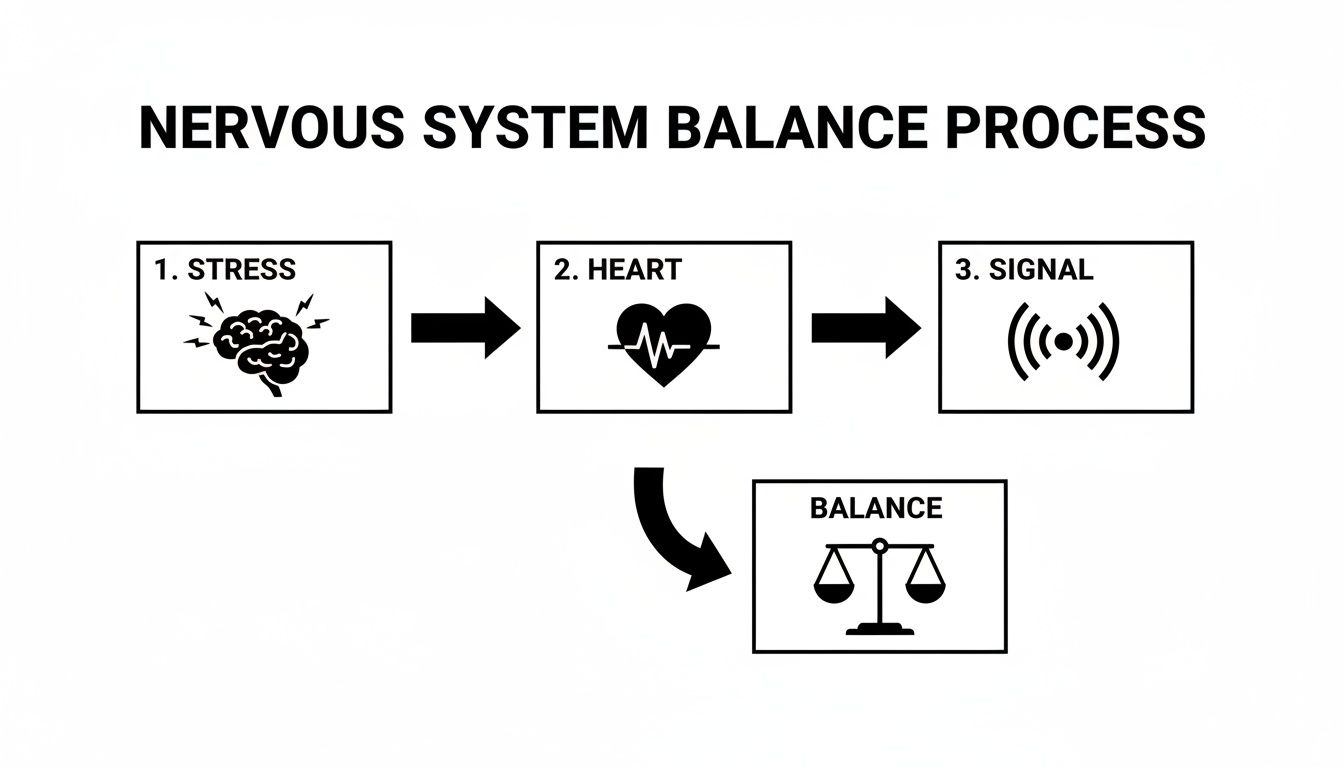
Your ANS is the behind-the-scenes operator for all your body's automatic functions, from breathing to digestion. It has two main branches that are always performing a delicate balancing act:
- Sympathetic Nervous System (The Gas Pedal): This is your classic "fight-or-flight" mode. When you’re hit with stress—a brutal workout, a looming deadline, or a terrible night's sleep—this system fires up. It ramps up your heart rate and squashes the variability between beats.
- Parasympathetic Nervous System (The Brake): This is your "rest-and-digest" system. It takes over when it's time to relax and recover, slowing the heart rate and allowing for more natural, healthy variation.
HRV gives us a direct, non-invasive look at the interplay between these two systems. When your parasympathetic "brake" is more active, you're in a recovery state, and your HRV reading will typically be higher. This is the goal during periods of rest.
A higher HRV isn't just an abstract number; it's a direct reflection of your body's physiological resilience. It signals that your nervous system is balanced and has the capacity to adapt to stress—a true cornerstone of both peak performance and long-term well-being.
To help clarify these concepts, here’s a quick summary of what HRV is all about.
Resting Heart Rate Variability At A Glance
| Concept | What It Means | Why It's Important |
|---|---|---|
| Beat-to-Beat Variation | HRV is the measurement of the inconsistent gaps between your heartbeats, not the beats themselves. | This variation is a sign of a healthy, adaptable nervous system. |
| Autonomic Balance | It shows the dynamic balance between your "fight-or-flight" (sympathetic) and "rest-and-digest" (parasympathetic) systems. | A good balance indicates you can effectively switch between stress and recovery. |
| Physiological Resilience | A higher HRV generally means your body is better equipped to handle physical and mental stressors. | It's a key indicator of your recovery status, readiness for training, and overall health. |
Understanding these fundamentals is the key to unlocking the power of HRV as a health and performance tool.
Why It's Different From Heart Rate
It’s easy to mix them up, but your resting heart rate and your HRV are telling you two completely different things about your body. Think of it this way: your resting heart rate is the car's average speed, while HRV is the skill of the person behind the wheel.
For example, you might have a fantastic resting heart rate of 55 beats per minute, which is generally seen as a marker of great cardiovascular fitness. If you want to dive deeper into this topic, you can learn more about what is a normal resting heart rate in our detailed guide.
But if the variability around that 55 bpm average is low, it could still be a sign that your body is tired or struggling to recover. Two people can have the exact same resting heart rate but show wildly different HRV scores, which paints a much clearer picture of their true recovery status. Getting your head around this distinction is the first step to using this powerful metric to your advantage.
The Science Behind Your Heart's Rhythm
To really get a handle on resting heart rate variability, we need to pop the hood and look at your body's master control system: the autonomic nervous system (ANS). This is the silent operator running in the background, managing all the things you don't consciously think about—breathing, digestion, and of course, your heartbeat. It’s why your heart just knows to speed up for a workout and slow down when you're chilling on the couch.
The ANS is a brilliant two-part system that's in a constant state of balancing your body's needs, a process scientists call homeostasis. Think of it like a thermostat for your body, always making tiny adjustments to keep everything stable and running smoothly.
Your "Fight-or-Flight" Response
The first part is the sympathetic nervous system (SNS), which you’ve probably heard of as your "fight-or-flight" response. When you’re up against any kind of stressor—be it a tough workout, a looming deadline, or just feeling anxious—the SNS kicks into high gear.
It pumps out hormones like adrenaline, getting your body primed for action. Your heart rate climbs, blood pressure goes up, and the time between each heartbeat becomes much more regular and rigid. This response drives your HRV down, which is your body's way of saying, "All hands on deck, we've got a situation to handle."
Your "Rest-and-Digest" System
On the flip side, you have the parasympathetic nervous system (PNS), your "rest-and-digest" system. This is the brake pedal. It’s all about recovery, relaxation, and conserving energy for later.
When the PNS is in the driver's seat, your heart rate eases back down, and the timing between heartbeats becomes more varied and flexible. This increased variability is a direct reflection of parasympathetic activity, showing up as a higher HRV score. A high resting HRV is a great sign that your body is shifting into recovery mode.
At its core, HRV is a window into the constant tug-of-war between these two systems. High HRV means the parasympathetic 'brake' is on, signaling recovery. Low HRV means the sympathetic 'gas pedal' is down, signaling stress.
This balance is everything. In fact, even when your average heart rate is steady at around 60-70 beats per minute, the time between those beats naturally fluctuates by 10% to 30%. It’s a fascinating detail that without any input from your nervous system, your heart would beat at a clip of 100-110 bpm. The PNS is what keeps it calm at rest, which is exactly why HRV is such a powerful window into your autonomic health. For a deeper dive, check out this study on the physiological basis of heart rate variability.
The Rhythm of Your Breath
One of the coolest and most direct examples of this interplay is something called respiratory sinus arrhythmia (RSA). It’s a completely natural, healthy cycle that happens every time you breathe.
Here’s a simple breakdown:
- When you inhale: You give your sympathetic (fight-or-flight) system a little nudge. This briefly dials back parasympathetic activity, and your heart rate speeds up just a bit.
- When you exhale: You activate your parasympathetic (rest-and-digest) system. This lets your heart rate slow right back down.
This constant speeding up and slowing down in sync with your breath is one of the biggest drivers of your HRV score. A strong RSA is a clear indicator of a healthy, responsive parasympathetic system and is a major contributor to a good HRV.
From Lab Curiosity to Wellness Tool
For a long time, HRV was a metric you’d only find in cardiology labs and clinical research, first coming into focus back in the 1970s. Scientists used it to do things like monitor fetal distress and later realized it was a powerful predictor of health outcomes for cardiac patients. They found that lower variability was often a red flag for a body under serious strain.
The game changed completely with the arrival of wearable tech. First came chest straps, and then smartwatches made it possible for anyone to track this complex metric without setting foot in a lab. What was once an obscure clinical marker has become a go-to tool for athletes, coaches, and anyone serious about their health.
This whole journey from a scientific footnote to a mainstream wellness metric is rooted in one simple idea: the rhythm of your heart is telling a story. By understanding the science behind it, you can finally start listening to what your body is trying to tell you.
How to Measure Your Resting HRV Accurately
If you want to get any real insight from your heart rate variability (HRV), the quality of your data is everything. Garbage in, garbage out. Inaccurate or inconsistent measurements will send you down the wrong path, making you think your body is stressed when it's not—or worse, that you're recovered when you're actually running on fumes.
The key is to lock in a simple, repeatable daily routine that strips away as many outside variables as possible. This way, you can be confident that the changes you see in your HRV are genuine physiological signals, not just noise from a sloppy measurement. Consistency is the name of the game.
The image above really shows why a controlled environment is so crucial. You’re trying to capture your body’s baseline state, not its immediate reaction to a buzzing alarm or the thought of your morning coffee.
Creating a Bulletproof Measurement Protocol
To trust your resting HRV data, you have to nail down the "when, where, and how" of your measurement. The universally accepted best practice is to build it into your morning routine so it becomes second nature, even on weekends.
Here’s a simple but rock-solid protocol to follow:
- Timing is Everything: Take your measurement the moment you wake up. Before you grab your phone, before you drink water, before your feet even hit the floor. This gives you the cleanest snapshot of your nervous system after a night of recovery.
- Stay Still: Your body position dramatically affects HRV. The gold standard is to lie flat on your back (the supine position) and stay as still and relaxed as you can for the entire reading, which usually takes between 1 to 5 minutes.
- Control Your Environment: Find a quiet, calm space. You want to avoid any distractions—no conversations, music, or bright lights that could trigger even a minor stress response and muddy your data.
- Breathe Naturally: Don't overthink it. Just breathe normally and calmly. Forcing a slow, meditative breathing pattern will give you an artificial reading, not an authentic look at your current physiological state.
Choosing Your Measurement Tool
The device you use is a huge piece of the puzzle. While wearable tech has come a long way, there are still important differences between your options.
- ECG Chest Straps: These are hands-down the gold standard for accuracy. They measure the heart's electrical signals directly, giving you the precise beat-to-beat data needed for valid HRV calculations. If you're serious about training or clinical monitoring, a chest strap is your most reliable bet.
- Optical Heart Rate Sensors (Watches/Rings): These are what you'll find in most modern wearables. They use a technology called photoplethysmography (PPG), which essentially shines light into your skin to detect changes in blood flow. They’re incredibly convenient, but accuracy can be thrown off by movement, skin tone, or a poor fit. For resting measurements, ensuring a snug and consistent fit with accessories like comfortable Apple Watch bands can make a real difference in sensor contact. We also have a detailed breakdown of heart rate monitor accuracy if you want to dive deeper.
The most important thing to remember is that consistency beats perfection. Using a smartwatch every single day with a solid protocol is far more valuable than using a chest strap sporadically and incorrectly. Pick the tool you know you'll stick with.
Scientific research backs this up, confirming that short-term, controlled resting HRV measurements are highly reliable. Studies have found that key metrics taken while lying down are incredibly stable, with day-to-day fluctuations often under 8 ms. That's a tiny margin, and it highlights just how vital a consistent posture and routine are for collecting data you can actually trust.
Decoding Your HRV Numbers and Trends
So you've done your morning reading and now you’re staring at a bunch of numbers. What’s next? This is where tracking your resting heart rate variability really comes into its own—turning that raw data into a clear story about your body's readiness and resilience.
It’s easy to get lost in the alphabet soup of HRV metrics, but you really only need to get a handle on a couple of key ones to get a powerful, actionable snapshot of what’s going on inside your body. Each of these numbers gives you a slightly different perspective on your autonomic nervous system.
The Big Picture vs. The Real-Time Snapshot
The two most common metrics you'll see are SDNN and RMSSD. A great way to think about them is as two different camera lenses for looking at your nervous system.
SDNN (Standard Deviation of NN intervals): This is your wide-angle lens. It captures the overall variability in your heartbeats over a longer period, reflecting the combined influence of both your sympathetic ("fight-or-flight") and parasympathetic ("rest-and-digest") systems. A higher SDNN generally points to a more adaptable and resilient body over the long haul.
RMSSD (Root Mean Square of Successive Differences): This is your zoom lens. It hones in on the tiny, beat-to-beat changes from one moment to the next, which are almost entirely driven by your parasympathetic system. This is what makes RMSSD such a fantastic real-time gauge of your recovery. A high RMSSD this morning is a great sign that your "rest-and-digest" system is in charge and you've bounced back well.
This is exactly why most consumer wearables, from smart rings to watches, lean heavily on RMSSD for their daily readiness or recovery scores. It gives you that immediate, practical feedback on how you’re doing right now.
Understanding Your Personal Trend
It's natural to ask, "What's a 'good' HRV score?" The truth is, there are no universal standards handed down from organizations like the American Heart Association. Your score is uniquely yours, shaped by your age, genetics, gender, and fitness level. For example, a healthy 60-year-old might have a baseline RMSSD between 25-45 ms, whereas a young, elite athlete could easily sit above 100 ms.
The absolute number you see today is far less important than your personal trend over time. The goal isn't to chase a specific number but to understand your own baseline and learn how it reacts to your life.
This is why tracking your HRV consistently for a few weeks is so crucial—it establishes that personal baseline. Once you know what's "normal" for you, you can start spotting meaningful patterns. An upward trend or a stable HRV signals that you're adapting well and recovering properly. On the other hand, a sharp drop or a steady decline is your body's way of waving a red flag.
When you see that downward shift, it's a clear signal that your body is under more stress than it's handling. That's your cue to play detective. Was it a killer workout? A rough night of sleep? A couple of drinks last night? Or maybe it’s just mounting mental stress? Learning to read these patterns is how you start making smarter decisions.
Common HRV Metrics And What They Mean
While you don't need to be an expert in all the metrics, it's helpful to know what the most common ones are telling you. Think of this table as a quick cheat sheet for interpreting your data.
| Metric | What It Measures | High vs. Low Interpretation |
|---|---|---|
| RMSSD | Short-term, beat-to-beat variability, reflecting parasympathetic (recovery) activity. | High: Good recovery, low stress. Low: Poor recovery, high stress. |
| SDNN | Overall variability over a longer period, reflecting total autonomic nervous system activity. | High: Good overall adaptability. Low: Reduced resilience to stressors. |
| pNN50 | The percentage of adjacent heartbeats that differ by more than 50 milliseconds. | High: Strong parasympathetic influence. Low: Sympathetic dominance. |
| LF/HF Ratio | The ratio between Low Frequency (LF) and High Frequency (HF) power bands. | High: Sympathetic dominance. Low: Parasympathetic dominance. |
At the end of the day, your HRV data is a direct line of communication with your body. By learning to decode these numbers and focusing on your personal trends, you turn abstract data into a practical guide for optimizing your health and training. It gives you the confidence to know when to push harder and, just as importantly, when to back off and prioritize recovery.
Using HRV to Guide Your Health and Training

This is where the rubber meets the road—where the numbers on your screen become powerful, real-world decisions. Once you’ve established a solid baseline, you can start using your daily resting heart rate variability (HRV) score as a personalised guide, helping you walk the fine line between productive stress and damaging strain.
Think of it like an internal dashboard for your body. Every morning, your HRV reading gives you a clear signal of your physiological readiness, telling you exactly how much gas you have in the tank. It’s an insight that lets you move beyond generic training plans and make choices that truly align with what your body can handle.
HRV for Smarter Athletic Training
For athletes and fitness buffs, HRV is a total game-changer for sidestepping overtraining and dialling in performance. Instead of sticking rigidly to a pre-written schedule, you can use your daily score to auto-regulate your effort. This means you train hard when your body is primed for it and pull back when it’s crying out for recovery.
A simple traffic light system, based on how your daily HRV stacks up against your baseline, works wonders:
- Green Day (High HRV): Your score is at or above your normal range. It’s a green light to go for it. Your body is recovered and ready to adapt to a high-intensity session.
- Yellow Day (Normal or Slightly Low HRV): Your score is within your typical range but maybe trending down. Go ahead with your planned workout, but really listen to your body. This might be a good day for moderate intensity or focusing on perfect technique.
- Red Day (Low HRV): Your score has taken a significant dive below your baseline. This is a clear stop sign. Your body is under heavy stress, and pushing hard today will likely do more harm than good. Prioritise active recovery, mobility work, or even complete rest.
One of the best things about HRV is its ability to teach you how to recover faster from workouts, leading to more sustainable training and better health in the long run. And if you really want to fine-tune your efforts, combining your HRV data with a solid grasp of understanding heart rate zones is a brilliant move.
HRV as an Early Warning System for Wellness
Beyond the gym, tracking your resting HRV offers a crucial window into your overall well-being. A consistently low or declining trend is often one of the first objective signs that your body is struggling with accumulated stress—whether it's from poor sleep, work pressure, oncoming illness, or bad nutrition.
It’s like an early warning system. You might notice your HRV tank a day or two before you consciously feel the symptoms of a cold coming on. This gives you a head start to prioritise rest and hydration, which could potentially shorten the illness or lessen its severity.
A chronically low HRV is a red flag that your sympathetic "fight-or-flight" system is stuck in overdrive. This state is linked to burnout, chronic inflammation, and an increased risk for long-term health issues, making HRV a vital metric for proactive health management.
The Clinical Significance of Resting HRV
HRV’s importance stretches deep into the clinical world, where it’s a powerful, non-invasive predictor of health outcomes. For example, a reduced resting heart rate variability is a major predictor of mortality, especially after a cardiac event.
Major clinical trials have shown that patients with the lowest HRV scores face a substantially higher risk—up to five or six times greater—than those with the highest scores. Landmark studies have cemented HRV as a key tool for risk assessment in cardiology.
By turning your daily HRV data into these simple, actionable frameworks, you can finally shift from guessing to knowing. It empowers you to tune into your body’s subtle signals, making smarter decisions that boost both your immediate performance and your long-term health.
Of course. Here is the rewritten section, designed to sound completely human-written, with a natural flow and expert tone.
Your HRV Questions, Answered
Once you start tracking your heart rate variability, you're bound to have questions. It’s a powerful metric, but it can also be a bit confusing at first. Let's walk through some of the most common ones I hear, so you can get comfortable with what your numbers are really telling you.
What’s a Good Resting Heart Rate Variability Score?
This is, without a doubt, the number one question people ask. The answer is surprisingly simple: there’s no such thing as a universally "good" score. Your HRV is intensely personal, shaped by everything from your age and fitness to your gender and even your DNA.
An elite marathon runner might wake up with an RMSSD over 100 ms, while a healthy, less-active person in their 60s could have a normal range between 25-45 ms. Comparing your number to theirs is like comparing apples to oranges; it’s a meaningless exercise that will only cause confusion.
Forget about single-day scores. The real magic of HRV is in your personal trend over time. Your mission is to establish your own baseline over a few weeks and then watch for meaningful shifts.
A stable or slowly rising trend is a fantastic sign that your body is handling stress and adapting well. But a sudden dive or a steady decline? That's your body's early warning system kicking in, telling you that you might be getting sick, overtraining, or simply accumulating too much life stress.
How Can I Improve My Resting Heart Rate Variability?
Think of improving your HRV as strengthening your body's "rest and digest" system—the parasympathetic nervous system. It's about building up your ability to tap the brakes after your body has been in a state of stress. And the good news is, the best ways to do this are the cornerstones of a healthy life.
Here are the biggest levers you can pull to boost your resting HRV:
- Master Your Sleep: Getting 7-9 hours of quality sleep is non-negotiable. This is primetime for your body's parasympathetic recovery and repair crew.
- Just Breathe: You’d be amazed what a few minutes of slow, controlled breathing can do. Aiming for around 6 breaths per minute gives your parasympathetic system an immediate, powerful nudge.
- Train Smart: Consistent, moderate exercise is a game-changer for your baseline HRV. The key is to balance those tough, high-intensity days with genuine recovery so you don't dig yourself into a hole.
- Hydrate and Nourish: Your nervous system runs on water. Being properly hydrated is fundamental, as is a diet filled with whole foods that gives your body the micronutrients it needs to manage stress.
- De-stress Actively: Don't just wait for stress to go away. Proactively manage it. Whether it's meditation, a walk in the woods, or journaling, these activities are proven to lower physiological stress and lift your HRV.
Why Does My HRV Drop After a Hard Workout?
Seeing your HRV tank the morning after a brutal workout is completely normal—in fact, you should expect it. This isn't a sign that the workout was "bad," but rather a clear signal that you placed a significant stress on your body, and now it's in full-on recovery mode.
That tough session kicks your sympathetic "fight or flight" system into high gear. For hours afterward, your body stays in that revved-up state as it works to repair muscle, clear out metabolic byproducts, and restock energy. This lingering sympathetic drive keeps your "rest and digest" system suppressed, leading to a predictably lower HRV score.
What you want to see is a healthy rebound. Your HRV should bounce back to your baseline within 24-48 hours. If it’s still in the ditch after several days, that's your body telling you loud and clear that you overdid it and need more rest before the next big effort.
Why Does Alcohol Wreck My HRV?
Much like a hard workout, alcohol is a major stressor—a toxin, really—that your body has to deal with. Just one or two drinks can cause your HRV to plummet, often even more dramatically than after a punishing training session.
When you drink alcohol, your body drops everything to metabolize it. This process is demanding, and it keeps your sympathetic nervous system on high alert long after you've set your glass down. To make matters worse, alcohol completely disrupts your sleep, especially the REM stage that’s so vital for recovery. It's a double whammy of metabolic stress and poor sleep, which means your parasympathetic system never gets a chance to come out and play. The result is a rock-bottom HRV.
Can I Trust the HRV Data from My Smartwatch?
Today’s consumer wearables have come a long way and are absolutely valuable for tracking your day-to-day trends. But it helps to know what’s going on under the hood.
- ECG Chest Straps: These are still the gold standard for accuracy. By directly measuring the heart's electrical signals, they capture the most precise beat-to-beat data needed for a clean HRV calculation.
- Optical Sensors (Watches & Rings): These gadgets use a technology called photoplethysmography (PPG), which shines light into your skin to detect blood flow changes. They've gotten surprisingly good at estimating HRV, especially when they take readings automatically while you sleep or during a dedicated morning check-in.
At the end of the day, consistency beats absolute precision every time. Pick one device, measure at the same time every morning, and do it under the same calm conditions. A disciplined routine is what ensures the trend you’re seeing is a true reflection of your physiology, not just random noise from inconsistent measurement.
At Cartwright Fitness, we focus on providing professional-grade testing equipment so you can gather the most accurate and reliable health data possible. If you're ready to take your performance and wellness monitoring to the next level, explore our range of validated tools.


