

You're probably in one of two situations right now. Either your clinic or gym already offers some form of recovery service and the kit is starting to look inconsistent, consumer-grade, or hard to defend when a serious client asks why you chose it. Or you're planning a larger upgrade and you've realised that the UK market is crowded with products that sound impressive but don't always hold up under clinical use, repeated cleaning, staff turnover, and servicing reality.
That's where most buying mistakes happen. Managers compare features, not workflows. They look at headline device functions, but not whether the unit fits their treatment model, whether consumables are easy to source in the UK, whether the warranty is enforceable locally, or whether the equipment will still be used properly six months after installation.
In recovery equipment uk procurement, the smartest buyers don't start with gadgets. They start with patient profile, staff competence, environment, and service model. Then they match equipment to actual demand, operational burden, and evidence standard.
Table of Contents
- Navigating the Modern Recovery Technology Market
- A Professional's Guide to Recovery Equipment Categories
- Matching Recovery Technology to Your Environment
- Evaluating Specs and Clinical Validation
- The Logistics of Procurement in the UK
- Budgeting and Calculating Your Return on Investment
- Making a Confident and Strategic Equipment Choice
Navigating the Modern Recovery Technology Market
The volume of choice has changed. Recovery tools that used to sit mostly in elite sport or specialist rehab are now common across private physio clinics, performance gyms, university labs, and hybrid wellness spaces. That sounds positive, but it also means buyers have to work harder to distinguish clinically useful equipment from polished consumer hardware.

That shift matters because capital spend in this category isn't marginal anymore. The UK physiotherapy equipment market is projected to grow from USD 898.60 million in 2023 to USD 1,899.74 million by 2032, at a CAGR of 8.29% according to UK physiotherapy equipment market projections. For clinic owners and facility managers, that tells you two things. Demand is expanding, and so is the number of suppliers trying to win your budget.
What buyers usually get wrong
The first mistake is buying for appearance. A recovery chair, compression unit, or contrast setup may look impressive on a tour, but if it's awkward to clean, hard to move, noisy in use, or dependent on expensive proprietary parts, staff will avoid it.
The second mistake is buying too low in the market. Cheap devices often perform acceptably in a home setting and fail quickly in a commercial one. Repeated daily use changes everything. Upholstery, seals, cables, batteries, connectors, and controls all get tested harder in practice than they do in a showroom demo.
Practical rule: If a device only makes sense when a specific staff member is present, it's probably too fragile or too complicated for routine service delivery.
What a strategic purchase looks like
A sound recovery equipment uk plan usually follows a clear order:
- Define the service case: post-op rehab, general member recovery, athlete monitoring, or mobile support.
- Decide the evidence threshold: wellness convenience is one standard, clinical application is another.
- Check the operating burden: cleaning, setup time, storage footprint, staff training, and replacement parts.
- Review UK support: delivery, warranty, servicing, consumables, and downtime procedures.
Experienced buyers gain an edge through their approach. They don't ask, “What does this machine do?” They ask, “Who will use it, how often, under what supervision, and what happens when it fails on a full clinic day?”
A Professional's Guide to Recovery Equipment Categories
Not every recovery tool solves the same problem. Some target circulation and swelling. Some support pain management. Others help tissue loading, neuromuscular activation, or simple compliance with a home programme. If you buy across categories without being clear on mechanism, you end up with overlap instead of coverage.
What belongs in a serious recovery setup
Pneumatic compression systems are usually chosen when you want structured external pressure and a repeatable recovery session. In practice, they suit post-session lower limb recovery, swelling management strategies, and facilities that want a passive modality clients can tolerate easily. The trade-off is storage space, garment sizing, and the need to keep liners and sleeves in good condition.
Cryotherapy units and cold application systems work when temperature control matters more than improvisation. A proper cold therapy unit is easier to standardise than a bag of ice and towels, especially in post-exercise or post-procedure settings. The limitation is workflow. Cold-based systems need clear protocols, supervision standards, and patient screening, otherwise they become an underused corner purchase.
Percussive therapy devices are common because they're portable and easy for staff to learn. They can help with short-duration soft tissue preparation or recovery routines, but they're frequently overbought. Many sites end up with several handheld devices doing the same job as one well-managed unit plus better exercise programming.
Electrotherapy devices such as TENS and NMES belong in a different decision category. They're not “nice to have massage tech.” They're intervention tools. TENS is usually considered for pain management contexts. NMES is more relevant where muscle activation and rehab progression are part of the service model. These units require staff who understand electrode placement, contraindications, and documentation.
Advanced rollers and vibration tools fill the gap between self-management and guided recovery. They can work well in gym floors, athlete warm-down spaces, and semi-supervised rehab areas. Their strength is accessibility. Their weakness is that they often get treated as a complete recovery strategy when they're only one component.
A parallel point worth making is that equipment rarely works in isolation. Recovery outcomes depend on session design, education, load management, and basics like sleep and nutrition. For teams building a broader support offer, resources on best supplements for exercise recovery can help frame where nutritional support sits alongside hardware rather than replacing it.
Recovery equipment categories compared
| Equipment Type | Primary Mechanism | Best For… | Ideal Environment | Typical UK Price Range (£) |
|---|---|---|---|---|
| Pneumatic compression systems | External sequential pressure | Lower-limb recovery, swelling-focused protocols, passive recovery stations | Sports clinics, recovery lounges, performance facilities | £££ to ££££ |
| Cryotherapy units | Controlled cold exposure | Post-exercise recovery workflows, selected rehab settings | Clinics, sports environments, dedicated treatment spaces | ££ to ££££ |
| Percussive therapy devices | Rapid mechanical stimulation | Soft tissue preparation, short-duration recovery work | Gyms, treatment rooms, mobile practice | £ to ££ |
| TENS and NMES units | Electrical stimulation for pain modulation or muscle activation | Rehab pathways, activation work, pain-management support | Physiotherapy clinics, rehab departments | £ to £££ |
| Rollers and vibration tools | Pressure, oscillation, self-myofascial work | General recovery access, warm-up and cool-down support | Gyms, studios, team environments | £ to ££ |
What works versus what doesn't
A category works when it matches the decision environment. Compression can be excellent in a structured athlete recovery room and awkward in a cramped clinic with no storage. NMES can be valuable in a post-injury pathway and pointless in a gym that has no staff trained to use it correctly.
Buy fewer categories well rather than buying every category badly.
That often means choosing one flagship modality, one versatile support category, and one low-friction option for broad member use. The worst setup is usually the one with six different tools, no protocol, and no one clearly responsible for upkeep.
Matching Recovery Technology to Your Environment
A product that makes sense in a private clinic can be a poor fit in a commercial gym. The reverse is also true. Good purchasing starts with the setting, because environment dictates how durable, portable, supervised, and repeatable the equipment needs to be.

Clinical physiotherapy practice
In a clinical practice, recovery kit has to stand up to documentation and treatment planning. The useful question isn't whether a device is popular. It's whether it supports a defined phase of care. For example, a clinic handling post-surgical patients may get more value from electrotherapy and controlled cold application than from a wall of massage devices.
Clinics also need equipment that behaves predictably. Controls should be simple. Surfaces should clean easily. Accessories should be replaceable without long delays. If your team has mixed experience levels, complicated interfaces create inconsistency fast.
A useful benchmark is whether the tool helps the clinician progress or regress treatment logically. If it doesn't change decision-making, it's probably decorative.
Sports performance facility or gym
Performance settings usually need faster turnover and broader appeal. The equipment has to be easy to explain, durable enough for repeated use, and attractive to members without becoming a liability. Compression stations, mobility tools, and managed cold recovery setups often work well because they fit pre-session and post-session routines.
This is also where buying adjacent resources can matter. If you're considering a cold recovery area, it helps to compare how athletes use these systems in practice. A guide to ice baths for athletes is useful for deciding whether a dedicated cold setup suits your member profile or whether a simpler workflow would be easier to maintain.
Mobile coaching and off-site testing
Mobile practitioners face a different problem entirely. The equipment has to travel, survive transport, and remain safe to use outside controlled indoor spaces. A lightweight percussive device, compact bands, a folding step platform, and a small first-aid and cleaning kit may be far more valuable than bulkier technology.
That matters because there's a documented gap in guidance on portable recovery equipment and safety protocols for mobile fitness professionals near roadsides or remote sites, as outlined in UK guidance on equipment safety standards for recovery operators. In practical terms, many mobile professionals carry assessment tools but overlook visibility, spill management, and safe setup procedures.
For off-site work, I'd prioritise the following before adding another gadget:
- High-visibility basics: PPE that suits low-light or roadside-adjacent setups.
- Portable treatment logic: Devices that work quickly without complex assembly.
- Protective storage: Cases that stop cables, screens, and attachments being damaged in transit.
- Cleaning materials: Wipes, liners, and containment for sweat-heavy or shared-use sessions.
A portable service isn't portable if setup risk, missing accessories, or transport damage keeps cancelling sessions.
Evaluating Specs and Clinical Validation
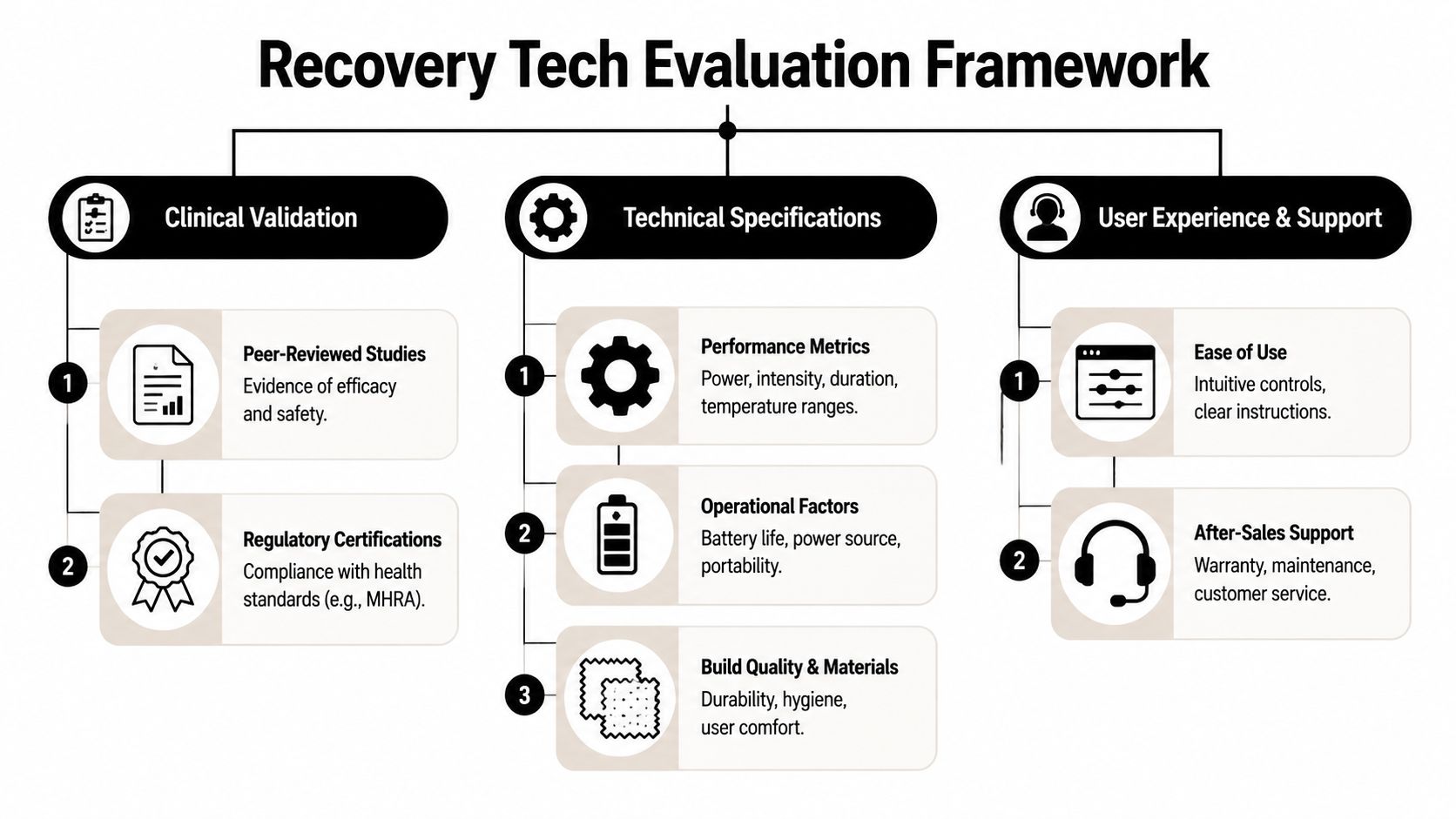
This is the point where serious buyers separate professional equipment from attractive retail stock. A device can look sturdy, claim advanced performance, and still be poorly suited to clinical or commercial use. Specification review needs to go deeper than brochure language.
What good specification review looks like
Start with the operational basics. Can the unit hold its settings consistently? Are controls clear enough that two staff members would run the same protocol the same way? Are pads, cuffs, probes, sleeves, or attachments available without a long special-order delay?
Then assess what matters by category:
- Compression systems: pressure adjustability, garment options, cycle customisation, connector durability, cleaning method.
- Cryotherapy equipment: temperature stability, fill and drain practicality, insulation quality, cleaning access, noise profile.
- Percussive devices: amplitude, speed control, ergonomics, battery swap or charging workflow, attachment durability.
- TENS and NMES units: channel options, programme flexibility, lead quality, electrode compatibility, interface clarity.
- Rollers and vibration tools: motor consistency, material durability, weight-bearing tolerance, surface grip, charging reliability.
If you also run assessment-led services, apply the same standard to every measurement device in the building. A vague reading is no use in rehab review. That's why it helps to understand the difference between consumer-facing body metrics and higher-grade measurement methods. A practical reference is this DEXA scan and body fat accuracy guide, which is useful when deciding how much precision your service needs.
How to separate validation from marketing
Clinical validation isn't a logo and it isn't a testimonial. It's a combination of appropriate certification, coherent design, and evidence that the equipment performs as intended in the hands of real users.
Ask suppliers direct questions:
- What is the intended use? Clinical rehab, general wellness, or consumer self-care?
- What regulatory status applies? Don't assume every recovery device is positioned the same way.
- What does support look like in the UK? Manuals, training, maintenance, replacement parts.
- What user training is required? If training is essential, is it included and documented?
For organisations that also buy monitoring and testing systems, the same discipline applies. Comparing recovery hardware against the standards used in health monitoring devices for professional settings can sharpen your purchasing criteria, especially around accuracy, repeatability, and support.
If a supplier can explain features but not limitations, treat that as a warning sign.
The strongest products usually come with ordinary, specific answers. Not grand promises. Just clear statements on what the device does well, where it fits, and where it doesn't.
The Logistics of Procurement in the UK
Many disappointing purchases aren't caused by poor equipment choice. They're caused by poor procurement decisions. The product looked right. The commercial pathway wasn't.

Buying direct versus buying through a UK supplier
Buying direct from an overseas manufacturer can work when the product is simple, low risk, and unlikely to need technical support. It can also reduce your control over delivery timing, warranty claims, and parts availability. For higher-value recovery equipment uk purchases, that trade-off often isn't worth it.
A UK-based distributor usually gives you fewer surprises. Communication is easier. Invoices align with domestic accounting processes. Support tends to be more practical because the supplier understands local expectations around servicing, training, and replacement lead times. Where validated testing or rehab-adjacent equipment is involved, buyers should also understand how suppliers handle quality processes, which is why medical device quality assurance is worth reviewing before signing off a larger order.
The hidden costs that catch buyers out
Procurement teams often compare unit price and stop there. That's not enough. The actual cost sits across several layers:
- Import exposure: duties, VAT handling, customs delays, and admin burden.
- Operational readiness: installation needs, staff induction time, storage changes, electrical compatibility.
- Consumables and wear items: electrodes, sleeves, liners, cables, straps, seals, and cleaning products.
- Downtime risk: what happens when a critical unit fails during a booked service day.
The smartest procurement file I see is usually the simplest one. It includes a supplier quote, delivery assumptions, warranty terms in plain English, expected consumables, service contacts, and a realistic downtime plan.
A practical UK procurement checklist
Before approving a purchase, ask for the following in writing:
- Lead time for delivery to your site.
- Warranty scope and who honours it in the UK.
- Availability of spare parts and consumables.
- User training options for your staff.
- Service route if the equipment develops a fault.
- Cleaning guidance suited to your clinical or gym environment.
Cartwright Fitness is one example of a UK supplier that handles validated health and fitness testing equipment with local shipping and support, which can matter when your recovery setup also depends on related assessment tools such as step-test platforms, metabolic systems, or body composition devices. That doesn't make every purchase local by default. It means support access should carry real weight in your decision.
Procurement isn't finished when the box arrives. It's finished when the equipment is in service, staff can use it correctly, and a fault can be resolved without derailing your week.
Budgeting and Calculating Your Return on Investment
Recovery equipment rarely justifies itself on enthusiasm alone. It has to earn its place in the business. That means tying spend to service capacity, pricing logic, retention, and operational quality rather than assuming clients will value it because it looks advanced.
Build the business case from service design
Start with the commercial role of the equipment. Is it there to support clinical outcomes, create a premium recovery service, improve member experience, or strengthen your assessment-to-intervention pathway? Those are different business cases, and each should be costed differently.
If you're building a business case in the current UK environment, it helps to note wider confidence in facility and infrastructure investment. In a related sector, UK retail sales of construction and earthmoving equipment rose 17% in Q2 2024 from Q1, exceeding long-term averages, according to UK construction equipment sales data. That doesn't prove your recovery room will pay for itself. It does suggest that organisations are still putting capital into physical environments where services are delivered.
A good budget case usually includes four lines of value:
- Direct revenue: paid recovery sessions, rehab add-ons, athlete support packages.
- Retention support: better continuity for members, patients, and team clients.
- Operational efficiency: smoother delivery, less improvisation, more consistent protocols.
- Brand positioning: a more credible service mix for referrals and high-value clients.
A practical ROI framework
Keep the calculation plain. You don't need invented multipliers to justify a purchase.
Use a simple structure:
ROI = value created over a defined period minus total cost of ownership
For recovery equipment uk buying, total cost of ownership should include:
- Purchase price
- Delivery and setup
- Consumables
- Staff training time
- Maintenance or replacement parts
- Lost revenue risk during downtime
Then estimate value created by asking:
- Will this let us charge for a new service?
- Will it improve conversion from assessment to treatment plan?
- Will staff use it enough to justify the floor space?
- Will it replace lower-quality kit that causes inconsistency or complaints?
A hypothetical example is enough for internal approval. If one compression system supports a paid recovery block, reduces scheduling friction, and becomes part of a premium athlete package, that's a different proposition from a percussive device that sits in a drawer and gets used only when a confident therapist remembers it's there.
The strongest investments usually share three traits. They fit the core client base, staff can apply them with confidence, and servicing won't become a recurring headache.
Making a Confident and Strategic Equipment Choice
The right purchase is rarely the flashiest device in the catalogue. It's the one that fits your environment, solves a defined problem, survives regular use, and has a support route that makes sense in the UK.
That means being disciplined. Match the category to the service model. Review the specs like an operator, not a shopper. Check validation claims carefully. Treat procurement and after-sales support as part of the product, because in practice they are.
The best recovery equipment uk decisions also stay narrow at first. Buy what your team can implement properly. Build protocols around it. Measure actual use. Then expand only when the service proves demand.
If you're signing off a significant capital investment, think beyond the installation day. Ask what the equipment will contribute to patient care, athlete experience, staff efficiency, and business resilience a year from now. That's the standard that protects both outcomes and budget.
If you're comparing recovery and assessment equipment for a clinic, gym, or university setting, Cartwright Fitness is a practical place to review professional-grade options, especially where recovery workflows overlap with validated testing, body composition, metabolic analysis, and step-test equipment.


