

A mobile screening van is parked outside a depot, the clinic list is full, and the next person through the door has already done three blows that look different enough to raise doubt. The nurse needs a result that can stand up in an occupational file, the supervisor wants a clear fitness-for-duty answer, and the equipment has to be quick enough to keep the day moving. That is where a portable spirometer stops being a convenience item and becomes a governance problem.
Used well, portable spirometry gives clinicians, occupational health teams and sports scientists a practical way to measure lung function outside a full pulmonary lab. Used badly, it produces numbers that are hard to defend, hard to compare and easy to over-interpret. The difference is rarely the screen size or the brand badge. It's the protocol, the calibration discipline, the repeatability standard and the way results are stored and reported.
For professional users, that matters because small systematic errors can alter whether a result crosses a diagnostic or fitness-for-duty threshold, and UK guidance still expects trace repeatability, syringe checks and validation discipline to sit behind the device. The right question isn't "which portable spirometer should be bought". It's "which workflow will make the results defensible".
Table of Contents
- Introduction to Portable Spirometry in Professional Practice
- What a Portable Spirometer Measures and How It Works
- Accuracy Validation and Standards You Must Meet
- Where Portable Spirometers Add Value in Clinical and Occupational Settings
- Calibration Quality Control and Common Sources of Error
- How to Choose a Portable Spirometer for Professional Use
- Building a Defensible Portable Spirometry Service
Introduction to Portable Spirometry in Professional Practice
A common field-testing day starts with a queue, a laptop on a small trolley and a person who says they've “given their best blow” twice already. The operator can see the effort, but the curves still don't look quite right, and that leaves everyone in an awkward place. The result may be technically captured, yet still not fit for a report that will be reviewed by a clinician, HR manager or sports scientist later.
That is why portable spirometry has moved from backup kit to frontline equipment in many settings. Occupational health teams use it for surveillance and pre-placement assessment, community services use it for accessible testing, sports science teams use it around aerobic profiling, and some services are now extending use into remote monitoring. The device matters, but the test environment, the operator's coaching and the reporting trail matter just as much.
A portable spirometer is not just a hand-held substitute for a lab machine. It is a measurement system that has to be governed like any other professional instrument. The output only becomes useful when the team can show how the test was performed, how the device was checked and how the reading was judged acceptable.
Practical rule: if the result could influence access to work, treatment, training or follow-up, the service needs a protocol that someone else could audit and repeat.
Cartwright Fitness works in professional measurement across respiratory, aerobic and functional testing, so this topic sits in the same family as Chester Step Test administration, grip-strength work and broader assessment governance. The same principle applies across all of them. Reliable data comes from a controlled method, not from a hopeful device purchase.
What a Portable Spirometer Measures and How It Works
A portable spirometer does not just record how much air leaves the lungs. It measures how the air comes out, which is why a weak start, poor seal or incomplete effort can change the reading as much as the device itself.
The core numbers are FEV1, FVC and the FEV1/FVC ratio. FEV1 is the volume exhaled in the first second, FVC is the full forced vital capacity, and the ratio helps show whether the airflow pattern looks normal or obstructed. Flow-volume loops add another layer, because they show the speed and shape of the blow, not only the total volume.
Why the blow matters as much as the sensor
A spirometer does not read the lungs directly. It measures the manoeuvre, then converts that effort into numbers, so coaching, timing, posture and full inspiration all affect the result.
Portable devices may use turbine, ultrasonic or differential pressure sensing. That sensing method still depends on a clear, forceful blow. A hesitant start, an early stop or a poor inhalation can give a misleading trace even when the hardware is working properly. In practice, the operator has to judge whether the curve is technically acceptable and whether the effort was maximal.
Key concept: the best portable spirometer is the one that gives a reproducible reading under a reproducible method.
For teams standardising respiratory assessment, the same measurement logic applies to lung capacity measurement. A portable device can still be a controlled diagnostic tool, provided the service can show how the test was performed, how the trace was judged, and whether the reading can be defended later. Cartwright Fitness uses the same compact-professional approach in other screening equipment, including the Omron M2 Blood Pressure Monitor, which is built for straightforward clinical use with one-button operation, memory for the last reading, Intellisense Technology and a medium 22 to 32 cm cuff.
Accuracy Validation and Standards You Must Meet
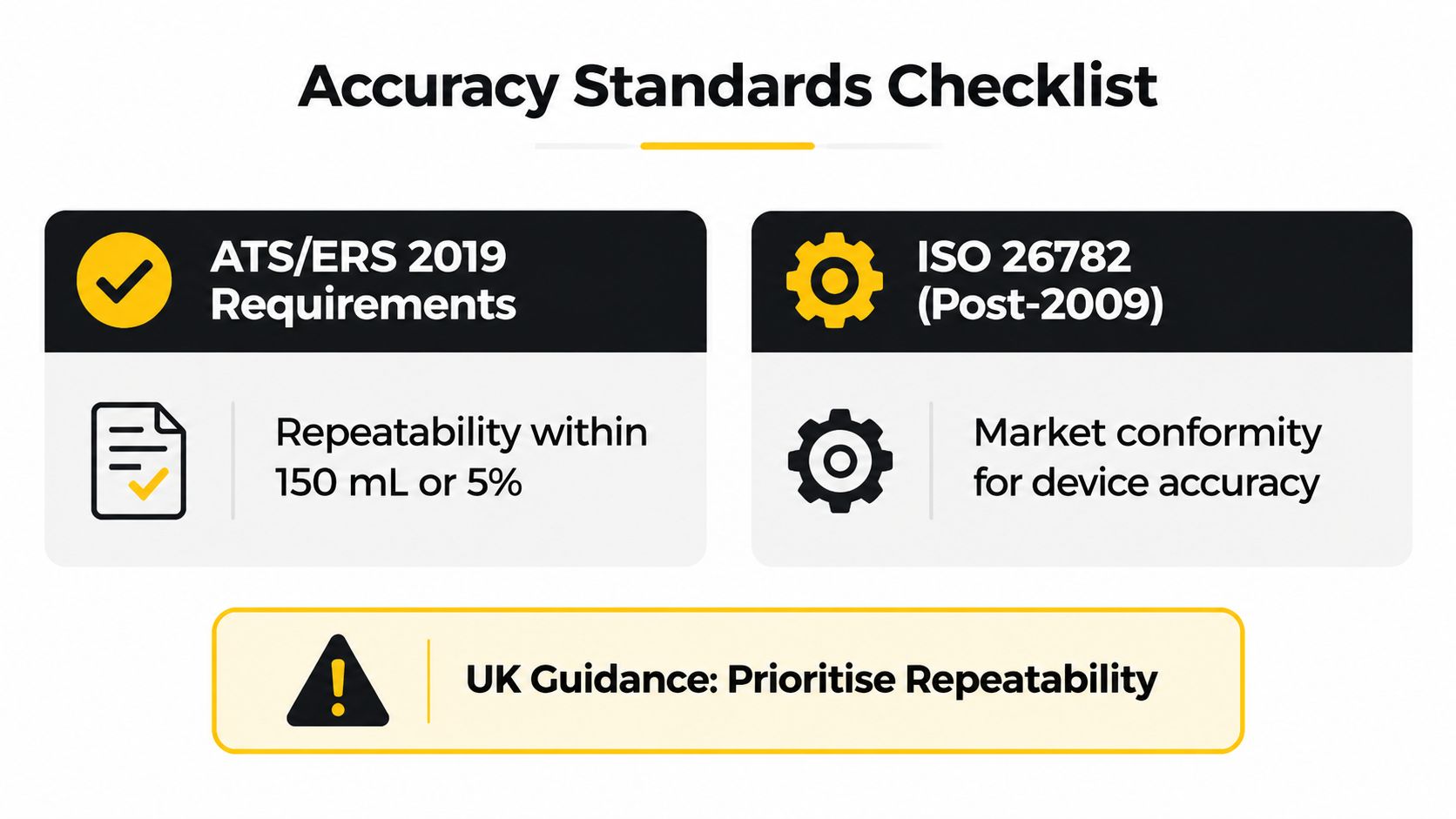
A portable spirometer used in UK clinical and occupational settings should comply with ATS/ERS technical standards and ISO 26782. The ATS/ERS 2019 interpretation sets a maximum permissible spirometer accuracy error of ±2.5%, with the calibration syringe adding a further ±0.5%. UK guidance also states that spirometry traces should be repeated at least three times, with the highest acceptable reading recorded, as explained in the ATS and ERS standards summary.
Those figures look small, but they matter because spirometry is often judged near a cut-off. A device that drifts, or a syringe check that is slightly off, can shift a reading above or below a threshold that changes the next decision. In occupational health, that may affect whether a person is referred, repeated or cleared. In clinical practice, it can affect whether the result stands as evidence of stable function.
Repeatability as the central governance issue
Accuracy is only one part of defensible spirometry. Repeatability shows whether the service can obtain a similar result when the person repeats the test under comparable conditions. A trace can be technically acceptable once and still fail governance if it cannot be reproduced with confidence.
NICE's review found that portable turbine-based devices can achieve reproducibility comparable to laboratory spirometers, while usability remains a separate issue. In one cited study, at least two acceptable and intra-device reproducible curves were obtained in 88% of laboratory spirometers versus 76% of portable spirometers, according to NICE's clinical and technical evidence review. That gap matters operationally, because portable kit may need more coaching time, more grading of traces and more repeat attempts.
A portable spirometer can be technically sound and still generate more rejected blows if the workflow is rushed.
The British spirometry FAQ also states that diagnostic spirometers should meet ISO 26782, and that spirometers placed on the market since 2009 must conform to that standard, with one-way mouthpieces and nose clips as equipment requirements, as set out by ARTP. For a professional service, procurement, maintenance and training belong in the same governance conversation.
Where Portable Spirometers Add Value in Clinical and Occupational Settings
Portable spirometry earns its place when access matters. A clinic room may not be available, a screening day may be split across sites, or a sports science team may need respiratory data alongside aerobic field tests. In those situations, portability is not a luxury, it is the reason the measurement happens at all.
Different settings need different levels of control
Supervised clinic use gives the operator the best chance to coach the manoeuvre, grade the trace and repeat it until the curves are acceptable. Occupational health surveillance often asks the same of the device, but under tighter time pressure and with more varied testing environments. Community screening sits somewhere between those two, because the populations are often mixed and the workflow has to absorb more variability.
Remote testing adds another layer. UK evidence from the SPIRO-MOTE study summary indicates that portable devices can match hospital equipment and that unsupervised home testing can be equivalent to supervised testing in experienced children and young people, while younger children may still show acceptable variability and results depend on user experience, as described in the device summary. That makes remote use a risk-based decision, not a blanket yes or no.
The most overlooked issue is that a portable spirometer may be adequate from an engineering standpoint, yet still unsuitable for unsupervised use in a particular population. Novice users, younger children and people with limited instruction usually need more support. Experienced users may do fine, but the service still has to know how results are quality graded and when to step back to supervision.
A useful comparison for nurses and allied staff is a guide to asthma care for nurses, because spirometry decisions often sit alongside symptom review, escalation pathways and inhaler timing in real workflows. Those decisions are easier when the test result is treated as one part of the clinical picture, not the whole picture.
The market is clearly shifting towards handheld, battery-powered, PC-linked, Bluetooth-enabled and calibration-free claims, which sounds efficient on paper. Yet that same shift raises the governance question of how results are stored, reviewed and standardised across sites. In UK occupational and clinical practice, that conversation matters as much as device capability. The best portable system is the one the team can defend after the session has ended.
Calibration Quality Control and Common Sources of Error
A portable spirometry result is only as defensible as the controls behind it. If the device, accessories and operator routine are inconsistent, the reading may look tidy while still being hard to trust in occupational or clinical review. The governance question starts here, before the first manoeuvre is accepted.
A simple control routine
Before testing, the team should confirm the device is clean, assembled correctly and ready for a validation check. During testing, the operator should look for a sharp start, sustained effort and a full exhalation. After testing, save the best acceptable trace, not the one that looks neat, and record any reason the person needed extra repeats.
Common failure point: a person who starts too slowly can produce a curve that appears plausible but underestimates true function.
The equipment details matter as much as the coaching. British guidance specifies one-way mouthpieces and nose clips, which helps reduce contamination risk and keep the manoeuvre standardised, as noted by ARTP. Where local policy requires a syringe check, it should be done the same way every time and recorded, because calibration is part of the test record even when the final result looks acceptable.
A second equipment requirement comes from ISO 26782, which supports the wider expectation that a portable spirometer should produce measurements that can be checked, compared and defended. In practice, that means the service needs a routine that links the device to a known standard, rather than relying on confidence in the screen display alone.
Environmental conditions also shape the reading. If testing happens in a van, a field shelter or a temporary clinic, the workflow should account for temperature, device readiness and the practical limits of the space. A portable spirometer does not remove those constraints, it moves them into a more exposed setting.
What to watch for in the curve
Short, hesitant, cough-affected or prematurely stopped blows are not just imperfect, they can mislead. An acceptable session depends on the operator separating a limited effort from a valid physiological result. That judgement takes training, especially where the result may affect occupational clearance or clinical follow-up.
The audit trail matters here. If the service can show how the device was checked, how the person was coached, how the blows were graded and why any trace was rejected, the result is far easier to defend. Without that record, a portable spirometer becomes a black box, and a black box is difficult to justify after the session has ended.
How to Choose a Portable Spirometer for Professional Use
A procurement choice can fail before the first test is run. A device may be light, tidy and easy to carry, yet still hard to validate, awkward to export from, or inconsistent across testers. In occupational health and clinical practice, the core question is whether the unit fits the service model and can produce results that stand up to review.
Portable Spirometer Procurement Decision Matrix
| Feature | Why It Matters | Priority for Occupational Health | Priority for Clinical and Research |
|---|---|---|---|
| ATS/ERS and ISO 26782 conformity | Supports defensible measurement and acceptance | High | High |
| Calibration checks and documented validation | Shows the device can be trusted in routine use | High | High |
| Repeatability workflow | Helps capture acceptable blows without rushed decisions | High | High |
| Software export and reporting format | Makes cross-site audit and record keeping easier | High | High |
| Bluetooth or PC linkage | Reduces manual transcription and supports integration | Medium | High |
| Battery-powered portability | Matters for vans, field work and bedside testing | High | Medium |
| Quality grading tools | Helps identify unusable curves and training needs | High | High |
| Calibration-free claims | Needs careful scrutiny against verifiable checks | Medium | Medium |
That matrix shows why “calibration-free” should never be treated as a shortcut in governance. If a device claims lower maintenance, the service still needs a way to verify performance, document use and defend the result later. Software matters for the same reason. If results cannot be exported cleanly, reviewed by another clinician, or built into a consistent report template, the workflow becomes fragile.
A useful way to judge a device is to ask whether it preserves the test record as well as the measurement. In a service that may face audit, referral, or cross-site comparison, the curve, the grading, and the export format all matter. A spirometer that gives a number but hides the trail is harder to defend than one that keeps the evidence visible.
Cartwright Fitness' own assessment ecosystem is relevant here because the company already works with validated professional measurement equipment and is developing Cartwright Assess to standardise testing, calculate and interpret results, maintain assessment histories and generate reports. That kind of workflow support matters more than a shiny screen when the data has to survive audit, referral or cross-site comparison.
A practical buying habit is to compare the device with the setting, not the brochure. Occupational health teams usually need portability, speed and sturdy reporting. University labs often need tighter integration and clearer data export. Community teams need low-friction setup and repeatable coaching. The best purchase is the one that makes the service more standardised, not just more mobile.
Building a Defensible Portable Spirometry Service
A defensible service starts with staff who know what an acceptable curve looks like and what to do when the curve isn't acceptable. It needs a written SOP, a validation routine, a data trail and a reporting method that doesn't change every time a different operator is on duty. Without that, even a good device becomes a weak process.
The strongest teams treat portable spirometry as part of a wider assessment system. They train staff to the same standard across sites, keep calibration and quality checks documented, and make sure the result can be interpreted in context. That approach is the difference between a gadget and a service.
For teams that already run VO₂ testing, the Chester Step Test, grip strength or occupational fitness assessments, the same governance habits apply. Standardise the method, record the conditions and keep the history visible. For a practical refresher on reading results and avoiding common misinterpretation, the how to interpret spirometry results guide is a useful companion for professional teams.
The bottom line is simple. Portable spirometry is reliable when the service is reliable. If the aim is a result that can stand up in occupational, clinical or performance settings, the device has to be managed with the same rigour as any other professional measurement tool.
If your team needs portable spirometry equipment, assessment software or support with professional testing workflows, visit Cartwright Fitness to review validated measurement options and related resources. The right setup makes it easier to standardise testing, defend results and keep assessments consistent across sites.


