

A portable dynamometer measures isometric muscle force, most commonly grip strength, and can provide reliable readings when the protocol is controlled. In UK occupational-health surveillance, the Society of Occupational Medicine requires three attempts in each hand, standardised seating and recording to the nearest 1 kg. Society of Occupational Medicine HAVS guidance
A clinician may see apparently simple testing: a subject sits down, grips a handle and produces a force reading. Yet the same subject can produce different results when staff change the chair, handle position, instructions or timing. That's why a portable dynamometer should be treated as a precision measurement procedure, not as a squeeze test or a device that produces valid data automatically.
This distinction matters in rehabilitation, occupational health, emergency-service screening and human-performance laboratories. A portable instrument makes testing accessible, but only a controlled method makes results comparable. The practical question isn't merely which device to buy. It's whether the organisation can reproduce the same test across people, sites and assessment dates.
Table of Contents
- Understanding Portable Dynamometry as a Professional Procedure
- What a Portable Dynamometer Measures and Why Protocol Matters
- Evaluating Reliability, Accuracy, and Common Pitfalls
- Deciding Between Handheld Portability and Fixed Laboratory Systems
- Applying Dynamometry in UK Occupational and Clinical Standards
- Specifying and Procuring the Right Dynamometer for Your Organisation
Understanding Portable Dynamometry as a Professional Procedure
A common problem appears when an occupational-health team compares results from two clinics. One technician seats the participant with the shoulder relaxed and the elbow positioned consistently. Another allows the participant to stand, changes the grip setting and records the single highest attempt. The resulting numbers may look precise, but they don't represent the same procedure.
That situation is avoidable. A portable dynamometer detects force during an isometric contraction, in which the tested position remains fixed while the participant exerts effort. The instrument is portable, but the measurement still needs a defined setup, familiar instructions, controlled effort and documented recording rules.
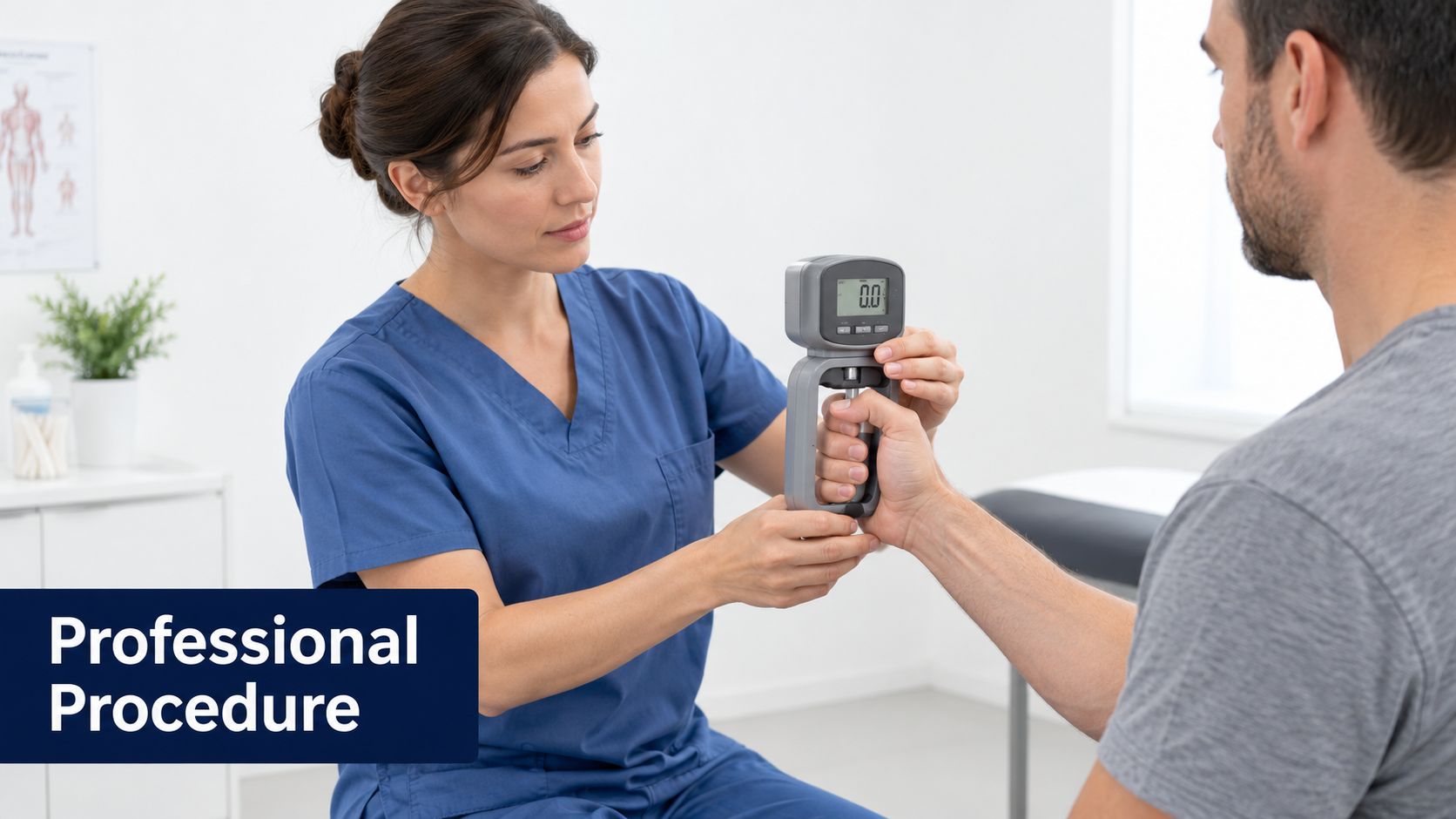
Why ownership isn't enough
A device can display a number without answering the clinical question. A clinician assessing hand-arm vibration exposure may need a repeatable result for surveillance. A rehabilitation service may need to compare the same limb over time. An emergency-service assessor may need to determine whether a candidate meets a role-specific standard.
Each use requires a written method covering:
- Positioning: The subject's seated posture, limb position and stabilisation should remain consistent.
- Instructions: Staff should use the same explanation and encouragement so effort isn't influenced by changing verbal cues.
- Trials: The number of attempts and their order must be defined before testing begins.
- Recording: Units, rounding rules, device settings and any unusual observations belong in the assessment record.
Practical rule: Portability reduces logistical burden. It doesn't remove the need for operator training, equipment checks or protocol control.
This procedure-driven approach also supports defensible reporting. If results change, the assessor can distinguish a genuine change in strength from a change in technique. That distinction is central to longitudinal monitoring, fitness-for-task decisions and research data collection.
What a Portable Dynamometer Measures and Why Protocol Matters
A portable dynamometer quantifies force produced during an isometric contraction. For a grip test, the subject squeezes a handle while the wrist and arm stay in a defined position. The display may show kilograms, kilogram-force, or another instrument-selected unit. That unit does not make results comparable by itself.
The Society of Occupational Medicine's 2025 HAVS guidance requires grip-strength testing with a dynamometer and a standardised seated posture. The assessor records the average of three attempts in each hand, records values to the nearest 1 kg, and uses the same chair style for every measurement. The SOM HAVS guidance sets out the posture, repetition and recording requirements.
A controlled grip protocol
Write the sequence into the local SOP:
- Prepare the equipment. Inspect the device, confirm the handle setting, and zero the display where applicable.
- Seat the subject consistently. Use the defined chair and posture rather than switching between seated and standing tests.
- Set the handle position. Keep the setting unchanged for comparable assessments.
- Explain the effort. Use clear, standard instructions before every attempt.
- Complete three attempts per hand. Alternate hands if that is the chosen method, then apply it consistently.
- Record the average. Follow the specified rounding rule and document pain, poor comprehension, or an interrupted attempt.
The same discipline applies when results support a prepare for a functional capacity evaluation. A force value without its method is difficult to interpret. Hand-grip testing equipment available from Cartwright Fitness should therefore be assessed alongside the procedure, operator training, and recording requirements.
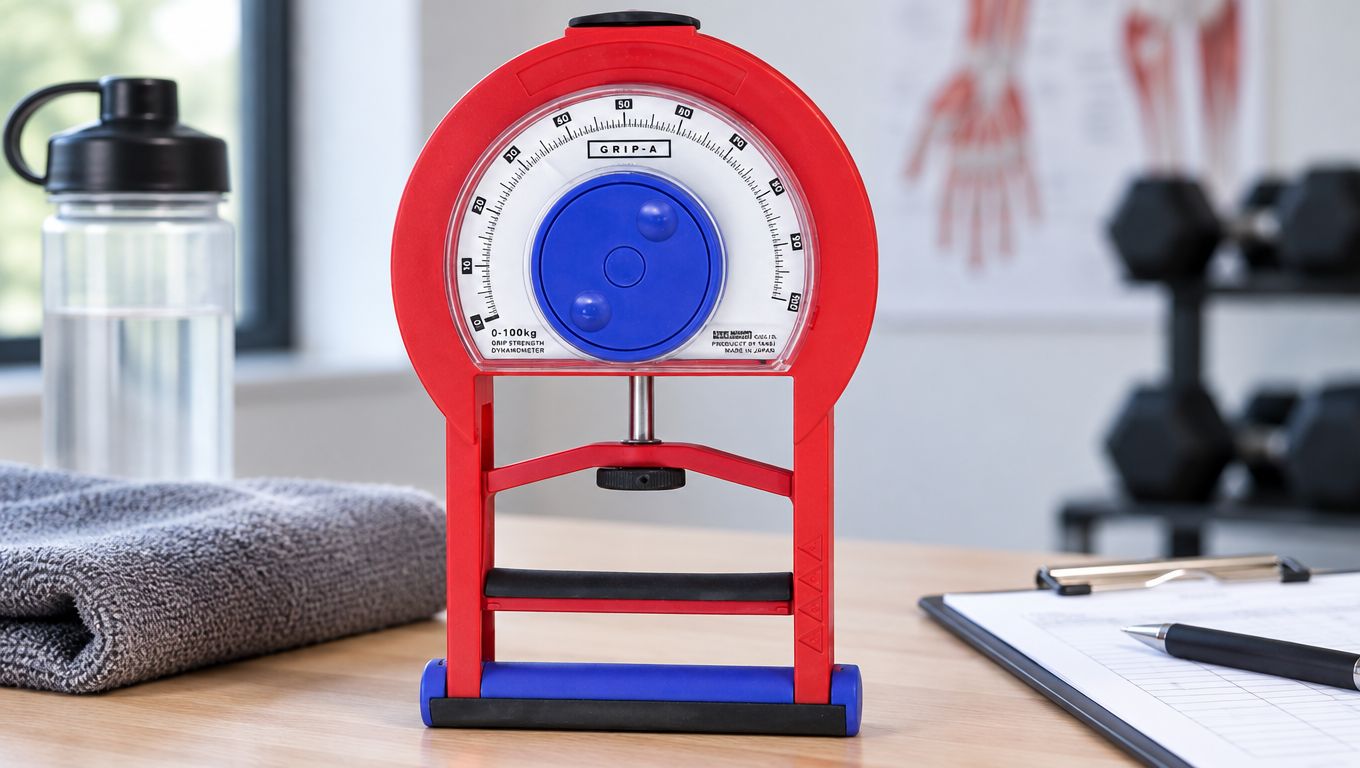
The Takei Hand Grip Dynamometer has an adjustable isometric design for grip-strength assessment. It examines static flexor power in each forearm, measures from 5.0 to 100 kgf, and displays maximum measured values. The available configuration uses either an analogue dial display or the Takei 5401 hand-grip digital dynamometer.
Evaluating Reliability, Accuracy, and Common Pitfalls
A portable dynamometer can produce highly consistent results, but only when the tester controls the procedure. Clinical equipment evidence reports intra- and inter-tester reliability in the excellent range, with ICC values of 0.93 to 0.97, under standardised conditions (hand-held dynamometer reliability and measurement considerations).
That finding applies to a defined method, not to every use of the device. Reliability describes consistency under controlled conditions. If one assessor stabilises the limb while another permits compensatory movement, the test method has changed, even when the instrument is identical.
Where error enters the workflow
Practical sources of error include:
- Tester strength and stabilisation: A handheld assessor may be unable to resist a high-force participant, allowing movement that changes the reading.
- Inconsistent positioning: Joint angle, trunk posture, limb support and handle placement all affect mechanical demand.
- Variable encouragement: Differences in instructions or verbal motivation can change voluntary effort.
- Fatigue and learning: Familiarisation, discomfort and repeated maximal efforts may alter performance.
- Incompatible comparisons: A portable result should not be treated as interchangeable with a fixed laboratory measurement without accounting for different mechanics.
Portable devices can overestimate force compared with isokinetic systems. The choice of instrument therefore depends on the decision the result must support, whether screening, serial monitoring or a formal threshold assessment. Tester technique and protocol consistency can create more measurement error than the device itself when standardisation is weak.
Validate the local procedure before collecting a large dataset. Use the same assessor for repeat testing where practical, or require different assessors to follow the same SOP. Record stabilisation, positioning, instructions, effort type and any pain or interrupted attempt. This approach also supports lower-limb testing, where changes in joint position and examiner resistance can substantially affect reproducibility.
For aerobic assessment, the same governance principle applies even though the instrument differs. The Chester Step Test Kit includes a step and calculation software, while a separate heart-rate device can provide readings. The software uses test credits that expire one year after purchase, and each calculated test consumes a credit. Procurement records should capture these workflow requirements because software control forms part of measurement quality.
Deciding Between Handheld Portability and Fixed Laboratory Systems
Portable handheld and fixed isokinetic systems answer different questions. A handheld instrument is useful when the assessor needs rapid isometric screening, repeated bedside testing or field collection across multiple locations. A fixed system is more appropriate when the assessment requires controlled movement through a range of motion, detailed torque analysis or laboratory-level mechanical control.
| Feature | Portable Handheld Dynamometer | Fixed Isokinetic System |
|---|---|---|
| Primary use | Rapid isometric force assessment | Controlled force assessment through movement |
| Location | Clinic, workplace, ward or field setting | Dedicated laboratory or assessment room |
| Setup | Compact and comparatively quick to deploy | Requires fixed infrastructure and trained operators |
| Data strength | Efficient for screening and serial monitoring | Suited to detailed movement and torque analysis |
| Main limitation | Greater dependence on tester stabilisation and technique | Less practical for mobile or multi-site testing |
| Best fit | Occupational surveillance and routine clinical workflows | Specialist research and comprehensive laboratory evaluation |
The decision should follow the assessment question
If an occupational-health provider needs repeatable grip testing across workplaces, portability is usually the operational advantage. If a research team needs force behaviour during controlled angular movement, a fixed isokinetic system may justify its space and capital requirements.
The wrong comparison is “portable versus accurate”. A better comparison is fit for purpose versus uncontrolled use. A portable dynamometer can provide reliable data for a defined isometric protocol, but it can't reproduce every output available from a laboratory system.
A smaller device isn't automatically a simpler measurement system. It transfers more responsibility to the person holding it.
Procurement teams should also consider staffing, room availability, data transfer and the consequences of a failed measurement. A device that can reach the participant is valuable only when the organisation can apply the same method wherever testing occurs.
Applying Dynamometry in UK Occupational and Clinical Standards
UK practice places dynamometry within formal occupational and clinical systems. NHS procurement includes portable grip devices, including rechargeable models, while NHS procedures document the use of the JAMAR hydraulic hand dynamometer for structured clinical measurement.
The Southampton University Hospitals procedure for measuring grip strength with the JAMAR was last reviewed in May 2014. It shows how NHS clinical research and practice have used controlled procedures for hand dynamometry over many years (Southampton NHS JAMAR grip-strength procedure). Occupational-health guidance connects vibration-related health surveillance with the Control of Vibration at Work Regulations 2005. Where surveillance is required, the guidance describes annual assessment and dynamometer-based grip testing using three attempts per hand.
Portable equipment therefore belongs within a defined method. The device reaches workers across sites, but reproducibility depends on positioning, instructions, attempt order, rest periods and recording practice. The same principle applies as services extend portable dynamometry beyond hand grip into lower-limb strength testing. A lower-limb assessment still requires a specified position, stabilisation method and force direction before results can support clinical or occupational decisions.
Thresholds are role-specific
Some organisations set a minimum result for a particular job rather than relying on a general description such as “good strength”.
The South East Coast Ambulance Service procedure requires 30 kg grip strength in both hands, permits three alternating attempts and places the result within a physical fitness assessment procedure (SECAMB physical fitness assessment procedure). The Scottish Prison Service tests both dominant and non-dominant hands, with minimum standards of 32 kgf for the dominant hand and 30 kgf for the non-dominant hand (Scottish Prison Service fitness test standards.doc)).
These figures apply to their specified roles and procedures. They should not become universal occupational cut-offs. The device, protocol and threshold must belong to the same standard.
Interpretation needs context
Population reference data also argues against one universal benchmark. Research drawing on 12 general-population studies in Great Britain reports age- and sex-stratified means and centiles. The male median rises from 17 kg at age 10 to 29 kg at age 15, supporting age- and sex-specific interpretation rather than a single reference value (British life-course grip-strength reference data).
An operational-readiness threshold and a normative reference value answer different questions. Practitioners should record which standard supports the decision and apply the matching protocol consistently.
Specifying and Procuring the Right Dynamometer for Your Organisation
A procurement specification should begin with the decision the assessment must support. A consumer-oriented grip meter may provide a quick reading, but an NHS, occupational-health or research service needs a documented method, stable handling, appropriate measurement range and a defensible record of results.
Start with governance
The essential questions are procedural:
- What will be tested? Grip alone, or also back, leg and lower-limb force?
- Who will test? A single trained assessor, a rotating clinical team or staff across multiple sites?
- What decision follows? Screening, rehabilitation monitoring, research analysis or a role-specific pass/fail outcome?
- How will records be kept? Manual forms, connected software or an assessment platform with client histories and reports?
- How will consistency be checked? Written SOPs, staff training, equipment checks and periodic review should be defined before deployment.
Digital connectivity can reduce transcription work, but it also introduces device pairing, software permissions and data-governance requirements. A simple analogue display may suit a tightly controlled local workflow, while a multi-site service may gain more from structured digital capture.
Don't limit the specification to grip
The University of Southampton identifies development of portable equipment for quadriceps strength and endurance and evaluation of handheld grip-endurance devices. UK sources also show portable dynamometry being used for leg and back strength when protocols are tightly controlled (University of Southampton research on portable dynamometry).
That broader application is important for physically demanding occupations and ageing workforces. Portability makes field testing possible, but it doesn't make lower-limb or back testing automatically valid. Staff still need defined posture, stabilisation, timing and instructions, including controls for variation such as time of day where the protocol requires it.
A supplier should therefore be assessed on more than raw cost. The specification should cover:
- Measurement suitability: Is the force range appropriate for the intended population and task?
- Reproducibility: Can the handle, chain, seat or stabilisation arrangement be set consistently?
- Data workflow: Can results be recorded without avoidable transcription errors?
- Training and support: Can staff learn the method and resolve operational issues?
- Assessment integration: Can the device work within a professional system for standardised tests, histories and reports?
Cartwright Fitness supplies professional assessment equipment and software for areas including grip strength, back and leg strength, functional assessment, aerobic and VO₂ testing, body composition and occupational fitness. Its developing Cartwright Assess platform is intended to standardise testing, calculate and interpret results, maintain assessment histories and generate professional reports. Relevant fitness assessment tools should be evaluated as part of the complete measurement workflow rather than as isolated products.
The strongest procurement decision is the one that protects data quality after purchase. A portable dynamometer becomes valuable when the organisation can reproduce its measurements, interpret them against the correct standard and connect them to a controlled professional assessment process.
Cartwright Fitness supplies professional equipment, software and support for dynamometry, back and leg strength, Chester Step Test assessment, VO₂ measurement, body composition and occupational fitness testing. Visit Cartwright Fitness to select equipment and assessment solutions that match the organisation's protocol, population and reporting requirements.


