

You can usually spot the athlete who’s ready for plyometrics before they say a word. They’re strong in the gym, compliant with the plan, and frustrated that their first step, jump take-off, or reacceleration still looks flat. They’ve built capacity, but they haven’t turned it into speed of force production.
That gap is where a well-run plyometric leg exercise programme earns its place. Not as a random set of jumps at the end of a session, but as a controlled method for improving how quickly athletes absorb force, reverse it, and express it where performance happens.
For coaches, physiologists, and facility managers, the challenge isn’t finding exercises. It’s deciding who is ready, what dose fits, how to progress safely, and how to verify that adaptation is happening. That’s where practice separates from content.
Beyond the Jump Why Plyometrics Fuel Explosive Power
A sprinter clears the weight-room standards, then still looks half a step late on the track. A basketball player squats well, yet cannot turn that strength into a cleaner second jump or a sharper plant. In both cases, the missing piece is rarely effort. It is rate of force development under tight ground-contact constraints.
Plyometrics target the stretch-shortening cycle. The athlete absorbs force, limits time lost in transition, and re-applies that force fast enough for sport. That quality shows up in more than jump height. It affects acceleration, deceleration, cutting, reacceleration, and the ability to stay stiff and organised when contact times shorten.
Good plyometric work starts at ground contact.
Take-off gets the attention, but transfer usually depends on what happens just before and just after it. Athletes need enough ankle stiffness, trunk control, and positional discipline to keep the amortisation phase short. If they collapse into the floor, spend too long on contact, or land without control, the session becomes conditioning with jumps in it. Coaches may still get sweat and soreness. They are less likely to get better reactive performance.
That is why experienced practitioners treat plyometric leg exercise as a force-management task, not a jump menu. The drill has to match the quality being trained. Extensive contacts can help teach rhythm and landing mechanics. More reactive contacts can improve elastic rebound and fast force expression, but only when the athlete can tolerate the loading and keep execution clean.
For facilities that want more than visual guesswork, this is also where testing sharpens decision-making. A functional movement assessment for coaches and performance facilities helps establish whether the athlete can hold positions, control landing, and earn higher-velocity plyometric work. Once jumping starts, tools such as contact grids, timing systems, and force platforms help confirm whether the athlete is reducing contact time, improving jump strategy, or just finding ways to hide fatigue.
What separates useful plyometrics from empty volume
Three factors usually decide whether the work carries over to performance.
- Intent: The athlete must strike the ground with a clear objective. Height, distance, stiffness, or minimal contact time. Vague effort produces vague adaptation.
- Time constraint: Sport rewards athletes who can produce force quickly. Plyometric selection should reflect that demand rather than turning every drill into a max-height jump.
- Elastic efficiency: Effective sessions improve how the lower limb stores and returns energy. Poorly chosen drills often drift back toward slower strength patterns performed in the air.
Practical rule: If the jump looks powerful but the landing is loud, slow, or unstable, the athlete is borrowing output from a pattern they cannot yet control.
Recovery matters here as well. High-quality contacts depend on tendon tolerance, nervous system freshness, and session placement across the training week. Coaches who monitor that side of the process often pair their loading plan with a broader guide to athlete wellness tools, especially when they are managing dense competition calendars or shared facility environments.
The primary question is not which jump looks advanced. It is whether the drill improves a specific explosive quality, and whether your testing setup can verify that the athlete is getting faster, stiffer, and more efficient rather than doing more contacts.
The Foundation Assessing Readiness and Injury-Proofing Athletes
A common scene in performance facilities is an athlete hitting an impressive box jump, then failing to control a simple landing on the next rep. The jump gets attention. The landing tells you whether plyometric loading is appropriate.
Readiness sits at the center of that decision. Plyometric outcomes change with the athlete’s starting point, especially their strength level, coordination, and neuromuscular control, as discussed in the review on individual variability and personalised plyometric progression. Coaches who skip that step usually end up prescribing by sport label or drill popularity instead of tissue capacity and movement quality.

Strength first, but not strength alone
A strength base matters because the athlete has to tolerate fast loading, not just produce force in slow lifts. Squat strength can help set the floor for more demanding jump work, but it does not clear an athlete on its own.
I’ve seen strong athletes struggle the moment the task shifts from producing force to absorbing it. They collapse into pronation, lose pelvic control, or stiffen through the trunk and turn every landing into a braking error. In practice, that athlete needs lower-level plyometric exposure and better force acceptance mechanics before they need more intensity.
A technically clean snapdown or low-level drop landing gives you more useful information than a maximal effort jump. You can see whether the athlete owns posture, controls joint position, and distributes load through the foot instead of chasing output they cannot organise.
What to screen before you programme
Pre-plyometric screening should answer a simple question. Can this athlete absorb and redirect force in the positions their sport will demand?
That screen usually includes:
- Landing mechanics: Assess a snapdown, drop landing, or stick landing for foot stability, knee tracking, pelvic control, and trunk position.
- Single-leg control: Check whether the athlete can decelerate and stabilise without losing frontal-plane control.
- Eccentric tolerance: Look for athletes who can lower and absorb well, not just produce force aggressively.
- Exposure history: Previous tendon pain, limited jump exposure, or long periods of bilateral sagittal-plane training all change your starting point.
- Repeatability: One good rep is not enough. The standard is consistent quality across several contacts.
Facilities that want a tighter link between coaching, sports science, and risk management should formalise that process. A structured functional movement assessment helps set exercise direction, contact volume, and progression level from an actual baseline rather than coach intuition alone.
That matters for more than safety. It improves programming efficiency. If testing shows poor single-leg control but acceptable bilateral landing mechanics, the coach can progress one quality while holding another back instead of stalling the whole plan.
Injury-proofing is mostly load management and progression discipline
Most plyometric problems come from bad dose selection. The athlete is exposed to too much intensity, too much novelty, or too much fatigue in the wrong week of the training cycle.
The fix is rarely complicated. Build from low to high amplitude. Progress bilateral before aggressive unilateral rebound work when control is limited. Keep contacts high quality. Place demanding jump sessions where the athlete is fresh enough to produce and absorb force properly. For teams and facilities using professional testing tools, force-time data, contact-time trends, and asymmetry checks help confirm whether the athlete is adapting or just surviving the session load.
Recovery support still matters, especially when jump exposure sits beside sprinting, heavy lifting, and field or court practice. If you’re building a broader support system around high-output lower-body work, this guide to athlete wellness tools is a useful reference for recovery planning between loading days.
Control earns progression. Testing confirms it.
The Core Plyometric Leg Exercise Arsenal
A useful plyometric menu gives the coach options for a specific force problem. If the target is concentric output, short ground contact reactivity, lateral braking, or single-leg stiffness, the drill choice becomes much clearer and the coaching standard gets tighter.
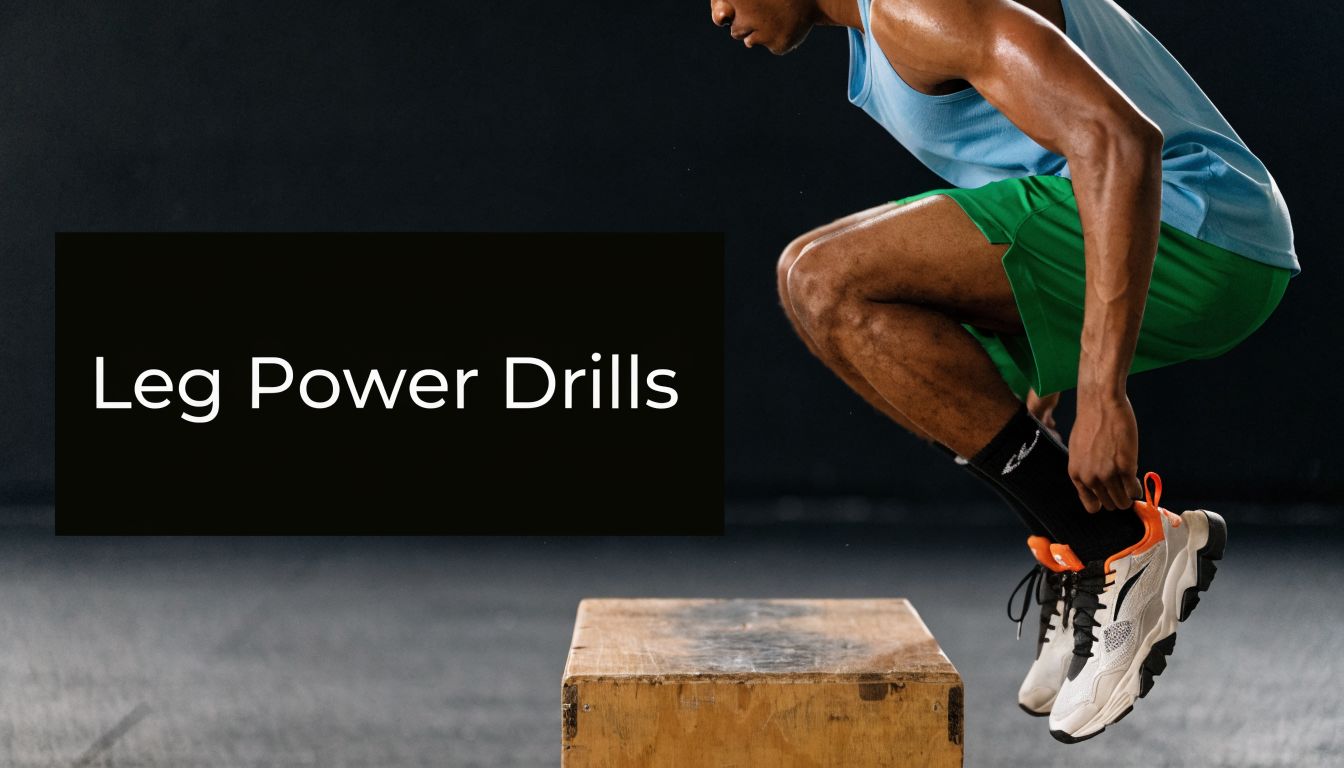
Across every good plyometric leg exercise, the shared requirement is efficient force transfer. The athlete needs organised trunk position, active foot strike, clean hip-knee-foot alignment, and landing mechanics that stay quiet under speed. Coaches can cue that by eye, but facilities that pair jump training with muscular strength assessment methods and force-platform testing can confirm whether the athlete is producing force well, absorbing it well, or compensating around a limitation.
Squat jumps
Purpose
Use squat jumps to train concentric intent with a lower reactive demand than rebound-based drills. They fit well when an athlete needs to express force cleanly from a static start, or when you want a jump pattern that exposes posture and coordination without the added complexity of a fast stretch-shortening cycle.
Execution cues
Start from a consistent squat depth. Brace, keep the ribcage stacked over the pelvis, and drive hard through hip, knee, and ankle. Land under control, reset, and keep each rep discrete unless repeated contacts are part of the session objective.
Common faults
- Too much countermovement: The athlete turns a concentric jump into a slower mixed strategy. Tighten the start position and standardise depth.
- Chest drops forward: Usually a trunk control or intent issue. Clean up the setup before asking for more effort.
- Extra reps after quality fades: Stop the set once take-off speed or landing position drifts.
Regression and progression
Regress to snapdowns, jump-and-stick drills, or unloaded quarter-squat pop-ups. Progress to repeated squat jumps only after the athlete can reproduce the same take-off and landing shape across the full set.
Box jumps
Purpose
Box jumps let athletes project force aggressively while reducing landing stress compared with maximal floor landings. That makes them useful for teaching intent, especially during phases where you want output without adding unnecessary eccentric cost.
Execution cues
Choose a box that matches the athlete’s actual jump capacity, not their hip mobility. Use a quick dip, punch vertically, and land in a stable athletic position with full foot contact. Step down after each rep.
Common faults
The box is often too high. The athlete then wins the rep by tucking the knees and folding at the hips instead of producing a better take-off. If the jump looks slow or the landing on the box needs a balance correction, lower the height.
Box height should reflect take-off quality, not social media ambition.
Bounds
Purpose
Bounds train horizontal propulsion, rhythm, and elastic coordination over distance. They carry over well to sprint mechanics, acceleration development, and field-sport movement where athletes need to project force forward without leaking energy side to side.
Execution cues
Project forward with intent, but keep the contact under control. The foot should strike close enough to the centre of mass to avoid obvious braking, the trunk should stay tall, and the pattern should keep its rhythm from contact to contact.
Common faults
- Overreaching: Contact lands too far in front, which kills speed and increases braking.
- Lateral drift: Usually linked to pelvic control or poor line discipline.
- Heavy, sinking contacts: Reduce distance and rebuild stiffness before asking for more amplitude.
A marked lane helps. It gives the athlete a task they can repeat and gives the coach a cleaner way to judge projection versus wasted motion.
A useful visual reference for coaching rhythm and projection is below.
Depth drops and depth jumps
These drills suit prepared athletes with proven landing control and enough tendon and joint tolerance to handle high eccentric and reactive demand.
Purpose
Depth drops train force absorption and positional discipline on landing. Depth jumps add a rapid rebound, so they train the ability to switch from braking to propulsion with very little delay. That combination makes them valuable, but expensive. Use them when the athlete needs a high-rate reactive stimulus and has already earned that exposure.
Execution cues
Step off the box. Do not jump out. Meet the ground with an active foot, absorb force quickly, and keep the trunk stacked with the knee tracking cleanly over the foot. In depth jumps, the rebound should be sharp and direct, not a paused countermovement after collapse.
Common faults
The athlete lands heel-heavy, folds at the trunk, or spends too long on the floor before the second action. Lower the box or remove the rebound and return to depth drops.
Single-leg hops and lateral skater variations
Purpose
Single-leg work exposes deficits that bilateral jumps can hide. These drills train unilateral stiffness, frontal-plane control, and the ability to accept and redirect force in sport positions that look much closer to cutting, sprinting, and repeated take-off tasks.
Execution cues
Keep the pelvis level and the foot active. Land with the knee tracking in line, own the position first, then add repeated contacts or more distance. In lateral patterns, the goal is organised force acceptance, not speed for its own sake.
Common faults
- Knee collapse inward: Regress immediately and rebuild the landing strategy.
- Trunk sway or rotation: Cut the distance or simplify the pattern.
- Post-contact balance search: Stay with hop-to-stick variations until control improves.
For many athletes, the highest-value unilateral plyometric work is still the simple version. A clean snapdown, stick landing, or controlled hop often does more for long-term progress than a more advanced drill performed badly.
Programming Plyometrics for Peak Performance
A coach sees this every season. The drill selection looks good on paper, but by week three the contacts are slower, the landings are louder, and sprint quality starts to dip. The problem is usually programming, not exercise choice.
Good plyometric planning comes down to dose, sequence, and context. Frequency, contact volume, jump intensity, surface, and recovery all change the training effect. A menu of strong drills means very little if they are dropped into a week that already carries heavy sprint, lifting, and match demands.
As noted earlier, structured plyometric programmes often sit within a fairly modest weekly range. That range is only a starting point. I set the dose from the athlete’s training age, tendon tolerance, body mass, current speed exposure, and how costly the selected drill is to the neuromuscular system.
How to organise the week
Place high-velocity reactive work where the athlete can produce it. In practice, that usually means early in the session, after preparation and before fatigue-heavy strength or conditioning work. Lower-level jumps, rhythm contacts, and teaching drills can fit more flexibly, provided execution standards stay high.
The weekly plan matters as much as the session plan. A depth jump session on the same day as heavy accelerations and large change-of-direction volumes can be appropriate for a well-prepared athlete, but it needs intent and restraint. For a developing athlete, the same combination often just piles stress onto the ankle, patellar tendon, and calf complex without improving output.
I programme with four filters:
- What quality are we targeting? Rapid force production, reactive stiffness, horizontal projection, or single-leg reactivity.
- What is the true cost of the drill? Repeated bounds and depth jump variations create a very different fatigue signature from pogo jumps or squat jumps.
- What else is loading the lower limb this week? Sprint exposures, decelerations, max strength work, and competition all count.
- What will we measure after the session or in the next 48 hours? If the facility is using jump testing platforms, contact mats, or force plates, that information should shape the next exposure rather than sit in a spreadsheet.
That last point separates organised plyometric training from random hard work. Coaches who understand how to measure muscular strength tend to make better decisions about pairing jumps with squats, Olympic lift derivatives, and isometric work because they can see whether the athlete is prepared for more output.
Sample Plyometric Programming by Athlete Phase
| Phase | Focus | Sample Exercises | Volume (GCTs/Session) | Rest Between Reps/Sets |
|---|---|---|---|---|
| Foundation | Positioning, force acceptance, and repeatable rhythm | Snapdowns, jump and stick, low box jump, squat jump | Low | Full reset between reps, longer set rest to keep mechanics clean |
| Development | Faster ground contacts and direction-specific projection | Box jumps, bounds, lateral skater jumps, repeated low pogo variations | Moderate | Brief reset when rhythm matters, full recovery between sets |
| Performance | High-output reactive actions with clear sport transfer | Depth drops, selected depth jumps, single-leg hops, advanced bounds | Moderate to high, only if output stays stable | Enough rest to preserve sharp contacts and consistent intent |
Use phases as a guide, not a script. A senior athlete returning from tendon irritation may need Foundation loading for two weeks. A younger athlete with excellent stiffness and poor landing control may look advanced in one quality and underprepared in another.
What tends to work
- Keep the exercise pool tight. Repetition gives coaches time to coach, and it gives testing tools a cleaner signal.
- Build from lower shock to higher shock. Absorption capacity and positional control should be in place before aggressive reactive work.
- Match contacts to the sport calendar. In-season programming usually needs fewer high-cost contacts and stricter exercise selection.
- Log the work properly. A simple record of contacts, drill type, jump quality, and readiness trends is often enough to prevent poor loading decisions. The Strive Workout Log for progressive overload is one practical way to keep that process consistent.
What usually fails
Constant exercise rotation makes coaching shallow and progress hard to verify. So does adding large jump volumes on top of hard field or court loads because the athlete "handled it" once.
The best plyometric blocks often look restrained. What makes them effective is clear intent, stable execution, and objective monitoring that confirms the athlete is adapting rather than just surviving the session.
Measuring What Matters Monitoring Progress and Neuromuscular Response
Coaches often make a basic mistake with plyometrics. They judge the block only by visible performance output, usually jump height. That’s incomplete.
A short plyometric phase may improve how the athlete recruits muscle and manages force before a large performance change appears. In one 6-week plyometric intervention, performed twice weekly, researchers found significant increases in EMG activity in the vastus lateralis by 13.25%, vastus medialis by 9.60%, and gastrocnemius by 13.93%, while countermovement jump height improved by 2.77% but not significantly, as reported in the study on 6-week plyometric training, jump performance, and muscle activation. That matters because it tells practitioners that adaptation can be real before it becomes obvious in a single top-line metric.
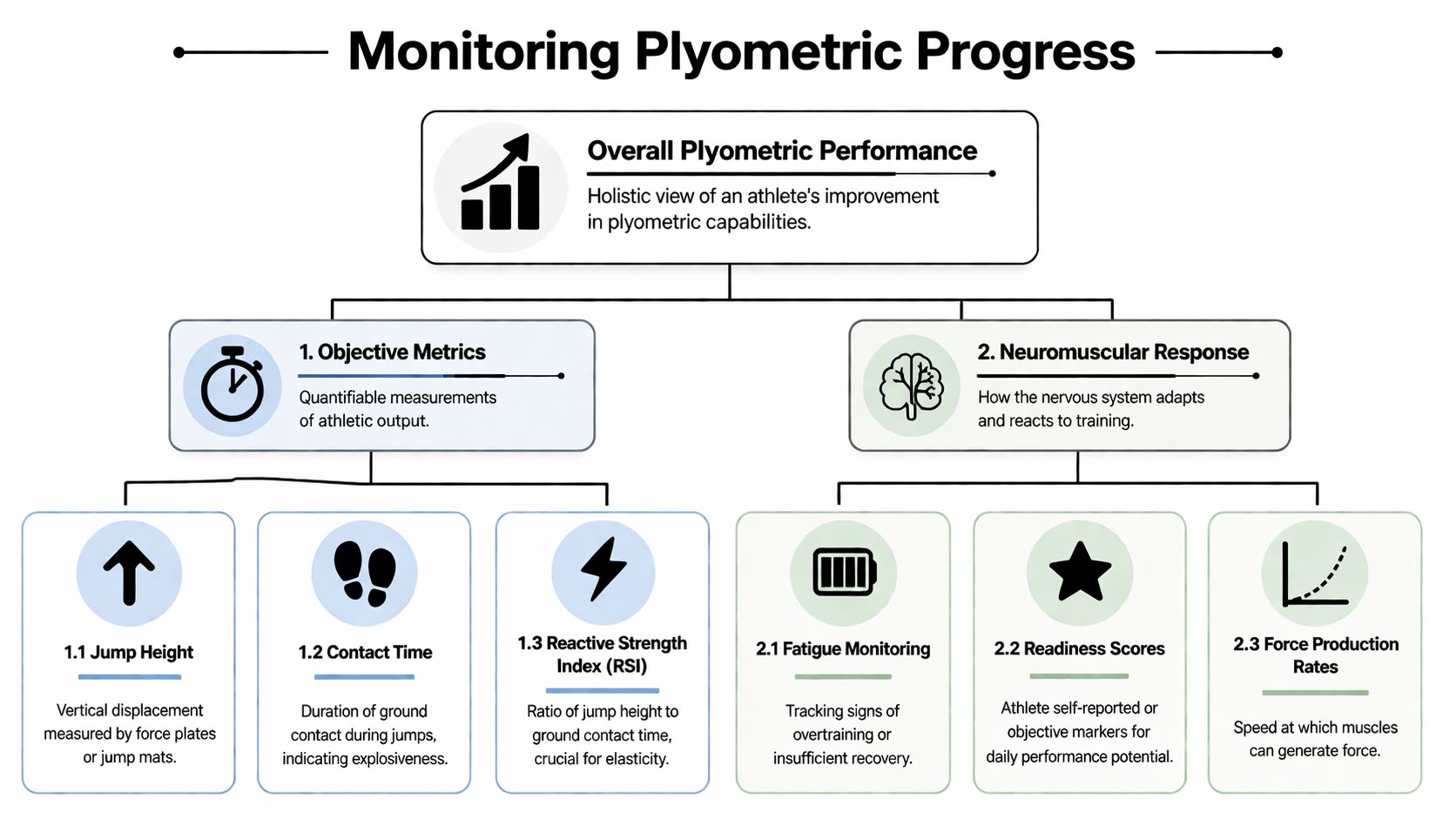
The metrics worth tracking
A useful monitoring system combines field practicality with enough sensitivity to guide decisions.
- Jump height: Still useful, especially when measured consistently with the same protocol.
- Ground contact time: Critical when reactive ability is the target rather than pure displacement.
- Reactive Strength Index: Helpful because it links output to time spent on the floor.
- Countermovement versus squat jump profile: This helps separate reactive contribution from concentric-only capacity.
- Daily readiness notes: Not glamorous, but often the first sign of accumulating neuromuscular fatigue.
If your staff want a simple process for logging progression over time, the Strive Workout Log for progressive overload is a useful example of how to keep training records consistent enough to support decisions.
Tools are only useful when they change decisions
Jump mats, contact grids, and force plates shouldn’t be treated like gadgetry. They’re decision tools.
A force plate can help you see whether an athlete is improving braking strategy, concentric intent, or time-related reactive qualities. A jump mat gives you a simpler field option when you need repeatable exposure across a squad. Video, used well, still matters for joint alignment and rhythm. The point isn’t to collect everything. The point is to collect enough to answer the coaching question in front of you.
For practitioners building a more formal jump testing workflow, this coach’s guide to vertical jump testing is a practical starting point. Cartwright Fitness also supplies professional testing equipment used in health and performance settings, including tools relevant to validated jump assessment and broader athlete monitoring.
What progress can look like before it looks impressive
Sometimes the athlete doesn’t jump visibly higher right away, but the contacts get crisper, the landing gets quieter, and the repeated efforts hold up longer before form fades. That’s progress. It tells you the nervous system is adapting and the athlete is becoming more efficient.
Don’t let one stagnant output metric convince you that nothing is changing. Look at the full movement and the data around it.
When professionals monitor both performance and neuromuscular response, they stop guessing whether the programme worked. They can show it.
Conclusion From Power Potential to Proven Performance
Plyometrics work best when they stop being treated as a jump menu and start being treated as a system. Assess the athlete first. Build from mechanics that hold up under speed. Progress volume and intensity with intent. Measure enough to verify what changed.
That approach solves two problems at once. It improves performance quality, and it reduces the risk that comes from giving advanced drills to athletes who haven’t earned them. For coaches and sports scientists, that’s the primary value of a serious plyometric leg exercise programme. It turns explosive training into something you can justify, repeat, and refine.
Good practitioners already know that enthusiasm isn’t a method. What moves athletes forward is controlled exposure, sharp observation, and objective testing that keeps programming honest.
If you’re building a data-led plyometric system for your athletes, Cartwright Fitness offers professional testing equipment and assessment tools that support reliable jump testing, movement analysis, and wider performance evaluation in coaching, clinical, and academic settings.