

A firefighter candidate leaves a Chester Step Test with a recorded heart rate, a completed stage and an assessor's handwritten note. By the end of the day, the same result may appear as an estimated VO₂ value on one record and a MET level on another. If the pass decision changes with the assessor, the problem isn't the candidate's physiology. It's the scoring governance around the measurement.
That distinction matters in occupational health, emergency services, rehabilitation and performance laboratories. Physical performance test scoring must connect what happened on the day to a defined metric, an appropriate UK reference frame and a written interpretation. Without that chain, even a carefully administered test can produce a decision that's difficult to defend.
Table of Contents
- When Scoring Goes Wrong on the Day
- The Scoring Pipeline Every Test Shares
- Scoring Aerobic Tests and the Chester Step Test
- Scoring Strength and Functional Tests
- Threshold Standards Versus Percentile Norms
- A Worked Example Across Multiple Tests
- Reliability, Errors and Defensible Records
- Putting It Into Practice in Your Service
When Scoring Goes Wrong on the Day
A firefighter medical in Cardiff can produce two different decisions from the same Chester Step Test. One practitioner records the completed stage and applies a published conversion to estimate aerobic capacity. Another reads the printed MET level in the test material. Both records contain real observations, yet one may indicate a borderline pass while the other indicates a clear fail.
Experience alone cannot settle that dispute. The report must identify which raw value was captured, which conversion was applied, which reference standard governed the decision and how borderline results are handled. Without that record, a grievance or tribunal can challenge the conclusion even when the test protocol was suitable.
The contested points are usually procedural
Four problems appear repeatedly:
- The conversion step is missing. A completed stage, heart rate or force value is reported as the result, with no explanation of how it became the final metric.
- The reference frame is unpublished. A percentile dataset, occupational threshold or service standard is cited without naming its population or purpose.
- The pass rule is unclear. The report does not state whether every component must pass, whether an overall rule applies or whether an assessor may override an isolated result.
- The retest rule is absent. A borderline finding is treated as definitive, although the service has not specified when a repeat is allowed or how it should be documented.
The Chester Step Test is a submaximal aerobic capacity test with a maximum protocol of five two-minute stages, progressing through 15, 20, 25, 30 and 35 steps per minute, while heart rate and Borg RPE are recorded at each stage. Its score therefore depends on more than the completed stage. The assessor must retain the cadence, final heart rate, effort rating, stopping reason and calculation method.
A practical rule is simple: another qualified practitioner should be able to reproduce the interpretation from the record without asking the original assessor what was intended.
The remedy is a controlled scoring process, not a more complicated test. The service needs named reference standards, checked calculations, consistent recording fields and an explicit decision rule. That governance is what connects measurements taken in practice to defensible occupational and clinical decisions.
The Scoring Pipeline Every Test Shares
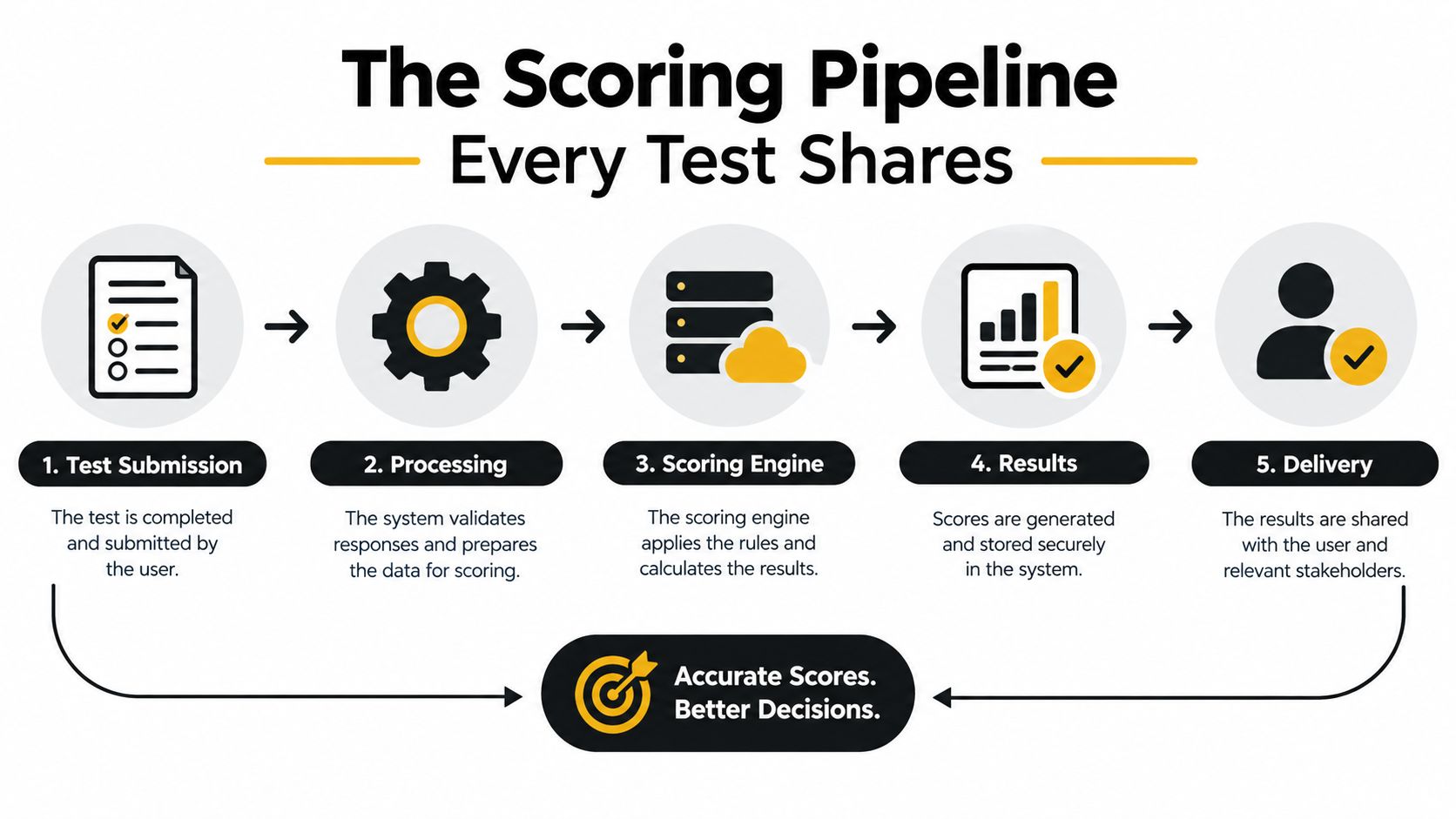
Every physical performance assessment can be treated as a four-stage measurement pipeline:
- Raw score, such as repetitions, seconds, kilograms, Newtons, stepping cadence or heart rate.
- Standardised metric, such as estimated VO₂, force in Newtons, time in seconds or a body-mass-normalised value.
- Reference frame, such as a UK age- and sex-specific dataset or a job-related threshold.
- Interpretation statement, such as a percentile band, pass, fail, borderline result or recommendation for further assessment.
The process resembles currency conversion. A sum in pounds can't be interpreted as euros until the exchange rate is known. In the same way, a grip result in kilograms can't be called “good” or “weak” until the practitioner identifies the protocol, reference population and purpose of the comparison.
Each transfer can introduce error
The raw score can be affected by positioning, verbal instruction, effort, device resolution, fatigue and assessor technique. The standardised metric adds calculation risk. A heart rate copied from the wrong stage, an incorrectly entered body mass or an unsuitable equation can change the reported result without changing the underlying performance.
The reference frame creates a different kind of risk. A population norm answers how a person compares with peers. An occupational threshold answers whether performance meets a defined role requirement. Those are not interchangeable questions, and a percentile mustn't be presented as a pass mark unless the governing standard explicitly says so.
For back and leg strength, the Takei Back and Leg Dynamometer measures leg and back strength using an adjustable chain, with analogue and digital display options that accommodate different user heights.
The record should travel with the result
Before a scored result leaves the assessment room, the record should contain:
- Protocol identity, including the test name, version and administration conditions.
- Raw observations, including all trials, stages, times, force values, heart rates and stopping reasons.
- Calculation method, including the equation, conversion table or software routine.
- Reference frame, including the dataset or occupational standard and its intended population.
- Decision rule, including pass logic, borderline handling and retest arrangements.
- Equipment record, including device identity, calibration status and any relevant environmental conditions.
- Assessor record, including the practitioner and any deviations from standard procedure.
This documentation turns a measurement into evidence. It also makes quality improvement possible because a later reviewer can identify whether disagreement arose during administration, calculation or interpretation.
Scoring Aerobic Tests and the Chester Step Test
A candidate reaches stage 3, records a heart rate of 167 bpm and asks whether that result is a pass. The assessor cannot answer from those three facts alone. The score depends on the protocol, the stopping rule, the calculation used and the occupational standard selected for comparison.
The Chester Step Test estimates aerobic capacity from a controlled submaximal heart-rate response. It does not measure VO₂ directly through breath-by-breath gas analysis. The standard protocol runs for a maximum of 10 minutes, in five two-minute stages at 15, 20, 25, 30 and 35 steps per minute (published Chester protocol).
A defensible scoring sequence begins with the observations made during administration:
- Confirm the stepping cadence and identify the last fully completed stage.
- Record heart rate at the specified point, rather than using a rounded or recalled value.
- Record Borg RPE and the reason for stopping.
- Apply the published Chester conversion to estimate METs.
- Convert METs to estimated VO₂ using 3.5 ml·kg⁻¹·min⁻¹ per MET, when that conversion belongs to the selected method.
- Compare the estimate with the named reference frame, such as an age- and sex-based norm or an occupational threshold.
Stopping is normally governed by 80% of age-predicted maximum heart rate and/or a Borg RPE of 14. The assessment is therefore limited by effort and heart rate, rather than automatically continuing to the maximum duration (occupational medicine discussion of the Chester Step Test). Do not extrapolate beyond the final prescribed stage, and do not score an incomplete stage as completed.
Why the estimate needs context
A submaximal equation predicts aerobic capacity from the observed response. Its uncertainty reflects individual differences in the relationship between stepping workload, heart rate and maximal aerobic capacity. The report should label the result estimated VO₂, identify the equation used and distinguish it from directly measured metabolic testing.
Normative and occupational comparisons answer different questions. UK fire and rescue research found strong associations between selection tests and criterion performance, with reported correlations and limits of agreement (UK fire and rescue personnel study). The findings support validated occupational testing, while still requiring the service to document how each individual score was produced.
The proposed example cannot be completed defensibly from the verified assessment information. The record does not supply the MET conversion for a 35-year-old male finishing stage 3 at 167 bpm, the relevant ACSM percentile for males aged 30 to 39 or an NFCC threshold for that exact case. Inserting values would create false precision.
| Stage completed | Final HR (bpm) | Estimated METs | VO₂ (ml·kg⁻¹·min⁻¹) | ACSM percentile (male, 30–39) | NFCC firefighter threshold |
|---|---|---|---|---|---|
| Stage 3 | 167 | Apply the published Chester conversion | Convert estimated METs using 3.5 per MET | Confirm against the selected ACSM reference | Confirm the governing role standard |
For operational decisions, obtain the threshold from the employer or regulator. A separate UK example is the Cumbria Fire “DGT” standard, which requires completion in 11 minutes 11 seconds and corresponds to an aerobic capacity of 42.3 ml·kg·min. That value must not be substituted for another service's rule, as cited above.
Store the Chester Step Test protocol with the service SOP, calculation method and report template. Frequent scoring errors include using a rounded final heart rate, missing the post-stage recording window, selecting the wrong sex-specific reference frame and extrapolating beyond stage 5. Each error can change the apparent result, so the raw record and decision rule should remain visible alongside the final score.
Scoring Strength and Functional Tests
A result becomes defensible only when the record separates what the person did from how the service interprets it. A handgrip dynamometer records force, a sit-to-stand records repetitions or time, and the Timed Up and Go records elapsed seconds. The assessor must define the protocol and decision rule before treating any output as a score.
UK grip-strength references use age- and sex-specific centiles rather than one universal cut-off. A large UK life-course study analysed 60,803 grip-strength observations from 49,964 participants and produced reference centiles across age and sex. For a 20-year-old male, the median was 40 kg and the 90th-centile value 52 kg. The corresponding female values were 28.4 kg and 36 kg (UK grip-strength centile study). The reference frame therefore belongs beside the measurement in the report.
Three tests, three interpretation problems
Handgrip scoring should retain each trial value, the hand tested, handle position, posture and encouragement. State whether the final result uses the best trial or a prespecified average. Absolute force may support role screening, whereas a relative value or age- and sex-adjusted position may better support clinical interpretation. Bilateral comparison can identify asymmetry, but the SOP must specify any threshold rather than leaving the assessor to choose one during reporting.
For the 30-second sit-to-stand, record the repetition count and the exact testing conditions. These include chair height, arm position, instructions and whether a partial repetition counted. A regression-based reference model can treat the count as a continuous observation, provided that the selected model matches the protocol. The five-repetition version produces a completion time instead, showing slower transfer performance even when the person completes the task.
The TUG records time across standing, walking, turning and sitting. Document the instructions, footwear, walking aid, start point and finish point. A measured time should not become an occupational pass decision unless the governing service has formally adopted that rule.
| Test | Raw output | Standardised metric | UK reference frame | Interpretation anchor |
|---|---|---|---|---|
| Handgrip dynamometry | Force per trial | Absolute, relative or age- and sex-adjusted score | UK population centiles and normative datasets | Percentile position, asymmetry flag or role threshold |
| 30-second sit-to-stand | Repetition count | Age-adjusted continuous score or z-score where validated | Selected functional reference dataset | Functional comparison, not an assumed pass mark |
| Five-repetition sit-to-stand | Completion time | Time-based reference value | Protocol-specific clinical dataset | Movement and transfer performance |
| Timed Up and Go | Seconds | Age-band reference value or centile | Selected TUG reference frame | Mobility interpretation and risk stratification |
The occupational decision should integrate test results with job demands, symptoms, relevant history and the stated threshold. A low grip percentile does not by itself establish inability to perform a role. Equally, an acceptable TUG does not demonstrate safe performance in a demanding emergency-service task. Keep the raw trials, protocol conditions, calculated metric and interpretation anchor visible, so another practitioner can reproduce the scoring decision.
Threshold Standards Versus Percentile Norms
A scoring decision becomes defensible only when the practitioner separates the role threshold from the population comparison. A threshold asks whether performance meets a defined requirement for a job. A percentile asks where the result sits within a reference population.
A firefighter service may require completion of a specified operational test. A police service may use a role-related aerobic or shuttle test. An NHS assessment may apply a task-specific manual handling requirement. In each case, the threshold belongs to the role, employer or governing procedure, not to a general population table.
The UK grip-strength study provides 10th, 25th, 50th, 75th and 90th centiles, allowing comparison with an age- and sex-specific population distribution, as noted in the UK life-course grip-strength reference cited earlier. That comparison can identify an unexpectedly low or high result. It does not become a pass mark because a candidate falls above or below a selected centile.
The two frameworks can sit in the same report
A clear report can record both outcomes without treating them as competing pass rules:
- Occupational outcome: “The candidate met or did not meet the specified role threshold under the stated protocol.”
- Normative context: “The result sits within the stated age- and sex-specific reference band.”
- Clinical or operational interpretation: “The combined findings support, limit or require further review of the stated duty.”
The first statement governs eligibility when the service has formally adopted that threshold. The second adds context. The third records the professional reasoning, but should not introduce a new pass rule.
A percentile describes position in a population. It does not create an occupational standard.
Silent mixing produces predictable errors. If a candidate must meet a threshold and is also failed because the percentile comparison appears low, the service may be applying two penalties to one performance domain. A strong percentile result should not override failure against a validated, job-related requirement.
UK fire and rescue testing illustrates the distinction. Research may examine how selection and field tests relate to criterion performance, while service procedures specify an operational pass standard. The report should state which element decides the case and which provides context. Keep that distinction visible when raw measurements are converted into occupational or clinical decisions.
A Worked Example Across Multiple Tests
A defensible multi-test decision starts with the record, not the final score. Consider David, 42, firefighter candidate, whose assessment includes Chester Step Test observations, grip trials, a 30-second sit-to-stand count and a TUG time. The example is fictional, so the purpose is to show how raw measurements become a traceable occupational decision without inventing results.
Record each observation before applying any equation or threshold. For every test, calculate the specified metric, identify the occupational standard for the firefighter role and select the relevant normative dataset separately. If those frames point in different directions, the report should explain the difference rather than compressing it into one unexplained rating.
David's assessment record
For the Chester Step Test, record the completed stage, cadence, final heart rate, Borg RPE and reason for stopping. Apply the published Chester conversion and label the output as estimated VO₂. Compare that estimate with the named role threshold, using the five-stage structure and stopping criteria set out in the Chester Step Test protocol described earlier. The heart-rate and RPE stopping approach should follow the occupational medicine source cited previously.
For grip strength, record three trials per hand where that is the service protocol. State whether the reported value is a prespecified mean, the best trial or another agreed measure. Include the left-to-right comparison and the selected UK reference dataset. UK reference values can provide age- and sex-specific centiles, but they do not supply David's fictional trial results or establish a universal occupational cut-off.
Sit-to-stand and TUG require the same separation between measurement and interpretation. A repetition count or completion time can be compared with a named reference frame. Do not create an age-adjusted z-score or centile unless the raw result and validated calculation method are available.
| Test | Raw score | Standardised metric | Threshold outcome | Percentile rank |
|---|---|---|---|---|
| Chester Step Test | Stage, heart rate, RPE and stopping reason recorded | Estimated VO₂ using the stated Chester method | Compare with the named firefighter role standard | Compare with the selected aerobic reference |
| Handgrip dynamometry | Three trials per hand | Prespecified mean, bilateral comparison and selected normalisation | Apply only if the role has a grip threshold | UK age- and sex-specific centile |
| 30-second sit-to-stand | Repetition count | Validated age-adjusted metric where available | Apply only if specified by the service | Functional reference position |
| Timed Up and Go | Completion time | Protocol-specific time interpretation | Apply only if specified by the service | Age-band reference position |
The written conclusion
A suitable conclusion would state whether David's aerobic result met the named role threshold, identify the normative band occupied by his grip result and describe the functional tests as supporting context. If a result was borderline, document the measurement limitation and apply the service's published retest rule. Do not turn uncertainty into an automatic fail.
The fictional record should contain no numerical outcome that has not been supplied by source data. Its value is the decision sequence: raw observation, standardised metric, reference frame, threshold verdict and percentile context.
That sequence also makes the report easier to use. David can see which finding affected the occupational decision, while the hiring manager can distinguish a job requirement from a population comparison. The same structure allows a clinical reviewer to trace the reasoning without mistaking normative context for a pass rule.
Reliability, Errors and Defensible Records
More tests don't automatically produce a better decision. Each additional test adds administration time, fatigue, equipment dependence and another opportunity for inconsistent scoring. The useful battery is the one that measures job-relevant capacities with a standardised protocol and a clear decision purpose.
Three safeguards support defensible records:
- Reliability: The same person, or different assessors, should obtain sufficiently consistent results under comparable conditions.
- Standardisation: Position, instructions, cadence, rest, encouragement, equipment and stopping criteria should be controlled.
- Auditability: Another practitioner should be able to trace the final interpretation back to the raw observations.
Interrater reliability matters particularly when several assessors share a service. A 2025 UK study of adult grip-strength testing examined interrater reliability and produced new age-, sex- and hand-stratified reference values, reinforcing that scoring quality depends on both measurement consistency and the chosen reference frame (UK grip-strength reliability study).
Common errors need named controls
The following table is a governance template, not a licence to invent universal numerical triggers. Each service should populate the reliability field from the validation evidence for its own protocol and equipment.
| Test | Reported ICC / CV% | Common scoring error | Retest trigger |
|---|---|---|---|
| Chester Step Test | Use the validation evidence for the adopted protocol | Miscounted cadence, wrong heart-rate ceiling or stage extrapolation | Borderline result, protocol deviation or unclear stopping point |
| Handgrip dynamometry | Use the device and protocol validation record | Early rounding, inconsistent handle position or mixed trial rules | Suspected assessor or equipment error, or result near the decision boundary |
| 30-second sit-to-stand | Use the selected functional test reliability record | Counting partial repetitions or changing arm instructions | Unclear repetition count or material protocol deviation |
| Timed Up and Go | Use the selected TUG reference and reliability record | Different start point, walking aid or verbal instruction | Start or finish ambiguity, interruption or unsafe execution |
The service should define rest intervals, calibration cadence and retest authority in advance. Those values can't be borrowed casually from another test because fatigue, learning and recovery behave differently across aerobic, strength and functional measures.
A report should also disclose whether the assessor used a best trial, mean, median or first valid attempt. The fitness testing reliability guidance can support the development of a consistent approach, but the final SOP still needs to name the exact tests, devices and rules used by the service.
Cartwright Assess is being developed as professional assessment software for standardising tests, calculating and interpreting results, maintaining assessment histories and generating professional reports. A structured platform can provide a more controlled home for scoring governance than disconnected spreadsheets, provided the underlying protocols, references and decision rules are properly configured.
Putting It Into Practice in Your Service
A UK occupational health or physiotherapy service can make scoring governance practical within one clinical governance meeting. The handover should produce a short SOP, a report template and an audit checklist.
- Name the reference frame: Record the normative dataset or occupational threshold behind every test currently in use.
- Publish the pipeline: Define the route from raw score to standardised metric, reference comparison and interpretation.
- Separate decisions: State whether each test informs a percentile description, a pass/fail threshold or both.
- Control retesting: Specify when a repeat is allowed, who authorises it and how the original result remains visible.
- Control equipment: Record calibration, device identity and any setting that could affect measurement.
- Audit the report: Check that a second practitioner can reproduce the conclusion from the recorded data.
The UK evidence supports this emphasis on reference frames and consistency. Grip-strength research provides age- and sex-specific centiles, while fire and rescue research links validated field tests with operational criterion performance. Neither replaces local governance. The service still has to decide which standard applies to each role and how borderline cases are handled.
The immediate next step is specific: pilot the SOP on the next three assessments, audit one completed report against the checklist and record every ambiguity before scaling the process across the service. That small governance exercise will expose missing equations, unclear thresholds and inconsistent retest decisions while correction is still manageable.
Cartwright Fitness supplies professional equipment, software and assessment solutions for aerobic and VO₂ testing, Chester Step Test delivery, grip and dynamometry, back and leg strength, body composition, metabolic assessment and occupational fitness testing. Visit Cartwright Fitness to review the professional measurement options and build a scoring workflow that your practitioners, candidates and clinical reviewers can audit.