

You're in the room with a client, a patient, or a worker who needs a clear answer, not a clever spreadsheet. The complaint sounds simple, maybe fitness has dropped, return-to-work looks uncertain, or an athlete wants a number they can trust, but the actual question is whether the test you choose will produce a result that changes a decision. That's where performance assessment methods stop being a catalogue of tools and become a practical judgment about validity, reliability, equipment, and the cost of being wrong.
Table of Contents
- What Performance Assessment Methods Actually Measure
- The Five Core Categories of Physical Performance Tests
- Cardiorespiratory Testing From Lab to Step Test
- Strength, Power, and Body Composition Protocols
- Validity, Reliability, and the Root Cause of Bad Data
- Choosing the Right Method for Your Setting
- Common Misreads and How to Avoid Them
What Performance Assessment Methods Actually Measure
A nurse says the patient “looks better.” A manager says the team member “seems ready.” A coach says the athlete is “probably fine.” Those instincts can be useful, but they're not assessment. Performance assessment methods are built to make the person produce something, then have a trained rater judge it against explicit criteria. The principle is simple, the execution isn't.
That's why constructed-response tasks sit in the same family as writing samples, portfolios, exhibitions, simulations, science experiments, and oral interviews. The person has to create an answer or product, not pick the right box on a list, and that makes the method stronger when the world skill is production rather than recognition. The trade-off is scoring complexity, because a human rater has to judge quality against criteria instead of checking a single key, which is exactly why good rubrics matter. The core technical distinction is described clearly in the Princeton overview of performance assessment, which frames these tasks as performance-based rather than recognition-based methods. Princeton performance assessment overview
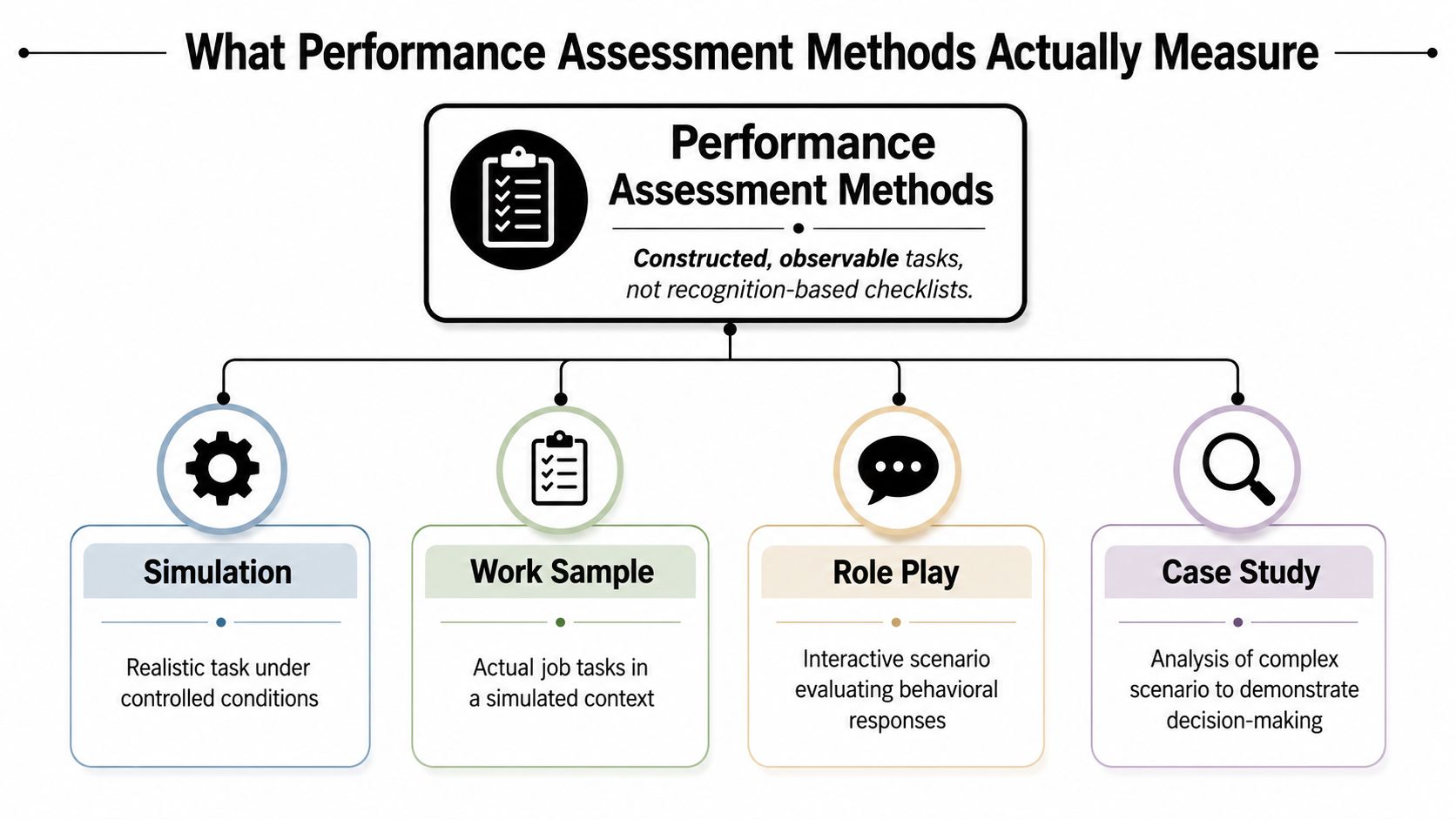
What the result really tells you
A sound test tells you more than “good” or “bad.” It gives you a repeatable performance sample, a scoring framework, and enough context to decide whether the result reflects capacity, confidence, familiarity, or compensation. In practice, that means the value of the method comes from the task design, the rating criteria, and the conditions under which the person performs.
Proxy measures are different. Organisations often use output counts, checklist compliance, or a single easy-to-record metric when direct observation is hard, but those proxies can miss what matters most. A high output number might hide poor quality, and a clean-looking score can still be distorted by workload, role design, or team dependence.
Practical rule: if the task does not resemble the real decision, the score usually looks cleaner than it deserves.
For a practitioner, that changes the question from “What test is available?” to “What evidence do I need before I trust the result?” If the answer needs to support referral, return-to-work, athlete profiling, or clinical monitoring, the method has to produce an observable performance sample, not just a convenient label. For practitioners who need a sports-specific conditioning example, this sprint drag carry training advice piece shows how a practical task can be linked to the demand of the job rather than to a vague notion of fitness.
The Five Core Categories of Physical Performance Tests
The easiest way to choose a test is to stop thinking in brand names and start thinking in questions. Does the person have enough engine, enough force, enough explosive output, the right body composition, or the functional capacity to do the task in front of them? Those are not the same problem, and they should not be measured with the same tool.
The five categories and the question each one answers
Cardiorespiratory tests ask whether the person can sustain oxygen delivery and utilisation under load. Think of it as engine size, not driving style. A maximal lab test or a validated step test can answer different versions of that question depending on how much precision you need and how much burden the person can tolerate.
Muscular strength tests ask how much force a muscle group can produce against resistance. Grip dynamometry, hand-held dynamometry, and one-repetition maximum testing all live here, but they answer different clinical and training questions. Grip strength is quick and useful as a broad indicator, while a specific lift tells you more about task-specific force production.
Muscular power tests ask how quickly force can be expressed. A jump mat, timing gates, or a force plate can show that better than a slow maximal lift can, because power is about rate as much as output. If the sport or job needs acceleration, jumping, or rapid repositioning, strength alone won't tell the full story.
Body composition methods ask what the body is made of, and that includes fat mass, lean tissue, and in some settings regional distribution. Skinfolds, bioimpedance, ultrasound, and DEXA can all help, but they don't solve the same problem and they don't fit the same setting. For day-to-day practice, the right choice is usually the one that is repeatable, defensible, and realistic to run.
Functional or rehab tests ask whether the person can do a specific movement or task safely and consistently. Sit-to-stand tests, walking tests, reach tests, and job-specific simulations sit here. These are often the most honest tests in clinical work because they stay close to the actual demand rather than trying to infer capacity from a distant proxy.
What tends to work, and what gets oversold
Commercial settings sometimes oversell the most elaborate device as if expense alone guarantees insight. It doesn't. A simple test run with good protocol control often gives more usable information than an intricate system used badly, and that's especially true when the question is practical rather than research-grade.
Clinical takeaway: choose the category that matches the decision, then choose the device that can repeat that decision reliably.
The best practitioners I've worked with start with the question, then pick the narrowest test that can answer it without introducing unnecessary noise. That keeps the assessment useful and saves the client from paying for data they can't act on.
Cardiorespiratory Testing From Lab to Step Test
Cardiorespiratory testing is where equipment choice most obviously shapes the result. If you want the most detailed physiological picture, a laboratory protocol with a metabolic analyser can give you that. If you need a practical screening answer in an occupational, community, or clinic setting, a validated sub-maximal field test is often the better decision.
Laboratory testing versus field testing
A maximal laboratory protocol asks the person to work to exhaustion under controlled conditions while gas exchange is measured directly. That is the cleanest route when you need high-resolution data, specialist supervision, and strong control over confounders. It also asks more of the client, needs more room and more equipment, and depends on operator skill that not every service can support every day.
A validated step test is a different decision, not a weaker one. The Chester Step Test, for example, is built for practical aerobic screening and repeat testing, and Cartwright Fitness offers protocols and equipment for that workflow, including the official VO2 max measurement approach. The point is not to mimic a lab at lower cost. The point is to produce a defensible estimate that fits the setting.
That same logic is why a client might use the check your cardio fitness biomarker resource as a quick educational reference, while the actual service uses a proper protocol with controlled cadence and recovery checks.
What has to be controlled
With a step test, the details matter. Step height has to stay fixed, cadence has to be followed exactly, test duration has to be consistent, and heart rate capture has to be reliable. If any of those drift, you've moved from a validated estimate to a noisy guess.
The reason sub-maximal tests keep their place is simple. They reduce burden, they're easier to repeat, and they're safer for many people who don't need or can't tolerate a maximal effort. In practice, that makes them the workhorse for occupational health screening and many community settings, where the question is usually readiness, trend, or broad risk rather than a lab-grade physiological ceiling.
Practical rule: if you can't control cadence, timing, and heart rate collection, you don't have a step test, you have an improvised walk-up.
The other advantage is client tolerance. A controlled sub-maximal test often gets better cooperation and less anxiety, which improves the quality of the session and the usefulness of the result. For many services, that trade-off is exactly what makes the test worth running.
Strength, Power, and Body Composition Protocols
Strength, power, and body composition are the assessments most practitioners run repeatedly, so they're also the ones most likely to get sloppy. The protocol looks straightforward on paper, then the world gets involved, with fatigue, warming-up habits, machine setup, and operator consistency all affecting the result.
Strength and power tests in plain terms
Grip dynamometry is quick, portable, and surprisingly useful as a broad strength marker. The protocol needs the same hand position, the same encouragement style, and a standard posture from one session to the next. If those don't stay consistent, the comparison gets muddy fast.
One-repetition maximum testing is more specific. It answers a clear force question for a chosen movement, but it only works well when the person is familiar with the lift, the warm-up is sensible, and rest periods are adequate. In rehab or deconditioned clients, submaximal estimation or task-based alternatives often make more sense than chasing a true maximal lift.
Jump mats and force plates are your best friends for power, because they capture the speed element that strength testing misses. They're valuable when you care about explosive capacity, landing strategy, asymmetry, or change in output over time. Their usefulness depends on reproducible setup, stable surface conditions, and a protocol the athlete can repeat without learning a different movement pattern every session.
Body composition choices that actually fit the setting
Body composition is where people overspend and still get poor decisions. Skinfolds can be practical if the assessor is trained and the same measurer repeats the test. B-mode ultrasound systems, including devices such as BodyMetrix, give useful regional soft tissue information when the operator knows the landmarks and the software is used consistently. DEXA and BIA have their place, but the right answer depends on the client, the decision, and the service model, not on which machine sounds most impressive.
For a client wanting a workflow overview, this body composition testing guide is useful because it frames the choices around method rather than hype. The most expensive option is not automatically the most appropriate one, and in routine practice that's a point worth repeating.
| Method | What it measures | Typical setting | Equipment example |
|---|---|---|---|
| Grip dynamometry | Hand and forearm strength | Clinic, occupational health, rehab | Hand dynamometer |
| One-repetition maximum | Maximal force in a specific lift | Gym, sport science, rehab | Barbell and plates |
| Jump testing | Explosive lower-body power | Sport lab, training facility | Jump mat or force plate |
| Skinfolds | Subcutaneous fat estimate | Gym, university, clinic | Calipers |
| B-mode ultrasound | Regional tissue thickness | Clinical or applied sports setting | BodyMetrix system |
What to record every time
The result alone isn't enough. Record the test position, warm-up, number of attempts, rest intervals, device used, and any pain or technique limitation that could change interpretation. If a client wants “muscle mass” or “fat loss,” the test has to be tied to a repeatable method, not a casual estimate from the nearest device on the shelf.
Validity, Reliability, and the Root Cause of Bad Data
Bad data usually looks reasonable at first. That is what makes it dangerous in practice. A score can be neat, formatted, and easy to explain, while still being the wrong measure for the decision or the wrong number for the person on the day.
The three questions that matter
Validity asks whether the test measures the thing you need for the decision in front of you. If the question is return-to-work lifting tolerance, a general wellness proxy may be too loose to support the call. If the question is athletic explosiveness, a slow controlled movement can miss the quality you are trying to assess.
Reliability asks whether the same person will get the same answer again under the same conditions. A test that swings widely from one session to the next is hard to use for progression, referral, or clearance. In practice, reliability depends on protocol consistency, rater training, and equipment setup, and those details are often what separate useful numbers from tidy noise. A clear framework for assessment reliability protocols helps keep those variables under control.
Root cause analysis is the discipline of asking why the number looks wrong instead of blaming the person being tested. Brendan Gregg's methodology for operational performance analysis starts with symptoms, then works through measurement and decomposition until the origin is clear, which is a useful model for assessment work too. The same logic applies when a result feels off. Define the problem, check what was measured, inspect the pathway, and only then decide whether the issue is the person, the protocol, or the device. Brendan Gregg methodology
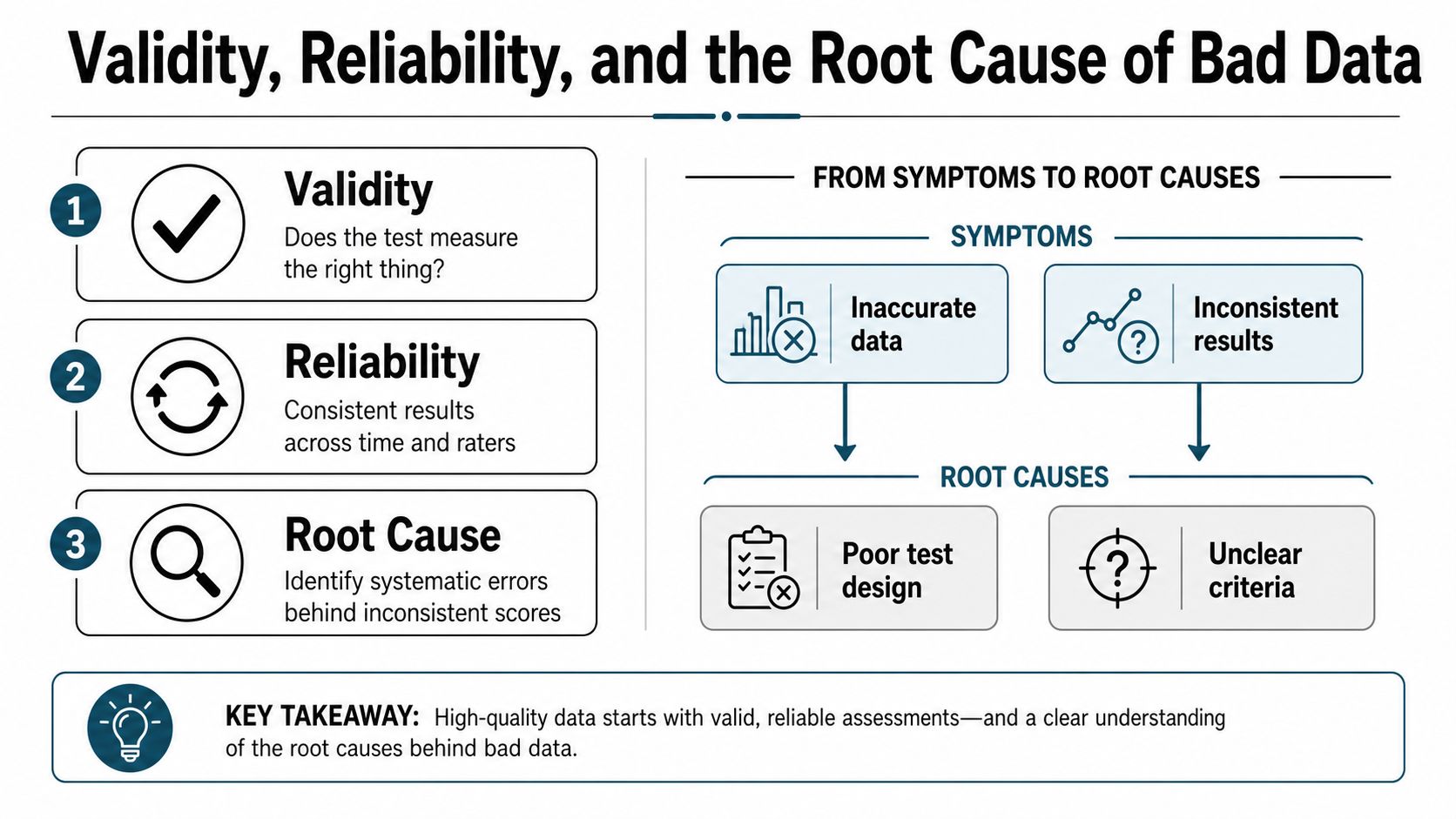
Bad numbers usually come from a few places. The task can be wrong for the decision, the assessor can drift from the protocol, the device can be poorly matched to the setting, or the client can perform under different conditions than last time.
A quick checkpoint before you trust the number
- Does the task match the decision? If not, the result may be tidy but not useful.
- Can another trained assessor reproduce it? If not, the method is too loose for high-stakes use.
- Are the criteria explicit? If the rater is improvising, scoring will drift.
- Is the device appropriate for the setting? Overly complex equipment can create avoidable failure points.
- Did the person perform under comparable conditions? Fatigue, pain, and unfamiliarity all change interpretation.
A good way to keep this honest is to tie the test to the decision before the first rep, then check whether the protocol holds up on the second and third run. That matters in clinical referral, athlete profiling, and return-to-work decisions, because the number only has value if it can be defended when someone asks how it was produced. For a practical view on measuring recovery outcomes, the same principle applies, the measure has to match the change you want to track.
The wider appraisal literature makes the same point in a different setting. Common methods often have known weaknesses, and systems are sometimes used because they are familiar rather than because they are validated for the specific decision. That is why the practical question is not what method is popular. It is what method is valid for promotion, coaching, compliance, or clinical competency in this case? A review of appraisal practice
Practical rule: if you cannot explain the error source, do not pretend the number is precise.
Choosing the Right Method for Your Setting
The right method depends on what you need to decide, not on which assessment looks most complete. A service that screens return-to-work capacity needs different tools from a sport lab chasing power outputs, and both differ from a rehab clinic that tracks functional change over time.
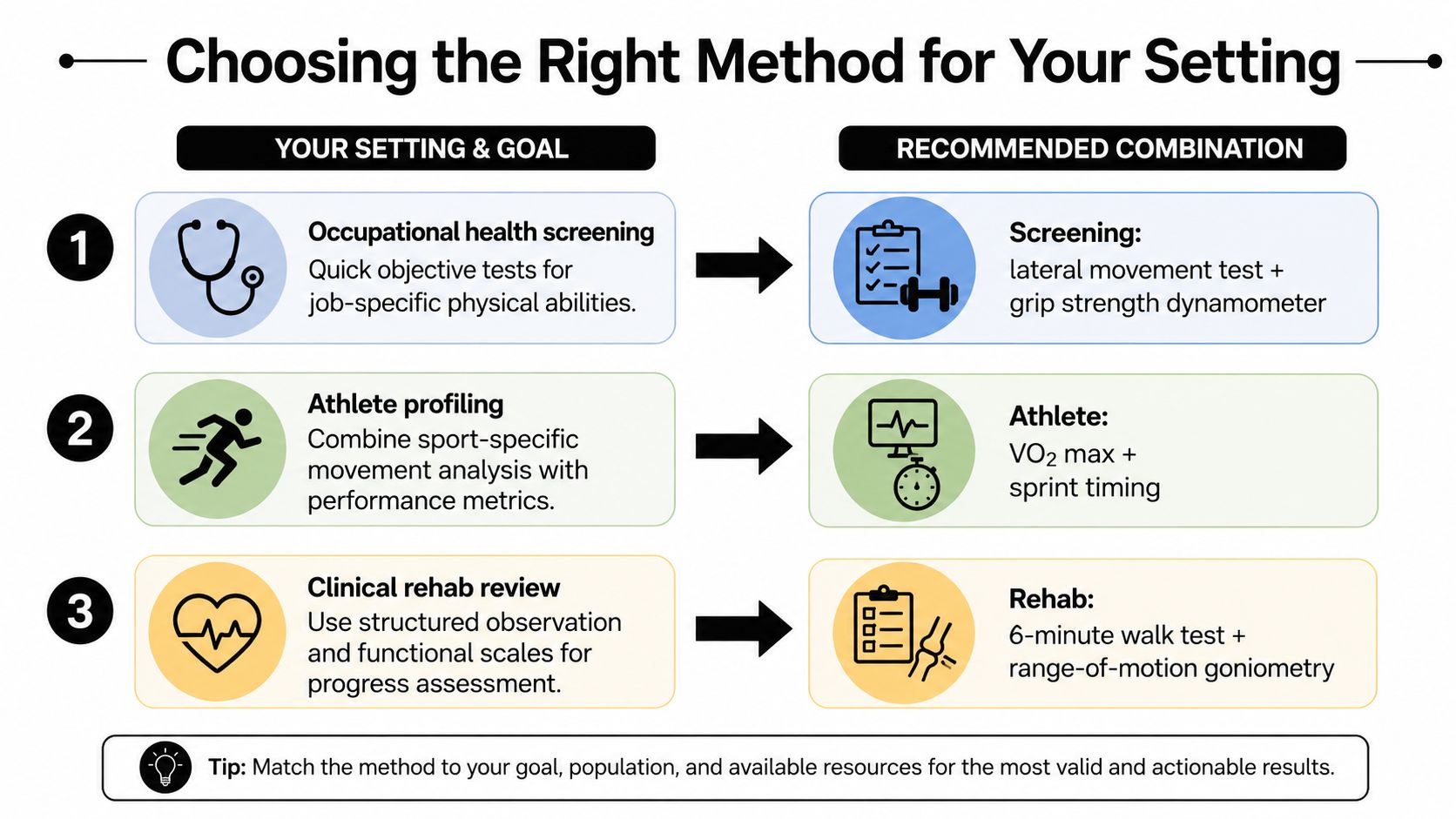
Three practical scenarios
Occupational health screening usually needs quick, objective tests with low burden. A lateral movement screen, grip dynamometry, or a validated step test can give a defensible answer without overbuilding the service. The equipment tier can stay modest as long as the protocol is standardised and the operators are trained.
Athlete profiling usually needs a combination approach. You might pair VO2 max testing with sprint timing or jump assessment, depending on the sport and the question. That's where higher-end equipment, including metabolic analysers or force platforms, earns its keep, because the output has to inform training decisions, not just fill a report.
Clinical rehab review usually benefits from structured observation and functional scales. A 6-minute walk test, range-of-motion goniometry, or a task-specific movement assessment often says more than a flashy machine. The important thing is repeatability, clinical relevance, and the ability to track change across visits.
Equipment tiers and credibility
Validated step-test kits, hand dynamometers, goniometers, jump mats, and metabolic systems all sit on the same spectrum, but the choice should follow the decision. Consumables matter too, because a service that runs out of sensors, calibration checks, or replacement parts loses credibility fast. Training seminars help, but only if they're tied to the protocol you use, not to a generic overview that leaves staff improvising at the point of care.
Cartwright Fitness is one option for services that need validated equipment, including Chester Step Test tools, BodyMetrix ultrasound systems, and Cosmed metabolic analysers. The practical value is in matching the kit to the setting, then keeping the process repeatable.
Common Misreads and How to Avoid Them
The biggest mistake is assuming more data automatically means better assessment. More numbers can just mean more ways to confuse a client, especially when the measures aren't answering the same question or don't fit the setting. In health care, systems are often used because they're familiar, not because they're the right tool for the decision, and that habit can damage judgement.
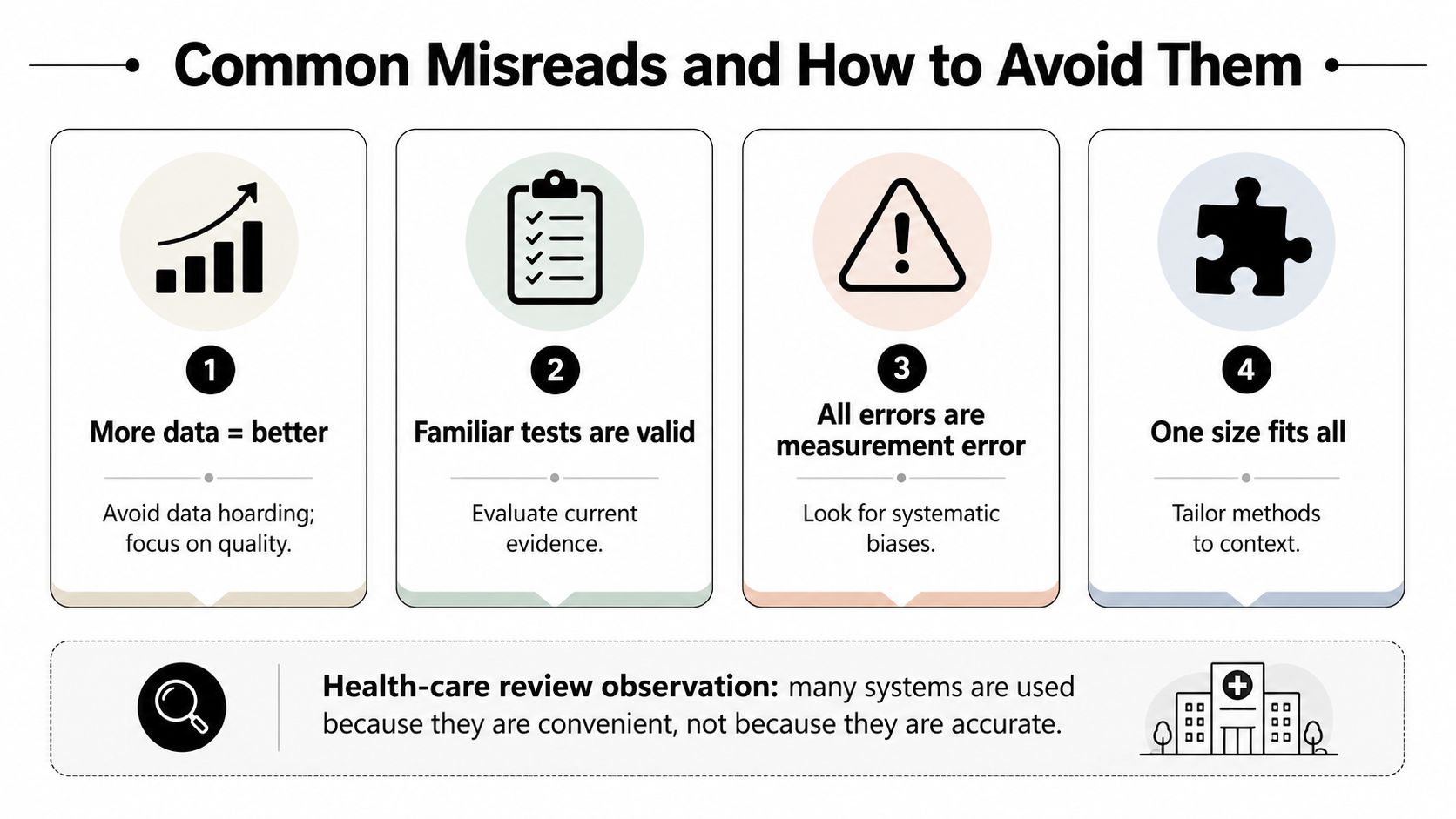
Four errors that keep showing up
More data equals better is the easiest trap to fall into. Avoid data hoarding, and keep only the measures that inform the decision.
Familiar tests are valid is another common shortcut. A test that's been used for years still needs to be checked against the current question.
All errors are measurement error is too simplistic. Sometimes the problem is systematic bias, not random noise.
One size fits all fails in occupational health, sport, and rehab. Tailor the method to the setting, the person, and the decision.
The workplace literature also warns that proxy measures and easy-to-count outputs can distort judgement when they're used alone. That means you need behavioural evidence, objective indicators, and human judgment balanced against each other, not one measure pretending to be the whole story. If the number doesn't fit the case, the answer isn't to add more numbers, it's to fix the method.
Cartwright Fitness supports practitioners who need assessment tools they can defend in front of clients, employers, and clinical teams. If you're choosing between step testing, body composition methods, or metabolic systems, visit Cartwright Fitness to review the equipment and protocols that fit your setting.