

A warehouse operative returns after several weeks away with “general fatigue”. A short appointment records resting observations, asks a few questions and concludes that the worker can resume a demanding shift pattern. The decision appears efficient, but it doesn't answer the questions that matter: can the worker tolerate the actual manual-handling demands, has capacity changed from their previous baseline, and is recovery improving or deteriorating?
That is where a properly designed occupational health assessment differs from a generic medical screen. The assessment connects validated physical tests, clinical history, exposure information and job demands, then records the findings so later decisions can be compared with an established baseline. It supports recruitment, fitness-for-work decisions, health surveillance, rehabilitation and return-to-work planning without reducing the worker to a single pass-or-fail result.
Table of Contents
- The Real Job of an Occupational Health Assessment
- What an Occupational Health Assessment Actually Covers
- Legal and Ethical Foundations for UK Practice
- Core Tests and Validated Protocols Practitioners Use
- Interpreting Results Against Real Job Demands
- Designing a Defensible OH Assessment Programme
- Best Practice Checklist for OH Practitioners and Employers
The Real Job of an Occupational Health Assessment
A quick screening appointment can identify an obvious problem. It rarely explains whether a worker can safely perform a specific job over a full shift, under realistic environmental and operational pressures. The warehouse example illustrates the weakness of treating assessment as a one-off clearance. “Fatigue” may relate to sleep, medication, cardiometabolic health, psychological strain, deconditioning, shift rotation or a combination of factors, and a brief consultation won't establish the functional consequences of each possibility.
A senior practitioner starts with the job, not the test menu. The assessment should identify lifting frequency, carrying distance, awkward postures, walking requirements, work at height, exposure to noise or dust, emergency response expectations, shift length and opportunities for recovery. Those demands determine which measurements are relevant and whether the worker needs a clinician-led examination, a functional assessment, health surveillance or a referral for further investigation.
Why a single visit gives false confidence
HSE health-surveillance guidance describes repeated checks used to identify ill health caused by work. Health surveillance is one part of occupational health, and HSE distinguishes it from general health screening, health monitoring and health promotion. Select surveillance according to the relevant exposure and risk assessment; do not treat every fitness-for-work consultation as a surveillance programme.
A useful record therefore contains more than a conclusion. It should show:
- The role demand: What the worker must physically and cognitively do.
- The protocol: Which test was selected, under what conditions and by which competent practitioner.
- The result: Raw values, symptoms, perceived exertion and relevant observations.
- The interpretation: How the result relates to the task, not to an arbitrary universal standard.
- The follow-up: Adjustments, rehabilitation, repeat testing or clinical escalation.
Practical rule: A fitness-for-work opinion should be traceable from job demand, through measurement, to action.
Digital contact can strengthen follow-up when workers are dispersed or unable to attend every appointment in person. Used with appropriate consent, secure records and clear escalation criteria, remote consultations can support symptom review, rehabilitation conversations and monitoring between formal assessments. They shouldn't replace an examination or validated physical test where those are necessary.
The scale of the problem makes this systematic approach difficult to dismiss. HSE estimated that 1.9 million workers in Great Britain were suffering from work-related ill health in 2024/25, with 52% linked to stress, depression or anxiety, 27% to musculoskeletal disorders and 21% to other illness types (HSE statistics). The same release estimated 35.7 million working days lost to work-related illness, compared with 4.4 million days lost to non-fatal workplace injury, and 40.1 million total days lost from illness and non-fatal injury combined. A programme that measures only injury risk is therefore incomplete.
What an Occupational Health Assessment Actually Covers
An occupational health assessment is a structured evaluation of health, physical capacity and work-related risk against the demands of a defined role. It isn't automatically a full medical examination, and it shouldn't become a collection of fashionable tests that produce data without a decision pathway.
Start with the referral question and relevant workplace risks. A return-to-work consultation, a role-specific fitness assessment and a statutory health-surveillance programme have different purposes. The practitioner should select the appropriate assessment and agree what findings will trigger advice, follow-up or referral.
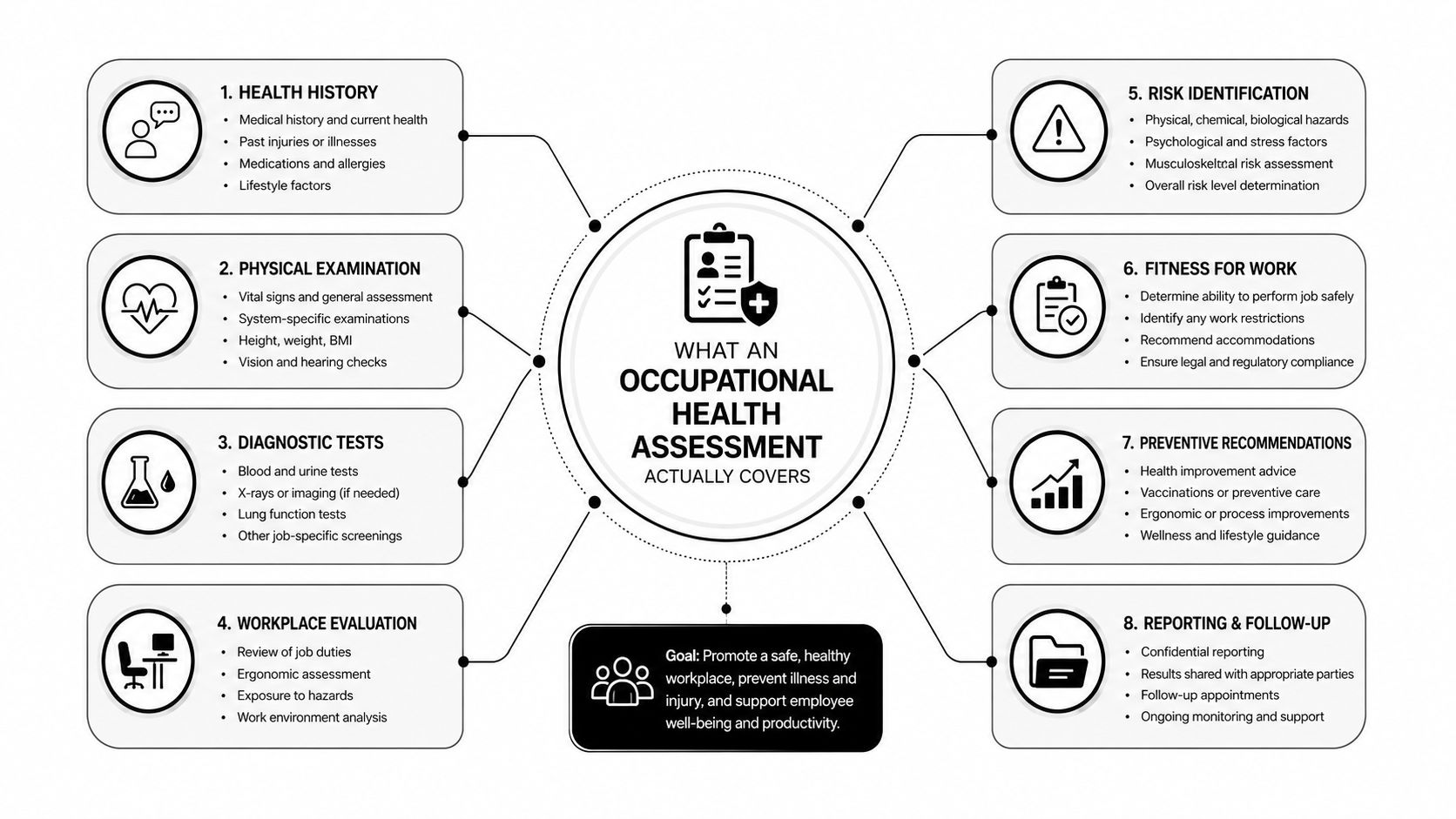
Match each domain to a workplace question
Aerobic assessment helps explore tolerance for sustained walking, stair climbing, emergency response or physically demanding shifts. A step test can be appropriate where the protocol, contraindication screening and stopping rules are controlled.
Musculoskeletal assessment should examine exposure to manual handling, repetition, force and awkward posture. HSE estimates 511,000 workers affected by work-related musculoskeletal disorders in 2024/25, with 7.1 million working days lost and WRMSDs representing 27% of work-related ill-health cases (HSE 2025 statistics, pages 3 and 5). These figures support targeted assessment, not blanket testing of every employee.
Body composition and anthropometry can help describe physical characteristics relevant to equipment fit, load carriage or clinical risk, but they shouldn't be used as crude proxies for competence or suitability.
Metabolic markers may support cardiovascular risk conversations or clinical referral. Point-of-care testing requires quality control, trained operators and a clear governance process. For example, the Cobas b 101 HbA1c Panel Control is for use with the Cobas b 101 device and supports quality-control checks using a control solution with lot-specific target ranges supplied through a QC information disc. Follow the applicable manufacturer instructions for the instrument, test and control lot; see Roche’s HbA1c method sheet for an explanation of the QC information disc.
Sensory and psychological domains become central where hearing, vision, stress, concentration or decision-making affect exposure to harm. The assessment must distinguish a health finding from an unsupported judgement about capability.
Pre-placement assessments answer whether known requirements can be met with suitable adjustments. Periodic assessments monitor change. Statutory surveillance applies where legislation and exposure risk require it. Executive assessments may be broader, but they still need a defined clinical purpose and shouldn't be confused with fitness-for-work certification.
Legal and Ethical Foundations for UK Practice
A defensible UK occupational health assessment demonstrates necessity, proportionality, competence and confidentiality. A generic health screen can fail on all four points if it collects information unrelated to the job, applies an unexplained threshold or sends excessive clinical detail to a manager.
In Great Britain, the Equality Act 2010 places a duty on employers to make reasonable adjustments where the duty applies. Acas explains the requirements and practical examples, including when an employer knows, or could reasonably be expected to know, that someone is disabled. An assessment should describe relevant functional effects and possible adjustments, helping the employer reach an informed decision. Northern Ireland has a separate legal framework.
ICO guidance on workers’ health information explains that processing health data requires both an Article 6 lawful basis and an Article 9 special-category condition, with any applicable Data Protection Act 2018 safeguards. Document these before processing, limit collection and access to what is necessary, and define retention. Consent is not an automatic solution in employment: the ICO warns that a power imbalance can prevent it being freely given.
| Duty | Source | Practical implication for OH assessment |
|---|---|---|
| Reasonable adjustments | Equality Act 2010 | Describe functional limitations and workable adjustments, not just a binary outcome. |
| Data minimisation and confidentiality | UK GDPR and Data Protection Act 2018 | Separate clinical records from management advice and disclose only necessary information. |
| Risk assessment and controls | HSE: managing risks and risk assessment at work | Identify workplace hazards, assess the risk of harm and eliminate or control the risk. Use relevant occupational-health findings to inform these controls. |
| Consent and professional confidentiality | GMC consent guidance, GMC confidentiality guidance and the NMC Code | Explain the assessment, obtain appropriate consent and protect information from unnecessary disclosure. |
When seeking a report from a worker’s treating doctor, follow the applicable medical-report process. Acas guidance on obtaining a doctor’s report explains permission, written information about rights under the Access to Medical Reports Act 1988, and the worker’s options to see the report, seek corrections or withhold sharing. Request only the information needed for the workplace question. Acas also explains permission before sharing an occupational health assessment with an employer.
A robust report avoids statements such as “no concerns” when the actual assessment was limited. It identifies the task, the evidence reviewed, the limitations of the assessment and the review point. Clinical professionals should also recognise their obligations under GMC or NMC guidance, particularly around consent, confidentiality, candour and working within competence. Secure data management systems can help separate identifiable clinical information from controlled management outputs, but technology can't correct a poorly defined purpose.
Core Tests and Validated Protocols Practitioners Use
Test selection should follow the risk assessment. The most useful battery is often smaller than the one proposed by a supplier, because each additional test creates training, calibration, interpretation and data-governance requirements.
Aerobic capacity and occupational fitness
The Chester Step Test is a progressive, submaximal assessment that estimates aerobic capacity. In Kevin Sykes’s 2018 description, heart rate and perceived exertion are recorded at two-minute stages, with a described endpoint of 80% of maximum heart rate and/or RPE 14 and a maximum duration of 10 minutes. Use the applicable manual for the selected test variant, step height, heart-rate calculation and stopping rules; consult the Chester Step Test protocol guide when planning delivery.
The protocol's value lies in standardisation, not in pretending that a predicted VO₂ result is a direct measure of every occupational task. It requires pre-test screening, appropriate supervision, reliable heart-rate measurement, a consistent platform and a plan for abnormal symptoms. High-risk workers, symptomatic participants and those with relevant medical concerns need clinician-led decisions rather than an improvised test.
Strength, composition and clinical markers
Grip-strength reference values describe a population; they do not by themselves establish an occupational pass mark. Dodds and colleagues’ 2014 British reference study combined 60,803 observations from 49,964 participants across 12 studies and produced age- and sex-specific centile curves for ages 4 to 90 years. Select a reference appropriate to the participant and measurement method, record the tested hand and technique, and interpret the result alongside symptoms and the actual job demand.
Back and leg dynamometry records force during a specified isometric pulling task. Standardise posture, handle height, instructions and trial selection, and document symptoms separately. A single combined pull result does not quantify left–right asymmetry or establish a safe workplace lifting limit. Select and interpret the test against the demands of the role. Bioelectrical impedance and skinfolds can describe body composition, while anthropometry may be more useful for equipment fit and workspace design than for selection decisions.
| Domain | Validated protocol | Equipment | Primary output |
|---|---|---|---|
| Aerobic fitness | Chester Step Test | Step, metronome, heart-rate monitor | Stage response, heart rate, RPE and estimated aerobic capacity |
| Hand strength | Standardised grip dynamometry | Jamar or comparable dynamometer | Side-specific force and comparison with appropriate norms |
| Back and leg strength | Controlled isometric dynamometry | Professional back or leg dynamometer | Force in the specified test posture; symptoms recorded separately |
| Body composition | Standardised BIA or skinfold protocol | Validated analyser or callipers | Repeatable anthropometric and composition measures |
| Metabolic screening | Laboratory or governed point-of-care testing | Approved analyser and QC materials | Marker result for clinical interpretation |
| Respiratory assessment | Spirometry under a suitable surveillance protocol | Calibrated spirometer | Lung-function measures and quality indicators |
| Functional capacity | Job-specific functional task assessment | Task equipment and observation tools | Tolerance, technique, symptoms and restrictions |
Respiratory surveillance should follow the substance, exposure and risk assessment. HSE COSHH guidance explains when surveillance is needed and identifies lung function as one possible assessment; this does not make spirometry a universal annual test for every worker. For noise-related risk, follow HSE hearing-surveillance guidance, using suitable hearing checks, records, feedback and medical review where hearing damage is identified.
Functional movement screens may help identify movement limitations, but they don't independently prove that a worker can perform a safety-critical task. A job-specific functional capacity evaluation, clinician review or supervised work simulation may be more defensible.
Interpreting Results Against Real Job Demands
The same physiological result can mean different things in different jobs. A borderline aerobic result from the Chester Step Test may warrant limited action for a desk-based analyst whose role involves occasional walking, while the same result in a firefighter with an outcome medical may require escalation because the operational demand, consequence of fatigue and medical standard are different.
Interpretation therefore needs more than a reference range. It should triangulate the task, the individual and the trend. The practitioner should ask whether the person can perform the task safely today, whether the finding is changing over time, whether an adjustment closes the gap and whether the evidence supports a manager-led plan or clinical referral.
Four questions for every report
- What must the worker do? Name the task, duration, force, posture, pace, environment and recovery opportunity.
- What does the measurement show? Record the protocol, raw result, symptoms, perceived exertion, validity concerns and test conditions.
- What has changed? Compare with the person's own baseline where available, rather than relying only on population norms.
- What happens next? Specify restrictions, adjustments, rehabilitation, repeat assessment or referral, with a review point.
This approach protects against two common errors. The first is false reassurance from a result that falls within a broad reference range but doesn't reflect the job. The second is unnecessary exclusion based on a low value that could be managed through equipment changes, pacing, staged duties or rehabilitation.
A functional capacity evaluation can make the conclusion more task-specific by examining how the person performs relevant activities under controlled conditions. Guidance on what a functional capacity evaluation involves can help OH teams distinguish general fitness testing from structured assessment of work-related capacity.
A defensible conclusion doesn't say that a worker is “fit” in the abstract. It says whether the assessed evidence supports the defined duties, with stated controls and review conditions.
Longitudinal interpretation is especially important after absence or rehabilitation. A single result may reflect pain, anxiety, unfamiliarity with the test or temporary deconditioning. Repeating a validated protocol under comparable conditions can show whether capacity is stabilising, improving or drifting, but it shouldn't delay referral when symptoms or clinical findings require investigation.
Designing a Defensible OH Assessment Programme
A programme becomes defensible when every assessment has a reason, every result has an owner and every trigger leads to an agreed action. The design should begin with a role and hazard map, then group workers according to exposure, task demand and clinical pathway rather than job title alone.
Build the programme around decision points
Start by defining cohorts. Manual-handling roles may need structured musculoskeletal and strength assessment, dust-exposed roles may need respiratory surveillance, and safety-critical roles may require formal aerobic, sensory or medical standards. Pre-placement testing should be limited to genuine job requirements, while periodic review should focus on change and early intervention.
Trigger points can include a new exposure, repeated absence, a reported symptom, a failed quality check, a significant change from baseline or a return after rehabilitation. Each trigger needs a documented response. That response might be a workplace adjustment, task review, repeat measurement, clinician referral or urgent escalation.
Reporting should use separate audiences:
- The worker receives: Findings, explanations, consent information and recommendations.
- The manager receives: Functional advice, restrictions, adjustments and review dates, without unnecessary diagnosis.
- HR receives: Case-management information required for the employment process.
- The OH team retains: Full clinical records, raw measurements, consent and professional reasoning.
Keep consent to an examination or disclosure distinct from the data-protection basis for processing health information. Follow the applicable medical-report process and professional confidentiality requirements when requesting or sharing clinical information. Use aggregated management reporting where appropriate, and assess whether small groups or unusual cases could still identify an individual.
Make quality measurable
The 2023–24 occupational health provision study, commissioned jointly by DWP and DHSC, surveyed 200 providers. It found that 96% collected some data for central analysis; reported patient-data categories included conditions or injuries (56%), fitness records from health surveillance (53%) and interventions (46%). These are survey findings, not quality benchmarks. For a local programme, define consistent fields for referral, intervention, review and outcome.
Internal audit should examine consent, protocol adherence, calibration records, report quality and closure of recommendations. SEQOHS standards provide a useful quality framework for service governance and continual improvement. In-house delivery offers proximity and operational knowledge, while external providers may bring specialist competence, independence and scalable capacity. A hybrid model often works when the boundary between services is explicit.
Implementation should be phased. Establish governance and role mapping first, pilot a small number of high-risk cohorts, review data quality and worker feedback, then expand. Professional systems such as those supplied by Cartwright Fitness can support standardised testing, assessment histories and report generation, provided the clinical governance around the data is sound.
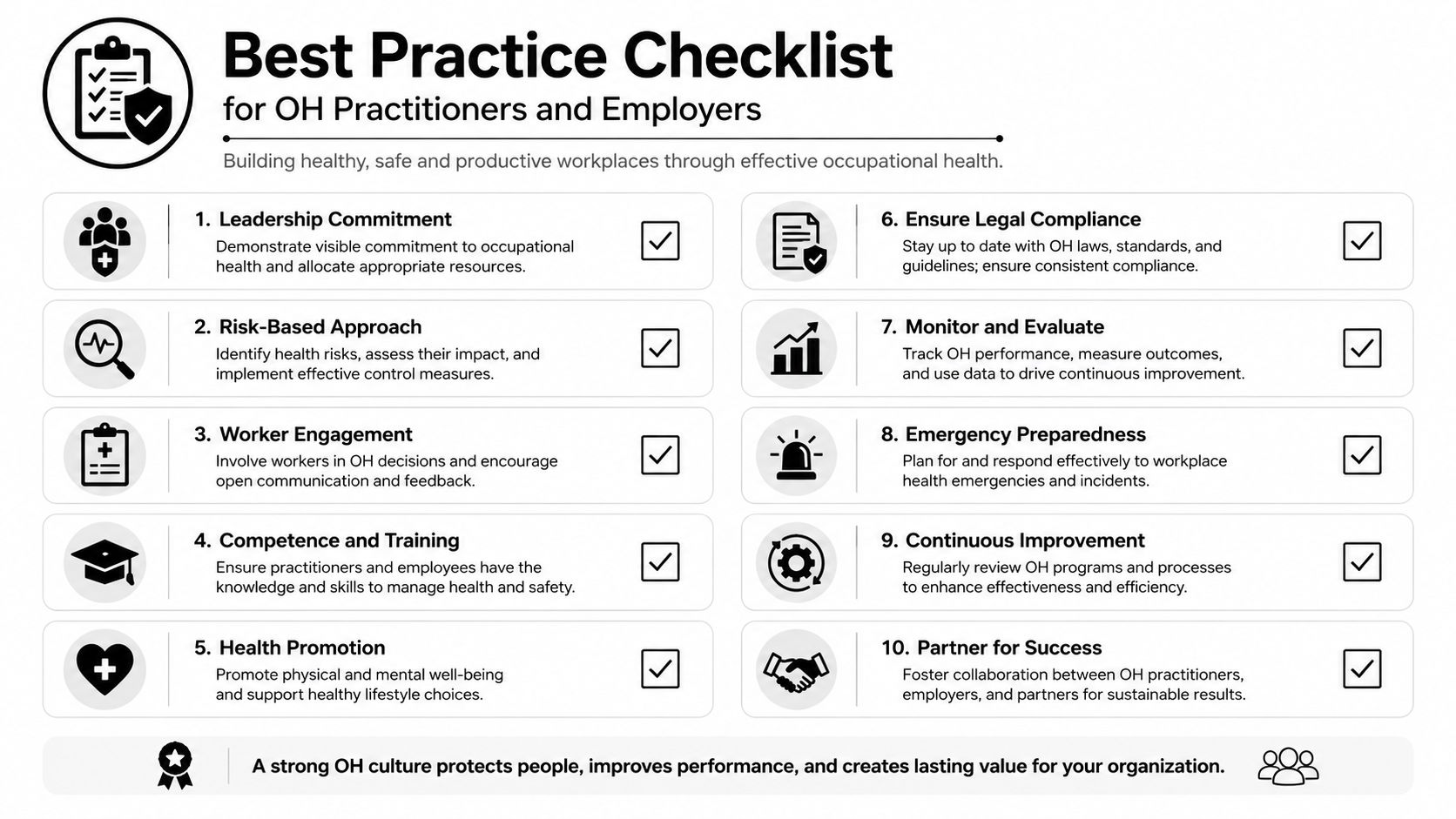
Best Practice Checklist for OH Practitioners and Employers
A practical checklist should test whether the programme can withstand a real referral, audit or challenge. Governance comes first:
- Accountability: Secure board-level sign-off and name an accountable OH lead.
- Standard operating procedures: Document referral, consent, testing, escalation and reporting processes in line with SEQOHS expectations.
- Role mapping: Record the actual physical, sensory, environmental and cognitive demands of each assessed role.
Assessment design should then connect protocol to purpose:
- Validated methods: Use recognised procedures, trained assessors and role-appropriate thresholds.
- Baseline and trend: Record repeatable measures so change can be interpreted over time.
- Proportionality: Don't impose a broad package where a focused surveillance protocol answers the risk question.
Delivery quality needs active control:
- Competence checks: Confirm that clinicians and technicians can administer, recognise limitations and escalate safely.
- Equipment control: Maintain calibration, maintenance and quality-control records for cardiorespiratory, strength, respiratory and metabolic equipment.
- Blinded review: Audit a sample of reports each quarter for reasoning, consent, confidentiality and actionability.
Reporting must close the loop:
- Risk-stratified triage: Match urgency and referral route to the finding.
- Adjustment pathway: Give line managers clear functional recommendations and a route for questions.
- Outcome review: Confirm whether restrictions, adjustments or rehabilitation changed the work situation.
A common failure is applying one generic grip or fitness cutoff to every manual-handling role. The checklist exposes the error by asking whether the task was defined, whether the protocol reflects the task, whether the result was compared with suitable norms and whether pain, technique and trend were considered. Use the job-related fitness test guide to connect assessment selection with role demands; a checklist cannot replace clinical judgement.
Plan your measurement setup
Once the clinical purpose and assessment protocol are agreed, choose the equipment, reporting tools and practitioner preparation needed to deliver it consistently.
- Professional assessment equipment — review equipment for the measures your programme requires.
- Chester Step Test setup builder — plan equipment and preparation for that protocol.
- CST2 software — review the current Chester Step Test reporting product.
- Chester Step Test practitioner programme — review training and competency options.
- Cartwright Assess — explore the developing assessment platform and enquire about availability.
Contact Cartwright Fitness with your protocol, testing volume and existing setup for equipment and software enquiries. Product selection does not replace an occupational-health assessment or determine fitness for work.