

If you've ever hit a weight loss plateau despite doing everything "right," you know how frustrating it can be. The reality is, most popular diet plans are built on generic formulas and calorie estimates that completely ignore the most important factor: your unique biology.
Following a one-size-fits-all diet is like trying to navigate a new city with a blurry, outdated map. You’re bound to get lost and hit dead ends.
Stop Guessing and Start Measuring Your Metabolism
Metabolic testing is the antidote to this frustrating cycle. It swaps that blurry map for a high-definition, real-time GPS for your body. Instead of guesstimating how much fuel you need, you get a precise measurement, finally clearing up the ambiguity that so often stalls weight loss efforts.
The Power of a Single Number
The real magic of metabolic testing comes down to one key metric: your Resting Metabolic Rate (RMR). This is the exact number of calories your body burns just to keep the lights on—powering your heart, lungs, and brain while you're completely at rest. Think of it as the baseline for your personal energy budget.
Once you know your RMR, you can finally:
- Create an Accurate Calorie Deficit: You can set a daily calorie target that actually works for your body, ensuring sustainable fat loss without feeling deprived.
- Understand Your Body's Needs: Learning if your metabolism is "slower" or "faster" than average isn't a judgment. It's just powerful data you can use to adjust your strategy.
- Make Informed Decisions: Your RMR gives you the framework to build a smart plan for your meals and workouts, all aimed at reaching your specific goals.
"Metabolic testing provides more than just numbers; it delivers insights that transform training and nutrition plans from guesswork into science."
The need for this kind of personalized data has never been more urgent. Obesity has become a global health crisis with serious consequences. It's estimated that by 2025, nearly 900 million adults worldwide will be living with obesity, which is a major risk factor for over 20 different diseases, including diabetes and heart conditions. You can find more details on this global health challenge in reports from McKinsey & Company.
By shifting from generalized advice to data based on your own body, we can create health strategies that are far more effective and sustainable.
To really see the difference, let's compare the old way with the new.
Comparing Generic vs Personalized Weight Loss Approaches
This table breaks down why a data-driven approach is a game-changer.
| Feature | Generic Weight Loss Plan | Metabolic Testing-Based Plan |
|---|---|---|
| Calorie Target | Based on population averages (e.g., 2000-calorie diet) | Based on your precise Resting Metabolic Rate (RMR) |
| Effectiveness | Often leads to plateaus and frustration | Highly effective due to personalized calorie deficit |
| Sustainability | Difficult to maintain due to being overly restrictive or ineffective | Easier to stick with because it's tailored to your body's needs |
| Personalization | One-size-fits-all; ignores individual metabolic differences | Completely customized to your unique biology |
| Approach | Guesswork and estimation | Scientific measurement and data |
Ultimately, a plan built on your metabolism isn't just another diet—it's a strategy designed exclusively for you.
Understanding Your Body's Personal Engine
Let's break down metabolism with a simple analogy. Think of your body as a high-performance car. Even when it's parked and seemingly doing nothing, the engine is still humming quietly in the background. It's running the onboard computer, keeping fluids at the right temperature, and powering the security system. That constant, quiet energy burn is your metabolism.
The amount of fuel your body uses just to keep these essential, life-sustaining systems running is your metabolic rate. This is the energy you need for breathing, circulating blood, and repairing cells—all before you even think about getting up and moving. This foundational energy burn is the biggest piece of your entire weight loss puzzle.
The Most Important Number for Weight Loss
In the world of metabolic testing for weight loss, the one number that matters most is your Resting Metabolic Rate (RMR). This isn't an estimate or a wild guess; it’s the precise number of calories your body burns in a state of complete rest.
Why is this so critical? Your RMR accounts for a staggering 70% of your total daily calorie expenditure. Trying to create a weight loss plan without knowing this number is like planning a cross-country road trip without knowing your car's MPG. You’re just guessing, and you're bound to run out of gas.
This infographic perfectly captures the shift from guessing to knowing.
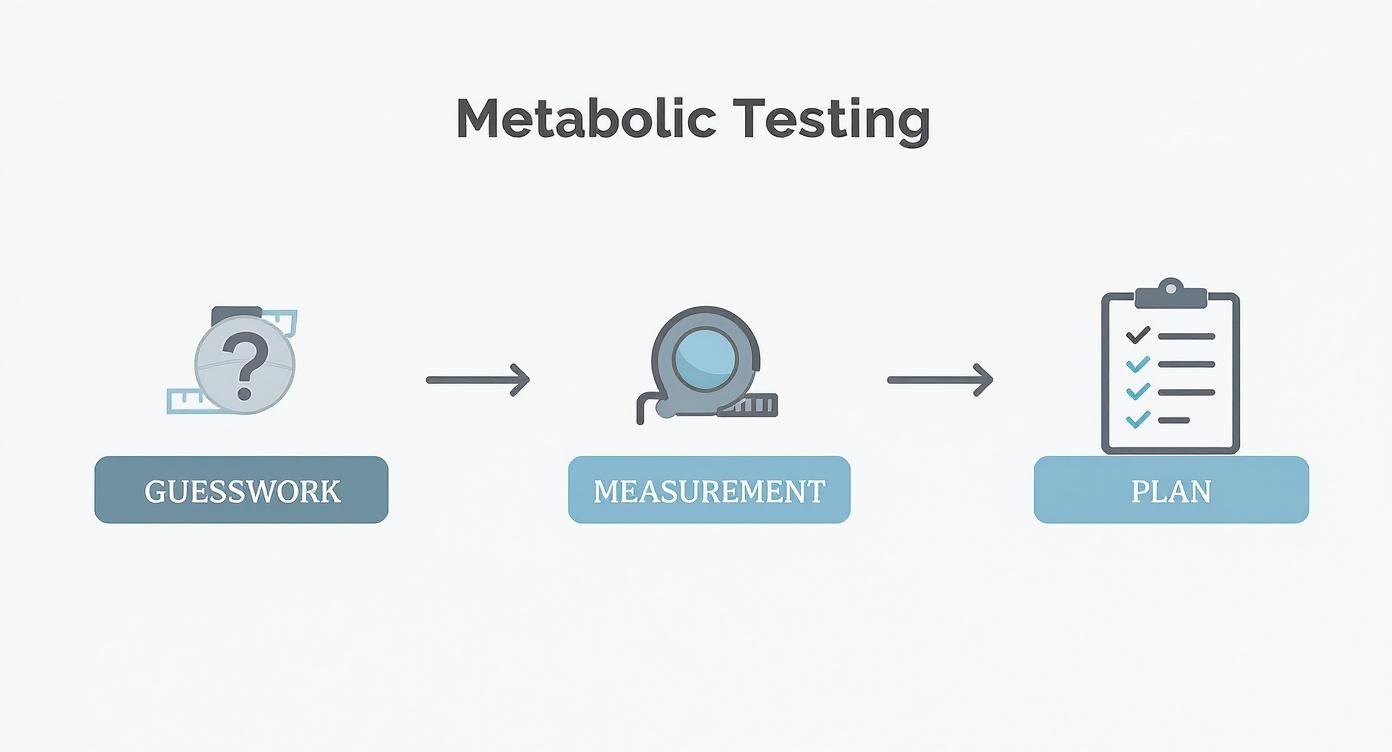
It shows how you move from the frustration and uncertainty of a generic plan to the clarity and confidence of a data-driven approach built around your body.
RMR vs BMR: What Is the Difference?
You’ve probably also heard the term Basal Metabolic Rate (BMR). While people often use it and RMR interchangeably, there's a small but important difference.
Basal Metabolic Rate (BMR): This is a measurement taken under extremely strict, clinical laboratory conditions. To get a true BMR reading, you’d need to be in a temperature-controlled room, have fasted for 12 hours, and have just woken from a full eight hours of sleep. It’s a measure of your body’s absolute bare-minimum energy needs.
Resting Metabolic Rate (RMR): This is the far more practical and accessible measurement we use in the real world. The test is done under less restrictive conditions—usually after just a few hours of fasting and a brief period of quiet rest. The results are incredibly close to BMR (typically within 10%), which makes RMR the gold standard for creating personalized weight loss plans.
For our purposes, RMR is the number that truly matters. It provides the actionable data we need to build a smart nutrition and exercise strategy, all without requiring an overnight stay in a sleep lab.
Your RMR is your personalized metabolic blueprint. It's the starting line from which every effective and sustainable weight loss plan should be built.
Once you know this number, you can finally ditch the generic online calculators that are often off by as much as 20-30%. Those calculators can't see the real you—they don't account for your unique genetics, hormone profile, or body composition.
Metabolic testing closes that gap. It swaps ambiguity for a scientific baseline, empowering you to create a calorie deficit that actually works for fat loss and is sustainable for the long haul. You can finally get off the yo-yo dieting rollercoaster. By truly understanding your body's personal engine, you replace frustrating guesswork with predictable, data-driven success.
What to Expect During a Metabolic Test

The phrase "metabolic test" can sound pretty clinical, maybe even a little intimidating. But the reality is that the whole experience is surprisingly simple and relaxing. For a metabolic testing for weight loss plan, the go-to method is a technique called Indirect Calorimetry.
Think of it as a breathalyzer for your metabolism. By analyzing the air you breathe out, it can tell exactly what kind of fuel your body is burning and, more importantly, how much. This is how we get a scientifically accurate measurement of your Resting Metabolic Rate (RMR)—the number of calories your body burns just by existing.
The test itself is completely non-invasive and painless. From start to finish, you’re looking at less than 30 minutes of just sitting back and breathing normally. It’s a peaceful process that gives us an incredible window into how your personal energy engine runs.
Preparing for Your RMR Test
To get a truly accurate snapshot of your metabolism, we need to measure it in a pure resting state. That means no recent food, stimulants, or exercise muddying the waters.
Your provider will give you a specific pre-test checklist, but it almost always boils down to these three things:
- Fasting is a Must: You’ll need to stop eating for at least 4 to 5 hours before the test. An overnight fast is even better. This way, we're measuring your baseline metabolism, not the energy you're using to digest breakfast.
- Skip the Caffeine: Avoid coffee, tea, energy drinks, and any other stimulants for at least 4 hours beforehand. They can temporarily fire up your metabolic rate and throw off the results.
- Hold Off on Exercise: Don't do any strenuous workouts for at least 12 hours prior to your appointment. A tough gym session keeps your metabolism elevated for hours, which would give us an artificially high RMR.
Sticking to these rules is non-negotiable. If you don't, you could end up with a skewed RMR reading, making it much harder to create a calorie plan that actually leads to weight loss.
The Testing Experience: A Step-by-Step Walkthrough
When you arrive for your test, the entire process is designed to be comfortable. There's no treadmill, no exertion—just pure relaxation.
Here’s a quick rundown of what will happen:
- Settle In: First, you’ll get to sit or recline in a quiet, comfortable chair for about 10 to 15 minutes. This is to let your heart rate and breathing settle into a natural, resting rhythm.
- Get Connected: A small, soft clip will be placed on your nose. Then, you'll be given a mouthpiece to breathe into (connected to the machine) or, in some cases, a clear hood will be placed loosely over your head.
- Relax and Breathe: For the next 15 to 20 minutes, your only job is to breathe normally. That's it. You can close your eyes or just zone out while the machine does all the work.
During this time, the device is carefully analyzing every breath. It’s measuring the oxygen your body is taking in and the carbon dioxide it’s producing. This O2/CO2 exchange gives us the data needed to calculate your unique RMR with incredible precision.
Other Types of Metabolic Tests
While the RMR test is the cornerstone for weight loss, you might come across other metabolic assessments, especially if you’re also focused on athletic performance.
The most well-known is the VO2 Max test. This measures your body’s maximum oxygen uptake during intense exercise, making it a fantastic tool for gauging cardiovascular fitness and setting personalized heart rate zones for training.
For weight loss, though, your RMR is king. It accounts for the vast majority of your daily calorie expenditure, making it the single most important number for building a smart, effective nutrition plan. The best part? Your results are ready immediately after the test. You can finally stop guessing and start making decisions based on your body's true science.
How to Read Your Metabolic Test Results

Getting a report full of numbers can feel a little intimidating at first, but this is exactly where metabolic testing for weight loss shows its true power. These aren't just abstract figures; they're the precise coordinates on your body's unique energy map. Learning to read this report turns confusing metrics into your best tool for achieving real, lasting results.
The most important number on that entire report is your Resting Metabolic Rate (RMR). This tells you, with clinical accuracy, how many calories your body burns every single day just to keep you alive—think breathing, circulating blood, and basic cell functions. It’s your body's foundational energy burn, and it's the scientific baseline for any effective nutrition plan.
Slower vs. Faster Metabolism: What It Really Means
Your report will almost always compare your measured RMR to a predicted RMR. The prediction is just an estimate based on standard formulas that use your age, sex, height, and weight. The difference between the two numbers tells you if your metabolic "engine" is currently running slower, faster, or right about average for someone your size.
It's really important to see this for what it is: data, not a grade. A "slower" metabolism isn't a personal failure, and a "faster" one isn't a gold star. It's just a critical piece of the puzzle about your body's current state.
Slower Than Predicted: This means your body is more fuel-efficient, burning fewer calories at rest than expected. It's incredibly common, especially for people with a history of yo-yo dieting or those with less muscle mass. Knowing this is liberating! It finally explains why generic calorie plans felt impossible and shows that you simply need a more conservative, precisely calculated calorie deficit to make progress.
Faster Than Predicted: This shows your body burns more calories at rest than the average person. This could be due to having more muscle, your genetics, or other physiological factors. Armed with this knowledge, you can confidently eat more food while still losing weight, which helps sidestep the ravenous hunger that so often sabotages a diet.
Your metabolic rate isn't set in stone. It's a dynamic number that gives you a starting point. By understanding it, you can finally build a strategy that works with your body instead of fighting against it.
Turning Data into Action: A Real-World Example
Let's make this crystal clear. Meet Jane, a 40-year-old woman who has hit one weight loss plateau after another for years. Fed up with the guesswork, she gets an RMR test.
Her results show her measured RMR is 1,450 calories per day. The standard prediction for her was 1,650 calories, meaning her metabolism is about 12% slower than average. This one piece of information is a total game-changer. It instantly explains why the 1,500-calorie diets she was trying just weren't working.
With this number in hand, Jane and her coach can map out a clear, actionable plan.
First, they calculate her Total Daily Energy Expenditure (TDEE) by factoring in her daily activity and workouts. Let's say her TDEE comes out to 2,100 calories. Now, they can set specific, personalized targets.
Calculating Your Personal Calorie Zones
Now for the fun part—turning that data into a plan. Using Jane's actual numbers, we can create precise calorie zones that completely eliminate the "let's just try this" approach that plagues most diets. Here’s a sample profile to show you how it works.
Sample Metabolic Profile and Interpretation
| Metric | Jane's Result | Interpretation and Action |
|---|---|---|
| Measured RMR | 1,450 calories/day | This is her body's true baseline energy burn. All calculations start here. |
| Total Daily Energy | 2,100 calories/day | This is her estimated maintenance level, including all activity. |
| Fat Loss Target | ~1,785 calories/day | A 15% deficit (2,100 – 315) creates sustainable fat loss without causing extreme hunger or muscle breakdown. |
| Maintenance Target | ~2,100 calories/day | This is the calorie goal she'll use to maintain her results once she reaches her goal weight. |
| Muscle Gain Target | ~2,310 calories/day | A 10% surplus (2,100 + 210) provides the extra energy needed to build muscle, which can boost her RMR over time. |
This table shows exactly why starting with an accurate RMR is so powerful. Instead of pulling a low-calorie number out of thin air, Jane now has a strategic plan backed by her own physiology. She can start her fat loss journey knowing her target is designed specifically for her body's needs.
This is the entire point of metabolic testing. It takes you from a world of frustrating guesswork into one of data-driven precision, giving you the clarity and confidence to finally build a weight loss plan that actually works.
Building Your Weight Loss Plan Around Your RMR
Getting your metabolic test results back is a huge turning point. This is where the guesswork finally stops and a truly strategic plan can begin. With your precise Resting Metabolic Rate (RMR) in hand, you can officially ditch the generic online calculators and build a weight loss strategy that’s actually designed for your body.
The first, most important step is setting up a calorie deficit that you can actually stick with. Your RMR is the solid foundation for this number. From there, we factor in the calories you burn through daily life and workouts to get your Total Daily Energy Expenditure (TDEE). Think of your TDEE as your "maintenance" number—what you'd eat to stay exactly where you are.
To start losing fat, we need to create a sensible deficit. The sweet spot is a 15-20% reduction from your TDEE. This approach is so much better than just randomly slashing calories, as it’s designed to be effective without leaving you starving, nutrient-deprived, or losing precious muscle.
Structuring Your Macronutrients for Success
Once your calorie target is set, the next level of fine-tuning is all about your macronutrients—protein, carbs, and fat. This isn't just a simple "calories in, calories out" game; we want to optimize what those calories are doing for you. Getting the right balance is key to controlling hunger, holding onto lean muscle, and keeping your energy up.
For most people, a solid plan starts with protein. Making sure you get enough protein is absolutely crucial during weight loss for a few big reasons:
- It keeps you full. Protein is the most satisfying macronutrient. It helps you feel fuller for longer, which makes sticking to your calorie deficit a whole lot easier.
- It protects your muscle. When you’re eating less, your body might start breaking down muscle for fuel. A higher protein intake acts like a shield for your hard-earned muscle, which is essential for keeping your metabolism revved up.
- It burns more calories. Believe it or not, your body uses more energy to digest protein than it does for fats or carbs. This "thermic effect of food" gives your metabolism a nice little boost.
With your RMR data, you can finally figure out your real daily calorie needs and learn how to calculate your macronutrients to perfectly match your weight loss goals. It's about making sure every piece of your plan is working together.
Integrating Exercise the Smart Way
Exercise is an amazing tool for speeding up weight loss, but it's all about how you account for it. The goal is to use activity to expand your TDEE and deepen your calorie deficit—not to "earn" a treat. This is a mental trap that trips up so many people and stalls their progress.
A lot of people get stuck in a cycle of "eating back" every calorie they burn at the gym. When you do that, you're just canceling out the deficit you worked so hard to create. A winning strategy sees exercise as a way to enhance your deficit, not as a permission slip to eat more.
Instead of obsessively tracking every calorie burned on the elliptical and adding it to your food log, a more effective approach is to focus on consistency. Build a routine that includes both strength training and cardio, but stick to the calorie target you already set.
- Strength Training (2-3 times per week): This is non-negotiable for your metabolic health. Building or at least preserving lean muscle is the best way to keep your RMR from dropping as the pounds come off.
- Cardiovascular Exercise: Things like brisk walking, cycling, or running intervals are fantastic for your heart and for burning extra calories, pushing you further into that energy deficit.
By using your RMR as the starting point, you're building an intelligent, comprehensive plan. You'll have a precise calorie target that promotes fat loss, a macro strategy that fights hunger and protects muscle, and an exercise plan that amplifies your results. This is how you move from another frustrating diet to a sustainable transformation built on your own biology.
Why Personalized Metabolic Health Is the Future
The move towards health strategies backed by real data isn't just a trend—it's a real shift in how we approach our well-being. We're finally moving past the generic, one-size-fits-all advice that leaves so many people frustrated. Instead, personalized medicine is bringing the focus back to the individual.
Metabolic testing for weight loss is a perfect example of this. It replaces the old trial-and-error cycle of dieting with a scientific roadmap tailored specifically to you. This is happening because people are more aware of metabolic health than ever before and want to be proactive. Guesswork just isn't good enough anymore when technology can give us precise, actionable answers.
When you understand your body’s unique energy blueprint, you stop being a passive rule-follower and become the architect of your own health.
The Growing Demand for Precision
You can see this demand reflected in the market's explosive growth. The global metabolic testing market is currently valued at around USD 547 million, and it's not slowing down. In fact, projections show it's expected to nearly double, hitting approximately USD 1.06 billion by 2033.
You can explore detailed market analysis from Straits Research to see the numbers for yourself.
This isn't just about fancy new gadgets; it's about making this technology accessible. As these powerful tools become more affordable, more people can take control of their health with real confidence. For a deeper look into why this proactive stance is so important, it's worth understanding why monitoring your metabolic health is crucial.
Investing in metabolic testing is about more than just finding a number for a diet plan. It’s about adopting a forward-thinking, preventative approach to your long-term wellness.
Ultimately, this isn't a fad. It's about using credible, science-backed insights to build a healthier future. By learning how your body actually works, you gain the power to make sustainable changes that go far beyond the number on a scale. You're finally in the driver's seat of your own health journey.
Still Have Questions About Metabolic Testing? Let's Clear Them Up
It’s completely normal to have questions when you’re thinking about getting your metabolism tested. After all, you want to be sure it's the right move for you. Let's tackle some of the most common ones I hear from people just like you.
"Are These Tests Actually Accurate?"
This is probably the number one question, and for good reason. The short answer is yes, professional-grade tests are incredibly accurate. We're talking about indirect calorimetry, which is the gold standard for measuring your Resting Metabolic Rate (RMR).
Forget those online calculators. They’re really just guessing, and they can be off by a staggering 20-30%. A professional test takes the guesswork out of the equation. While it’s an investment upfront, it saves you from wasting months on a diet plan that was never going to work for your body in the first place.
"How Often Should I Get Tested?"
Great question. Your metabolism isn't set in stone; it changes as your body changes.
For most people just starting out, one initial test is perfect. It gives you a solid, reliable baseline to build your entire strategy around. From there, you'll want to think about re-testing whenever you hit a major milestone.
A good rule of thumb is to re-test after you've lost more than 10% of your body weight or if you've made significant gains in muscle mass. This gives you fresh data to fine-tune your approach for the next phase, whether that’s continued weight loss or shifting into maintenance.
"What About Those At-Home Metabolism Trackers?"
I see a lot of these on the market now, and it's tempting to think they're a good substitute. Honestly, while the technology is interesting, most consumer devices just can't match the precision of clinical-grade equipment.
If you're serious about getting data you can truly rely on to build a nutrition plan, a test done in a professional setting is the way to go. It’s the difference between a rough estimate and a precise measurement you can use to get real, lasting results.
At Cartwright Fitness, we focus on one thing: providing professionals with the high-precision, validated equipment they need to get the job done right. Our Cosmed metabolic analyzers and BodyMetrix systems are trusted by practitioners who refuse to compromise on accuracy. You can explore all our professional-grade solutions at https://www.cartwrightfitness.co.uk.


