

A Tuesday morning occupational assessment rarely feels theoretical. A firefighter candidate completes a maximal treadmill test, and the report returns a borderline VO₂ value of 41 mL/kg/min against a committee threshold of 42 mL/kg/min. One reviewer focuses on the number, another questions whether the effort was maximal, and the return-to-work decision pauses while the team checks calibration, symptoms, heart-rate response and the shape of the trace.
That situation captures the practical value of metabolic gas analysis. A single result can influence fitness-for-duty clearance, cardiac rehabilitation dosing or return-to-sport decisions, but only when the measurement has been collected and interpreted properly. Expired-gas data quantify cardiopulmonary reserve and workload tolerance in a way that symptom descriptions alone cannot.
The same principles connect bedside blood-gas interpretation with performance testing. NHS guidance links blood-gas analysis to severe metabolic disturbance, shock, sepsis, hypothermia below 32°C and altered consciousness, while unexpected hypoxaemia below 94% on room air or oxygen can also trigger testing (NHSAAA guidance on blood-gas analysis). In sport, rehabilitation and occupational health, the question changes, but the underlying logic remains gas exchange under physiological stress.
Table of Contents
- Why Metabolic Gas Analysis Matters in Professional Practice
- The Core Principles Behind Gas Exchange Measurement
- Equipment Choices From Lab Carts to Portable Analysers
- Standard Testing Protocols From Resting to Maximal
- Reading the Data and Identifying True Thresholds
- Sources of Error and Validation Discipline
- Connecting Results to Real Workload Decisions
- Professional Takeaways for Confident Interpretation
Why Metabolic Gas Analysis Matters in Professional Practice
One result can change the decision
The firefighter example is deliberately uncomfortable. A value close to a pass threshold shouldn't be accepted or rejected in isolation, because the professional decision depends on whether the test reached a defensible physiological endpoint. A poor mouth seal, inconsistent pacing, analyser drift or early symptom-limited termination can make a borderline result look more conclusive than it is.
For a return-to-work committee, the relevant question isn't just, “What was the VO₂?” It's whether the candidate can tolerate the expected workload with an appropriate safety margin, whether the response was internally consistent and whether the report explains the evidence clearly enough to withstand review.
Practical rule: A number earns authority from its collection conditions, trace quality and interpretation, not from its decimal places.
Occupational assessment makes this especially visible. Fire and rescue work, policing, confined-space duties and manual handling can demand sustained aerobic work alongside rapid changes in intensity. Metabolic gas analysis helps the assessor compare physiological response with a defined job demand, rather than relying only on reported breathlessness or a generic fitness label.
The bedside and performance connection
Clinical blood-gas analysis measures variables such as pH, carbon dioxide, bicarbonate and lactate to help identify metabolic acidosis, alkalosis and compensation patterns. Scottish NHS guidance also presents these measurements as part of distinguishing metabolic and respiratory disturbance (Scottish blood-gas analysis guidance).
Exercise testing applies related gas-exchange principles over a changing workload. VO₂ describes oxygen uptake, VCO₂ describes carbon-dioxide output, and the relationship between them shows how the cardiopulmonary system responds as demand rises. That information can support rehabilitation triage, graded return planning and performance profiling.
Public-facing UK information explains access to blood-gas testing, spirometry and gas transfer, and NHS services deliver respiratory physiology and exercise testing in hospital and community diagnostic settings (North West Anglia respiratory investigations). The practical interpretation layer is less developed, particularly for occupational health and performance audiences. A useful respiratory health guide for seniors can provide general context, but professional decisions still require a validated test and appropriately trained interpretation.
The central discipline is to connect every measured variable to an action. A threshold may determine a training zone, a step rate, a rehabilitation progression or a request for further clinical review. Without that connection, metabolic gas analysis becomes an impressive data display rather than a decision tool.
The Core Principles Behind Gas Exchange Measurement
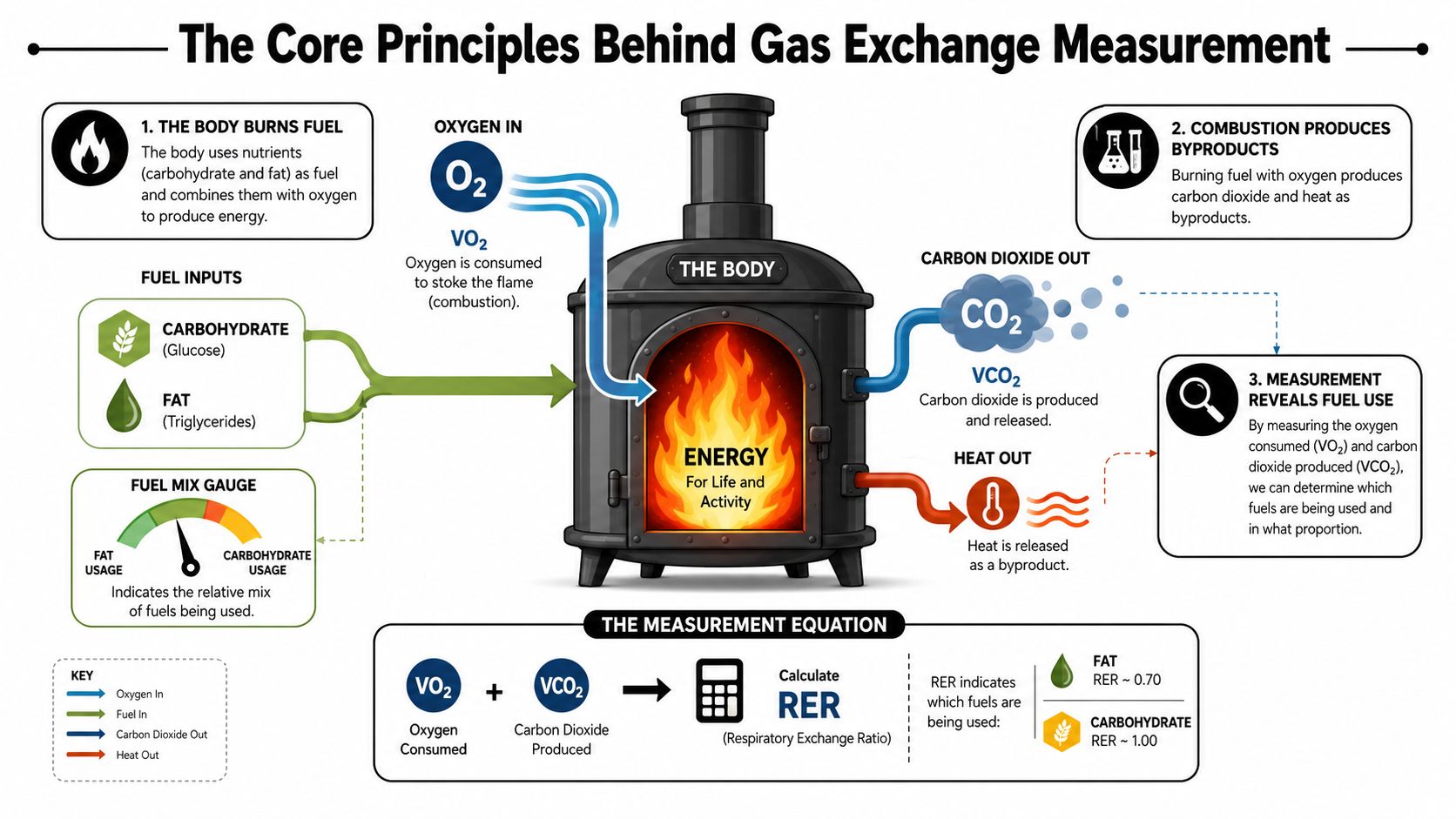
Start with a furnace. The body uses fuel, adds oxygen to support combustion and produces carbon dioxide and heat as exhaust. Carbohydrate and fat contribute differently to that process, so measuring the gases entering and leaving the system provides a window into both energy demand and fuel use.
VO₂ is the volume of oxygen consumed. On a breath-by-breath trace, it should generally rise as workload increases, although individual breaths fluctuate. VCO₂ is the volume of carbon dioxide produced and exhaled, and its pattern becomes especially informative when buffering processes add carbon dioxide to the output.
The respiratory exchange ratio, or RER, is calculated as VCO₂ divided by VO₂. A lower ratio is associated with greater fat contribution, while a higher ratio indicates greater carbohydrate contribution. The result is influenced by exercise intensity, recent food intake, protocol design and the quality of the gas and volume measurements, so it should never be treated as a direct fuel ledger without context.
Reading the furnace as workload rises
At lower intensities, ventilation and gas exchange usually increase in a relatively coordinated manner. At ventilatory threshold 1, ventilation begins to rise disproportionately as lactate buffering contributes additional carbon dioxide. On the trace, the assessor looks for a sustained change in the relationship between ventilation, VO₂ and VCO₂ rather than reacting to one irregular breath.
At ventilatory threshold 2, carbon-dioxide production and ventilatory demand accelerate again. The furnace is approaching a level where acid-base regulation and respiratory compensation become increasingly important. VE/VCO₂, VE/VO₂, V-slope behaviour and the RER pattern should be considered together.
The Fick principle provides the physiological foundation for oxygen uptake. VO₂ reflects cardiac output multiplied by the arterial-venous oxygen difference, so a reduced result may reflect limitations in delivery, extraction, ventilation or several systems at once. Stoichiometric equations can estimate energy contribution from VO₂ and VCO₂, but the equations don't remove the need to check the subject, equipment and protocol.
A sustained RER above 1.10 isn't automatically an equipment error. During heavy exercise, hyperventilation can drive additional carbon dioxide offload and push the ratio above one. The assessor must decide whether that pattern accompanies a genuine maximal effort, a protocol-induced response or a subject who stopped before reaching a physiological ceiling.
For staff who regularly convert gas measurements between pressure units, an ATA to pO2 conversion table can help clarify the language used in adjacent respiratory and hyperbaric contexts. It doesn't replace the analyser's calibration or the laboratory's reporting conventions.
Equipment Choices From Lab Carts to Portable Analysers
Equipment selection should follow the decision that the test must support. A stationary laboratory cart, such as a Vyntus system, CORTEX Metalyser or COSMED Quark, prioritises controlled conditions, detailed breath-by-breath data and repeatable calibration. Portable analysers, including the COSMED K5, CORTEX MetaMax and VO₂ Master, prioritise field deployment and access to environments where a full cart isn't practical.
The trade-off isn't just “accurate” versus “inaccurate”. A laboratory cart typically offers a stable setup with automated gas calibration and, depending on the configuration, mixing-chamber or breath-by-breath analysis suited to clinical CPET and maximal VO₂ testing. Portable equipment reduces logistical friction for occupational step tests, on-field profiling and clinics working across multiple sites, but its sensors and flow pathway demand careful preparation.
The commonly cited portable accuracy margin of ±2 to 3% versus Douglas bag validation isn't permissible here as a general claim without a supplied source, so the responsible approach is to compare each device with the manufacturer's validation material and the laboratory's own verification records. Cost also varies by configuration, service contract, consumables and software, so a purchasing decision shouldn't rest on the analyser name alone.
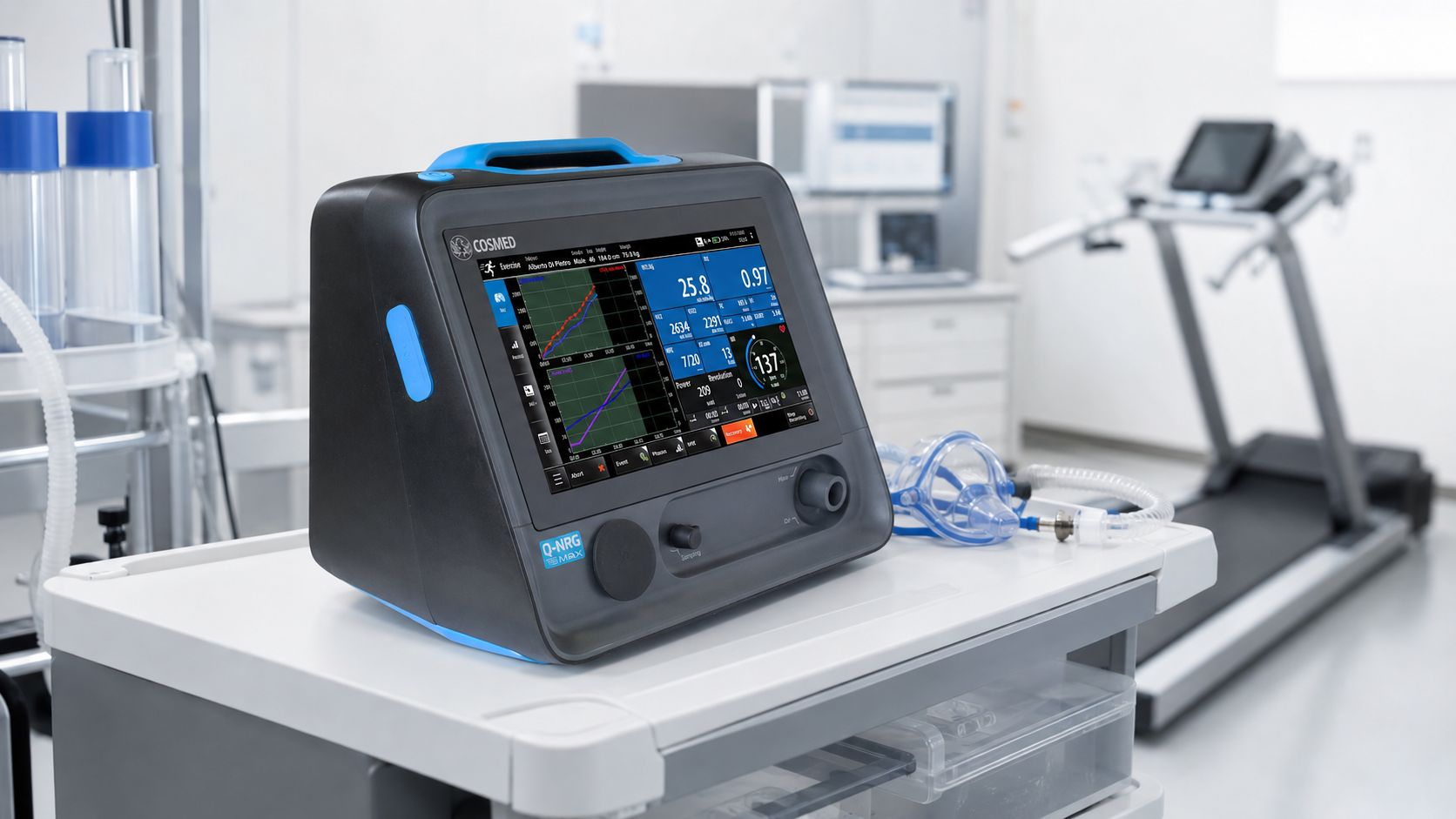
The Cosmed Q-NRG Max Metabolic Analyser is listed with features including individual assessment, full metabolic analysis, an easy workflow, compact form and ready-to-use positioning. Price and further information are available by contacting sales@cartwrightfitness.co.uk.
| Attribute | Laboratory Metabolic Cart | Portable Analyser |
|---|---|---|
| Measurement environment | Controlled laboratory or clinical room | Field, occupational or multi-site setting |
| Primary strength | Detailed physiological trace and repeatability | Deployment flexibility and lower logistical burden |
| Typical use | Clinical CPET, maximal VO₂ assessment and research | Step testing, field profiling and distributed services |
| Main risk | Higher setup, space and operating requirements | Greater sensitivity to fit, drift and field conditions |
| Purchasing focus | Validation, calibration, software and service | Portability, battery workflow, fit and verification |
| Product planning | Compare laboratory systems through specialist indirect calorimetry equipment | Confirm the portable unit's validation and intended environment |
A simple decision rule works well. If the question is whether a patient is safe to return to work, a validated cart trace collected under controlled conditions generally carries more interpretive weight. If the question is how workload distributes across a squad or how a test behaves at multiple venues, a portable unit may be the more workable choice, provided the team preserves calibration discipline.
Standard Testing Protocols From Resting to Maximal
A sound testing pathway moves from low-risk observation to higher physiological demand. The assessor should choose the least demanding protocol that answers the question, rather than treating maximal exercise as the default.
Tier one establishes the baseline
A seated resting measurement establishes baseline VO₂ and RER after a 10 to 15 minute stabilisation period. The subject should be calm, still and instructed consistently, with the mask or mouthpiece fitted before the recording begins. Diet, caffeine, recent physical activity, medication and sleep should be documented because they can alter resting physiology and complicate repeat testing.
Resting data aren't a substitute for exercise testing. They provide context for later values and can expose unstable breathing, leaks or an unexpectedly unsettled baseline before workload is added.
Tier two answers many screening questions
Submaximal protocols include the Chester Step Test, YMCA cycle test and Astrand treadmill protocol. The Chester Step Test progresses through five stages, beginning at 15 steps per minute and increasing by 5 steps per minute every two minutes. It terminates at 80% of predicted maximal heart rate or an RPE of 14, and can last up to 10 minutes (Chester Step Test protocol).
A practical cadence sequence is 15, 17.5, 20, 22.5 and 25 steps per minute with a fixed 30 cm step height. Heart rate response is recorded at each stage, and the resulting submaximal relationship is used to derive a predicted VO₂ max. The protocol suits occupational screening when maximal exertion is unnecessary or unsuitable, although prediction remains dependent on protocol adherence, heart-rate behaviour and the reference equation used.
Tier three tests the upper limit
A graded exercise test increases workload continuously or in stages until volitional exhaustion or a clinically required stopping point. A staged protocol may use 3 minute stages to allow stabilisation, while a ramp protocol may change workload each minute. Those timings must be specified in the laboratory report rather than assumed from the software display.
Fasting may be appropriate for a metabolic resting assessment, but the laboratory must define the preparation standard and apply it consistently. Caffeine abstinence, familiarisation with the treadmill, cycle or step protocol, suitable clothing and a clear symptom-screening process all improve interpretability. A maximal test should only be selected when the clinical question requires it and the supervising team can manage the associated risk.
Reading the Data and Identifying True Thresholds
A raw breath-by-breath trace is noisy by nature. The first task is to inspect the signal before interpreting physiology. Rolling means over 10 to 30 seconds can reveal the underlying trend, while the unaveraged trace helps expose leaks, coughs, irregular breaths and abrupt artefacts.
A threshold should appear as a sustained change across related variables. VT1 is supported when VE/VO₂ rises without a corresponding rise in VE/VCO₂, while VCO₂ begins to diverge from VO₂. The V-slope method plots VO₂ against VCO₂ and looks for a change in slope. A second threshold may be supported by a further rise in VE/VCO₂, falling end-tidal CO₂ or a clear ventilatory compensation pattern.
No single criterion should carry the entire interpretation. RER deflection can support the finding, but it can also be affected by hyperventilation, pacing and the subject's familiarity with the test. The report should state which criteria were used and whether the thresholds were clear, approximate or indeterminate.
Confirming a genuine maximal effort
A true maximal effort is supported by converging evidence. RER ≥ 1.10, peak heart rate within 10 beats per minute of age-predicted maximum, post-exercise lactate ≥ 8 mmol·L⁻¹ and a plateau in VO₂ each provide context, but the exact thresholds and their sources should be stated in the laboratory's adopted standard. The supplied brief does not provide a source link for these criteria, so they should be treated as professional interpretation points rather than universal pass rules.
| Criterion | Threshold for True Max |
|---|---|
| RER | RER ≥ 1.10, interpreted alongside the trace and symptoms |
| Peak heart rate | Within 10 bpm of age-predicted maximum |
| Post-exercise lactate | ≥ 8 mmol·L⁻¹ |
| VO₂ response | Plateau despite further workload |
| Clinical endpoint | Volitional exhaustion or a documented symptom-limited endpoint |
A falling RER while workload remains stable can indicate premature termination, recovery contamination or a technical problem rather than a physiological ceiling. The assessor should check whether ventilation, heart rate, workload, symptoms and perceived exertion all tell the same story.
A useful interpretation checklist is:
- Signal quality: Are breaths plausible, or are there abrupt discontinuities?
- Workload progression: Did the protocol reach its intended stages or ramp?
- Cardiovascular response: Did heart rate rise appropriately for the workload?
- Ventilatory response: Do threshold markers agree across methods?
- Reason for stopping: Was termination physiological, symptomatic, procedural or voluntary?
- Report wording: Does the conclusion distinguish measured peak VO₂ from predicted or estimated capacity?
Sources of Error and Validation Discipline
Many compromised tests look professional because the final report is neatly formatted. The hidden problem is often earlier, with gas analyser drift, an unrecognised leak or a volume signal that was never checked properly.
Oxygen and carbon-dioxide analysers require two-point calibration before every test using certified reference gases. Flow measurement needs its own verification with a calibration syringe, and the laboratory should record ambient temperature, humidity and barometric pressure so gas volumes can be converted correctly between BTPS and STPD conventions.
Where the trace breaks down
A mouthpiece or face-mask leak changes the gas fractions reaching the analyser. Valve dead space, including the dead space associated with a Hans Rudolph valve, can affect the relationship between the subject's breath and the sampled gas. Rapid breathing, irregular respiratory frequency and talking during the test can create artefacts that averaging alone won't repair.
Environmental conditions also matter. Temperature, humidity and pressure influence gas volume conversion, so a report that omits those conditions leaves an important part of the measurement chain undocumented.
Common shortcuts include:
- Skipping syringe calibration: The system may report plausible volumes without proving that flow measurement remains accurate.
- Using expired calibration cylinders: Reference gas concentration may no longer be defensible.
- Estimating inspired fractions from population means: The assumption may not represent the actual testing environment.
- Ignoring interface fit: A small leak can undermine an otherwise technically sound protocol.
- Relying on software flags alone: Automated quality checks don't replace inspection of the trace and test conditions.
The brief identifies a potential VO₂ impact of 3 to 8% from these types of errors, but no supplied source link supports that figure, so it should not be presented as a validated universal range. The correct operational response is to quantify local error through verification and document the procedure.
Validation discipline: A biological control, monthly multi-grade simulator check and the manufacturer's recommended verification schedule should sit alongside every clinical or occupational testing system.
A laboratory's calibration record should be easy to audit. Guidance on metabolic cart calibration can support that process, but local standard operating procedures, manufacturer instructions and competent technical oversight remain essential.
Connecting Results to Real Workload Decisions
A VO₂ result becomes useful when it can be translated into a task. Oxygen uptake is often expressed relative to body mass, while occupational demands may be described in metabolic equivalents, or METS. One MET is conventionally treated as resting oxygen consumption, but the supplied data do not provide a numerical conversion standard to cite here, so reports should state the convention used.
The table below is therefore a decision framework, not a set of normative pass values. It shows how a service can connect measured capacity with job demands, provided the workload requirements and local fitness-for-duty standard are documented separately.
| VO2 Max (ml/kg/min) | METS | Typical Workload Capacity | Return-to-Work Indicator |
|---|---|---|---|
| Measured value below the documented job demand | Convert using the service convention | Sustained task may exceed aerobic reserve | Consider further assessment or graded duties |
| Measured value close to the documented job demand | Convert using the service convention | Limited margin for heat, equipment, fatigue or repeated tasks | Require careful risk review and task-specific testing |
| Measured value above the documented job demand | Convert using the service convention | Greater apparent reserve for the assessed task | Support clearance only when other criteria are satisfactory |
| Submaximal estimate without maximal confirmation | Estimate only | Capacity remains uncertain at the upper limit | Use for screening, not unsupported definitive clearance |
For rehabilitation, ventilatory thresholds can guide step rates and progression. A patient returning after cardiac or pulmonary rehabilitation may tolerate work below VT1 but show disproportionate ventilation above it. The threshold can help the team prescribe a starting workload, monitor symptoms and increase demand in a controlled way, subject to clinical supervision.
Performance staff use the same logic differently. A submaximal VO₂ estimate can support pacing decisions, while RER drift during a supposedly steady workload may prompt review of recovery, fuelling, heat exposure or accumulated training stress. It doesn't diagnose over-reaching by itself, but it can identify a response that deserves investigation before a planned block continues unchanged.
Blood-gas analysis adds another layer when dyspnoea or poor exercise tolerance may reflect metabolic disturbance. NHSAAA guidance includes DKA and renal failure among indications for blood-gas analysis, alongside shock, sepsis, severe hypothermia and altered consciousness (NHS blood-gas indications). Exercise data shouldn't be used to conceal an acute clinical concern. A suspicious pattern requires the appropriate referral pathway.
The final report should answer one question in plain language: what did this result change? If it changes neither a clearance letter, a graded return plan nor a periodised training block, the test may have generated information without generating value.
Professional Takeaways for Confident Interpretation
A defensible metabolic gas analysis service depends on repeatable practice and clear decisions. The analyser matters, but so do preparation, interface fit, protocol selection and the link between the trace and the referral pathway.
The workstation checklist
- Verify calibration: Complete gas and volume checks before accepting results.
- Confirm effort: Interpret RER, VO₂ response, heart rate, symptoms and protocol completion together.
- Match protocol to purpose: Use submaximal testing for screening when it answers the occupational, rehabilitation or performance question safely.
- Separate the outputs: Label measured peak VO₂, predicted VO₂ max and submaximal estimates accurately.
- Inspect the trace: Review breath-by-breath behaviour and artefacts before relying on summary values.
- Record the decision: State whether the result changed clearance, progression, referral or training.
- Audit escalation: Confirm that a suspicious exercise response reaches the correct clinical pathway before another borderline result appears.
A report should also state uncertainty. Automated threshold detection can speed review of large datasets, but it cannot decide whether early stopping, a mask leak or a borderline value changes the judgement. That requires clinical and performance context, much as bedside blood-gas interpretation requires the patient's condition rather than isolated numbers.
The strongest report connects validated measurement with a practical consequence for the worker, patient or athlete.
Cartwright Fitness supplies professional assessment equipment, calibration support and training for VO₂ testing, metabolic and respiratory assessment, occupational fitness and related workflows. Visit Cartwright Fitness to discuss how a validated testing service can support defensible professional decisions.


