

A clinic can complete a sub-maximal aerobic assessment, collect a breath reading and still face an awkward question: can the result be trusted well enough to influence a decision? The same problem appears in university laboratories, occupational health services and performance centres when readings vary between sessions without a clear physiological explanation. A metabolic breath analyzer can provide valuable insight, but only when the device, protocol, operator and calibration process work as one measurement system.
The professional distinction matters. Consumer breath-tracking gadgets may support general lifestyle feedback, whereas professional metabolic equipment is used alongside controlled testing, repeatable procedures and documented interpretation. UK respiratory practice has long treated breath-based physiological assessment as a precision activity, with acceptability and reproducibility requirements shaping how clinicians and physiologists judge meaningful data.
This guide focuses on aerobic fitness, VO₂ assessment, metabolic testing and occupational fitness workflows. It also considers how breath analysis fits with the Chester Step Test, dynamometry, anthropometry and broader functional assessment. Readers looking for a simple wellness score will find a different standard here. The central question is whether a device can produce defensible data within a professional service.
Table of Contents
- Why Metabolic Breath Analysis Matters for Professionals
- How Indirect Calorimetry Measures Metabolic Function
- Clinical and Performance Applications of Breath Analysis
- Professional Systems Versus Consumer Breath Trackers
- Choosing Between Portable and Lab-Based Configurations
- Calibration and Maintenance Requirements for Valid Data
- Integrating Breath Analysis with Comprehensive Assessment Protocols
Why Metabolic Breath Analysis Matters for Professionals
A sports scientist can run the same broad protocol across several sessions and still see metabolic outputs shift enough to complicate interpretation. An occupational health practitioner may face the same problem when an aerobic assessment informs a fitness-for-duty decision. Before attributing the change to physiology, check the measurement chain: mask seal, sampling line, subject preparation, instrument calibration and operator records.
A metabolic breath analyzer measures respiratory gases, giving professionals more than the indirect wellness signals provided by consumer breath-tracking gadgets. Professional systems use indirect calorimetry to relate oxygen consumption and carbon dioxide production to energy expenditure and substrate use. That makes breath analysis relevant to VO₂ assessment, resting metabolic rate, exercise physiology and metabolic monitoring.
The distinction between consumer and professional equipment is methodological as much as technical. A consumer device may provide useful feedback for personal tracking, while a professional analyzer must fit a controlled protocol, documented preparation and repeatable reporting process. Its value depends on whether the readings can be interpreted alongside workload, heart rate and observed performance, rather than presented as an isolated score.
UK practice also places gas measurement within a controlled reference framework. British breathing-air standards and guidance specifies oxygen at 21% ± 1%, with carbon dioxide no higher than 500 ppm and carbon monoxide no higher than 5 ppm in one cited framework. It also describes sampling and analysis at least every three months, or more often when production changes or quality concerns arise. These requirements concern breathing-air quality, not metabolic testing directly, but they demonstrate the discipline expected when gas measurements inform professional decisions.
Practical rule: Treat a metabolic result as defensible only when subject preparation, sampling interface, calibration, protocol and reporting are documented as one chain.
The strongest use of breath analysis is integration. It can add physiological context to aerobic capacity assessment and the Chester Step Test, while complementing strength, anthropometry, body-composition and functional measures. It does not replace clinical judgement or a validated protocol. Used within that framework, it helps explain how a person responds to a defined workload, which is more useful than a standalone wellness score.
How Indirect Calorimetry Measures Metabolic Function
Indirect calorimetry estimates metabolic activity by observing what the body takes in and gives off during respiration. The basic analogy is an engine. Oxygen is part of the combustion process, while carbon dioxide is one of the resulting exhaust gases. A metabolic breath analyzer samples that exchange and uses the relationship between the gases, ventilation and time to characterise physiological demand.
From gas exchange to usable outputs
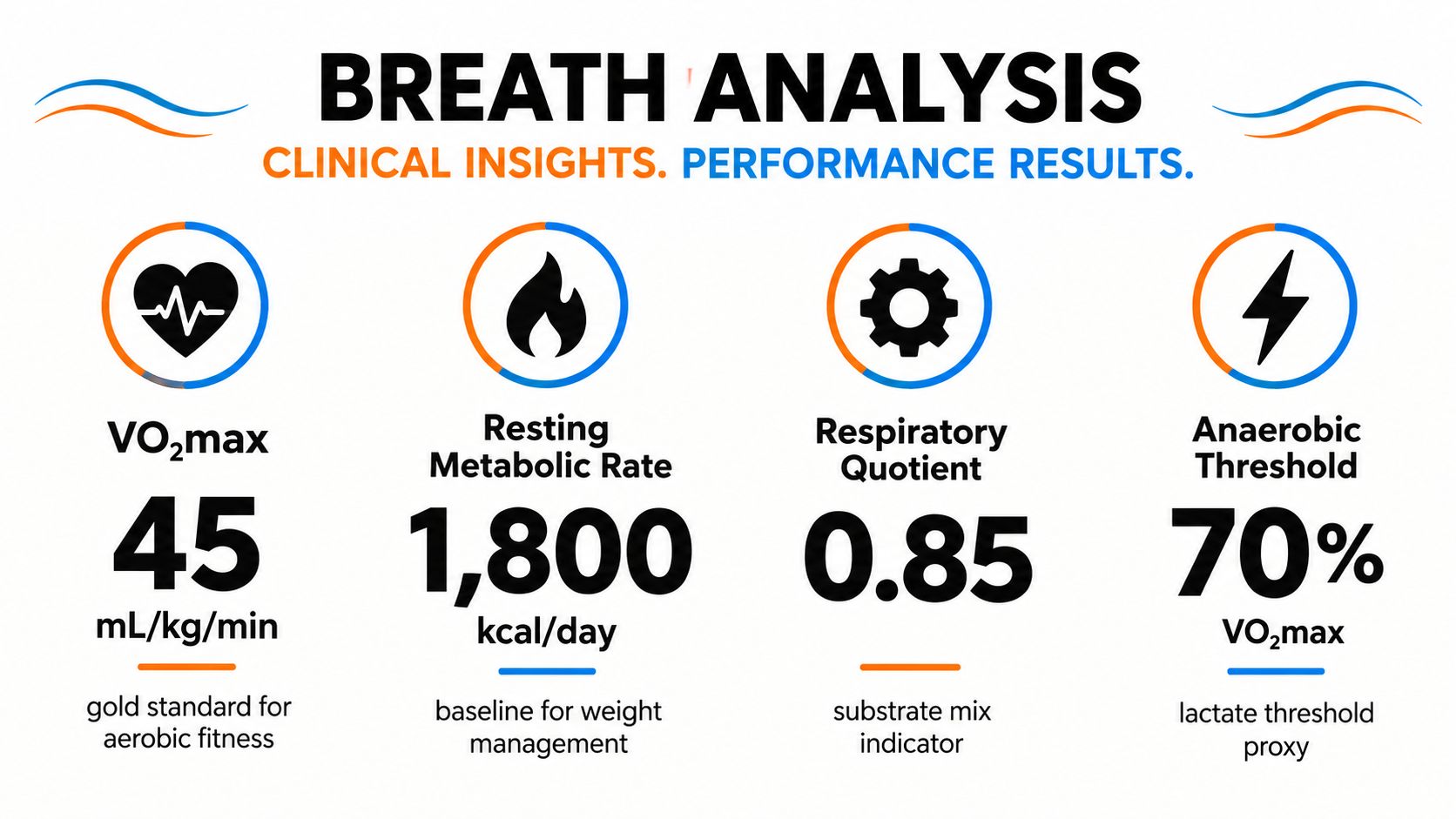
The two central variables are VO₂, oxygen consumption, and VCO₂, carbon dioxide production. During exercise, oxygen consumption generally rises as workload increases. Carbon dioxide production also changes, and the relationship between the two produces the respiratory exchange ratio, commonly written as RER. RER helps indicate the balance of carbohydrate and fat oxidation, although interpretation depends on exercise intensity, ventilation and the test conditions.
A professional workflow normally follows a sequence:
- Capture the breath. A mask or mouthpiece and sampling line collect expired gas while the person rests or exercises.
- Analyse the sample. The device measures gas concentrations and, depending on configuration, ventilation-related variables.
- Apply the gas data. The system calculates VO₂, VCO₂ and derived outputs such as RER or energy expenditure.
- Interpret against the protocol. The practitioner considers workload, heart rate, perceived exertion, symptoms and test termination criteria.
Modern portable metabolic carts developed from earlier static systems, including spirometers and Douglas bags. Automated open-circuit calorimetry became the dominant approach for quantifying energy expenditure because it can measure oxygen consumption and carbon dioxide production continuously during a practical assessment. The history matters because it shows that portability is a change in workflow, not a removal of the underlying measurement requirements.
Why specifications need scrutiny
A device listing can mention VO₂max, resting metabolic rate or sub-maximal testing, but those labels don't describe the whole measurement chain. Practitioners should ask how the system samples gases, how operators calibrate it, whether it measures oxygen consumption directly and how the software handles quality checks.
The Cosmed Fitmate Pro is listed with VO₂max and sub-maximal measurement, resting metabolic rate measurement, portability, a full-colour screen, a built-in printer and Windows software. Those features may suit a service that needs structured testing outside a fixed laboratory, but the choice still depends on the intended protocol and the level of gas analysis required.
The key distinction is between measuring a physiological variable and estimating it from a proxy. A practitioner who understands that difference can judge whether a device is appropriate for clinical reporting, occupational screening, research or longer-term monitoring.
Clinical and Performance Applications of Breath Analysis
Breath analysis earns its place when it answers a defined professional question. In occupational health, that question may concern aerobic capacity within a broader fitness-for-duty assessment. In rehabilitation, it may involve the physiological response to a controlled workload. In sport science, the aim may be to characterise aerobic performance or examine how substrate use changes under a repeatable nutritional and exercise condition.
Where direct metabolic data helps
VO₂ assessment can add physiological detail to a sub-maximal test, especially when the practitioner needs more than heart rate and perceived exertion. Resting metabolic rate measurement can provide a measured baseline for a clinical or performance discussion, but it still needs standardised preparation and careful interpretation. RER and related outputs can help describe substrate oxidation, provided the practitioner avoids treating a single reading as a complete account of metabolism.
Breath analysis also works best as one component of a wider battery. A Chester Step Test provides a progressive, sub-maximal aerobic assessment through five 2-minute stages, beginning at 15 steps per minute and increasing by 5 steps per minute at each stage to 35 steps per minute. The commonly cited stopping threshold is 80% of age-predicted maximum heart rate, with heart rate and perceived exertion recorded during testing. The Chester Step Test protocol gives the practitioner a structured external workload against which respiratory response can be considered.
The limit of short-term feedback
The most useful evidence for day-to-day decision-making is also the most cautionary. Researchers at Anglia Ruskin University studied a handheld Lumen metabolic breath analyzer with 27 healthy active adults using the device at home across one week. The device detected a significant rise in expired carbon dioxide within 30 minutes of a high-carbohydrate meal and identified diet-related changes in percentage carbon dioxide over the week, but it wasn't sensitive enough for day-to-day monitoring. The Anglia Ruskin University study summary therefore supports longer-term dietary tracking more strongly than session-to-session decision-making.
The limitation is important for practitioners. The device studied provided an indirect measure because it didn't measure oxygen consumption, as discussed in the UK commentary on Lumen. A consumer result may be interesting without being sufficient for a high-stakes occupational or clinical decision.
Professional interpretation should therefore match the measurement. Use breath data to enrich a defined assessment, and treat indirect consumer tracking as a trend tool rather than a substitute for validated metabolic testing.
Professional Systems Versus Consumer Breath Trackers
A consumer breath tracker can report a breath marker, combine breathing data with other signals or produce an estimated score. That may support engagement and behaviour change. It does not automatically provide the controlled gas-exchange measurement required for direct assessment of oxygen consumption and carbon dioxide production.
Calibration separates a professional measurement system from a convenient gadget. UK breathing-air guidance identifies oxygen at 21% ± 1%, carbon dioxide at no more than 500 ppm and carbon monoxide at no more than 5 ppm in one cited framework, with sampling and analysis at least every three months, or more frequently when conditions require it. The UK gas standards reference addresses breathing-air quality rather than prescribing calibration for every metabolic device. It still illustrates why controlled gas composition and documented checks matter when gas measurements underpin a decision.
What professional equipment must control
Professional equipment requires a documented process for reference gases, zeroing, flow or volume measurement and sample integrity. The operator must also check mask fit, leaks, dead space, ambient conditions and reading times. A device that does not measure oxygen consumption cannot provide the same direct VO₂ measurement chain as a system designed for that purpose.
The visual comparison below can help orientate a purchaser. Its claims should not be treated as universal specifications across every product category.
Practitioners should test marketing claims against the intended protocol:
- What is measured? Is VO₂ measured directly, or inferred from another breath signal?
- How is calibration performed? Does the operator use traceable reference material and document the process?
- What is the intended use? A wellness trend, research protocol and fitness-for-duty assessment have different evidential requirements.
- Can results be repeated? Preparation, workload, sampling and reporting should be controlled well enough to support repeat testing.
Consumer trackers can be convenient and inexpensive. They still carry measurement error, and their outputs may not transfer cleanly into a Chester Step Test or another established assessment protocol. Professional equipment demands more operator time, training and maintenance, as well as a higher purchase cost. That burden is justified when clinical, occupational or performance decisions depend on defensible gas-exchange data.
Choosing Between Portable and Lab-Based Configurations
The right configuration depends less on whether a system is portable and more on where the testing occurs, what must be measured and how results will be governed. A field-based occupational service may value transportability and a short setup. A university laboratory may prioritise environmental control, broad gas analysis and repeatability across research sessions.
Portable equipment is practical for distributed testing. It can support assessments in occupational settings, rehabilitation environments or performance facilities where a fixed laboratory cart isn't available. The trade-off is that field conditions create more opportunities for temperature variation, movement artefact, mask disruption and inconsistent setup. A portable system still needs disciplined operators and a documented test environment.
Laboratory configurations generally offer greater control over the testing space and can support more detailed analysis. They require dedicated room, equipment management and staff who understand the measurement chain. They may be excessive for a service that only needs a defined sub-maximal assessment, but valuable where full metabolic characterisation is central to the programme.
Matching the system to the service
The indirect calorimetry equipment range gives practitioners a starting point for comparing metabolic configurations. A portable Cosmed Fitmate Pro can suit services that need VO₂max, sub-maximal and resting metabolic rate measurement in a compact workflow. The Cosmed Q-NRG Max Metabolic Analyser is positioned for metabolic analysis, individual assessment and aerobic-capacity work within an easy, compact workflow.
The purchasing decision should be written as a service specification rather than a product preference. A useful specification includes:
| Decision factor | Portable configuration | Lab-based configuration |
|---|---|---|
| Testing location | Field, clinic or performance facility | Controlled laboratory |
| Primary priority | Mobility and practical deployment | Environmental control and broad analysis |
| Operator requirement | Strong setup discipline in changing environments | Strong calibration and laboratory quality control |
| Workflow question | Can the system travel without compromising the protocol? | Can the laboratory support the required throughput and reporting? |
Software integration matters as much as hardware. A service should decide how results will be stored, reviewed, compared over time and incorporated into reports before equipment arrives. This prevents a technically capable analyser from becoming an isolated data source that staff rarely use.
Calibration and Maintenance Requirements for Valid Data
A metabolic breath analyser can produce a precise-looking result while measuring the wrong thing. Calibration determines whether the gas, flow and volume data are defensible on the day, so maintenance must cover the analysers, flow measurement, sampling lines, mask or mouthpiece, software records and test environment.
UK respiratory practice provides a useful quality benchmark. For gas-transfer testing, the British Thoracic Society evidence portfolio describes acceptable repeated measurements and defined limits for reproducibility. Those limits are not metabolic-testing thresholds, but the principle transfers directly: record acceptance criteria in advance, apply them consistently and investigate results that fail them.
A workable maintenance schedule
| Task | Frequency | Acceptance criteria |
|---|---|---|
| Inspect mask, mouthpiece, tubing and sampling line | Before each session | Clean, intact, correctly connected and free from visible leaks |
| Confirm sensor status and perform the manufacturer's required checks | Before testing | Device indicates readiness and checks are recorded |
| Calibrate with the specified reference gas and flow or volume procedure | According to the validated device protocol, normally before testing sessions | Calibration passes the device's stated acceptance check |
| Review environmental and subject-preparation conditions | Before each test | Conditions are recorded and suitable for the protocol |
| Sample and analyse breathing air where the applicable quality framework requires it | At least every three months, or more often after production changes or quality concerns | Results remain within the applicable breathing-air limits described in the UK standards documentation |
| Audit records and investigate drift, failed checks or unusual traces | At defined quality-review intervals | Exceptions have a documented explanation and corrective action |
The schedule should distinguish routine checks from formal servicing. Sensor drift can create gradual bias, while a mask leak may produce an apparently plausible but invalid reading. Condensation, poor sampling-line placement and environmental interference can distort results in less obvious ways. If a trace conflicts with workload, heart rate, symptoms or perceived exertion, stop the test and troubleshoot the setup before interpreting it.
Consumer breath-tracking gadgets often provide convenience without the same control over reference gases, flow verification or audit trails. A professional analyser still depends on operator discipline. Calibration records should identify the device, operator, date, reference material and outcome, with failed checks linked to corrective action.
Teams can use the metabolic cart calibration service information to plan formal support around the manufacturer's instructions. This is particularly useful when a service needs consistent procedures across portable testing, laboratory work and established protocols such as the Chester Step Test. The record makes maintenance auditable rather than dependent on memory.
Integrating Breath Analysis with Comprehensive Assessment Protocols
Metabolic breath analysis is most useful when it answers a question that another test cannot answer alone. A Chester Step Test supplies a structured progressive workload and records heart rate and perceived exertion. Breath analysis can add direct respiratory gas information to that response, helping the practitioner examine how oxygen use changes as the workload progresses. The two methods shouldn't be treated as interchangeable. The step test estimates aerobic capacity, while metabolic gas measurement can characterise the respiratory response during the test itself.
A assessment battery can then place aerobic findings beside strength and functional data. Grip dynamometry is a good example of the value of standardisation. UK NHS-style procedures take three measurements for each hand, alternate sides and allow a 60-second rest between repeated trials on the same hand, as described in standardised grip-strength assessment guidance. British adult research has also used calibrated hand-held dynamometry and examined 20 to 49-year-old British adults to update comparison values, supporting comparison when the method is controlled. The British grip-strength study provides that population and methodology context.
Build the battery around decisions
Back and leg strength, anthropometry, body composition and functional movement measures can explain why two people with similar aerobic results may have different occupational or rehabilitation profiles. A practitioner might use metabolic data to characterise aerobic demand, dynamometry to assess force production and a functional test to examine task tolerance. The report should preserve the conditions for each measure, rather than presenting disconnected scores.
A sensible workflow includes:
- Standardised preparation: Record rest, food, caffeine, medication considerations and recent activity according to the chosen protocol.
- Consistent sequencing: Decide whether resting metabolic testing, anthropometry, strength and aerobic work occur in a fixed order.
- Controlled documentation: Capture workload, heart rate, perceived exertion, symptoms, equipment checks and termination reasons.
- Integrated reporting: Present metabolic, aerobic, strength and functional findings together, with limitations clearly stated.
Software can reduce transcription and interpretation errors when it reflects the actual protocol. Cartwright Assess is being developed as a professional assessment platform for standardising tests, calculating and interpreting results, maintaining assessment histories and generating professional reports. It should be evaluated as part of the wider workflow, not as a replacement for operator competence.
The final report needs to distinguish measured variables, estimates and clinical interpretation. That distinction protects the practitioner and gives the referring organisation a clearer basis for action. Breath analysis adds value when it is connected to a repeatable assessment system, not when it sits alone as an impressive-looking number.
Cartwright Fitness supplies professional equipment and solutions for VO₂ assessment, metabolic and respiratory measurement, dynamometry, body composition, anthropometry and occupational fitness testing. Visit Cartwright Fitness to review assessment equipment and professional support options for integrating metabolic breath analysis into a controlled testing workflow.


