

An occupational health team discovers that two technicians have recorded markedly different FEV1 values for the same worker. Both reports look polished, both devices appear suitable, and neither operator can immediately identify an obvious fault. Yet the discrepancy may affect a fitness-for-work decision, a fire warden assessment, sickness-absence planning or return-to-work clearance.
This is how medical testing equipment fails in practice. The problem isn't always a broken instrument. It may be calibration drift, inconsistent accessories, different software settings, weak operator training or validation evidence that never reflected the service's real population and workflow. A defensible result depends on the complete measurement system, not just the name printed on the casing.
Table of Contents
- Why Measurement Quality Matters in Professional Settings
- Defining Medical Testing Equipment and Its Main Categories
- Accuracy, Repeatability and Validation Explained
- Calibration, Quality Assurance and UK Regulatory Requirements
- Choosing Equipment for Different Professional Users
- Integrating Equipment Into Real Assessment Workflows
- Maintenance, Training and Lifecycle Management
- Building a Defensible Measurement Programme
Why Measurement Quality Matters in Professional Settings
The first question after a conflicting result shouldn't be, “Which device is better?” It should be, “Which measurement process was controlled well enough to support a decision?”
A spirometer can be technically capable while the surrounding process remains unreliable. One technician may use a fresh disposable mouthpiece and complete the required checks, while another uses a different device with an overdue verification record. The worker's effort, posture, coaching and timing can also vary. Once those differences enter the assessment, the report presents a number without making its uncertainty visible.
That matters because professional testing rarely ends with the reading itself. A result may influence whether a worker can perform a safety-sensitive role, whether a rehabilitation plan is adjusted, or whether a performance programme investigates an unexpected change in aerobic capacity. If the underlying measurements aren't comparable, downstream decisions inherit the error.
Practical rule: A result is only as defensible as the equipment, protocol, operator and records that produced it.
The UK has a long history of treating medical equipment as a matter of inspection, testing and public protection. During and after the Second World War, the Ministry of Supply created a medical equipment section to support UK manufacture. In 1947, procurement responsibility passed to the Ministry of Health, where a Technical Services Group inspected and tested equipment. The Department of Health later created the Scientific and Technical Board in 1969, introduced adverse incident reporting and established a voluntary quality assurance scheme that evolved into the Manufacturers Registration Scheme. The Royal College of Radiologists equipment policy paper records this regulatory lineage, which predates modern CE-marking rules and culminated in the Medical Devices Regulations 2002 coming into force on 13 June 2002.
The practical lesson is straightforward. Professional teams need a controlled chain from measurement question to report. That chain includes device selection, calibration, validation, consumable control, operator competence, data transfer and post-market follow-up. A feature catalogue won't reveal whether the chain is intact.
Defining Medical Testing Equipment and Its Main Categories
Medical testing equipment includes the instruments, sensors, software and consumables that trained professionals use to generate quantitative physiological data. The useful classification isn't based on appearance or price. It starts with the measurement question and the decision that follows.
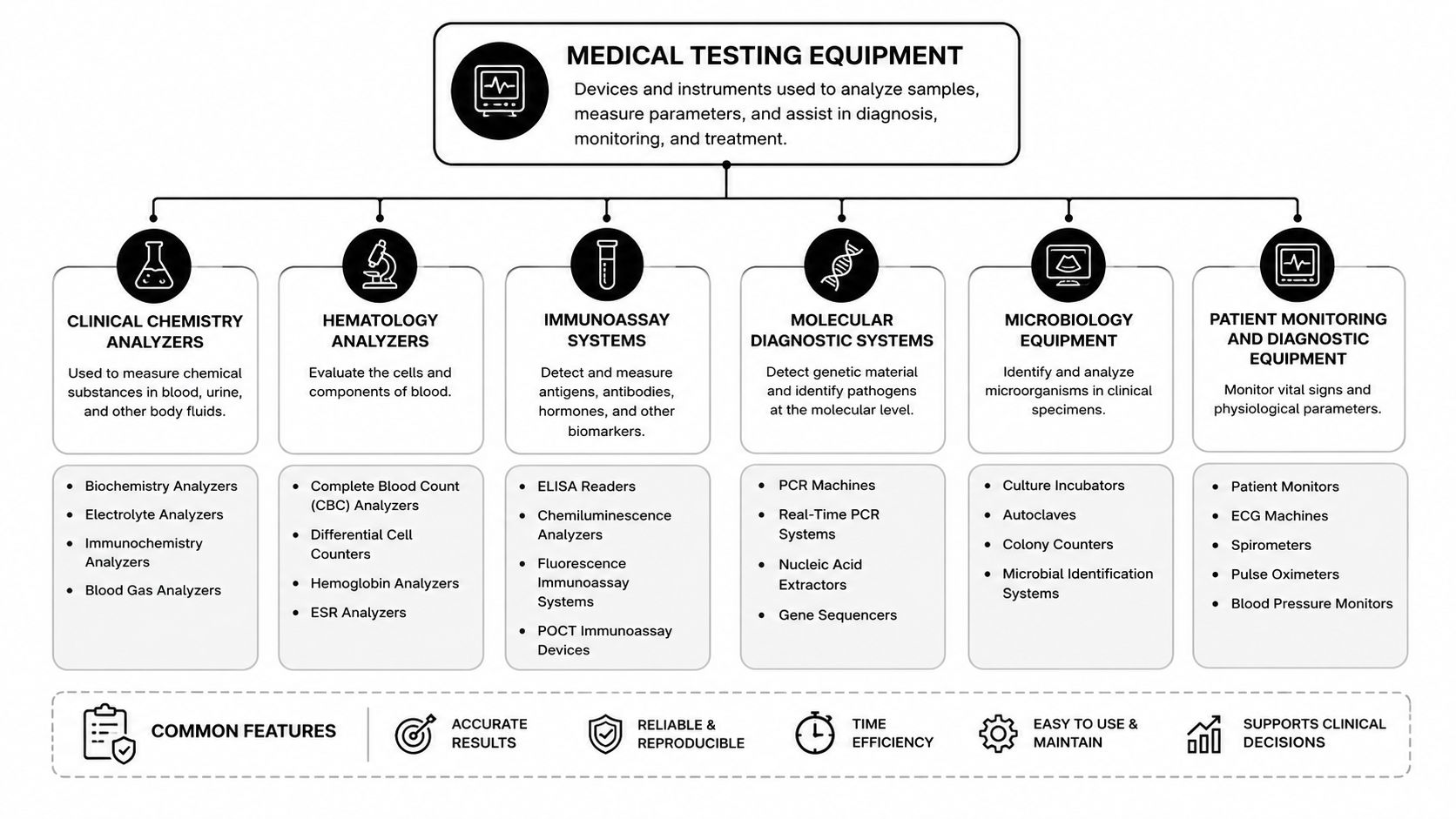
Equipment for aerobic and metabolic assessment
Metabolic analysers and gas exchange systems measure variables such as oxygen uptake, carbon dioxide production and ventilation during exercise. In a sport science laboratory, they support VO₂ assessment and exercise prescription. In occupational testing, they can add physiological detail to a functional or step-based assessment, but they also create more demands around calibration gases, flow measurement, masks, software and operator training.
The Chester Step Test Kit consists of a step of the desired height and calculation software. A separate heart-rate device can be purchased, such as a Polar H10 Heart Rate Strap. The test software uses credits that expire one year after purchase, with one credit used each time a test is calculated.
Equipment for body composition and anthropometry
BIA scales estimate body composition using electrical impedance, while skinfold callipers provide a field measure that depends heavily on site selection, technique and assessor consistency. Neither category should be treated as interchangeable with every other body composition method. A consumer BIA scale may be useful for general monitoring, but that doesn't automatically make it suitable for clinical reporting or research-grade comparison.
Anthropometric tools also include weighing scales, stadiometers, measuring tapes and segmental measures. Their value comes from standardised positioning, repeatable technique and clear documentation, not from collecting the largest possible set of measurements.
Respiratory, strength and functional tools
Spirometers and peak flow meters measure respiratory performance. Dynamometers quantify grip or other force outputs, while back and leg strength systems assess force production under defined positions and loads. Functional assessment equipment may include steps, heart-rate monitors, timing systems and software that records the protocol and calculates results.
Consumables hold the system together. Mouthpieces, filters, electrodes, masks, straps and reagent materials can affect hygiene, signal quality and comparability. Procurement that focuses only on the main device can miss the recurring costs and compatibility limits that determine whether a service can run consistently.
Accuracy, Repeatability and Validation Explained
Three terms are often used as if they mean the same thing. They don't.
Accuracy describes how close a measurement is to a reference value. Repeatability describes how closely repeated measurements agree when the same operator, equipment, method and conditions are used. Reproducibility concerns agreement when conditions change, such as between operators, sites or devices.
A device can be repeatable without being accurate. For example, an instrument might produce nearly identical readings each time while carrying a systematic bias. Conversely, a device may be accurate on average but produce variable readings when technique, positioning or environmental conditions change.
| Property | Definition | Typical Evidence |
|---|---|---|
| Accuracy | Closeness to a recognised reference value | Comparison with a traceable reference standard or reference method |
| Repeatability | Agreement between repeated measures under controlled, identical conditions | Replicate testing by the same operator using the same device |
| Reproducibility | Agreement across operators, sites, sessions or devices | Multi-operator, multi-site or inter-device comparison |
Why uncertainty changes interpretation
Measurement uncertainty is the range within which the true value may reasonably lie. A stated ±3% uncertainty on VO₂ max creates a wider interpretation band than a headline specification may suggest. That difference matters when a result sits close to a service threshold, because a small apparent change may reflect the measurement process rather than a genuine physiological change.
The source of uncertainty should be mapped rather than hidden. Flow sensors, gas analysers, heart-rate signals, participant effort, environmental temperature, mask fit and software calculations can all contribute. A laboratory validation study may show acceptable performance under controlled conditions, but a busy occupational assessment room can introduce different sources of variation.
What validation evidence should show
Validation should be reviewed in layers:
- Bench evidence compares the instrument with reference standards under controlled conditions.
- Clinical or field evidence tests performance in the population and setting where the service will use it.
- Post-market evidence shows whether safety and performance remain acceptable after deployment.
Spec sheets are a starting point, not a conclusion. Before issuing reports, the service should establish its own repeatability and reproducibility evidence, define acceptable deviations and record the conditions under which testing takes place. Without that local evidence, a professional report may be numerically precise but operationally fragile.
Calibration, Quality Assurance and UK Regulatory Requirements
Calibration compares an instrument with a traceable reference and allows adjustment where necessary. Verification checks whether the device remains within an agreed tolerance. Those activities are related, but they aren't interchangeable.
Factory calibration describes the manufacturer's process before equipment reaches the customer. Traceable calibration through a suitable UKAS-accredited laboratory provides documented linkage to reference standards. On-site verification uses a calibrated reference to confirm that the device performs acceptably in its working environment. A service needs to know which of these activities the manufacturer requires and which checks its own risk assessment demands.
For equipment used in occupational health and clinical testing, UK guidance and service providers describe calibration as a comparison against traceable reference standards, with adjustment if required. Annual calibration is commonly recommended, while higher-risk or heavily used devices may need six-monthly checks. Equipment suspected of producing unreliable results should be removed from service until it has been tested, as outlined by UK occupational health calibration guidance.
The quality system around the device
Point-of-care testing requires a safe environment and quality assurance systems covering diagnosis, monitoring and screening, as set out in NHS England point-of-care testing guidance. For imaging-related testing, quality assurance can operate at measurement level. NHS screening guidance for stereotactic biopsy and localisation requires accurate, reproducible positioning and recording of target spatial-coordinate error in millimetres across X, Y and Z, rather than relying on a simple pass or fail result.
A practical programme should distinguish:
- Immediate quality control, such as gas and flow analyser checks before each metabolic session.
- External quality assurance, such as inter-laboratory proficiency schemes where an appropriate scheme exists.
- Calibration records, which document reference standards, date, result, adjustment and next due date.
- Operational records, which capture operator, device identifier, consumable lot, deviations and corrective action.
Teams developing a wider laboratory framework may find it useful to build a lab quality program around documented procedures, responsibilities and corrective actions rather than isolated certificates.
A step-test oxygen analyser provides a useful worked example. The service may schedule traceable calibration every six months, then complete room-air verification at the start of each testing day. If the verification falls outside the defined tolerance, the analyser stays out of service, the deviation is logged, affected results are reviewed and corrective action is recorded. The service's medical equipment calibration process should make that chain visible to the operator and auditor.
UKCA and CE marking support conformity with applicable regulatory requirements, but neither replaces local quality control. Procurement teams should also review the manufacturer's intended purpose, technical documentation, software status, instructions for use and quality management arrangements, including whether the supplier operates in a way aligned with ISO 13485 principles.
From 16 June 2025, Great Britain's post-market surveillance regime requires manufacturers to proactively collect and assess real-world safety and performance data, report serious incidents within 15 days and submit safety communications to the MHRA for review before issuing them. These responsibilities make post-purchase evidence part of procurement, not an issue reserved for the manufacturer. The MHRA 2025 medical device regulation update also reports that approved clinical investigations rose 17% in 2025 compared with 2024, a sign that buyers need to assess how innovation, software and follow-up evidence will be managed after installation.
Choosing Equipment for Different Professional Users
A procurement decision should reflect workload, room capacity and consequence of error. NHS England is estimated to carry out about 1.5 billion diagnostic tests each year, with diagnostic services featuring in 85% of clinical pathways, while the UK has 10 CT scanners per million people compared with an OECD EU average of 20.5, and 8.6 MRI scanners per million compared with an EU average of 12.4, according to the British Medical Association's analysis. These figures describe imaging rather than every occupational or performance service, but they show why throughput, access and workflow capacity belong in equipment decisions.
| User profile | Recommended equipment mix | Typical weekly throughput | Main procurement risk |
|---|---|---|---|
| NHS occupational health team | Modular BP, respiratory, strength and functional equipment, with optional metabolic assessment | Set locally from referral demand and room time | Buying for peak demand without staffing or service capacity |
| Private screening clinic | Compact connected vital-signs and point-of-care equipment, with validated reporting | Set by appointment model and test duration | Software integration and consumable costs |
| University sport science lab | Metabolic cart, force or dynamometry equipment, anthropometry tools and research data export | Set by teaching, research and participant schedules | Over-specification and underused specialist capability |
| Corporate wellness provider | Portable BP, body composition, grip and functional equipment | Set by travel schedule and on-site session design | Transport damage, operator variation and weak identification controls |
Versatile systems versus modular kits
A multi-parameter metabolic cart can make sense when the service runs enough aerobic assessments to justify its calibration, consumables, training and maintenance burden. It becomes less attractive when most referrals require only blood pressure, spirometry, grip strength or body composition. In that case, separate validated devices may reduce downtime and let staff run parallel stations.
The relevant comparison isn't “one machine versus several machines”. It is validated capacity per available staff hour. A versatile system may reduce transfers and consolidate data, but it can also create a single point of failure. Modular equipment can support parallel testing, yet it increases device identifiers, calibration records and opportunities for manual transcription.
Teams comparing options can review the range of devices to measure relevant to professional assessment, then ask suppliers for evidence rather than relying on brochure language. Cognitive assessment may also sit alongside physiological testing in some services, and a separate resource on cognitive tools from Orange Neurosciences can help clarify that equipment category without confusing it with physiological measurement.
Supplier questions should cover:
- Repeatability evidence: What was tested, under which conditions and by whom?
- Intended use: Which populations, protocols and accessories are covered?
- Data ownership: Can results be exported in usable formats without proprietary lock-in?
- Consumables: Which items are mandatory, how are lot numbers recorded and what happens after expiry?
- Service continuity: What is the repair route, loan arrangement and software support policy?
- Training: What competency documentation does the supplier provide and maintain?
Integrating Equipment Into Real Assessment Workflows
A good room layout makes the correct action easier. A poor layout turns every assessment into a sequence of workarounds.
Consider a Tier 2 occupational health fitness-for-work assessment. The participant arrives, confirms identity, gives consent and completes the relevant screening information. The operator records resting blood pressure and body composition before moving to functional capacity testing, because rushing directly into exertion can compromise the baseline measures and the participant's readiness.
For an aerobic assessment, the Chester Step Test uses a low step and an audio track that sets the stepping pace. The stages progress through 15, 20, 25, 30 and 35 steps per minute, with heart rate and rating of perceived exertion recorded at the end of each stage. The protocol terminates when the participant reaches 80% of age-predicted maximum heart rate and/or an RPE of 14, with a maximum duration of 10 minutes, as described in the Occupational Medicine Chester Step Test paper. A heart-rate monitor, RPE chart and calculation software or graphical datasheet are required, not merely the step itself.
Recovery monitoring follows the exertion phase. The operator checks the participant, confirms that recovery data are captured against the correct identifier and records any deviation from the protocol before producing the report. If breath-by-breath gas analysis is added, the mask, flow sensor and analyser must be prepared without disrupting the timing or safety controls of the step test.
Different pathways, different interfaces
A private cardiology screening pathway may begin with resting ECG, continue with blood collection and point-of-care analysis, then combine the laboratory output with lipid profile review. A university VO₂max session may instead prioritise metabolic calibration, workload control, breath-by-breath capture and research export. The equipment differs, but the data governance problem is similar.
CSV export may be adequate for a research workflow. An occupational health system may need an HL7 or FHIR feed, while a clinician may require a readable PDF report. Manual re-entry between devices creates avoidable transcription risk. Mismatched participant identifiers and clock drift can also make a physiological trace difficult to reconcile with the corresponding event.
Room design should therefore follow the assessment sequence:
- Create a single identification point before any device records data.
- Keep resting and exertion stations distinct so cables, cuffs and consumables don't cross the workflow.
- Use synchronised clocks or record the time source for every instrument.
- Define a named data owner who checks exports before report release.
- Place emergency and cleaning resources within reach, without obstructing participant movement.
Maintenance, Training and Lifecycle Management
Maintenance works best as a scheduled operational discipline, not as a response to visible failure. A device may continue to switch on while its sensor, cable, filter, membrane, battery or software is no longer supporting the required measurement quality.
The maintenance log and calibration certificate serve different purposes. The log records routine actions, such as cleaning, consumable replacement, battery checks, software version changes, fault reports and service visits. The certificate records the formal calibration activity, reference standard, observed performance, adjustments and traceability. Combining the two into one vague spreadsheet makes both harder to audit.
Competence is part of equipment control
A named operator should be authorised for each procedure, with training linked to the actual device and protocol. Supervised practice should be distinguishable from independent testing, and the service should retain evidence of observed competence, protocol adherence and corrective feedback.
Reassessment should follow risk, complexity, workload and changes to the equipment. A technician who regularly administers grip testing may need a different competency approach from a technician who occasionally operates a gas analyser. The record should show who can run which test, who can interpret or release results, and who can take equipment out of service.
Routine checks commonly include:
- Consumable control: Check expiry, lot number, storage condition and compatibility before use.
- Signal checks: Inspect ECG leads, electrodes, cables, masks, mouthpieces and respiratory sensors for damage.
- Gas analyser care: Follow the manufacturer's requirements for filters, membranes, sampling lines and reference gases.
- Software control: Record installed versions, updates, configuration changes and any effect on calculations.
- Battery management: Track charging, replacement and safe storage for portable equipment.
Knowing when to retire equipment
Retirement becomes appropriate when a device drifts beyond tolerance, depends on obsolete consumables, lacks secure software support or reaches manufacturer end-of-life. Continued use is difficult to defend when the service can't obtain parts, calibration or reliable technical support.
Replacement planning should protect throughput. A service can introduce and validate a new unit while the existing device remains available as a controlled backup, then retire the old unit only after comparison, staff training and documentation are complete. The changeover needs a clear date, device identifiers and a plan for interpreting results across the transition.
Building a Defensible Measurement Programme
A defensible programme begins with the decision, not the device. The service should define what must be measured, why it matters and what action may follow. Only then can procurement specify the required equipment category, validation evidence, quality controls and reporting pathway.
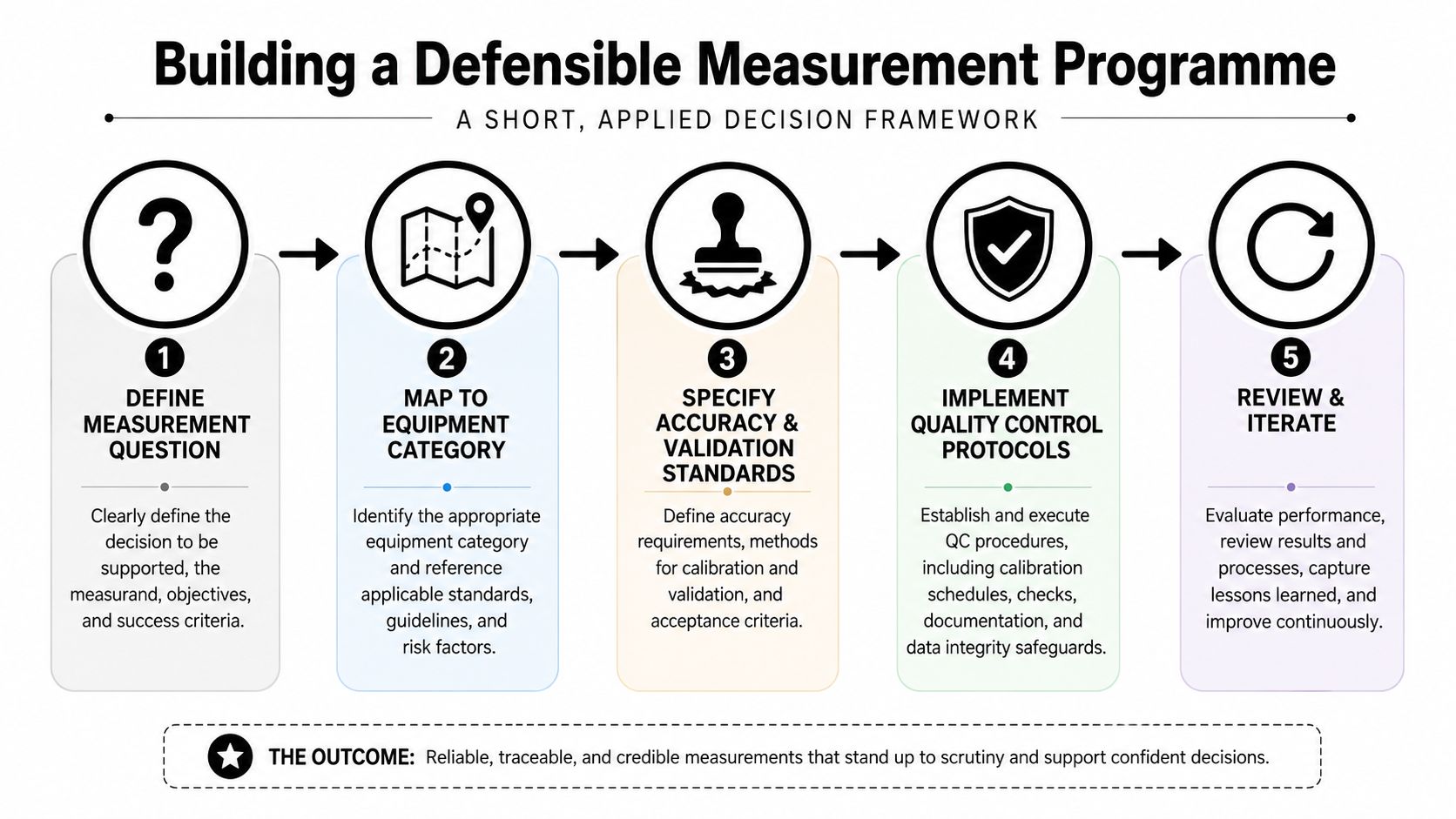
A practical decision sequence
Define the measurement question. A service assessing fitness for work may need repeatable functional capacity data, while a laboratory studying aerobic physiology may need breath-by-breath gas exchange. The intended decision determines the required resolution, protocol and operator skill.
Map the question to equipment. Select spirometry for respiratory flow and volume, dynamometry for force, anthropometric tools for defined body measurements, and metabolic analysers for gas exchange. Don't add complexity unless it answers a real measurement need.
Specify evidence before purchase. Ask for accuracy, repeatability, validation population, reference method, uncertainty information and post-market performance data. The supplier should also state the intended use of software, accessories and consumables.
Implement quality control. Create calibration schedules, daily or session checks, deviation criteria, operator training records, consumable lot tracking and corrective-action procedures. A mixed-device environment needs stronger identification and data controls because every instrument adds another possible source of variation.
Review and iterate. Examine failed checks, repeated measures, operator differences, report corrections and user feedback. If the same discrepancy appears repeatedly, investigate the process rather than replacing the device.
A defensible programme makes a result traceable from participant identity to released report, with every important decision visible in the record.
A fragile programme looks different. It mixes devices without comparison, accepts undocumented drift, lets expired or untracked consumables enter the workflow and treats manufacturer specifications as proof of local performance. It may produce attractive reports, but it can't answer basic audit questions about who tested the participant, which device was used, whether checks passed and whether the software changed.
Connected assessment platforms can reduce some of that administrative exposure when they preserve device identity, standardise calculations, flag out-of-tolerance readings and generate auditable reports. Cartwright Assess is being developed for professional assessment workflows, with functions intended to standardise testing, calculate and interpret results, maintain client assessment histories and produce professional reports. It should complement, not replace, calibration, validation and competent clinical or performance judgement.
Teams reviewing their current medical testing equipment should begin with one live pathway. Map every device, operator, consumable, data transfer and decision point. Then contact Cartwright Fitness to discuss professional equipment, Chester Step Test resources, calibration support, training and assessment software that can help turn a collection of instruments into a controlled measurement programme.