

The Margaria-Kalamen Test is a classic, no-frills way to measure an athlete's raw, explosive power. Think of it as a snapshot of your body's "launch" capability—the pure force you can generate in just a few seconds. It’s a direct look at lower-body explosiveness.
A True Test of Explosive Athletic Power
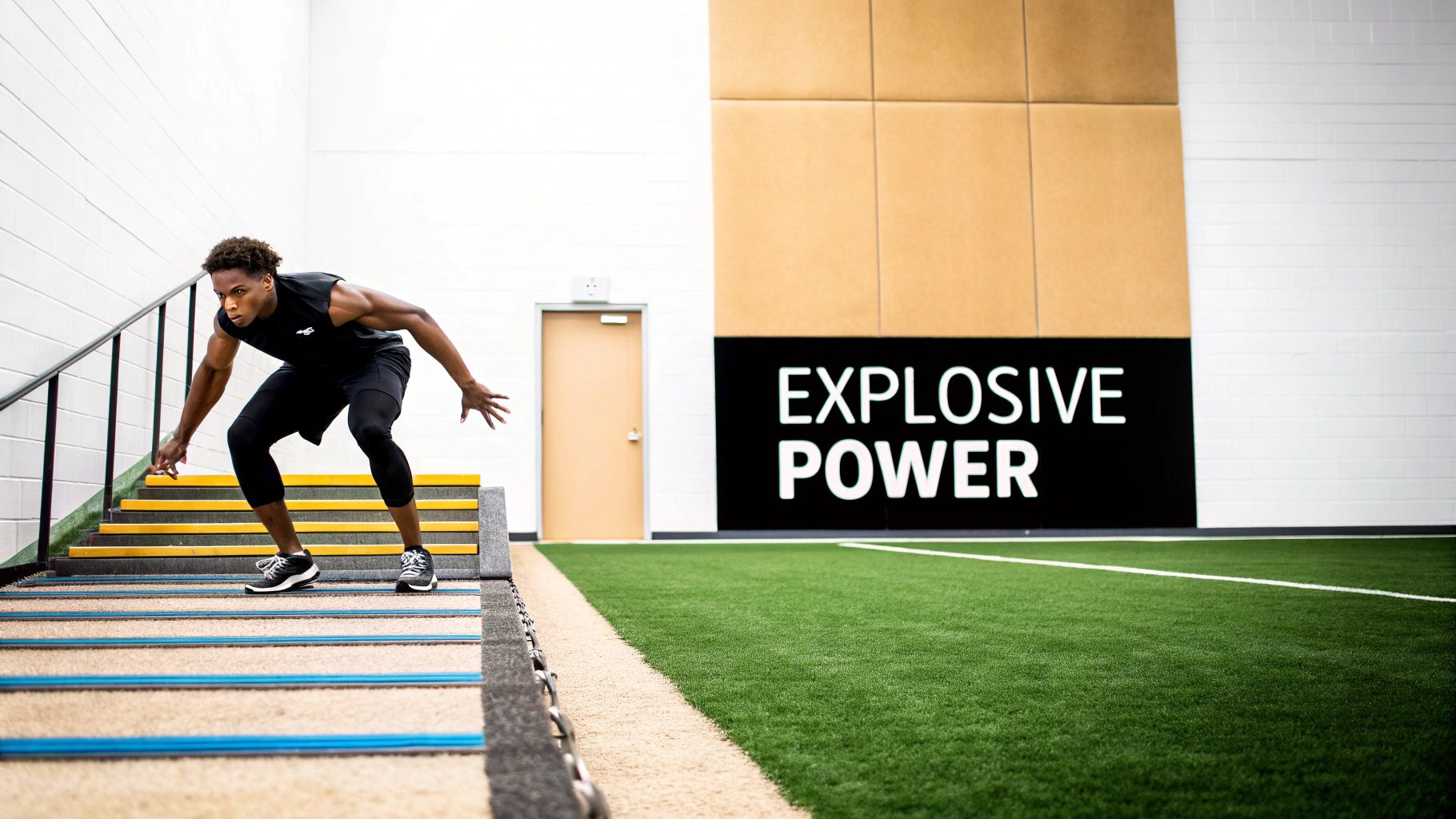
Picture a drag racing car lined up against a family sedan. The dragster is engineered for one purpose: pure, unadulterated acceleration over a short burst. In contrast, the sedan is built for steady, efficient cruising on the highway. This analogy gets right to the heart of what the Margaria-Kalamen Test is all about. It doesn't care about your endurance for a marathon (the sedan); it’s laser-focused on those first few seconds of all-out effort (the dragster).
For a quick overview, here's a look at the test's core components.
Margaria Kalamen Test at a Glance
| Attribute | Description |
|---|---|
| Primary Goal | Measures peak anaerobic power of the lower body. |
| Energy System | Assesses the anaerobic alactic (ATP-PC) system. |
| Duration | Extremely short, with the timed portion lasting just 1-2 seconds. |
| Equipment Needed | Staircase, timing gates (or stopwatch), measuring tape, scale. |
| Ideal For | Athletes in power-based sports (e.g., sprinting, football, basketball). |
This table shows just how simple and focused the assessment is, making it a powerful tool for coaches and athletes.
What Does It Actually Measure?
The test’s main job is to put a number on the power of your anaerobic alactic energy system. This is the body's go-to fuel for immediate, high-octane movements that last less than 10 seconds.
By having an athlete sprint up a flight of stairs, the test isolates and quantifies the peak power their legs can produce. We measure how quickly they can lift their own body weight vertically against gravity, giving us a clean, objective score of their explosive potential. It remains a gold standard in performance testing for a few key reasons:
- It isolates explosive power: The incredibly short duration ensures you’re only measuring the immediate ATP-PC energy system, not aerobic fitness.
- It’s highly practical: All you need is a staircase and a timer. This makes it accessible to almost any coach or athlete without needing a fancy lab.
- It provides hard data: The result is a power score in watts, which is perfect for comparing athletes and tracking progress over time.
A Legacy in Sports Science
The Margaria-Kalamen Test has a solid history, evolving from an earlier concept into the staple it is today. The version we use now was refined by J. Kalamen in 1968, who adapted a step test from a couple of years prior.
Kalamen's crucial update was standardizing the protocol. He specified a 6-meter run-up to build momentum and designated the timing to occur over a specific vertical distance—usually between the 3rd and 9th steps. This seemingly small change allowed for a much more accurate calculation of maximal power. Since then, it has become a fundamental tool for evaluating athletes in power-dominant sports like football, sprinting, and basketball. If you want to dive deeper into the original methodology, you can learn more about its development and application from sports science resources.
The Science Behind Your Explosive Power
To really get why the Margaria-Kalamen Test is such a brilliant tool, we need to pop the hood and look at the body's engine. When you go all-out in an explosive burst—like sprinting up a flight of stairs—your muscles aren't using the same fuel that gets you through a marathon. They're tapping into a very specific, high-octane energy reserve.
Your Body's "Nitro Boost"
This is where the phosphocreatine (ATP-PC) energy system comes into play. Think of it as your body's built-in nitro boost. It’s designed for incredibly powerful movements that last for less than 10 seconds, giving you a massive, almost instant surge of energy.
The genius of the Margaria-Kalamen Test is its brevity. The actual timed part of the test is over in a flash, often just a second or two. This forces the body to only use the ATP-PC system. It gives us a pure, unfiltered look at an athlete’s raw anaerobic power, without their aerobic endurance muddying the results.
Turning a Stair Climb into a Power Score
So how does a quick run up some stairs translate into a hard number? It’s all about fundamental physics. The test cleverly combines three simple variables to calculate an athlete's explosive ability.
- Body Mass: This is the weight the athlete has to move. It’s the resistance.
- Gravity: The constant force pulling that mass downward. The test is a direct battle against it.
- Vertical Velocity: This is the key metric—how fast can the athlete move their own body mass upward over a set distance?
At its core, the test is asking a simple question: How quickly can you propel your own body weight vertically against gravity? The answer, measured in watts, gives you a direct measurement of your lower-body explosive power.
This elegant calculation turns basic inputs like body weight and time into a meaningful power score. It's more than just a number; it’s a precise measure of how effectively an athlete's muscles and nerves can fire together to produce maximum force in a split second.
To dig even deeper into the physiology, it's worth exploring the mechanisms through which creatine enhances athletic performance, since it's the key compound that fuels this very energy system. This direct connection between a simple physical test and a precise power output is what has made the Margaria-Kalamen Test such a durable and trusted tool in sports science.
How to Perform the Test for Accurate Results
Getting reliable data from the Margaria-Kalamen Test all comes down to a precise and consistent setup. Think of it like a pre-flight check for a pilot—any small mistake on the ground can throw off the entire mission. If you standardize your procedure, you can be confident that every sprint truly reflects an athlete's peak anaerobic power.
First things first, you need the right space and tools. A standard staircase with at least 12 steps of the same height is non-negotiable. From there, you just need some basic gear to set up the course and capture the data.
- Measuring Tape: You'll need this to confirm the height of the steps and to mark off the run-up distance.
- Scale: To get an accurate reading of the athlete’s body mass in kilograms right before the test.
- Timing System: Electronic timing gates are the gold standard here, offering unmatched precision. If you don't have access to those, a smartphone with a high-frame-rate camera or even a manual stopwatch can work in a pinch, but they definitely require a skilled hand to be accurate.
Setting Up the Testing Course
You can't cut corners on the course setup. The whole point is to create an identical testing environment for every single trial and every athlete who runs it.
- Measure Step Height: Grab your tape measure and get the exact vertical height of a single step in meters. Most standard steps are around 0.175 meters (roughly 7 inches).
- Mark the Timing Zone: The test specifically measures the time it takes to get from the 3rd to the 9th step. You'll need to place clear, visible markers or set up your timing gates right at the edge of these two steps.
- Establish the Run-Up: Mark off a straight, clear path of 6 meters (about 20 feet) leading to the bottom of the first step. This run-up is absolutely critical; it gives the athlete the runway they need to hit top speed before they even touch the stairs.
This process is all about converting stored energy into measurable power.
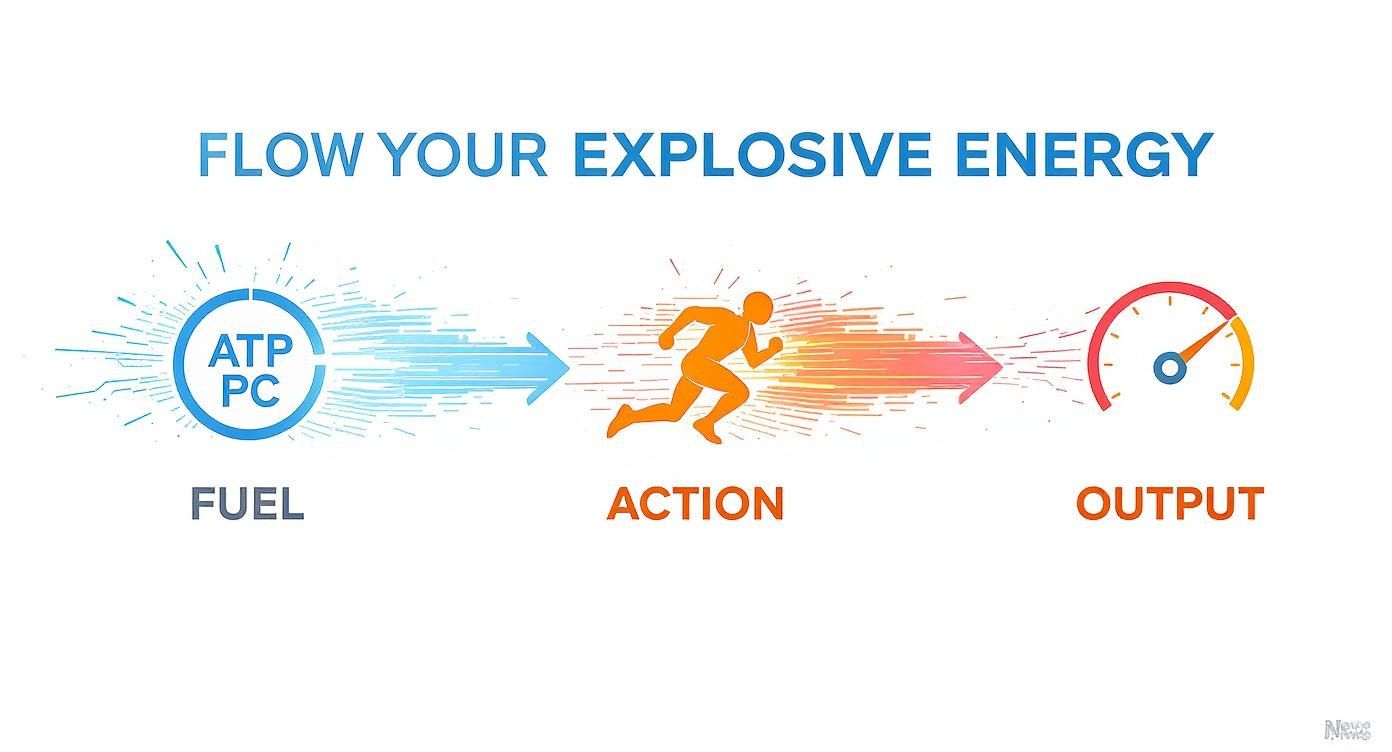
The infographic really nails it, showing how the body's instant fuel source powers the explosive sprint up the stairs, which ultimately gives us that final power score.
Executing the Test Protocol
Once the course is ready, all eyes are on the athlete. The key to getting a true maximal effort—safely—is a solid warm-up and crystal-clear instructions.
A dynamic warm-up is a must. We're talking 5-10 minutes of light cardio to get the blood flowing, followed by dynamic stretches like leg swings. It's also a good idea to include activation drills like glute bridges to wake up the neuromuscular system and prep it for the explosive work ahead.
When you're explaining the test to the athlete, keep it dead simple. Their one and only job is to sprint from that 6-meter line and power up the stairs as fast as humanly possible, taking them three steps at a time. That three-step rhythm is a core part of the official Margaria-Kalamen protocol.
Critical Tip: The clock starts the very instant their foot touches the 3rd step and stops the moment their foot hits the 9th step. Make it clear that this isn't a jog—it's an all-out, maximal-effort sprint from beginning to end.
To make sure you capture their absolute best performance, have them run at least three trials. Give them a full 2-3 minute rest between each attempt. This recovery time is vital for letting their ATP-PC energy system recharge, ensuring each sprint is a genuine measure of peak power, not just a test of their fatigue. When you're done, you'll use the fastest time of the three trials for your calculations.
Calculating and Understanding Your Power Score
Once you’ve recorded the athlete's fastest time, you're ready for the real magic. The next step is to transform that simple stopwatch reading into a powerful, objective metric: their peak anaerobic power, measured in watts.
This isn't just some abstract number. It’s a direct calculation of explosive strength based on fundamental physics. The calculation itself is straightforward, but precision is everything. A small mistake in any of your initial measurements can throw the final score off, so double-check your numbers.
Breaking Down the Power Formula
At first glance, the formula might look a little intimidating, but it’s just made up of the simple measurements you’ve already taken. Let's walk through it.
Power (Watts) = (Mass × Gravity × Vertical Distance) / Time
- Mass (M): This is the athlete’s body weight in kilograms (kg). For the most accurate result, weigh the athlete in their gear right before they perform the test.
- Gravity (g): A constant that never changes. It represents the acceleration of gravity, which is always 9.81 m/s².
- Vertical Distance (d): The total vertical height the athlete climbed between the 3rd and 9th steps, measured in meters.
- Time (t): The fastest time you clocked during the trials, recorded in seconds (s).
Think of it this way: the formula calculates the rate at which an athlete can do physical work. It's measuring how quickly they can propel their own body mass upward against the pull of gravity. That is the very definition of power.
This elegant equation turns a few simple field measurements into a lab-quality performance metric, all without needing any expensive, high-tech equipment.
A Practical Worked Example
Let's plug in some numbers to see how it works in the real world.
Imagine you just tested an athlete who weighs 80 kg (about 176 lbs). They absolutely flew up the stairs, clocking a best time of 0.55 seconds between the 3rd and 9th steps. You previously measured the vertical distance between those two steps and found it to be 1.05 meters.
Now, let's put it all together:
Power = (80 kg × 9.81 m/s² × 1.05 m) / 0.55 s
Power = (824.04) / 0.55 s
The final calculation gives us a peak power output of 1498 Watts. This single number is a fantastic snapshot of that athlete's explosive ability.
What Does Your Score Actually Mean?
Okay, so our athlete hit 1498 W. Is that good? Average? Elite? By itself, the number is meaningless. Its true value is revealed through comparison, and that’s where normative data comes in.
Normative data tables provide crucial context by showing you how your athlete stacks up against others. These benchmarks are compiled from tests on large groups of athletes, often broken down by sport, gender, age, or skill level.
Here’s a look at some sample data to give you an idea of what different scores mean across various sports.
Normative Power Output Data (Watts) for Athletes
| Athlete Group | Gender | Average Power (W) |
|---|---|---|
| Elite Sprinters | Male | 1700 – 1900 |
| Professional Soccer Players | Male | 1300 – 1500 |
| Collegiate Volleyball Players | Female | 950 – 1150 |
| High School Football (Linemen) | Male | 1100 – 1300 |
| Untrained Adults | Male | 900 – 1100 |
| Untrained Adults | Female | 650 – 850 |
As you can see, a "good" score is highly relative. A power output that’s exceptional for a high school lineman might be considered just average for an Olympic-level sprinter.
By comparing your athlete’s score to relevant normative data, you can:
- Pinpoint strengths and weaknesses: Is their anaerobic power a key asset or a limiting factor in their performance?
- Set realistic goals: Establish clear, data-driven targets for their training program.
- Track progress objectively: Re-test throughout the season to see exactly how their power output is changing.
This final step—adding context—is what transforms a simple number from a stopwatch into actionable intelligence. It’s how you design smarter training plans and help athletes unlock their true potential.
Real-World Applications for Athletes and Coaches
https://www.youtube.com/embed/pL4RtMaZems
So, what does all this physics and physiology mean on the ground? For coaches and athletes, the real magic of the Margaria-Kalamen test is how it translates into smarter training and better performance on the field, court, or track. It’s more than just a number—it’s a powerful diagnostic tool.
Its most straightforward use is for talent identification and benchmarking. A coach can get a quick, objective snapshot of an athlete's raw anaerobic power, instantly flagging those with natural explosive potential. This gives you a hard number to compare athletes within a team or against the standards for their sport, helping to identify who might be a great fit for a power-heavy position.
It's also an incredible tool for monitoring training progress. By running the test at the start, middle, and end of a training block, you get clear, data-driven feedback. You can see, without guessing, if your program is actually improving an athlete's explosive power. If their score flatlines or drops, that's your cue to rethink the training plan.
Tailoring Programs and Managing Recovery
The test's value doesn't stop at measurement. The results can directly inform how you design training programs and manage an athlete's recovery. By pinpointing weaknesses in power production, you can create more targeted interventions. It’s not just about the final score; it’s about using that information to explore effective strategies to enhance overall strength and build a more powerful athlete.
This test is also a game-changer for return-to-play protocols after a lower-body injury. By comparing an athlete’s current score to their pre-injury baseline, the medical team gets an objective green light. It helps confirm they've regained the explosive strength needed to compete safely, significantly cutting down the risk of re-injury.
One of the best things about the Margaria-Kalamen test is its versatility. You can easily tweak it for different groups by changing the number of steps or the technique, making it a relevant tool for everyone from pro athletes to weekend warriors.
The screenshot below shows a study that did just that, creating a modified version of the test for recreational master athletes.
This highlights just how adaptable the test is. The protocol can be adjusted to work for older or less-trained individuals and still produce reliable data on their anaerobic power.
Modifications for Different Sports
The standard protocol isn't a one-size-fits-all solution. Coaches have long adapted it to meet the specific demands of their sport.
Take American football, where athletes are bigger and the power demands are off the charts. Researchers working with collegiate football players modified the test to include a longer climb of 20 steps and allowed up to 25 trials to ensure they captured a true max-effort performance.
What they found was fascinating. There were huge power differences between positions:
- Linemen averaged 1712.6 Watts
- Linebackers averaged 1674.5 Watts
- Skill players (like receivers and defensive backs) averaged 1388.6 Watts
This modification not only delivered more position-specific data but also outsmarted a common problem where athletes could "cheat" the timing gates, which could artificially inflate scores by 10-24%.
Common Questions About the Test
Even when you've got the protocol down pat, real-world questions always pop up. Let's tackle some of the most common ones I hear about the Margaria-Kalamen test.
Think of this as the practical advice that separates good data from great data.
Margaria Kalamen Test vs Vertical Jump
This is a fantastic question, and one I get all the time. Both are classic tests for lower-body power, but they're measuring different things. The secret is in the momentum.
A Vertical Jump Test, like a Sargent jump, measures explosive power from a dead stop or a countermovement. It’s a pure, clean look at an athlete's ability to generate vertical force from a standstill.
The Margaria-Kalamen test, on the other hand, measures power while the athlete is already moving. That mandatory 6-meter run-up means they hit the stairs with speed. This makes it a much better indicator of how an athlete transfers horizontal velocity into vertical power—a skill absolutely critical in sports where you're sprinting into a jump, a tackle, or a quick change of direction.
- Use the Vertical Jump if you want to isolate raw, static vertical explosiveness.
- Use the Margaria-Kalamen Test if you want to see how an athlete generates power during dynamic, forward-moving actions.
Neither is "better" than the other; they just give you different pieces of the puzzle. The right one depends entirely on what you want to measure.
Can You Test Without Electronic Gates
While timing gates are the gold standard for accuracy, you can absolutely get valuable data without them. The best alternative is a high-frame-rate video camera—even the slow-motion feature on a modern smartphone can do the trick.
By recording the test and reviewing the footage frame-by-frame, you can pinpoint the exact moment the foot makes contact with the 3rd and 9th steps. This method is miles more accurate than trying to use a manual stopwatch, which is always subject to human reaction error. A stopwatch should be your last resort, but if it’s all you have, it’s better than nothing.
The bottom line is, don't let a lack of high-tech gear stop you. A well-filmed video analysis can still give you reliable data to track an athlete's progress over time.
How Often Should Athletes Be Tested
The answer here is simple: test when it makes sense within your training plan. We're trying to measure the results of a training block, not just test for the sake of it. Power adaptations take time, so testing too often is a waste of everyone’s energy.
A smart schedule usually involves testing at a few key points:
- Start of the Pre-Season: This gives you a solid baseline for every single athlete.
- End of a Power-Focused Training Block: Check in after a dedicated 8-12 week cycle to see if the program actually worked.
- End of the Season: See how much progress was made over the year to help guide off-season training.
This rhythm gives you objective feedback on your methods without burning out your athletes.
Can the Test Be Modified for Different People
Absolutely. The original protocol is a great starting point, but it's not set in stone. For example, some interesting research on recreational master athletes (ages 30 to 50) used a modified version where they took two steps at a time instead of three.
This small tweak made the test more appropriate for an older or less-trained group, and the study found it was still a reliable and valid measure. Adjustments like these ensure the test remains a useful tool for measuring power across all sorts of different people. If you're interested in the details, you can explore how these modified protocols compare to the standard test and see the research for yourself.
At Cartwright Fitness, we provide validated, high-precision testing equipment to help you get the most accurate performance data. From timing systems to body composition analyzers, our tools are trusted by professionals worldwide.
Explore our range of professional testing equipment at Cartwright Fitness