

A clinician in occupational health knows the scene well. A 47-year-old warehouse operative arrives with three months of wheeze on exertion, a mixed smoking history, and regular exposure to dust and cold loading bays. Management wants an answer about respirator clearance. The worker wants a quick fit note. The clinician needs something better than impressions.
That's where a lung function test earns its place. Not as a ritual, and not as a box to tick, but as an objective measure that can support diagnosis, surveillance, fitness-for-duty decisions, and defensible reporting. In UK practice, spirometry became embedded much more firmly in primary care after the Quality and Outcomes Framework in 2004, and later NICE guidance reinforced spirometry as a core diagnostic standard for COPD across a clear policy timeline covering 2004, 2011, 2016, and 2018 (PCRS UK spirometry in primary care summary).
Table of Contents
- Why Lung Function Testing Matters in Professional Practice
- The Core Measurements Behind Every Lung Function Test
- The Main Types of Lung Function Tests and When to Use Them
- Running a Standardised Spirometry Session
- Turning Numbers into Clinical Decisions
- The 2025 Reference Equation Shift and What It Means for You
- Lung Function Tests in Occupational and Fitness-for-Work Assessment
- Quality Control and Professional Reporting
Why Lung Function Testing Matters in Professional Practice
Symptoms don't tell the whole story. Wheeze can come from asthma, COPD, deconditioning, anxiety, upper airway dysfunction, or poor symptom recall. In occupational settings, the picture gets messier because smoking, prior respiratory disease, and workplace exposure can all point in different directions.
Decision-making, not just measurement
A lung function test helps separate three different professional questions:
- Clinical diagnosis: Is there objective evidence of airflow obstruction or another ventilatory problem that needs medical follow-up?
- Occupational surveillance: Is there a change over time that might relate to dust, fume, chemical, or respirator exposure?
- Fitness-for-work assessment: Can the worker safely perform a task that adds respiratory load or requires protective equipment?
Those questions overlap, but they're not identical. A result that supports referral for diagnostic work-up doesn't automatically answer deployability. Equally, a worker may be fit for a specific role while still needing further respiratory investigation.
The four test families professionals actually use
In practice, most services rely on four test modalities:
- Spirometry for airflow and volume pattern assessment.
- Peak expiratory flow for serial variability monitoring.
- Gas transfer testing when alveolar-capillary function matters.
- Body plethysmography when static lung volumes need clarification.
Practical rule: A reported number is only as defensible as the session that produced it.
That's the part new clinicians often underestimate. The legal and clinical value of a report depends on preparation, coaching, repeatability, reference equations, and the competence of the person interpreting the printout. A poor test can still produce neat numbers. It just won't produce trustworthy ones.
The Core Measurements Behind Every Lung Function Test
Most confusion starts because the report looks mathematical before it feels physical. The easiest way to teach it is to think of the lungs as a reservoir with an outlet tap. The total amount available to empty is one thing. The speed at which it comes out is another.
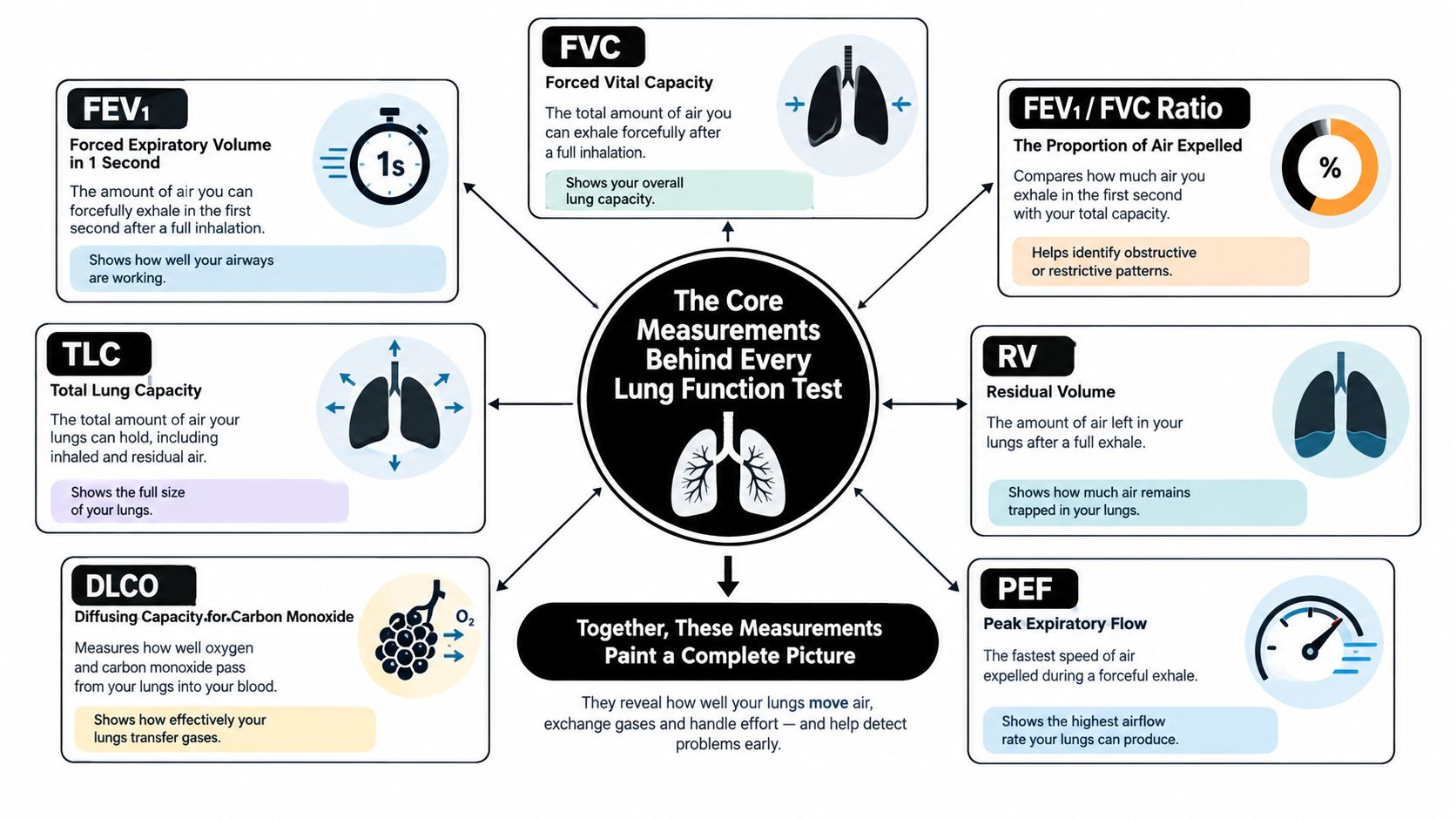
FEV1, FVC, and the ratio
FVC is the full volume the patient can blow out after a maximal inhalation. It's the size of the usable reservoir.
FEV1 is the volume blown out in the first second of that forced exhalation. It reflects how quickly air can leave the system when the patient tries hard.
The FEV1/FVC ratio tells the clinician how much of the total volume leaves in that first second. That ratio is often the hinge point in interpretation. In UK adult asthma guidance, airflow limitation is suggested when the FEV1/FVC ratio is below 70%, and bronchodilator reversibility supports diagnosis when FEV1 rises by at least 12% and 200 mL, or by 10% or more of predicted normal FEV1 (BNSSG NHS adult asthma guidance).
The three pattern families
A clinician usually reads the report in pattern form before disease form.
- Obstructive pattern: The ratio falls because the patient can't get air out quickly. Asthma and COPD sit here most often.
- Restrictive pattern: Total available volume is reduced, so FVC is low, but the ratio may stay normal or even look relatively high.
- Mixed pattern: The ratio is low and the vital capacity is also reduced, raising the possibility of combined processes.
This is why isolated numbers can mislead. A low FEV1 alone doesn't tell the whole story. The clinician needs the relationship between speed and volume.
What this means in day-to-day equipment use
For serial self-monitoring or clinic follow-up, a focused device may be enough if the question is narrow. The Vitalograph Asma-1 Electronic Asthma Monitor, for example, measures PEF and FEV1, displays personal best for both, allows personalised zones, stores best values automatically, has a large display, and stores 600 test sessions. That doesn't replace full spirometry, but it can fit a structured asthma-monitoring workflow.
A spirometry printout shouldn't be read as a list of disconnected numbers. It should be read as a breathing pattern with a technical quality story behind it.
The Main Types of Lung Function Tests and When to Use Them
Not every respiratory question needs the same instrument. Problems arise when a service uses the test it owns rather than the test that best matches the referral question.
Choosing the first test wisely
Spirometry is usually the first stop because it gives the fastest objective view of expiratory airflow and forced vital capacity. It's the workhorse for suspected obstruction and for detecting a pattern that may suggest restriction.
Peak expiratory flow helps when variability matters more than a single clinic snapshot. That's particularly useful in asthma pathways, occupational symptom diaries, and work-related pattern tracking.
Gas transfer testing adds a different dimension. It asks how effectively gas crosses from alveoli into blood. That makes it useful when spirometry and symptoms don't align neatly, or when parenchymal disease is part of the differential.
Body plethysmography comes into play when true lung volumes matter. If spirometry suggests reduced capacity but can't confirm whether restriction is genuine, plethysmography helps define trapped gas and residual volume.
Choosing the right lung function test
| Test | Primary Measurement | Main Indication | Equipment |
|---|---|---|---|
| Spirometry | FEV1, FVC, ratio | First-line assessment of obstructive or possible restrictive patterns | Desktop or portable spirometer with trained operator |
| Peak expiratory flow | Peak flow | Serial variability tracking, often in asthma or work-related symptom review | Peak flow meter or handheld electronic monitor |
| Gas transfer | Diffusing capacity | Clarifying gas exchange problems or discordant findings | Dedicated pulmonary function system |
| Body plethysmography | Static lung volumes | Confirming restriction or quantifying trapped gas | Plethysmograph cabin and specialist setup |
For services comparing device categories and clinical setups, lung capacity measurement equipment options provide a useful orientation point.
A practical escalation cue
Most referrals still start with spirometry. If the pattern, symptoms, and occupational context line up, that may be enough for the next decision. If they don't, escalation should be deliberate rather than automatic. Peak flow answers a different question from gas transfer, and plethysmography answers a different question again.
Running a Standardised Spirometry Session
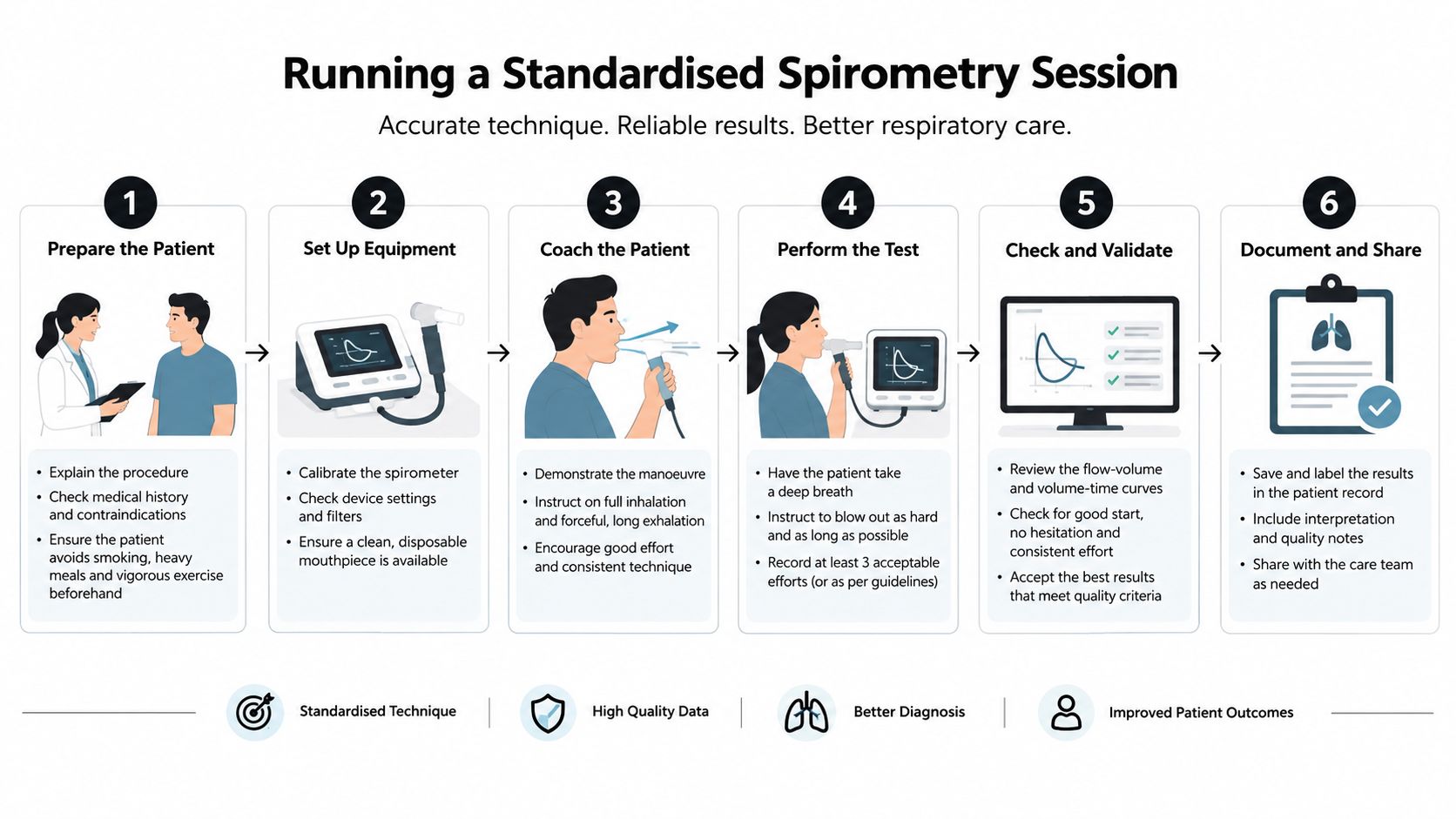
A good spirometry session looks simple from the patient chair. Behind the scenes, it's controlled, repetitive, and unforgiving of shortcuts.
Before the first blow
Preparation begins before the mouthpiece is lifted. The operator checks symptoms, smoking and caffeine intake where relevant to local protocol, confirms contraindications, verifies identity, and enters accurate demographic details. Height matters because predicted values depend on correct input. A wrong height can make a good manoeuvre look abnormal, or a poor result look ordinary.
Equipment checks matter just as much. The service should have a documented calibration or verification process, often using a 3-litre syringe where required by device and protocol. The point isn't bureaucracy. It's proving that a low reading belongs to the patient, not the kit.
Coaching and acceptability
The forced manoeuvre needs clear instruction. Full inhale first. Tight seal. Fast start. Hard blast. Keep going until the exhalation is complete.
Common technical failures are familiar:
- Tongue occlusion: Airflow is partly blocked by the tongue at the mouthpiece.
- Glottic closure: Effort is interrupted by upper airway closure.
- Poor posture: Slumped position limits inhalation and alters mechanics.
- Early cough: A cough near the start distorts the most important part of the tracing.
- Premature stop: The patient quits before the blow is complete.
Repeatability decides whether the session stands up
ARTP guidance states that the two largest FEV1 and FVC values should be within 150 mL, and where FVC is 1.0 L or less, the two largest FEV1 and FVC values must be within 100 mL (ARTP spirometry FAQs). ARTP standards also specify a maximum difference of 150 mL between the two highest FEV1 values, with specific consideration for low-volume manoeuvres where FVC is below 1.00 L (ARTP spirometry standards 2025).
That distinction between acceptable and merely usable is critical. A blow can be technically imperfect yet still offer limited information. But if repeatability isn't met, the clinician shouldn't treat the output as a firm basis for major decisions.
Session rule: If the best blows don't agree closely enough, the problem isn't solved by choosing the highest number.
Bronchodilator reversibility testing may follow if clinically indicated. The same discipline still applies after bronchodilator administration. Post-bronchodilator data only help if the baseline and follow-up manoeuvres are both sound.
Turning Numbers into Clinical Decisions
Interpretation starts with pattern recognition, not with disease labels. The report answers a physiological question first. Diagnosis comes after that, with symptoms, history, exposure, examination, and sometimes further tests.
Ratio first, then volume, then severity
In UK practice, an obstructive airflow pattern is typically identified when the post-bronchodilator FEV1/FVC ratio is below 0.70, but reporting should also consider the lower limit of normal because a fixed 0.70 threshold can misclassify some patients across age groups (NICE final scope on spirometry services). The British Thoracic Society also notes that an FEV1/VC ratio below 0.7 indicates airflow obstruction, while warning that a fixed cut-off can misclassify some older adults because it may be normal in the elderly (BTS spirometry e-guide).
That's the reason experienced readers don't stop at the ratio. They ask whether the value is low for that person, not only low against a fixed line.
For COPD, NICE uses a post-bronchodilator FEV1/FVC ratio of less than 0.7 as the threshold indicating airflow obstruction, and grades severity by FEV1 % predicted as 80% or more for mild, 50 to 79% for moderate, 30 to 49% for severe, and below 30% for very severe disease (NICE COPD recommendations).
FEV1 Percent Predicted and ATS/ERS Severity Grades
| FEV1 % Predicted | Severity Grade | Clinical Implication |
|---|---|---|
| 80% or more | Mild | Airflow limitation may be present, but interpretation still depends on pattern and context |
| 50 to 79% | Moderate | Functional impact becomes more likely and clinical review gains weight |
| 30 to 49% | Severe | Usually supports a more urgent and structured management discussion |
| Below 30% | Very severe | Indicates marked impairment and demands careful clinical correlation |
Why borderline results need restraint
A single borderline result rarely settles the matter. NHS England guidance notes that post-bronchodilator FEV1/FVC ratios at or above 0.7 should trigger further clinical review rather than immediate COPD confirmation, and NICE materials note that spirometry should be performed at diagnosis and repeated when needed because a single normal result doesn't rule out asthma (NHS England spirometry commissioning guidance).
Bronchodilator response can add useful weight in the right setting, particularly when symptoms suggest asthma and baseline obstruction is present. Flow-volume loops can also help the experienced reader spot patterns that suggest upper airway limitation rather than typical lower airway obstruction. But no graph should be over-read in isolation.
The 2025 Reference Equation Shift and What It Means for You
A worker attends annual surveillance. Their measured FEV1 is almost identical to last year. The spirometry software has been updated since the previous test, and the report now places that same raw result in a different percent predicted band. Unless the clinician notices the reference equation change, it can look like a physiological change when none has occurred.
ARTP's 2025 position is clear on the points that affect day-to-day interpretation. Self-identified race or ethnicity is no longer required for lung function interpretation, GLI Global equations apply to spirometry only, retrospective values may need recalculation for longitudinal monitoring, and software availability will vary by device age and service agreements (ARTP GLI Global position statement 2025).
The practical point is simple. Spirometry interpretation always compares the patient's measured result with a reference frame built from age, sex, height, and the equation set used by the device. Change the frame, and the position of the same measured blow can shift relative to the lower limit of normal and relative to percent predicted cut points. The lungs have not changed. The ruler has.
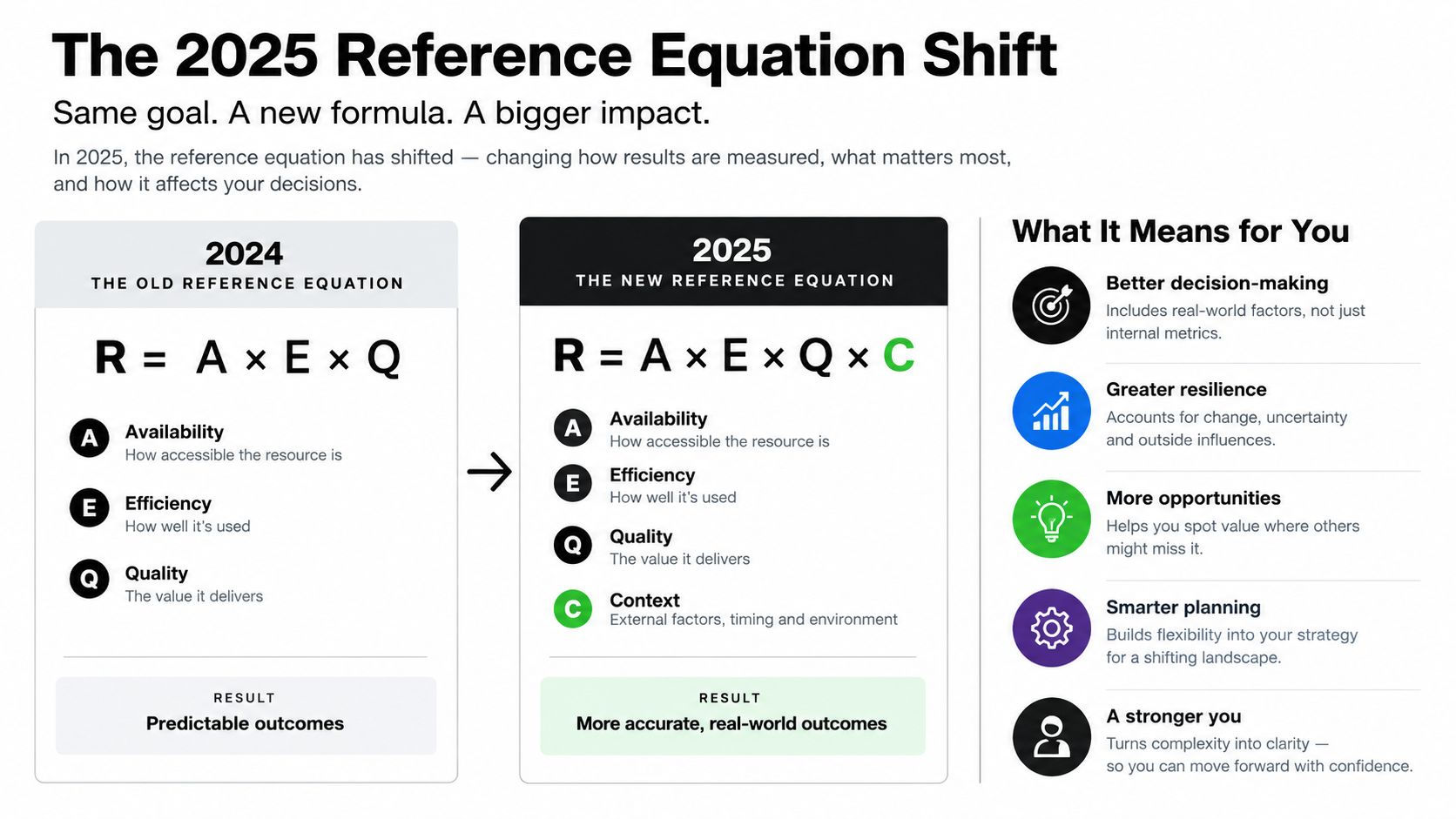
This matters most when the number sits near a decision boundary. A small shift in predicted value can reclassify a result from within normal limits to below the lower limit, or move FEV1 percent predicted across a policy threshold used in occupational review. New clinicians often focus on the measured volume because it feels tangible. In practice, the interpretation lives in the ratio between the measured result and the reference equation chosen by the software.
That creates three immediate tasks for services:
- Check which equation set each device is using. Different sites in the same organisation may not update at the same time.
- Flag longitudinal reports that cross the 2025 changeover. Serial comparisons are weaker if older and newer results sit on different reference systems.
- Review local thresholds written around percent predicted values. Policies may still be clinically sensible, but they need rechecking under the new equations.
For clinicians reviewing trends, a spirometry normal values chart can help explain where a result sits, but charts do not solve the version-control problem. The report itself should state the reference equation used, the software version where available, and whether earlier results were recalculated or left on their original basis.
The safest habit is to read every post-2025 spirometry trend as two questions, not one. Has the patient changed, and has the reference system changed? If you cannot answer both, treat any apparent rise or fall with caution before attaching clinical or fitness-for-work meaning to it.
Lung Function Tests in Occupational and Fitness-for-Work Assessment
In workplace health, spirometry shouldn't be used as a crude pass or fail gate. It's one input into a broader judgement that also includes symptoms, exposure history, task demands, PPE requirements, and trend over time.
Three contexts, three different logics
A firefighter recruit, a metalworker under surveillance, and a patient attending respiratory follow-up may all perform a lung function test. The decision logic isn't the same.
| Context | Primary Tests | Decision Driver | Typical Frequency |
|---|---|---|---|
| Fire and rescue or emergency response | Spirometry, sometimes additional occupational assessment | Ability to meet respiratory demands and use protective equipment safely | Baseline and role-related review |
| Exposure surveillance | Spirometry, with peak flow where indicated | Change over time, symptom association, and referral trigger | Periodic surveillance |
| Clinical disease monitoring | Spirometry, with escalation to fuller testing if needed | Disease course and treatment response | According to clinical review need |
What clinicians often get wrong
The most common mistake is over-interpreting a single low reading. If repeatability isn't secure, the result may reflect effort, technique, or coaching rather than impairment. Another common error is using baseline logic for periodic testing. Baseline testing asks where the worker starts. Periodic surveillance asks whether something is changing.
Pre-shift and post-shift timing can also matter in symptomatic workers, especially when the suspicion is work-related bronchoconstriction or irritation rather than fixed disease. In those cases, pattern across time may tell more than a one-off clinic value.
A fitness-for-work decision should match the respiratory risk of the job, not the convenience of the device on the desk.
Sleep quality can also complicate exertional symptoms and upper-airway complaints. For clinicians who want a patient-friendly resource on airway-related symptom patterns beyond formal lung testing, better sleep with SleepHabits offers a useful explainer.
Quality Control and Professional Reporting
A reportable session has a paper trail. A wasted session also has a paper trail, if the service is honest enough to record it properly.
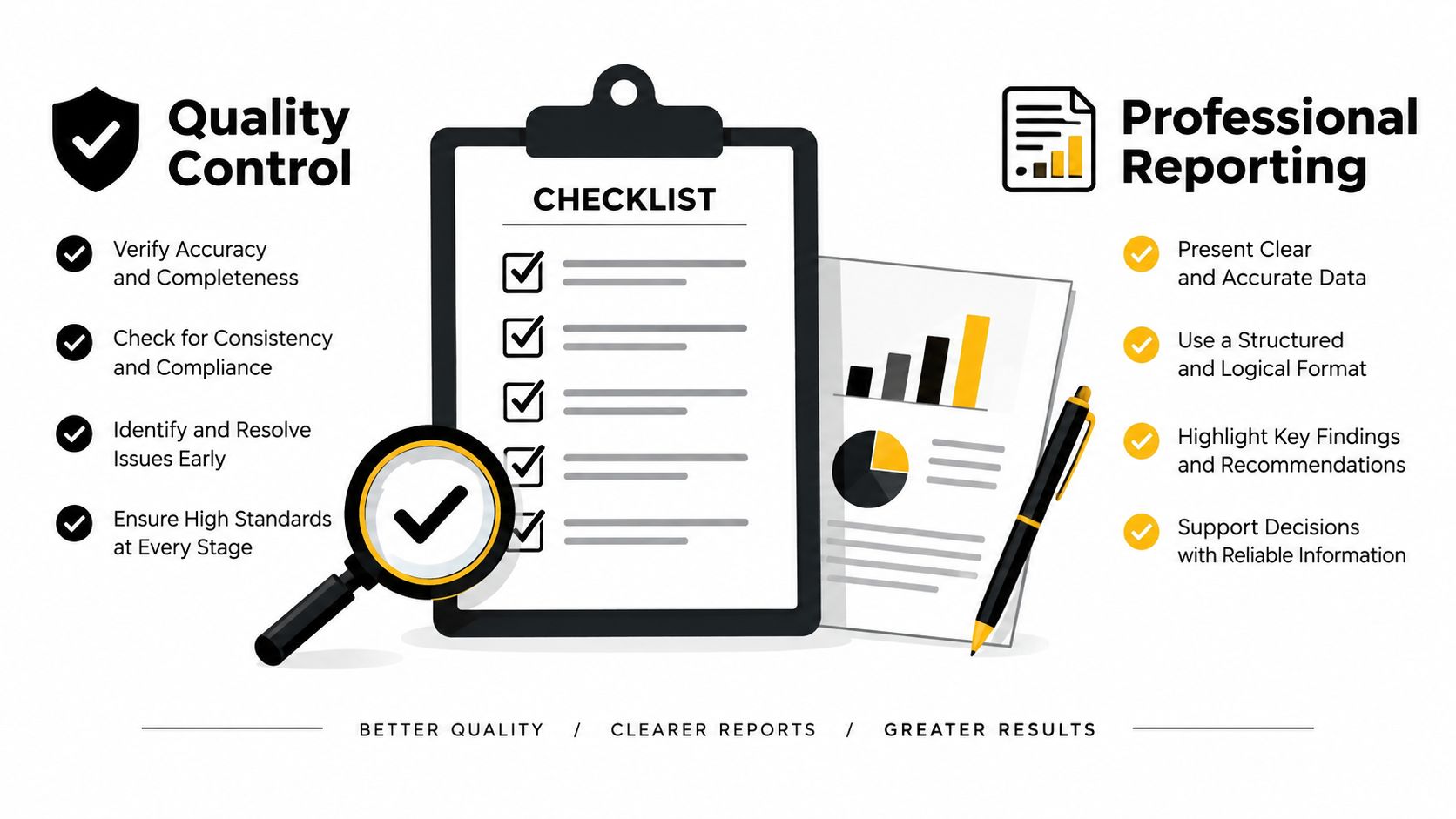
The quality checklist that protects the report
A defensible spirometry workflow should show:
- Verified equipment status: calibration or verification logs are current and appropriate to the device.
- Correct patient data: identifiers, age, sex, height, and test indication are entered accurately.
- Technical quality: acceptable manoeuvres are documented and repeatability standards are met where possible.
- Right reference set: the equation used for interpretation is stated, especially during transition periods.
- Competent sign-off: interpretation is reviewed and authorised by an appropriately trained practitioner.
What a professional report should actually contain
The report should do more than dump numbers. It should include the patient identifiers, reason for test, device used, reference equation, measured values, percent predicted where relevant, quality comment, physiological pattern, and a short interpretive statement in plain clinical language.
For busy services, workflow design matters as much as physiology. Administrative systems that reduce transcription and scheduling friction can improve the quality chain around testing. In adjacent clinical settings, tools built for physical therapy front desk automation show the wider operational principle well. Structured intake, appointment flow, and cleaner records reduce avoidable human error before interpretation even begins.
A software-enabled approach is increasingly the logical next step for services still relying on isolated desktop spirometers and separate spreadsheets. Cartwright Fitness is developing Cartwright Assess, a professional assessment software platform intended to standardise testing, calculate and interpret results, maintain assessment histories, and generate professional reports. In respiratory work, that kind of version-controlled workflow matters because it can help preserve longitudinal consistency while equation sets, devices, and reporting standards evolve.
Cartwright Fitness supplies professional health and human-performance measurement equipment, including respiratory assessment solutions used in occupational health, healthcare, sport science, and emergency services. For teams building a better lung function testing workflow, from equipment selection to reporting systems, visit Cartwright Fitness.


