

A recruitment panel has two candidates, two very different fitness reports, and no clear answer to a basic question: can either person perform the essential duties safely? One report lists body composition and a treadmill score. The other records a shuttle-run result, grip strength and a medical questionnaire. Neither report links its findings to the actual job.
That gap matters. A job related fitness test isn't a generic gym assessment with a more serious name. It is a role-specific process that connects documented physical demands, medical screening, measurable performance and a defensible occupational decision. The strongest programmes measure what the work requires, control how testing is delivered and avoid treating a single score as a complete fitness-for-work opinion.
Table of Contents
- Defining the Purpose of Occupational Fitness Testing
- Translating Job Demands into Measurable Thresholds
- Selecting the Right Assessment Protocols and Equipment
- Standardising the Testing Environment and Procedure
- Integrating Medical Screening and Equality Considerations
- Capturing Data and Generating Professional Reports
Defining the Purpose of Occupational Fitness Testing
A candidate may pass a treadmill assessment yet struggle to climb repeatedly, handle an awkward load or maintain grip while wearing protective equipment. A worker with average recreational fitness may still perform every required duty in a sedentary or modified role. These outcomes are not contradictory. They show why a job related fitness test must assess the demands of a defined role rather than produce a general fitness profile.
A health check may include resting measures, body composition, aerobic capacity or strength. Those findings can support clinical care and performance planning, but they do not by themselves establish work capability. The employer needs a written job analysis before selecting a protocol. It should record essential tasks, load characteristics, working postures, movement patterns, task duration, environmental conditions, recovery opportunities and the consequences of fatigue.
The physical assessment should then reproduce those demands or represent them through a validated protocol. A generic threshold copied from another occupation is difficult to defend when no evidence connects it to the work. The defensible decision combines medical screening with a performance threshold tied to an identified safety requirement.
Health assessment and work capability are not interchangeable
A fitness-for-work medical assessment considers whether an individual can perform work safely and whether modifications may be appropriate. Guidance from the University of Cambridge occupational health service describes fitness-for-work assessment as a way to establish whether someone can perform required tasks safely, with modification potentially preferable to exclusion. That distinction matters in recruitment, return-to-work and periodic review cases.
A physical test can show a performance limitation, but it cannot explain the cause on its own. Medical history, symptoms, medication, injury history and functional restrictions may alter the interpretation. Keep clinical information separate from management information. Managers generally need a capability outcome, restrictions and agreed adjustments, rather than an unnecessary diagnosis.
Practical rule: A pass mark should answer a documented job question, not express an employer's preference for a particular body type or general fitness level.
Build the decision around the role
Role specificity also prevents one-size-fits-all standards. London Fire Brigade guidance illustrates different aerobic thresholds for operational firefighters and senior operational staff, with the detailed figures set out in the next section (London Fire Brigade guidance). The point is not to adopt those values elsewhere. It is to show that standards should follow duties, exposure and safety consequences within the assessed service.
A defensible programme should document:
- Essential functions: What must the worker do, and what safety risk follows if the task cannot be completed?
- Performance constructs: Is the relevant capability aerobic capacity, maximal strength, repeated effort, balance, dexterity or a combination?
- Decision boundaries: What result indicates capability, what result requires review, and what result shows that the job demand has not been demonstrated?
- Adjustment route: Can the task, equipment, schedule or duties be modified without removing an essential function or creating unacceptable risk?
An occupational health assessment can support this process, but no equipment or report replaces clear job analysis. Occupational health, operational managers, human resources and qualified testing professionals should agree what each result means before candidates enter the testing room. That approach limits arbitrary exclusion while keeping the employer's safety decision evidence-based.
Translating Job Demands into Measurable Thresholds
A candidate may complete a treadmill test yet fail to carry equipment safely through a confined space. That outcome exposes the central design problem: a generic fitness assessment measures capacity, while a defensible job related fitness test demonstrates the capabilities a role requires. Thresholds should therefore begin with observed work, then combine physical performance measures with appropriate medical screening.
A practical job-analysis sequence
- List the essential tasks. Separate duties that determine safe job performance from occasional or marginal activities. Firefighting may involve climbing, carrying, pulling, equipment handling and work under pressure. A warehouse role may depend more on repeated handling, walking and postural tolerance.
- Describe the physical demand. Record movement pattern, load position, duration, surface, height and frequency. “Manual handling” is too broad to produce a meaningful test. Note whether work occurs indoors, outdoors, at height or in protective equipment.
- Identify the physiological requirement. Decide whether the task depends mainly on aerobic capacity, local muscular endurance, whole-body strength, grip, power, balance or several qualities together.
- Select a criterion measure. Use direct physiological measurement when the decision requires it. A validated field or submaximal protocol may be proportionate where the role, cohort and risk profile support that choice.
- Set the threshold from the task. The pass mark should represent the minimum capability needed for safe completion, with allowance for normal variation and fatigue. A familiar test score is not, by itself, a defensible threshold.
- Validate and review. Compare test performance with the actual task, monitor adverse events and check whether the protocol creates barriers unrelated to essential work.
Thresholds used by emergency services illustrate how the same physiological construct can support different operational decisions. Staffordshire Fire and Rescue Service requires at least 42 ml·kg⁻¹·min⁻¹ before candidates proceed to job-related tests. Other service guidance uses a similar aerobic standard, sometimes expressed through a bleep-test level rather than a direct oxygen-uptake value. These figures are examples, not universal values for every occupation.
UK Emergency Service Aerobic Threshold Examples
| Service and assessment context | Published requirement | Method and source limits |
|---|---|---|
| London Fire Brigade: operational firefighters | 42.3 mL/kg/min | 2024 annual-testing report, sections 1.4 and 2.5.3.3–4: Chester Treadmill, multi-stage bleep and 1.5-mile run options. The report makes bleep/run introduction subject to safety assessment and consultation; it does not confirm current implementation. |
| London Fire Brigade: incident commanders, Station Commander and above | 36.8 mL/kg/min | Role-specific figure in section 1.5 of the same 2024 report. Confirm the current service policy and permitted assessment route. |
| North Yorkshire: recruitment, final aerobic assessment | 42.3 mL/kg/min | Stage 4 maximal breath-by-breath treadmill assessment. The separate wholetime Stage 2 MSFT screening value is 41.8 mL/kg/min; the two stages are not interchangeable. |
| Staffordshire: entry-level selection | At least 42 mL/kg/min | Recruitment fitness information: Chester Treadmill prediction or gas analysis with an adapted ramp protocol, before job-related tests. The PDF has no visible issue date; confirm current candidate instructions. |
| Greater Manchester: recruitment | Level 8.8 | Recruitment fitness-tests page: 20-metre bleep test. This source states a level, not a measured VO₂max or an annual-testing policy. |
These are examples from the cited documents, not a universal UK pass standard. Recruitment, periodic testing and different job roles can have different decision rules. Use the employer’s current policy, specified test version and authorised interpretation; do not transfer a threshold between protocols.
The table also shows why test names cannot carry the decision alone. Different methods may estimate the same broad capability, while roles within one service may require different thresholds. A result should be interpreted alongside task performance, symptoms, relevant medical history and the reason for testing.
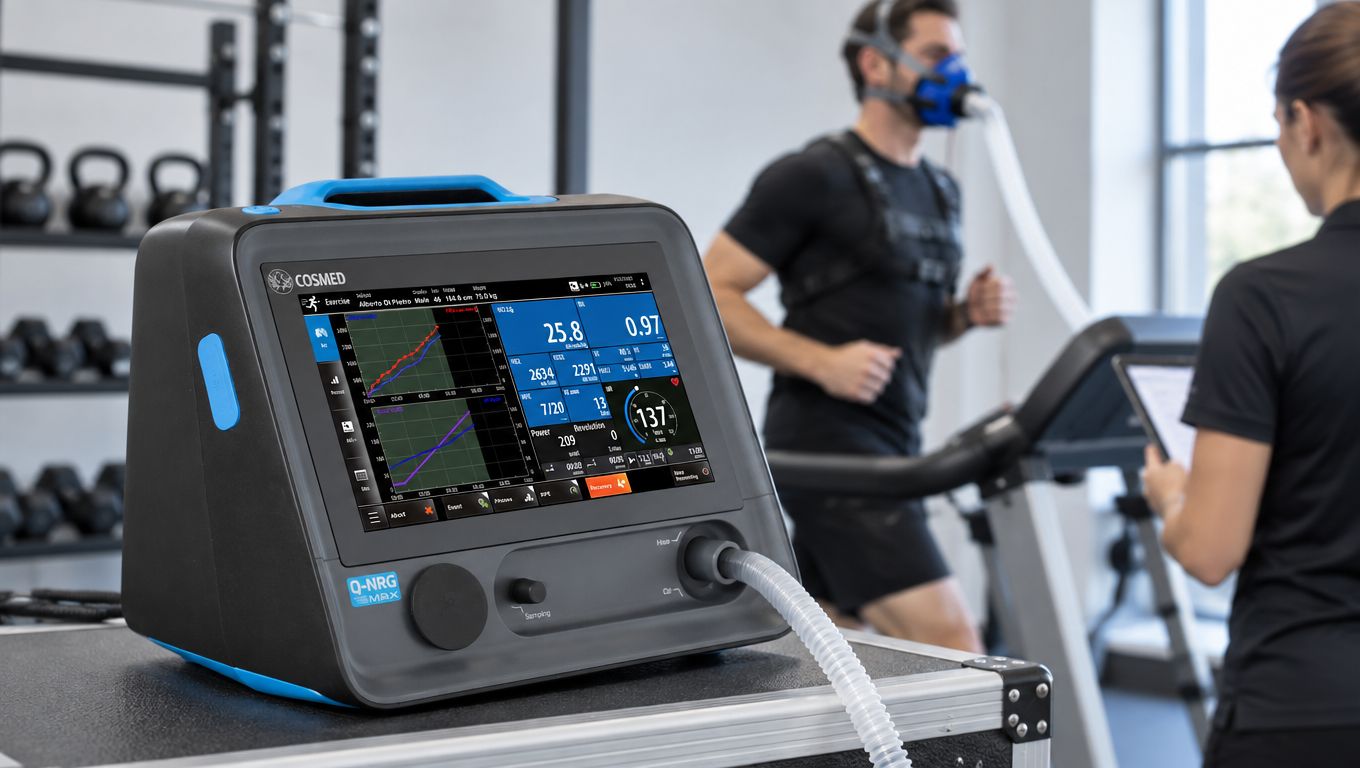
Considering laboratory assessment equipment? View the Cosmed Q-NRG Max Metabolic Analyser product page for specifications and an enquiry. Confirm the equipment, protocol and operator requirements for the assessment you intend to deliver.
Cartwright Fitness states that professionals should contact sales@cartwrightfitness.co.uk for price and more information. The employer should still define the decision rule before testing begins, including what constitutes a pass, what triggers clinical review and what requires further role-specific assessment.
Selecting the Right Assessment Protocols and Equipment
The choice between a maximal field test and a submaximal clinical protocol is a risk and validity decision, not a matter of fashion. A shuttle run can assess a large recruitment cohort under the same audio pace, but it places substantial demands on participants and requires enough space, supervision and exclusion criteria. A submaximal test may suit an occupational health room better, particularly when the practitioner needs a controlled estimate rather than an all-out effort.
The Multi-Stage Fitness Test uses an audio-paced shuttle protocol. For example, Greater Manchester’s recruitment guidance specifies a 20-metre bleep test with a minimum level of 8.8. Use the service-specified recording and scoring rules; a shuttle score is not a direct measurement of oxygen uptake. A result below the required level still needs context, including test familiarity, acute illness, symptoms and any protocol deviations.
The Chester Step Test
The Chester Step Test is a progressive, submaximal assessment. In Kevin Sykes’s 2018 description, the participant steps to an audio beat, with exercise heart rate and perceived exertion recorded every 2 minutes before the pace increases. The described endpoint is 80% of maximum heart rate and/or RPE 14, with a maximum duration of 10 minutes. This predicts aerobic capacity rather than directly measuring oxygen uptake.
Use the step height, heart-rate calculation and stopping rules specified by the applicable manual and participant assessment. A 30 cm step is not a universal requirement. Use the Chester Step Test protocol guide when planning delivery, and retain the selected height in the test record.
That design reduces the need to push every participant to exhaustion, but it doesn't make the assessment risk-free or universally suitable. The practitioner still needs pre-test screening, clear stopping rules, observation of symptoms and a plan for abnormal responses. Heart-rate data can also be affected by medication, stress, heat, recent exertion and device error, so the report should preserve the raw observations rather than presenting only an estimated value.
Compare the method, not just the effort level
- Direct measurement: gas analysis measures oxygen uptake during the specified exercise protocol.
- Prediction: a field score or submaximal response estimates aerobic capacity through a particular equation or model.
- Occupational interpretation: check whether the organisation accepts that method for the role and decision. A maximal effort alone does not establish predictive accuracy, and a submaximal test still requires screening and stopping rules.
Match equipment to the measurement question
The Chester Step Test requires a low step, heart-rate monitor, instructional CD or audio pacing track, RPE chart and Chester Step Test software or graphical datasheet to estimate aerobic capacity from exercise heart-rate data (Chester Step Test equipment requirements). A professional setup should also include a safe test area, cleaning procedures, a timing method and a way to record symptoms and recovery.
Strength testing should be similarly specific. A grip dynamometer measures handgrip, not whole-body lifting ability. Back and leg strength devices may help quantify isolated or regional capability, while functional assessment can show whether the worker coordinates strength across lifting, carrying, pushing or pulling. Body composition and anthropometry can describe the candidate, but they shouldn't become indirect exclusion criteria unless a documented task requires a relevant measurement.
Practitioners can use the fitness testing protocol resources to structure a consistent battery. The right battery is the smallest set of valid measures that answers the job question. More tests don't automatically create a better decision.
Standardising the Testing Environment and Procedure
A reliable result depends on the conditions surrounding the measurement. Two candidates shouldn't receive different instructions, different warm-up expectations or different opportunities to recover. The testing team should write a standard operating procedure that covers room preparation, equipment checks, consent, screening, instructions, test order, stopping criteria, recovery monitoring, data recording and incident management.
Room temperature, ventilation, flooring, lighting, footwear and available space can alter comfort and movement. The team should schedule testing so that candidates arrive prepared, record recent exercise or illness, and use the same approach to food, caffeine and hydration guidance. A candidate shouldn't be penalised because one assessor allowed self-pacing while another enforced the audio track precisely.
Control the measurement chain
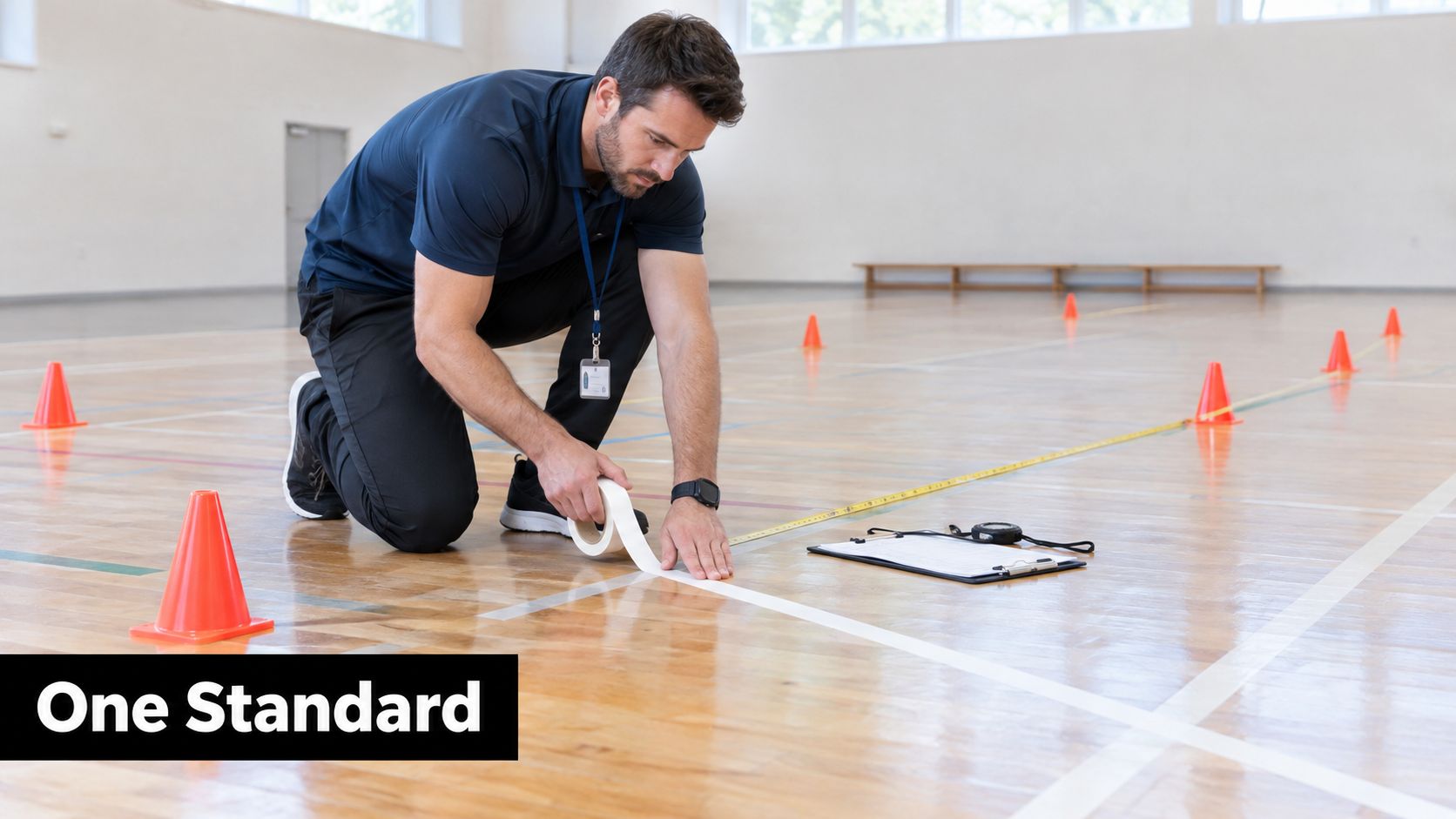
Before each session, the assessor should verify the test course, audio source, step height, heart-rate monitor, scales and dynamometers. Equipment checks should be documented, including battery status, zeroing, cleaning and any calibration requirement. A single missing record can make a later result difficult to interpret, especially when the test informs recruitment or continued deployment.
The NIHR Southampton BRC JAMAR procedure is an example of a defined measurement protocol, not a universal NHS standard. Its public extract, last reviewed in May 2014, specifies reading the dial when the needle stops rising, recording to the nearest 1 kg, and taking three measurements per hand with alternating sides. It allows the handle to be adjusted for hand size and comfort. Follow the selected protocol and current device instructions; record handle position, posture, tested hand, trial method and any pain or deviation so repeat assessments remain comparable.
Use a repeatable sequence
A practical sequence includes:
- Confirm identity and consent: Check the candidate, explain the purpose and obtain agreement before testing.
- Complete screening: Review the medical questionnaire, current symptoms, recent injury, medication and any referral requirement.
- Deliver standard instructions: Use a fixed script. Don't coach one participant more than another.
- Record baseline observations: Capture the values relevant to the protocol before exercise begins.
- Apply the published procedure: Enforce the prescribed pace, range, posture and stopping criteria.
- Monitor throughout: Record symptoms, RPE, heart rate and recovery rather than relying on the final score alone.
- Document deviations: Note equipment faults, missed beats, pain, technical errors or assessor intervention.
Measurement discipline: If a protocol says the participant follows an audio pace, the assessor shouldn't replace that pace with personal encouragement or informal timing.
Common failures are predictable. Self-pacing turns a standardised test into a different test. A poorly placed shuttle line changes distance. A step that isn't the specified height changes the work rate. A grip result recorded after inconsistent positioning may look precise while measuring technique differences. Standardisation doesn't remove human variation, but it makes the remaining variation visible and manageable.
Integrating Medical Screening and Equality Considerations
A candidate completes a shuttle test below the required level after reporting knee pain. That result does not answer the occupational question by itself. The organisation must establish whether the person could not participate safely, completed the test but fell below the role threshold, or requires clinical review before any decision is made.
Physical performance should therefore be interpreted alongside proportionate medical screening. The questionnaire should address symptoms, injury history, long-term conditions, current treatment and previous adverse responses to exertion. It should also explain when an occupational-health clinician reviews the information, when testing is deferred and how the candidate can request clarification or an adjustment.
Separate performance from diagnosis
The Metropolitan Police constable recruitment process includes both a medical health assessment and a job-related fitness test. These are separate parts of the assessment process: a fitness-test result should not be presented as medical clearance. Employers should use the current requirements for the specific role and follow their occupational-health referral process where required.
Use outcome categories that preserve this distinction:
- Demonstrated capability: The person completed the defined task or met the physiological threshold.
- Unable to complete safely: Symptoms, clinical concerns or technical issues stopped the assessment.
- Below the role threshold: The person completed the protocol but did not demonstrate the required capability.
- Further review required: The result needs occupational-health interpretation, job analysis or consideration of an adjustment.
This terminology ties the decision to defined duties. It avoids labelling someone globally “fit” or “unfit”, and it prevents a performance result from being presented as a diagnosis. A medical screen also cannot replace a job analysis. It identifies risks relevant to participation, while the physical test examines whether the person can meet a defined work demand.
Design for fairness without weakening safety
A published standard needs more than a pass mark. It should state the task being assessed, the reason that task represents the role, the administration method, the stopping rules and the process used to review equality impacts.
Sussex Police’s recruitment information specifies level 5.4 on a 15-metre audio-paced shuttle run: four shuttles at level 5. The page gives a duration of 3 minutes 35 seconds and a distance of 525 metres. These figures describe that test version; they should not be transferred to a 20-metre bleep test or treated as the standard for every specialist role. Check the force’s current instructions for the role being assessed.
North Yorkshire Fire and Rescue Service illustrates a different design choice through a multi-component battery covering strength, ladder work, dexterity and casualty extraction (North Yorkshire Fire and Rescue Service selection tests). This structure can reduce reliance on a single generic shuttle score when the occupation involves several distinct tasks. Each component still requires a documented link to an essential duty, a defensible scoring method and an assessment of the combined burden placed on candidates.
Reasonable adjustments should be considered through occupational-health and equality processes. An adjustment might change administration while preserving the essential requirement, or use another validated method that measures the same capability more appropriately. Safety thresholds must remain connected to actual job demands. Fairness requires checking whether the protocol measures work-related capacity or mainly rewards familiarity with a particular test.
Capturing Data and Generating Professional Reports
A job related fitness test creates a chain of evidence. If the organisation records only a final pass or fail, it loses the information needed to review safety, explain decisions, compare repeat assessments and identify procedural error. Professional data capture should preserve the protocol, raw observations, equipment used, assessor, environmental conditions, symptoms, deviations, calculated outputs and final occupational interpretation.
Paper forms can work for a controlled session, but they create avoidable transcription and version-control risks when a programme includes recruitment, annual monitoring and return-to-work cases. A standardised digital workflow can prompt the assessor through screening, enforce required fields and separate clinical notes from employer-facing conclusions. It can also retain assessment histories so that a change over time is visible without implying that every change represents a medical deterioration.
Report for the decision-maker
A useful report has two layers. The technical record contains the detail needed by the clinician or physiologist. The management summary answers the operational question without disclosing unnecessary medical information.
The technical section may include:
- protocol name and version;
- equipment and identification details;
- participant preparation and screening outcome;
- baseline and exercise observations;
- test stage, termination reason and recovery data;
- strength, anthropometry or functional results;
- technical deviations and assessor comments.
The occupational conclusion should state whether the candidate demonstrated the defined requirement, whether further review is needed and what restrictions or adjustments apply. It shouldn't exceed the assessor's competence by diagnosing disease or making a blanket employment decision unrelated to the documented role.
A professional report doesn't hide uncertainty. It identifies the uncertainty, explains its source and directs the next safe decision.
Data governance matters as much as presentation. Medical information should be stored separately from general personnel records, with access limited to people who need it. Retention periods, consent, correction rights and audit trails should be defined before the programme starts. For ongoing monitoring, the organisation should compare like with like. A result from a different protocol, device, assessor method or role threshold isn't automatically a valid trend.
Cartwright Fitness supplies professional assessment equipment, software and solutions across aerobic and VO₂ assessment, Chester Step Test delivery, grip strength, dynamometry, body composition, anthropometry, metabolic assessment and occupational fitness testing. Its developing Cartwright Assess platform is intended to standardise testing, calculate and interpret results, maintain client assessment histories and generate professional reports.
Plan your assessment setup
Once your organisation has selected an appropriate protocol, use these resources to plan delivery:
- Chester Step Test setup builder — organise equipment and practitioner preparation.
- CST2 software — review the Chester Step Test reporting product and available options.
- Chester Step Test practitioner programme — review training and competency options.
- Professional assessment equipment — choose equipment for the measures your protocol requires.
For help matching equipment and reporting requirements, contact Cartwright Fitness with your protocol, expected testing volume and existing setup. Equipment or software selection does not determine an occupational pass standard.


