

A returning footballer is on the rig after a cautious rehab block, the setup looks almost identical to last week, and the mid-thigh pull drops by 6 kg. That number might mean real regression, or it might be the result of a small change that made the setup non-comparable. In professional testing, that distinction matters more than the raw force value.
Isometric strength testing only earns its place when the protocol is tight enough to support a decision. A reliable number can still mislead if the joint angle, device, stance, or cueing has shifted, and that is where many assessments lose clinical value. The practical question is not merely whether the test repeats well, but whether it can be defended when a return-to-play, return-to-work, or rehabilitation decision depends on it.
Table of Contents
- Why a Small Setup Change Can Break Your Isometric Numbers
- What Isometric Strength Testing Measures
- The Handgrip Protocol That Produces Reproducible Data
- Lower-Body and Trunk Tests Worth Running Professionally
- Why Repeatable Does Not Mean Interchangeable
- Choosing and Maintaining Professional Isometric Equipment
- Interpreting Results in Occupational and Rehab Settings
- A Practical Checklist for Professional Isometric Assessment
Why a Small Setup Change Can Break Your Isometric Numbers
A sports physiotherapist retests a footballer who is returning from injury, changes the chain length by a small amount, and sees a lower mid-thigh pull output. The athlete feels fine, the movement looks the same, but the number has moved enough to raise concern. That is the problem with isometric data. A result can look objective while hiding a setup change that makes the comparison shaky.
The number is only as good as the setup
Isometric testing is attractive because the force happens against a fixed resistance, so the athlete or patient is not moving through a full dynamic lift. That makes it easier to standardise, but only if the joint angle, device position, body alignment and instructions are stable from session to session. A tiny change in stance or handle height can alter the output enough to cloud interpretation.
The better approach is to treat each setup as its own test, not as a generic measure of “strength”. That matters in clinics, occupational screening and sport environments where a score is used to judge readiness, recovery or capacity. It also explains why a repeatable test can still fail if someone tries to compare two different rigs as though they were identical.
Practical rule: if the setup changed, the comparison changed.
This guide focuses on what works in professional testing, including validated lower-body and grip protocols, the difference between repeatability and interchangeability, and the equipment choices that make results defensible. It also deals with the harder question that many articles skip, which is when an isometric score does not carry over to dynamic lifting, sprinting or job-specific tasks.
What Isometric Strength Testing Measures
Isometric strength testing measures force or torque while the joint angle stays fixed and the muscle length does not visibly change. It is different from isotonic work, where the load moves, and from isokinetic testing, where movement speed is controlled through a range. The result is tightly tied to the angle, posture and task being tested.
Why angle specificity matters
Force production is not constant across a movement. A person who looks strong in one position may produce much less force a few degrees away from that angle, because the muscle is working in a different part of its force-length and force-velocity relationship. That is why isometric testing works well for clinical baselines and occupational screening, it captures force in one controlled position instead of assuming capacity carries across all positions.
The same point explains a common error in interpretation. A strong squeeze on a grip dynamometer does not prove someone can lift, carry, sprint or complete a manual task at the same level. The tests are related, but they are not interchangeable.
The main professional use cases
Clinicians and performance staff usually use isometric testing in three broad ways. Grip testing gives a quick upper-limb strength marker, lower-body tests such as the mid-thigh pull and squat profile bilateral force expression, and back or trunk rigs can help screen job-related lifting demands. Each test tells a different story, so the score should be read as a task-specific output, not a universal measure of fitness.
The Ulster University review concluded that the best-established lower-body multi-joint isometric tests are the isometric squat and the isometric mid-thigh pull, with strong evidence for reliability and construct validity, moderate responsiveness for the squat and unknown responsiveness for the IMTP, and no isometric leg press tests meeting inclusion for the best-evidence synthesis (Ulster University review). For professional lower-body assessment, those two tests remain the clearest starting points in the UK context.
The Handgrip Protocol That Produces Reproducible Data
Grip testing looks simple, but the protocol decides whether the result is useful. The UK Biobank procedure standardises the test carefully, with a seated posture, Jamar J00105 hydraulic dynamometer, the second handle slot for most participants, elbow at 90 degrees, wrist neutral, a roughly 3-second maximal squeeze, and whole-kilogram recording (UK Biobank grip-strength procedure). That degree of control is what makes the number comparable across sessions.
Positioning beats guesswork
The seated setup matters because it removes avoidable variation. The University Hospitals Southampton JAMAR protocol adds further standardisation by having participants remove shoes, watches and bracelets, sit with back support and fixed arm rests, rest the forearms on the chair arms, and record hand dominance as part of the assessment (UHS JAMAR protocol). Those details sound minor until a retest differs by a handle placement issue or a change in upper-limb posture.
The Brunel University data on functional grip strength found very high test-retest reliability, with ICC between 0.94 and 0.99, intra-session reliability of 0.88 to 0.97, and SEM values of about 2.23 to 5.52 kg (Brunel functional grip study). In practical terms, that supports the idea that standardised grip testing can detect small true changes, but only when the same protocol is used consistently.
Clinician note: if the handle setting changes, record it. Handle position is not a footnote, it is part of the test.
A comparison table for daily use
| Step | Specification | Reason |
|---|---|---|
| Seated posture | Back supported, arm rests used, feet stable | Reduces body sway and inconsistent bracing |
| Elbow position | Around 90 degrees | Keeps lever arm comparable |
| Wrist | Neutral | Avoids force loss from wrist deviation |
| Device | Hydraulic or equivalent adjustable dynamometer | Supports reproducible grip measurement |
| Trial structure | Familiarisation, then maximal test efforts | Reduces novelty effects |
| Recording | Whole-kilogram output and hand dominance | Improves auditability and repeat testing |
The Takei Hand Grip Dynamometer is an easy to use and accurate test for strength levels, with a fully adjustable isometric design for accurate and reproducible results, and it is suitable for examining the static flexor power of each forearm (Takei Hand Grip Dynamometer). For purchasing and protocol support, Cartwright Fitness also provides a practical grip testing resource at dynamometer hand grip test.
Lower-Body and Trunk Tests Worth Running Professionally
A clinician can run a clean lower-body test and still get the wrong answer if the setup does not match the question. For professional use, the main options are the isometric mid-thigh pull, the isometric squat, and a back/leg dynamometer setup. As noted earlier, the key issue is not only whether a test is reliable, but whether results from one setup can be treated as interchangeable with another.
Choosing the right test for the question
The mid-thigh pull suits bilateral hip and posterior chain force production. A fixed chain or bar position helps hold joint angle steady, and the athlete should build force smoothly rather than launch into the rig. That approach gives a clearer view of force development, not just how hard someone can brace and yank.
The isometric squat fits questions about bilateral leg force in a posture that resembles squatting. The review cited earlier supports its use for monitoring change when the protocol is kept consistent. Even then, a repeatable score does not make it interchangeable with the mid-thigh pull or with another squat rig. Stance width, bar height, and depth all matter.
Back and leg dynamometer testing has a place in occupational screening, return-to-work decisions, and settings where lifting readiness needs a simple force measure. It can help judge whether trunk and leg force are likely to meet manual demands. It should not be read as proof of job performance on its own. A back/leg result is a force output, not a full task simulation.
The Takei Back and Leg Dynamometer is described by Cartwright Fitness as a reliable and easy-to-use device for measuring leg and back strength, with analogue and digital display options and an adjustable chain, which makes it relevant for this kind of professional assessment. It sits naturally alongside the brand's broader occupational testing range, including the Chester Step Test Kit, when a service needs both strength and aerobic screening in one measurement pathway.
Comparing lower-body and trunk tests
| Test | Primary Joint Position | Main Output | Best-Used Setting | Key Limitation |
|---|---|---|---|---|
| Mid-thigh pull | Fixed knee and hip angle | Peak force, force-time profile | Sport profiling, rehab monitoring | Not interchangeable with other pull set-ups |
| Isometric squat | Fixed squat posture | Bilateral leg force | Return-to-performance, monitoring change | Protocol sensitivity to stance and depth |
| Back/leg dynamometer | Fixed chain or strap position | Trunk and leg force | Occupational screening, manual task readiness | Task specificity is limited |
| Trunk flexion rig | Seated or anchored torso position | Trunk force output | Rehab and occupational trunk assessment | Results depend heavily on attachment and position |
What makes these tests defensible
A defensible session starts with familiarisation, clear cueing, and repeated maximal trials with enough rest to keep fatigue from hiding true capacity. The athlete or worker should know to build force smoothly, keep the body position fixed, and avoid turning the trial into a jump or a shrug. That keeps the result tied to isometric force production rather than compensation.
The hardest part is often interpretation. A clean retest can show the person was more familiar with the device, more comfortable bracing, or more consistent with the setup. It may also show real change, but only if the protocol, body angles, and attachment points were kept stable. For trunk and lower-body testing, that discipline matters more than chasing the highest number.
Why Repeatable Does Not Mean Interchangeable
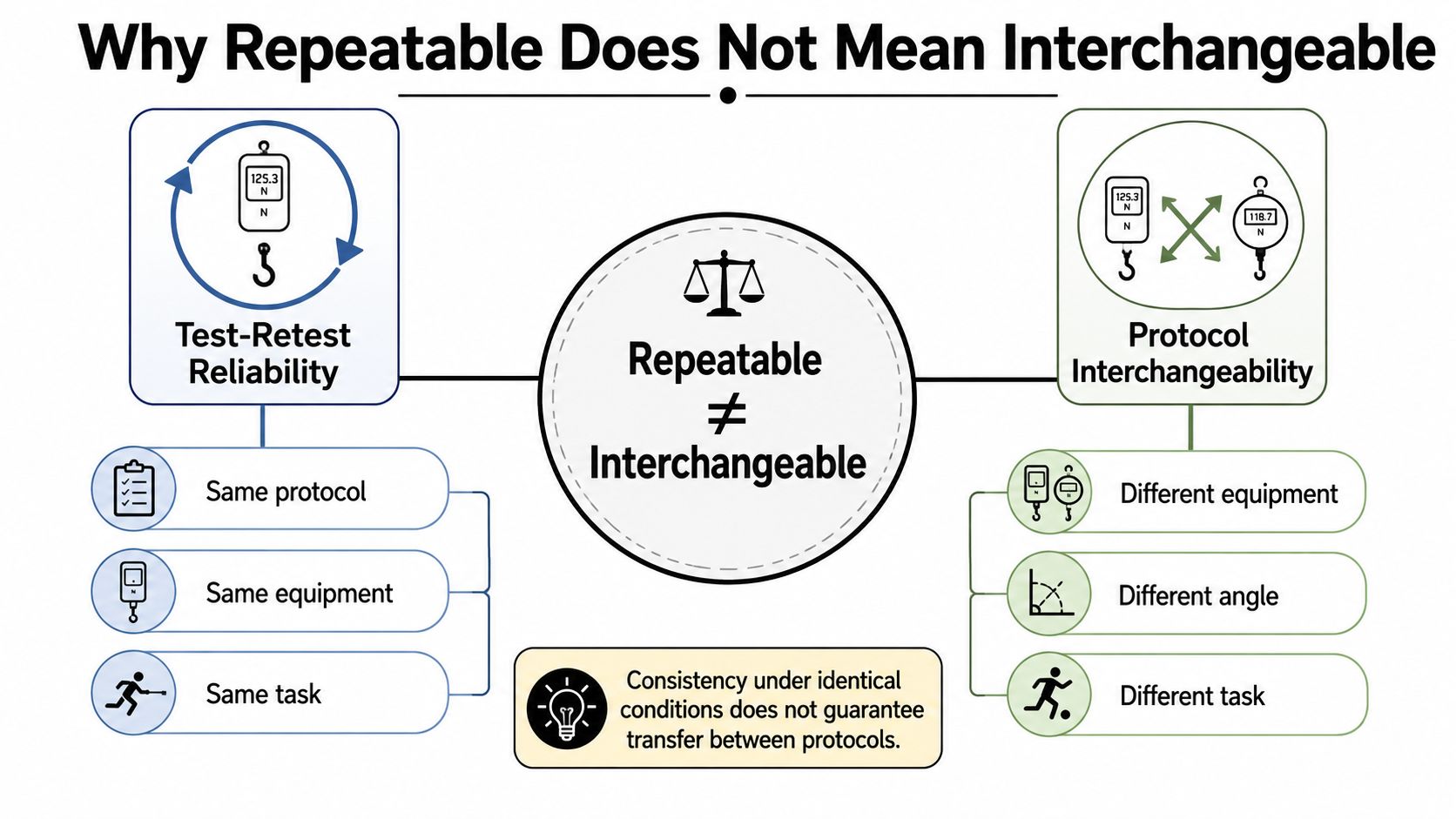
A protocol can produce the same number twice and still measure something different from the next setup. That is the point many clinics miss when two devices both look clean on paper. Reliability asks whether the same arrangement gives similar results again. Interchangeability asks whether two arrangements can be treated as equivalent.
The setup can be repeatable and still not travel well
Recent UK-based evidence in NordBord knee-flexor testing showed that knee-flexion angle changes peak force and muscle activation, with the ISO-Prone and ISO-30 positions producing different outputs. One protocol should not be treated as a substitute for the other. That matters in football, rehab, and occupational screening, where staff may want to compare a new rig with last year's data as if nothing had changed. In practice, angle, stance, and device choice can shift the score enough to make the comparison invalid.
The same issue shows up in applied football research, where commonly used isometric measures can be reliable but still have meaningful minimum detectable change values of 22.2% to 26.4% (UK academy football research). A small rise on the screen may still sit inside measurement noise. If a practitioner treats every increase as real change, the readout becomes more optimistic than the test allows.
A clean retest may only show that the setup was repeated well.
Why dynamic transfer is limited
Isometric strength also does not transfer cleanly to dynamic performance. A 2025 meta-analysis found that dynamic resistance training transferred to non-trained isometric measures only with a small effect size, while dynamic strength itself improved more strongly. The pattern points to task-specific adaptation, not a universal strength gain that appears in every test format.
Another meta-analysis found that isometric resistance training improved isometric strength more than dynamic training did, but it did not clearly outperform dynamic training for isokinetic strength. That matters because a person can look stronger in one force test without showing the same change in sprinting, lifting, or a job task that uses speed, coordination, or a different joint angle.
The practical takeaway is direct. Reliability does not guarantee transfer, and a change in one force test does not automatically mean a change in dynamic output or task performance. Interpret the score against the exact task being measured, not as a universal badge of strength.
Choosing and Maintaining Professional Isometric Equipment
Equipment selection should start with the question being asked, not the price tag. Analogue hydraulic devices are still useful in many clinics because they are straightforward and durable. Digital load-cell systems add cleaner data capture, and Bluetooth export can reduce transcription error in longitudinal screening. Spring-loaded devices can have a place, but they need careful scrutiny before they are used as a professional standard.
What to look for before purchase
For handgrip work, handle sizing matters because the user has to be able to produce force in a consistent grip position. For back and leg or mid-thigh testing, chain or strap integrity is critical, because the rig has to hold position safely under maximal effort. The unit should also have a clear calibration process, whether that is a zero check, periodic verification against a known load, or confirmation against a certified load cell.
Cartwright Fitness advises practitioners to inspect published CV%, request a calibration certificate format, and ask whether a device has been used in peer-reviewed UK validation work before buying. That is a more useful purchasing filter than marketing language, because published reliability and repeatability matter more than glossy claims. For calibration procedure support, the internal reference at testing equipment calibration is a sensible operational starting point.
Maintenance is part of measurement quality
A worn handle, loose chain link or drifting battery can alter a result long before the device visibly fails. Digital units need battery management, hydraulic units need periodic service, and any device that starts to feel inconsistent should be taken out of routine use until it is checked. The safest standard is to treat maintenance as a reporting issue, not just a workshop task.
For clinicians who also support clients with non-standard grips or adaptive setups, AIDictation's family equipment guide can be a useful reminder that equipment choice should match the user's functional needs, not just the default setup. That principle matters in isometric testing too, especially when a handle or restraint needs to be adapted without compromising repeatability.
Interpreting Results in Occupational and Rehab Settings
Raw force numbers only become useful when they are compared with the right reference point. In occupational health, that might be a job-specific threshold or a sector norm. In rehab, it might be the athlete's own baseline, a limb symmetry comparison, or a prior session recorded with the same device and setup. Without that context, the score is just a number.
Occupational decisions need task relevance
The Chester Step Test is a good reminder that professional assessment is about decision-making, not pass-fail theatre. Its UK protocols start at 15 steps per minute for 2 minutes, then increase by 5 steps per minute every 2 minutes, with exercise heart rate and RPE recorded, and termination when heart rate exceeds 80% of predicted maximum or RPE exceeds 14 (UK occupational Chester Step Test protocol). The companion UK guidance also notes common step heights of 15 cm, 20 cm, 25 cm or 30 cm, selected according to age and physical activity history, with the estimate table tied to MET prediction rather than simple pass/fail outcomes (Chester Step Test guidance).
That logic applies directly to strength screening. A grip or back/leg result should be compared with the specific occupational demand, not with a generic “fit” label. If the task involves lifting, carrying or sustained manual work, the result needs to be interpreted as one part of the readiness picture, not the whole answer.
Rehab decisions need change thresholds
The older-adult Birmingham study showed that maximal isometric knee extension, hip abduction and adduction, and handgrip could be measured with high reliability in frail and pre-frail adults, with coefficients of variation at or below 4.65% and intraclass correlation coefficients at or above 0.96 between the most repeatable trials (Birmingham reliability study). That level of repeatability supports use in clinical follow-up, provided the protocol is stable and the assessor understands the limits of the comparison.
For a worker returning to a lifting role, the question is not just whether the number improved. It is whether the improvement is large enough to matter relative to measurement noise, and whether the task being screened matches the job. For a knee rehab patient, the question may be whether quadriceps force is moving in the right direction within the same setup, not whether it matches a different test from a different session.
| Test | Population / Cohort | Reference Value | Decision Context |
|---|---|---|---|
| Handgrip | UK Biobank procedure | Seated, Jamar J00105, elbow at 90 degrees, 3-second squeeze | Longitudinal clinical and population comparison |
| Grip conditions | Brunel functional grip study | ICC 0.94 to 0.99, SEM about 2.23 to 5.52 kg | Detecting small true change |
| Lower-body isometrics | Birmingham frail and pre-frail older adults | CV at or below 4.65%, ICC at or above 0.96 | Repeatable clinical retesting |
| Chester Step Test | UK occupational and fitness contexts | Start 15 steps per minute, stop at 80% predicted max HR or RPE 14 | Aerobic fitness screening alongside strength tests |
For deeper strength testing guidance in sport settings, the pro athlete's grip strength tester guide is a useful external reference point because it reinforces the same principle, use the same test the same way if the comparison has to mean something.
A Practical Checklist for Professional Isometric Assessment
A good report template keeps the process honest. It also stops different assessors from writing different versions of the same test, which makes audit trails messy and longitudinal comparison unreliable.
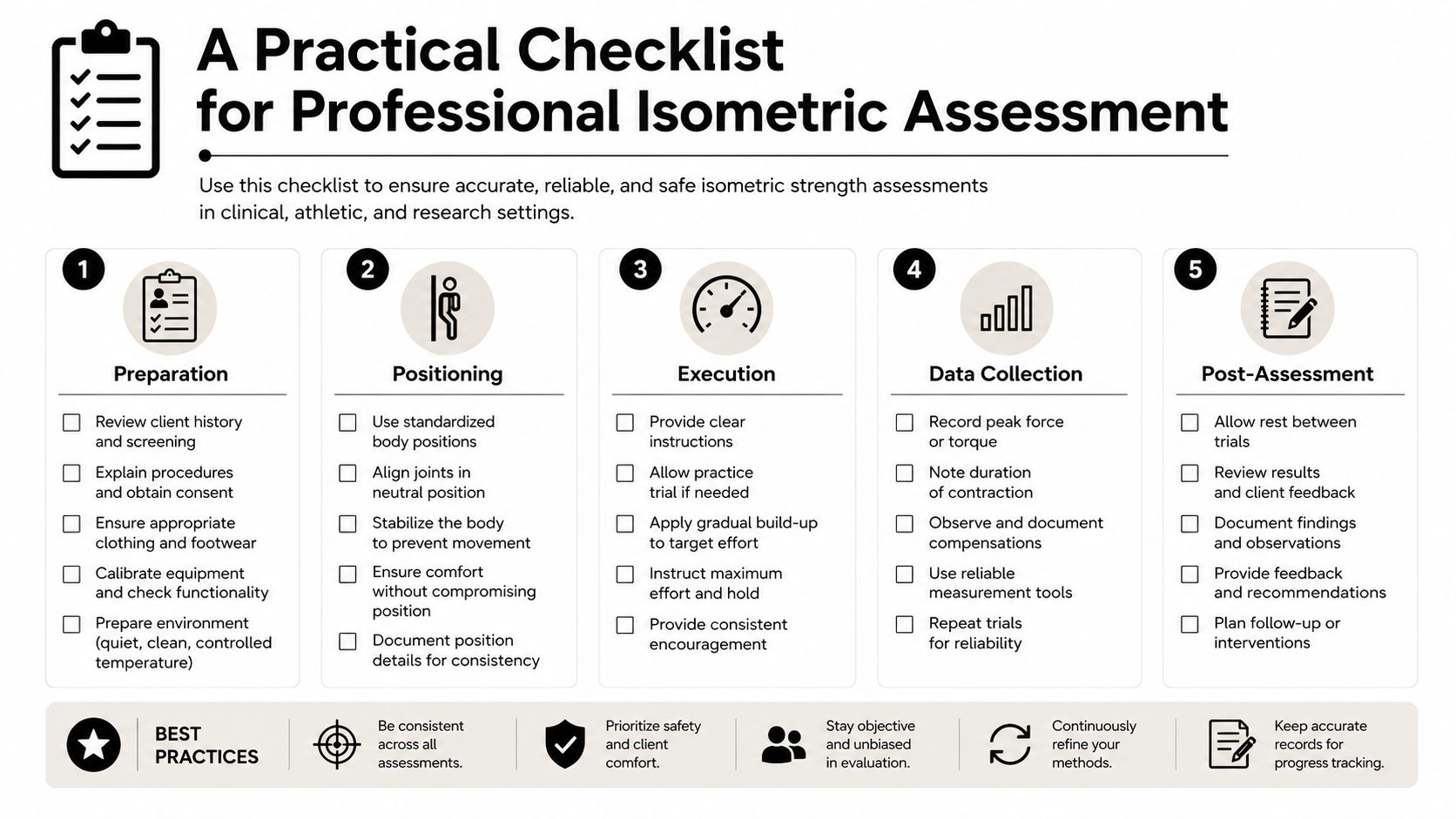
Use the same workflow every time
- Confirm readiness. Check warm-up status, relevant symptoms and medical clearance before maximal testing.
- Standardise the rig. Record joint angle, posture, device model, handle position and chain or strap setup.
- Run familiarisation. Use practice trials so the first recorded effort is not the first time the person has felt the setup.
- Capture the best valid trials. Keep the chosen scoring method consistent and note pain inhibition, compensation or poor effort.
- Interpret against the right benchmark. Compare the score with the appropriate normative dataset, job demand or the participant's own baseline, then document change against the test's published MDC rather than a guess.
Reporting standard: if a detail could change the force output, write it down.
That final point is the one that protects the test when the result is challenged later. A well-documented isometric assessment is easier to defend, easier to repeat and far more useful to the clinician who has to make the next decision.
Cartwright Fitness supplies professional assessment equipment, including grip dynamometers, back and leg strength devices, aerobic testing tools and supporting calibration resources for clinical and occupational use. If this kind of protocol-driven testing is part of your service, visit Cartwright Fitness to review equipment that fits professional isometric assessment, grip testing and broader human-performance measurement.