

Absolutely. When you combine intermittent fasting and lifting, you can create a powerful strategy for transforming your body composition—shedding fat while preserving, and even building, lean muscle. But it only works if your nutrition and training are set up correctly.
Can You Build Muscle While Fasting?
Let's cut right to the chase and tackle the biggest question: can you actually build muscle while intermittent fasting? The short answer is a confident yes. Success isn’t a given, though. It hinges entirely on a smart approach to your nutrition, workout timing, and recovery.
Think of your body as a sophisticated hybrid engine. During your fasting window, it gets incredibly efficient at burning stored fat for fuel. Then, when you lift weights, you send a powerful signal to your muscles that they need to adapt and grow stronger.
Combining these two processes creates an environment where you can burn fat for energy while telling your body to hang onto—or even build—precious muscle tissue. This section will get past the hype and show you exactly how to make it happen.
The Foundation for Muscle Growth
One of the most common fears I hear from clients is that fasting automatically cannibalizes muscle. While that can be a risk with prolonged, unstructured fasts, a well-designed intermittent fasting plan can actually do the opposite by enhancing hormonal responses that favor a better body composition.
The real key is creating the right conditions for muscle to grow. This comes down to two non-negotiable factors:
- An Adequate Training Stimulus: Your workouts have to be challenging enough to signal to your body that it needs to build more muscle (a process called hypertrophy).
- Sufficient Nutrient Intake: During your eating window, you must consume enough calories—and especially enough protein—to repair the damage from your workouts and build new muscle tissue.
The primary driver of muscle growth is resistance training, and the primary driver of fat loss is a calorie deficit. Intermittent fasting is simply a tool to help manage that calorie deficit while maintaining the anabolic signal from your workouts.
What the Evidence Shows
Modern research is increasingly backing up what many of us have seen in practice. For instance, a 2021 trial found that active women who combined time-restricted eating (TRE) with high-intensity interval training (HIIT) lost significant fat without losing any lean muscle mass.
Furthermore, a systematic review of over 20 studies confirmed that intermittent fasting had no negative impacts on sports performance. In fact, metrics like gripper strength and jump height either stayed the same or even improved.
Intermittent Fasting and Lifting At a Glance
Here’s a quick summary of what to expect when you put these two powerful strategies together.
| Area of Impact | Potential Outcome | Key Consideration |
|---|---|---|
| Muscle Growth | Possible, but slower than traditional bulking. | Protein and calorie intake must be sufficient within the eating window. |
| Fat Loss | Enhanced due to improved fat oxidation and calorie control. | A consistent calorie deficit is still required. |
| Strength & Performance | Generally maintained or slightly improved. | Workout timing and pre/post-workout nutrition are crucial. |
| Hormonal Response | Increased Human Growth Hormone (HGH), improved insulin sensitivity. | These benefits support both fat loss and muscle preservation. |
| Recovery | May be challenging; requires attention to sleep and nutrition. | Adequate protein and hydration are non-negotiable for repair. |
This table highlights that success isn't just about fasting; it's about a holistic plan.
To really kickstart muscle protein synthesis and support growth while fasting, your protein intake has to be on point. Integrating a well-structured high-protein meal plan is one of the most effective ways to make sure you’re hitting your daily targets without guesswork.
The Science Behind Fasted Training Benefits
When you pair intermittent fasting with your lifting routine, you’re doing more than just changing your meal times. You're fundamentally altering your body's internal chemistry, creating a unique environment that can unlock serious fat loss while sending a powerful signal to hold onto hard-earned muscle. Getting a handle on this science is the key to making it work.
Think of your body's energy supply like a hybrid engine. It has a small, easy-access fuel tank filled with glucose (sugar) from the food you’ve recently eaten. It also has a much larger, more efficient reserve tank filled with stored body fat. Normally, your body loves running on glucose. But after about 12-14 hours of fasting, that glucose tank starts running on empty. This forces a critical metabolic switch.
This is precisely where fasted training shines. By hitting the weights when you're in this carb-depleted state, you’re basically forcing your body to draw energy directly from its fat reserves. You’re training your metabolic engine to become much more efficient at burning fat for fuel.
The Hormonal Advantage
One of the biggest wins from fasted training comes from the hormonal cocktail it creates. When you haven't eaten for a while, your insulin levels are rock bottom. Insulin is a "storage" hormone; when it's present, fat-burning grinds to a halt.
With insulin sidelined, a few other key players can step up to the plate.
- Human Growth Hormone (HGH): Fasting is a well-known natural booster of HGH. Not only is HGH vital for repairing and building muscle, but it also helps pull fatty acids out of storage to be used for energy.
- Catecholamines: Ever feel a bit more alert or focused during a fast? You can thank hormones like adrenaline and noradrenaline for that. They don't just sharpen your mind for a workout; they actively help break down stubborn body fat.
This combination creates the ideal hormonal environment for improving body composition—burning fat while preserving muscle.
Activating Your Cellular Cleanup Crew
Beyond just burning fat, fasting kicks off an incredible process called autophagy. The best way to think about autophagy is as your body’s in-house quality control and recycling program. When you fast, your cells get to work clearing out old, damaged parts and junk proteins that can gum up the works.
Autophagy is like a deep-cleaning service for your cells. It improves their efficiency and resilience, which is essential for long-term health and optimal muscle function.
When you lift weights in a fasted state, you essentially double down on this effect. The stress from training, layered on top of the stress from fasting, sends an even stronger signal for your cells to clean house and rebuild themselves stronger and more resilient than before.
This isn't just theory; we can see it in practice. One study on resistance-trained men found that a time-restricted eating (TRE) group lost significant body fat while completely maintaining their muscle mass and strength. They also saw huge improvements in inflammation markers, insulin sensitivity, and cholesterol. Most importantly, their respiratory exchange ratio (RER) dropped, a clear sign their bodies were getting better at using fat for fuel. You can discover more about these findings on fat-burning efficiency.
The respiratory exchange ratio, or RER, is how we measure which fuel—carbs or fat—your body is burning at any given moment. You can learn more about respiratory quotient and its implications from our team. By tracking this number, we get concrete proof that the body is becoming more metabolically flexible. That’s the real goal here: turning your body into an efficient hybrid engine that can burn whatever fuel is available.
Structuring Your Training and Fasting Windows
When you combine intermittent fasting with serious lifting, timing is everything. How you arrange your fasting periods, eating windows, and training sessions is the single biggest factor that determines your results. Get it right, and you can accelerate fat loss or build muscle more efficiently. Get it wrong, and you’ll just spin your wheels.
There's no one-size-fits-all schedule, but there are clear principles to guide you. Think of your primary goal—be it fat loss or muscle gain—as your destination. Your fasting and training schedule is simply the route you take to get there. You wouldn't take the scenic, cross-country route if you were just trying to get to the next town over, and the same logic applies here.
To build the right plan, you first need to understand the different fasting methods and how they fit with a lifter's lifestyle.
Comparing Popular Intermittent Fasting Protocols for Lifters
For anyone serious about resistance training, not all fasting protocols are created equal. Some slot neatly into a demanding lifting schedule, while others can make it tough to perform well and recover properly.
The table below breaks down the most common approaches, helping you see which one might be the best fit for your training and daily life.
| Protocol | Best For | Key Challenge | Training Timing Tip |
|---|---|---|---|
| The 16/8 Method | Lifters seeking consistency and a simple daily structure that's easy to schedule workouts around. | Can be socially limiting at first (e.g., skipping breakfast meetings or late dinners). | Ideal for timing workouts either just before breaking the fast (for fat loss) or in the middle of the eating window (for performance). |
| The 5:2 Diet | Individuals who prefer more eating flexibility on most days and can handle two very low-calorie days. | Training on the 500-600 calorie days is extremely difficult and can significantly impair recovery and performance. | Schedule your hardest lifts on the normal eating days. Use the low-calorie days for rest or very light activity. |
| OMAD (One Meal a Day) | Advanced fasters whose primary goal is aggressive fat loss and who are experienced with large meals. | Consuming enough protein and total calories in one sitting to support muscle growth is incredibly challenging for most lifters. | The single meal must be strategically timed post-workout to refuel and kickstart recovery. |
Each method has its place, but for the vast majority of people lifting weights, the 16/8 method strikes the perfect balance. It provides the metabolic benefits of fasting without completely compromising your ability to train hard and recover.
Should You Train Fasted or Fed?
This brings us to the big question on every lifter's mind. And the answer, once again, comes down to what you're trying to accomplish. Are you laser-focused on shredding fat, or is building size and strength your number one priority?
The trade-off is simple: training in a fasted state ramps up fat oxidation, making it a powerful tool for fat loss. Training in a fed state gives your muscles the immediate fuel they need for peak performance, making it the superior choice for strength and hypertrophy.
This decision tree lays it out perfectly. Figure out your main goal, and the choice becomes clear.
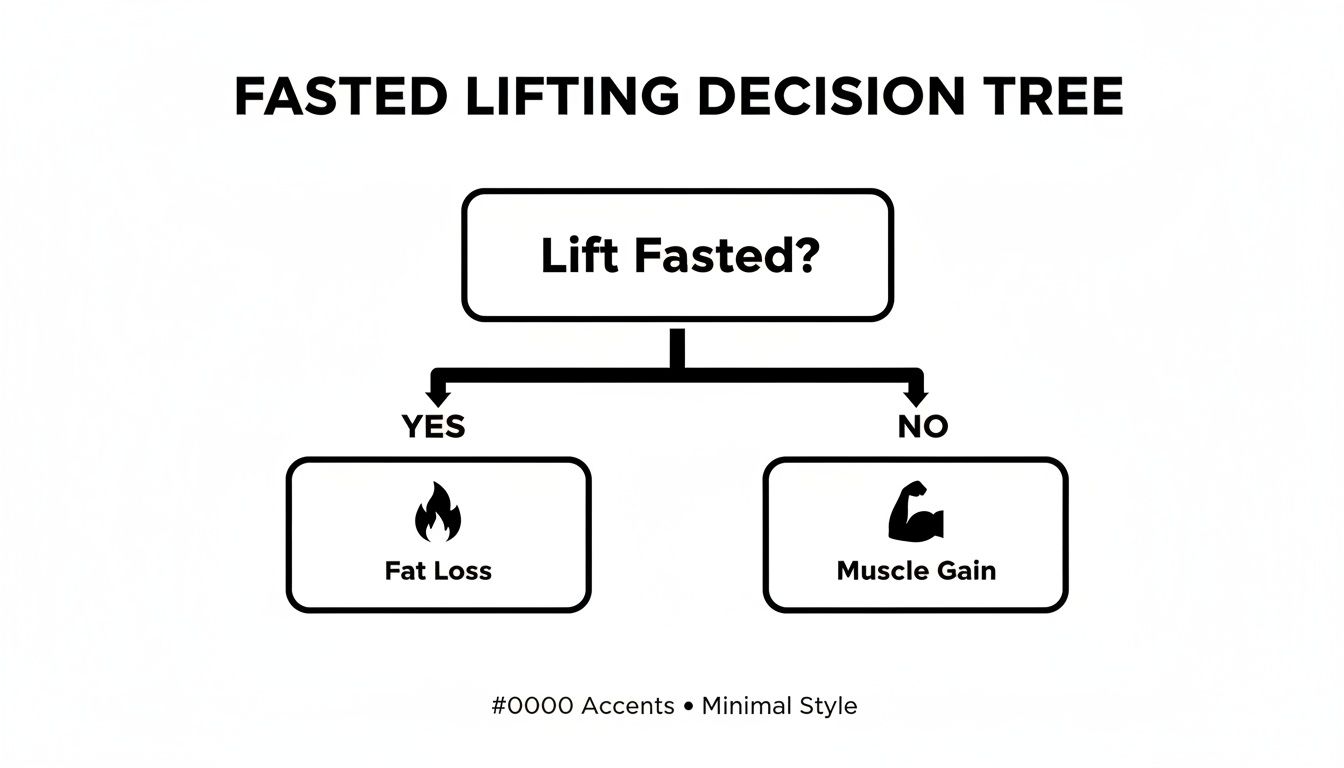
Use this as your guide. Aligning your workout timing with your primary goal is non-negotiable for getting the results you want.
Training Fasted for Fat Loss
If dropping body fat is your main objective, working out in a fasted state is a game-changer. By training before you've eaten, you force your body to tap into stored body fat for fuel.
Here’s a simple way to set it up with a 16/8 schedule:
- Time your workout for the very end of your fast. If your eating window is 12 PM to 8 PM, you might train from 10:30 AM to 11:30 AM.
- Break your fast immediately after training. This post-workout meal should be your largest of the day, packed with protein and carbohydrates to replenish your muscles.
- Eat your other meals as usual within your 8-hour window.
This approach takes full advantage of the hormonal environment created by fasting, turning your workout into a potent fat-burning session.
Training Fed for Muscle Gain
On the other hand, if you're all about building muscle and hitting new PRs, you need to train in a fed state. Period. Your performance, energy, and pump will be worlds better when your muscles are properly fueled.
Here’s how that looks with a 16/8 schedule:
- Eat a solid pre-workout meal 1-2 hours before you lift. This should include some quality protein and easily digestible carbs for energy.
- Schedule your workout firmly within your eating window. For example, with a 12 PM – 8 PM window, you could have a meal at 3 PM and hit the gym at 4:30 PM.
- Have a post-workout shake or meal soon after you finish. Follow it up with at least one more substantial meal before your fast begins.
Training fed gives your body the on-demand fuel it needs to perform with high intensity—a non-negotiable stimulus for growth. It also jump-starts the recovery process, ensuring you're repairing and building muscle right away.
How Does Fasting Affect Strength and Performance?
Let's get right to the big question on every lifter's mind: will intermittent fasting wreck my hard-earned gains? It’s a completely fair question. The thought of training on an empty stomach often brings up images of flimsy lifts and shrinking muscles. But what we see in the research—and in the real world—paints a much different, more encouraging picture.
When you do it smartly, intermittent fasting doesn't have to be a performance killer. Far from it. Study after study shows that people who lift weights can maintain their strength, and sometimes even improve it, while using time-restricted eating to get leaner. The fear of your body instantly eating away at muscle is mostly overblown, as long as your total weekly nutrition and training are dialed in.
Your body is smarter than you think. It's incredibly adaptive and doesn't just start breaking down precious muscle tissue the second you skip breakfast. If you continue to challenge it with heavy, intense workouts and then refuel with enough protein in your eating window, your body gets the message loud and clear: keep the muscle, burn the fat.
What Really Happens to Your Performance?
When we talk about "performance," we need to get specific. For most of us in the gym, it boils down to a few key things. Here’s a look at how combining intermittent fasting with lifting actually stacks up.
Maximal Strength (Your 1-Rep Max): Research consistently shows that lifters can hold onto their one-rep max (1RM) on big lifts like the squat and bench press. You might not feel spring-loaded to hit a new personal best every single fasted session, but your top-end strength holds remarkably steady.
Muscle Growth (Hypertrophy): This is where most of the worry comes from. While putting on brand new muscle is tougher in a calorie deficit (that’s just physics), fasting is excellent for preserving the muscle you already have while you shed fat. The muscle-breakdown effect of fasting is easily offset by the powerful muscle-building signal from a tough workout, especially when you break your fast with a high-protein meal.
Anaerobic Power (Explosiveness): This is your ability to generate force fast, which is vital for sprinting or Olympic lifts. This metric can be a bit more sensitive to not having immediate fuel in the tank. Some people notice a small dip in their peak power if they train completely fasted, which is exactly why workout timing becomes so important.
The bottom line from all the research is clear: as long as your protein is high enough (a good target is 1.6-2.2 grams per kilogram of body weight) and you time your post-workout meal well, your strength and muscle are safe.
The View From the Gym Floor
This isn't just theory rattling around in a lab. For trainers using Cartwright Fitness assessment tools, it means you can confidently program fasting and lifting protocols for clients without worrying about them losing strength. Systematic reviews back this up, confirming that performance markers like grip strength, vertical jump height, and Wingate test scores remain stable.
In major markets like Europe and North America, where an estimated 23% of adults lift weights, this approach offers a powerful solution. It's a practical way to target visceral fat, a major health risk linked to conditions like NAFLD, which now affects about 25% of the global population. To see the data for yourself, you can read the full review of exercise and intermittent fasting studies.
Think of it like this: Intermittent fasting is the tool that controls when and how much you eat. Resistance training is the tool that tells your body what to do with that food—specifically, to hang onto and build muscle.
When you pair these two tools, you get an incredible effect on your body composition. You unlock the fat-burning advantages of fasting without having to sacrifice the strength you've fought for in the gym. For a deeper dive into tracking your progress accurately, check out our guide on how to measure muscular strength. Seeing the numbers hold steady is all the proof you’ll need to trust the process.
Measuring Your Progress the Right Way
When you’re combining intermittent fasting with serious training, the bathroom scale can be your worst enemy. I’ve seen it countless times: a client gets discouraged by a number that doesn't tell the whole story. A drop in weight might be fat loss, which is great. But it could also be precious muscle you've worked so hard to build.
Success isn't about the number on the scale going down. It’s about recomposition—changing what your body is made of. The real goal is to watch fat melt away while your muscle mass holds steady or, even better, increases. Relying only on your total body weight is like trying to understand a company's health by only looking at its total revenue; you're missing the context of profit and loss.
This is why we have to look beyond the scale. You need a reliable feedback loop to see what’s truly happening, so you can make intelligent tweaks to your program instead of blindly guessing.
Going Beyond the Scale
To get the full picture, you have to blend the hard numbers with how you actually feel. Quantitative data gives you the objective facts, but it’s the qualitative feedback—your energy, your mood, your sleep—that provides the crucial context.
A smart approach means keeping an eye on these key areas:
- Body Composition: This is your north star. It’s the metric that separates fat from lean tissue, telling you if you’re actually achieving body recomposition.
- Performance Metrics: Are you getting stronger in the gym? Hitting more reps or lifting heavier weight? This is direct evidence that your muscle is sticking around.
- Subjective Feedback: How’s your energy? Are you sleeping like a rock or tossing and turning? These personal insights are powerful clues about how your body is adapting.
How to Track Body Composition
This is the only way to know for sure that you're shedding fat, not muscle. While different methods come with varying levels of accuracy and cost, the most important thing is consistency. Tracking the trend over time is what matters.
The goal isn't just weight loss; it's fat loss. Consistently tracking body composition ensures you're on the right path, empowering you to adjust your nutrition or training before muscle loss becomes an issue.
There are a few ways to get this done. For clinical-grade accuracy, you could use something like the BodyMetrix Professional Ultrasound systems we supply at Cartwright Fitness. You can explore various body composition assessment methods to see what works for your situation. Even something as simple as a weekly tape measurement around your waist can provide incredibly valuable feedback.
Monitoring Performance and Well-Being
Your training log is just as vital as your nutrition plan. Carefully documenting your workouts gives you objective proof of progress. Seeing your strength numbers climb is one of the best proxies we have for muscle maintenance or growth. To really dial this in, a good AI fitness platform can help by structuring your workouts and tracking every lift in detail.
But don’t stop with the numbers. Pair that data with how you feel. A quick note in a journal at the end of the day can reveal patterns you’d otherwise miss. If you feel sluggish for three days in a row and your lifts are stalling, that’s a clear signal. It might be time to adjust your eating window, bump up your calories, or get more serious about sleep. This complete feedback system is what transforms a generic plan into a personalized strategy that actually works for you.
Real-World Fasting and Lifting Scenarios

Theory is one thing, but seeing how intermittent fasting and resistance training fit into a real day is what truly matters. It’s time to move from the 'how' and 'why' to a practical daily plan.
Let's walk through two common scenarios. Think of these as proven templates you can adapt to your own goals, schedule, and lifestyle. The key isn't to follow them rigidly, but to understand the principles behind them—like workout timing and meal composition—and build your own successful routine.
Scenario 1: The Morning Trainee for Body Recomposition
Meet Alex. Alex is a busy professional who wants to lean out while keeping every ounce of hard-earned muscle. Using the 16/8 method, their primary goal is body recomposition, making a workout at the tail end of the fast a perfect strategy to tap into fat stores.
Here's what a typical day looks like:
- 7:00 AM: Wake up. Hydrate with water, and maybe some black coffee or tea to get going.
- 10:30 AM: Hit the gym for a heavy resistance training session, focusing on compound strength movements.
- 12:00 PM: Break the fast right after the workout with the day's largest meal. This should be packed with protein and carbs to slam the brakes on muscle breakdown and kickstart the recovery process.
- 4:00 PM: A smaller, balanced meal helps manage hunger and provides another wave of nutrients for recovery.
- 7:30 PM: The final meal of the day, with a focus on protein and healthy fats to stay full overnight.
- 8:00 PM: The 16-hour fast begins.
Key Takeaway: By training in a fasted state, Alex maximizes fat oxidation for energy. Immediately following up with a nutrient-dense meal provides the muscles with exactly what they need for repair and growth, right when they're most receptive.
Scenario 2: The Afternoon Lifter for Performance
Now, let's consider Jordan. Jordan is an athlete focused on pure performance and strength, even while in a slight calorie deficit. To ensure peak energy and power output for the most demanding workouts, Jordan trains in the afternoon, well inside the eating window.
For Jordan, workout quality trumps the potential fat-burning benefits of a fasted session.
Here’s how this schedule plays out:
- 12:00 PM: Break a 16-hour fast with a solid, balanced meal that includes a moderate amount of protein and carbohydrates.
- 3:30 PM: A light pre-workout meal comes next. Think easily digestible carbs and a bit of protein to top off energy stores.
- 5:00 PM: Time for a high-volume, high-intensity lifting session.
- 6:30 PM: Immediately after training, a simple post-workout protein shake or a small, protein-rich snack is enough to start the recovery process.
- 7:45 PM: The final and largest meal of the day. This is crucial for replenishing glycogen stores and giving the body the resources it needs to repair muscle overnight.
- 8:00 PM: The fasting window begins again.
This structure guarantees Jordan has plenty of fuel in the tank for those grueling workouts, which is absolutely vital for signaling muscle retention and growth. Both of these examples show just how flexible intermittent fasting can be when combined with a smart lifting program.
Common Questions About Intermittent Fasting and Lifting
Once you start considering combining intermittent fasting with serious training, the practical questions pop up fast. Let’s get straight to the most common ones I hear from lifters and clear up the confusion with some practical, evidence-based answers.
Will I Lose Muscle if I Lift Weights While Fasted?
This is probably the number one fear that holds people back. The thought of losing hard-earned muscle is terrifying, but the reality is much less scary. While there's a theoretical risk, research shows that as long as you hit your daily protein target within your eating window, lifting in a fasted state does not cause significant muscle loss.
Your body is smarter than you think. During a fast, you get a natural spike in human growth hormone, which acts as a protective shield for your muscle tissue. The real key is what happens after you train. As long as you refuel with a high-protein meal within a few hours, you signal your body to switch from breakdown to repair mode, effectively protecting your gains.
What Should I Eat to Break My Fast After a Workout?
Your post-workout meal is where the magic happens. Its job is to slam the brakes on the catabolic (breakdown) state of fasting and kickstart the anabolic (building) process.
To do this, you need a combination of high-quality protein and easily digestible carbohydrates. Aim to break your fast with a meal containing 20-40 grams of protein—think whey protein, chicken, or eggs—along with some carbs like rice, potatoes, or fruit. This powerful duo rushes amino acids to your muscles for repair and rapidly refills your depleted energy stores.
Think of this meal as flipping a switch. The protein tells your muscles it's time to rebuild, and the carbs act as the delivery truck, shuttling those nutrients where they need to go.
Can I Take Supplements Like BCAAs During My Fast?
The answer here really depends on what you're trying to achieve. If your main goal is tapping into the deep metabolic health benefits of fasting, like autophagy, then you need to be strict. Technically, anything with calories, including Branched-Chain Amino Acids (BCAAs), will break your fast. In that case, stick to zero-calorie options like water, black coffee, or plain tea.
However, if your absolute top priority is maximizing workout performance and muscle preservation, it's a bit of a gray area. Some lifters find that a small dose of BCAAs before a fasted workout helps them feel stronger and train harder. It’s a trade-off: you sacrifice a "pure" fast for potentially better performance in the gym.
Is This Approach Suitable for Everyone?
Absolutely not. Combining intermittent fasting and heavy lifting is an advanced strategy and shouldn't be treated as a one-size-fits-all solution.
Certain individuals should always consult with a healthcare professional before even considering it. This includes:
- Anyone who is pregnant or breastfeeding.
- Those with a history of eating disorders.
- People who are underweight or have pre-existing medical conditions, especially diabetes.
For coaches and trainers, it's our responsibility to screen clients thoroughly and insist on medical clearance when there are any red flags. This approach is generally safest and most effective for healthy, experienced lifters aiming to fine-tune their body composition.
At Cartwright Fitness, we're dedicated to giving professionals the objective data they need to make smart programming decisions. Our high-precision testing equipment—from body composition analyzers to metabolic carts—provides the accurate feedback required to guide clients through advanced protocols like intermittent fasting safely and effectively. Explore our validated tools to see how we can help.