

A respiratory therapist has a metabolic cart parked beside an ICU bed, while a sports physiologist is comparing a full desktop system with a handheld analyser that can fit in a kit bag. Both buyers want the same thing, a trustworthy picture of energy expenditure, but they don't need the same instrument. One needs defensible measurements in a mechanically ventilated patient. The other needs equipment that can survive repeated exercise testing away from the laboratory.
That tension explains why choosing indirect calorimetry equipment isn't a matter of selecting the newest model or the smallest price tag. The useful question is whether a device's validation evidence, workflow, patient population, and ownership demands match the physiological change you need to detect.
COSMED equipment finance enquiries: Finance may be available for eligible COSMED capital equipment purchases, but not consumables. Contact Cartwright Fitness to discuss equipment selection, a quotation and finance options. Eligibility and terms are subject to confirmation.
Table of Contents
- The Buying Dilemma Behind Indirect Calorimetry Equipment
- How Indirect Calorimetry Actually Measures Metabolism
- A Short History of the Technology
- The Four Device Classes You Will Compare
- Why Whole-System Accuracy Matters More Than Brand
- Matching Equipment to Clinical and Performance Settings
- Are Portable and Handheld Units Good Enough
- Final Checklist and Common Buyer Questions
The Buying Dilemma Behind Indirect Calorimetry Equipment
A procurement form rarely captures the decision. It may show a desktop metabolic cart, a portable analyser, or a canopy system, but it won't tell you whether the instrument's error is small enough for your clinical decision. It also won't reveal how much operator training, calibration gas, mask replacement, cleaning, software support, and troubleshooting the unit will require after installation.
The first buyer may need a system for resting energy expenditure in nutrition care. The second may be testing athletes during graded exercise. A third may want field screening for occupational health. Each setting changes the meaning of “accurate.”
Four questions should come before the brand name
- What validation pedigree does the unit have? Look for evidence that the complete system, not just its oxygen sensor, has been tested against known gas mixtures and simulated gas exchange. Expert methods distinguish analyzer testing from full-system validation because a calibrated component can still produce an incorrect metabolic result when flow and gas signals are combined (published validation methods).
- Does the workflow fit the setting? A laboratory can accommodate warm-up time, calibration, a facemask, and a treadmill connection. A mobile team may need rapid setup, battery operation, and minimal equipment.
- Who will be measured? A spontaneously breathing adult, a child, an athlete at high ventilation, and a mechanically ventilated patient create different measurement problems.
- What keeps the system running? Masks, breathing circuits, antibacterial filters, tubing, calibration gases, software licences, servicing, and sensor replacement can matter as much as the purchase price.
Practical rule: Choose the device class first, then compare brands within that class.
The right instrument isn't automatically the most expensive one. It's the system whose demonstrated total error is appropriate for the decision you're making. Screening and education may tolerate broader uncertainty than a feeding prescription, a research endpoint, or a published exercise protocol.
How Indirect Calorimetry Actually Measures Metabolism
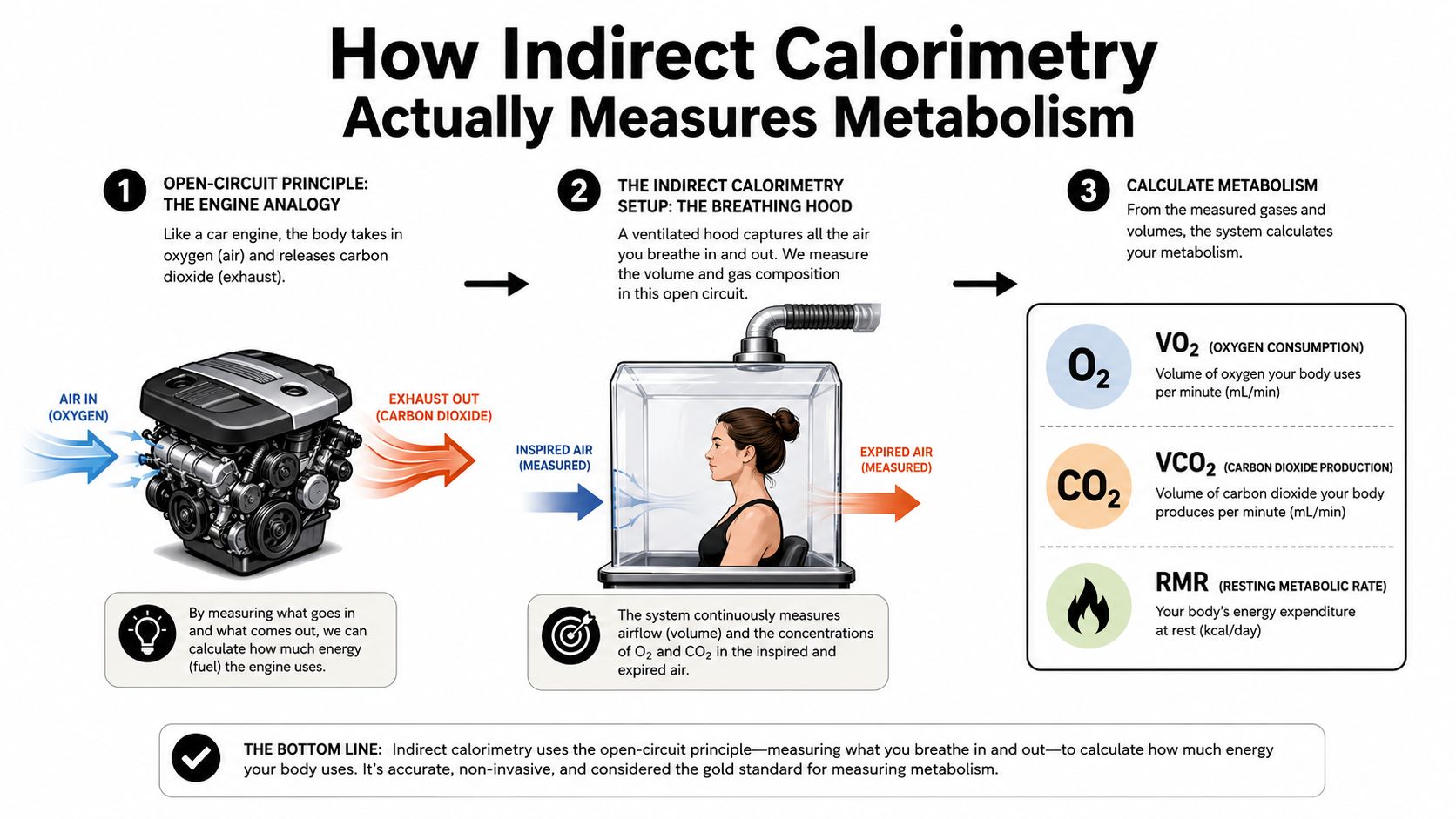
Indirect calorimetry doesn't measure heat directly. It estimates energy expenditure from the gases involved in metabolism.
Think of a car engine. The engine draws in air, uses oxygen to release energy from fuel, and sends exhaust out. If you measure the air entering and the gases leaving, you can infer how the engine is working. Human metabolism follows the same broad logic. Cells consume oxygen and produce carbon dioxide, and the equipment measures those exchanges while you breathe.
The three outputs
A ventilated hood, facemask, or mouthpiece captures respiratory flow. The analyser then measures the gas composition and flow rate.
- VO2, or oxygen consumption, is the amount of oxygen removed from inspired air.
- VCO2, or carbon dioxide production, is the amount of carbon dioxide added to expired air.
- Respiratory exchange ratio, or RER, is calculated from VCO2 divided by VO2.
The system combines VO2 and VCO2 with established calorimetry equations, such as the Weir equation, to estimate energy expenditure. The output may be expressed as resting metabolic rate or another period-specific energy value. A nutrition professional can then use the measured result as one input when designing an energy prescription. For practical meal-planning context, readers may also find this metabolic meal-planning resource useful, although a meal plan can't replace measured clinical interpretation.
Why sampling method changes the measurement
Breath-by-breath systems analyse each breath and can respond quickly to changes during exercise. Their weakness is that timing, analyzer response, leaks, and software processing become important when individual breaths are short or irregular.
Mixing-chamber systems blend expired gas over a defined period before analysis. This smooths short-term variation and can be useful during steady-state testing, though it may respond less immediately to rapid transitions.
Douglas bags collect expired air for later analysis. The method is conceptually straightforward, but collection, storage, weighing, and laboratory analysis create operational work. Modern systems are more convenient, but they still depend on the same physical assumptions.
A test also works best when the subject reaches a stable physiological state. Analyzer drift, leaks, incorrect flow measurement, temperature and pressure corrections, and unstable breathing can all affect the result. The equipment may produce a clean-looking number even when those conditions haven't been controlled.
A short visual explanation can help new operators connect the breathing signal to the metabolic calculation:
A Short History of the Technology
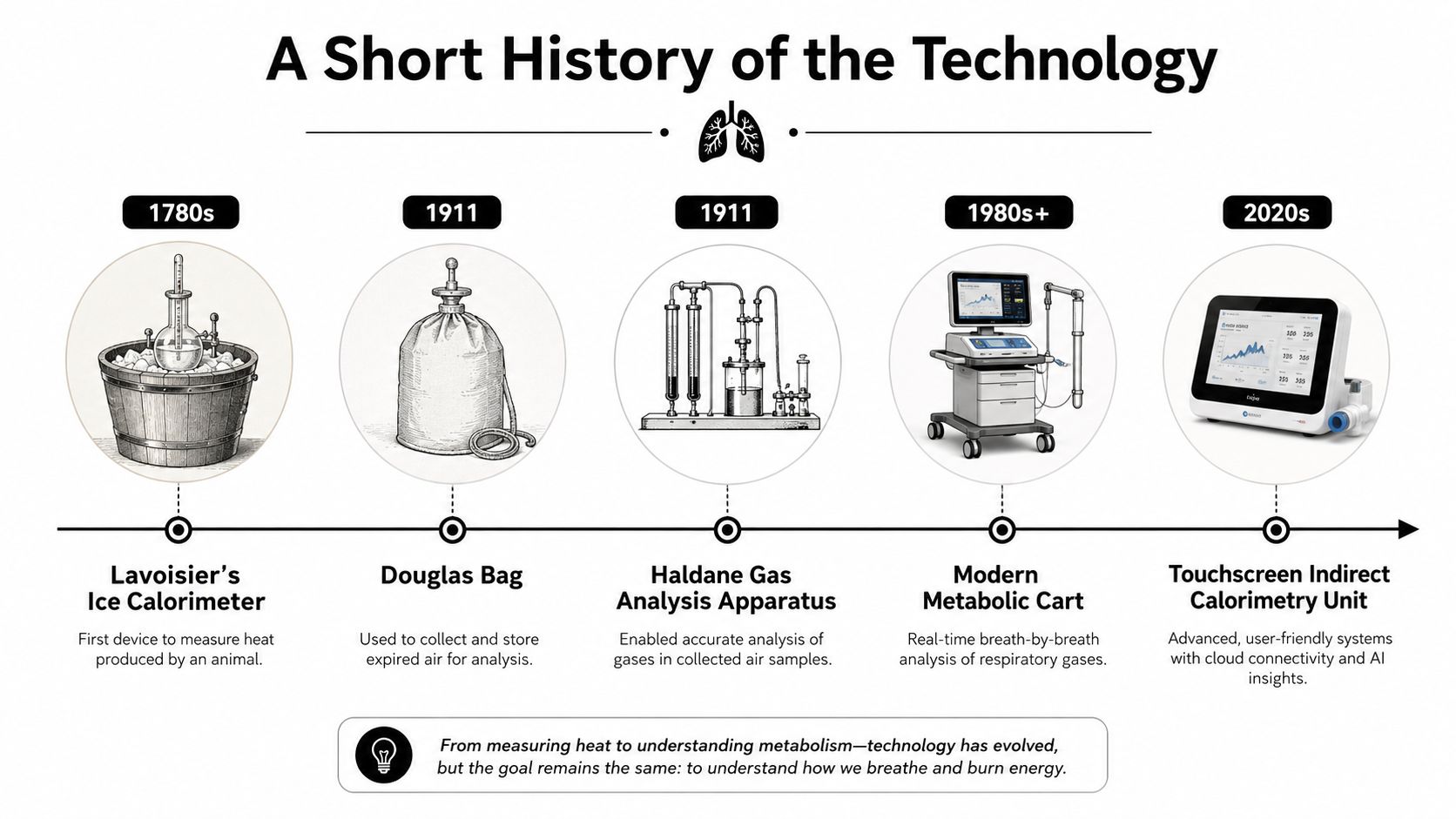
Indirect calorimetry equipment developed by solving practical problems one at a time. Early investigators needed to connect oxygen use and carbon dioxide production with energy release. Later engineers had to make the process portable, faster, and easier to operate around patients and athletes.
The historical record described in a clinical review shows several important steps. The Douglas bag, introduced in 1911, collected all expired air for later analysis. That approach created a reliable collection method, but the bag's size and handling requirements limited convenience. In 1952, Müller and Franz developed an open-circuit mask system that could be carried in a bag, an important move toward field use (historical review of indirect calorimetry).
From collection bags to portable analysis
The Kofranyi-Michaelis device had become widely adopted by the 1940s. Open-circuit measurement became the dominant approach in classical instruments because it allowed the subject to breathe atmospheric air while the system measured expired gas and flow.
Electronics changed the next generation. Systems developed in the 1950s could automate more of the gas-analysis process, reducing the manual burden of collecting and analysing samples. Later breath-by-breath instruments made the technology more useful for exercise physiology, where ventilation and gas exchange change rapidly.
The modern metabolic cart is the result of a compromise between laboratory control and real-world movement.
The move toward bedside, exercise, and mobile testing explains today's mixed equipment offerings. Desktop carts retain the physical footprint and operator discipline of laboratory systems. Portable and handheld units address mobility, but their smaller form factor doesn't automatically provide the same validation evidence.
The Four Device Classes You Will Compare
Treating every instrument as a “metabolic cart” hides the main procurement decision. Desktop carts, portable analysers, canopy hoods, and whole-room calorimeters measure related variables, but they differ in sampling, infrastructure, mobility, and the kind of validation they can realistically support.
| Device Class | Sampling Method | Typical Accuracy (VO2) | Portability | Best Setting |
|---|---|---|---|---|
| Desktop metabolic cart | Facemask or mouthpiece, often breath-by-breath or mixing chamber | Can be high when the complete system is validated, but performance varies by device | Limited | Sports laboratories, clinical testing, university research |
| Portable or handheld analyser | Facemask or mouthpiece, commonly breath-by-breath | Wider uncertainty is possible, particularly when validation evidence is limited | High | Field screening, mobile testing, selected exercise applications |
| Canopy hood system | Ventilated hood over the head, usually steady-state gas collection | Well suited to resting measurements when airflow, leaks, and stability are controlled | Low to moderate | Resting metabolic rate, clinical nutrition, wellness clinics |
| Whole-room calorimeter | Room airflow and continuous gas exchange | Designed for long-duration, research-grade measurement with dedicated validation | Very low | Multi-hour or multi-day metabolic research |
Desktop carts
A desktop cart is usually the most versatile choice for a laboratory. It can connect to a treadmill or cycle ergometer, support graded protocols, and deliver rapid breath-by-breath data. The trade-off is physical space, operator training, calibration routines, and dependence on masks, filters, hoses, and software.
Portable and handheld systems
Portable units make testing possible outside a fixed laboratory. That matters for occupational assessments, team environments, and field research. The buyer gives up some control over the testing environment and must ask whether the device has independent evidence for the intended workload and population.
Canopy systems
A canopy hood creates a calm, low-contact setup for resting measurement. It can suit patients who find a mask uncomfortable or who need a quiet protocol, but the hood must seal effectively around the neck without disturbing natural breathing. Buyers comparing metabolic testing systems can review metabolic testing equipment options alongside the intended clinical workflow.
Whole-room systems
A whole-room calorimeter measures gas exchange through room airflow rather than a mask. It can support extended observation, meals, sleep, and daily activity, but it requires dedicated infrastructure, environmental control, and specialist operation. It isn't a practical substitute for a portable cart.
Body composition and metabolic measurements often sit within a wider assessment pathway. For teams combining these data types, precision health tracking with Inbody may provide useful context, but body composition doesn't replace direct gas-exchange measurement.
Why Whole-System Accuracy Matters More Than Brand
A cart can pass a bench check yet give a misleading metabolic result beside a patient or athlete. The final calculation combines flow, oxygen concentration, carbon dioxide concentration, timing, pressure correction, and software processing. These signals must line up. A delayed gas signal or poorly matched flow measurement can distort VO2 and VCO2 even when individual sensors appear normal.
The practical question is not whether a device has an accurate analyser. It is whether the assembled system recovers a known metabolic input.
Two validation questions matter
Gas-composition testing checks whether the oxygen and carbon dioxide analysers measure known gas mixtures correctly. This isolates the analyser path and can expose sensor bias, drift, or response problems.
Gas-exchange simulation checks the complete measurement chain. A simulator supplies known volumes and gas concentrations to reproduce oxygen consumption and carbon dioxide production. The cart must then align flow with gas signals and recover the expected VO2 and VCO2.
These tests answer different questions. Component calibration doesn't establish end-to-end metabolic accuracy, as described in whole-system validation guidance. A procurement file should therefore include analyser testing and whole-system recovery across the operating range relevant to the intended patients or participants.
A comparative validation study shows why this distinction affects device comparisons. Among 12 instruments, only 5 measured RER within a ±2% difference from the true value, and consistency varied across the core measurements. In the same infusion testing, a whole-room system recorded mean total error of about 1.27% for VO2 and 0.42% for VCO2, with gas recovery near 99–100%. Those results describe one validated system, not every desktop, portable, handheld, or whole-room device.
Ask vendors for peer-reviewed or independently documented validation reports, not only sensor specifications. Look for the reference method, gas mixtures or simulator inputs, tested flow range, error calculations, repeatability, and stated limits for oxygen enrichment or mechanical ventilation. Metabolic cart calibration service information can help clarify how routine calibration differs from a broader validation programme. Calibration keeps measurements aligned. Whole-system validation shows whether the equipment turns those measurements into dependable metabolic values.
Matching Equipment to Clinical and Performance Settings
The same VO2 number can support very different decisions. A sports scientist may need to identify a rapid change during an interval. A clinical nutrition team may need a stable resting value to guide feeding. Equipment selection should start with the consequence of error, not the convenience of the device.
A setting-based decision
| Setting | Primary Goal | Recommended Device Class | Required Validation Evidence |
|---|---|---|---|
| ICU and clinical nutrition | Resting energy expenditure and ventilator-integrated assessment | Validated desktop or canopy system suited to the respiratory circuit | Full-system gas-exchange simulation, analyser testing, ventilated-patient compatibility |
| Sports science laboratory | Exercise gas exchange and graded testing | Desktop breath-by-breath cart | Exercise-range accuracy, response-time evidence, repeatability, ergometer integration |
| Occupational health and weight management | Efficient resting assessment during appointments | Canopy hood or validated portable system | Resting steady-state evidence, repeat measurements, practical leak control |
| Field screening | Mobile physiological screening | Portable or handheld analyser | Conditions-specific field validation and clear uncertainty limits |
| Research-grade metabolic studies | Extended energy-expenditure measurement | Whole-room calorimeter | Long-duration recovery, environmental control, and independent reference comparison |
A clinical team should prioritise patient tolerance, infection control, ventilator compatibility, and data integration. A sports laboratory should prioritise sampling response, exercise equipment interfaces, and the ability to inspect raw breath-by-breath data. Those priorities aren't interchangeable.
Portable devices can be defensible for field work when the research question concerns broad session-level patterns rather than a narrow clinical prescription. For athlete support, equipment choice may sit within a wider programme involving functional medicine for athletes, but the metabolic analyser still needs validation appropriate to the testing protocol.
A university department should also consider teaching value. Students need to see calibration, mask fitting, leak detection, steady-state criteria, and data-quality flags, not just a final calorie estimate. A smaller unit may improve access, while a desktop cart may provide a richer platform for methods training and research.
Are Portable and Handheld Units Good Enough
Portable indirect calorimetry equipment is neither automatically unreliable nor automatically equivalent to a desktop cart. The answer depends on the question, the subject, the activity, and the acceptable uncertainty.
The strongest recent evidence in the supplied brief points in a cautious direction. A 2025 systematic review found that standard desktop devices showed the most consistent validity, predictive ability, and reliability for resting energy expenditure in adults with overweight or obesity, while a 2026 review of nine devices reported poor concurrent validity and poor reliability for handheld portable units (systematic review of diagnostic accuracy). The reviews describe device classes, not a verdict on every model.
Where portability can make sense
A portable analyser may be a reasonable choice when:
- The test is mobile by design. First-responder screening, occupational visits, and team-sport testing may be impossible with a fixed cart.
- The output is used as a broad indicator. Session averages may answer the question even when individual-breath precision isn't sufficient for a narrow physiological threshold.
- The operator controls the protocol. Consistent mask fitting, calibration, warm-up, posture, workload, and data review can reduce avoidable variation.
- The buyer has tested the actual use case. Evidence from a resting bench test shouldn't automatically be extended to high-intensity exercise, children, ventilated patients, or outdoor conditions.
| Device Class | Resting VO2 Error (%) | Moderate Exercise Error (%) | High-Intensity Error (%) |
|---|---|---|---|
| Portable or handheld | Do not assume equivalence. Require device-specific evidence | Require workload-specific validation | Require workload-specific validation |
| Desktop metabolic cart | Often the stronger reference choice, but verify the model | Verify exercise-range recovery | Verify response time and high-ventilation performance |
The table intentionally avoids unsupported universal error percentages. Published reviews show that performance varies by instrument and setting, so a buyer should request the actual validation report rather than apply a class-wide number.
The practical boundary is clear. A portable unit may be appropriate for field screening or exploratory work, but a buyer should be cautious when the result changes feeding, rehabilitation progression, surgical preparation, or a peer-reviewed endpoint. In those situations, mobility is useful only if the evidence supports the decision.
Final Checklist and Common Buyer Questions
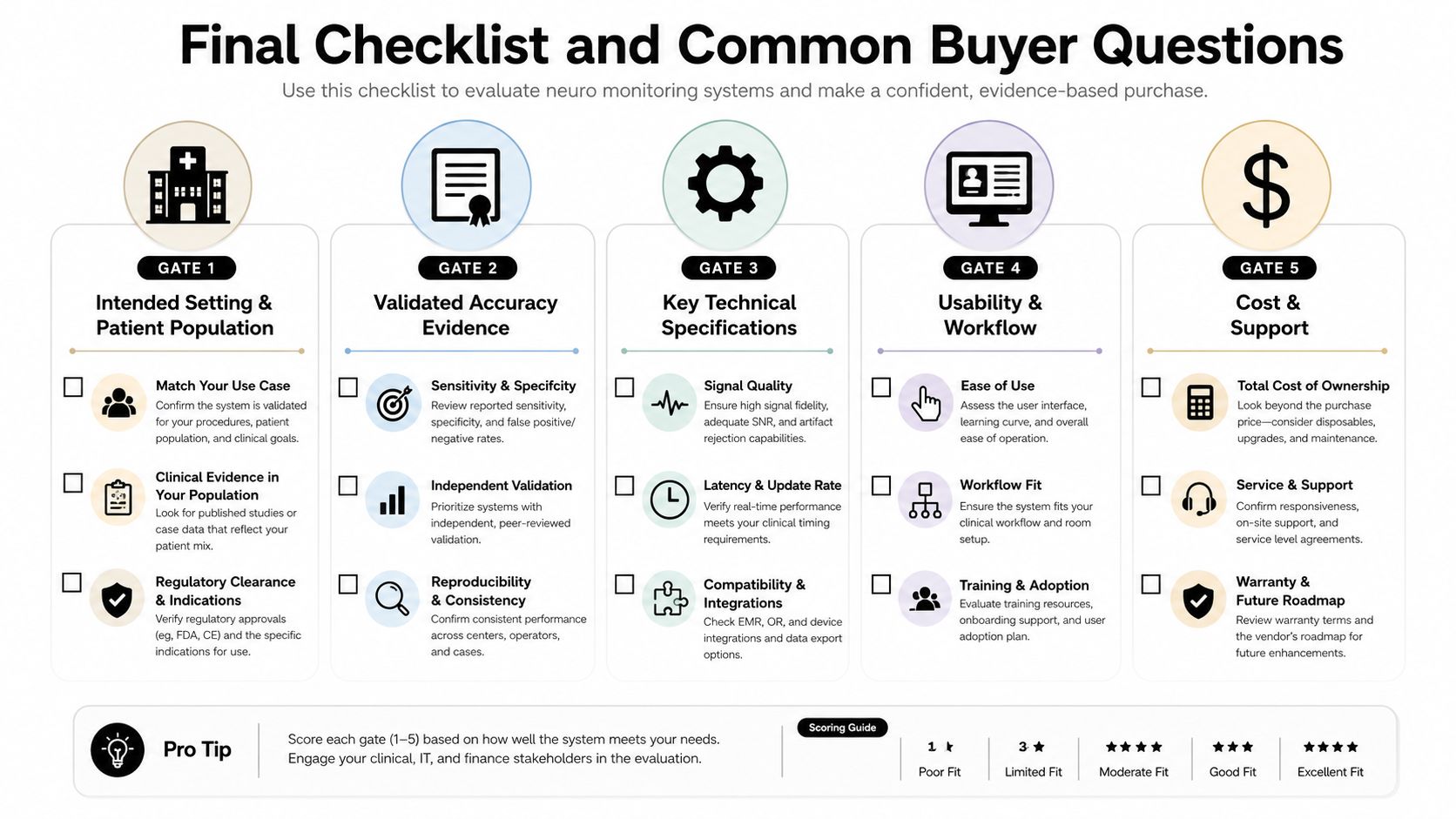
A purchase order should pass five gates before anyone compares colours, screens, or brand familiarity. The questions below are designed for a clinical physiologist, sports laboratory manager, or occupational health buyer who will own the system after delivery.
Five procurement gates
- Define the population and setting. State whether you'll test resting adults, athletes, patients on ventilators, children, or mobile workers. Include posture, workload, expected throughput, and whether a hood, mask, or mouthpiece is acceptable.
- Demand whole-system evidence. Request gas-composition testing and gas-exchange simulation against known inputs. Confirm that the report covers VO2, VCO2, RER, linearity, repeatability, and the relevant flow range.
- Inspect technical behaviour. Ask about analyzer response time, flow-sensor drift, pressure and temperature correction, oxygen-enriched gas compatibility, data smoothing, and raw-data access.
- Map the consumables. Price masks, mouthpieces, antibacterial filters, hoses, calibration gases, batteries, sensor modules, and cleaning supplies. Confirm which items are single-use and which can be reprocessed under your infection-control policy.
- Calculate ownership cost. Include installation, training, software, service contracts, sensor replacement, shipping, downtime, and data integration. A cheaper instrument can become expensive if the workflow depends on frequent specialist support.
For the software side, confirm whether results can be exported into your reporting system and whether the vendor supports the data format your information-technology team requires. Teams considering metabolic data analysis support should assess whether the workflow preserves raw measurements, quality flags, and test conditions rather than exporting only a final calorie estimate.
Common buyer questions
How often is calibration required? Follow the manufacturer's protocol before each testing session or whenever the system indicates a check is due. Calibration frequency depends on the instrument, gas supply, flow sensor, and local quality system, so don't substitute a generic schedule for the vendor's instructions.
Does a canopy hood change resting measurements compared with a mask? It can if the hood leaks, alters comfort, changes breathing, or fails to capture the intended airflow. Compare methods only when the protocol controls rest, posture, environmental conditions, and steady-state criteria.
Which infection-control items are reusable? The answer depends on the material, manufacturer instructions, and your local policy. Treat masks, filters, tubing, and breathing circuits as separate procurement lines, and obtain written reprocessing guidance before purchase.
What does the warranty cover? Ask specifically about flow sensors, oxygen and carbon dioxide analysers, batteries, tablet or computer hardware, calibration faults, labour, turnaround time, and loan equipment. “Full warranty” is too vague for a system that depends on replaceable sensors.
A final decision flow is simple:
- If you need high-confidence laboratory or clinical measurement, start with a validated desktop, canopy, or whole-room class.
- If you need mobility and can accept broader uncertainty, evaluate portable units against your exact field protocol.
- If the device will guide a high-consequence prescription, require independent whole-system evidence before approving the purchase.
Cartwright Fitness supplies indirect calorimetry and metabolic testing equipment, including Cosmed metabolic analysers and related consumables, for clinical, performance, and research workflows. Visit Cartwright Fitness to compare suitable systems and request practical product guidance before you commit to a device class.