

Here’s the simple, unvarnished truth about ice baths for athletes: they are a powerful tool, but they come with a major catch. While countless athletes swear by them to crush muscle soreness and bounce back faster for the next game, a growing body of evidence shows they might actually get in the way of building muscle if you use them after strength training. Ultimately, the decision to take the plunge comes down to one question: what’s more important right now—immediate recovery or long-term strength gains?
The Cold Plunge Into Athletic Recovery
From professional locker rooms to the finish lines of marathons, the image of an athlete sinking into an icy tub is everywhere. What used to be a somewhat fringe practice for the truly hardcore has become a fixture in modern sports. So, what’s behind this explosion in popularity? It’s a mix of real physiology and powerful perception.
Athletes are always on the hunt for an edge, and ice baths seem to offer a quick fix for one of their biggest enemies: post-exercise muscle soreness and fatigue. The logic feels simple and direct—cold numbs pain and reduces swelling. It just makes sense. This straightforward appeal is a huge reason why it has been adopted so enthusiastically at the highest levels of competition.
From Niche Tactic to Olympic Standard
The rise of cold water immersion isn't just something you see on Instagram; the data backs it up, and the trend in elite sports is staggering. You only have to look at the numbers coming out of Olympic polyclinics to see the dramatic shift.
At the Athens 2004 and London 2012 Olympic Games, cold water immersion was a relatively minor part of the recovery toolkit, making up only about 10% of treatments given by physiotherapists. But then something changed. By the Rio 2016 Olympics, that number had jumped to a massive 44% of all physiotherapy treatments—a more than four-fold increase in just a handful of years. You can see the astonishing data on its rising popularity in elite sports for yourself.
This rapid adoption shows how deeply ice baths for athletes have been embraced as a primary recovery strategy. But it also forces us to ask a tough question: is all this popularity built on solid science, or is it driven by a potent combination of placebo effect and good old-fashioned hype?
The core of the debate is this: ice baths can make you feel better and perform better tomorrow, but they might be blunting the very adaptations that make you stronger in the long run.
That’s the exact question this guide is here to answer. We're going to break it all down.
- The Science: We’ll look at what’s actually happening in your muscles, blood vessels, and nervous system when you hit that ice-cold water.
- The Trade-Offs: We’ll unpack the critical conflict between short-term recovery and long-term adaptation for strength and endurance.
- The Protocols: Most importantly, we'll get into the practical side of things—how to use ice baths the right way for your specific goals.
By the end, you’ll have a clear, evidence-based framework for deciding if braving the cold is the right move for you.
What Really Happens to Your Body in an Ice Bath?
So, what’s actually going on when you plunge into a tub of icy water? It’s far more than just a shocking jolt to the system. Think of it as a powerful, controlled reset for your muscles after they've been pushed to their limits. This whole process is essentially a two-act play: first, squeezing out all the bad stuff, then flooding the area with everything good.
The moment you hit that icy water, your body’s survival instincts kick in. The immediate, and most dramatic, reaction is vasoconstriction. It's a fancy term for your blood vessels clamping down hard. Imagine wringing out a wet sponge. The intense cold effectively squeezes your muscles, forcing out the metabolic waste—like lactic acid—that builds up during a tough workout. It’s a rapid-fire cleanup crew for all the debris left behind.
The Rebound: Flooding Your Muscles with Fresh Blood
As soon as you step out of the bath and start warming up, the complete opposite happens. Your body, desperate to get back to its normal temperature, triggers vasodilation. Your blood vessels fly open, and a rush of fresh, oxygen-rich blood comes flooding back into your muscle tissues.
This rebound is where the real recovery begins. This new blood brings all the nutrients needed to kickstart muscle repair, dial down inflammation, and soothe those overworked tissues. While ice baths for athletes are a fantastic tool, getting the full picture on how to reduce muscle soreness for faster recovery will help you build a truly comprehensive routine.
It's amazing to see how the humble ice bath has gone from a fringe practice for elite athletes to a mainstream recovery tool, now capturing the serious attention of the scientific community.
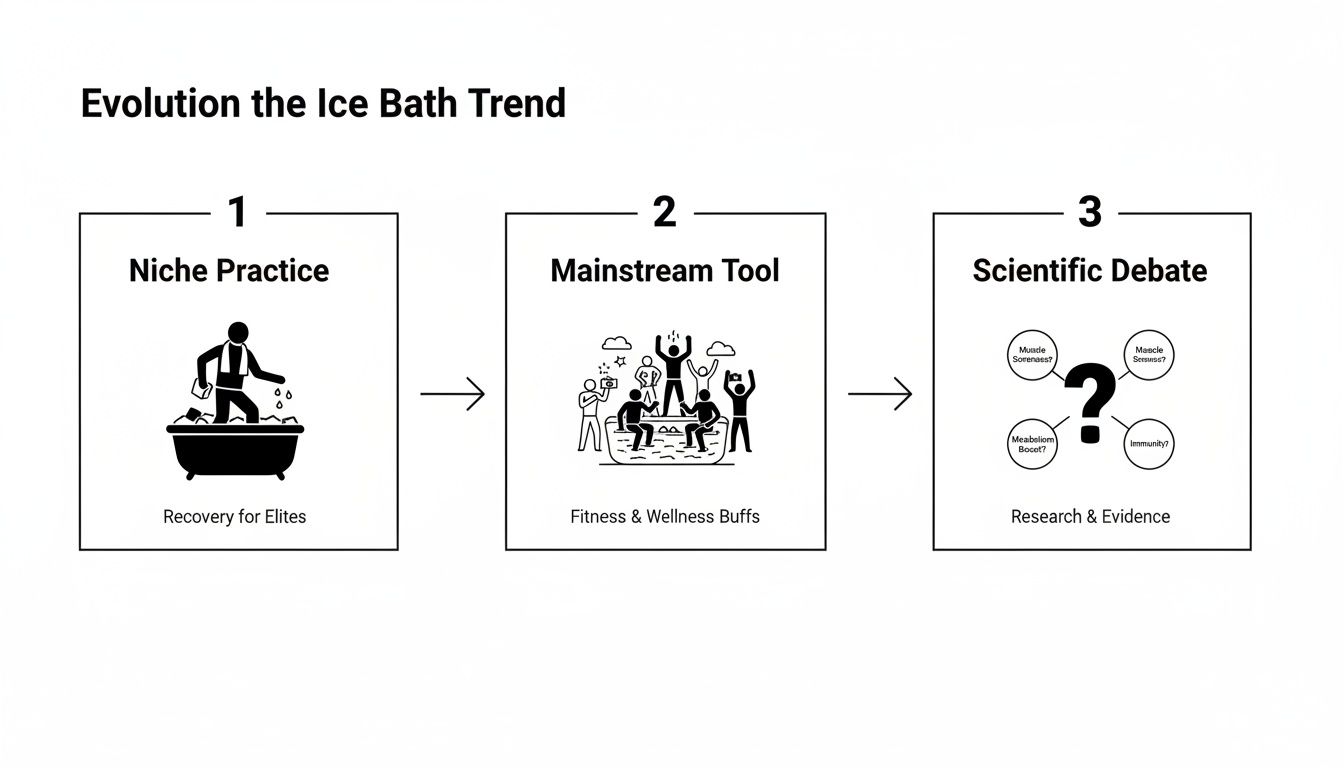
What started with a few pros looking for an edge has become standard practice in team settings, which has, in turn, fueled the research to figure out exactly how and why it works.
The Other Ways Cold Works Its Magic
Beyond that big circulatory "flush," a few other things are happening that explain why an ice bath feels so good on sore muscles.
- Pain Gatekeeper: The cold literally slows down the speed of your nerve signals. This creates a natural numbing effect, providing that immediate, blessed relief from the ache and burn of a hard session.
- Putting Inflammation on Pause: Cooling down your tissues also temporarily lowers their metabolic rate. Think of it like hitting the pause button on the inflammatory process, stopping secondary damage before it can really get going.
- A Natural Mood Boost: That initial shock of cold can trigger a release of endorphins—your body’s built-in painkillers. It’s a big reason why many people report feeling surprisingly great and clear-headed after a plunge.
At its core, the ice bath is a circulatory game-changer. By first constricting your vessels to push out waste and then opening them back up to rush in nutrients, you're basically hitting the fast-forward button on your body's natural cleanup and repair cycle.
This rapid exchange is exactly why timing is so important. Hitting an ice bath right after a tough competition can immediately get a handle on acute inflammation and metabolic waste. If you're an athlete who really geeks out on the data, learning about blood lactate testing can give you a deeper understanding of how your body is responding to hard efforts.
The Big Debate: Do Ice Baths Kill Your Gains?
This is probably the most heated question in the world of athletic recovery: are ice baths helping you or are they actually holding you back from getting stronger? It feels fantastic to plunge into icy water after a brutal workout, but the very thing that makes you feel better might be working against your long-term goals. It's a classic trade-off, and knowing how it works is the key to using ice baths for athletes the right way.
On the surface, the logic for an ice bath seems solid. You train hard, creating tiny micro-tears in your muscles. Your body responds with inflammation, which is what causes that familiar delayed onset muscle soreness (DOMS). An ice bath clamps down on that inflammation, numbs the pain, and helps you feel ready to train again sooner. Simple enough.
But there’s a major catch, and a growing pile of research is pointing it out. That inflammation you're so eager to get rid of isn't just a pesky side effect of training. It's actually a crucial signal for growth.
The Problem With Shutting Down Inflammation
Think of inflammation as the foreman on a construction site. After a tough workout (the demolition), the foreman shows up, surveys the "damage," and calls in the specialized crews needed to rebuild the muscle fibers bigger and stronger than before. This whole repair and rebuilding process is what we call muscle protein synthesis.
When you jump into an ice bath, you're essentially telling that foreman to go home early. By aggressively reducing inflammation, you also mute the very signals that tell your body to start the repair and growth process. The worksite might feel quieter and less painful, but the message to send in the muscle-building crew either gets lost or comes through muffled.
This puts two things you want in direct conflict:
- Feeling Better Now: Less soreness and a faster return to feeling "normal."
- Getting Stronger Later: Allowing the body's natural adaptation process to run its course, which leads to actual muscle growth and strength gains over time.
This isn’t just a hunch; scientists have looked at this exact problem. Studies have shown pretty clearly that cooling your muscles right after a workout can get in the way of building new muscle.
A pivotal study in the Journal of Physiology found that cooling muscles post-exercise seriously hampered the muscle-building process. In fact, the daily rate of muscle protein synthesis was 11.4% lower in the group that used ice baths compared to those who just rested. You can discover more about these findings on muscle growth and what they mean for athletes.
This is a real compromise. Every time you opt for an ice bath after a strength session, you might be trading a little bit of future strength for a little bit of immediate comfort.
So, When Does an Ice Bath Make Sense?
Seeing this evidence, it becomes obvious that timing and context are everything. The question isn't if you should ever use an ice bath, but when you should use one to get the benefit without sacrificing your main goal.
The best approach is to match your recovery method to the goal of that specific workout.
Good Times for an Ice Bath:
- During a Tournament or Multi-Day Competition: When you have back-to-back games or events, your number one priority is being ready for the next performance. Tamping down soreness so you can compete at your best is far more important than long-term muscle adaptation in that specific window.
- After Long, Slow Endurance Work: Following a lengthy run or bike ride where the main goal was cardiovascular fitness, not building massive muscle, an ice bath can be great for recovery without getting in the way of your primary objective.
When You Should Probably Skip the Ice:
- Right After a Strength or Hypertrophy Workout: If the whole point of your session was to build muscle and get stronger, stay out of the ice. You want that natural inflammatory response to signal your body to rebuild and adapt. Don't short-circuit the process.
Think of the ice bath as a specific tool in your recovery toolbox, not a go-to solution for every ache and pain. By understanding this crucial trade-off, you can make smarter decisions that help you recover on your own terms, without undoing all the hard work you just put in.
Actionable Protocols for Using Ice Baths
Knowing the "why" behind ice baths is half the battle. The other half is mastering the "how." To get consistent, predictable results from cold water immersion, you have to get methodical about three things: temperature, duration, and timing.
Think of it this way: you can't just toss ingredients in a bowl and expect a perfect cake. It takes the right oven temperature, the right baking time, and the right sequence. The same goes for ice baths for athletes. Getting the protocol right is what separates a genuine recovery tool from just a miserable, cold experience.
Dialing in the Temperature
Finding the ideal temperature for an ice bath is a balancing act. You need the water cold enough to kick off those key physiological changes, like vasoconstriction, but not so frigid that it becomes dangerous or self-defeating.
For most applications, the sweet spot is a surprisingly specific window: 45-59°F (or 7-15°C). This range consistently delivers therapeutic benefits without exposing athletes to unnecessary risks like a non-freezing cold injury. A simple floating thermometer is non-negotiable here; you need to know your numbers.
Even a massive 2026 meta-analysis, which reviewed studies with over 3,000 participants, found that while protocols varied wildly, this temperature range was a common thread for effective results. With exposures ranging from 30 seconds to 15 minutes, it’s clear that precision matters. You can dig into the research findings on cold water immersion benefits to see just how tightly these parameters are controlled in studies.
Mastering the Duration
How long you stay in is just as crucial as how cold the water is. The objective is to stay immersed long enough to cool down deep muscle tissues but get out before your body is over-stressed or you drift toward hypothermia.
For most athletes, the optimal duration is between 5 and 15 minutes. If you're new to this, start at the low end—even just a few minutes—and gradually build up your tolerance.
Never go beyond 15 minutes. This is one area where the "more is better" mindset is just flat-out wrong and dangerous. Extended time in the ice offers no extra recovery benefits and seriously ramps up the health risks.
Strategic Timing for Peak Performance
Of all the variables, timing is arguably the most important. It’s what determines whether the ice bath is helping or hurting your progress. Get it right, and you accelerate recovery. Get it wrong, and you could be undoing all your hard work in the gym.
The table below breaks down when to take the plunge based on what you're trying to achieve.
Ice Bath Timing Based on Athletic Goal
| Training Goal | Ice Bath Recommendation | Rationale |
|---|---|---|
| Strength & Hypertrophy | AVOID | Inflammation is a critical signal for muscle growth. An ice bath mutes this signal, which can blunt long-term gains in strength and size. |
| Tournament/Competition | USE | The goal here is immediate recovery for the next game or event. Dampening soreness and inflammation helps you feel fresh and perform at your peak on a short turnaround. |
| Endurance Session | USE | After a long run, ride, or swim, an ice bath is fantastic for easing muscle soreness. It won't interfere with the main cardiovascular adaptations you're training for. |
| General Soreness | USE WITH CAUTION | If you're just trying to feel better and reduce DOMS, an ice bath works well. Just be mindful of the trade-off if that soreness came from a strength workout. |
By using these protocols, you can confidently fit ice baths for athletes into a training plan, ensuring you’re supporting recovery when it counts and protecting your gains when it matters most. For anyone looking to get even more granular with their recovery data, our guide on HRV monitoring for athletes is a great next step.
Navigating the Risks and Safety Measures
As powerful as cold water is for recovery, it's not something to be taken lightly. That same intense cold that helps you bounce back can pose real dangers if you don't treat it with respect. Thinking about safety first is the only way to responsibly use ice baths for athletes.
The moment you hit the water, your body triggers a "cold shock" response. You'll take an involuntary gasp, and your breathing will become rapid and shallow. For anyone with an underlying health issue, this sudden jolt can be risky. The trick is to manage it—enter the water slowly, don't just jump in, and focus on slow, controlled breaths until the initial shock passes.
Beyond that initial shock, the two main concerns are hypothermia and non-freezing cold injuries. Hypothermia is a dangerous drop in your core body temperature. A non-freezing cold injury, on the other hand, can damage nerves and tissues in your arms and legs even if your core temp is fine. This is exactly why sticking to proven time and temperature guidelines is absolutely critical.
Who Must Avoid Ice Baths
Cold immersion simply isn't for everyone. For certain people, the intense physiological stress is not just uncomfortable—it's downright dangerous.
You should absolutely avoid ice baths if you have any of the following:
- Cardiovascular Issues: If you have high blood pressure, heart disease, or any history of heart problems, stay away. The cold causes blood vessels to clamp down hard, putting a major strain on your heart.
- Circulatory Disorders: Conditions like Raynaud's phenomenon (where blood flow to your extremities is already poor) can get much worse with extreme cold.
- Diabetes: Nerve damage from diabetes can affect your ability to feel just how cold the water is, raising the risk of serious tissue injury without you even realizing it.
- Cold Agglutinin Disease: This is a rare autoimmune disorder where cold causes red blood cells to clump, creating a severe and dangerous circulatory blockage.
Always get the green light from a doctor before you start any cold immersion routine. A quick conversation can confirm whether ice baths are a safe choice for your specific health profile and athletic goals, helping you avoid a preventable injury.
Critical Red Flags to Monitor
Even if you’re perfectly healthy, you have to listen to your body. Pushing through the wrong kind of pain or ignoring your body's warning signs is a fast track to getting hurt.
Get out of the water immediately if you notice any of these red flags:
- Uncontrollable Shivering: A little shivering is one thing. But if you start shaking uncontrollably, your body is losing heat way too fast. Time to get out.
- Numbness or Tingling: If you get a "pins and needles" feeling that won't go away or gets worse, it could be a sign of nerve irritation or the start of a cold injury.
- Changes in Skin Color: Skin that turns waxy white, grey, or blue and stays that way is a clear sign of severe blood flow restriction.
- Dizziness or Lightheadedness: Feeling faint or dizzy means the cold is significantly impacting your blood pressure and brain function.
When you treat the ice bath with the same focus and respect you give your training, you can unlock its benefits without putting your health on the line.
Effective Recovery Alternatives to Ice Baths
Ice baths get a lot of attention in conversations about recovery, but they’re far from the only effective tool in your arsenal. In fact, for many athletes, other methods can be a much better fit depending on your specific goals, available resources, and even your personal tolerance for the cold.
Sometimes, a full-blown ice bath is just impractical. You might not have access to a tub and hundreds of pounds of ice, or maybe the goal of your workout was building muscle, making a cold plunge counterproductive. Knowing your other options is key to building a smart, flexible recovery plan.
Contrast Water Therapy
A fantastic alternative to a straight ice bath is Contrast Water Therapy (CWT). This technique involves quickly switching between cold and warm water, which creates a powerful "pumping" action in your circulatory system.
Think of it like a vascular workout. The cold water makes your blood vessels clamp down (vasoconstriction), and then jumping into warm water forces them to open up wide (vasodilation). This rapid cycle pushes blood through your muscles, which can help flush out metabolic byproducts and reduce swelling more dynamically than just sitting in the cold.
A classic CWT protocol looks like this:
- Alternate: Switch between a cold tub (50-60°F or 10-15°C) and a warm tub (100-110°F or 38-43°C).
- Timing: Aim for about one minute in the cold, followed by one minute in the warm.
- Repetition: Keep this cycle going for 10-15 minutes, always finishing with a cold immersion.
CWT is a great middle-ground, giving you circulatory benefits without the prolonged, intense chill of a traditional ice bath.
Active Recovery
Sometimes the best medicine for sore muscles is simply to get them moving again. Active recovery is all about performing low-intensity exercise after a tough session or on a dedicated rest day. This could be anything from a light jog or a gentle swim to dynamic stretching or an easy bike ride.
The idea isn’t to add more stress to your body, but to gently stimulate blood flow. This boost in circulation helps deliver fresh oxygen and nutrients to your working muscles, speeding up repair and easing stiffness without the shock of an ice bath.
Active recovery is a superior choice after a strength training session. Unlike an ice bath, it promotes recovery without blunting the inflammatory signals needed for muscle adaptation and growth, making it ideal for athletes focused on getting stronger.
Compression Garments
Another evidence-backed option is the use of compression garments. These tight-fitting sleeves, socks, or leggings apply steady, mechanical pressure to your limbs, which can significantly reduce post-exercise swelling and soreness.
This pressure works in two ways: it physically prevents excess fluid from pooling in your muscle tissue and helps improve venous return, pushing blood back toward the heart more efficiently. It’s a passive and incredibly convenient method—you can wear them for hours after a workout, during your cool-down, or even on a flight to a competition. For athletes looking to broaden their toolkit, exploring various muscle recovery tools can reveal new strategies to complement or replace cryotherapy.
Ultimately, the right recovery method is the one that fits your specific training goals and is easy for you to use consistently. By having a range of strategies, from contrast therapy to a simple walk, you give yourself the flexibility to recover smarter. To dive even deeper into the science behind these modalities, our guide on evidence-based physical therapy offers practical insights for both athletes and coaches.
A Few Common Questions About Ice Baths
Even when you understand the science, putting ice baths into practice can bring up a lot of questions. Let's walk through some of the most common ones I hear from athletes and coaches so you can use this tool with confidence.
Can I Use an Ice Bath for General Muscle Soreness?
You absolutely can, but you have to be smart about why you're sore. If you're just looking to take the edge off a brutal workout so you can feel human again, a quick 5 to 10 minute plunge is fantastic. It does a great job of numbing the pain and reducing that stiff, achy feeling we all know as DOMS.
Here’s the catch: if that soreness came from a strength session where the goal was to build muscle, you might be shooting yourself in the foot. The ice bath can blunt the very inflammation your body needs to adapt and get stronger. It’s a classic trade-off: feel better right now, or let your body do its thing to maximize long-term gains.
How Often Should an Athlete Be Taking Ice Baths?
This is a big one. Ice baths for athletes should be a strategic weapon, not a daily habit. Their real power is unleashed during intense competition periods when bouncing back quickly is everything.
Think of it as a specialized tool for specific jobs:
- During Your Season: Perfect for multi-day tournaments or when you have games on back-to-back days. The goal here is to feel as fresh as possible for the next performance.
- In the Off-Season: Use them sparingly, if at all. When you're in a training block focused on building strength, you want those adaptive signals firing on all cylinders. Limiting ice baths to maybe once or twice a week after your most grueling sessions is a good rule of thumb.
Overdoing it, especially for strength athletes, can seriously hamper your body's ability to adapt to all the hard work you're putting in.
The key is to match the recovery method to the goal. An ice bath is a tool for performance and short-term recovery, not a daily habit for long-term athletic development. Using it every day could negatively impact your strength and muscle growth.
Is an Ice Bath Really Better Than a Cold Shower?
When we're talking about targeted recovery for major muscle groups, an ice bath is in a different league. Immersing your legs or entire lower body in consistently cold water creates the deep, thorough cooling needed to constrict blood vessels and really tackle inflammation.
A cold shower, on the other hand, is just too inconsistent. The water runs right off your skin, giving you a brief shock of cold but never delivering that therapeutic dose deep into the muscle. While a cold shower is great for waking you up, for real post-exercise recovery, the ice bath is the clear winner.
What's the First Thing I Should Do After Getting Out?
Your number one priority is to rewarm your body, but do it gradually. The last thing you want to do is shock your system again by jumping straight into a hot shower.
Instead, have a simple routine ready:
- Dry Off: Get a towel and dry yourself off right away.
- Layer Up: Put on warm, dry clothes. Think sweatpants, a hoodie, and warm socks.
- Warm Up from the Inside: Sip a warm drink (not boiling hot). Gentle movement, like walking around the room for a bit, will also help get your blood flowing and bring your core temperature back up naturally over the next 30 to 60 minutes.
This gentle approach helps your circulatory system get back to normal without any unnecessary stress.
At Cartwright Fitness, we are dedicated to providing health and fitness professionals with the most accurate and reliable testing equipment available. From performance evaluation to body composition analysis, our curated selection of professional-grade tools helps you make data-driven decisions. Explore our validated solutions at Cartwright Fitness and see how we can support your goals.