

When it comes to measuring your resting metabolic rate (RMR), you've got two main routes: you can go for a clinical test known as indirect calorimetry, or you can get a solid estimate using a predictive equation. While equations give you a decent starting point based on your age, weight, and height, nothing beats the precision of indirect calorimetry, which directly analyzes your oxygen and carbon dioxide exchange.
Your Metabolic Blueprint: Why RMR Is a Game Changer

Think of your RMR as your body's personal energy signature. It's the exact number of calories you burn just by being alive—keeping your heart beating, your lungs breathing, and your brain ticking while you're completely at rest. This isn't just another health metric; it's the very foundation of your metabolism.
Knowing your specific RMR allows you to move past the generic, one-size-fits-all calorie targets you get from tracking apps. It provides a truly personalized baseline, which is absolutely critical if you're serious about any health or fitness goal.
RMR vs. BMR: What's the Practical Difference?
You'll often hear the terms RMR and Basal Metabolic Rate (BMR) used as if they're the same thing, but there's a subtle yet important distinction. BMR is the stricter, lab-grade measurement taken under highly controlled conditions, typically after a full night of sleep and a 12-hour fast.
RMR, on the other hand, is a bit more practical. It reflects your resting energy needs in a more typical, real-world state. Because the testing conditions aren't quite as rigid, RMR values usually come out about 10-20% higher than BMR. This actually makes RMR a more functional and realistic number to use for planning your daily nutrition.
Why an Accurate Measurement Matters
Getting a handle on your true RMR is the first step toward actually managing your metabolism. An accurate number lets you:
- Build effective nutrition plans: You can set precise calorie targets for fat loss, muscle gain, or maintenance without all the guesswork.
- Boost athletic performance: By understanding your body's foundational energy needs, you can fuel yourself properly for tough training and faster recovery.
- Spot metabolic shifts: You can track how your metabolism responds to changes in muscle mass, diet, or even the aging process.
Your RMR isn't set in stone. It's a dynamic reflection of your body's engine. Measuring it gives you the blueprint to fine-tune that engine for peak performance and health.
The energy your body uses at rest is a direct reflection of your whole-body metabolism. The gold-standard measurement is indirect calorimetry, a method that tracks your oxygen consumption and carbon dioxide production. To get a truly accurate reading, it requires a bit of prep—you'll need to fast for at least seven hours and steer clear of stimulants or exercise beforehand. This protocol ensures you're in a genuine resting state, which is key for getting the most precise results.
Setting the Stage for an Accurate RMR Test
Getting a truly accurate reading of your resting metabolic rate is all about controlling the variables. If you don’t, the numbers you get will be pretty much useless. Think of it like this: you're trying to measure your body's energy expenditure at its absolute baseline—its quietest, most restful state. The slightest thing, from a cup of coffee to a stressful drive to the clinic, can throw that measurement off.
The biggest rule, and the one you absolutely cannot bend, is fasting. You need to stop eating and drinking anything with calories for at least 7-12 hours before your test. That means no late-night snack, no creamy coffee, no "quick" protein shake in the morning. Any of these will kickstart your digestion, a process called the thermic effect of food, which temporarily cranks up your metabolism and makes your results inaccurate.
Getting Rid of Stimulants and Stress
Fasting is just the start. Your body is incredibly reactive, so you have to eliminate anything else that might artificially rev up your metabolic engine.
Here’s a quick checklist of things to avoid:
- Caffeine: This is a big one. No coffee, tea, soda, or energy drinks for a full 12 hours before your test.
- Nicotine: You'll need to avoid all nicotine products for at least 2-3 hours beforehand.
- Supplements: Steer clear of things like pre-workout powders, fat burners, or other stimulants for a solid 24 hours.
Exercise is another major factor. You have to avoid anything more than very light activity for at least 12 hours before your test. We’re not just talking about your scheduled gym session. This also means no brisk power walks, no heavy yard work, and no hauling groceries up three flights of stairs. The afterburn from even moderate exercise can keep your RMR elevated for hours.
I see this all the time: people nail the fasting and exercise rules but completely forget about mental stress. A heated argument before leaving the house or a panic-inducing traffic jam can spike your cortisol and adrenaline, which in turn spikes your metabolic rate. You need to be physically and mentally calm.
A Tale of Two Tests
Let's picture two clients coming in for an RMR measurement.
Client A wakes up, has a black coffee (thinking it has no calories), rushes to get ready, gets frustrated in traffic, and walks into the lab feeling frazzled.
Client B, on the other hand, wakes up, sips some water, reads a book for 20 minutes, and has a smooth, easy drive to their appointment.
Even if these two people have the exact same true RMR, I can almost guarantee Client A’s results will come back significantly higher. Their measurement won't reflect a true resting state; it'll reflect a stressed and stimulated one. To get data you can actually rely on, you need to be Client B. Your goal is to capture your genuine metabolic baseline, not a number inflated by the chaos of a typical morning.
The Gold Standard: A Look at Indirect Calorimetry
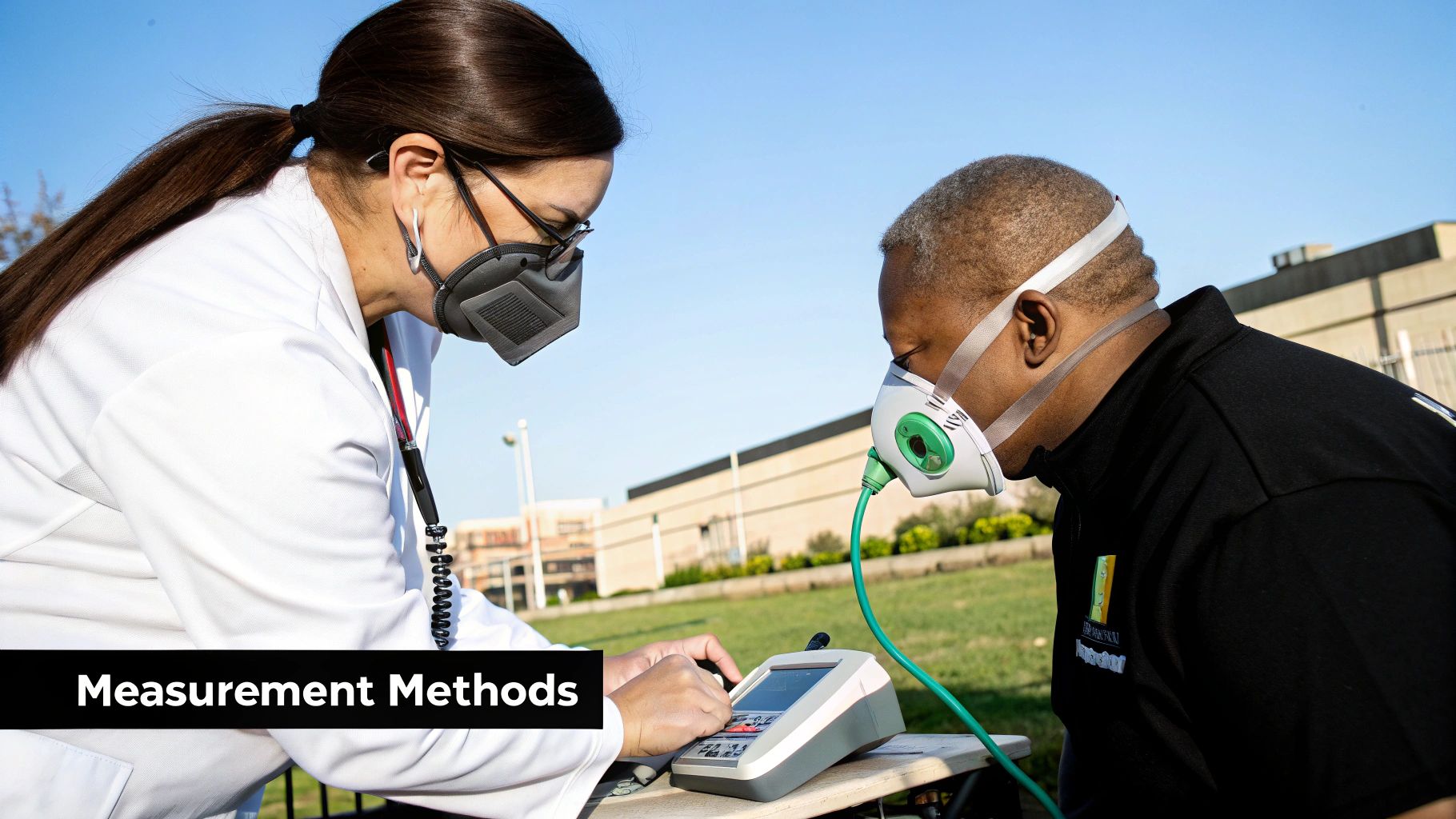
When you need the most accurate measurement of your resting metabolic rate—no guesswork, no estimates—indirect calorimetry is the answer. It's considered the scientific gold standard for a reason. It directly measures your body's unique energy expenditure, giving you a precise number to work with.
While the name sounds technical, the process is actually quite simple and completely non-invasive. At its heart, indirect calorimetry is all about analyzing your breath. A specialized machine, often called a metabolic cart, measures the exact amount of oxygen you breathe in (VO2) and the carbon dioxide you breathe out (VCO2). This gas exchange tells us exactly how many calories your body is burning in real-time while you're at rest.
What to Expect During the Test
The goal is to get you into a true resting state, so the whole experience is set up to be calm and relaxing. You’ll usually find yourself lying down in a quiet, dimly lit room. The test itself just requires you to breathe normally for a short period.
You'll likely use one of three common setups:
- A Ventilated Hood: This is a clear canopy that sits over your head and shoulders. It feels surprisingly open because air circulates freely, but it allows the machine to capture every breath you exhale.
- A Mouthpiece and Nose Clip: This classic setup involves plugging your nose with a soft clip and breathing through a sterile mouthpiece that's connected to the analyzer.
- A Face Mask: Much like the mouthpiece method, this involves wearing a soft, fitted mask over your nose and mouth to collect your breath.
The actual measurement takes about 15 to 30 minutes. Your only job is to lie still and breathe as you normally would. That short window of data is all it takes to get a crystal-clear picture of your resting metabolism.
Beyond the RMR Number: Understanding Your RER
Once the test is done, the data you get is much richer than just a single calorie number. One of the most fascinating metrics is your Respiratory Exchange Ratio (RER). This is calculated by dividing the amount of CO2 you produce by the amount of O2 you consume.
Think of your RER as a window into what your body is using for fuel. It shows whether you're primarily burning fats, carbohydrates, or a combination of both to keep your engine running at rest.
An RER value of 0.70 means your body is running almost exclusively on fat. A value of 1.0 indicates it’s burning straight carbohydrates. For most people in a rested state, the RER will fall somewhere between 0.75 and 0.85, showing a healthy mix of fuel sources.
This insight is incredibly valuable. For an athlete, it can guide nutrition timing. For someone focused on weight management, a surprisingly high RER might signal that their diet is too high in carbohydrates or that their body isn't very efficient at tapping into fat stores.
Professional-grade equipment, like the systems offered by specialists such as Cartwright Fitness, delivers this kind of detailed analysis. It transforms a simple RMR test into a powerful tool for anyone serious about optimizing their metabolic health.
Using Predictive Equations to Estimate Your RMR
While getting a lab-based RMR test (indirect calorimetry) gives you the most precise data, it’s not always practical or accessible for everyone. Let's be realistic—most of us don't have a metabolic cart in our garage.
This is where predictive equations become incredibly useful. These formulas use your basic stats—age, sex, height, and weight—to provide a solid RMR estimate without ever leaving your home. Think of them as a highly educated guess that gives you a fantastic starting point for understanding your body's baseline energy needs.
Choosing the Right Formula for You
Not all equations are built the same. Over the years, researchers have developed several, but three have really stood the test of time: the Mifflin-St Jeor, Harris-Benedict, and Katch-McArdle. Each has its place, and picking the right one comes down to who you are.
- Mifflin-St Jeor Equation: If you're looking for a reliable, all-purpose formula, this is it. It’s widely considered the gold standard for the general population and is what most modern calorie-tracking apps use by default. Its accuracy has been shown to outperform older equations for a broad range of people.
- Harris-Benedict Equation: This is one of the originals, a true pioneer in metabolic prediction. While it's been around for over a century, it has a known tendency to slightly overestimate RMR, sometimes by up to 5%. It's still a decent benchmark, but newer formulas are often more accurate.
- Katch-McArdle Equation: This one is different. Instead of total body weight, it uses your lean body mass. This makes it the go-to choice for athletes, bodybuilders, or anyone who is particularly lean. Why? Because muscle is more metabolically active than fat, and this formula accounts for that crucial difference.
For instance, if a 180-pound individual has 15% body fat, their RMR estimate from the Katch-McArdle formula will likely be more on-point than one from Mifflin-St Jeor, which treats all 180 pounds the same.
The image below gives you a glimpse into why at-home equations are so popular by showing what a clinical RMR test actually involves.
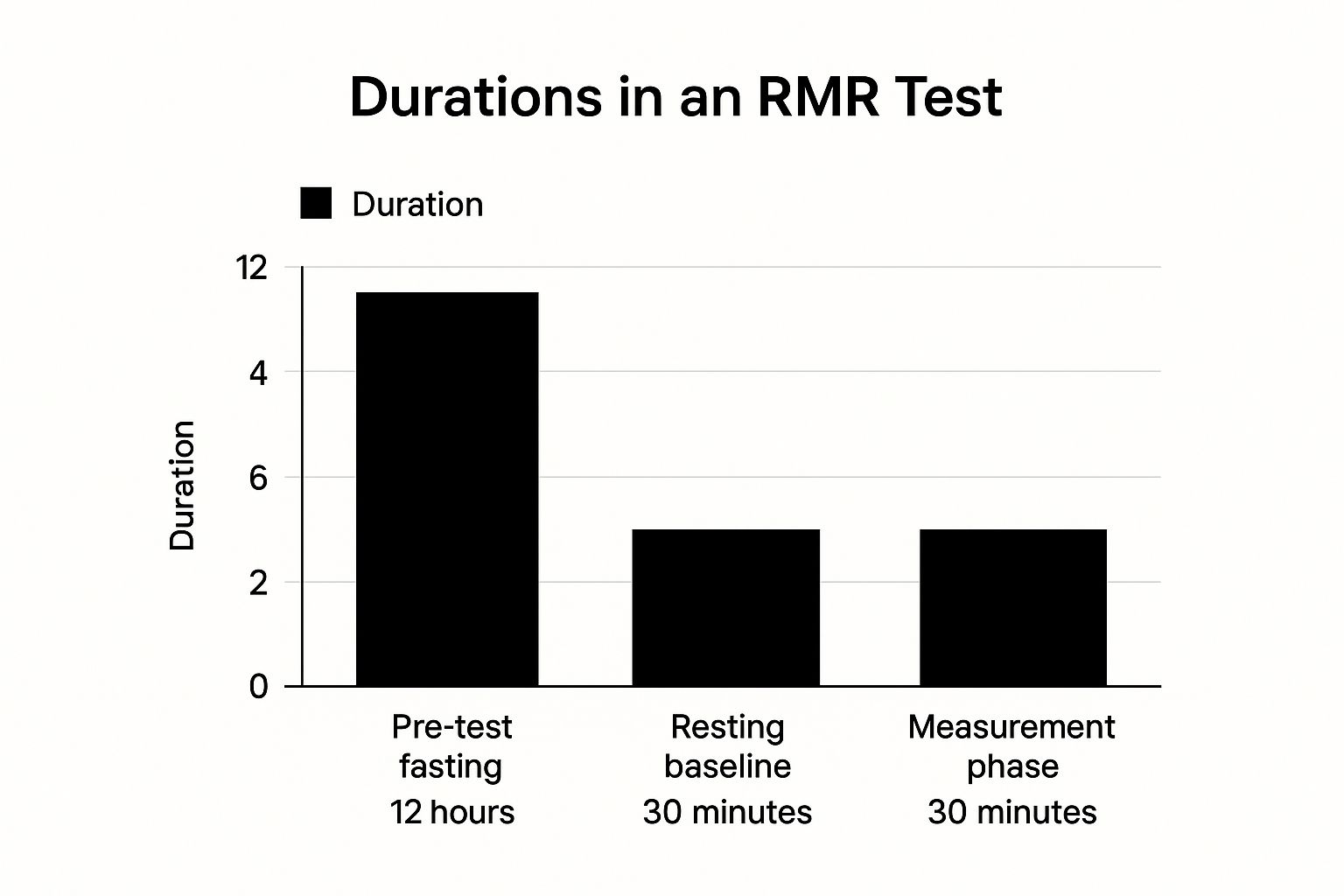
As you can see, a proper clinical test requires a lot of prep, like a 12-hour fast, before you even get to the resting and measurement phase. Equations give you a good estimate in minutes.
A Closer Look at the Top Equations
To help you decide, here's a quick comparison of these common formulas. Each one looks at your body through a slightly different lens.
Comparison of Common RMR Predictive Equations
| Equation Name | Variables Required | Best For | Key Consideration |
|---|---|---|---|
| Mifflin-St Jeor | Age, sex, height, weight | The general population; most non-athletic adults. | Considered the most accurate general-purpose equation currently available. |
| Harris-Benedict | Age, sex, height, weight | Historical reference; quick general estimation. | An older formula that often overestimates RMR by up to 5%. |
| Katch-McArdle | Lean body mass, total weight | Athletes, bodybuilders, and very lean individuals. | Requires an accurate body fat percentage measurement to calculate lean body mass. |
These formulas are your best bet for an at-home calculation. Just plug in your numbers and you have a solid baseline to work from.
The Honest Limitations of Equations
It's really important to go into this with open eyes. These formulas are powerful tools, but they are still predictions, not direct measurements. The number you get is based on population averages and might not capture your unique metabolic fingerprint perfectly.
For many people, an estimated RMR can be off by as much as 10-15% compared to a direct measurement. That could mean a difference of a few hundred calories per day—a gap that can absolutely affect your progress, whether you're trying to lose fat or gain muscle.
Predictive equations give you a starting point. An indirect calorimetry test gives you the precise answer. Use the estimate to get going, but consider a measured test if you need absolute accuracy.
This isn't just theory; research backs it up. One study on overweight adults found that while the average difference between estimated and measured RMR was small, the variances for individuals were significant. This is especially true for older adults or those with unique metabolic situations, where equations tend to be less precise. You can read the full research about these metabolic findings for a deeper dive.
Ultimately, using an equation is a fantastic and accessible way to start learning about your energy needs. It empowers you to make smarter choices about your diet and activity. But for competitive athletes, individuals with metabolic conditions, or anyone who demands the highest level of precision, a clinical test is still the best path forward.
Turning Your RMR Number Into Actionable Insights

Alright, so you've got your Resting Metabolic Rate. Great. But that number on its own is just an interesting piece of trivia. Its real power comes from what you do with it next. Think of your RMR as the calories your body burns just to keep the lights on—it doesn't factor in walking the dog, typing at your desk, or hitting the gym.
To get a truly useful figure, we need to convert your RMR into your Total Daily Energy Expenditure (TDEE). This is done by multiplying your RMR by an activity factor that reflects your unique lifestyle. This simple step transforms your baseline metabolic rate into a practical estimate of how many calories you actually burn in a 24-hour period.
From RMR to TDEE: A Practical Example
Let’s put this into a real-world context. Imagine your RMR measurement came back at 1,600 calories. You work a desk job but manage to get in some light exercise 1-3 times per week. For this lifestyle, a common activity multiplier is 1.375.
Here’s the math:
1,600 (RMR) x 1.375 (Activity Factor) = 2,200 calories per day.
That 2,200 calories is your magic number—your "maintenance" level. Eating around this amount should, in theory, keep your weight stable. This is the new, more accurate baseline you can use to plan for weight loss (by creating a calorie deficit) or muscle gain (by aiming for a calorie surplus). Understanding this number is foundational for any serious fitness plan, like the ones discussed in this guide to nutrition for strength training.
Adapting to a Changing Metabolism
Here's something crucial to remember: your metabolism isn't set in stone. It’s a dynamic system that responds to changes in your body and habits. You can't just measure your RMR once and assume it’s good for life.
Several key things will shift your metabolic rate over time:
- Building Muscle: This is the big one. Lean muscle is metabolically active tissue. The more you build, the more calories your body burns around the clock, even when you're just sitting on the couch.
- Major Weight Loss: If you lose a significant amount of weight, your RMR will drop. It’s simple physics—your body has less mass to sustain, so it requires less energy.
- Getting Older: Metabolism naturally tends to slow as we age. This is often tied to a gradual, age-related loss of muscle mass (sarcopenia).
Your RMR is a live number that reflects your current physiological state. Think of it less as a permanent tattoo and more as a real-time dashboard readout for your body's engine.
Interestingly, it's not just our individual metabolisms that change. Long-term studies have shown that the average Basal Metabolic Rate (BMR), a close cousin of RMR, has actually decreased over the past century by about 81 kilocalories per day, even after accounting for body mass and age. This trend is likely linked to our increasingly sedentary modern lives and underscores why relying on generic estimates can be so misleading.
By recognizing that your RMR will evolve, you can stay ahead of the curve, adjusting your nutrition and training strategies as your body changes. This is how a single measurement becomes a powerful, lifelong tool for managing your health.
Got Questions About RMR Testing? Let's Clear Things Up.
As you dig into the science of measuring your metabolism, you're bound to have some questions. It's a complex topic, after all. Let's tackle some of the most common things people ask, so you can feel confident about what these numbers really mean for you.
One of the biggest points of confusion I see is the difference between RMR (Resting Metabolic Rate) and BMR (Basal Metabolic Rate). People often use them interchangeably, but they're not quite the same thing.
Think of BMR as a strict, lab-grade measurement. It's your body's absolute minimum energy requirement, taken under tightly controlled conditions—usually after a full night's sleep and a 12-hour fast. RMR is more practical for real-world application. It's measured while you're rested, but not necessarily in that perfect "basal" state. This makes it a slightly higher, more realistic snapshot of your daily resting energy burn.
How Often Should I Get My RMR Retested?
Your RMR isn't set in stone. It's a dynamic number that fluctuates as your body changes, which is why periodic re-testing is so valuable. It helps ensure your nutrition and training plans are always dialed in to your current metabolic reality.
So, when should you book a follow-up test? I usually recommend it when you hit a significant milestone or change.
- You've had a major weight change. If you've lost or gained 10% or more of your body weight, your RMR has definitely shifted.
- Your body composition is different. Maybe you've dedicated the last six months to serious strength training and have packed on noticeable muscle. That new tissue burns more calories at rest, and your RMR will reflect that.
- You've hit a frustrating plateau. When your progress grinds to a halt for weeks on end, getting a fresh RMR measurement can be the key to figuring out what adjustments you need to make.
As a general guideline, re-evaluating every 6 to 12 months is a solid plan. Or, simply schedule one whenever you've made a big change to your body or your fitness routine.
Can I Just Use My Smartwatch to Get My RMR?
It's a fair question. We rely on our wearables for so much data, from steps to sleep. But when it comes to measuring your resting metabolic rate, your smartwatch or fitness tracker just isn't up to the task.
These gadgets don't measure your RMR; they estimate it. They use predictive equations that factor in your heart rate, movement, and the personal data you entered (age, weight, height). The accuracy can be all over the place.
A clinical RMR test using indirect calorimetry is a different beast entirely. It directly measures the oxygen you consume and the carbon dioxide you produce. This isn't an algorithm—it's a direct, physical measurement of your metabolic processes at work, making it vastly more accurate than any wearable's guess.
If you're serious about getting a precise number for your unique metabolism, a clinical-grade test is truly the only reliable path.
At Cartwright Fitness, we specialize in providing the high-precision equipment necessary for accurate metabolic analysis. Our validated systems, including professional-grade Cosmed metabolic analysers, are trusted by clinics and sports scientists worldwide. Discover our range of testing solutions.