

The most common advice on how to calculate metabolic rate is also the least useful: plug a client into one formula, trust the result, and move on. In practice, equation choice changes the answer enough to matter, especially when the client is older, carries a lot of lean mass, lives with obesity, or trains hard enough that a generic activity multiplier starts to drift away from reality. The skill is not doing the arithmetic, it's deciding whether a prediction equation is defensible or whether measured resting metabolic rate is the better tool.
Table of Contents
- Why Most Metabolic Rate Estimates Are Wrong
- Understanding BMR RMR and Total Energy Expenditure
- Choosing the Right Prediction Equation for Your Client
- Performing Indirect Calorimetry in Practice
- Applying Metabolic Rate Data to Training and Nutrition Plans
- Common Pitfalls and Best Practices for Professionals
Why Most Metabolic Rate Estimates Are Wrong
The biggest mistake is treating Mifflin-St Jeor like a universal answer. It's widely used and often treated as the default, but the actual question is whether the person in front of you resembles the population the equation was meant to approximate. A calculator can still produce a number when the fit is poor. That does not make the number useful.
Equation fit matters more than convenience
Older adults, athletes with high lean mass, and people with obesity can all sit outside the comfortable middle of equation-based estimation. In those cases, the issue is not broken arithmetic. The model is being asked to infer metabolic rate from variables that do not fully capture the client's physiology. The Medscape calculator reference on the Mifflin-St Jeor equation is useful here because it reflects the broader reality that multiple formulas circulate, but it also highlights a common gap in mainstream coverage, the lack of a clean decision rule for who should get which equation.
Practical rule: if the client's body composition or training status is unusual, a single weight-height-age equation deserves less trust.
That matters because even a modest prediction miss can derail a nutrition plan. A client who is being told to eat at a precise deficit can end up underfed, stalled, or discouraged if the estimate is built on the wrong assumption about resting needs. The same problem shows up in sports settings, where a small error can push the athlete into low energy availability or leave recovery under-supported. For teams that want a broader starting point before testing, a practical BMR guide from Cartwright Fitness can help frame the basics, while still leaving room for judgment about whether the equation is appropriate at all.
The better question is what level of error this decision can tolerate
For a general wellness client, a reasonable estimate may be enough to start. For occupational health, clinical physiology, or sports science, the bar is higher, because the number has to stand up to scrutiny and explain a real-world plan. That is why prediction error matters more than the elegance of the equation itself, and why direct measurement becomes worth the investment when the estimate is likely to mislead.
A lot of public content stops at listing formulas. That misses the actual practitioner problem, which is choosing between approximation and measurement. If the client is stable and typical, a calculator may be fine. If the client is not typical, the right move is often to stop asking the formula to do a job it was not built to do.
Even small context details can shift the interpretation. Recent illness, aggressive dieting, heavy training blocks, and poor sleep can all pull resting needs away from what a simple equation predicts, so the decision is rarely just about plugging in age, weight, and height. In practice, the skill lies in deciding whether a prediction equation is defensible or whether measured resting metabolic rate is the better tool. For clients whose intake strategy also needs caffeine guidance, the timing and dose questions belong in a separate conversation, and the safe caffeine dosing tips piece is a better fit than trying to squeeze stimulant advice into the metabolic rate estimate itself.
Understanding BMR RMR and Total Energy Expenditure
Before you calculate anything, define the target. Basal metabolic rate, or BMR, resting metabolic rate, or RMR, and total daily energy expenditure, or TEE, are related, but they are not interchangeable in practice. Confusing them is one of the fastest ways to overstate precision.
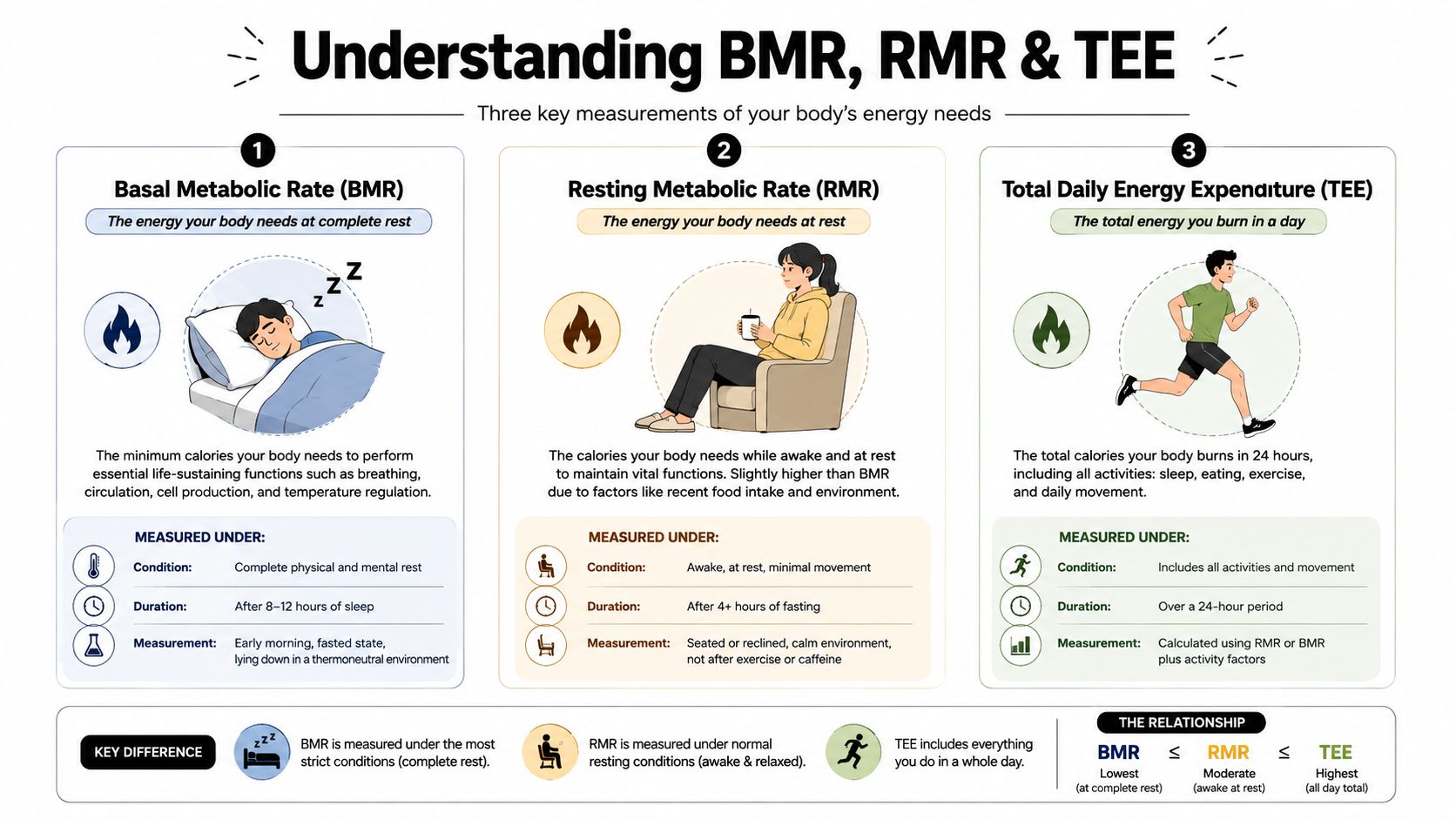
BMR is the strict lab concept
BMR is the most controlled of the three. It assumes a tightly standardised environment, extended fasting, sleep, and complete rest. That makes it useful as a physiological concept, but it's rarely the number practitioners can collect outside a lab. For most field settings, BMR is more theoretical than operational.
RMR is the more practical measure. It's collected under less restrictive conditions, so it's better suited to clinics, performance centres, and testing environments where a client can lie down and breathe through a metabolic system without the burden of strict basal conditions. The practical difference matters because those who say they want to “calculate metabolism” need a defensible RMR estimate or a measured resting value.
TEE is where the programming decisions happen
TEE layers activity on top of resting needs. That's the number that eventually shapes body-composition targets, fueling strategies, and performance plans. It also becomes the messiest estimate in the chain, because activity is the least stable part of a person's day. Two clients with the same resting value can finish the day with very different totals depending on job demands, training load, and incidental movement.
RMR is the anchor. TEE is the working estimate that changes when the day changes.
The distinction matters when clients ask for a calorie target. A rehab patient, a sedentary office worker, and an endurance athlete all need different levels of confidence in the number. For a client who wants a simple starting point, the calculator may only need to estimate resting needs before activity is layered on. For a client with unstable energy expenditure, the estimate needs to be revisited more often, because the usual multiplier approach can start lying by omission.
The language you use with clients matters too. I'll often say that BMR is the “under ideal conditions” number, RMR is the “realistic resting number,” and TEE is the “whole-day total.” That keeps the discussion grounded and stops clients from assuming the first output is the final answer. For a basic consumer-style walkthrough, the internal guide on how to calculate BMR can sit beside this more clinical framing, but it shouldn't replace it.
For clients who also ask about stimulants or pre-workout routines, a separate resource on safe caffeine dosing tips can help keep the metabolism conversation tied to practical preparation, not mythology.
Choosing the Right Prediction Equation for Your Client
The right equation depends on who you're assessing, what inputs you have, and how much error you can tolerate. That's the core decision point most guides skip. The formula itself is only half the job, because the match between model and client drives whether the estimate is close enough to use.
A practical selection framework
Start with the simplest question. If the client is broadly typical, stable, and you only have age, sex, height, and weight, Mifflin-St Jeor is usually the first place practitioners go. If you're comparing older literature or need a historical reference point, Harris-Benedict and its revised form are still useful for context. If the client is an athlete and you have fat-free mass data, Cunningham becomes more attractive because it leans into the variable that often matters most in that group, lean tissue.
Decision rule: use the least complicated equation that still matches the client's physiology.
That said, each equation has a trade-off. Weight-based models are convenient, but convenience isn't the same as accuracy. Fat-free-mass-based models can improve relevance in athletic populations, but they also add complexity because the quality of the body-composition input becomes part of the error chain. If the body-composition method is weak, the “better” equation may not help much.
Metabolic Rate Prediction Equations Compared
| Equation | Best For | Required Inputs | Key Limitation |
|---|---|---|---|
| Mifflin-St Jeor | General adult clients, everyday practice | Age, sex, height, weight | Less convincing when body composition or physiology is non-standard |
| Harris-Benedict | Historical comparison, legacy protocols | Age, sex, height, weight | Still an approximation, not a substitute for measurement |
| Revised Harris-Benedict | Users working from updated legacy workflows | Age, sex, height, weight | Same broad limitation, equation choice can still miss special populations |
| Cunningham | Athletes or clients with reliable fat-free mass data | Fat-free mass | Depends on the quality of the fat-free-mass measurement |
Where the equations break down
Older adults often present a mismatch between body size and metabolic need that simple calculators don't fully capture. Athletes with high lean mass are another common problem, because total weight alone can understate the energy cost of maintaining and supporting that tissue. People with obesity can also fall outside the centre of validation, which means two clients with similar scale weight may not deserve the same equation choice if their tissue composition differs.
The most useful habit is to ask three things before picking a formula. What population was this equation built for, what inputs do I trust, and do I need an approximation or a more defensible measurement? If the answer to the third question is “defensible,” that's when you move toward indirect calorimetry instead of trying to force certainty out of a calculator.
A decent rule of thumb is simple. Use prediction equations when you need a fast, approximate resting estimate. Use measured RMR when the client is atypical, when the plan is high stakes, or when you need to justify the number in a clinical or performance setting.
Performing Indirect Calorimetry in Practice
When prediction equations stop being good enough, indirect calorimetry gives you a measured resting value through gas analysis. That's the method most professionals mean when they talk about “testing metabolism,” and it's the right choice when you need something more defensible than a formula.
Set up the test properly
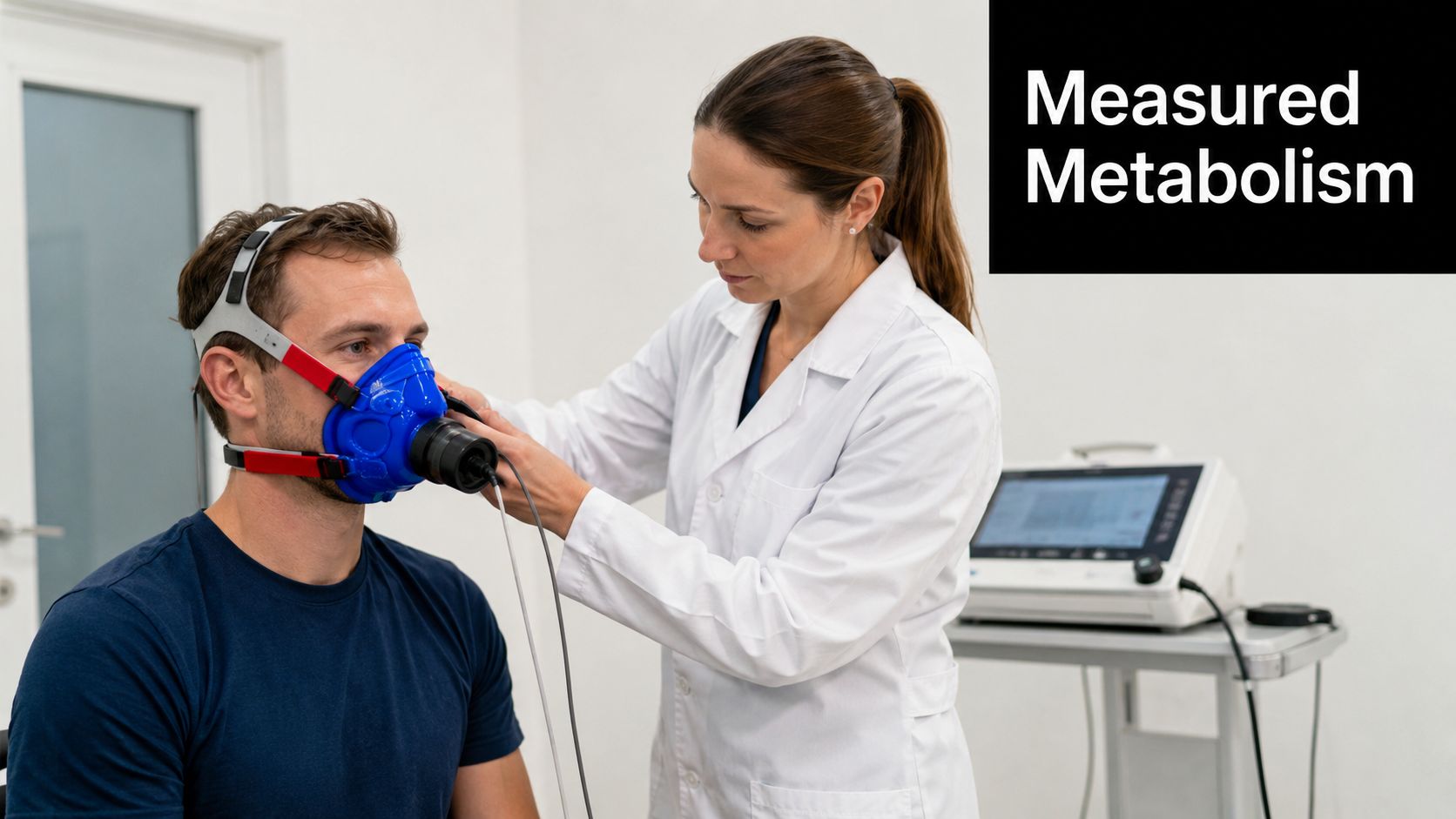
Client preparation matters before the analyser ever starts recording. The person should arrive fasted, rested, and free from recent exercise, because both feeding and activity can distort the reading. Caffeine and nicotine are also common confounders, which is why pre-test instructions need to be explicit rather than implied. If you want a practical preparation checklist, Cartwright Fitness has a clear overview of what indirect calorimetry involves, including the kind of setup practitioners should expect in a real testing environment.
The room should be quiet, thermally stable, and free from interruptions. Calibration is essential, and the device choice matters too. Systems like Cosmed metabolic analysers are widely used in professional settings because they're built for this kind of work, but the operator still has to select the right interface, usually a mask or canopy, based on the client and the testing context.
The reading has to settle before it counts
A useful test is not just a reading, it's a stable reading. The client needs time to acclimatise to the environment and the apparatus, especially if a mask is used. Operators who rush that phase tend to collect noisy data, then pretend the output is stronger than it really is. That's the mistake I see most often in under-supervised settings, the analyser is trusted more than the protocol.
If the client is fidgeting, talking, or still adjusting to the mask, the number is premature.
Mask versus canopy selection should follow the testing goal and the client's tolerance. A mask is often more practical in active or mixed-use environments, while a canopy may suit a more controlled resting assessment. Either way, the job is the same, capture a steady-state sample that reflects resting physiology rather than the stress of being tested.
The reading quality comes from the protocol, not just the device. If the client ate too recently, had caffeine too recently, exercised beforehand, or spent too little time settling, the result loses credibility. That's why indirect calorimetry works best when the testing centre treats it like a clinical procedure, not a quick add-on.
For practitioners building a workflow around metabolic testing, the difference between “owning a analyser” and “running a valid test” is huge. Equipment matters, but so does the discipline around setup, timing, and interpretation.
Applying Metabolic Rate Data to Training and Nutrition Plans
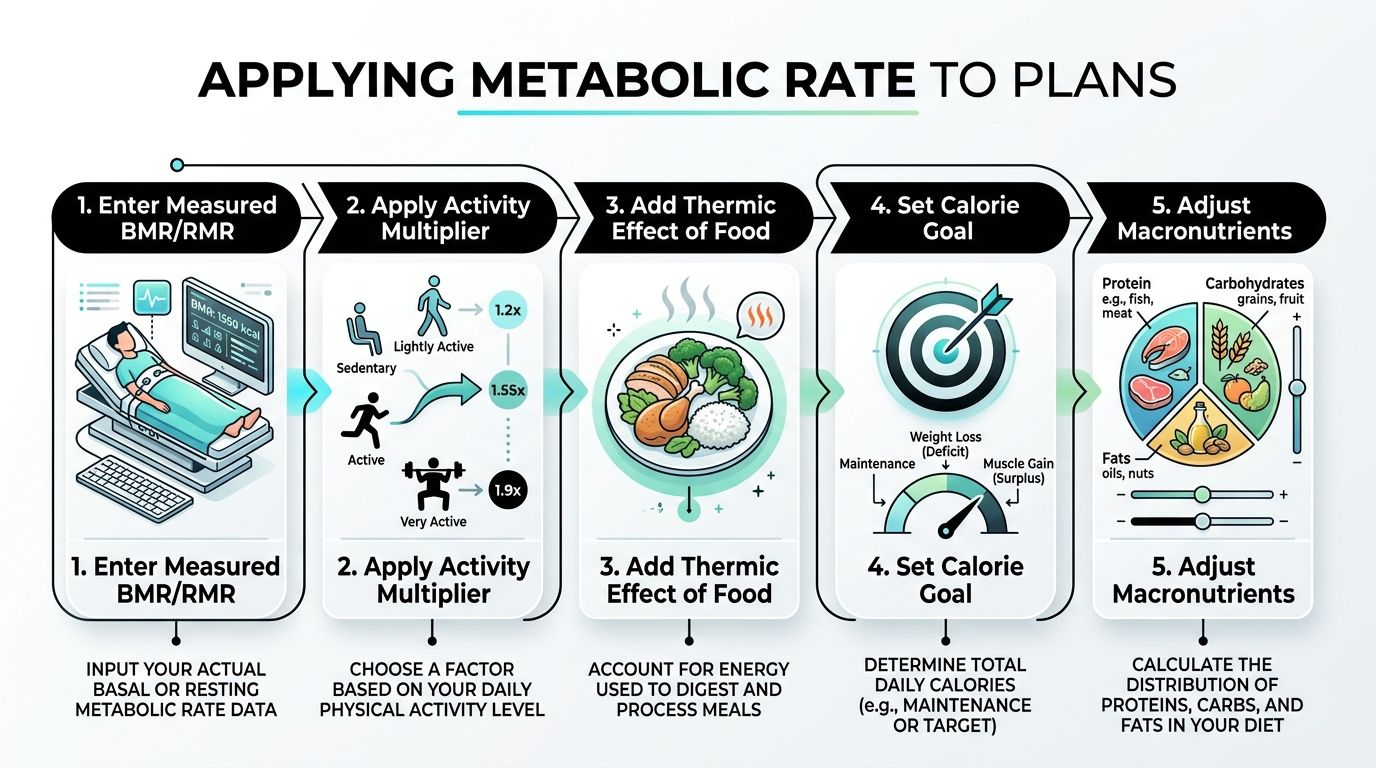
A metabolic rate number only matters when it changes what you prescribe. If the output sits in a file and never shapes calories, training load, or review timing, it's just an expensive label. The practical value comes from turning a resting number into a day plan the client can follow.
From resting number to total intake
The usual workflow starts with RMR or an estimated basal value, then adds activity. That's the part most consumer calculators compress into a single multiplier, but the multiplier only works if the activity classification is honest. A recreational endurance athlete, for example, can't be treated like a sedentary desk worker with a gym habit, because the structured training and incidental movement profile are different enough to shift total needs.
A post-menopausal client with changing body composition is a different case again. The estimate may still start with a calculator, but the reassessment interval should be shorter if body composition, appetite, sleep, or training tolerance is changing. Rapid weight loss can create the same problem, because the equation that was reasonable a few weeks ago may no longer reflect the client's current state.
Three client scenarios
A recreational endurance athlete usually needs a tighter eye on training-day variation than a standard multiplier gives you. The base number can still be useful, but it should be treated as a starting point, not a ceiling. A sedentary office worker pursuing fat loss often benefits from a more conservative activity assumption, because overestimating daily movement is an easy way to overshoot intake. A post-menopausal client may need more frequent review if recent body composition change, illness recovery, or altered recovery capacity is affecting energy expenditure and appetite.
The video below is a useful visual companion for translating the number into a working plan.
Adjustments have to track the client, not the template
Thermic effect of food, non-exercise activity, and training load all introduce noise into a fixed multiplier approach. That's why a rigid BMR times activity factor workflow gets shaky in people with high training loads, illness recovery, or recent muscle gain. If those conditions are present, the estimate should be revisited sooner and the client's response should drive the next adjustment.
The most useful nutrition target is the one the client can sustain while still performing and recovering well. If body weight is moving in the wrong direction, training quality is falling, or fatigue is climbing, the first move is to question the estimate rather than blame the client for “not following the plan.”
For practitioners who want to organise that information cleanly, the internal guide on metabolic data analysis fits naturally with this step, because the calculation is only the start of the interpretation process. A patient-facing companion piece from Pause Medical's guide to metabolic rate can also help bridge the gap between physiology and day-to-day behavior without overselling what metabolism can do.
Common Pitfalls and Best Practices for Professionals
The biggest mistakes are usually not technical. They're procedural. People use the wrong input, trust a stale estimate, or overstate how much confidence a calculator deserves. Those errors are avoidable if you build the assessment around the client's actual physiology instead of the template.
The mistakes that keep showing up
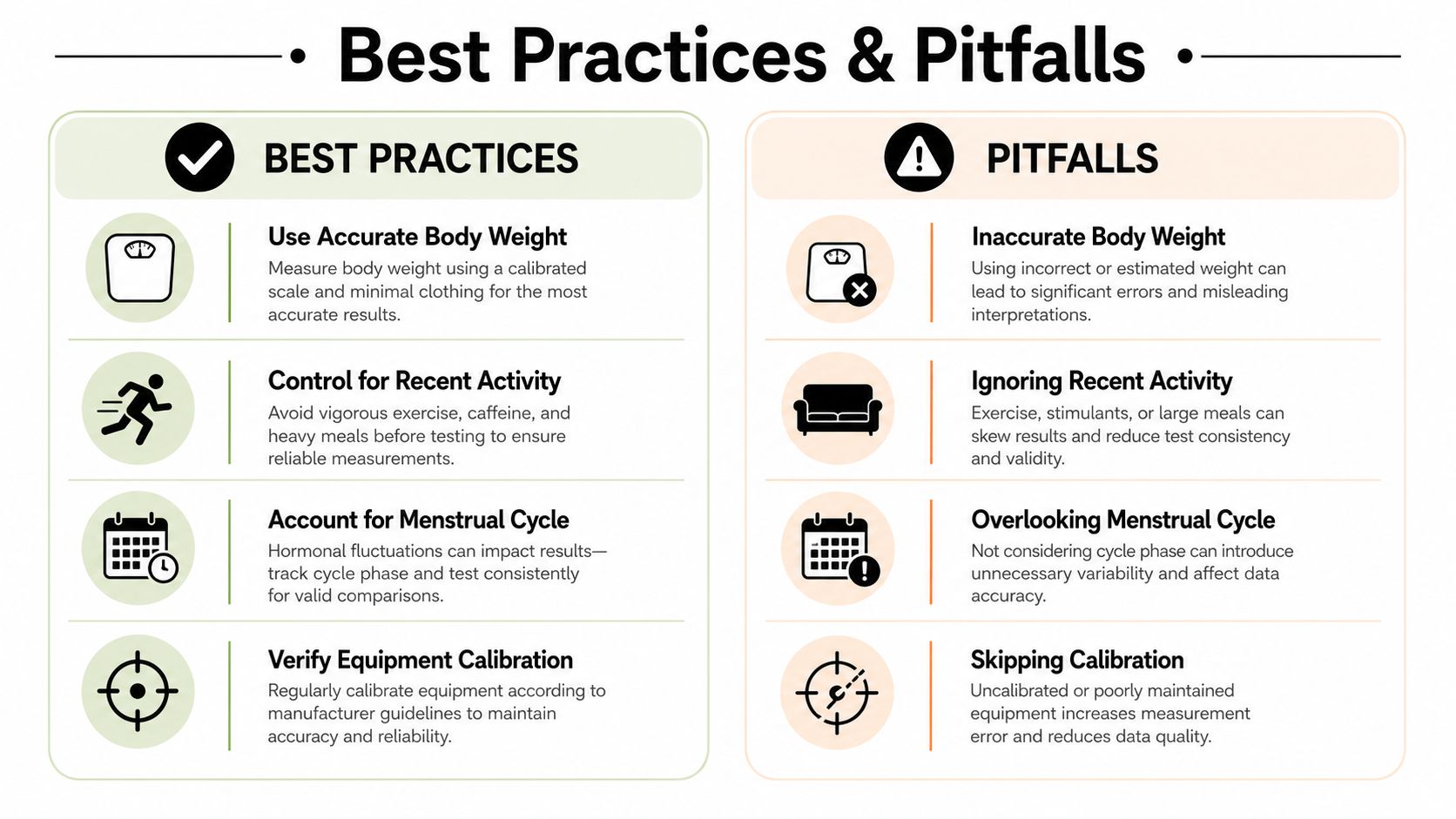
Using total body weight in a situation that really calls for fat-free mass is a classic problem. So is misclassifying activity because the client “goes to the gym” and therefore must be moderately active. Training frequency tells you very little if the rest of the day is sedentary.
Another common error is failing to reassess after meaningful physiological change. A client who has lost weight, gained muscle, recovered from illness, or changed training load deserves a fresh look. Old numbers are convenient, but convenience can turn into poor programming.
- Use accurate body weight: Make sure the input reflects the current client, not last month's intake sheet.
- Control for recent activity: Recent exercise can distort resting estimates if you don't manage the pre-test window.
- Account for menstrual cycle: For clients where cycle-related variation matters, note the timing rather than assuming every reading is equivalent.
- Verify equipment calibration: A metabolic analyser that isn't calibrated properly can't produce a defensible number.
What good practice looks like
If you're buying equipment, look for validated metabolic analysers and body composition tools that fit the population you serve. In a performance setting, that may mean a system capable of consistent indirect calorimetry alongside reliable tissue assessment tools such as ultrasound-based body composition systems. In a clinic, it may mean prioritising repeatability, support, and workflow stability over bells and whistles.
A clean protocol beats a fancy device with sloppy handling.
The best practitioners also keep a short decision log. Which equation was used, why it was chosen, whether the client fit the validation population, and whether the result should be revisited. That record makes the number easier to defend later, and it stops the team from treating every estimate as equally trustworthy.
If the client is standard, stable, and low-risk, a well-chosen equation is usually enough. If the client is not standard, or if the number will drive a high-stakes plan, measured RMR is the stronger choice. The goal isn't to collect more data for its own sake. It's to give the client a number that supports better decisions.
Cartwright Fitness works with health and performance professionals who need validated testing equipment rather than guesswork, including tools for resting metabolic rate assessment, body composition, and related protocols. If you're building a more defensible assessment workflow, visit Cartwright Fitness and review the equipment and support options that fit your testing environment.