

Most coaches ask for the highest vertical jump record as if one number settles the conversation. It doesn't. The moment you ask how the jump was performed, what device measured it, and who verified it, the record changes category.
That's the useful surprise. The biggest problem in vertical jump testing isn't that athletes can't jump high. It's that practitioners often compare unlike results and treat them as equivalent. A standing test, a running-start leap, and a hardware-specific “max vertical” score can all produce very different numbers even when the athlete is the same. If you work in performance, rehab, or research, that distinction matters more than the headline.
For context, athletes and coaches who want normative context can compare tested results against broader performance ranges in this guide to average vertical jump standards. But records sit at the extreme edge, and extreme results demand tighter scrutiny, not looser interpretation.
Table of Contents
- The Myth of a Single Jump Record
- Deconstructing the Official Vertical Jump Records
- The Science of Accurate Jump Measurement
- Beyond the Numbers Profiles of Elite Jumpers
- Claims Controversies and Measurement Errors
- Applying Jump Analytics Your Testing Protocol
The Myth of a Single Jump Record
The phrase highest vertical jump record sounds clean, but in practice it hides multiple events under one label. Coaches hear one big number online, then try to compare it against a countermovement jump in the gym or a Vertec test at pre-season screening. That's where the confusion starts.
A standing vertical jump and a running-approach vertical jump are not just variations of the same task. They reward different mechanics. One isolates explosive output from a mostly static setup. The other lets the athlete convert approach speed, timing, stiffness, and arm action into extra elevation.
That difference changes what the result means for training.
Practical rule: If two jump scores come from different protocols, they are different tests first and performance numbers second.
The issue isn't academic. It affects athlete profiling, return-to-play decisions, recruitment benchmarks, and how coaches talk about “elite” power. If a football player posts a standing jump score and a dunk specialist posts a running-start leap, comparing the raw heights without context tells you very little.
Two records that shouldn't be merged
Some records come from organized standardized testing. Others come from running-start record attempts. Still others come from brand-led events that use their own equipment and scoring conventions. All of those can be legitimate within their own rules. None should be collapsed into one universal record.
For practitioners, the first question isn't “what's the biggest number?” It's “what was the protocol?” Once you ask that, the record discussion becomes much clearer and much more useful.
Deconstructing the Official Vertical Jump Records
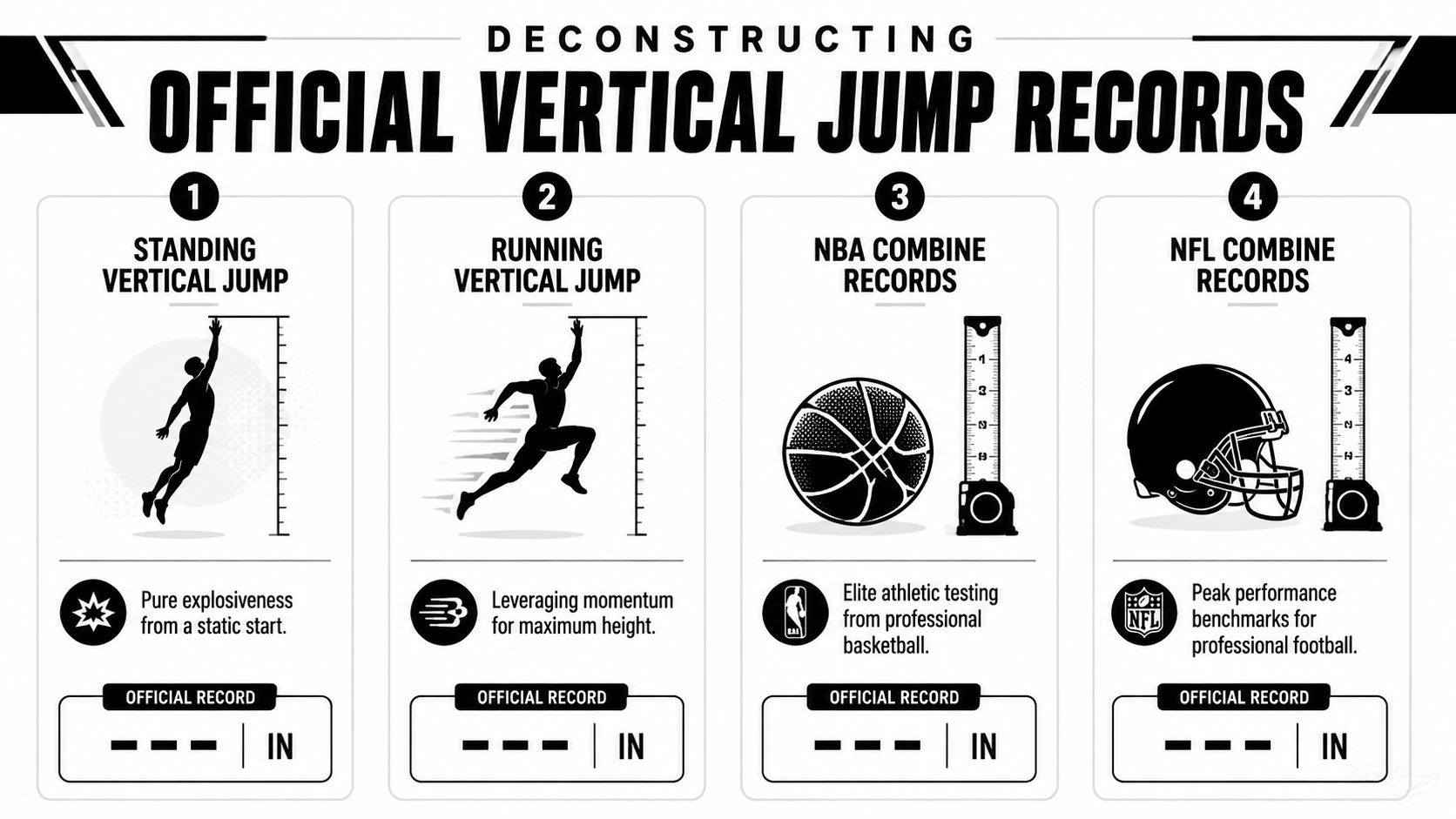
The cleanest way to discuss the highest vertical jump record is to separate the categories immediately.
Two records that shouldn't be merged
The most widely cited officially recorded highest vertical jump in an organized testing environment is 47.1 inches (119.6 cm) by Josh Imatorbhebhe at the 2015 Nike Football Rating Championships, as documented in this review of the highest standardized vertical jump benchmark.
The current Guinness World Record for highest vertical leap with a running start is 1.27 m (4 ft 1.92 in), achieved by Darius Clark in Salt Lake City on 28 June 2022. Guinness also states he reached 50 inches during the attempt, which is recorded on the Guinness running-start vertical leap page.
Those two marks are both meaningful. They just don't describe the same event.
Official Vertical Jump Record Comparison
| Record Category | Athlete | Jump Height | Verification Body/Event |
|---|---|---|---|
| Organized standardized testing environment | Josh Imatorbhebhe | 47.1 inches (119.6 cm) | 2015 Nike Football Rating Championships |
| Running-start vertical leap | Darius Clark | 1.27 m (4 ft 1.92 in), with Guinness also stating 50 inches during the attempt | Guinness World Records |
Why the higher number isn't automatically the better comparison
A running jump usually produces a different ceiling because the athlete can use an approach. That introduces horizontal momentum, different timing demands, and a larger contribution from elastic qualities and arm swing. In practical coaching terms, you're no longer isolating pure vertical projection from a near-static start.
That's why a standing jump score is usually more useful for routine monitoring in team sport settings. It's easier to standardize, easier to repeat, and less affected by runway length, foot placement, and approach rhythm. A running jump can still be valuable, especially in basketball or volleyball, but it belongs to a different decision-making lane.
When a coach asks whether an athlete's jump is “record level,” the answer depends on whether you mean combine-style testing or approach-based leap performance.
For this reason, I'm cautious with any facility leaderboard that mixes standing countermovement jumps, approach jumps, and device-generated “max vertical” outputs in the same ranking. It creates noise, not insight. If the aim is comparability, separate the tests, label the protocol, and record the device used every time.
The Science of Accurate Jump Measurement
Measurement technology determines what you think you know about an athlete. In jump testing, that's not a small technicality. It's the difference between a number that can drive programming and a number that only looks impressive.
Practitioners who want a broader overview of tools and testing options can use this guide to measuring vertical leap in professional settings.
What each device is actually measuring
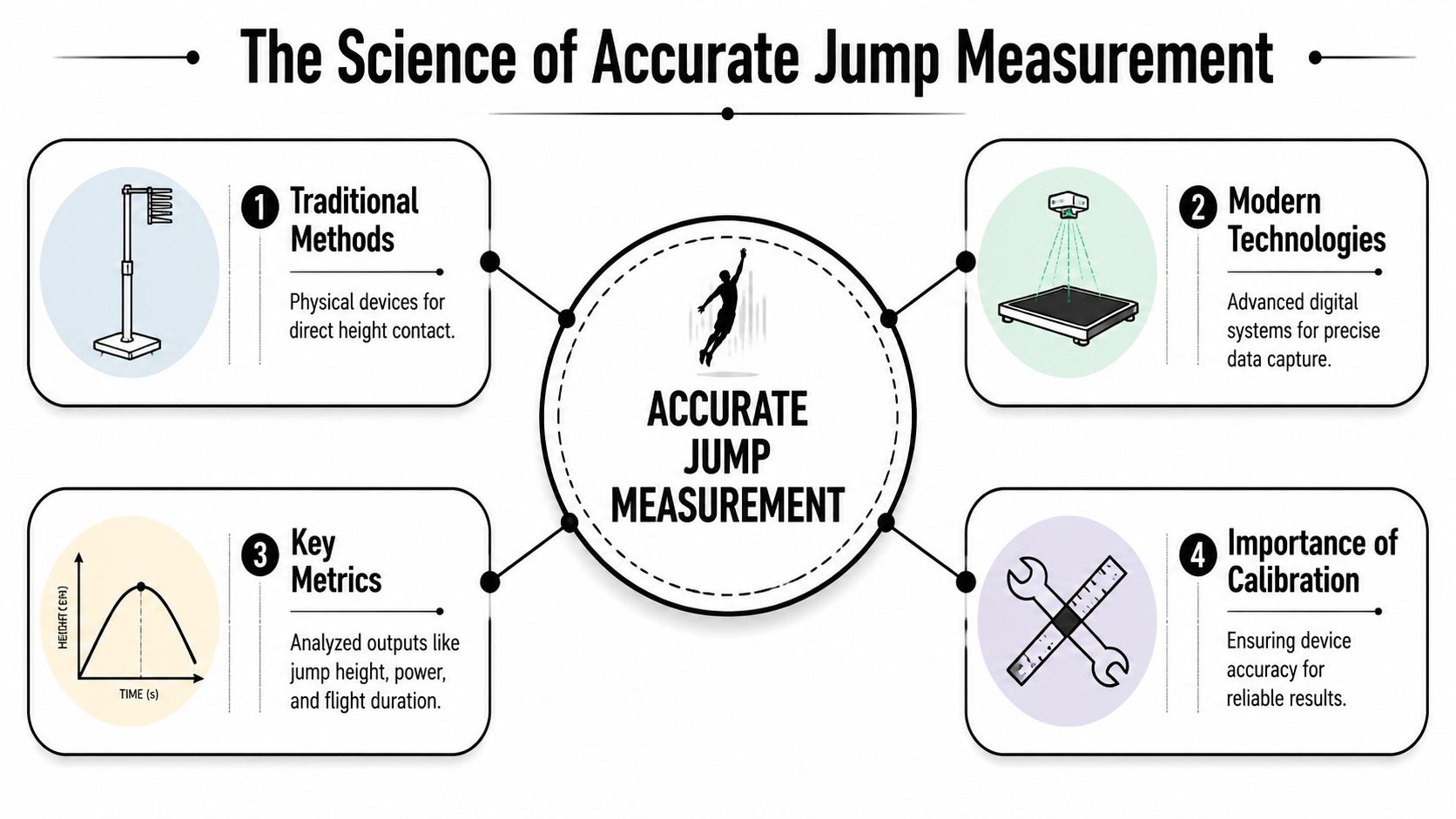
A Vertec or similar vane system measures a contact outcome. The athlete displaces vanes at the top of the jump, and jump height is derived from standing reach and highest touch. The strength of this method is ecological relevance for sports that involve reaching. The weakness is that shoulder mobility, reach technique, and touch timing can influence the result.
A jump mat usually estimates jump height from flight time. That makes setup relatively simple, but the calculation depends on assumptions about take-off and landing posture. If the athlete leaves the floor one way and lands another, the output can shift without a true change in propulsion.
A force plate measures ground reaction force across the movement. That gives you far more than a jump-height number. It lets you examine impulse, phase structure, and movement strategy. In a research or high-performance environment, that extra context often matters more than the headline jump itself.
Later in the session, visual demonstration helps more than description alone.
Where testing errors usually creep in
Errors rarely come from one dramatic mistake. They come from small inconsistencies repeated across a squad.
- Reach height drift. If one tester records standing reach aggressively and another does it conservatively, vane-based scores stop being comparable.
- Arm swing changes. A no-arm countermovement jump and a free-arm jump are different tests.
- Depth variation. If athletes self-select countermovement depth without instruction, you may be measuring strategy changes rather than capacity.
- Landing manipulation. On flight-time systems, athletes can alter posture and change the reported output.
- Warm-up inconsistency. Underprepared athletes don't just jump lower. They often jump less consistently.
What to standardize before the first jump
A useful protocol doesn't need to be complicated, but it does need to be fixed.
Testing note: Standardize the athlete, the device, the instructions, the environment, and the scoring rule. If one of those changes, log it.
I'd lock down these variables before any formal testing block:
- Jump type. Standing static jump, countermovement jump, squat jump, or running approach.
- Arm action rule. Hands on hips, restricted arm use, or free arm swing.
- Measurement device. Vertec, mat, force plate, or another validated system.
- Trial criteria. What counts as valid, what counts as a fault, and how many attempts are allowed.
- Recorded output. Best trial, mean of valid trials, or another pre-set rule.
That's also where one practical equipment supplier can fit into the workflow. Cartwright Fitness offers vertical leap test equipment alongside other testing tools, which is relevant when a facility wants to build a more standardized assessment setup rather than relying on ad hoc gym-floor methods.
Beyond the Numbers Profiles of Elite Jumpers
Numbers matter, but a record only becomes meaningful when you understand what kind of athlete produced it and under what conditions.

Darius Clark and the value of validated spectacle
Darius Clark's place in this conversation matters because his jump sits in a validated public record category, not just in social circulation. The Guinness listing gives the running-start mark a formal frame, and that frame is what makes the result useful to practitioners. It tells you the event type, the record type, and the verification standard.
That's an important distinction in a performance culture that often treats clips as proof. A spectacular leap on video can inspire athletes. It doesn't automatically create a benchmark you can compare against your testing database.
Why great leapers matter beyond the test result
Elite jumpers don't just produce tall numbers. They show what a powerful lower-body system looks like when timing, stiffness, and force application align under pressure. In applied sport, that shows up differently depending on the game.
A football athlete may express it in first-step explosiveness and contested play. A basketball player may express it in rebounds, shot contests, and finishing above the rim. A volleyball player may express it repeatedly over the course of a match, where reactive ability and fatigue resistance matter as much as the peak effort.
That's why I don't treat the highest vertical jump record as a training target in itself for most athletes. Records are useful reference points. Athlete development still depends on transfer. The jump has to mean something in the sport.
A record tells you what's possible at the edge. Testing tells you what your athlete can repeat, express, and improve.
When coaches profile elite leapers well, they don't just ask how high the athlete went. They ask what motor qualities supported it, what testing category captured it, and whether those qualities match the demands of the sport in front of them.
Claims Controversies and Measurement Errors
The current record situation is fragmented enough that coaches need a filter, not more hype. That's especially true when a social clip, a branded event, and a formal record body all use the word “record” differently.
Why promotional records create confusion
Recent promotional claims, such as a 51-inch max vertical jump by Darius Clark on the Vert Trainer in 2025, have highlighted the gap between marketing-driven numbers and formally validated records, as described in Dunk Camp's report on the Vert Trainer max vertical claim.
That doesn't mean the effort wasn't impressive. It means the claim belongs to a different validation category. The event used its own device, its own contest structure, and its own framing. For a practitioner trying to benchmark an athlete, those details aren't minor. They are the entire point.
Common ways a jump gets overstated
When coaches get misled, it's usually because one of these problems sits underneath the headline:
- Protocol mismatch. A running or rhythm-assisted jump gets compared with a standing test.
- Device-specific scoring. A platform reports a “max vertical” value that isn't interchangeable with another system's output.
- Loose verification. There's no independent oversight, no published rule set, or no clear calibration standard.
- Selective trial reporting. Only the most favorable attempt is shown, without clarity on failed or borderline efforts.
- Terminology drift. “Official,” “world record,” and “highest ever” get used as marketing language rather than technical language.
In this context, data literacy is essential. A high-level coach shouldn't reject every non-traditional jump event, but they also shouldn't import those numbers directly into athlete evaluation. If the claim doesn't document the protocol, equipment, and verification process, it's content first and benchmark second.
Applying Jump Analytics Your Testing Protocol
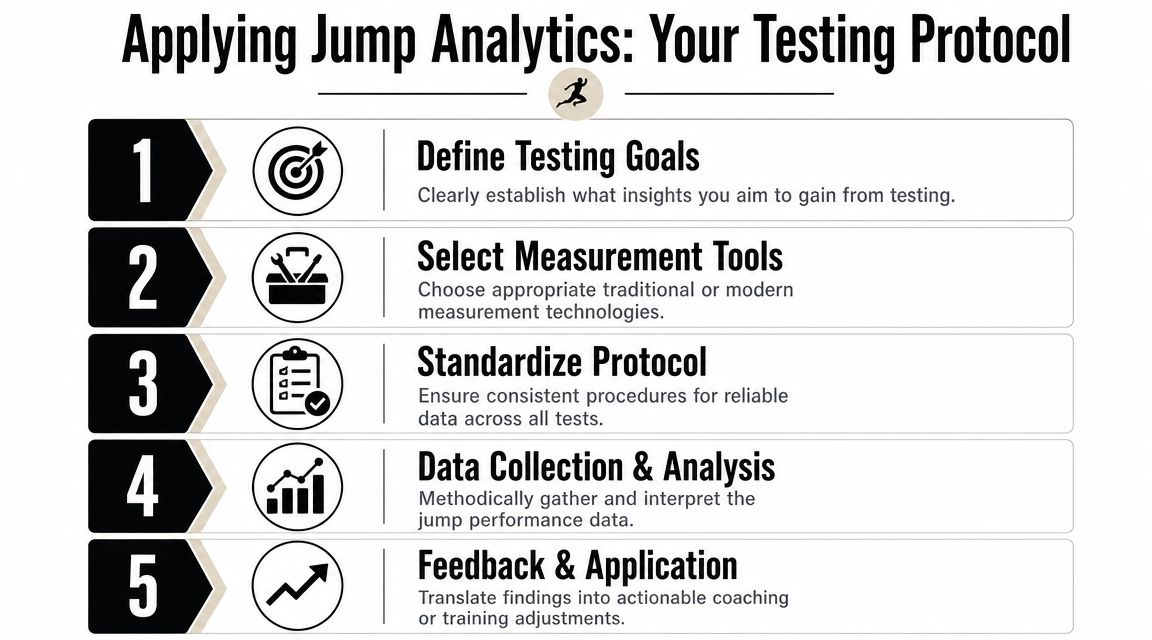
Good jump testing starts long before the athlete leaves the floor. The best protocols are boring in the right places. They remove avoidable variability so the result says something useful about the athlete.
Start with the question not the device
Pick the test based on the decision you need to make.
If you want a reliable, repeatable indicator of lower-body explosiveness for broad squad monitoring, a standardized standing countermovement jump often gives the cleanest signal. If you're working in a sport where approach mechanics are central, you may add a sport-specific jumping task. The mistake is choosing the most dramatic-looking test instead of the most decision-useful one.
Write the testing purpose before you set up the equipment:
- Screening use. Establish a repeatable baseline across a squad.
- Monitoring use. Track changes across a training block or return-to-play process.
- Performance profiling. Compare jump strategy and output between athletes.
- Sport transfer use. Include approach or reactive tasks that better reflect actual competition demands.
Build a repeatable test day workflow
I'd structure a practical vertical jump testing session like this.
Prepare the athlete
Use the same footwear rule, surface, and warm-up structure every time. Keep instructions tight. If athletes get different coaching cues across sessions, you've already introduced noise.
Confirm equipment readiness
Check placement, stability, battery status if relevant, and software readiness before the first formal trial. If your system relies on reach height or setup calibration, assign that task to one trained tester.
Demonstrate the exact jump
Show one valid rep and one invalid rep. Athletes need to know whether they can use arm swing, whether a shuffle or step is allowed, and what counts as a failed attempt.
Control the trial sequence
Keep attempt order and rest structure as consistent as possible. In groups, random chaos tends to produce rushed attempts and uneven preparation. A controlled rotation gives cleaner data.
Record more than the top score
The best jump matters, but so does the pattern. Note whether the athlete improved across trials, looked technically inconsistent, or showed obvious asymmetry or landing control issues.
Field reminder: The cleanest test sheet is the one that another coach can repeat next month without asking what you meant.
Interpret the result like a practitioner
A single jump height can tell you only so much. Its full value comes from pairing the number with what you observed.
If an athlete produces a strong jump but does it with poor landing mechanics, you may have a power profile with a force-acceptance issue. If another athlete's peak trial is fine but all other efforts drop off sharply, repeatability may be the limiting factor. In team settings, those distinctions can shape exercise selection and load management more effectively than chasing a bigger headline score.
Use the result to guide the next decision:
- When jump height is low but movement quality is solid, you may prioritize strength and concentric force development.
- When jump height is decent but strategy is erratic, coaching and task familiarity may deliver quick gains.
- When the athlete jumps well fresh but poorly under accumulated fatigue, programming and readiness management become more relevant.
- When return-to-play testing shows hesitation or asymmetry, don't let a single acceptable score override what the movement pattern shows.
The highest vertical jump record is interesting because it defines the outer edge of performance. Your testing system matters because it helps you decide what to train tomorrow. That's the practical distinction coaches should protect.
If you're building or tightening a vertical jump testing setup, Cartwright Fitness provides professional testing equipment and guidance for facilities that need more reliable, repeatable assessment workflows. For coaches, clinicians, and sports science teams, the value is straightforward: clearer protocols, cleaner data, and fewer false comparisons when jump results start driving real decisions.