

Popular advice says to start with features, app design, or the number of metrics a device can track. That's backwards for professional use. If a monitor can't hold its accuracy under motion, sweat, cleaning, or poor signal conditions, the feature list doesn't matter, because the data can't be trusted in an occupational health clinic, rehab gym, or research lab.
The market growth explains why buyers keep making this mistake. The global home health monitoring systems market was estimated at $12.3 billion in 2020 and is projected to reach $29.1 billion by 2025, a 18.8% CAGR over that span, according to BCC Research. Growth at that pace brings in consumer-grade products, hybrid systems, and clinical platforms that all look similar on a product page, but behave very differently once they're used on real people.
The right question is not “What does it track?” It's “Can I defend the reading, the workflow, and the decision that follows it?”
Table of Contents
- Why Device Validation Matters More Than Features
- Categories of Professional Health Monitoring Devices
- Accuracy Standards and Validation Benchmarks
- Selecting Devices for Clinical Research and Performance Settings
- Data Integration Workflows and Regulatory Compliance
- Practical Applications for Health Professionals
- Addressing Equity Gaps and Evidence Limitations
Why Device Validation Matters More Than Features
A polished interface doesn't make a monitor clinically useful. A device can measure heart rate, SpO2, or blood pressure and still be the wrong tool for professional work if its accuracy, sampling behavior, or transmission path hasn't been validated for the setting where you plan to use it.
For procurement, validation is the dividing line between a wellness gadget and a professional instrument. WHO-aligned technical requirements commonly call for heart rate measurement from 30 to 250 bpm with better than ±5 bpm accuracy and 1 bpm resolution, SpO2 from 70 to 99% with better than ±3% accuracy and 1% resolution, and blood pressure from 30 to 300 mmHg with 1 mmHg gradation, while ECG monitor mode should support at least 0.5 to 100 Hz bandwidth and a sampling rate of at least 1 kHz (WHO technical specifications). Those thresholds matter because bradycardia, tachycardia, desaturation, and rapid hemodynamic change are easy to miss when range or resolution is too coarse.
Practical rule: if a manufacturer won't state measurement range, accuracy margin, and resolution clearly, treat the device as a trend tool, not a clinical instrument.
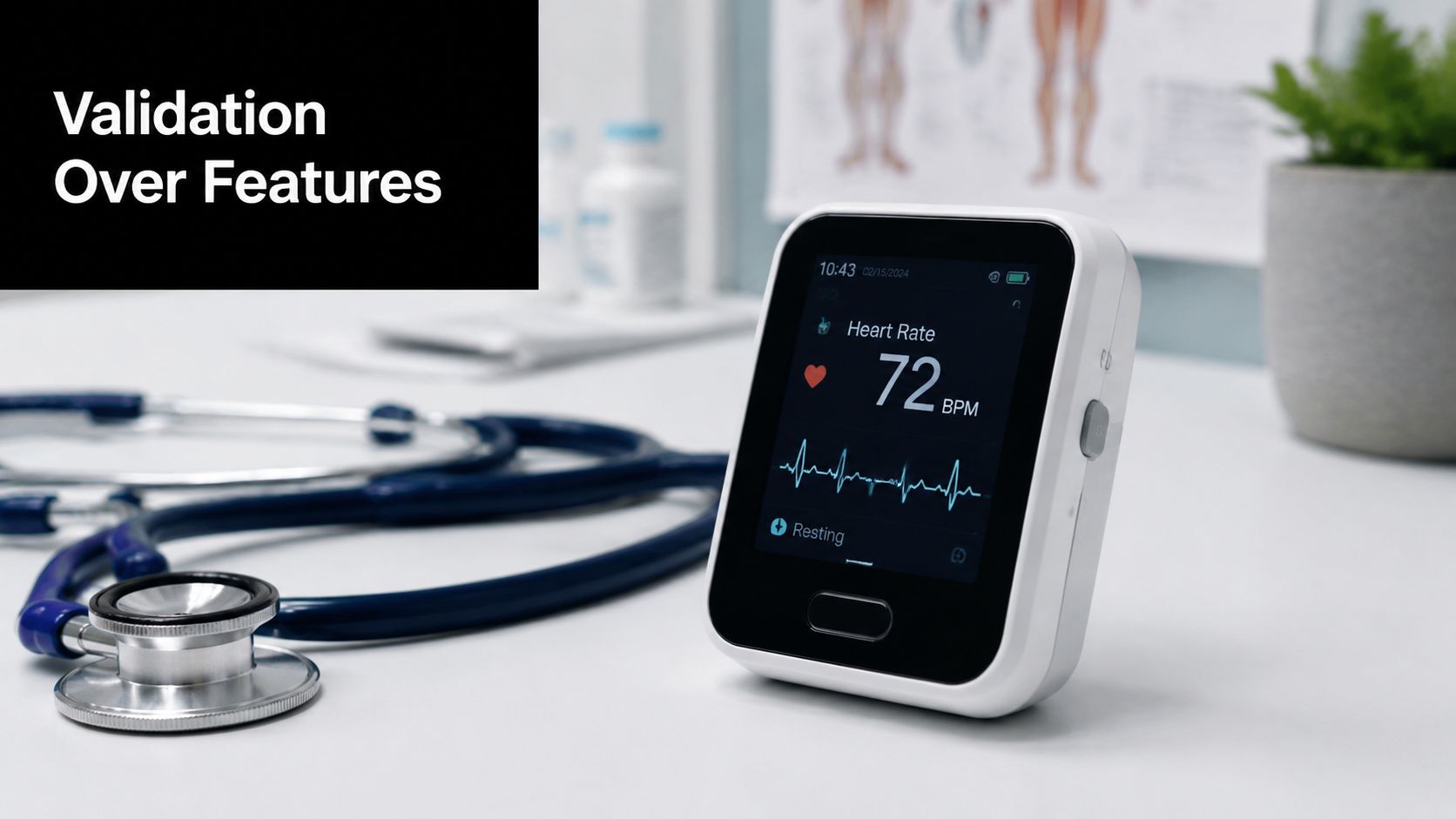
The operational risk is straightforward. A consumer wearable may be useful for motivation, rough trend tracking, or patient engagement, but if you put it into a clearance pathway, return-to-work assessment, or research protocol without evidence of performance, you're asking staff to interpret numbers they can't defend.
For teams building a formal verification and validation trail, Sheridan Technologies' V&V guide is a useful reference point because it frames the difference between a device that functions and a device that can be relied on in a regulated workflow. That distinction is what keeps procurement grounded in evidence instead of sales claims.
Categories of Professional Health Monitoring Devices
Professional health monitoring devices fall into distinct classes, and each one answers a different measurement question. The mistake many teams make is buying one category and expecting it to serve another, which usually leads to frustration, workarounds, or false confidence in the data.
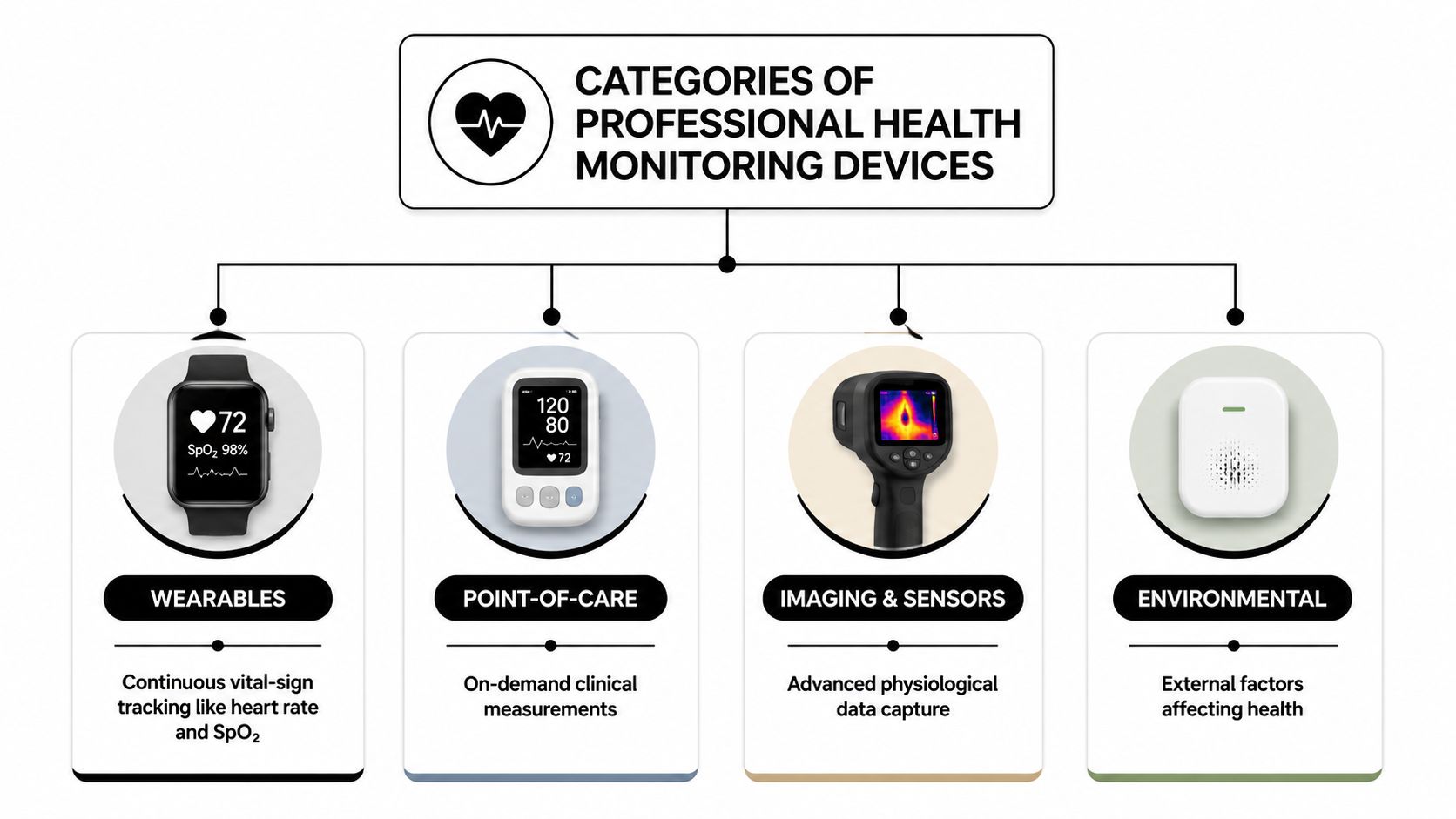
Wearables for continuous tracking
Wearables are built for continuity. The market has moved from early fitness trackers into mainstream monitoring, with a peer-reviewed review article noting that the global wearable devices market was already around $26 billion and expected to reach nearly $34 billion in 2019, while the healthcare and medical segment alone was projected to approach $15 billion in the same year; later industry summaries also report shipments above 580 million units in 2024 and smartwatch user bases above 500 million globally by the mid-2020s (review article). Those numbers matter because they show how normalized wrist-worn sensing has become, but market size still doesn't equal clinical suitability.
Use wearables when you need heart rate trends, activity, sleep, or recovery patterns. Use them cautiously when you need treatment decisions.
Point-of-care and bedside monitors
Point-of-care monitors are for on-demand clinical measurements, screening, and observation. These are the devices that need to sit comfortably inside routine workflows, with clear display logic, stable sensor behavior, and interoperable output that clinicians can use. A hospital-grade modular wearable can measure ECG, heart rate, respiratory rate, SpO2, temperature, posture, falls, arrhythmia, and non-invasive blood pressure, while transmitting through Bluetooth Low Energy plus integrated Wi‑Fi and exposing a proprietary API with FHIR customization, which is a very different design intent from a consumer app-first device (system description).
Metabolic, body composition, and respiratory systems
Metabolic analysers, ultrasound or bioimpedance body composition systems, and respiratory devices belong in settings where the question is physiological capacity, work rate, recovery, or pulmonary function. These tools are common in rehabilitation, sports science, and academic testing because they give structured outputs that can be repeated under protocol. For occupational health and exercise testing, the value is not just the reading, it's the repeatability and the documented method.
Environmental and contextual sensors
Environmental sensors don't measure the patient directly, but they still influence the interpretation. Air quality, temperature, and other ambient conditions shape the data you collect from people in a clinic, gym, or workplace. That's why the most effective deployments connect physiology to environment instead of treating them as separate silos.
For teams mapping assessment workflows to equipment portfolios, the internal reference on health assessment equipment is useful because it groups practical testing needs rather than marketing categories.
Accuracy Standards and Validation Benchmarks
Clinical procurement becomes easier once the question shifts from “Is it advanced?” to “Does it measure what we need, within the range we need?” A monitor can be compact, durable, and easy to deploy, yet still miss the benchmark for the setting where it will be used. That gap is where costly buying mistakes happen, especially in occupational health, rehabilitation, and research workflows.
What the technical thresholds really mean
WHO-aligned technical requirements give buyers a practical baseline for comparison. Heart rate should cover 30 to 250 bpm with accuracy better than ±5 bpm and 1 bpm resolution. SpO2 should cover 70 to 99% with better than ±3% accuracy and 1% resolution. Blood pressure should span 30 to 300 mmHg with 1 mmHg gradation, and ECG monitor mode should support at least 0.5 to 100 Hz bandwidth with a sampling rate of at least 1 kHz (WHO technical specifications).
| Metric | Measurement Range | Accuracy Requirement | Resolution |
|---|---|---|---|
| Heart rate | 30 to 250 bpm | Better than ±5 bpm | 1 bpm |
| SpO2 | 70 to 99% | Better than ±3% | 1% |
| Blood pressure | 30 to 300 mmHg | 1 mmHg gradation | 1 mmHg |
| ECG monitor mode | 0.5 to 100 Hz bandwidth | Sampling at least 1 kHz | Not specified in the benchmark |
Those figures matter because a narrow range or coarse resolution can miss rapid change. In screening, rehabilitation, or exercise testing, that can lead to the wrong interpretation, unnecessary repeat testing, or a device that looks acceptable on a spec sheet but underperforms in practice.
Reliability in the real world
Validation also means understanding how a device behaves under load, not only how it reads on a bench test. A representative hospital-grade modular wearable can transmit over Bluetooth Low Energy plus integrated Wi‑Fi, has IP67 ingress protection, weighs 122 g plus 22 g of replaceable parts, and uses 30-second respiratory and oxygenation update intervals (system description). Those design details matter in sweat-heavy, motion-heavy, or cleaning-intensive environments because the hardware has to stay readable, stable, and maintainable once it leaves the lab.
The validation gap is easiest to see when consumer wellness devices are compared with clinically cleared systems. BionicGym's FDA-cleared cardio device is a useful reference point because it shows how intended use, clearance status, and measured performance have to align. A product can advertise appealing features and still leave procurement teams without the evidence needed for clinical deployment.
If the spec sheet hides sampling rate, range, or validation conditions in fine print, the device was built for marketing first and clinical accountability second.
The internal resource on medical device validation process is worth reviewing when vendor claims need to be checked against procurement requirements. It keeps the conversation on evidence, not appearance.
Selecting Devices for Clinical Research and Performance Settings
Device choice shifts sharply depending on whether the end user is a clinician, a researcher, or a performance coach. The hardware may look similar on a product table, but the tolerance for ambiguity is very different across those settings.
Clinical assessments need defensible outputs
In clinical work, accuracy and interoperability matter more than convenience features. The device has to fit into records, support consistent interpretation, and survive audit scrutiny. If a monitor can't export data cleanly or can't be traced back to a validation standard, the clinical team inherits the risk.
Academic research needs reproducibility
Research protocols care about reproducibility, export depth, and protocol fit. A device that gives a nice dashboard but hides raw data is often the wrong choice for academic work. Researchers also need consistency across sessions, because even small changes in sampling behavior can complicate analysis or make comparison between cohorts harder.
Athletic performance values speed and comfort
Performance testing often needs portability, rapid measurement cycles, and athlete tolerance. A heavy unit can be technically excellent and still fail in practice if it slows the test or changes how the participant moves. That's where simpler systems, chest straps, and portable metabolic tools often win, not because they're flashy, but because they stay out of the way.
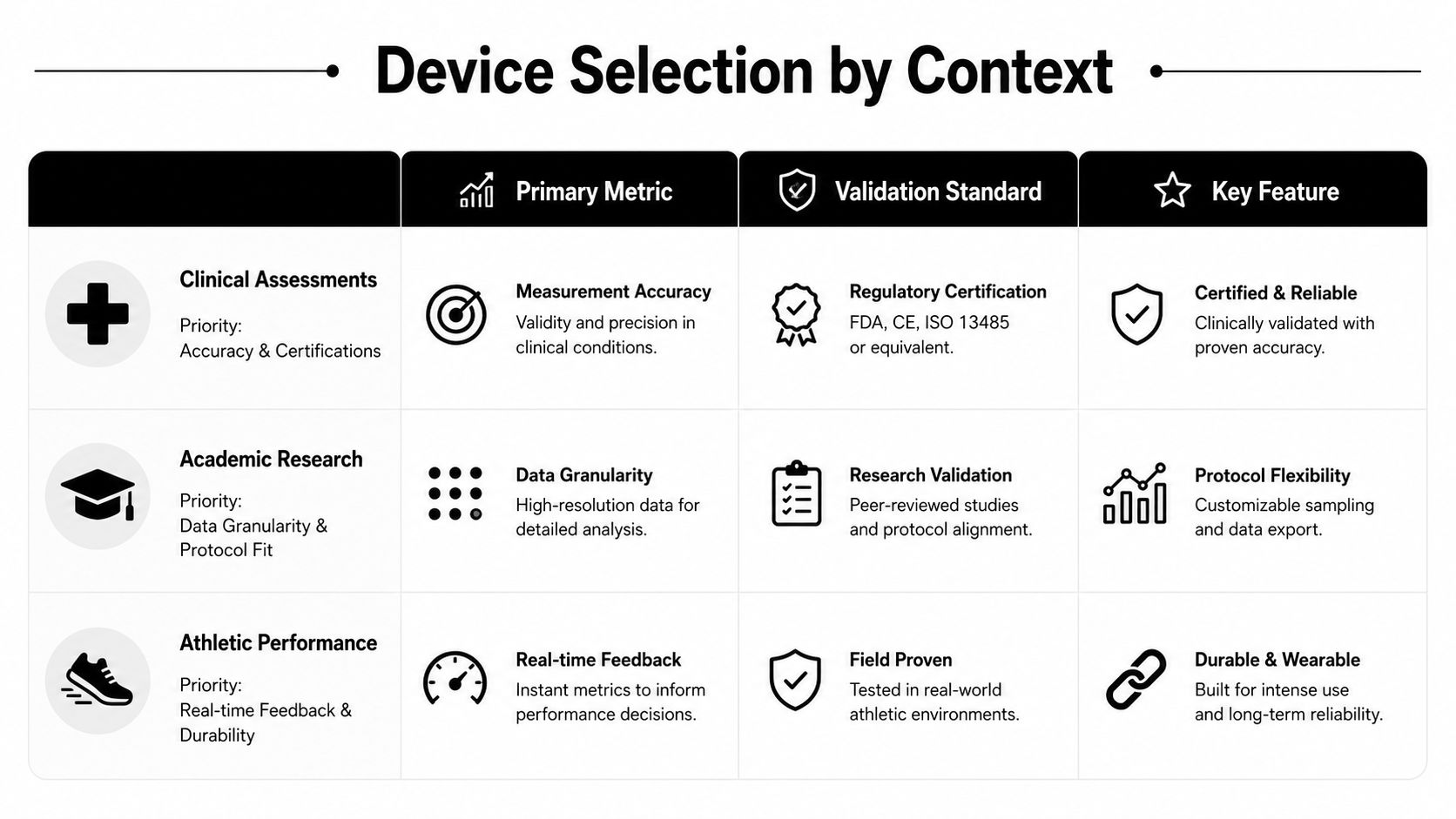
A practical shortcut is to match the device class to the consequence of error. If the consequence is a missed diagnosis, choose validated clinical equipment. If the consequence is a weaker dataset, choose research-grade equipment with reliable export. If the consequence is a slower test, choose a device that preserves the athlete's movement and the assessor's throughput.
One useful option in the testing portfolio is a fingertip pulse oximeter, which measures blood oxygen saturation and pulse rate, and it fits low-burden screening better than a full bedside platform. Used correctly, it complements more complex systems instead of pretending to replace them.
The internal guide on data management systems is relevant here because selection should include how the device will store, export, and organise results, not just how it feels in the hand.
Data Integration Workflows and Regulatory Compliance
A monitor that does not fit the workflow cleanly creates hidden labour. Staff then spend time transcribing results, chasing files, or reformatting exports, and that friction often costs more than the device itself.
Integration is part of the device, not an add-on
In healthcare settings, integration starts at capture and ends at reporting. Devices need secure transfer paths, clear data structures, and a practical way to move readings into clinical systems without duplicate records or manual errors. FHIR customisation is useful when devices need to fit modern exchange frameworks, especially in mixed environments where different platforms have to communicate with each other.
Security and maintenance are ongoing costs
Compliance is not a one-time checkbox. GDPR and HIPAA expectations push teams toward secure transmission, restricted access, and documented handling of patient data, while maintenance schedules and calibration checks keep the device trustworthy after deployment. In high-throughput environments, that maintenance burden needs to be counted during procurement, not discovered after rollout.
Workflow friction is where good projects fail
A device can be technically excellent and still fail if staff do not use it consistently. Training, onboarding, and calibration discipline matter because a well-designed monitor used badly still produces bad data.
Operational insight: the cheapest device on day one can become the most expensive one if it creates manual re-entry, duplicated files, or avoidable calibration downtime.
For teams thinking about the full stack of capture, transfer, and reporting, a validated wearable still needs a deployment pathway, not just a purchase order. The internal data management systems reference is the practical place to start when you are mapping exports to real workflows.
Practical Applications for Health Professionals
Occupational health teams use monitors differently from sports scientists, and rehab clinicians use them differently again. Good procurement respects those differences instead of forcing one device to do every job.
An occupational health practitioner screening a workforce for fitness-for-duty needs dependable, quick measurements and a process that's simple enough to standardise across sites. In that setting, a validated pulse oximeter, a blood pressure monitor, and a structured testing platform can be more useful than a feature-heavy wearable because the assessor needs repeatable outputs and minimal interpretation overhead.
In rehabilitation, the priorities change. A clinical physiologist might pair a metabolic analyser with body composition or respiratory testing to track recovery, exercise tolerance, and progression across sessions. The point is not just to collect numbers, it's to compare one protocol session with the next and know that the difference reflects the patient, not the machine.
University sports science departments usually need mixed portfolios. One lab may need a gold-standard metabolic system for precise physiological change, while teaching spaces need sturdy, simpler equipment that can survive repeated student use. A setup like that works only if each device is assigned to the measurement problem it's best suited for.
Good practice is to build a portfolio, not a trophy cabinet. One validated device for one job usually beats three underperforming devices trying to cover everything.
Fitness professionals sit in the middle. They often want fast client assessments, visible feedback, and equipment that doesn't intimidate new users. A validated device still helps here, but the best choice is usually the one that supports consistent repeat testing and clear communication, not the one with the longest app feature list.
The key is to align the device with the decision you expect to make from the result. If the result affects return-to-work status, rehab progression, or research conclusions, then the device has to carry that burden. If it only motivates a client to train harder, the technical bar is different.
Addressing Equity Gaps and Evidence Limitations
A lot of device marketing assumes the user has money, stable internet, high digital confidence, and a routine that fits app-driven care. Real-world access is less tidy than that.
Recent research found that use of remote patient monitoring, medical apps, and wearables is substantially lower in economically disadvantaged populations than earlier studies suggested, with cost, poor internet connectivity, and low health literacy being the barriers most often cited (equity research). That matters because the same devices that expand access for one group can deepen exclusion for another when the workflow depends on broadband, smartphones, or patient self-management.
There's also a clinical evidence problem. A recent review notes that evidence for the clinical effectiveness of wearable devices remains scant, even as remote monitoring expands, and it also points to under-representation of minority, rural, and low-digital-literacy populations in studies, which limits generalisability and can bias performance interpretation (clinical evidence review). In practice, that means a device may be acceptable for trend tracking, but not yet strong enough to anchor a care decision for every population you serve.
The more honest procurement stance is to treat connectivity-dependent wearables as one part of a pathway, not the whole pathway. Cellular-enabled monitoring is being explored for underserved rural settings because it reduces dependence on local internet access, but that doesn't erase the need for validation, training, and interpretation discipline.
The strongest programs are candid about what the device can and can't do. They use validated tools where the consequence of error is high, lighter-touch tools where the purpose is engagement, and patient education where digital literacy is a known constraint.
If you're choosing equipment for occupational health, rehabilitation, or academic testing, Cartwright Fitness supplies validated assessment tools, metabolic systems, body composition equipment, and supporting software that fit those workflows. Visit Cartwright Fitness to review the current range and compare devices against the measurement standards your setting needs.