

Welcome to the world of professional health assessment. If you're a clinician, researcher, or performance coach, you already know that guesswork has no place in your practice. To deliver real results and build lasting trust, you need to move beyond subjective observations and into the world of precise, measurable data.
This is exactly where professional health assessment equipment comes in.
Your Introduction to High-Precision Health Assessment Equipment

It helps to think of these tools not as gadgets, but as indispensable instruments for truly understanding the human body. For instance, a body composition analyser is like an internal blueprint, revealing the exact makeup of muscle, fat, and water. A metabolic analyser, on the other hand, acts like a car's fuel efficiency meter, showing precisely how the body uses energy at rest and during exercise.
They provide the objective data that forms the bedrock of any credible, evidence-based program.
To give you a quick overview, this guide will walk you through the core categories of equipment you'll encounter. Here’s a snapshot of what they are and who uses them.
Core Health Assessment Equipment Categories at a Glance
| Equipment Category | Primary Function | Key User Groups |
|---|---|---|
| Body Composition Analysers | Measures the percentage of fat, muscle, and water in the body. | Gyms, weight management clinics, sports scientists, researchers. |
| Metabolic Analysers | Determines resting metabolic rate (RMR) and energy expenditure during exercise. | Dietitians, clinicians, high-performance sports centres, universities. |
| Respiratory Testing | Assesses lung function, capacity, and gas exchange (e.g., VO2 max). | Cardiopulmonary clinics, physiotherapists, sports performance labs. |
| Step & Fitness Tests | Provides standardized protocols to measure cardiovascular fitness and recovery. | Personal trainers, corporate wellness programs, physical therapists. |
| Diagnostic Ultrasound | Visualises soft tissues like muscles, tendons, and ligaments for injury assessment. | Physiotherapists, sports medicine doctors, rehabilitation specialists. |
Each of these categories offers a different window into human health, and choosing the right one depends entirely on the questions you need to answer.
Why Precision Is Non-Negotiable
In a field flooded with consumer apps and wellness fads, using validated, professional-grade equipment is what sets you apart. The accuracy of your data directly impacts the quality of your recommendations, the safety of your programs, and ultimately, the trust your clients place in you.
Think about it: inaccurate data can easily lead to ineffective training plans, flawed research conclusions, or even unsafe clinical advice.
Using validated equipment is a non-negotiable part of professional practice. It demonstrates a commitment to evidence-based methods and ensures that the insights you provide are built on a foundation of scientific accuracy. This is the cornerstone of building a reputable and successful service.
This commitment to quality is what separates a recreational gadget from a clinical-grade instrument. Professional tools are engineered for reliability and repeatability, which allows you to track changes over time with confidence. For example, equipment from trusted suppliers like Cartwright Fitness undergoes rigorous testing to meet the high standards required for:
- Clinical care: Monitoring a patient's progress in a rehabilitation setting.
- Athletic training: Fine-tuning performance for an elite athlete.
- Academic research: Gathering reliable data for scientific studies.
The Growing Demand for Accurate Data
The importance of these tools is clear when you look at market trends. As health and wellness become more data-driven, the demand for accurate assessment technology is surging. The global medical equipment market, which includes these devices, is projected to climb to $1,217.9 billion by 2030. This growth is being fuelled by a greater focus on preventative healthcare and the need for high-precision diagnostics. You can explore more about the medical equipment market trends to see where the industry is heading.
This guide is designed to be your complete resource for navigating this field. We'll break down the key categories of equipment, explain how to select the right tools for your work, and show you how to integrate them effectively into your professional practice.
A Look at the Main Types of Health Assessment Equipment
To get a true picture of someone's health, you can't just rely on one tool. It’s a bit like a mechanic diagnosing a car; you need different instruments to check the engine, the electronics, and the chassis. Health assessment equipment works the same way. Each category gives you a unique look inside the body, and when you put those views together, you get a much clearer, more complete understanding of health and performance.
Let's walk through the essential categories of equipment you'll encounter, what they actually measure, and where they make the biggest impact.
Body Composition Analysers: Seeing Beyond the Scale
Think of a body composition analyser as a tool that reveals the body's true architecture. A standard bathroom scale only gives you a single number—total weight—which tells you very little. A composition analyser breaks that number down into what really matters: muscle, fat, bone, and water. Having this detailed blueprint is the first step toward any meaningful health or fitness plan.
One of the most reliable methods here is ultrasound, which is what systems like the BodyMetrix Professional use. Unlike devices that send an electrical current through the body (which can be easily thrown off by how hydrated someone is), ultrasound gives you a direct measurement of fat and muscle thickness at key points on the body. You get a highly accurate, visual confirmation of how a client's body is actually changing.
To dig deeper into this, you can check out our complete guide on body composition analysis equipment.
This kind of detail is a game-changer for a few key groups:
- Personal Trainers can finally give clients concrete proof that their hard work is paying off—showing fat loss and muscle gain even when the scale hasn't budged.
- Clinicians can precisely track muscle wasting (sarcopenia) in older adults or monitor progress in rehabilitation patients.
- Sports Scientists use it to help athletes fine-tune their power-to-weight ratio for peak performance.
Metabolic Analysers: Measuring the Body's Engine
If body composition is the blueprint, metabolic analysis is like running a full diagnostic on the body's engine. A metabolic analyser tells you exactly how your body uses fuel. It measures your Resting Metabolic Rate (RMR)—the number of calories you burn just to stay alive—and your energy expenditure during exercise.
The technology behind this is called indirect calorimetry. The person simply breathes into a mask, and the analyser measures the oxygen they consume (VO2) and the carbon dioxide they produce (VCO2). The ratio of these gases tells you precisely which fuel source—fats or carbohydrates—the body is using for energy at that moment.
A metabolic test replaces guesswork and generic online calculators with a person's unique metabolic fingerprint. It definitively answers the question, "How many calories should I actually be eating?" and becomes the bedrock of a truly personalised nutrition plan.
This is the kind of professional-grade equipment we're talking about, used in both high-performance and clinical settings.
As you can see, the devices range from compact, portable units to larger clinical carts, showing just how versatile this technology has become.
Respiratory Testing and Fitness Assessments
Beyond what the body is made of and how it burns fuel, you need to understand its capacity for work. This is where respiratory and fitness testing comes in, giving us standardized, repeatable ways to measure lung health and cardiovascular fitness.
- Spirometers are the go-to tool for measuring lung capacity and airflow. They are essential in diagnosing and managing respiratory conditions like asthma and COPD.
- Sub-Maximal Fitness Tests, like the well-regarded Chester Step Test, provide a practical and safe method for estimating aerobic capacity (VO2 max). Because they don't require pushing someone to their absolute physical limit, they are perfect for corporate wellness programs, physiotherapy clinics, and general fitness assessments where all-out exertion isn't safe or appropriate.
The need for these assessments is only growing. The global population of people over 60 is set to double to 2.1 billion by 2050, and with 1.9 billion people living with chronic disease, accessible and accurate health monitoring is more critical than ever. We're already seeing this shift—industry data shows that 70% of personal trainers now use some form of body composition technology, pointing to a wider move toward data-driven health.
Other Essential Assessment Instruments
The world of health assessment is vast, and many other specialized tools provide critical data for physiotherapists, sports medics, and ergonomists. For example, a simple-looking device like a dynamometer is incredibly useful. It measures grip strength, which has proven to be a powerful indicator of overall muscle function, frailty, and even longevity.
Every piece of equipment is designed to provide objective, reliable data for a different piece of the human puzzle. For professionals outfitting a clinic or practice, even the supporting equipment matters. A good guide on Medical Chairs, Dental Chairs, and Ergonomic Seating can offer valuable insights into how these elements support both the practitioner and the client during assessments. By carefully selecting the right combination of tools, you can move beyond guesswork, track progress with confidence, and deliver far better outcomes.
How to Select the Right Equipment for Your Needs
Choosing the right health assessment equipment can feel overwhelming. With so many options, brands, and price points, it’s easy to get lost in the noise. Let's cut through that clutter and focus on what really matters so you can make a smart, strategic investment for your practice.
The goal isn't just to buy a piece of tech; it's to find a tool that genuinely fits your services, your clients, and your professional goals. To get there, we need to look at a few core elements that separate a short-term gadget from a long-term asset.
Precision and Validation
This is the absolute most important factor. Accuracy and reliability are what distinguish a professional instrument from a recreational toy. A smart scale from a department store might be fine for someone tracking general trends at home, but it just doesn't have the scientific backing needed for you to make professional, data-driven decisions.
Validation isn't a bonus feature—it's the bare minimum. It means the equipment has been properly tested against "gold standard" methods in scientific, peer-reviewed studies. This proves its measurements are not only accurate but also repeatable. Without it, you’re just making educated guesses.
When you're looking at a new device, hunt for any mention of validation studies or its use in published research. This is your proof that the data you'll be collecting is trustworthy and defensible, giving you a rock-solid foundation for your client programmes or research.
This is where your primary goal comes into play. As you can see below, knowing whether you're aiming for peak performance, body composition changes, or general fitness will point you toward the right tools for the job.
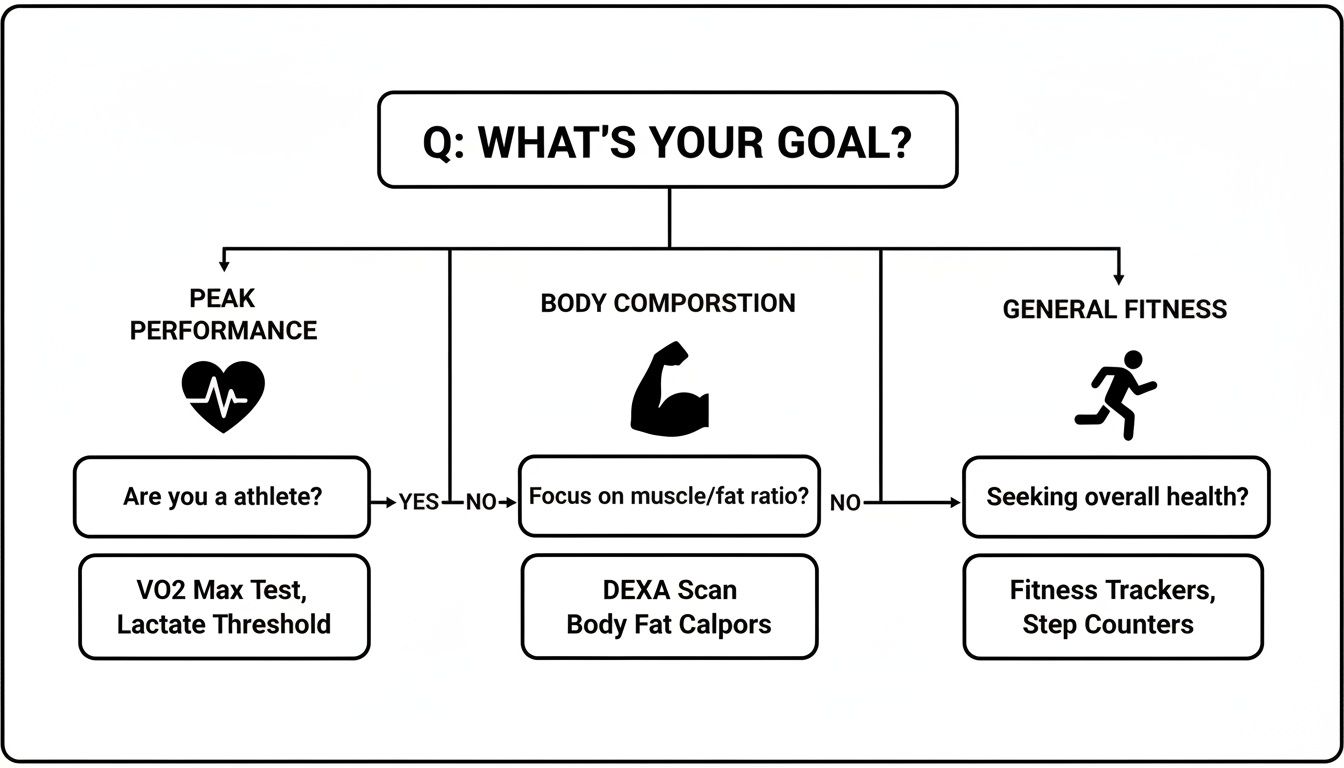
Starting with a clear objective is the first and most critical step in narrowing down the vast field of options to what will actually work for you.
A Good, Better, Best Framework
To put this into practice, let's apply a "Good, Better, Best" model to something common like body composition analysis:
- Good: A basic, single-frequency Bioelectrical Impedance Analysis (BIA) scale. It's fast and simple, but the results can be easily thrown off by hydration levels. It's best for tracking very broad, long-term trends.
- Better: A multi-frequency, segmental BIA device. This is a big step up. It provides more granular data by analysing arms, legs, and trunk separately and is far less sensitive to daily hydration shifts. This is a fantastic workhorse for most modern fitness and wellness businesses.
- Best: A clinical-grade tool like the BodyMetrix Ultrasound. Instead of relying on electrical currents, this method directly measures the thickness of tissue layers, completely bypassing the variables that affect BIA. For elite athletics, clinical settings, or serious research where pinpoint accuracy is non-negotiable, this is the gold standard.
Software and Data Integration
Even the most accurate data is worthless if it's a pain to access, interpret, and share. The hardware is only half the equation; the software experience is just as important.
Before committing, ask some tough questions:
- How easy is it to export data? Can I get it into a spreadsheet or my own database?
- Does the software create reports that my clients can actually understand and get motivated by?
- What's the learning curve like? Is the interface intuitive, or will my team need weeks of training?
A smooth software workflow saves you time, cuts down on human error, and is the key to turning raw numbers into meaningful, actionable advice for your clients.
To make this process easier, we've developed a simple checklist to walk you through these key decision points.
Equipment Selection Criteria Checklist
Use this table to systematically evaluate your options and ensure you're covering all the bases, from the science behind the device to the support you'll receive after the purchase.
| Criteria | What to Look For | Why It Matters for Your Practice |
|---|---|---|
| Validation & Precision | Peer-reviewed studies, comparisons to gold-standard methods, documented accuracy and repeatability. | Your professional credibility rests on this. Validated data ensures your advice is based on fact, not guesswork. |
| Software & Reporting | Intuitive interface, easy data export (e.g., CSV), and professional, client-friendly PDF reports. | Good software saves hours of administrative time and helps you communicate value to your clients more effectively. |
| Use-Case Fit | Does it measure what you actually need? Does it align with your client goals and business model? | Avoid buying an expensive tool that only answers a question you rarely ask. Match the tech to your service. |
| Consumables & Ongoing Costs | Required single-use items like masks, electrodes, calibration gases, or software subscription fees. | The sticker price is just the start. Calculate the total cost of ownership over 3-5 years for a true budget picture. |
| Training & Support | Availability of expert training (online or in-person), clear user manuals, and responsive technical support. | Proper use is essential for accuracy. Good training ensures you get reliable data from day one and have help when you need it. |
| Shipping & Supplier | Reputable supplier with a track record of fast, reliable shipping and in-house product expertise. | Delays cost you money. A reliable partner gets you set up quickly and acts as a resource, not just a box-shifter. |
Thinking through each of these points will help you move beyond the marketing hype and make a choice that serves your business well for years to come.
Consumables and Ongoing Costs
Always look beyond the initial price tag. The true cost of ownership must include any ongoing consumables needed to operate the device. Some metabolic analysers, for instance, require disposable masks, and other lab-based tools might need single-use test strips or calibration gases.
Sit down and calculate these recurring expenses. A device with a higher upfront cost but zero consumables might actually be the more economical choice over its lifespan. Factoring this into your budget from the start will save you from surprise costs down the road. You can see a full range of options and compare their requirements by exploring different types of fitness testing equipment from established suppliers.
Shipping, Support, and Training
Finally, think carefully about who you’re buying from. A great supplier like Cartwright Fitness is more than a shop—they’re a partner. Fast, dependable shipping is crucial to get your equipment in-house and working for you without costly delays.
Just as important is what happens after the delivery truck leaves. Access to in-house experts who can help you with setup, answer protocol questions, and troubleshoot problems is invaluable. Professional equipment demands professional protocols to get accurate results, and quality training ensures your whole team can use the technology with confidence from the very beginning.
Integrating Equipment into Professional Workflows
So, you’ve invested in top-tier assessment gear. What now? The real magic happens when you move beyond one-off tests and weave this equipment into the daily fabric of your practice. It’s about creating a repeatable system—a professional workflow—that delivers consistent, reliable data your clients can actually see and understand.
Without a solid process, that expensive device risks becoming a novelty item. A well-designed workflow ensures every assessment is done the same way, every time. This gives you data you can trust and insights that make you look like the expert you are. It’s the difference between just offering tests and delivering a strategic, data-driven service.
Workflow Example for Personal Trainers
For any personal trainer, a body composition analyser is a game-changer for winning and keeping clients. It gives you objective proof that your programs work, moving the conversation far beyond the number on a bathroom scale.
Here’s how a simple four-stage workflow can look:
- Client Onboarding: Your first session is the perfect time for a baseline scan. Using something like a BodyMetrix ultrasound, you’re not just gathering numbers. You're showing the client a visual snapshot of their starting point—the exact thickness of muscle and fat. This makes goal-setting a collaborative and highly motivating process.
- Program Design: That baseline data becomes the blueprint for their plan. See a client with less muscle than they need? Your program can now focus squarely on resistance training. The data provides a rock-solid foundation for setting realistic calorie and macro targets.
- Periodic Re-testing: Book follow-up scans every 6-8 weeks. These appointments create accountability and serve as powerful motivational check-ins. Nothing keeps a client going like seeing a measurable drop in fat thickness or an undeniable increase in muscle, especially when the scale isn’t moving.
- Progress Review and Adjustment: Each re-test is your chance to shine. You get to celebrate their wins using concrete data and make smart, informed tweaks to their program. This loop of test-act-review demonstrates your expertise and continually reinforces the value of your coaching.
Workflow Example for Sports Science Labs
In a sports science lab, protocol is king. When you’re tracking an elite athlete's aerobic fitness with a metabolic analyser, you need a process that’s airtight to ensure the data is meaningful across a long season.
A typical testing protocol looks something like this:
- Pre-Season Baseline: The athlete comes in for a graded exercise test on a treadmill or bike, hooked up to a metabolic cart like a Cosmed. This test nails down their peak oxygen uptake (VO2 max) and pinpoints the precise heart rate zones for their training.
- Mid-Season Check-in: You repeat the exact same test protocol mid-season. Did the last training block work? This is how you find out. A 5% increase in VO2 max, for instance, is a massive win, showing a real physiological adaptation.
- Taper and Peak: A final test before a major competition confirms the athlete is ready to fly. The data helps you and the coach fine-tune their taper, ensuring they hit the starting line with a full tank.
A structured assessment protocol removes ambiguity from performance tracking. It provides objective evidence that a training intervention is effective, allowing coaches to make data-driven decisions instead of relying on subjective feedback alone. This systematic approach is the hallmark of high-performance support.
Workflow Example for Physiotherapy Clinics
In a clinical setting like physiotherapy or cardiac rehab, your priorities are safety and steady, measurable progress. A sub-maximal assessment like the Chester Step Test is an ideal tool because it’s reliable, safe, and easy to administer.
Below is a typical Chester Step Test kit, which is all you need to establish these crucial baselines.
The kit’s standardized step heights and heart rate monitor are key to getting a valid and repeatable result. For a cardiac rehab patient, the workflow is all about building confidence and function safely.
The process is straightforward:
- Initial Assessment: After a patient is referred, they perform the Chester Step Test. This gives you a safe baseline of their cardiovascular fitness and an estimated VO2 max, which you can use to design a rehab program with appropriate starting intensity.
- Monitored Progression: The patient begins their supervised exercise program. Your assessment data allows you to set firm but safe heart rate limits for every session, giving both of you peace of mind.
- Follow-up Testing: Repeating the step test every 4-6 weeks gives you objective proof of their improvement. This data is vital for safely increasing their exercise intensity and provides concrete results to share with the referring physician. For seamless operation, integrating reliable tools such as medical appointment scheduling software is paramount, ensuring optimal utilization of your assessment equipment and staff resources.
Proper Setup and Maintenance: The Foundation of Accurate Data
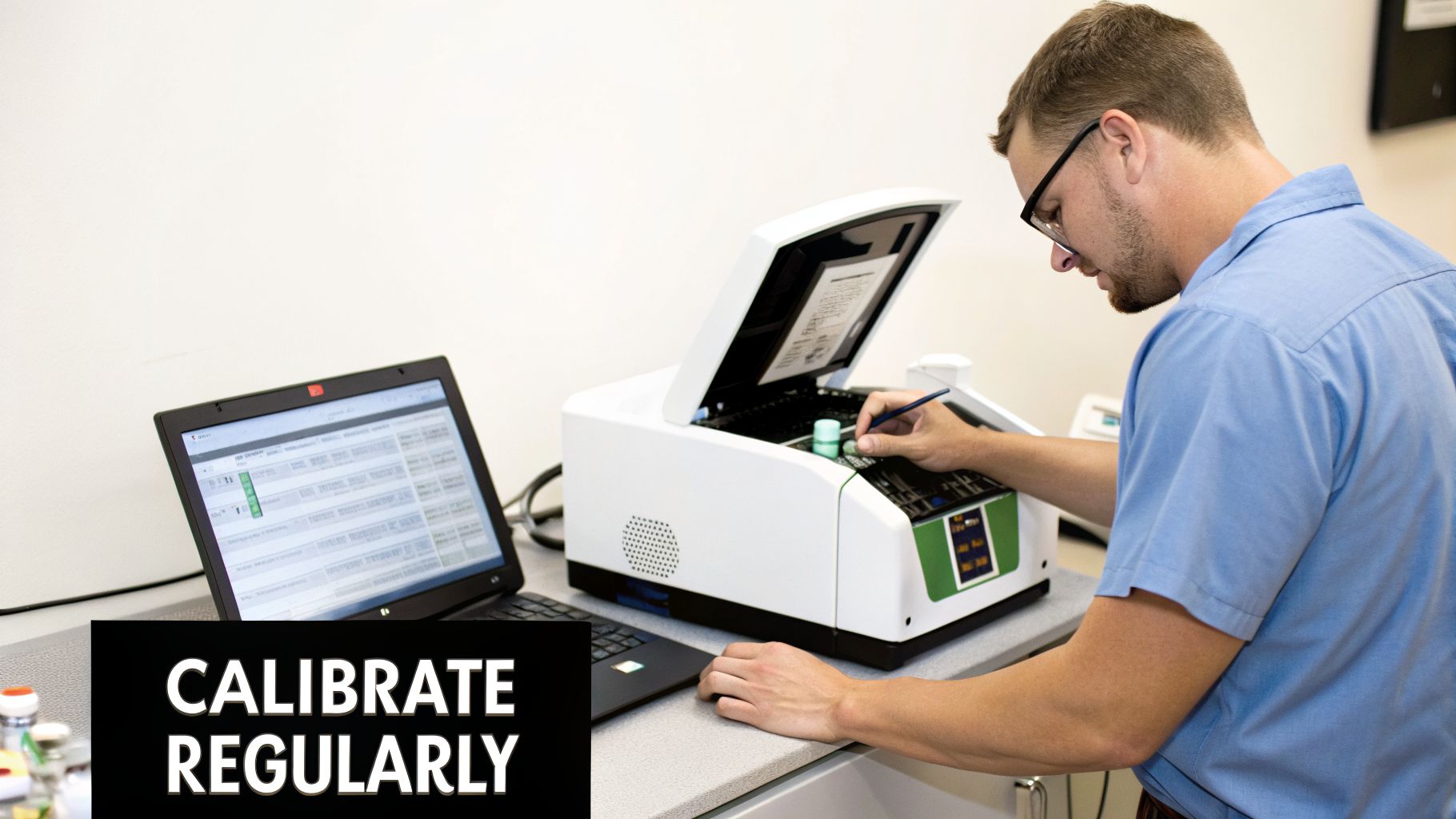
You can invest in the most validated, high-precision health assessment equipment on the market, but if it isn’t set up and maintained correctly, your data won't be worth much. Think of it as a finely tuned racing car; it needs a skilled pit crew and regular checks to perform at its peak. Your commitment to a meticulous setup and a consistent maintenance plan is what protects your investment and ensures every measurement is trustworthy.
The journey from the delivery box to your first assessment is a crucial one. It's tempting to rush, but any corners cut here can introduce stubborn errors that are difficult to trace later. Before you even think about plugging anything in, prepare the space. For body composition scales, that means finding a perfectly level floor. For a sensitive metabolic analyser, it means securing a stable, surge-protected power source.
Once the environment is prepped, you can get down to the initial setup.
Your Initial Setup Checklist
While every device has its quirks, a few universal steps will set you up for success from day one. Following a simple process like this builds a strong foundation for data integrity.
- Inspect for Shipping Damage: Unpack everything carefully and give it a thorough once-over. Make sure no components were knocked around or broken in transit.
- Assemble by the Book: Follow the manufacturer's assembly guide to the letter. Don't improvise or skip steps—they're there for a reason.
- Install the Software: Load any necessary software onto your computer, ensuring all drivers are up to date and correctly installed before connecting the hardware.
- Run the Initial Calibration: This is absolutely non-negotiable. Most professional-grade devices need an initial calibration—whether it's with a supplied weight for scales or a specific gas mixture for a metabolic cart—to establish a true, accurate baseline.
Getting that first calibration right is arguably the most important thing you can do to guarantee reliable data.
Building a Long-Term Maintenance Schedule
Great data doesn't happen by accident. Keeping your equipment accurate is an ongoing commitment, not a one-time task. The good news is that a simple, repeatable maintenance schedule turns this into a quick habit rather than a major headache, catching small issues before they snowball.
Just like an athlete relies on consistent training to stay in peak condition, your equipment needs consistent care. A simple maintenance log is one of the best tools you have for maximising the life of your device and ensuring the quality of every single assessment.
Here’s a basic routine you can adapt for your specific equipment:
- Daily Checks: Wipe down all surfaces and sensors that come into direct contact with clients, like hand grips, face masks, or ultrasound probes. Do a quick visual check for any loose connections or obvious wear and tear.
- Weekly Tasks: Run any available software updates and system diagnostics. It's also a great practice to perform a quick calibration check to see if the readings are still spot on.
- Annual Servicing: This is the big one. Book a professional service and recalibration. Most manufacturers require this to maintain the device's validation. You can learn more about what's involved in professional testing equipment calibration to understand its importance.
By sticking to the manufacturer's guidelines and working with expert suppliers for support, you can troubleshoot issues with confidence and know that your health assessment equipment is producing valid, consistent data for years to come.
Navigating Regulatory and Ethical Considerations
The moment you press 'start' on a health assessment, you're not just collecting numbers; you're taking on a serious responsibility. You become the keeper of someone's private health information, and handling that with integrity is the bedrock of a trustworthy practice.
First up, let's talk about the data itself. Regulations like GDPR have set a very high bar for how you're allowed to collect, store, and manage client health data. In short, this information has to be locked down tight, with access strictly limited to only those who absolutely need to see it. Getting this wrong isn't just a slap on the wrist; it can lead to massive fines and completely torpedo your professional reputation.
Protecting Your Clients and Your Practice
But the legal side is just one piece of the puzzle. How you actually talk about these results with a client is where the real art and responsibility lie. Data points around body fat, fitness levels, or metabolic health can be incredibly sensitive and personal. Your goal should always be to empower and guide, never to judge or discourage.
This means you need to get good at framing the results in a supportive way. Instead of just dropping a number on them, use the data to start a constructive conversation about positive, achievable next steps.
The real value of an assessment isn't the data itself, but the conversation it starts. It's a tool to build a collaborative plan that inspires clients, helping them see a clear path forward rather than getting hung up on a single number.
Understanding Your Scope of Practice
This conversation will sometimes lead you to a critical ethical crossroads: recognizing when a client's results point to something beyond your expertise. This is all about knowing your scope of practice. Your equipment is powerful, and it might flag something that suggests an underlying medical issue—think unusually low lung function or a spike in blood pressure during a step test.
It's your professional duty to know when to hit pause and refer that client to a medical professional. You’re not a diagnostician; you’re an assessor. That means you need to be prepared to:
- Know what a red flag looks like: Be trained to spot results that fall outside the normal range and could signal a deeper problem.
- Build a referral network: Have a trusted group of physicians, registered dietitians, or other clinicians you can confidently send clients to.
- Stay in your lane: Your role is to assess, educate, and guide. Never, ever try to diagnose a medical condition.
Handling client data and assessment results responsibly does more than just keep you out of trouble. It protects the very people you're trying to help, cements your professionalism, and establishes you as a trusted expert in your field.
Frequently Asked Questions
Stepping into the world of professional health assessment gear can feel a bit overwhelming, and it's natural to have questions. We've been there. Here are some straightforward answers to the questions we hear most often from professionals just like you.
What Is the Difference Between Consumer and Professional Equipment?
It really boils down to validation, accuracy, and reliability. Think about the smart scale in someone's bathroom—it's great for tracking general trends at home. But when you're making critical decisions for a client or athlete, you need data you can absolutely trust.
That's where professional health assessment equipment comes in. Tools like BodyMetrix Ultrasound or Cosmed metabolic carts have been through rigorous scientific testing. This process ensures the numbers they produce are not just accurate but also repeatable, which is non-negotiable for clinical work, high-performance sports science, or published research.
Which Body Composition Analyser Is Right for Me?
That's a great question, and the answer depends entirely on your clients, your budget, and how deep you need to go with your data. For general fitness environments where speed and ease of use are key, Bioelectrical Impedance Analysis (BIA) devices can be a good starting point. They're quick and non-invasive.
But if you need a higher degree of accuracy—especially for athletes or in a clinical setting—methods like Ultrasound are in a different league. Tools like the BodyMetrix directly measure tissue thickness, giving you a true picture of body composition that isn’t skewed by something as simple as the client's hydration level.
Do I Need Special Training to Use This Equipment?
Yes, and this is something we can't stress enough. Getting accurate data and, just as importantly, knowing how to interpret it correctly hinges on proper training. While a device might look simple on the surface, advanced systems like metabolic analysers or ultrasound equipment rely on very specific protocols to give you valid results.
Any good supplier will offer more than just a user manual; they should provide in-depth training and ongoing expert support. This isn't just about learning which buttons to press. It’s about understanding the science behind the measurements so you can confidently explain the results and build truly effective client programs.
At Cartwright Fitness, we're more than just an equipment supplier. We see ourselves as your partner, here to provide the expertise and support you need to excel. Take a look at our handpicked selection of validated health assessment tools and see what the right data can do for your practice.
Find the right equipment for your professional needs at Cartwright Fitness