

You're probably in one of two situations right now. You have a new client who says they want to “get fitter,” move better, or feel stronger for everyday life, and you need a baseline that means more than a bench press number. Or you're already testing people, but you know the results don't always translate cleanly into programming, progress reviews, or clinical handover.
That's where functional fitness testing earns its keep. Done well, it gives you a structured picture of how a person moves, tolerates effort, manages balance, and expresses useful strength. Done badly, it becomes a random collection of drills that produce noisy data and false confidence.
The biggest practical problem is that the field isn't equally mature across all adult populations. There's a well-recognized gap for healthy working-age adults, because many validated protocols were built for older or clinical populations, which leaves practitioners trying to judge whether a score is “functional” for daily life or only in relation to sport or rehab benchmarks, as discussed in this review of functional fitness testing in adults. That gap is exactly why a principles-first approach matters.
Table of Contents
- What Is Functional Fitness Testing and Why It Matters
- Understanding the Core Principles of Functional Assessment
- A Guide to Common Functional Fitness Tests
- How to Standardize Your Testing Protocols for Reliable Results
- Ensuring Validity and Choosing the Right Equipment
- Interpreting Results Using Normative Data
- Building Assessment Batteries and Communicating Results
What Is Functional Fitness Testing and Why It Matters
Functional fitness testing measures how well someone performs capacities that matter outside the gym. That usually means some combination of mobility, balance, gait, useful strength, task tolerance, and aerobic capacity. The point isn't to ask whether a client can produce a peak performance in one narrow lift. The point is to ask whether they can move through daily demands efficiently, repeatedly, and safely.
That distinction matters in practice. A client can be strong on isolated machine work and still struggle with transitions, balance under fatigue, floor transfers, loaded carries, stairs, or basic movement control. A traditional strength test may tell you they can produce force. A functional test tells you whether they can use it.
Function beats isolated capacity
In a clinical setting, the value is obvious. You need to know if someone can get up from a chair, walk with confidence, and maintain independence. In a performance setting, the same principle applies with different stakes. You want to know whether movement quality, fatigue tolerance, or asymmetry is limiting output before symptoms show up.
For general fitness, this becomes even more important because clients rarely present with one clean goal. They want fat loss, fewer aches, better energy, improved confidence, and less stiffness. A functional lens helps you organize that mess into testable domains.
Practical rule: If a test result won't change your exercise prescription, it probably doesn't belong in your battery.
A useful test changes decisions
The value of functional fitness testing is less about the test itself and more about what it lets you do next. It sharpens exercise selection, flags referral needs, guides progressions, and gives the client a reason to care about the program beyond aesthetics.
The challenge is that the field has clearer pathways for seniors and rehab than for healthy adults in the middle decades. In everyday coaching, that's why many practitioners borrow from clinical testing, then adapt the interpretation rather than copying the entire framework. That's a sensible approach, provided you're honest about what is validated, what is borrowed, and what is a practical proxy.
A good functional assessment doesn't pretend to be a full medical workup. It gives you a cleaner map of capacity and limitation than guesswork ever will.
Understanding the Core Principles of Functional Assessment
A strong assessment works like a mechanic's diagnostic process. A good mechanic doesn't just check one part and declare the whole vehicle sound. They look at how systems interact under real operating conditions. Functional assessment should work the same way.
Function beats isolated capacity
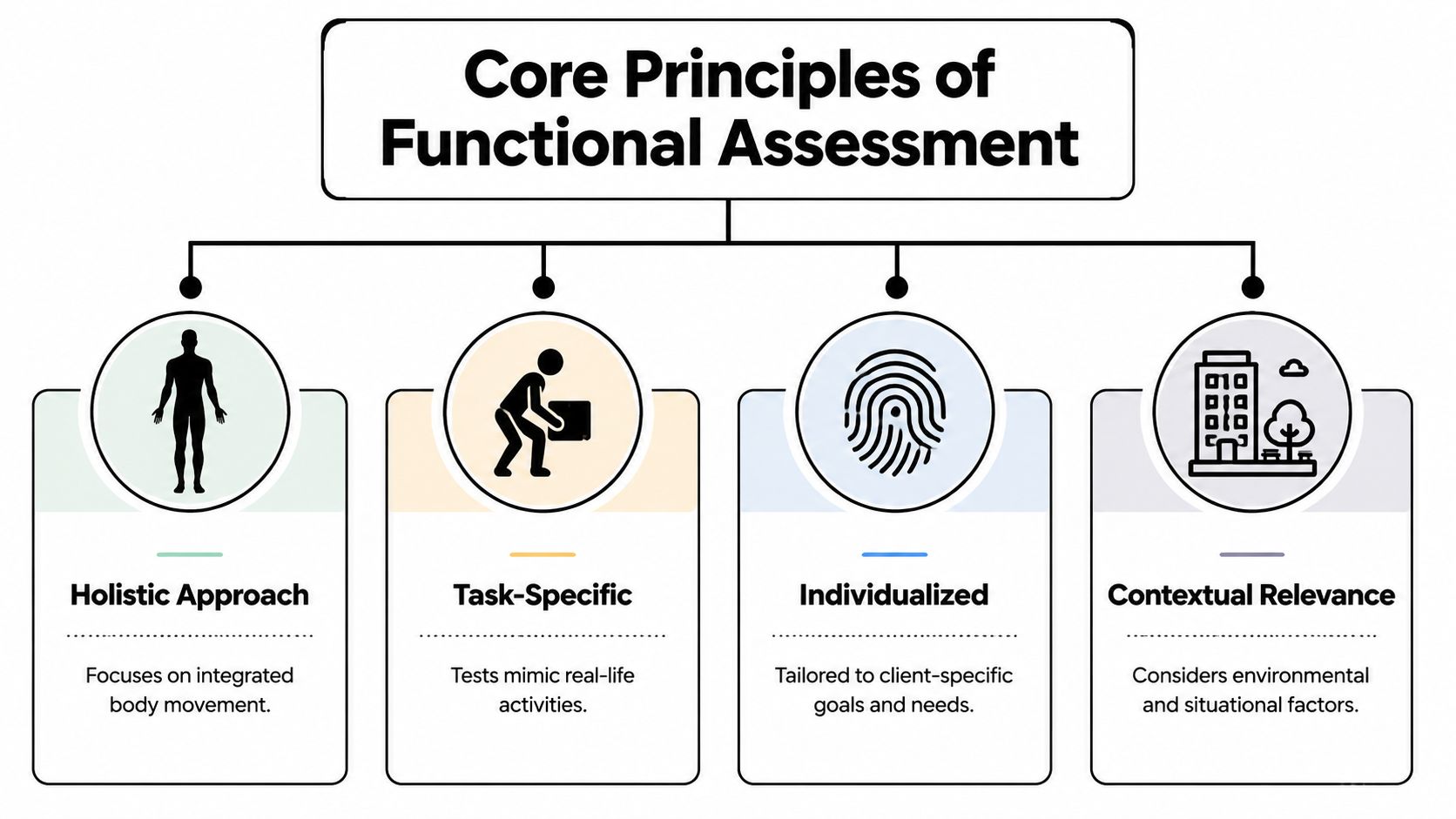
The first principle is integration. Real movement is rarely isolated. People stand up, turn, step, carry, brace, reach, recover, and repeat. That's why assessments that look at patterns such as squatting, pushing, stepping, and transitional mobility often tell you more than single-joint testing alone.
The second principle is task specificity. Tests should resemble the demands you care about. If the client's goal is fall prevention, a mobility and balance measure has direct relevance. If the goal is work capacity for a physically demanding role, you need tests that reflect repeated effort, posture control, and movement under load or fatigue.
The third principle is individualization. Two people can have the same score and need completely different programs. One may be limited by confidence and pacing. Another may be limited by stiffness, pain behaviour, or poor coordination. A useful framework for this kind of thinking is a structured functional movement assessment approach, provided you apply it to the client in front of you rather than treating the template as the answer.
A useful test changes decisions
The fourth principle is context. Testing doesn't happen in a vacuum. Flooring, footwear, medication status, familiarity with the task, and fear of movement can all affect performance. If you ignore those factors, you'll mistake context for capability.
That's why a test battery should answer a set of practical questions:
- What does this person need to do well? Daily living, return to work, sport, or independent aging all shift the emphasis.
- What level of precision do I need? Screening, coaching, and rehabilitation each require different depth.
- Can I repeat this consistently? If the setup changes every session, the score won't mean much.
- Will the result alter training? If not, strip it out.
Holistic testing doesn't mean testing everything. It means testing enough of the right things to make a sound decision.
The practitioners who get the most from functional fitness testing are usually the ones who stay disciplined. They don't chase novelty. They select a small number of tests that fit the client, repeat them properly, and interpret them inside the practical demands that client faces.
A Guide to Common Functional Fitness Tests
A 68-year-old in cardiac rehab, a 42-year-old warehouse supervisor returning after back pain, and a healthy 35-year-old who wants to train hard again can all look "functional" in casual conversation. Testing separates that vague label into something usable. The right test shows whether the limitation sits in strength, mobility, aerobic tolerance, balance, or task-specific confidence.
In practice, a small battery usually does the job better than a long menu. The aim is to choose tests that match the person in front of you and answer a real programming or clinical question.
Lower body functional strength
The 30-second Sit-to-Stand Test is one of the most useful chair-based tests because the task is familiar, the equipment demands are low, and the result translates well to daily life. Repeated chair rise performance matters in older adults, post-illness populations, and working-age adults who have lost lower-body capacity after inactivity or injury.
The score is only meaningful if the task is performed to a consistent standard. Full standing, controlled sitting, fixed chair height, and a clear rule on arm use all matter. If someone cannot complete the movement without pushing off the chair, that tells you something clinically important, but it also changes what the score represents.
The 60-second Sit-to-Stand Test adds a stronger endurance component. I use it when short-burst performance looks acceptable but fatigue during sustained work is the concern. That is often the case in pulmonary or cardiac rehabilitation, in deconditioned adults returning to work, and in clients who report that they start well but fade quickly.
Used together, the two versions can be informative. A decent 30-second result with a clear drop-off over 60 seconds points toward limited local muscular endurance or pacing issues rather than a pure strength deficit.
Dynamic balance and mobility
The Timed Up and Go, or TUG, remains a practical option because it captures several linked tasks in one short test. The client stands, walks, turns, returns, and sits. That sequence exposes problems that do not always show up in isolated strength testing.
The value of TUG is its breadth and its limitation. It is efficient, but it does not tell you why the time is slow. A poor result may reflect reduced leg strength, cautious gait, vestibular issues, joint pain, poor turning control, dual-task difficulty, or simple unfamiliarity with moving quickly.
That is why I rarely interpret TUG in isolation.
Pairing it with a chair-rise test helps. If chair-rise performance is acceptable but TUG time is poor, the bottleneck often sits in gait speed, turning mechanics, dynamic balance, or movement confidence. If both are reduced, a broader loss of physical capacity is more likely.
Aerobic capacity in real settings
The Six-Minute Walk Test is widely used because walking is familiar, submaximal, and easy to scale across clinical settings. It works well for cardiac, pulmonary, and general rehabilitation, but it also has value in less obviously clinical groups. Healthy working-age adults with low activity tolerance often reveal more in a controlled walk test than in a maximal gym-based protocol they cannot pace properly.
The main strength of the test is ecological validity. It reflects what many people need to do. Walk, sustain effort, manage symptoms, and recover. In clinical practice, that makes it useful for baseline profiling, monitoring change, and judging whether exercise tolerance is improving in a way the client will notice outside the clinic. The American Thoracic Society statement on the Six-Minute Walk Test remains the standard reference for procedure and interpretation.
Raw distance still needs context. Age, body size, symptoms, medications, and the walking environment all affect performance. A shorter distance in a frail older adult can represent a meaningful gain in independence. The same number in a healthy 40-year-old would raise a different question and lead to a different follow-up plan.
Flexibility and reach-based screening
The Chair Sit and Reach is often treated as a simple flexibility screen, but its practical value depends on how you use it. It gives a quick view of posterior chain mobility in a seated position that reduces balance demands, which is why it is common in older adult testing.
I would not use it alone to make decisions about movement quality or injury risk. It is better used as one piece of a broader picture, particularly when limited hamstring length or posterior chain stiffness may be affecting gait, bending tolerance, or floor transfer strategies.
Comparison of key functional fitness tests
| Test Name | What It Measures | Primary Population | Equipment Needed |
|---|---|---|---|
| 30-second Sit-to-Stand | Lower body functional strength and repeated chair-rise ability | Older adults, rehab, general deconditioned adults | Standard chair, timer |
| 60-second Sit-to-Stand | Lower body muscular endurance in a functional pattern | Clinical and rehab settings | Standard chair, timer |
| Timed Up and Go | Dynamic balance, mobility, transitional control, fall risk screening | Older adults, rehab, general mobility screening | Chair, marked walking distance, timer |
| Six-Minute Walk Test | Walking-based aerobic capacity and exercise tolerance | Cardiac rehab, clinical populations, selected general populations | Measured walking course, timer |
| Chair Sit and Reach | Lower body flexibility relevant to sitting and bending mechanics | Older adults, general flexibility screening | Chair, measuring tool |
The best battery is usually brief and targeted. In many settings, one lower-body test, one mobility test, and one aerobic test are enough to guide decisions. The clinical principle is the same across populations. A senior maintaining independence, a patient rebuilding capacity, and a healthy adult trying to return to full function all benefit from testing that is specific, repeatable, and interpreted against the demands of their actual life.
How to Standardize Your Testing Protocols for Reliable Results
A client tests on Monday after two flights of stairs from the parking lot, in work shoes, with one assessor counting partial reps. Six weeks later the retest happens in trainers, after a longer warm-up, with a different assessor who insists on full lockout. The numbers changed, but the protocol changed more.
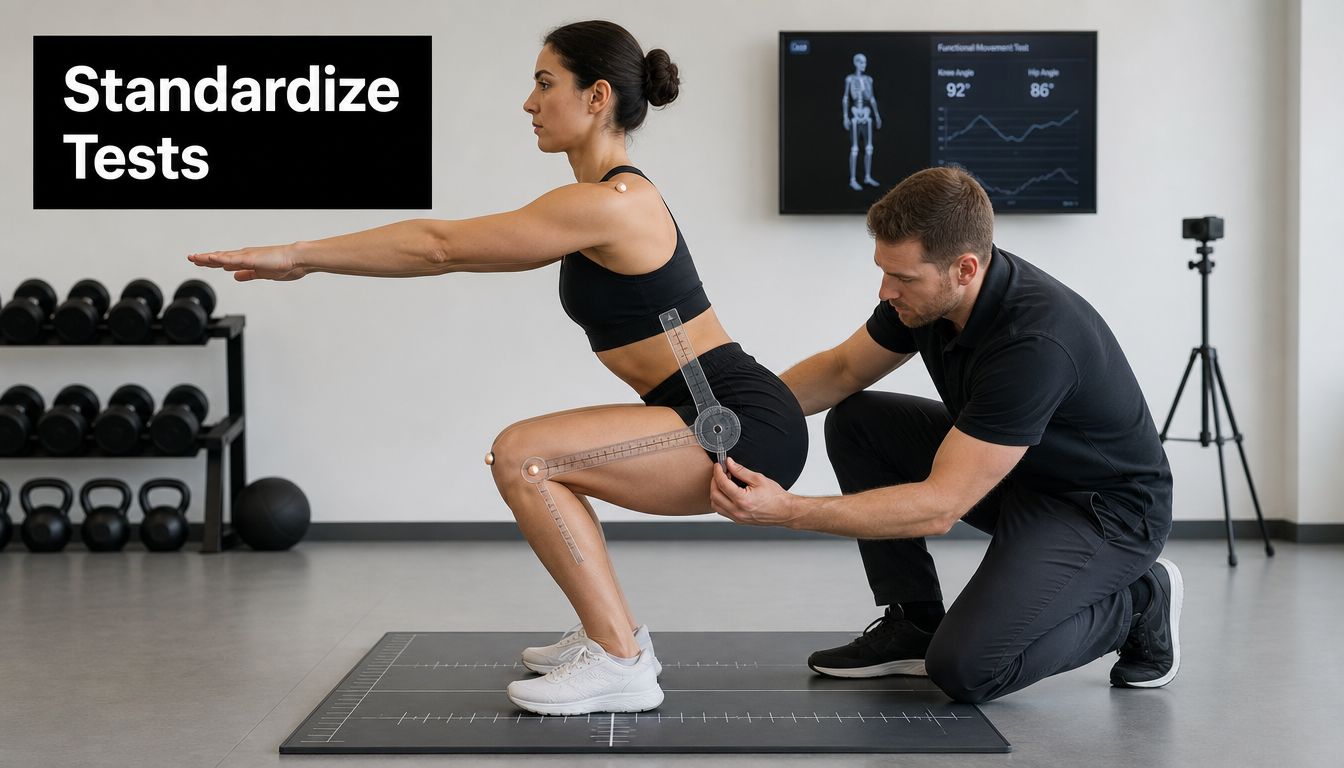
Standardization is what makes a score usable across time, staff, and populations. The same principle applies whether you are testing an older adult in a falls clinic, a patient in outpatient rehab, or a healthy office worker who wants to know why daily tasks still feel harder than they should. If the setup drifts, interpretation gets weak fast.
Control the setup before you test
Start with the factors that subtly alter performance. Use the same room, floor surface, chair height, walking distance, and timing method whenever possible. Set footwear expectations in advance. Keep the same cueing script and the same practice allowance, because a familiar test often improves on repetition even when capacity has not changed much.
Scoring rules need the same level of control. Define what counts as a valid repetition, what range is required, when a trial stops, and when a test is modified or abandoned for safety. In practice, that means writing down details that staff often keep in their heads. Full standing in a sit-to-stand test. Hand placement rules. Whether momentum is allowed. Whether verbal encouragement is standardized or withheld.
For clinics and performance settings that need a repeatable framework, these rehabilitation assessment tools and testing resources are useful reference points for building written procedures.
A workable protocol usually includes four things:
- A fixed pre-test routine covering recent activity, medication timing if relevant, pain check, and warm-up.
- Clear stop or modification criteria for dizziness, unstable symptoms, unsafe mechanics, or symptom escalation.
- A written scoring sheet with task instructions, rep standards, and space for deviations.
- A planned retest interval that matches the expected rate of change in that population.
Keep the order and recovery periods fixed
Test sequence changes outcomes. If one session starts with a demanding walk test and another starts with chair rises, later scores reflect different fatigue states. That matters in older adults with limited reserve, in clinical groups where symptoms build during exertion, and in healthy adults whose deficits only show up after work capacity is challenged.
Use the same order every time and set the rest periods in advance. Do not decide recovery by feel on the day. A fixed sequence reduces one of the biggest sources of noise in multi-test batteries, especially when lower-body strength, mobility, and aerobic capacity are all being assessed in the same appointment.
The trade-off is simple. A longer, more controlled session improves comparability, but it also increases scheduling demands and client burden. In busy settings, I would rather run a shorter battery well than a larger battery inconsistently.
Record what happened, not just the score
A raw number is incomplete without context. Document pain, symptom behavior, assistive device use, pacing changes, balance losses, rest breaks, and any departure from the standard protocol. If a participant could not complete a test because of safety or symptom limits, record that clearly rather than swapping in an easier variation and treating the result as equivalent.
That point matters across populations. In a senior adult, an incomplete task may reflect fall risk or fatigue intolerance. In a clinical patient, it may reflect symptom irritability. In a healthy working-age adult, it may expose a capacity gap that would be missed by a simpler pass-fail screen.
Check staff consistency
Inter-rater drift shows up quickly. One assessor demonstrates faster. Another gives more encouragement. A third counts borderline reps. Those small differences can erase the value of serial testing.
Audit the process. Observe each other. Compare scoring on the same trial. If the team cannot agree on what a valid rep looks like, clients do not have a measurement problem. The service has a protocol problem.
Reliable testing comes from controlled conditions, clear scoring, and disciplined documentation. That is how a functional assessment becomes useful in real decisions instead of just producing numbers.
Ensuring Validity and Choosing the Right Equipment
A test can be reliable and still be the wrong test. That's the distinction many practitioners miss.
Validity is not the same as reliability
Reliability asks whether you can get the same result under the same conditions. Validity asks whether the test measures the thing you care about.
A simple example is balance and motor control under altered sensory input. Many standard screens are done with eyes open, which allows the visual system to compensate for proprioceptive weakness. A more demanding approach is to remove that visual assistance and see what changes.
A contrarian but useful perspective is that eyes-closed lifts and movement tests can expose deficits that eyes-open testing misses. Guidance from Advanced Human Performance on functional strength testing suggests that if a client can't maintain 80 to 90% of their load with eyes closed, they need targeted work for proprioceptive stability. You wouldn't use that as a blanket rule for every client, but it's a sharp reminder that visible competence doesn't always equal stable control.
In practice, that means validity improves when the test condition matches the demand you're trying to understand. If you suspect sensory dependence, test for it. If you're concerned about stair tolerance, a chair-based test alone won't answer the whole question.
Equipment can strengthen or weaken your data
The tools matter because poor equipment undermines both validity and reliability. An unstable step, inconsistent chair height, uncalibrated timing device, or improvised measurement setup can turn a decent protocol into weak evidence.
For clinics, universities, and performance centres, it often makes sense to use purpose-built rehabilitation assessment tools that support repeatable setup and cleaner scoring. The goal isn't to make testing look more impressive. It's to reduce avoidable measurement error.
Video can also improve practical accuracy when used well. It helps with reviewing movement quality, checking rep standards, and training staff to score consistently.
A brief demonstration can help teams tighten their own setup and administration process:
The best equipment choice is rarely the most complex one. It's the one that lets your team repeat the same test, under the same conditions, with the least ambiguity.
Interpreting Results Using Normative Data
A 48-year-old office worker and a 72-year-old community-dwelling adult can post the same chair stand score and require completely different conclusions. One result may point to low activity and declining reserve. The other may represent preserved independence for age and health status. Interpretation starts there.
A score only matters in context
Normative data gives the score a frame of reference. Use it to compare performance with an appropriate group, not with an abstract ideal. Age, sex, body size, training background, and clinical status all affect what a result means in practice.
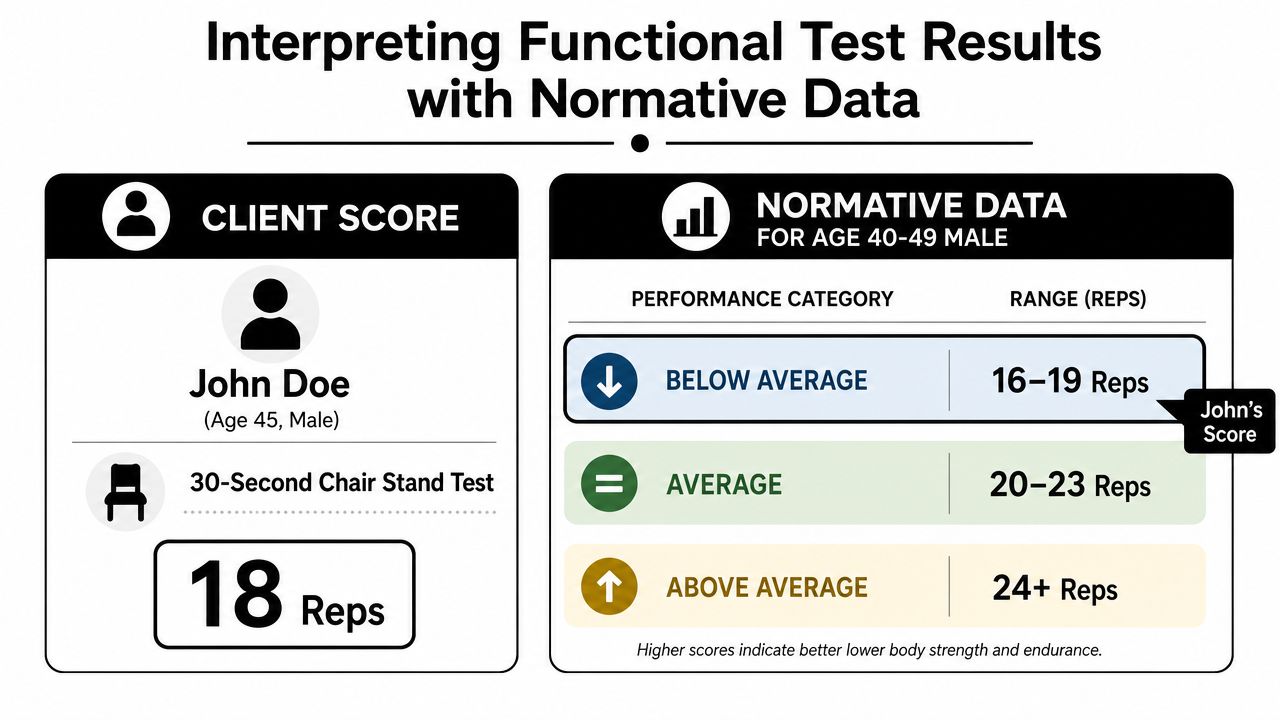
The common error is treating a single score as a verdict. A below-average result may reflect deconditioning, pain, fear of movement, unfamiliarity with the task, or a genuine functional limitation. Those possibilities do not carry the same risk, and they do not lead to the same intervention.
This is also the point where the gap between clinical testing and general fitness becomes obvious. Older adult populations often have better-established reference values and clearer decision pathways. Healthy working-age adults are harder to classify. In that group, the job is usually to combine published norms where they exist, compare the result with the person's occupational or sport demands, and track change over repeated testing.
That approach matters for prevention. A healthy adult who sits all day may still be years away from overt impairment, but functional testing can show reduced reserve before daily tasks start to feel difficult. For practitioners working with ageing populations, these same principles connect closely with broader functional fitness strategies for older adults.
Use normative data carefully
Norms are useful, but they are not neutral. Reference datasets differ by country, sampling method, health profile, and test procedure. A walk test performed on a marked indoor corridor is not directly comparable with one done on a gym floor with loose pacing instructions. If the protocol changes, the meaning of the norm can change with it.
Percentiles often help more than labels such as poor or excellent. They show where the person sits within a reference distribution, which is usually easier to explain and easier to defend. In clinic, I also want to know whether the score matches the rest of the profile. A low mobility score with normal lower-body strength pushes the interpretation in a different direction than a globally low battery.
Functional Fitness Age can help communication, with limits
Functional Fitness Age, or FFA, is one example of turning several test results into a summary value that clients understand quickly. In women over fifty, researchers have described an equation that combines chair stands, arm curls, a step test, chair sit-and-reach, back scratch, and timed up-and-go performance into an age-like score, as reported in this open-access study on functional fitness age in middle-aged and older women.
Used well, that kind of summary can improve adherence because it gives people a concrete way to understand change across a battery rather than fixating on one isolated result.
Use it with discipline. FFA is a communication tool for a specific population, not a universal clinical diagnosis, and it should not replace direct interpretation of the individual test components. A better chair stand score with worsening gait speed still deserves attention, even if the overall summary number looks improved.
Good reporting turns data into action. State how the person compares with an appropriate reference group, explain the likely meaning of the result, identify the main limitation of the interpretation, and record what you will reassess next time. That standard works in rehab, with older adults, and with healthy working-age clients who need early warning rather than late-stage confirmation.
Building Assessment Batteries and Communicating Results
A good assessor can collect clean scores and still make poor decisions if the battery is poorly built. The primary job is to combine a small number of tests into a set that answers one practical question. What limits this person right now, and what will change care, training, or work capacity over the next block?
That matters across populations. An older adult who wants to stay independent, a patient in rehabilitation, and a healthy 45-year-old office worker with declining exercise tolerance do not need the same battery. They do need the same discipline. Match the tests to the decision, standardize administration, and report results in a way that drives action.
Build the battery around the decision
Start with purpose, not habit. A battery for falls risk, return to work, post-hospital rehabilitation, and general fitness screening should differ because the consequences of a missed finding differ.
In practice, a useful battery usually includes one measure from each domain that matters most for that case:
- Mobility and transitional movement for tasks such as getting up, turning, and changing direction
- Functional strength, usually lower body first, because it affects transfers, stairs, gait, and work tolerance
- Aerobic capacity or walking tolerance when fatigue, deconditioning, or cardiopulmonary limitation is part of the picture
- Balance or gait quality if instability, falls history, or neurologic involvement is relevant
- Task-specific capacity for the specific demand in front of you, such as carrying, repeated sit-to-stand, or sustained walking
Selection changes by setting.
For older adults concerned about independence, pair a mobility measure with lower-body function and a walking test. If you work with this population regularly, practical guidance on functional fitness for older adults can help shape both the battery and the exercise plan that follows.
For clinical populations, keep the battery sensitive to change and safe to repeat. A walking-based aerobic test plus a functional strength measure often gives enough information to guide progression without overloading the session.
For healthy working-age adults, the common mistake is under-testing because they look well. That group often benefits from adapted clinical principles. Use simple validated tests to detect early decline in work capacity, mobility, or recovery, then add one or two tasks that reflect job demands, training history, and symptoms. At this juncture, the clinical and fitness worlds should overlap more often than they do.
For larger services, restraint matters. A battery that takes too long, requires too much equipment, or depends on one highly experienced staff member will break down under normal workload. Short batteries get repeated. Repeated batteries produce usable trend data.
Communicate results so they change practice
Reporting should do more than document performance. It should help the client, patient, coach, or referrer understand what the result means, how confident you are in that interpretation, and what happens next.
A workable format includes five parts:
- State the result plainly. Name the test and the score without jargon.
- Interpret it against the right reference. Use normative, predicted, or within-person comparison as appropriate for that population.
- Explain the practical consequence. Connect the result to walking tolerance, stair climbing, work tasks, or exercise participation.
- Tie it to a decision. Show how the result changes programming, monitoring, referral, or risk management.
- Set the retest plan. Record what you expect to change, and in what timeframe.
For example, "Timed Up and Go performance was slower than expected for age. Mobility and turning ability are likely limiting confidence with community walking. Current programming will prioritize sit-to-stand capacity, gait speed, and direction-change practice. Retest in four weeks under the same conditions."
That level of reporting works in clinic, in sport, and in general fitness settings. It also keeps the assessor honest. If a result does not alter the plan, question why it was tested.
One more point matters. Avoid hiding mixed findings inside a single summary statement. A person can improve walking distance while showing no change in balance. Another can gain strength without improving transfer efficiency. Report both. Batteries are useful because they show pattern, not because they reduce everyone to one neat label.
Clear batteries and clear reporting close the gap between measurement and intervention. They also make functional testing more useful for the overlooked middle group: adults who are not yet patients, but are no longer functioning as well as their age and history would suggest.